


Mark 4:22
Bible text: King James Version (1769 Blayney text) · Public domain
Bible text: King James Version with Strong's numbers · Public domain
Bible text: Berean Standard Bible · Public domain
Bible text: American Standard Version (1901) · Public domain
Bible text: World English Bible, Messianic edition · Public domain
Bible text: Geneva Bible (1599) · Public domain
Bible text: Young's Literal Translation · Public domain
- οὐouNothingG3756PRT-NNegative Particle Negative
- γάρgarforG1063CONJConjunction
- ἐστινestinthere isG1510V-PAI-3SVerb Present Active Indicative 3rd Singular
- τίtianythingG5100X-NSNIndefinite pronoun Nominative Singular Neuter
- κρυπτόνkruptonhiddenG2927A-NSNAdjective Nominative Singular Neuter
- ὃhowhichG3739R-NSNRelative pronoun Nominative Singular Neuter
- ἐὰνeanonlyG1437CONDConjunction
- μὴmēunlessG3361PRT-NNegative Particle Negative
- φανερωθῇphanerōthēait shall be made manifestG5319V-APS-3SVerb Aorist Passive Subjunctive 3rd Singular
- οὐδὲoudenorG3761CONJ-NConjunction Negative
- ἐγένετοegenetohas taken placeG1096V-2ADI-3SVerb 2nd Aorist Middle Deponent Indicative 3rd Singular
- ἀπόκρυφονapokruphona secret thingG614A-NSNAdjective Nominative Singular Neuter
- ἀλλ᾽all᾽butG235CONJConjunction
- ἵναinathatG2443CONJConjunction
- ἔλθῃelthēit shall comeG2064V-2AAS-3SVerb 2nd Aorist Active Subjunctive 3rd Singular
- εἰςeistoG1519PREPPreposition
- φανερόνphaneronlightG5318A-ASMAdjective Accusative Singular Masculine
English is a literal word-by-word gloss of the Greek, not the KJV's wording. Why?
This is the original text the KJV's translators worked from — each Greek word with its own literal English meaning in this verse, prepared by scholars at Tyndale House, Cambridge. The KJV translates whole sentences, not word by word, so its wording differs: one Greek word can become several English words, and the KJV may choose “charity” where the gloss reads “love”. Both are faithful — they answer different questions. For the KJV's own rendering, switch to the KJV text.
Details
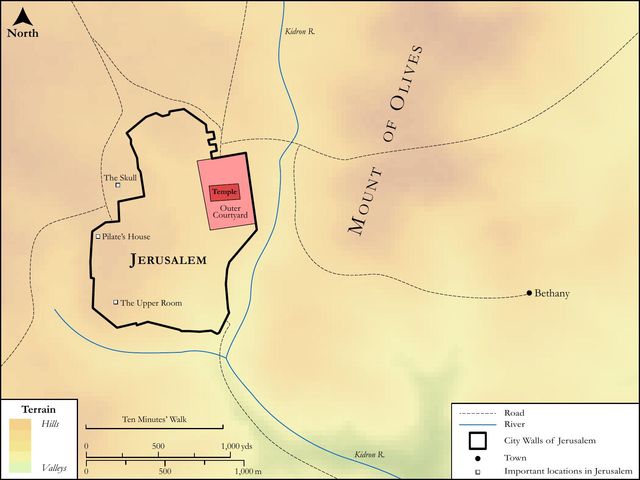
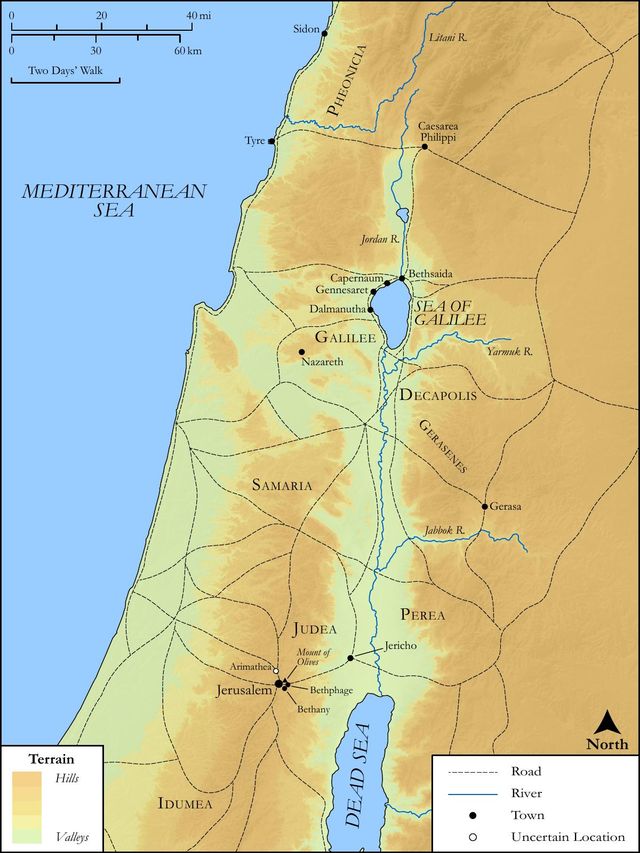
See on the biblical-era maps

Study this verse
Public-domain commentary
Matthew Henry
From his Commentary on the Whole Bible. Henry comments on passages, not single verses — this entry covers Mark 4:21–34. His three-level outline is real structure in the source text, so it is rendered as structure.
The lessons which our Saviour designs to teach us here by parables and figurative expressions are these: -
I.That those who are good ought to consider the obligations they are under to do good; that is, as in the parable before, to bring forth fruit. God expects a grateful return of his gifts to us, and a useful improvement of his gifts in us; for (Mar 4:21), Is a candle brought to be put under a bushel, or under a bed? No, but that it may be set on a candlestick. The apostles were ordained, to receive the gospel, not for themselves only, but for the good of others, to communicate it to them. All Christians, as they have received the gift, must minister the same. Note,
1.Gifts and graces make a man as a candle; the candle of the Lord (Pro 20:27), lighted by the Father of lights; the most eminent are but candles, poor lights, compared with the Sun of righteousness. A candle gives light but a little way, and but a little while, and is easily blown out, and continually burning down and wasting.
2.Many who are lighted as candles, put themselves under a bed, or under a bushel: they do not manifest grace themselves, nor minister grace to others; they have estates, and do no good with them; have their limbs and senses, wit and learning perhaps, but nobody is the better for them; they have spiritual gifts, but do not use them; like a taper in an urn, they burn to themselves.
3.Those who are lighted as candles, should set themselves on a candlestick; that is, should improve all opportunities of doing good, as those that were made for the glory of God, and the service of the communities they are members of; we are not born for ourselves.
The reason given for this, is, because there is nothing hid, which shall not be manifested, which should not be made manifest (so it might better be read), Mar 4:22. There is no treasure of gifts and graces lodged in any but with design to be communicated; nor was the gospel made a secret to the apostles, to be concealed, but that it should come abroad, and be divulged to all the world. Though Christ expounded the parables to his disciples privately, yet it was with design to make them the more publicly useful; they were taught, that they might teach; and it is a general rule, that the ministration of the Spirit is given to every man to profit withal, not himself only, but others also.
II.It concerns those who hear the word of the gospel, to mark what they hear, and to make a good use of it, because their weal or woe depends upon it; what he had said before he saith again, If any man have ears to hear, let him hear, Mar 4:23. Let him give the gospel of Christ a fair hearing; but that is not enough, it is added (Mar 4:24), Take heed what ye hear, and give a due regard to that which ye do hear; Consider what ye hear, so Dr. Hammond reads it. Note, What we hear, doth us no good, unless we consider it; those especially that are to teach others must themselves be very observant of the things of God; must take notice of the message they are to deliver, that they may be exact. We must likewise take heed what we hear, by proving all things, that we may hold fast that which is good. We must be cautious, and stand upon our guard, lest we be imposed upon. To enforce this caution, consider,
1.As we deal with God, God will deal with us, so Dr. Hammond explains these words, "With what measure ye mete, it shall be measured to you. If ye be faithful servants to him, he will be a faithful Master to you: with the upright he will show himself upright."
2.As we improve the talents we are entrusted with, we shall increase them; if we make use of the knowledge we have, for the glory of God and the benefit of others, it shall sensibly grow, as stock in trade doth by being turned; Unto you that hear, shall more be given; to you that have, it shall be given, Mar 4:25. If the disciples deliver that to the church, which they have received of the Lord, they shall be led more into the secret of the Lord. Gifts and graces multiply by being exercised; and God has promised to bless the hand of the diligent.
3.If we do not use, we lose, what we have; From him that hath not, that doeth no good with what he hath, and so hath it in vain, is as if he had it not, shall be taken even that which he hath. Burying a talent is the betraying of a trust, and amounts to a forfeiture; and gifts and graces rust for want of wearing.
III.The good seed of the gospel sown in the world, and sown in the heart, doth by degrees produce wonderful effects, but without noise (Mar 4:26, etc.); So is the kingdom of God; so is the gospel, when it is sown, and received, as seed in good ground.
1.It will come up; though it seem lost and buried under the clods, it will find or make its way through them. The seed cast into the ground will spring. Let but the word of Christ have the place it ought to have in a soul, and it will show itself, as the wisdom from above doth in a good conversation. After a field is sown with corn, how soon is the surface of it altered! How gay and pleasant doth it look, when it is covered with green!
2.The husbandman cannot describe how it comes up; it is one of the mysteries of nature; It springs and grows up, he knows not how, Mar 4:27. He sees it has grown, but he cannot tell in what manner it grew, or what was the cause and method of its growth. Thus we know not how the Spirit by the word makes a change in the heart, any more than we can account for the blowing of the wind, which we hear the sound of, but cannot tell whence it comes, or whither it goes. Without controversy, great is the mystery of godliness; how God manifested in the flesh came to be believed on in the world, Ti1 3:16.
3.The husbandman, when he hath sown the seed, doth nothing toward the springing of it up; He sleeps, and rises, night and day; goes to sleep at night, gets up in the morning, and perhaps never so much as thinks of the corn he hath sown, or ever looks upon it, but follows his pleasures or other business, and yet the earth brings forth fruit of itself, according to the ordinary course of nature, and by the concurring power of the God of nature. Thus the word of grace, when it is received in faith, is in the heart a work of grace, and the preachers contribute nothing to it. The Spirit of God is carrying it on when they sleep, and can do no business (Job 33:15, Job 33:16), or when they rise to go about other business. The prophets do not live for ever; but the word which they preached, is doing its work, when they are in their graves, Zac 1:5, Zac 1:6. The dew by which the seed is brought up tarrieth not for man, nor waiteth for the sons of men, Mic 5:7.
4.It grows gradually; first the blade, then the ear, after that the full corn in the ear, Mar 4:28. When it is sprung up, it will go forward; nature will have its course, and so will grace. Christ's interest, both in the world and in the heart, is, and will be, a growing interest; and though the beginning be small, the latter end will greatly increase. Though thou sowest not that body that shall be, but bare grain, yet God will give to every seed its own body; though at first it is but a tender blade, which the frost may nip, or the foot may crush, yet it will increase to the ear, to the full corn in the ear. Natura nil facit per saltum - Nature does nothing abruptly. God carries on his work insensibly and without noise, but insuperably and without fail.
5.It comes to perfection at last (Mar 4:29); When the fruit is brought forth, that is, when it is ripe, and ready to be delivered into the owner's hand; then he puts in the sickle. This intimates,
(1.)That Christ now accepts the services which are done to him by an honest heart from a good principle; from the fruit of the gospel taking place and working in the soul, Christ gathers in a harvest of honour to himself. See Joh 4:35.
(2.)That he will reward them in eternal life. When those that receive the gospel aright, have finished their course, the harvest comes, when they shall be gathered as wheat into God's barn (Mat 13:30), as a shock of corn in his season.
IV.The work of grace is small in its beginnings, but comes to be great and considerable at last (Mar 4:30-32); "Whereunto shall I liken the kingdom of God, as now to be set up by the Messiah? How shall I make you to understand the designed method of it?" Christ speaks as one considering and consulting with himself, how to illustrate it with an apt similitude; With what comparison shall we compare it? Shall we fetch it from the motions of the sun, or the revolutions of the moon? No, the comparison is borrowed from this earth, it is like a grain of mustard-seed; he had compared it before to seed sown, here to that seed, intending thereby to show,
1.That the beginnings of the gospel kingdom would be very small, like that which is one of the least of all seeds. When a Christian church was sown in the earth for God, it was all contained in one room, and the number of the names was but one hundred and twenty (Act 1:15), as the children of Israel, when they went down into Egypt, were but seventy souls. The work of grace in the soul, is, at first, but the day of small things; a cloud no bigger than a man's hand. Never were there such great things undertaken by such an inconsiderable handful, as that of the discipling of the nations by the ministry of the apostles; nor a work that was to end in such great glory, as the work of grace raised from such weak and unlikely beginnings. Who hath begotten me these?
2.That the perfection of it will be very great; When it grows up, it becomes greater than all herbs. The gospel kingdom in the world, shall increase and spread to the remotest nations of the earth, and shall continue to the latest ages of time. The church hath shot out great branches, strong ones, spreading far, and fruitful. The work of grace in the soul has mighty products, now while it is in its growth; but what will it be, when it is perfected in heaven? The difference between a grain of mustard seed and a great tree, is nothing to that between a young convert on earth and a glorified saint in heaven. See Joh 12:24.
After the parables thus specified the historian concludes with this general account of Christ's preaching - that with many such parables he spoke the word unto them (Mar 4:33); probably designing to refer us to the larger account of the parables of this kind, which we had before, Mt. 13. He spoke in parables, as they were able to hear them; he fetched his comparisons from those things that were familiar to them, and level to their capacity, and delivered them in plain expressions, in condescension to their capacity; though he did not let them into the mystery of the parables, yet his manner of expression was easy, and such as they might hereafter recollect to their edification. But, for the present, without a parable spoke he not unto them, Mar 4:34. The glory of the Lord was covered with a cloud, and God speaks to us in the language of the sons of men, that, though not at first, yet by degrees, we may understand his meaning; the disciples themselves understood those sayings of Christ afterward, which at first they did not rightly take the sense of. But these parables he expounded to them, when they were alone. We cannot but wish we had had that exposition, as we had of the parable of the sower; but it was not so needful; because, when the church should be enlarged, that would expound these parables to us, without any more ado.
Historical interpretation
Nine Centuries of Reception
7 surviving comments on this verse. Each one is dated, so this reads as a timeline rather than a list.
Select a marker to jump to its quote. Markers stagger vertically where authors wrote within a few decades of each other.
Or else the fruits of the earth are contained in thirty, sixty, and a hundred-fold, that is, in the Law, the Prophets, and the Gospel.
Or else the candle is the discourse concerning the three sorts of seed. The bushel or the bed is the hearing of the disobedient. The Apostles are the candlestick, whom the word of the Lord hath enlightened; wherefore it goes on, For there is nothing hidden, &c. The hidden and secret thing is the parable of the seed, which comes forth to light, when it is spoken of by the Lord.
According to the measure of his faith the understanding of mysteries is divided to every man, and the virtues of knowledge will also be added to them. It goes on: For he that hath, to him shall be given; that is, he who hath faith shall have virtue, and he who hath obedience to the word, shall also have the understanding of the mystery. Again, he who, on the other hand, has not faith, fails in virtue; and he who has not obedience to the word, shall not have the understanding of it; and if he does not understand, he might as well not have heard.
Why does the Lord call us the light of the world? Why has he compared us to a city on a hill? Are we not called to shine in the midst of darkness, and stand up high for those most sunk down? If you hide your lamp beneath a bushel, you will soon notice that you yourself will be in the dark. You will find others bumping into you. So what can you do to illumine the world? Let your faith produce good works. Be a reflection of God’s light. The good is not preoccupied with darkness. It rejoices in being seen. It exults over the very pointings which are made at it. Christian modesty not only wishes to be modest, but also it wishes to be beheld as what it actually is.
(non occ.) After the question of the disciples concerning the parable, and its explanation, He well subjoins, And he said unto them, Is a candle brought, &c. As if he said, A parable is given, not that it should remain obscure, and hidden as if under a bed or a bushel, but that it should be manifested to those who are worthy. The candle within us is that of our intellectual nature, and it shines either clearly or obscurely according to the proportion of our illumination. For if meditations which feed the light, and the recollection with which such a light is kindled, are neglected, it is presently extinguished.
(in Matt. Hom. 15) Or else, There is nothing hid; as if He said, If ye conduct your life with care, accusation will not be able to obscure your light.
(non occ.) Again it may be said, that he hath not, who has not truth. But our Lord says that he hath, because he has a lie, for every one whose understanding believes a lie, thinks that he has something.
(Vict. Ant. e Cat. in Marc.) Or else, He who has the desire and wish to hear and to seek, to him shall be given. But he who has not the desire of hearing divine things, even what he happens to have of the written law is taken from him.
(in Marc. i. 20) Or, because the time of our life is contained under a certain measurement of Divine Providence, it is rightly compared to a bushel. But the bed of the soul is the body, in which it dwells and reposes for a time. He therefore who hides the word of God under the love of this transitory life, and of carnal allurements, covers his candle with a bushel or a bed. But he puts his light on a candlestick, who employs his body in the ministry of the word of God; therefore under these words He typically teaches them a figure of preaching. Wherefore it goes on, For there is nothing hidden, which shall not be revealed, nor is there any thing made secret, which shall not come abroad. As if He said, Be not ashamed of the Gospel, but amidst the darkness of persecution raise the light of the word of God upon the candlestick of your body, keeping fixedly in your mind that day, when the Lord will throw light upon the hidden places of darkness, for then everlasting praise awaits you, and everlasting punishment your adversaries.
(ubi sup.) That is, if any man have a sense for understanding the word of God, let him not withdraw himself, let him not turn his ear to fables, but let him lend his ear to search those things which truth hath spoken, his hands for fulfilling them, his tongue for preaching them. There follows, And he said unto them, Take heed what ye hear.
(ubi sup.) Or else, If ye diligently endeavour to do all the good which ye can, and to teach it to your neighbours, the mercy of God will come in, to give you both in the present life a sense to take in higher things, and a will to do better things, and will add for the future an everlasting reward. And therefore it is subjoined, And to you shall more be given.
(ubi sup.) For sometimes a clever reader by neglecting his mind, deprives himself of wisdom, of which he tastes the sweetness, who, though slow in intellect, works more diligently.
For nothing is hidden, except to be made manifest; nor is anything secret, except to come to light. He says, do not be ashamed of the Gospel of God, but among the darkness of persecutors, raise the light of the word upon the candlestick of your body, retaining with a steadfast mind that day of ultimate recompense, where the Lord will illuminate the hidden things of darkness, and will reveal the thoughts of hearts. For then both praise from God awaits you, and eternal punishment for the adversaries of the truth.
Or else the Lord warns His disciples to be as light, in their life and conversation; as if He said, As a candle is put so as to give light, so all will look to your life. Therefore be diligent to lead a good life; sit not in corners, but be ye a candle. For a candle gives light, not when placed under a bed, but on a candlestick; this light indeed must be placed on a candlestick, that is, on the eminence of a godly life, that it may be able to give light to others. Not under a bushel, that is, in things pertaining to the palate, nor under a bed, that is, in idleness. For no one who seeks after the delights of his palate and loves rest can be a light shining over all.
For each of us, whether he have done good or evil, is brought to light in this life, much more in that which is to come. For what can be more hidden than God, nevertheless He Himself is manifested in the flesh. It continues, If any man have ears to ear, let him hear.
That is, that none of those things which are said to you by me should escape you. With what measure ye mete, it shall be measured to you, that is, whatsoever degree of application ye bring, in that degree ye will receive profit.
Continue studying Mark 4:22 across the web’s major study libraries — every link below opens this exact verse, chapter, or book on the destination site.
Read & Compare
 BibleGatewayThis verse in more than 200 translations and 70 languages.
 Bible.comThe YouVersion reader — hundreds of translations, reading plans, and highlights.
 ESV.orgCrossway's official English Standard Version reader.
 NET BibleThe NET translation with 60,000+ translators' notes on every rendering decision.
 STEP BibleTyndale House's free study tool — original text, vocabulary, and scholarly resources.
 BibliaLogos Bible Software's free web reader.
 USCCBThe New American Bible (Revised Edition) with the U.S. bishops' study notes.
Commentaries
 BibleHub CommentariesDozens of classic commentaries on this verse, gathered on one page.
 StudyLightMore than 100 commentary sets — the largest collection on the web.
 BibleRefPlain-English commentary on what this verse means, verse by verse.
 Enduring WordDavid Guzik's free commentary on this chapter, widely used by Bible teachers.
 Bible Study ToolsVerse commentary alongside Greek and Hebrew study aids.
Original Language & Research
- BibleHub InterlinearThe verse word by word — original language, transliteration, and English.
- BibleHub LexiconEvery word's original-language definition and Strong's entry.
 Blue Letter BibleDeep-study tools — Strong's numbers, concordance, and word studies.
 CNTR CollationThe earliest Greek manuscripts of this verse, collated letter by letter.
Sermons, Hymns & Audio


TrulyRandomVerse is not affiliated with these sites and doesn’t control their content. They’re linked because they’re genuinely useful.
Summary
Mark 4:22 encapsulates a profound principle articulated by Jesus: that all truth, whether initially veiled in parables or obscured by human action, is ultimately destined for revelation. This statement serves as a hermeneutical key to understanding the purpose of Jesus' enigmatic teachings about the Kingdom of God, asserting that divine mysteries are not meant to remain hidden indefinitely but are progressively unveiled for full comprehension and public manifestation.
Context
ShowHideLiterary Context
This verse is strategically placed within Jesus' extensive teaching on parables in Mark 4. It immediately follows the Parable of the Lamp under a Bushel, which illustrates that light (truth) is meant to illuminate, not to be concealed. Mark 4:22 functions as a direct interpretive commentary on this parable and, by extension, on all of Jesus' parabolic teaching. It clarifies that while the "mystery of the kingdom of God" (as mentioned in Mark 4:11) is given to the disciples, and "to those outside everything is in parables," the ultimate purpose is not to obscure but to prepare for a future, open proclamation. The parables serve to sift hearers, revealing the receptive heart, but the truth they contain is destined for a wider, clearer disclosure.
Historical & Cultural Context
In the 1st-century Jewish context, teaching often involved riddles, proverbs, and allegories that required interpretation. Rabbis frequently employed such methods to convey deeper truths, sometimes intentionally obscuring meaning from those deemed unworthy or unprepared. Jesus' use of parables fits this cultural pattern, yet His explanation in Mark 4:22-23 distinguishes His purpose. Unlike some rabbinic traditions that might hide truth permanently, Jesus' parables were designed to draw in the sincere seeker while simultaneously challenging the complacent. Furthermore, in a society where public reputation and hidden deeds carried significant weight, the idea that "nothing hid... shall not be manifested" would resonate deeply, speaking to both accountability and vindication. The concept of divine revelation was central to Jewish prophetic expectation, anticipating a time when God's truth would be fully known.
Key Themes
ShowHideMark 4:22 contributes significantly to several overarching themes in Mark's Gospel and broader biblical theology. The primary theme is Divine Revelation, emphasizing that God's truth, initially presented in veiled forms, will eventually be fully unveiled. This applies directly to the Kingdom of God, which, though present in mystery, will be openly manifested. A related theme is Ultimate Transparency and Accountability, asserting that all deeds, intentions, and hidden matters will eventually be brought to light before God. This carries implications for both divine judgment and the vindication of the righteous. Finally, the verse underscores the Purpose of Jesus' Teaching: His parables were not designed to permanently obscure truth but to prepare His disciples for a deeper understanding that would eventually be proclaimed openly to the world, fulfilling the divine plan for universal knowledge of God's saving truth.
Exposition and Analysis
ShowHideKey Word Analysis
ShowHideThis word refers to something concealed, secret, or private. It implies an intentional act of keeping something out of sight or knowledge. In this context, it speaks to truths or realities that are not immediately obvious or universally understood, such as the mysteries of the Kingdom of God presented in parables.
This verb means "to render apparent," "to make visible," "to make known," or "to bring to light." It signifies the act of revealing something that was previously hidden, making it clear, evident, and undeniable. The passive voice ("shall be manifested") indicates a divine agency in this unveiling.
This word is closely related to kryptós and means "secret" or "treasured away." It often implies something hidden for safekeeping or for a specific time of revelation. Its use here reinforces the idea that even deeply hidden or carefully guarded truths are not exempt from the ultimate process of disclosure.
Verse Breakdown
ShowHide"For there is nothing hid,"
This opening clause establishes a universal principle. The Greek particle "For" (G1063, gár) indicates that this statement provides the reason or explanation for the preceding parable of the lamp. It asserts that no truth, no matter how obscure or deliberately veiled, is beyond the scope of future revelation. The term "hid" refers to anything concealed, whether by design (like the parables) or by circumstance.
"which shall not be manifested;"
This phrase completes the first half of the parallelism, declaring the inevitable outcome for anything "hid." The passive verb "shall be manifested" (G5319, phaneróō) implies that the revelation is not a human effort but a divine act. It means to be made visible, evident, or clear, signifying a complete unveiling.
"neither was any thing kept secret,"
This second clause mirrors the first, employing synonymous parallelism to reinforce the absolute nature of the principle. "Kept secret" (G614, apókryphos) emphasizes the idea of something hidden away, perhaps even treasured or guarded, yet still subject to the same divine decree of revelation.
"but that it should come abroad."
This concluding phrase provides the purpose or result of the "kept secret" things. "Come abroad" (G2064, érchomai + G1519, eis + G5318, phanerós) literally means "come into the open" or "come into the light." It signifies a public, undeniable, and complete disclosure, emphasizing that the ultimate destiny of all truth is to be openly known.
Literary Devices
ShowHideMark 4:22 is a masterclass in Parallelism, specifically Synonymous Parallelism. The verse is structured with two clauses that express the same idea in different words: "nothing hid, which shall not be manifested" is echoed by "neither was any thing kept secret, but that it should come abroad." This repetition serves to intensify the message and underscore its absolute certainty. The use of Absolute Language ("nothing," "any thing") further emphasizes the comprehensive nature of this principle, leaving no exceptions. Furthermore, the verse employs Imagery of light and darkness, or concealment and exposure, which aligns perfectly with the preceding Parable of the Lamp under a Bushel (Mark 4:21). The lamp, representing truth or the Kingdom of God, is not meant to be hidden but to illuminate, making the "hidden" things "manifest." This consistent imagery creates a powerful and memorable statement about the nature of divine revelation.
Theological and Thematic Connections
ShowHideMark 4:22 is a foundational statement about God's sovereign plan for revelation and transparency. It underscores that God is a God of truth who ultimately brings all things into the light, whether they are the mysteries of His Kingdom or the hidden deeds and intentions of humanity. This principle assures believers that divine truth will not remain perpetually obscure but will be progressively and fully unveiled, culminating in the ultimate revelation of Christ and His Kingdom. It also serves as a potent reminder of divine accountability, affirming that no secret can be kept from God's all-seeing eye, ensuring that justice will ultimately prevail and that all hidden works, whether good or evil, will be exposed. This theological truth provides both comfort for the oppressed and a warning for the unrighteous.
Reflection and Application
ShowHideMark 4:22 carries profound implications for how we live and interact with truth. It encourages us to live lives of integrity and authenticity, knowing that our actions, motives, and even our most private thoughts are ultimately transparent before God. This truth should not evoke fear in the righteous but rather inspire a commitment to living in the light, pursuing honesty, and seeking to align our inner lives with our outward expressions. For those grappling with unanswered questions or obscured truths, this verse offers immense hope: God's ultimate design is for clarity and revelation. We are called to patiently seek understanding, trust in God's timing for revelation, and be prepared to receive and embrace the truths He unveils, knowing that the mysteries of His Kingdom are not meant to remain hidden indefinitely but are revealed to those who have "ears to hear" and hearts ready to obey.
Questions for Reflection
ShowHideFAQ
ShowHideWhy does Jesus speak in parables if everything will ultimately be revealed?
ShowHideJesus' parables served multiple purposes, as indicated in Mark 4:10-12. For those "outside," parables veiled the truth, fulfilling prophetic Scripture (e.g., Isaiah 6:9-10). This was not to permanently hide but to allow for a sifting, revealing the spiritual receptivity of hearers. For His disciples, the parables were a pedagogical tool, a seed that would later sprout into full understanding. Mark 4:22 clarifies that the temporary concealment in parables was part of a divine strategy to prepare hearts for deeper revelation, ensuring that the truth would ultimately be proclaimed openly and widely, once the time was right and the disciples were ready to receive and declare it.
Does this verse imply that all our private thoughts and sins will be exposed to everyone?
ShowHideWhile Mark 4:22 broadly states that "nothing hid... shall not be manifested," the primary context relates to the revelation of divine truth (the Kingdom of God). However, the principle extends to human actions and motives, as affirmed in other New Testament passages like 1 Corinthians 4:5 and Luke 12:2-3. This does not necessarily mean every private thought will be publicly broadcast to all humanity. Rather, it emphasizes that all things are transparent before God. On the Day of Judgment, all deeds and motives will be laid bare before Christ, the ultimate Judge. For believers, this exposure is covered by Christ's atonement, leading to vindication and reward for righteous deeds. For unbelievers, it leads to condemnation. The verse serves as a powerful call to live with integrity, knowing that ultimate accountability is before God.
Christ-Centered Fulfillment
ShowHideMark 4:22 finds its ultimate and most profound fulfillment in the person and work of Jesus Christ. He is the very embodiment of the "hidden" truth of God that has now been "manifested." For centuries, the "mystery" of God's redemptive plan was veiled in prophecy, types, and shadows, but in Christ, it was fully brought to light. As John 1:18 declares, "No one has ever seen God; the only God, who is at the Father's side, he has made him known." Jesus is the full revelation of God's character, His will, and His saving grace. The "mystery, which has been hidden for ages and generations" has now been "revealed to his saints" in Christ, "which is Christ in you, the hope of glory" (Colossians 1:26-27). Furthermore, the ultimate manifestation of the Kingdom of God, initially presented in parables, will be fully realized at Christ's glorious return, when "every eye will see him" (Revelation 1:7) and the full truth of His reign will be undeniably established for all eternity. Thus, Mark 4:22 points directly to Christ as the one through whom all hidden truths of God are revealed and through whom all things will ultimately be brought into the light.