


Mark 12:42
Bible text: King James Version (1769 Blayney text) · Public domain
Bible text: Berean Standard Bible · Public domain
Bible text: American Standard Version (1901) · Public domain
Bible text: World English Bible, Messianic edition · Public domain
Bible text: Geneva Bible (1599) · Public domain
Bible text: Young's Literal Translation · Public domain
- καὶkaiAndG2532CONJConjunction
- ἐλθοῦσαelthousahaving comeG2064V-2AAP-NSFVerb 2nd Aorist Active Participle Nominative Singular Feminine
- μίαmiaoneG1520A-NSFAdjective Nominative Singular Feminine
- χήραchērawidowG5503N-NSFNoun Nominative Singular Feminine
- πτωχὴptōchēpoorG4434N-NSFNoun Nominative Singular Feminine
- ἔβαλενebalenshe cast [in]G906V-2AAI-3SVerb 2nd Aorist Active Indicative 3rd Singular
- λεπτὰleptaleptaG3016N-APNNoun Accusative Plural Neuter
- δύοduotwoG1417A-NUIAdjective
- ὅhowhichG3739R-NSNRelative pronoun Nominative Singular Neuter
- ἐστινestinisG1510V-PAI-3SVerb Present Active Indicative 3rd Singular
- κοδράντηςkodrantēsa kodrantesG2835N-NSMNoun Nominative Singular Masculine
English is a literal word-by-word gloss of the Greek, not the KJV's wording. Why?
This is the original text the KJV's translators worked from — each Greek word with its own literal English meaning in this verse, prepared by scholars at Tyndale House, Cambridge. The KJV translates whole sentences, not word by word, so its wording differs: one Greek word can become several English words, and the KJV may choose “charity” where the gloss reads “love”. Both are faithful — they answer different questions. For the KJV's own rendering, switch to the KJV text.
Details
See on the biblical-era maps
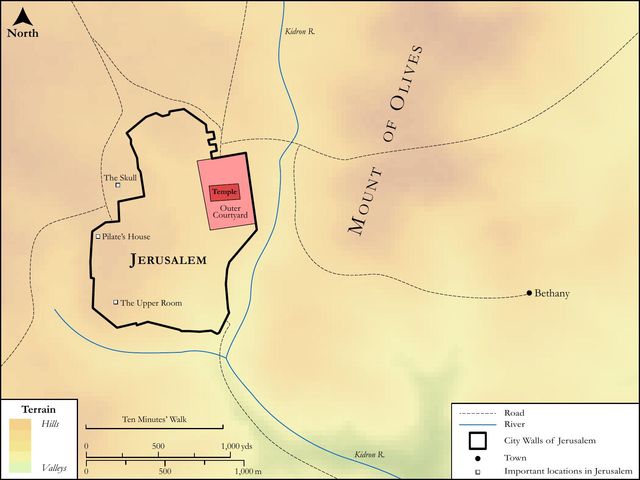
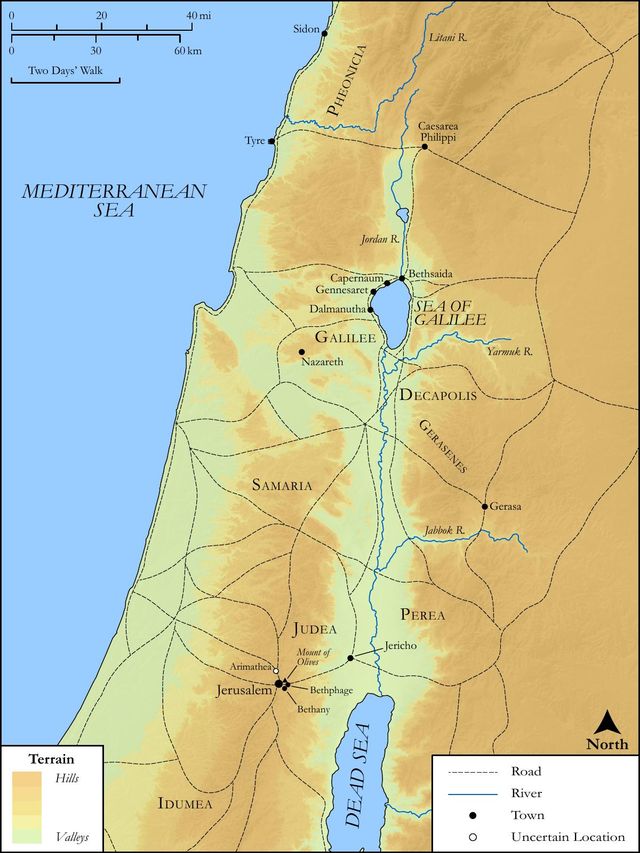
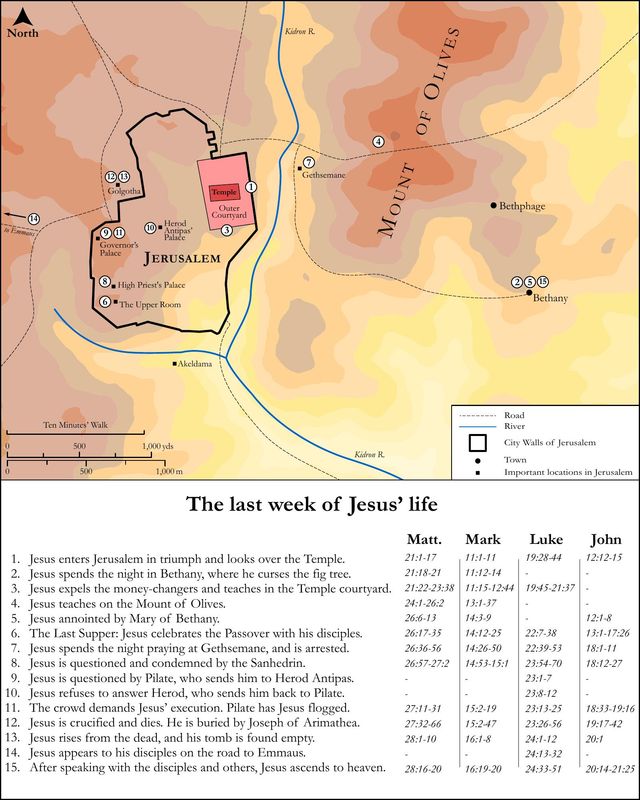
Study this verse
Public-domain commentary
Matthew Henry
From his Commentary on the Whole Bible. Henry comments on passages, not single verses — this entry covers Mark 12:41–44. His two-level outline is real structure in the source text, so it is rendered as structure.
This passage of story was not in Matthew, but is here and in Luke; it is Christ's commendation of the poor widow, that cast two mites into the treasury, which our Saviour, busy as he was in preaching, found leisure to take notice of. Observe,
I.There was a public fund for charity, into which contributions were brought, and out of which distributions were made; a poor's-box, and this in the temple; for works of charity and works of piety very fitly go together; where God is honoured by our worship, it is proper he should be honoured by the relief of his poor; and we often find prayers and alms in conjunction, as Act 10:2, Act 10:4. IT is good to erect public receptacles of charity for the inviting and directing of private hands in giving to the poor; nay it is good for those who are of ability to have funds of their own, to lay by as God has prospered them (Co1 16:2), that they might have something ready to give when an object of charity offers itself, which is before dedicated to such uses.
II.Jesus Christ had an eye upon it; He sat over against the treasury, and beheld now the people cast money into it; not grudging either that he had none to cast in, or had not the disposal of that which was cast in, but observing what was cast in. Note, Our Lord Jesus takes notice of what we contribute to pious and charitable uses; whether we give liberally or sparingly; whether cheerfully or with reluctance and ill-will; nay, he looks at the heart; he observes what principles we act upon, and what our views are, in giving alms; and whether we do it as unto the Lord, or only to be seen of men.
III.He saw many that were rich cast in much:
and it was a good sight to see rich people charitable, to see many rich people so, and to see them not only cast in, but cast in much. Note, Those that are rich, ought to give richly; if God give abundantly to us, he expects we should give abundantly to the poor; and it is not enough for those that are rich, to say, that they give as much as others do, who perhaps have much less of the world than they have, but they must give in proportion to their estates; and if objects of charity do not present themselves, that require so much, they ought to enquire them out, and to devise liberal things.
IV.There was a poor widow that cast in two mites, which make a farthing (Mar 12:42); and our Lord Jesus highly commended her; called his disciples to him, and bid them take notice of it (Mar 12:43); told them that she could very ill spare that which she gave, she had scarcely enough for herself, it was all her living, all she had to live upon for that day, and perhaps a great part of what she had earned by her labour the day before; and that forasmuch as he knew she did it from a truly charitable disposition, he reckoned it more than all that put together, which the rich people threw in; for they did cast in of their abundance, but she of her want, Mar 12:44. Now many would have been ready to censure this poor widow, and to think she did ill; why should she give to others, when she had little enough for herself? Charity begins at home; or, if she would give it, why did she not bestow it upon some poor body that she knew? What occasion was there for her bringing it to the treasury to be disposed of by the chief priests, who, we have reason to fear, were partial in the disposal of it? It is so rare a thing to find any that would not blame this widow, that we cannot expect to find any that will imitate her; and yet our Saviour commends her, and therefore we are sure that she did very well and wisely. If Christ saith, Well-done, no matter who saith otherwise; and we must hence learn,
1.That giving alms, is an excellent good thing, and highly pleasing to the Lord Jesus; and if we be humble and sincere in it, he will graciously accept of it, though in some circumstances there may not be all the discretion in the world.
2.Those that have but a little, ought to give alms out of their little. Those that live by their labour, from hand to mouth, must give to those that need, Eph 4:28.
3.It is very good for us to straiten and deny ourselves, that we may be able to give the more to the poor; to deny ourselves not only superfluities, but even conveniences, for the sake of charity. We should in many cases pinch ourselves, that we may supply the necessities of others; this is loving our neighbours as ourselves.
4.Public charities should be encouraged, for they bring upon a nation public blessings; and though there may be some mismanagement of them, yet that is not a good reason why we should not bring in our quota to them.
5.Though we can give but a little in charity, yet if it be according to our ability, and be given with an upright heart, it shall be accepted of Christ, who requires according to what a man has, and not according to what he has not; two mites shall be put upon the score, and brought to account, if given in a right manner, as if they had been two pounds.
6.It is much to the praise of charity, when we give not only to our power, but beyond our power, as the Macedonian churches, whose deep poverty abounded to the riches of their liberality, Co2 8:2, Co2 8:3. When we can cheerfully provide for others, out of our own necessary provision, as the widow of Sarepta for Elijah, and Christ for his five thousand guests, and trust God to provide for us some other way, this is thank-worthy.
Historical interpretation
Nine Centuries of Reception
9 surviving comments on this verse. Each one is dated, so this reads as a timeline rather than a list.
Select a marker to jump to its quote. Markers stagger vertically where authors wrote within a few decades of each other.
But in a mystical sense, they are rich, who bring forth from the treasure of their heart things new and old, which are the obscure and hidden things of Divine wisdom in both testaments; but who is the poor woman, if it be not I and those like me, who cast in what I can, and have the will to explain to you, where I have not the power. For God does not consider how much ye hear, but what is the store from which it comes; but each at all events can bring his farthing, that is, a ready will, which is called a farthing, because it is accompanied by three things, that is, thought, word, and deed. And in that it is said that she cast in all her living, it is implied that all that the body wants is that by which it lives; wherefore it is said, All the labour of man is for his mouth. (Eccl. 6:7)
In the treasury, besides, you ought to give of your labour, even as that widow whom the Anointed One preferred. [Mark 12:42; Luke 21:2]
Let such a one also be free from the love of money, free from arrogance, not given to filthy lucre, not insatiable, not gluttonous, but continent, meek, giving nobody disturbance, pious, modest, sitting at home, singing, and praying, and reading, and watching, and fasting; speaking to God continually in songs and hymns. And let her take wool, and rather assist others than herself want from them; being mindful of that widow who is honoured in the Gospel with the Lord's testimony, who, coming into the temple, "cast into the treasury two mites, which make a farthing. And Christ our Lord and Master, and Searcher of hearts, saw her, and said, Verily I say unto you, that this widow has cast into the treasury more than they all: for all they have cast in of their abundance, but this woman of her penury has cast in all the living that she had."
Do not despair. One cannot buy heavenly things with money.… If money could purchase such things, then the woman who deposited the two small copper coins would have received nothing very large. But since it was not money but rather her intention that prevailed, that woman received everything because she demonstrated firm conviction. Therefore, let us not say that the kingdom may be bought with money. It is not bought with money, but rather with an unsullied intention that may demonstrate itself by means of money. Therefore, one answers, is there no need for money? There is no need for money, but for a Christian disposition. If you have this, you will even be able to buy heaven with two small copper coins. Without this disposition, one will not be able to do with ten thousand talents of gold the very thing that the two coins can do. Why? Because whenever you have many things and deposit a lesser amount, you have given alms, but not the same kind of alms that the widow gave. For you were not depositing it with the same kind of eagerness that she did. For she robbed herself of everything, or rather did not rob but gave to herself a free gift.
The poor widow cast only two pennies into the treasury; yet because she gave all she had it is said of her that she surpassed all the rich in offering gifts to God. Such gifts are valued not by their weight but by the good will with which they are made.
I pass on to the widow in the gospel who, though she was but a poor widow was yet richer than all the people of Israel. [Mark 12:43] She had but a grain of mustard seed, but she put her leaven in three measures of flour; and, combining her confession of the Father and of the Son with the grace of the Holy Spirit, she cast her two mites into the treasury. All the substance that she had, her entire possessions, she offered in the two testaments of her faith. These are the two seraphim which glorify the Trinity with threefold song [Isa. 6:2-3] and are stored among the treasures of the church. They also form the legs of the tongs by which the live coal is caught up to purge the sinner's lips. [Isa. 6:6]
For our external possessions, however small, are sufficient for the Lord. For he weighs the heart, not the substance; nor does he consider how much is offered in his sacrifice, but from how much it is brought forth. For if we weigh external substance, behold, our holy merchants purchased the perpetual life of angels by giving up their nets and boat. Indeed it has no estimation of price, yet the kingdom of God is worth as much as you have. For it was worth half his substance to Zacchaeus, because he reserved the other half to restore fourfold what he had unjustly taken. It was worth the abandoned nets and boat to Peter and Andrew; it was worth two small coins to the widow; it was worth a cup of cold water to another. The kingdom of God, therefore, as we said, is worth as much as you have.
(ubi sup.) The Lord, who had warned them to avoid the desire of high place and vain glory, now distinguishes by a sure test those who brought in gifts. Wherefore it is said, And Jesus sat over against the treasury, and beheld how the people cast money into the treasury. In the Greek language, phylassein means to keep, and gaza is a Persian word for treasure; wherefore the word gazophylacium. which is here used means a place where riches are kept, which name also was applied to the chest in which the offerings of the people were collected, for the necessary uses of the temple, and to the porch in which they were kept. You have a notice of the porch in the Gospel, These words spake Jesus in the treasury as He taught in the temple; and of the chest in the book of Kings, But Jehoiada the priest took a chest. (John 8:20, 2 Kings 12:9)
(ubi sup.) Reckoners use the word 'quadrans' for the fourth part of any thing, be it place, money, or time. Perhaps then in this place is meant the fourth part of a shekel, that is, five pence. It goes on, And he called unto him his disciples, and saith unto them, Verily I say unto you, That this poor widow hath cast more in, than all they which have cast into the treasury: for God does not weigh the property but the conscience of those who offer; nor did He consider the smallness of the sum in her offering, but what was the store from which it came. Wherefore He adds, For all they did cast in of their abundance, but she of her want did cast in all that she had, even all her living.
(ubi sup) Again, in an allegorical way, the rich men, who cast gifts into the treasury, point out the Jews puffed up with the righteousness of the law; the poor widow is the simplicity of the Church: poor indeed, because she has cast away the spirit of pride and of the desires of worldly things; and a widow, because Jesus her husband has suffered death for her. She casts two mites into the treasury, because she brings the love of God and of her neighbour, or the gifts of faith and prayer; which are looked upon as mites in their own insignificance, but measured by the merit of a devout intention are superior to all the proud works of the Jews. The Jew sends of his abundance into the treasury, because he presumes on his own righteousness; but the Church sends her whole living into God's treasury, because she understands that even her very living is not of her own desert, but of Divine grace.
But the Scribes used to come to women, who were left without the protection of their husbands, as though they were their protectors; and by a pretence of prayer, a reverend exterior and hypocrisy, they used to deceive widows, and thus also devour the houses of the rich. It goes on, These shall receive a greater damnation, that is, than the other Jews, who sinned.
Now there was a praiseworthy custom amongst the Jews, that those who were able and willing should put something into the treasury, for the maintenance of the priests, the poor, and the widows; wherefore there is added, And many that were rich cast in much. But whilst many people were so engaged, a poor widow came up, and showed her love by offering money according to her ability; wherefore it is said, And there came a certain poor widow, and she threw in two mites, which make a farthing.
Or else; That widow is the soul of man, which leaving Satan to which it had been joined, casts into the temple two mites, that is, the flesh and the mind, the flesh by abstinence, the mind by humility, that so it may be able to hear that it has cast away all its living, and has consecrated it, leaving nothing for the world of all that it possessed.
Continue studying Mark 12:42 across the web’s major study libraries — every link below opens this exact verse, chapter, or book on the destination site.
Read & Compare
 BibleGatewayThis verse in more than 200 translations and 70 languages.
 Bible.comThe YouVersion reader — hundreds of translations, reading plans, and highlights.
 ESV.orgCrossway's official English Standard Version reader.
 NET BibleThe NET translation with 60,000+ translators' notes on every rendering decision.
 STEP BibleTyndale House's free study tool — original text, vocabulary, and scholarly resources.
 BibliaLogos Bible Software's free web reader.
 USCCBThe New American Bible (Revised Edition) with the U.S. bishops' study notes.
Commentaries
 BibleHub CommentariesDozens of classic commentaries on this verse, gathered on one page.
 StudyLightMore than 100 commentary sets — the largest collection on the web.
 BibleRefPlain-English commentary on what this verse means, verse by verse.
 Enduring WordDavid Guzik's free commentary on this chapter, widely used by Bible teachers.
 Bible Study ToolsVerse commentary alongside Greek and Hebrew study aids.
Original Language & Research
- BibleHub InterlinearThe verse word by word — original language, transliteration, and English.
- BibleHub LexiconEvery word's original-language definition and Strong's entry.
 Blue Letter BibleDeep-study tools — Strong's numbers, concordance, and word studies.
 CNTR CollationThe earliest Greek manuscripts of this verse, collated letter by letter.
Sermons, Hymns & Audio


TrulyRandomVerse is not affiliated with these sites and doesn’t control their content. They’re linked because they’re genuinely useful.
Summary
Mark 12:42 introduces a pivotal moment in Jesus' teaching at the Temple, highlighting a profound contrast between the ostentatious giving of the wealthy and the humble, yet deeply sacrificial, offering of a poor widow. This verse sets the stage for Jesus' radical redefinition of true generosity, revealing that God values the heart and proportion of a gift far more than its absolute monetary value, making the widow's seemingly insignificant contribution an eternal testament to faith and devotion.
Context
ShowHideLiterary Context
This verse is strategically placed within a broader section of Mark's Gospel (chapters 11-12) where Jesus is in Jerusalem, engaging in intense debates and teachings in the Temple courts just before His passion. Immediately preceding this verse, Mark 12:38-40 records Jesus' strong condemnation of the scribes for their hypocrisy, self-exaltation, and exploitation of vulnerable widows. This condemnation provides a stark backdrop for the widow's genuine piety. Following Mark 12:42, Jesus directly comments on her actions in Mark 12:43-44, explicitly stating that she gave more than all the others because she gave "all that she had, even all her living." This narrative sequence powerfully illustrates the principles Jesus had just taught, moving from abstract warning to concrete example.
Historical & Cultural Context
The scene unfolds in the Temple treasury, likely the Court of Women, where thirteen trumpet-shaped collection chests (known as "Corban chests") were placed for various offerings. People would deposit their contributions publicly, often drawing attention. In ancient Jewish society, widows were among the most vulnerable and overlooked groups, often lacking male protectors or independent means of support. They were frequently dependent on family, charity, or the meager provisions of the Mosaic Law. Their economic plight was often severe, making the act of giving away their last coins an act of extreme desperation or profound faith. The coins mentioned, "mites" (Greek: lepta) and a "farthing" (Greek: kodrantes), were the smallest denominations of currency in circulation, emphasizing the absolute insignificance of the amount in worldly terms, yet its immense spiritual weight. A lepton was the smallest Jewish copper coin, and a kodrantes was a Roman copper coin equivalent to two lepta, roughly 1/64th of a denarius (a common day's wage).
Key Themes
ShowHideThe narrative of the widow's mite powerfully encapsulates several key themes prevalent throughout Mark's Gospel and broader biblical teaching. Foremost is the theme of True Sacrifice vs. Outward Show, contrasting the superficiality of religious performance with genuine devotion. While the rich gave from their abundance, the widow gave from her poverty, highlighting that the value of an offering is measured by the heart and the proportion given, not the absolute amount. This leads to the theme of God's Perspective, which radically differs from human evaluation; God sees beyond material contributions to the spiritual commitment and trust involved, as Jesus explicitly states in Mark 12:43-44. Furthermore, the widow's act is a profound demonstration of Faith and Trust, as she relinquishes her entire livelihood, embodying a complete reliance on divine providence. Finally, her offering exemplifies Devotion – a pure act of worship, not seeking human praise or recognition, but solely focused on God. These themes challenge believers to examine their own motivations and priorities in all aspects of their discipleship.
Exposition and Analysis
ShowHideKey Word Analysis
ShowHideThis term describes a beggar or pauper, someone in absolute destitution, often cringing or crouching due to their poverty. Unlike penēs (which denotes merely straitened circumstances), ptōchós signifies public mendicancy and utter lack. Its use here emphasizes the widow's complete economic vulnerability, making her subsequent act of giving all the more striking.
Derived from a root suggesting deficiency or lack, this word refers to a woman who has lost her husband. In ancient society, a widow was typically without a male protector and often lacked legal or economic rights, rendering her highly susceptible to exploitation and extreme poverty. The term underscores her precarious social and financial position.
The neuter form of a word related to "scaled" or "light," leptón refers to the smallest Jewish copper coin, virtually worthless in commercial transactions. The fact that she gave "two" of these coins highlights the absolute minimal nature of her offering in terms of monetary value, yet it represented her entire financial possession.
Verse Breakdown
ShowHide"And there came a certain poor widow"
This clause introduces the central figure of the narrative, emphasizing her social and economic status. The use of "certain" (Greek: mía, meaning "one" or "a certain") suggests she was an anonymous individual, highlighting that her worth was not in her public recognition but in her private act of devotion. Her designation as "poor widow" immediately evokes sympathy and sets up the dramatic contrast with the wealthy donors.
"and she threw in two mites"
This describes her specific action. The verb "threw in" (Greek: bállō) can imply a decisive, perhaps even forceful, action, suggesting a deliberate and committed act rather than a casual one. The "two mites" (Greek: dýo leptá) are explicitly identified as the smallest possible offering, underscoring the seemingly insignificant nature of her contribution from a human perspective.
"which make a farthing"
This explanatory clause provides a crucial detail about the monetary value. A "farthing" (Greek: kodrántēs) was a Roman coin equivalent to two lepta. This detail confirms the extreme smallness of her offering, making it clear that her entire contribution was of negligible commercial worth, solidifying the contrast between the world's valuation and God's.
Literary Devices
ShowHideMark's account of the widow's mite is rich with Contrast, a primary literary device that underscores the central message. The scene is set by contrasting the wealthy individuals who "put in much" with the "poor widow" who put in "two mites." This stark opposition highlights the difference between giving from abundance and giving from utter destitution, challenging the conventional understanding of generosity. There is also a profound Irony at play: what is monetarily insignificant becomes spiritually paramount. The smallest offering is declared by Jesus to be the greatest. Furthermore, the narrative employs Symbolism; the "two mites" are not just coins but symbolize the widow's entire livelihood, her complete trust, and her unreserved devotion. Her act becomes a powerful symbol of true sacrifice, embodying the very essence of discipleship. The narrative also functions as a Parable-in-Action, where Jesus uses a real-life observation to teach a profound spiritual truth, making the abstract concept of sacrificial giving tangible and memorable.
Theological and Thematic Connections
ShowHideThe story of the widow's mite transcends a simple lesson on giving; it is a profound theological statement about the nature of true worship, the divine economy, and the radical demands of discipleship. It reveals that God's evaluation system is entirely counter-cultural, prioritizing the heart's posture and the proportion of sacrifice over the absolute quantity of a gift. Her act embodies complete trust in God's provision, even when it means relinquishing one's perceived security. This narrative challenges believers to re-evaluate their understanding of generosity, stewardship, and dependence on God, reminding them that genuine faith often manifests in costly acts of surrender, demonstrating a love that holds nothing back.
Reflection and Application
ShowHideThe account of the poor widow challenges us to look beyond the surface of our actions and examine the true motivations of our hearts. It compels us to ask if our giving, our service, and indeed our entire lives, are characterized by a willingness to offer our "all" to God, or if we are merely giving from our surplus, holding back what we deem essential for ourselves. This story is not a call to financial destitution for everyone, but a profound invitation to radical trust and wholehearted devotion. It teaches us that God values our willingness to sacrifice, our faith in His provision, and the love that fuels our actions, far more than any material contribution. It reminds us that even the smallest acts, when offered with a pure and sacrificial heart, are immeasurably precious in God's sight and carry eternal significance.
Questions for Reflection
ShowHideFAQ
ShowHideWhat was the actual value of the widow's offering in modern terms?
ShowHideWhile it's difficult to give an exact modern equivalent due to differences in economies and cost of living, the "two mites" (Greek: dýo leptá) which made a "farthing" (Greek: kodrántēs) represented the smallest possible monetary offering in ancient Israel. A kodrántēs was roughly 1/64th of a denarius, which was a typical day's wage for a laborer. So, her offering was equivalent to about 1/64th of a day's wage, an incredibly tiny sum by any standard, emphasizing its absolute insignificance in commercial terms, yet its immense spiritual value.
Why did Jesus highlight this particular woman and her offering?
ShowHideJesus highlighted the poor widow and her offering because it perfectly illustrated a profound spiritual truth that contrasted sharply with the prevailing religious practices of His day. He had just condemned the scribes for their hypocrisy and self-serving actions (Mark 12:38-40), and the wealthy donors were likely giving ostentatiously for public acclaim. The widow, in her anonymity and extreme poverty, demonstrated genuine, sacrificial devotion that was invisible to human eyes but profoundly significant to God. Jesus used her as a living parable to teach that true generosity is measured not by the amount given, but by the proportion of what is given and the heart of the giver, emphasizing faith and trust over outward show.
Christ-Centered Fulfillment
ShowHideThe poor widow's ultimate act of sacrificial giving in Mark 12:42 serves as a profound foreshadowing and reflection of the ultimate sacrifice of Jesus Christ. Just as the widow gave "all that she had, even all her living" (Mark 12:44), Jesus, though rich, "became poor, so that you through his poverty might become rich" (2 Corinthians 8:9). He did not merely give a portion of His abundance; He emptied Himself, laying aside His divine prerogatives and ultimately His very life, for the redemption of humanity. The widow's offering, seemingly insignificant in worldly terms, was her "all," pointing to the Lamb of God who offered His "all" on the cross, a sacrifice of infinite value that covered the sins of the world (John 1:29). Her act of complete trust in God's provision mirrors Christ's perfect obedience to the Father's will, even unto death (Philippians 2:8). Thus, the widow's mite becomes a powerful illustration of the principle of total surrender and self-giving love that finds its ultimate and perfect fulfillment in the person and work of Jesus Christ.