


Mark 12:44
Bible text: King James Version (1769 Blayney text) · Public domain
Bible text: King James Version with Strong's numbers · Public domain
Bible text: Berean Standard Bible · Public domain
Bible text: American Standard Version (1901) · Public domain
Bible text: World English Bible, Messianic edition · Public domain
Bible text: Geneva Bible (1599) · Public domain
Bible text: Young's Literal Translation · Public domain
- πάντεςpantesAllG3956A-NPMAdjective Nominative Plural Masculine
- γὰρgarforG1063CONJConjunction
- ἐκekout ofG1537PREPPreposition
- τοῦtouthat whichG3588T-GSNDefinite article Genitive Singular Neuter
- περισσεύοντοςperisseuontosis aboundingG4052V-PAP-GSNVerb Present Active Participle Genitive Singular Neuter
- αὐτοῖςautoisto themG846P-DPMPersonal pronoun Dative Plural Masculine
- ἔβαλονebaloncast [in]G906V-2AAI-3PVerb 2nd Aorist Active Indicative 3rd Plural
- αὕτηhautēsheG3778D-NSFDemonstrative pronoun Nominative Singular Feminine
- δὲdehoweverG1161CONJConjunction
- ἐκekout ofG1537PREPPreposition
- τῆςtēstheG3588T-GSFDefinite article Genitive Singular Feminine
- ὑστερήσεωςhusterēseōspovertyG5304N-GSFNoun Genitive Singular Feminine
- αὐτῆςautēsof herG846P-GSFPersonal pronoun Genitive Singular Feminine
- πάνταpantaallG3956A-APNAdjective Accusative Plural Neuter
- ὅσαhosaas much asG3745K-APNCorrelative pronoun Accusative Plural Neuter
- εἶχενeichenshe hadG2192V-IAI-3SVerb Imperfect Active Indicative 3rd Singular
- ἔβαλενebalencast [in]G906V-2AAI-3SVerb 2nd Aorist Active Indicative 3rd Singular
- ὅλονholonallG3650A-ASMAdjective Accusative Singular Masculine
- τὸνtontheG3588T-ASMDefinite article Accusative Singular Masculine
- βίονbionlivelihoodG979N-ASMNoun Accusative Singular Masculine
- αὐτῆςautēsof herG846P-GSFPersonal pronoun Genitive Singular Feminine
English is a literal word-by-word gloss of the Greek, not the KJV's wording. Why?
This is the original text the KJV's translators worked from — each Greek word with its own literal English meaning in this verse, prepared by scholars at Tyndale House, Cambridge. The KJV translates whole sentences, not word by word, so its wording differs: one Greek word can become several English words, and the KJV may choose “charity” where the gloss reads “love”. Both are faithful — they answer different questions. For the KJV's own rendering, switch to the KJV text.
Details
See on the biblical-era maps
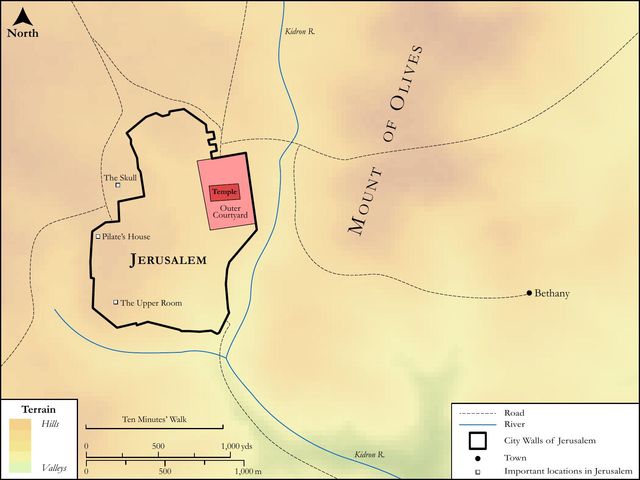
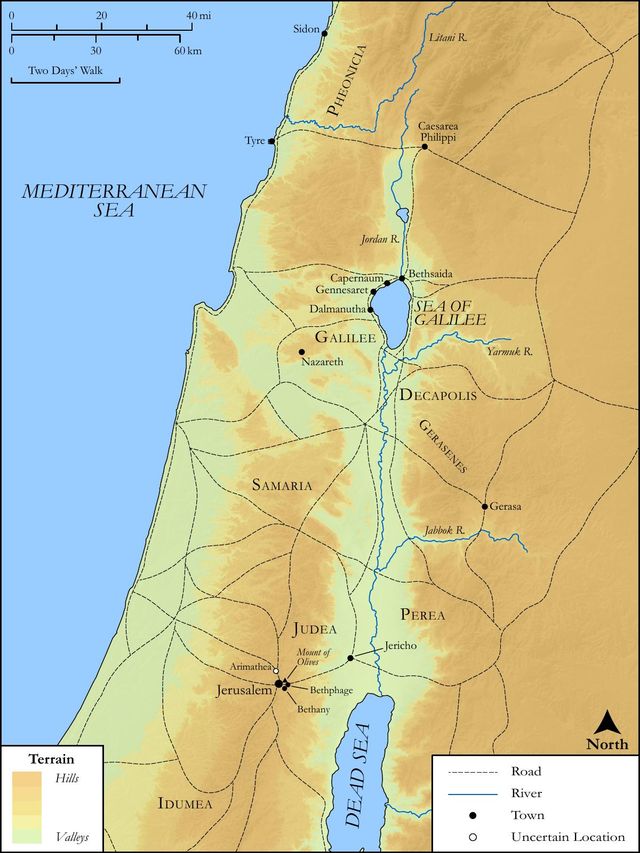
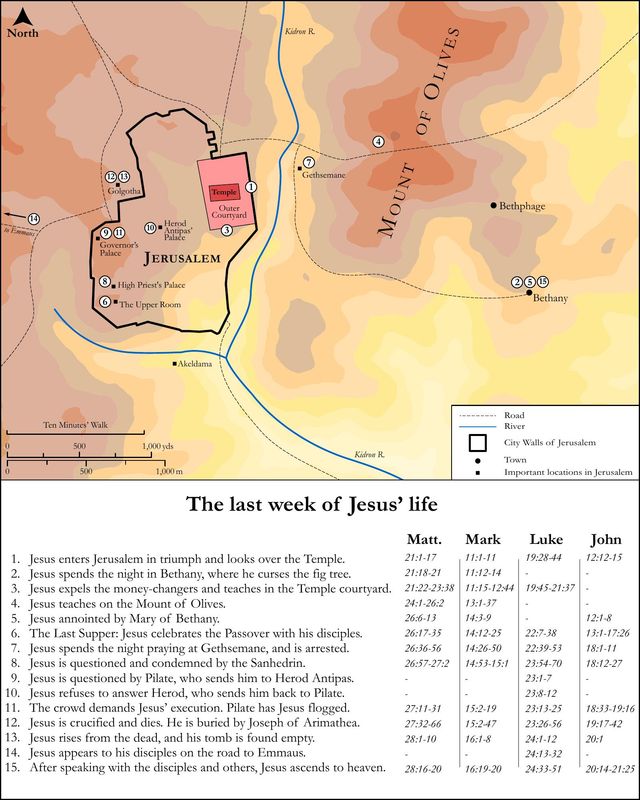
Study this verse
Public-domain commentary
Matthew Henry
From his Commentary on the Whole Bible. Henry comments on passages, not single verses — this entry covers Mark 12:41–44. His two-level outline is real structure in the source text, so it is rendered as structure.
This passage of story was not in Matthew, but is here and in Luke; it is Christ's commendation of the poor widow, that cast two mites into the treasury, which our Saviour, busy as he was in preaching, found leisure to take notice of. Observe,
I.There was a public fund for charity, into which contributions were brought, and out of which distributions were made; a poor's-box, and this in the temple; for works of charity and works of piety very fitly go together; where God is honoured by our worship, it is proper he should be honoured by the relief of his poor; and we often find prayers and alms in conjunction, as Act 10:2, Act 10:4. IT is good to erect public receptacles of charity for the inviting and directing of private hands in giving to the poor; nay it is good for those who are of ability to have funds of their own, to lay by as God has prospered them (Co1 16:2), that they might have something ready to give when an object of charity offers itself, which is before dedicated to such uses.
II.Jesus Christ had an eye upon it; He sat over against the treasury, and beheld now the people cast money into it; not grudging either that he had none to cast in, or had not the disposal of that which was cast in, but observing what was cast in. Note, Our Lord Jesus takes notice of what we contribute to pious and charitable uses; whether we give liberally or sparingly; whether cheerfully or with reluctance and ill-will; nay, he looks at the heart; he observes what principles we act upon, and what our views are, in giving alms; and whether we do it as unto the Lord, or only to be seen of men.
III.He saw many that were rich cast in much:
and it was a good sight to see rich people charitable, to see many rich people so, and to see them not only cast in, but cast in much. Note, Those that are rich, ought to give richly; if God give abundantly to us, he expects we should give abundantly to the poor; and it is not enough for those that are rich, to say, that they give as much as others do, who perhaps have much less of the world than they have, but they must give in proportion to their estates; and if objects of charity do not present themselves, that require so much, they ought to enquire them out, and to devise liberal things.
IV.There was a poor widow that cast in two mites, which make a farthing (Mar 12:42); and our Lord Jesus highly commended her; called his disciples to him, and bid them take notice of it (Mar 12:43); told them that she could very ill spare that which she gave, she had scarcely enough for herself, it was all her living, all she had to live upon for that day, and perhaps a great part of what she had earned by her labour the day before; and that forasmuch as he knew she did it from a truly charitable disposition, he reckoned it more than all that put together, which the rich people threw in; for they did cast in of their abundance, but she of her want, Mar 12:44. Now many would have been ready to censure this poor widow, and to think she did ill; why should she give to others, when she had little enough for herself? Charity begins at home; or, if she would give it, why did she not bestow it upon some poor body that she knew? What occasion was there for her bringing it to the treasury to be disposed of by the chief priests, who, we have reason to fear, were partial in the disposal of it? It is so rare a thing to find any that would not blame this widow, that we cannot expect to find any that will imitate her; and yet our Saviour commends her, and therefore we are sure that she did very well and wisely. If Christ saith, Well-done, no matter who saith otherwise; and we must hence learn,
1.That giving alms, is an excellent good thing, and highly pleasing to the Lord Jesus; and if we be humble and sincere in it, he will graciously accept of it, though in some circumstances there may not be all the discretion in the world.
2.Those that have but a little, ought to give alms out of their little. Those that live by their labour, from hand to mouth, must give to those that need, Eph 4:28.
3.It is very good for us to straiten and deny ourselves, that we may be able to give the more to the poor; to deny ourselves not only superfluities, but even conveniences, for the sake of charity. We should in many cases pinch ourselves, that we may supply the necessities of others; this is loving our neighbours as ourselves.
4.Public charities should be encouraged, for they bring upon a nation public blessings; and though there may be some mismanagement of them, yet that is not a good reason why we should not bring in our quota to them.
5.Though we can give but a little in charity, yet if it be according to our ability, and be given with an upright heart, it shall be accepted of Christ, who requires according to what a man has, and not according to what he has not; two mites shall be put upon the score, and brought to account, if given in a right manner, as if they had been two pounds.
6.It is much to the praise of charity, when we give not only to our power, but beyond our power, as the Macedonian churches, whose deep poverty abounded to the riches of their liberality, Co2 8:2, Co2 8:3. When we can cheerfully provide for others, out of our own necessary provision, as the widow of Sarepta for Elijah, and Christ for his five thousand guests, and trust God to provide for us some other way, this is thank-worthy.
Historical interpretation
Seven Centuries of Reception
9 surviving comments on this verse. Each one is dated, so this reads as a timeline rather than a list.
Select a marker to jump to its quote. Markers stagger vertically where authors wrote within a few decades of each other.
But in a mystical sense, they are rich, who bring forth from the treasure of their heart things new and old, which are the obscure and hidden things of Divine wisdom in both testaments; but who is the poor woman, if it be not I and those like me, who cast in what I can, and have the will to explain to you, where I have not the power. For God does not consider how much ye hear, but what is the store from which it comes; but each at all events can bring his farthing, that is, a ready will, which is called a farthing, because it is accompanied by three things, that is, thought, word, and deed. And in that it is said that she cast in all her living, it is implied that all that the body wants is that by which it lives; wherefore it is said, All the labour of man is for his mouth. (Eccl. 6:7)
It is better to begin from one’s feeble state and end up strong, to progress from small things to larger, than to set your heart from the very first on the perfect way of life, then only to abandon it later—or keep to it solely out of habit, because of what others will think—in which case all this labor will be in vain. It is the same with people who travel: if they tire themselves out on the very first day by rushing along, they will end up wasting many days as a result of sickness. But if they start out walking at a gentle pace until they have gotten accustomed to walking, in the end they will not get tired, even though they walk great distances. Likewise anyone who wishes to embark on the labors of the virtuous life should train himself gently, until he gradually reaches the full extent of his abilities. Do not be perplexed by the many paths walked by our fathers of old, each different from the other. Do not overzealously try to imitate them all—this would only upset your way of life. Rather, choose a way of life that suits your feeble state; travel on that, and you will live, for your Lord is merciful and he will receive you, not because of your achievements, but because of your intention, just as he received the destitute woman’s gift.
For here I perceive that Jesus also looks on willingly at the gifts of the rich men, when they are put into the treasury. All too little, at the same time, is it if gifts are cast into the treasury by the rich alone; and so there are the two mites of the poor widow which are also received with gladness; and in that offering verily something is exhibited that goes beyond what Moses prescribed on the subject of the receipt of moneys. For he received gifts from those who had; but Jesus receives them even from those who have not.
When the widow put into the collection box only two small coins, the master did not give her a recompense worth only two coins. Why was that? Because he paid no attention to the amount of the money. What he did heed was the wealth of her soul. If you calculate by the value of her money, her poverty is great. If you bring her intention into the light, you will see that her store of generosity defies description.
There is an old saying that a miser lacks as much what he has as what he has not. The believer has a whole world of wealth; the unbeliever has not a single farthing. Let us always live "as having nothing and yet possessing all things." [2 Cor. 6:10] Food and raiment, these are the Christian's wealth. [1 Tim. 6:8] If your property is in your own power, [Cf. Acts 5:4] sell it: if not, cast it from you. "If any man... will take away thy coat, let him have thy cloke also." [Matt. 5:40] You are all for delay, you wish to defer action: unless-so you argue-unless I sell my goods piecemeal and with caution, Christ will be at a loss to feed his poor. Nay, he who has offered himself to God, has given Him everything once for all. The apostles did but forsake ships and nets. [Matt. 4:18-22] The widow cast but two brass coins into the treasury [Mark 12:41-44] and yet she shall be preferred before Croesus with all his wealth. He readily despises all things who reflects always that he must die.
We have been entrusted with the administration and use of temporal wealth for the common good, not with the everlasting ownership of private property. If you accept the fact that ownership on earth is only for a time, you can earn eternal possessions in heaven. Call to mind the widow who forgot herself in her concern for the poor and, thinking only of the life to come, gave away all her means of subsistence, as the judge himself bears witness. Others, he says, have given of their superfluous wealth; but she, possessed of only two small coins and more needy perhaps than many of the poor—though in spiritual riches she surpassed all the wealthy—she thought only of the world to come, and had such a longing for heavenly treasure that she gave away, all at once, whatever she had that was derived from the earth and destined to return there. Let us then invest with the Lord what he has given us, for we have nothing that does not come from him: we are dependent upon him for our very existence.… So let us give back to the Lord the gifts he has given us. Let us give to him who receives in the person of every poor man or woman. Let us give gladly, I say, and great joy will be ours when we receive his promised reward.
For all of them have contributed out of their abundance. But she, out of her poverty, has given all she had, her whole livelihood. The Jew contributes to the gifts of God out of his abundance, who, presuming upon his own righteousness, prays to himself thus: God, I thank you that I am not like other men, extortioners, unjust, etc. (Luke 18). But the Church gives all her living to the gifts of God, understanding that all she lives is not by her own merit, but by divine grace, saying: God, be merciful to me, a sinner (Ibid.). And again: I will keep my strength for you, because you are my protector, my God; his mercy will precede me (Psalm 58).
(ubi sup.) The Lord, who had warned them to avoid the desire of high place and vain glory, now distinguishes by a sure test those who brought in gifts. Wherefore it is said, And Jesus sat over against the treasury, and beheld how the people cast money into the treasury. In the Greek language, phylassein means to keep, and gaza is a Persian word for treasure; wherefore the word gazophylacium. which is here used means a place where riches are kept, which name also was applied to the chest in which the offerings of the people were collected, for the necessary uses of the temple, and to the porch in which they were kept. You have a notice of the porch in the Gospel, These words spake Jesus in the treasury as He taught in the temple; and of the chest in the book of Kings, But Jehoiada the priest took a chest. (John 8:20, 2 Kings 12:9)
(ubi sup.) Reckoners use the word 'quadrans' for the fourth part of any thing, be it place, money, or time. Perhaps then in this place is meant the fourth part of a shekel, that is, five pence. It goes on, And he called unto him his disciples, and saith unto them, Verily I say unto you, That this poor widow hath cast more in, than all they which have cast into the treasury: for God does not weigh the property but the conscience of those who offer; nor did He consider the smallness of the sum in her offering, but what was the store from which it came. Wherefore He adds, For all they did cast in of their abundance, but she of her want did cast in all that she had, even all her living.
(ubi sup) Again, in an allegorical way, the rich men, who cast gifts into the treasury, point out the Jews puffed up with the righteousness of the law; the poor widow is the simplicity of the Church: poor indeed, because she has cast away the spirit of pride and of the desires of worldly things; and a widow, because Jesus her husband has suffered death for her. She casts two mites into the treasury, because she brings the love of God and of her neighbour, or the gifts of faith and prayer; which are looked upon as mites in their own insignificance, but measured by the merit of a devout intention are superior to all the proud works of the Jews. The Jew sends of his abundance into the treasury, because he presumes on his own righteousness; but the Church sends her whole living into God's treasury, because she understands that even her very living is not of her own desert, but of Divine grace.
But the Scribes used to come to women, who were left without the protection of their husbands, as though they were their protectors; and by a pretence of prayer, a reverend exterior and hypocrisy, they used to deceive widows, and thus also devour the houses of the rich. It goes on, These shall receive a greater damnation, that is, than the other Jews, who sinned.
Now there was a praiseworthy custom amongst the Jews, that those who were able and willing should put something into the treasury, for the maintenance of the priests, the poor, and the widows; wherefore there is added, And many that were rich cast in much. But whilst many people were so engaged, a poor widow came up, and showed her love by offering money according to her ability; wherefore it is said, And there came a certain poor widow, and she threw in two mites, which make a farthing.
Or else; That widow is the soul of man, which leaving Satan to which it had been joined, casts into the temple two mites, that is, the flesh and the mind, the flesh by abstinence, the mind by humility, that so it may be able to hear that it has cast away all its living, and has consecrated it, leaving nothing for the world of all that it possessed.
Continue studying Mark 12:44 across the web’s major study libraries — every link below opens this exact verse, chapter, or book on the destination site.
Read & Compare
 BibleGatewayThis verse in more than 200 translations and 70 languages.
 Bible.comThe YouVersion reader — hundreds of translations, reading plans, and highlights.
 ESV.orgCrossway's official English Standard Version reader.
 NET BibleThe NET translation with 60,000+ translators' notes on every rendering decision.
 STEP BibleTyndale House's free study tool — original text, vocabulary, and scholarly resources.
 BibliaLogos Bible Software's free web reader.
 USCCBThe New American Bible (Revised Edition) with the U.S. bishops' study notes.
Commentaries
 BibleHub CommentariesDozens of classic commentaries on this verse, gathered on one page.
 StudyLightMore than 100 commentary sets — the largest collection on the web.
 BibleRefPlain-English commentary on what this verse means, verse by verse.
 Enduring WordDavid Guzik's free commentary on this chapter, widely used by Bible teachers.
 Bible Study ToolsVerse commentary alongside Greek and Hebrew study aids.
Original Language & Research
- BibleHub InterlinearThe verse word by word — original language, transliteration, and English.
- BibleHub LexiconEvery word's original-language definition and Strong's entry.
 Blue Letter BibleDeep-study tools — Strong's numbers, concordance, and word studies.
 CNTR CollationThe earliest Greek manuscripts of this verse, collated letter by letter.
Sermons, Hymns & Audio


TrulyRandomVerse is not affiliated with these sites and doesn’t control their content. They’re linked because they’re genuinely useful.
Summary
Mark 12:44 concludes Jesus' observation of Temple giving, highlighting a profound spiritual truth: true generosity is measured not by the quantity of the gift, but by the proportion of sacrifice and the heart of the giver. While wealthy individuals contributed large sums from their surplus, a destitute widow offered two small copper coins, representing "all her living." Jesus declares her seemingly insignificant offering to be greater than all the others, revealing God's divine perspective that values radical faith and total devotion over material abundance.
Context
ShowHideLiterary Context
This poignant account immediately follows Jesus' sharp denunciation of the scribes in Mark 12:38-40. He warns against their ostentatious piety, love of public recognition, and exploitation of vulnerable widows. The contrast is stark: the scribes devour widows' houses while the widow herself, in profound humility and faith, gives all she has. The scene is set in the Temple treasury, where Jesus is teaching and observing the people's offerings, a detail also found in the parallel account in Luke 21:1-4. This strategic placement underscores Jesus' critique of religious hypocrisy and his commendation of genuine, sacrificial devotion.
Historical & Cultural Context
The Temple treasury in Jerusalem was a prominent feature of Jewish life, serving as a collection point for various offerings and taxes. There were thirteen trumpet-shaped chests, each designated for specific types of contributions. People would publicly cast their money into these chests, making their giving visible. Widows in ancient Jewish society were particularly vulnerable, often lacking social and financial support, and were frequently among the poorest members of society. Their economic survival was precarious, making their acts of charity or religious devotion exceptionally challenging. The "mites" (Greek: lepta) were the smallest copper coins in circulation, often worth only a fraction of a Roman penny, emphasizing the extreme poverty of the widow and the minuscule monetary value of her offering.
Key Themes
ShowHideThe passage powerfully articulates several core themes. Firstly, Sacrificial Giving is paramount, illustrating that the true value of a gift lies in the cost to the giver, not its absolute amount. The rich gave from their "abundance," a surplus that did not impact their lifestyle, while the widow gave "all her living," demonstrating complete self-denial. Secondly, Divine Perspective is revealed, as Jesus' judgment directly contrasts with human perception. While onlookers would have dismissed the widow's offering, Jesus saw its immense spiritual worth, echoing the principle in 1 Samuel 16:7 that "the LORD looks at the heart." Thirdly, the story highlights Radical Trust and Faith. By giving everything, the widow displayed an extraordinary dependence on God for her future sustenance, embodying a profound trust in His provision that surpasses human understanding or security. This act serves as a powerful testament to unreserved devotion.
Exposition and Analysis
ShowHideKey Word Analysis
ShowHideThis term, used to describe the giving of the rich, signifies "to superabound (in quantity or quality), be in excess, be superfluous." It highlights that their contributions, though large in absolute terms, came from an overflowing surplus, costing them nothing in terms of personal sacrifice or livelihood. Their giving was convenient, not costly.
Directly contrasting "abundance," this word describes the widow's condition, meaning "a falling short, i.e. penury, deficiency." It underscores her extreme poverty and destitution. Her giving was not from a surplus, but from a state of profound need, making her act of generosity all the more remarkable and spiritually significant.
This word, used in the phrase "all her living," refers to "life, i.e. the present state of existence; by implication, the means of livelihood." It emphasizes the totality of her offering. She did not just give a portion of her income or savings; she gave her entire means of sustenance, her very ability to survive, demonstrating an ultimate act of trust and self-emptying.
Verse Breakdown
ShowHide"For all they did cast in of their abundance"
This clause describes the wealthy benefactors. Their giving, while perhaps financially substantial, was characterized by its source: their "abundance" or overflow. It implies that their contributions did not require any personal sacrifice or adjustment to their comfortable lifestyles. Their generosity was convenient, not costly, and likely aimed at maintaining appearances or fulfilling a religious duty without deep personal investment.
"but she of her want did cast in all that she had"
This introduces the stark contrast. The widow's giving originated from her "want" or extreme poverty. Despite her destitution, she gave not a portion, but "all that she had." This phrase emphasizes the completeness and totality of her offering, revealing a profound commitment that transcended her dire circumstances. It was not merely a donation but a complete surrender of her worldly possessions.
"even all her living"
This final phrase serves as an emphatic clarification and hyperbole, underscoring the radical nature of her gift. "All her living" means her entire means of sustenance, her whole livelihood. It was not spare change but the very resources upon which her daily existence depended. This detail elevates her act from mere generosity to an extraordinary demonstration of faith and self-sacrificing devotion.
Literary Devices
ShowHideMark 12:44 is rich in literary devices that amplify its message. The most prominent is Contrast, strategically employed between the rich givers and the poor widow. This juxtaposition highlights the disparity in their circumstances and, more importantly, in the spiritual quality of their offerings. The rich give "of their abundance," while the widow gives "of her want," creating a powerful antithesis that underscores Jesus' counter-cultural valuation. Hyperbole is evident in the phrase "all her living," which emphasizes the extreme nature of the widow's sacrifice, suggesting she gave everything she possessed for her immediate sustenance. This is not merely a factual statement but a rhetorical device designed to impress upon the listener the totality of her devotion. Furthermore, there is a profound Irony at play: those who give the most in monetary terms are deemed to have given the least in spiritual value, while the one who gives the least in monetary terms is praised for giving the most. This inversion of worldly values serves as a powerful critique of outward appearances versus inner spiritual reality. Finally, the "mite" itself functions as Symbolism, representing not just a small coin, but the widow's entire self, her trust, and her complete devotion, making her offering a symbol of radical faith.
Theological and Thematic Connections
ShowHideThe story of the widow's offering transcends a simple lesson on giving; it is a profound theological statement on God's valuation of the human heart and true worship. It challenges the common human tendency to measure worth by outward appearance or material quantity, instead revealing a divine calculus where genuine sacrifice and faith are paramount. This passage emphasizes that God is not impressed by the size of a gift from a surplus, but by the proportion of sacrifice and the motive of a heart fully surrendered in trust. It speaks to the essence of stewardship, reminding us that all we have is from God, and our generosity is a response of faith, not merely an act of charity. The widow's act is an embodiment of radical dependence on God, demonstrating that true security is found not in accumulated wealth but in unwavering trust in His provision.
Reflection and Application
ShowHideThe account of the widow's mite serves as a timeless mirror for our own hearts, challenging us to re-evaluate our understanding of generosity, stewardship, and faith. In a world that often equates value with visible magnitude, Jesus' commendation of the widow's small offering reminds us that God's perspective is radically different. This passage calls us to examine not just how much we give, but how much we keep, and more importantly, the attitude and trust with which we give. Are we giving from our comfortable surplus, or are we truly sacrificing, trusting God with our perceived needs and future? The widow's act was not a calculated risk but a profound act of worship, demonstrating that our resources, time, and talents are ultimately God's, and our willingness to release them reflects our deep-seated trust in His sovereign care. It encourages us to prioritize God above personal security and comfort, to live with open hands, and to find our ultimate provision in Him alone, even when it demands radical faith.
Questions for Reflection
ShowHideFAQ
ShowHideWas Jesus encouraging poverty or reckless giving?
ShowHideNo, Jesus was not encouraging poverty or reckless giving in a way that would lead to destitution for its own sake. Rather, He was highlighting the heart and motive behind the giving. The widow's act was not praised because it made her poor, but because it demonstrated extraordinary faith and total devotion in her poverty. Her giving was an act of worship and trust in God's provision, not a command for everyone to divest themselves of all possessions. The emphasis is on the proportional sacrifice and the depth of faith, not the absolute amount or the state of poverty itself. The passage challenges our priorities and where we place our ultimate security.
How much should I give based on this passage?
ShowHideThis passage does not prescribe a specific percentage or amount for giving, such as a tithe. Instead, it shifts the focus from quantity to quality and proportion. It teaches that what matters is the spirit of giving and the sacrifice involved. For some, giving 10% might be from their abundance, while for others, giving 1% might be a profound sacrifice. The principle is to give sacrificially, willingly, and with a heart of trust, recognizing that all we have belongs to God. The apostle Paul later elaborates on principles of cheerful and proportionate giving in 2 Corinthians 9:7.
Does this story apply only to monetary giving?
ShowHideWhile the immediate context is monetary giving in the Temple, the principles extend far beyond money. The story of the widow's mite applies to all areas of our lives: our time, talents, energy, and even our very lives. It challenges us to consider if we are holding back any part of ourselves from God, or if we are willing to offer "all our living"—our whole being—in service and devotion to Him. It's about total surrender and trust in every aspect of our existence, as exemplified by the widow's radical act.
Christ-Centered Fulfillment
ShowHideThe profound truth revealed in the story of the widow's mite finds its ultimate and most glorious fulfillment in the person and work of Jesus Christ. The widow's act of giving "all her living" from her "want" powerfully foreshadows the ultimate, unparalleled sacrifice of Christ. He, "though he was rich, yet for your sakes he became poor, that ye through his poverty might be rich" as described in 2 Corinthians 8:9. Jesus did not merely give from His abundance; He emptied Himself, taking on the very nature of a servant and humbling Himself even to death on a cross, as beautifully articulated in Philippians 2:5-8. His entire life, culminating in His atoning death, was an offering of "all His living" – His very divine existence and perfect humanity – to redeem a humanity mired in spiritual poverty. The widow's radical trust in God's provision also points to Christ, who perfectly trusted His Father even unto death, becoming the ultimate example of faith. Thus, the mite, a symbol of total self-giving, finds its complete expression in the Lamb of God, whose sacrifice was not merely a portion, but the entirety of His being, given out of infinite love for a lost world, fulfilling the promise of John 3:16.