


Mark 13:1
Bible text: King James Version (1769 Blayney text) · Public domain
Bible text: King James Version with Strong's numbers · Public domain
Bible text: Berean Standard Bible · Public domain
Bible text: American Standard Version (1901) · Public domain
Bible text: World English Bible, Messianic edition · Public domain
Bible text: Geneva Bible (1599) · Public domain
Bible text: Young's Literal Translation · Public domain
- ΚαὶKaiAndG2532CONJConjunction
- ἐκπορευομένουekporeuomenouwhen is going forthG1607V-PNP-GSMVerb Present Middle Or Passive Deponent Participle Genitive Singular Masculine
- αὐτοῦautouHeG846P-GSMPersonal pronoun Genitive Singular Masculine
- ἐκekout ofG1537PREPPreposition
- τοῦtoutheG3588T-GSNDefinite article Genitive Singular Neuter
- ἱεροῦhi'eroutempleG2411N-GSNNoun Genitive Singular Neuter
- λέγειlegeisaysG3004V-PAI-3SVerb Present Active Indicative 3rd Singular
- αὐτῷautōto HimG846P-DSMPersonal pronoun Dative Singular Masculine
- εἷςheisoneG1520A-NSMAdjective Nominative Singular Masculine
- τῶνtōnof theG3588T-GPMDefinite article Genitive Plural Masculine
- μαθητῶνmathētōndisciplesG3101N-GPMNoun Genitive Plural Masculine
- αὐτοῦ·autouof HimG846P-GSMPersonal pronoun Genitive Singular Masculine
- διδάσκαλεdidaskaleTeacherG1320N-VSM-TNoun Vocative Singular Masculine Person Gentilic
- ἴδεidebeholdG2396INJInterjection
- ποταποὶpotapoiwhatG4217I-NPMInterrogative pronoun Nominative Plural Masculine
- λίθοιlithoistonesG3037N-NPMNoun Nominative Plural Masculine
- καὶkaiandG2532CONJConjunction
- ποταπαὶpotapaiwhatG4217I-NPFInterrogative pronoun Nominative Plural Feminine
- οἰκοδομαίoikodomaibuildings!G3619N-NPFNoun Nominative Plural Feminine
English is a literal word-by-word gloss of the Greek, not the KJV's wording. Why?
This is the original text the KJV's translators worked from — each Greek word with its own literal English meaning in this verse, prepared by scholars at Tyndale House, Cambridge. The KJV translates whole sentences, not word by word, so its wording differs: one Greek word can become several English words, and the KJV may choose “charity” where the gloss reads “love”. Both are faithful — they answer different questions. For the KJV's own rendering, switch to the KJV text.
Details
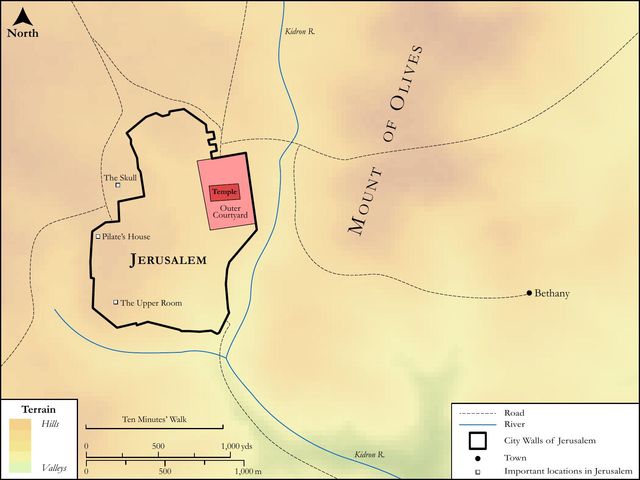
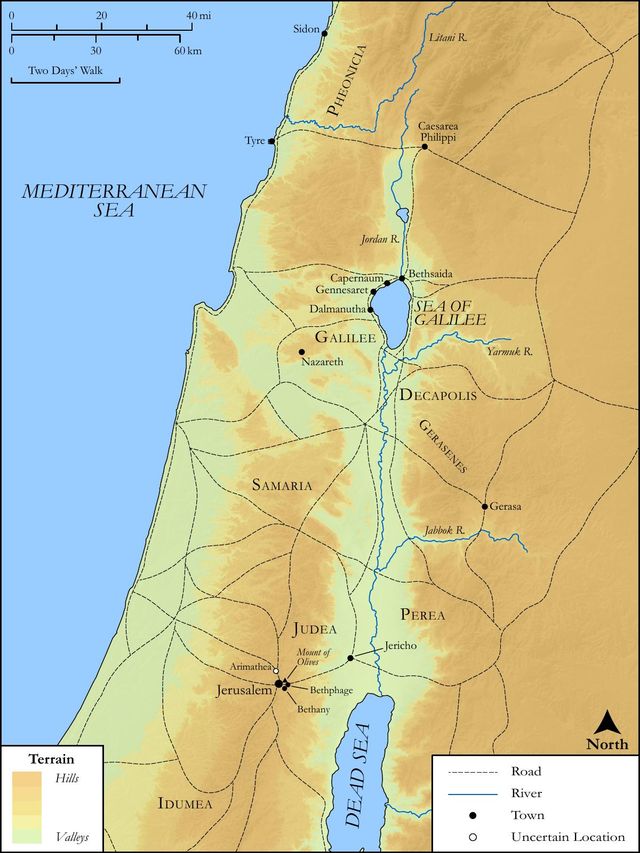
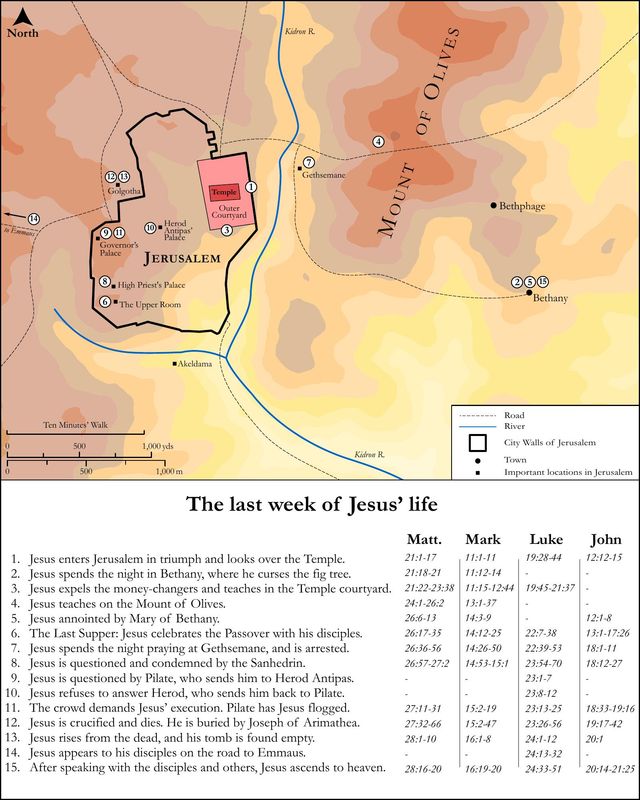
See on the biblical-era maps
Study this verse
Public-domain commentary
Matthew Henry
From his Commentary on the Whole Bible. Henry comments on passages, not single verses — this entry covers Mark 13:1–4.
We may here see,
I.How apt many of Christ's own disciples are to idolize things that look great, and have been long looked upon as sacred.
They had heard Christ complain of those who had made the temple a den of thieves; and yet, when he quitted it, for the wickedness that remained in it, they court him to be as much in love as they were with the stately structure and adorning of it. One of them said to him, "Look, Master, what manner of stones, and what buildings are here, Mar 13:1. We never saw the like in Galilee; O do not leave this fine place."
II.How little Christ values external pomp, where there is not real purity; "Seest thou these great buildings" (saith Christ), "and admirest thou them? I tell thee, the time is at hand when there shall not be left one stone upon another, that shall not be thrown down," Mar 13:2. And the sumptuousness of the fabric shall be no security to it, no nor move any compassion in the Lord Jesus towards it. He looks with pity upon the ruin of precious souls, and weeps over them, for on them he has put great value; but we do not find him look with any pity upon the ruin of a magnificent house, when he is driven out of it by sin, for that is of small value with him. With what little concern doth he say, Not one stone shall be left on another! Much of the strength of the temple lay in the largeness of the stones, and if these be thrown down, no footstep, no remembrance, of it will remain. While any part remained standing, there might be some hopes of the repair of it; but what hope is there, when not one stone is left upon another?
III.How natural it is to us to desire to know things to come, and the times of them; more inquisitive we are apt to be about that than about our duty. His disciples knew not how to digest this doctrine of the ruin of the temple, which they thought must be their Master's royal palace, and in which they expected their preferment, and to have the posts of honour; and therefore they were in pain till they got him alone, and got more out of him concerning this matter. As he was returning to Bethany therefore, he sat upon the mount of Olives, over against the temple, where he had a full view of it; and there four of them agreed to ask him privately, what he meant by the destroying of the temple, which they understood no more than they did the predictions of his own death, so inconsistent was it with their scheme. Probably, though these four proposed the question, yet Christ's discourse, in answer to it, was in the hearing of the rest of the disciples, yet privately, that is, apart from the multitude. Their enquiry is, When shall these things be? They will not question, at least not seem to question, whether they shall be or no (for their Master has said that they shall), but are willing to hope it is a great way off. Yet they ask not precisely the day and year (therein they were modest), but say, "Tell us what shall be the sign, when all these things shall be fulfilled? What presages shall there be of them, and how may we prognosticate their approach?"
Historical interpretation
Nine Centuries of Reception
5 surviving comments on this verse. Each one is dated, so this reads as a timeline rather than a list.
Select a marker to jump to its quote. Markers stagger vertically where authors wrote within a few decades of each other.
Here also the Lord enumerates to His disciples the destruction of the last time, that is of the temple, with the people, and its letter; of which one stone shall not be left upon another, that is, no testimony of the Prophets upon those, to whom the Jews perversely applied them, that is, on Ezra, Zerubbabel, and the Maccabees.
The temple was not overthrown all at once, but gradually as time went by. Similarly, every one who welcomes the Word of God into himself is something like a temple. If, after committing sin he does not completely fall away from the Word of God, but still partially preserves in himself traces of faith and accountability to God’s commands, he is a temple partly destroyed, partly standing. But he who after sinning has no care for himself but is always prone to depart from faith and from life according to the gospel, till he completely departs from the living God, he is a temple in which no stone of doctrine is left upon any stone and not thrown down.
(in Marc. lib. iv. 42) Because after the founding of the Church of Christ, Judæa was to be punished for her treachery, the Lord fitly, after praising the devotedness of the Church in the person of the poor widow, goes out of the temple, and foretold its coming ruin, and the contempt in which the buildings now so wonderful were soon to be held, wherefore it is said, And as he went out of the temple, one of his disciples saith unto him, Master, see what manner of stones and what buildings are here!
(ubi sup.) But it was ordered by Divine power that after that the grace of the faith of the Gospel was made known through the world, the temple itself with its ceremonies should be taken away; lest perchance some one weak in the faith, if he saw that these things which had been instituted by God still remained, might by degrees drop from the sincerity of the faith, which is in Christ Jesus, into carnal Judaism.
(ubi sup.) Again, when the Lord left the temple, all the edifice of the law and the framework of the commandments were destroyed, so that nothing could be filled up by the Jews; and now that the head has been taken away, all the limbs fight one against the other.
And as he went out of the temple, one of his disciples said to him, Teacher, behold what manner of stones and what buildings are here. And Jesus answering said to him: Do you see all these great buildings? There shall not be left one stone upon another, that shall not be thrown down. According to history, the meaning is clear. However, as the Lord departed from the temple, all the structures of the law and the composition of the commandments were so destroyed that nothing could be fulfilled by the Jews; and with the head removed, all the members clashed among themselves. And because, with faith established among the Gentiles and the Church of Christ, Judea was about to bear the worthy punishments for its perfidy, it was fitting for the Lord, after praising the devotion of the Church in the poor widow, to leave the temple, and to predict its future ruin and that the buildings then admired would soon be leveled. Divinely, it was arranged that, with the grace of the evangelical faith revealed throughout the world, the temple itself, once august with its ceremonies, would be removed, lest anyone still young and suckling in the faith, seeing those things which were made by the holy prophets and instituted by the Lord remaining, might wonder at the secular sanctity and gradually slip from the sincerity of the faith which is in Christ Jesus into carnal Judaism. Therefore, God, providing for our infirmity and desiring his Church to multiply, caused all those things to be overturned and utterly removed, so that with the shadow and type ceasing, the truth now declared throughout the world might hold the greater palm.
For, since the Lord had spoken much concerning the destruction of Jerusalem, His disciples wondered, that such numerous and beautiful buildings were to be destroyed; and this is the reason why they point out the beauty of the temple, and He answers not only that they were to be destroyed, but also that one stone should not be left upon another: wherefore it goes on: And Jesus answering said unto him, Seest thou these great buildings? there shall not be left one stone upon another, that shall not be thrown down. Now some may endeavour to prove that Christ's words were false, by saying that many ruins were left, but this is not at all the point; for though some ruins had been left, still at the consummation of all things one stone shall not be left upon another. Besides it is related, that Ælius Adrian overturned the city and the temple from the foundation, so that the word of the Lord here spoken was fulfilled.
Continue studying Mark 13:1 across the web’s major study libraries — every link below opens this exact verse, chapter, or book on the destination site.
Read & Compare
 BibleGatewayThis verse in more than 200 translations and 70 languages.
 Bible.comThe YouVersion reader — hundreds of translations, reading plans, and highlights.
 ESV.orgCrossway's official English Standard Version reader.
 NET BibleThe NET translation with 60,000+ translators' notes on every rendering decision.
 STEP BibleTyndale House's free study tool — original text, vocabulary, and scholarly resources.
 BibliaLogos Bible Software's free web reader.
 USCCBThe New American Bible (Revised Edition) with the U.S. bishops' study notes.
Commentaries
 BibleHub CommentariesDozens of classic commentaries on this verse, gathered on one page.
 StudyLightMore than 100 commentary sets — the largest collection on the web.
 BibleRefPlain-English commentary on what this verse means, verse by verse.
 Enduring WordDavid Guzik's free commentary on this chapter, widely used by Bible teachers.
 Bible Study ToolsVerse commentary alongside Greek and Hebrew study aids.
Original Language & Research
- BibleHub InterlinearThe verse word by word — original language, transliteration, and English.
- BibleHub LexiconEvery word's original-language definition and Strong's entry.
 Blue Letter BibleDeep-study tools — Strong's numbers, concordance, and word studies.
 CNTR CollationThe earliest Greek manuscripts of this verse, collated letter by letter.
Sermons, Hymns & Audio


TrulyRandomVerse is not affiliated with these sites and doesn’t control their content. They’re linked because they’re genuinely useful.
Summary
Mark 13:1 serves as the pivotal opening to Jesus's prophetic discourse on the Mount of Olives, often termed the "Little Apocalypse." As Jesus departs from the magnificent Jerusalem Temple, one of His disciples expresses profound admiration for its colossal stones and grand architecture. This seemingly innocent observation about human achievement and grandeur immediately precedes Jesus's sobering prophecy of the Temple's utter destruction, setting the stage for a profound teaching on the transience of earthly structures and the coming of the Son of Man.
Context
ShowHideLiterary Context
This verse immediately follows Jesus's final teachings within the Temple courts, including His commendation of the poor widow's offering in Mark 12:41-44. Prior to this, Jesus had engaged in intense debates with religious authorities, exposing their hypocrisy and false teachings (Mark 11:27-33 and Mark 12:1-40). His departure from the Temple in Mark 13:1 thus marks a significant transition, signaling the end of His public ministry within that sacred space and the beginning of a private, eschatological discourse delivered to His inner circle of disciples on the Mount of Olives. The disciple's awe at the Temple's physical splendor contrasts sharply with Jesus's preceding teachings about true devotion and His impending judgment on the religious establishment.
Historical & Cultural Context
The Temple admired by the disciples was Herod's Temple, a massive reconstruction project initiated by Herod the Great around 20 BCE and still unfinished in Jesus's day, though its main structures were complete. It was one of the most impressive architectural marvels of its day, renowned for its immense size, luxurious materials (including colossal white stones), and intricate craftsmanship. For Jews, the Temple was the spiritual and national heart of their identity, a symbol of God's presence among His people and a source of immense pride. Its perceived permanence and grandeur made the disciple's exclamation entirely understandable, reflecting the common awe it inspired. This context underscores the shock and profound significance of Jesus's subsequent prophecy regarding its complete demolition.
Key Themes
ShowHideThe disciple's observation in Mark 13:1 introduces several crucial themes that permeate Jesus's subsequent discourse. Firstly, it highlights the contrast between human admiration and divine foresight, as the disciples are captivated by the Temple's physical glory, while Jesus immediately foretells its utter destruction in Mark 13:2. Secondly, the verse serves as the catalyst for profound prophecy, directly prompting Jesus's extensive teachings on the signs of the end times, the destruction of Jerusalem, and His second coming. Finally, it subtly introduces the theme of the transience of earthly glory and human achievements, emphasizing that even the most magnificent human constructs are temporary and subject to God's sovereign plan and ultimate judgment, a concept echoed throughout the New Testament regarding the nature of God's enduring kingdom versus the passing world.
Exposition and Analysis
ShowHideKey Word Analysis
ShowHideThis term, used by the disciple to address Jesus, signifies "teacher" or "instructor." It reflects the disciple's recognition of Jesus's authority and wisdom, even as his focus remains on the physical edifice. The use of "Master" underscores the disciple's expectation that Jesus, as their authoritative teacher, would share in their admiration or provide a profound insight, which He indeed does, though not in the way they anticipated.
This word refers to the entire sacred precinct of the Temple in Jerusalem, encompassing not just the central sanctuary (ναός, naos) but also the surrounding courts, porticos, and ancillary buildings. The disciple's exclamation encompasses the entirety of this vast and impressive complex, emphasizing its overwhelming scale and the collective awe it inspired. The choice of hierón highlights the grand, public scope of the structure that so captivated the disciple.
Directly referring to the building blocks, this term emphasizes the sheer material solidity and monumental scale of the Temple's construction. The use of "stones" specifically points to the visible, tangible elements that contributed to the Temple's awe-inspiring appearance, many of which were indeed massive, cut from the quarries around Jerusalem. The disciple's focus on these "stones" underscores the human perception of permanence and strength.
Verse Breakdown
ShowHide"And as he went out of the temple,"
This phrase establishes the immediate setting and action. Jesus's departure from the Temple is highly symbolic, marking a definitive shift from His public ministry within its walls to a more private, eschatological discourse outside of them. It signifies the end of an era of direct engagement with the Temple system.
"one of his disciples saith unto him,"
This identifies the speaker as one of Jesus's followers, indicating a personal interaction. The singular "one" suggests a spontaneous, individual expression of wonder, perhaps one that resonated with the unstated feelings of the other disciples present.
"Master, see what manner of stones and what buildings [are here]!"
This is the disciple's exclamation, conveying profound astonishment and admiration. The repetition of "what manner" (ποταποὶ, potapoi) emphasizes the extraordinary nature of the Temple's construction. It highlights the disciples' focus on the physical grandeur, size, and apparent permanence of the Temple complex, setting up a dramatic contrast with Jesus's immediate prophetic response in the subsequent verse.
Literary Devices
ShowHideMark 13:1 employs several literary devices to establish the scene and foreshadow the impending discourse. Contrast is immediately evident, as the disciple's awe at the Temple's physical magnificence stands in stark opposition to Jesus's impending prophecy of its total destruction. This sets up a dramatic tension between human perception and divine reality. The verse also utilizes Foreshadowing, as the disciple's innocent observation about the Temple's grandeur serves as a direct trigger for Jesus's "Little Apocalypse," a discourse centered on the Temple's fall and the end times. Furthermore, the Temple itself functions as Symbolism, representing not just a physical structure but also the culmination of human religious achievement and national pride, which Jesus will declare transient and subject to divine judgment. The disciple's exclamation, "what manner of stones and what buildings," also uses Exclamation to convey a powerful sense of wonder and astonishment, drawing the reader into the scene.
Theological and Thematic Connections
ShowHideMark 13:1, while seemingly a simple observation, carries profound theological weight by setting the stage for Jesus's teaching on the transience of earthly structures and the enduring nature of God's kingdom. It underscores the biblical theme that human achievements, no matter how grand or revered, are ultimately temporary and subject to divine will. The disciples' focus on the visible, material grandeur of the Temple highlights a common human tendency to place value and security in tangible things, contrasting sharply with Jesus's emphasis on spiritual realities and the unseen kingdom of God. This moment marks a shift from the old covenant's focus on a physical dwelling place for God to the new covenant, where God's presence is manifested in Christ and His people.
Reflection and Application
ShowHideMark 13:1 serves as a timeless reminder for believers to critically evaluate where we place our admiration, trust, and security. The disciples, like many today, were captivated by external splendor and apparent permanence—the massive stones and magnificent buildings of the Temple. Yet, Jesus's immediate response (in the following verse) dramatically shifts the focus from human grandeur to divine judgment and the impermanence of all earthly things. This calls us to examine our own hearts: Are we overly impressed by worldly achievements, material possessions, or human institutions, even those within the church, to the point where they overshadow our focus on God's eternal kingdom and spiritual realities? This verse challenges us to cultivate a heavenly perspective, recognizing that true and lasting value is found not in what we build or accumulate, but in our relationship with God and our participation in His enduring purposes. It encourages us to invest in what is eternal, fostering a spirit of detachment from the transient glories of this world and a deeper commitment to the spiritual "building" that Christ is constructing.
Questions for Reflection
ShowHideFAQ
ShowHideWhat was the significance of the Temple that the disciple admired?
ShowHideThe Temple admired by the disciple was Herod's Temple, a massive and ongoing reconstruction project initiated by Herod the Great. It was not the original Temple of Solomon, which had been destroyed, nor the more modest Second Temple rebuilt after the Babylonian exile. Herod's Temple was a monumental undertaking, renowned throughout the Roman world for its colossal stones, intricate architecture, and immense wealth. For the Jewish people, it was the spiritual and national heart of their identity, symbolizing God's presence among them and serving as the center of their worship and religious life. Its grandeur was a source of immense pride, making the disciple's awe understandable, but also setting the stage for Jesus's shocking prophecy of its destruction in Mark 13:2.
What was Jesus's immediate response to the disciple's observation?
ShowHideWhile not explicitly stated in Mark 13:1, Jesus's immediate response is found in the very next verse, Mark 13:2. He directly counters the disciple's admiration for the Temple's permanence by prophesying its complete destruction: "Seest thou these great buildings? there shall not be left one stone upon another, that shall not be thrown down." This stark contrast between human awe and divine foresight serves as the dramatic catalyst for Jesus's extensive eschatological discourse.
Why is Mark 13 often referred to as the "Little Apocalypse"?
ShowHideMark 13, along with its parallels in Matthew 24 and Luke 21, is often called the "Little Apocalypse" because it contains Jesus's most extensive and detailed prophetic discourse concerning the end times. The term "apocalypse" refers to a revelation of hidden things, especially concerning the future. In this chapter, Jesus reveals signs of the end of the age, the destruction of Jerusalem and the Temple, the persecution of believers, and His own second coming. It echoes themes and imagery found in Old Testament prophetic books and the book of Revelation, providing a condensed yet profound prophetic outlook.
Christ-Centered Fulfillment
ShowHideMark 13:1, with its depiction of the disciples' awe at the physical Temple, serves as a crucial theological pivot pointing towards Christ-centered fulfillment. The Temple, a magnificent symbol of God's presence under the Old Covenant, was destined for destruction, as Jesus immediately prophesies in Mark 13:2. This foreshadows the end of the old covenant system and the advent of a new, spiritual reality centered on Jesus Himself. Christ is the true and ultimate Temple, as He declared in John 2:19-21, referring to the temple of His body. His death and resurrection represent the destruction and rebuilding of this ultimate Temple, through which humanity gains access to God. Furthermore, the Church, comprised of believers, becomes the spiritual temple where God's Spirit dwells (1 Corinthians 3:16; Ephesians 2:19-22). Thus, the disciples' admiration for a transient earthly structure ultimately directs our gaze to Christ, who is the enduring reality, the living cornerstone upon whom God's eternal spiritual house is built, and the one whose return will usher in the new heavens and new earth where He Himself is the Temple (Revelation 21:22).