


Judges 19:5
- וַיְהִיvay·Hiand it wasH1961Conj-w ¦ V-Qal-ConsecImperf-3msVerb Qal Consecutive Imperfect 3rd Singular Masculineוַandיְהִיit was
- בַּיּוֹםbai·Yomon the dayH3117Prep-b ¦ N-msNoun Singular Masculine Absoluteבַּon theיּוֹםday
- הָרְבִיעִיha·re·vi·'I<the> fourthH7243Art ¦ Adj-msAdjective Numerical Position Singular Masculine Absoluteהָ<the>רְבִיעִיfourth
- וַיַּשְׁכִּימוּvai·yash·Ki·muand they rose earlyH7925Conj-w ¦ V-Hiphil-ConsecImperf-3mpVerb Hiphil Consecutive Imperfect 3rd Plural Masculineוַandיַּשְׁכִּימוּthey rose early
- בַבֹּקֶרva·Bo·kerin the morningH1242Prep-b ¦ N-msNoun Singular Masculine Absoluteבַin theבֹּקֶרmorning
- וַיָּקָםvai·Ya·komand he aroseH6965Conj-w ¦ V-Qal-ConsecImperf-3msVerb Qal Consecutive Imperfect 3rd Singular Masculineוַandיָּקָםhe arose
- לָלֶכֶתla·Le·khetto goH1980Prep-l ¦ V-Qal-InfVerb Qal Infinitive Constructלָtoלֶכֶתgo
- וַיֹּאמֶרvai·yo·Merand he saidH559Conj-w ¦ V-Qal-ConsecImperf-3msVerb Qal Consecutive Imperfect 3rd Singular Masculineוַandיֹּאמֶרhe said
- אֲבִי'a·Vi[the] father ofH1N-mscNoun Singular Masculine Construct
- הַנַּעֲרָהha·na·'a·Rahthe young womanH5291Art ¦ N-fsNoun Singular Feminine Absoluteהַtheנַּעֲרָהyoung woman
- אֶל'eltoH413PrepPreposition
- חֲתָנוֹcha·ta·Nohis son-in-lawH2860N-msc ¦ 3msNoun Singular Masculine Constructחֲתָנson-in-lawוֹhis
- סְעָדse·'AdsustainH5582V-Qal-Imp-2msVerb Qal Imperative 2nd Singular Masculine
- לִבְּךָli·be·Khayour heartH3820N-msc ¦ 2msNoun Singular Masculine Constructלִבְּheartךָyour
- פַּתpata morsel ofH6595N-fscNoun Singular Feminine Construct
- לֶחֶםLe·chembreadH3899N-msNoun Singular Masculine Absolute
- וְאַחַרve·'a·Charand afterH310Conj-w ¦ Adj-msAdjective Numerical Singular Masculine Absoluteוְandאַחַרafter
- תֵּלֵכוּte·Le·khuyou will goH1980V-Qal-Imperf-2mpVerb Qal Imperfect 2nd Plural Masculine
English is a literal word-by-word gloss of the Hebrew, not the KJV's wording. Why?
This is the original text the KJV's translators worked from — each Hebrew word with its own literal English meaning in this verse, prepared by scholars at Tyndale House, Cambridge. The KJV translates whole sentences, not word by word, so its wording differs: one Hebrew word can become several English words, and the KJV may choose “the LORD” where the gloss reads “Yahweh”. Both are faithful — they answer different questions. For the KJV's own rendering, switch to the KJV text.
Details
See on the biblical-era map
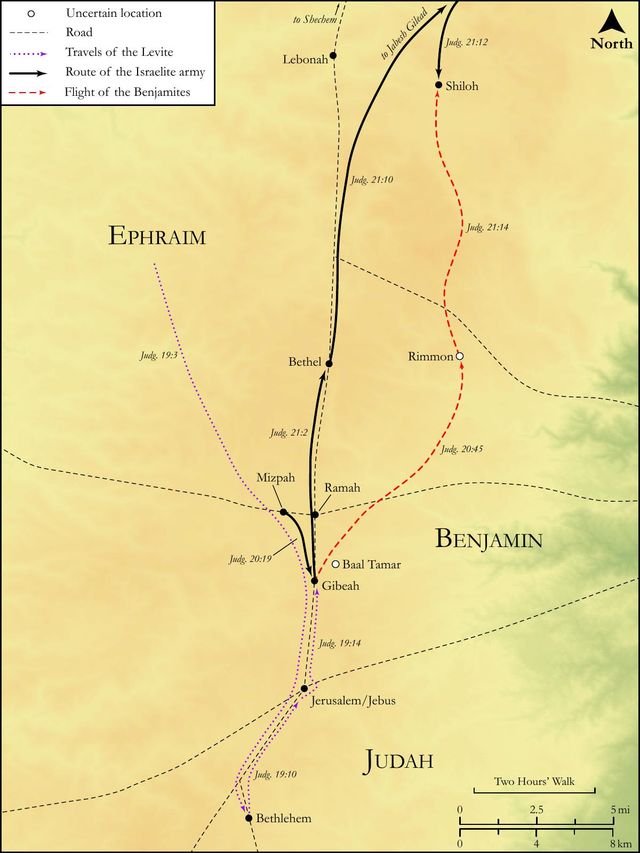
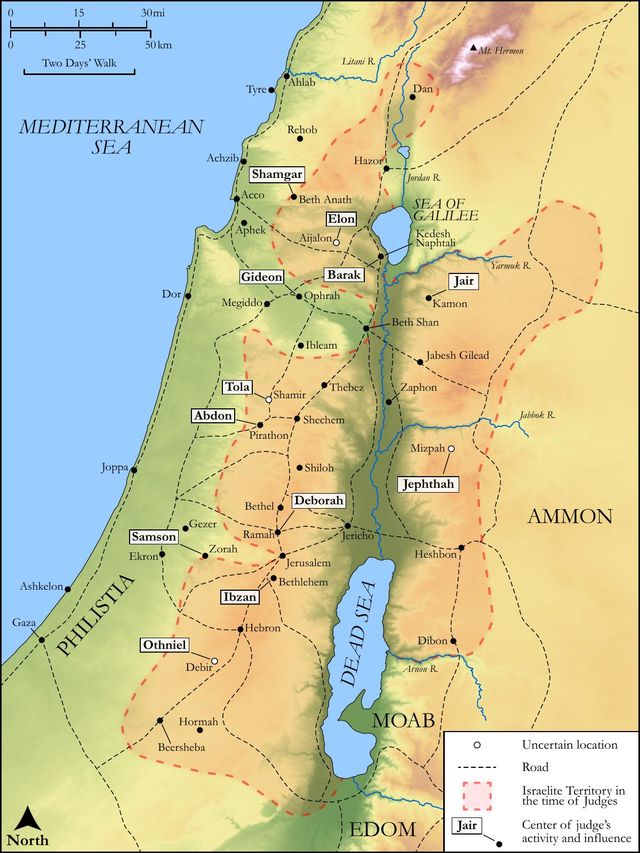
Study this verse
Public-domain commentary
Matthew Henry
From his Commentary on the Whole Bible. Henry comments on passages, not single verses — this entry covers Judges 19:1–15. His four-level outline is real structure in the source text, so it is rendered as structure.
The domestic affairs of this Levite would not have been related thus largely but to make way for the following story of the injuries done him, in which the whole nation interested themselves. Bishop Hall's first remark upon this story is, That there is no complain of a public ordered state but there is a Levite at one end of it, either as an agent or as a patient. In Micah's idolatry a Levite was active; in the wickedness of Gibeah a Levite was passive; no tribe shall sooner feel the want of government than that of Levi; and, in all the book of Judges, no mention is made of any of that tribe, but of these two. This Levite was of Mount Ephraim, Jdg 19:1. He married a wife of Bethlehem-Judah. She is called his concubine, because she was not endowed, for perhaps he had nothing to endow her with, being himself a sojourner and not settled; but it does not appear that he had any other wife, and the margin calls her a wife, a concubine, Jdg 19:1. She came from the same city that Micah's Levite came from, as if Bethlehem-Judah owed a double ill turn to Mount Ephraim, for she was as bad for a Levite's wife as the other for a Levite.
I.This Levite's concubine played the whore and eloped from her husband, Jdg 19:2.
The Chaldee reads it only that she carried herself insolently to him, or despised him, and, he being displeased at it, she went away from him, and (which was not fair) was received and entertained at her father's house. Had her husband turned her out of doors unjustly, her father ought to have pitied her affliction; but, when she treacherously departed from her husband to embrace the bosom of a stranger, her father ought not to have countenanced her sin. Perhaps she would not have violated her duty to her husband if she had not known too well where she should be kindly received. Children's ruin is often owing very much to parents' indulgence.
II.The Levite went himself to court her return.
It was a sign there was no king, no judge, in Israel, else she would have been prosecuted and put to death as an adulteress; but, instead of that, she is addressed in the kindest manner by her injured husband, who takes a long journey on purpose to beseech her to be reconciled, Jdg 19:3. If he had put her away, it would have been a crime in him to return to her again, Jer 3:1. But, she having gone away, it was a virtue in him to forgive the offence, and, though the party wronged, to make the first motion to her to be friends again. It is part of the character of the wisdom from above that it is gentle and easy to be entreated. He spoke friendly to her, or comfortably (for so the Hebrew phrase of speaking to the heart commonly signifies), which intimates that she was in sorrow, penitent fore what she had done amiss, which probably he heard of when he came to fetch her back. Thus God promises concerning adulterous Israel (Hos 2:14), I will bring her into the wilderness, and speak comfortably to her.
III.Her father made him very welcome, and, by his extraordinary kindness to him, endeavoured to atone for the countenance he had given his daughter in withdrawing from him, and to confirm him in his disposition to be reconciled to her.
1.He entertains him kindly, rejoices to see him (Jer 3:3), treats him generously for three days, Jdg 19:4. And the Levite, to show that he was perfectly reconciled, accepted his kindness, and we do not find that he upbraided him or his daughter with what had been amiss, but was as easy and as pleasant as at his first wedding-feast. It becomes all, but especially Levites, to forgive as God does. Every thing among them gave a hopeful prospect of their living comfortably together for the future; but, could they have foreseen what befel them within one day or two, how would all their mirth have been embittered and turned into mourning! When the affairs of our families are in the best posture we ought to rejoice with trembling, because we know not what troubles one day may bring forth. We cannot foresee what evil is near us, but we ought to consider what may be, that we may not be secure, as if tomorrow must needs be as this day and much more abundant, Isa 56:12.
2.He is very earnest for his stay, as a further demonstration of his hearty welcome. The affection he had for him, and the pleasure he took in his company, proceeded,
(1.)From a civil regard to him as his son-in-law and an ingrafted branch of his own house. Note, Love and duty are due to those to whom we are related by marriage as well as to those who are bone of our bone: and those that show kindness as this Levite did may expect to receive kindness as he did. And,
(2.)From a pious respect to him as a Levite, a servant of God's house; if he was such a Levite as he should be (and nothing appears to the contrary) he is to be commended for courting his stay, finding his conversation profitable, and having opportunity to learn from him the good knowledge of the Lord, hoping also that the Lord will do him good because he has a Levite to be his son-in-law, and will bless him for his sake.
[1.]He forces him to stay the fourth day, and this was kind; not knowing when they might be together again, he engages him to stay as long as he possibly could. The Levite, though nobly treated, was very urgent to be gone. A good man's heart is where his business is; for as a bird that wanders from her nest so is the man that wanders form his place. It is a sign a man has either little to do at home, or little heart to do what he has to do, when he can take pleasure in being long abroad where he has nothing to do. It is especially good to see a Levite willing to go home to his few sheep in the wilderness. Yet this Levite was overcome by importunity and kind persuasion to stay longer than he intended, Jdg 19:5-7. We ought to avoid the extreme of an over-easy yielding, to the neglect of our duty on the one hand, and that of moroseness and wilfulness, to the neglect of our friends and their kindness on the other hand. Our Saviour, after his resurrection, was prevailed upon to stay with his friends longer than he at first intimated to be his purpose, Luk 24:28, Luk 24:29.
[2.]He forces him to stay till the afternoon of the fifth day, and this, as it proved, was unkind, Jdg 19:8, Jdg 19:9. He would by no means let him go before dinner, promises him he shall have dinner early, designing thereby, as he had done the day before, to detain him another night; but the Levite was intent on the house of the Lord at Shiloh (Jdg 19:18), and, being impatient to get thither, would stay no longer. Had they set out early, they might have reached some better lodging-place than that which they were now constrained to take up with, nay, they might have got to Shiloh. Note, Our friends' designed kindnesses often prove, in the event, real injuries; what is meant for our welfare becomes a trap. Who knows what is good for a man in this life? The Levite was unwise in setting out so late; he might have got home better if he had staid a night longer and taken the day before him.
IV.In his return home he was forced to lodge at Gibeah, a city in the tribe of Benjamin, afterwards called Gibeah of Saul, which lay on his road towards Shiloh and Mount Ephraim. When it drew towards night, and the shadows of the evening were stretched out, they began to think (as it behoves us to do when we observe the day of our life hastening towards a period) where they must lodge. When night came they could not pursue their journey. He that walketh in darkness knoweth not whither he goes. They could not but desire rest, for which the night was intended, as the day for labour.
1.The servant proposed that they should lodge in Jebus, afterwards Jerusalem, but as yet in the possession of Jebusites. "Come," said the servant, "let us lodge in this city of the Jebusites," Jdg 19:11. And, if they had done so, it is probable they would have had much better usage than they met with in Gibeah of Benjamin. Debauched and profligate Israelites are worse and much more dangerous than Canaanites themselves. But the master, as became one of God's tribe, would by no means quarter, no, not one night, in a city of strangers (Jdg 19:12), not because he questioned his safety among them, but he was not willing, if he could possibly avoid it, to have so much intimacy and familiarity with them as a night's lodging came to, nor to be so much beholden to them. By shunning this place he would witness against the wickedness of those that contracted friendship and familiarity with these devoted nations. Let Israelites, Levites especially, associate with Israelites, and not with the sons of the stranger.
2.Having passed by Jebus, which was about five or six miles from Bethlehem (the place whence they came), and not having daylight to bring them to Ramah, they stopped at Gibeah (Jdg 19:13-15); there they sat down in the street, nobody offering them a lodging. In these countries, at that time, there were no inns, or public-houses, in which, as with us, travellers might have entertainment for their money, but they carried entertainment along with them, as this Levite did (Jdg 19:19), and depended upon the courtesy and hospitality of the inhabitants for a lodging. Let us take occasion hence, when we are in journeys, to thank God for this, among other conveniences of travelling, that there are inns to entertain strangers, and in which they may be welcome and well accommodated for their money. Surely there is no country in the world wherein one may stay at home with more satisfaction, or go abroad with more comfort, than in our own nation. This traveller, though a Levite (and to those of that tribe God had particularly commanded his people to be kind upon all occasions), met with very cold entertainment at Gibeah: No man took them into his house. If they had any reason to think he was a Levite perhaps that made those ill-disposed people the more shy of him. There are those who will have this laid to their charge at the great day, I was a stranger and you took me not in.
Historical interpretation
Historical reception
2 surviving comments on this verse. Each one is dated, so this reads as a timeline rather than a list.
How full of pitiful traits is this story! A man, it says, a Levite, had taken to himself a wife, who I suppose was called a concubine from the word concubitus. She some time afterwards, as is likely to happen, offended at certain things, returned to her father and was with him four months. Then her husband arose and went to the house of his father-in-law to reconcile himself with his wife, to win her back and take her home again. The woman ran to meet him and brought her husband into her father’s house.The maiden’s father rejoiced and went to meet him, and the man stayed with him three days, and they ate and rested. On the next day the Levite arose at daybreak but was detained by his father-in-law, that he might not so quickly lose the pleasure of his company. Again on the next and the third day the maiden’s father did not allow his son-in-law to start [his journey], until their joy and mutual regard was complete. But on the seventh day, when it was already drawing to a close, after a pleasant meal, having urged the approach of the coming night, so as to make him think he ought to sleep among friends rather than strangers, he was unable to keep him, and so let him go together with his daughter.
A Levite, more courageous than wealthy, lived in the region of Mount Ephrem, for his tribe was allotted a landed possession far removed in place of the right of inheritance. He took a wife from the tribe of Bethlehem of Judah. While they felt the first attraction of their love deeply and equally, he continued to burn with unbounded desire for his wife. Yet her ways were different. His passion for her intensified until he inwardly seethed with desire. Yet, because there was a difference in their ages, and because he felt—either because she seemed to love him less or due to the violence of his pain—that she didn’t consider him her equal, he used to criticize her. Frequently quarreling followed, and the offended wife gave back the keys of the house and went home.After the fourth month slipped by her husband, who was overwhelmed with love and had nothing else to hope for, went to her, trusting that the young girl’s heart would be softened on the advice of her parents. His father-in-law met him at the door and brought him into the house. He reconciled his daughter and, in order that he might send them away more joyous, kept them three days while he prepared a sort of nuptial banquet. Although the man wanted to depart, he kept him a fourth day, offering him excuses of civility, devising delays. In his desire to add a fifth day as well, he found new reasons for delaying them, while the husband, unwilling to thwart the father’s affection of its desire to keep his daughter, though he was at last promised an opportunity for setting forth, postponed it to midday so that they would start out well fortified with food. Even after dinner, the father wished to find some delay, saying that evening was now approaching. At last he acquiesced, though reluctantly, to the entreaties of his son-in-law.
Continue studying Judges 19:5 across the web’s major study libraries — every link below opens this exact verse, chapter, or book on the destination site.
Read & Compare
 BibleGatewayThis verse in more than 200 translations and 70 languages.
 Bible.comThe YouVersion reader — hundreds of translations, reading plans, and highlights.
 ESV.orgCrossway's official English Standard Version reader.
 NET BibleThe NET translation with 60,000+ translators' notes on every rendering decision.
 STEP BibleTyndale House's free study tool — original text, vocabulary, and scholarly resources.
 BibliaLogos Bible Software's free web reader.
 USCCBThe New American Bible (Revised Edition) with the U.S. bishops' study notes.
Commentaries
 BibleHub CommentariesDozens of classic commentaries on this verse, gathered on one page.
 StudyLightMore than 100 commentary sets — the largest collection on the web.
 BibleRefPlain-English commentary on what this verse means, verse by verse.
 Enduring WordDavid Guzik's free commentary on this chapter, widely used by Bible teachers.
 Bible Study ToolsVerse commentary alongside Greek and Hebrew study aids.
Original Language & Research
- BibleHub InterlinearThe verse word by word — original language, transliteration, and English.
- BibleHub LexiconEvery word's original-language definition and Strong's entry.
 Blue Letter BibleDeep-study tools — Strong's numbers, concordance, and word studies.
 SefariaThe Hebrew text with Rashi and centuries of Jewish commentary.
Sermons, Hymns & Audio


TrulyRandomVerse is not affiliated with these sites and doesn’t control their content. They’re linked because they’re genuinely useful.
Summary
Judges 19:5 marks a critical juncture in one of the Bible's most harrowing narratives, illustrating the persistent, almost manipulative, hospitality extended by the concubine's father to his son-in-law, the Levite. On the morning of the fourth day, as the Levite attempts to finally depart, the father-in-law reiterates his plea to "comfort thine heart with a morsel of bread," thereby orchestrating yet another delay in their journey. This seemingly benign act of generosity, repeated over several days, is imbued with profound dramatic irony, as it directly contributes to their late departure, which tragically places the Levite and his concubine in the path of the horrific violence and depravity that will unfold in Gibeah, setting the stage for one of the most disturbing episodes in Israel's history.
Context
ShowHideLiterary Context
Judges 19:5 is intricately woven into a deeply unsettling narrative that commences with a Levite from the hill country of Ephraim journeying to Bethlehem of Judah to retrieve his concubine, who had previously left him. The preceding verses Judges 19:1-4 establish the initial reconciliation and the father-in-law's overwhelming hospitality, which has already successfully delayed their departure for three consecutive days. This verse specifically highlights the morning of the fourth day, emphasizing the Levite's renewed and determined effort to leave, an attempt that is once more thwarted by his father-in-law's persuasive and insistent invitation. This prolonged and repeated delay is far more than a mere narrative detail; it functions as a crucial plot device, ensuring that the Levite and his concubine will be traveling at an ill-fated time, leading them directly to the Benjamite town of Gibeah under the perilous cover of darkness, where the chapter's unspeakable horrors are destined to unfold. The narrative's deliberate and careful pacing in these verses masterfully builds escalating tension and ominously foreshadows the impending tragedy.
Historical & Cultural Context
In the ancient Near East, hospitality was not merely a courtesy but a sacred and deeply ingrained cultural obligation, often extending for multiple days, particularly for weary travelers. It was considered a matter of profound honor and a vital means of providing protection and sustenance to guests. However, the father-in-law's actions in Judges 19 transcend customary courtesy, bordering on an almost coercive or manipulative insistence. His relentless prolongation of the stay, despite the son-in-law's evident desire to depart, suggests an overbearing affection for his daughter, a possessive attachment, or perhaps a strong desire to maintain the family connection. This specific period in Israel's history, as repeatedly underscored throughout the book of Judges, was characterized by a profound absence of central governmental or spiritual authority and a pervasive moral decay, famously encapsulated by the recurring refrain, "there was no king in Israel" and "every man did that which was right in his own eyes". This societal breakdown meant that even deeply revered customs like hospitality could be distorted, misapplied, or inadvertently lead to unforeseen and tragic consequences when wisdom, discernment, and divine guidance were conspicuously absent.
Key Themes
ShowHideThis verse contributes significantly to the development of several pivotal themes within Judges 19 and the broader book of Judges. Firstly, it powerfully illustrates the theme of excessive hospitality and its potential for unintended and devastating negative consequences. While hospitality is generally a commendable virtue, its overextension in this narrative becomes a form of obstruction, preventing the Levite from adhering to his necessary and timely course of action. Secondly, the theme of delay and its catastrophic consequences is paramount; the father-in-law's repeated and insistent pleas for the Levite to stay directly lead to their dangerously late departure, which inexorably places the Levite and his concubine in extreme peril. This narrative element starkly underscores how seemingly minor decisions or prolonged delays can precipitate catastrophic outcomes. Thirdly, the verse subtly yet powerfully reinforces the overarching theme of moral decay in Israel. The father-in-law's actions, though perhaps initially well-intentioned, are part of a larger tapestry depicting a society where personal desires and cultural customs are not tempered by divine wisdom or a clear moral compass. This ultimately contributes to the horrific events that graphically illustrate the profound depths of depravity in a land devoid of a righteous king or a guiding moral authority, a pervasive condition lamented throughout the book of Judges. The verse also functions as a potent point of foreshadowing, meticulously building suspense for the reader who is aware of the grim events awaiting the ill-fated travelers.
Exposition and Analysis
ShowHideKey Word Analysis
ShowHideMeaning "to support (mostly figurative); comfort, establish, hold up, refresh self, strengthen, be upholden." In this context, the father-in-law's use of "comfort" (often translated as "strengthen" or "refresh") is an appeal to the physical and emotional well-being of his son-in-law. It implies that a meal will invigorate him for the journey, but it simultaneously serves as a persuasive tactic to delay his departure, cloaking the father's true desire to prolong their stay under the guise of care.
Meaning "a bit; meat, morsel, piece." The term "morsel of bread" (Hebrew, pat lechem) signifies a small, simple, and perhaps quick bite. The father-in-law's choice of "morsel" rather than a full meal could be a rhetorical device to make his request seem minimal and easily granted, thereby reducing the Levite's resistance to yet another delay. It suggests a non-burdensome act of hospitality, yet it effectively achieves the father's objective of holding them back.
Meaning "a day (as the warm hours), whether literal (from sunrise to sunset, or from one sunset to the next), or figurative (a space of time defined by an associated term)." The explicit mention of the "fourth day" is crucial. It underscores the extraordinary length of the delay and the father-in-law's relentless persistence. This specific temporal marker highlights the Levite's growing impatience and the mounting narrative tension, as the repeated deferrals of departure inevitably lead to their journey commencing at a dangerously late hour.
Verse Breakdown
ShowHide"And it came to pass on the fourth day, when they arose early in the morning, that he rose up to depart"
This opening clause precisely sets the scene and unequivocally states the Levite's firm intention. After enduring three days of persistent delays, the Levite is clearly resolved to leave at the earliest possible moment ("early in the morning"), signaling his increasing impatience and a recognition of the urgent need to continue his journey. This declaration immediately establishes a direct narrative conflict with the father-in-law's desires.
"and the damsel's father said unto his son in law"
This phrase reintroduces the father-in-law as the active and dominant agent in this interaction, emphasizing his continued intervention and control over the situation. His voice is the consistent source of delay, underscoring his pivotal role in orchestrating the prolonged stay and the subsequent events.
"Comfort thine heart with a morsel of bread"
This is the father-in-law's familiar and highly persuasive plea, repeated from earlier in the narrative. It is framed as an appeal to basic human need for sustenance and comfort, presented as an act of genuine kindness. However, within the established context of repeated delays, this seemingly benign request functions as a subtle form of manipulation, utilizing the guise of hospitality to achieve his underlying desire to prolong their stay. The reference to a "morsel" makes the request appear small and easily granted, further entreating the Levite.
"and afterward go your way"
This concluding phrase is a deceptive and ultimately unfulfilled promise. It offers the Levite the hope of imminent departure, yet it is a promise that has been broken repeatedly over the preceding days. For the discerning reader, this phrase dramatically heightens the irony and suspense, as we are acutely aware that "afterward" will lead not to a safe and peaceful journey, but directly to the unfolding horror and depravity in Gibeah.
Literary Devices
ShowHideJudges 19:5 is rich with several literary devices that significantly enhance its dramatic impact and thematic depth. Foreshadowing is prominently featured, as the repeated delays, particularly the explicit mention of the "fourth day," meticulously build an ominous tension, subtly hinting at the dire and tragic consequences that will inevitably arise from their late departure. The reader is given a palpable sense that this prolonged stay will lead to trouble, a premonition that is tragically fulfilled. Irony is also powerfully at play: what begins as an act of sacred hospitality, culturally intended for comfort, protection, and blessing, ironically transforms into the very catalyst for the concubine's brutalization and death. The father-in-law's seemingly well-intentioned (or perhaps selfishly motivated) kindness directly contributes to the unfolding catastrophe. The Repetition of the father-in-law's persistent plea to "comfort thine heart" (reiterated in Judges 19:8) underscores his relentless insistence and the Levite's passive, yielding nature, creating a profound sense of inevitability about the delay. Finally, the narrative masterfully employs Suspense, as the reader is acutely aware of the Levite's increasing desire to leave and the father-in-law's unwavering insistence on staying, generating a palpable tension concerning when they will finally depart and the dreadful fate that awaits them on their journey.
Theological and Thematic Connections
ShowHideJudges 19:5, though seemingly a simple domestic interaction, serves as a profound theological statement on human responsibility, the insidious consequences of unchecked desires, and the inherent dangers of a society adrift from divine guidance. The father-in-law's excessive hospitality, while rooted in a culturally valued custom, starkly highlights the precarious fine line between virtue and vice when genuine discernment is lacking. His actions, coupled with the Levite's passive acquiescence, powerfully illustrate how seemingly minor decisions or prolonged indecision can inadvertently set in motion a devastating chain of events with catastrophic outcomes. This narrative functions as a stark and urgent warning about the critical importance of wisdom in discerning when to graciously accept hospitality and when to firmly prioritize one's necessary course of action, especially when facing potential dangers or responsibilities. It underscores the broader, pervasive theme of the book of Judges: that when individuals and an entire nation "do what is right in their own eyes" rather than diligently seeking and adhering to God's revealed will, even actions born of good intentions can tragically contribute to societal breakdown, moral depravity, and profound suffering.
Reflection and Application
ShowHideThe tragic and disturbing narrative of Judges 19, with verse 5 serving as a crucial turning point, offers profound and enduring lessons for contemporary life. It compels us to deeply consider the far-reaching and often unforeseen consequences of our choices, even those that appear minor, well-intentioned, or culturally acceptable. The father-in-law's excessive hospitality, while rooted in a cherished cultural value, ultimately contributes directly to a devastating disaster. This prompts us to critically examine our own motivations and the potential impact of our actions, even when they seem benevolent. Are there instances in our lives where our "kindness" or desire to please inadvertently hinders others, delays necessary progress, or leads to unforeseen negative outcomes? The Levite's repeated yielding to delay also serves as a potent cautionary tale about the paramount importance of discernment, resolve, and personal responsibility. There are indeed moments when we must courageously assert our boundaries, firmly adhere to our convictions, and diligently proceed with our responsibilities, even in the face of persuasive appeals, social pressure, or the allure of comfort. This harrowing story, set in a time when "every man did that which was right in his own eyes," powerfully reminds us of the inherent dangers of moral relativism and the critical, enduring need for a guiding moral compass rooted firmly in objective divine truth, rather than relying solely on subjective personal judgment, fleeting cultural norms, or the path of least resistance. It calls us to cultivate profound wisdom, spiritual discernment, and unwavering courage to make difficult choices that align with God's perfect will, even when it means resisting comfortable delays, popular opinion, or the expectations of others.
Questions for Reflection
ShowHideFAQ
ShowHideWhy did the father-in-law keep delaying them?
ShowHideThe text does not explicitly state his precise motivations, allowing for interpretive nuance, but several factors likely contributed to his persistent delays. Culturally, hospitality was a sacred and deeply ingrained duty, and prolonging a guest's stay was often seen as a significant sign of honor, affection, and protection. He may have genuinely enjoyed their company, or perhaps felt a deep, protective affection for his daughter and wished to keep her close for as long as possible after her return. Some interpretations suggest a more manipulative or controlling element, perhaps a desire to maintain influence or to ensure his daughter's well-being by keeping her under his immediate protection. Regardless of his exact intent, his actions, though possibly rooted in a form of care or cultural custom, ultimately prevented the Levite from leaving at a safer time, directly contributing to the tragic events that unfolded later in Judges 19.
What is the significance of the "fourth day" in this verse?
ShowHideThe explicit mention of the "fourth day" is highly significant because it powerfully emphasizes the prolonged, repeated, and almost relentless nature of the delay. The narrative meticulously details that the father-in-law successfully delayed them on the second day Judges 19:4, the third day Judges 19:7, and now again on this pivotal fourth day. This persistent repetition builds immense narrative tension and vividly highlights the father-in-law's unyielding insistence. It underscores the Levite's increasing frustration and the escalating urgency to depart. Crucially, this extended and cumulative delay means that they ultimately leave Bethlehem late in the day, causing them to be on the road at dusk and forcing them to seek lodging in the notoriously dangerous town of Gibeah, thereby directly setting the stage for the horrific and morally depraved events that define the climax of the chapter. The "fourth day" thus marks the critical point of no return for their ill-fated journey.
Christ-Centered Fulfillment
ShowHideThe profoundly dark and disturbing narrative of Judges 19, epitomized by the pervasive moral decay and the catastrophic consequences of human self-will, powerfully underscores humanity's desperate and inherent need for a true King and a perfect Shepherd. The Levite, a figure representing Israel's spiritual leadership, tragically fails to protect his concubine and make wise, discerning decisions, thereby reflecting the spiritual bankruptcy and moral chaos of a people where "there was no king in Israel and every man did what was right in his own eyes." This pervasive chaos and depravity find their ultimate and redemptive answer in the person and work of Jesus Christ. Unlike the Levite who passively yields to human persuasion and leads his household into unimaginable peril, Jesus is the Good Shepherd who willingly lays down His life for His sheep, demonstrating perfect leadership, unwavering protection, and unparalleled self-sacrificial love (John 10:11). The distorted and ultimately destructive hospitality depicted in Judges, which tragically leads to violence and death, stands in stark and glorious contrast to Christ's perfect and life-giving hospitality, where He graciously invites all who are weary and burdened to find true rest, comfort, and eternal sustenance in Him (Matthew 11:28). The "morsel of bread" offered in Judges 19:5, which indirectly leads to death, profoundly foreshadows the true Bread of Life, Jesus Himself, whose body broken for us offers not temporary comfort but eternal life and spiritual nourishment (John 6:35). The entire book of Judges, with its cyclical descent into sin and anarchy, cries out for a deliverer, a righteous King who would bring divine order out of human chaos. That King is Jesus, who perfectly fulfills the law, decisively conquers sin and death, and establishes an everlasting kingdom where righteousness and justice reign supreme, ensuring that all who follow Him will never walk in spiritual darkness but will have the glorious light of life (John 8:12).