


Judges 16:9
- וְהָאֹרֵבve·ha·'o·Revand the ambusherH693Conj-w ¦ Art ¦ V-Qal-Prtcpl-msVerb Qal Participle Singular Masculine Absoluteוְandהָtheאֹרֵבambusher
- יֹשֵׁבyo·Shev[was] sittingH3427V-Qal-Prtcpl-msVerb Qal Participle Singular Masculine Absolute
- לָהּlahof <the> herPrep-l ¦ 3fsSuffix Personal 3rd Singular Feminineלָof <the>הּher
- בַּחֶדֶרba·Che·derin the chamberH2315Prep-b ¦ N-msNoun Singular Masculine Absoluteבַּin theחֶדֶרchamber
- וַתֹּאמֶרva·To·merand she saidH559Conj-w ¦ V-Qal-ConsecImperf-3fsVerb Qal Consecutive Imperfect 3rd Singular Feminineוַandתֹּאמֶרshe said
- אֵלָיו'e·Lavto himH413Prep ¦ 3msPreposition Definiteאֵלָיtoוhim
- פְּלִשְׁתִּיםpe·lish·Tim[the] PhilistinesH6430N-mpNoun Gentilic Plural Masculine Absolute
- עָלֶיךָ'a·Lei·kha[are] on youH5921Prep ¦ 2msPreposition Definiteעָלֶי[are] onךָyou
- שִׁמְשׁוֹןshim·ShonO SamsonH8123N-proper-mNoun Proper Masculine
- וַיְנַתֵּקvay·na·Tekand he tore apartH5423Conj-w ¦ V-Piel-ConsecImperf-3msVerb Piel Consecutive Imperfect 3rd Singular Masculineוַandיְנַתֵּקhe tore apart
- אֶת'et<obj.>H853DirObjMParticle Object Indicator
- הַיְתָרִיםhay·ta·Rimthe cordsH3499Art ¦ N-mpNoun Plural Masculine Absoluteהַtheיְתָרִיםcords
- כַּאֲשֶׁרka·'a·Sherjust asH834Prep-k ¦ RelParticle Relativeכַּjustאֲשֶׁרas
- יִנָּתֵקyi·na·Tekit is torn apartH5423V-Niphal-Imperf-3msVerb Niphal Imperfect 3rd Singular Masculine
- פְּתִילpe·til<the> thread ofH6616N-mscNoun Singular Masculine Construct
- הַנְּעֹרֶתha·ne·'O·ret<the> towH5296Art ¦ N-fsNoun Singular Feminine Absoluteהַ<the>נְּעֹרֶתtow
- בַּהֲרִיחוֹba·ha·ri·Chowhen smells itH7306Prep-b ¦ V-Hiphil-Inf ¦ 3msVerb Hiphil Infinitive Constructבַּwhenהֲרִיחsmellsוֹit
- אֵשׁ'EshfireH784N-csNoun Singular common gender Absolute
- וְלֹאve·Lo'and notH3808Conj-w ¦ NegParticle Negativeוְandלֹאnot
- נוֹדַעno·Da'it was knownH3045V-Niphal-Perf-3msVerb Niphal Perfect 3rd Singular Masculine
- כֹּחוֹko·Chohis strengthH3581N-msc ¦ 3msNoun Singular Masculine Constructכֹּחstrengthוֹhis
English is a literal word-by-word gloss of the Hebrew, not the KJV's wording. Why?
This is the original text the KJV's translators worked from — each Hebrew word with its own literal English meaning in this verse, prepared by scholars at Tyndale House, Cambridge. The KJV translates whole sentences, not word by word, so its wording differs: one Hebrew word can become several English words, and the KJV may choose “the LORD” where the gloss reads “Yahweh”. Both are faithful — they answer different questions. For the KJV's own rendering, switch to the KJV text.
Details
See on the biblical-era map
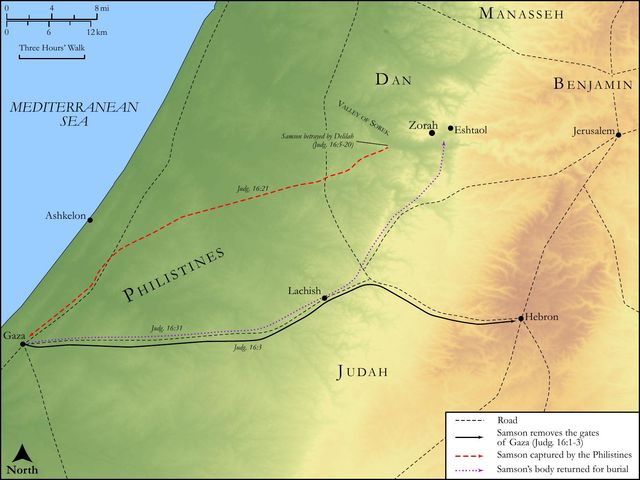
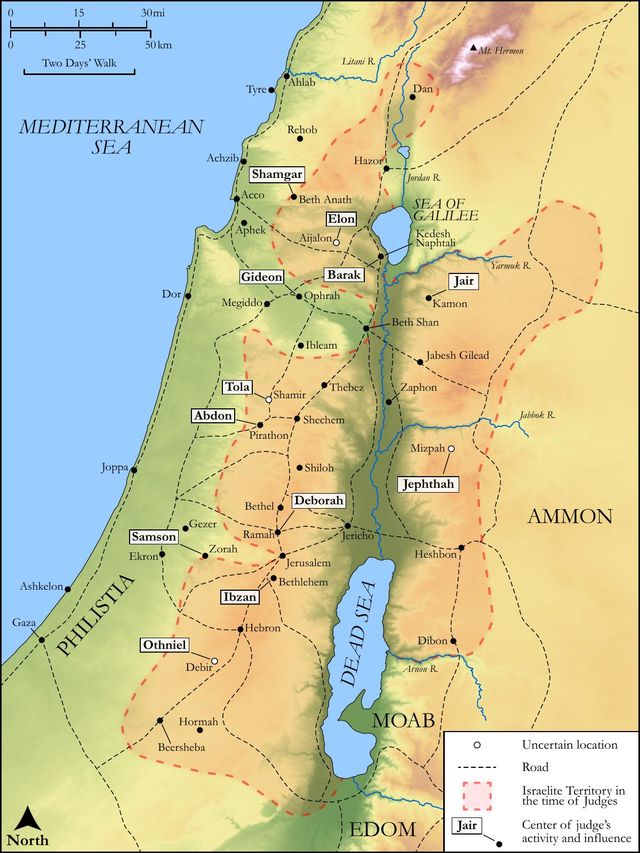
Study this verse
Public-domain commentary
Matthew Henry
From his Commentary on the Whole Bible. Henry comments on passages, not single verses — this entry covers Judges 16:4–17. His three-level outline is real structure in the source text, so it is rendered as structure.
The burnt child dreads the fire; yet Samson, that has more than the strength of a man, in this comes short of the wisdom of a child; for, though he had been more than once brought into the highest degree of mischief and danger by the love of women and lusting after them, yet he would not take warning, but is here again taken in the same snare, and this third time pays for all. Solomon seems to refer especially to this story of Samson when, in his caution against uncleanness, he gives this account of a whorish woman (Pro 7:26), that she hath cast down many wounded, yea, many strong men have been slain by her; and (Pro 6:26) that the adulteress will hunt for the precious life. This bad woman, that brought Samson to ruin, is here named Delilah, an infamous name, and fitly used to express the person, or thing, that by flattery or falsehood brings mischief and destruction on those to whom kindness is pretended. See here,
I.The affection Samson had for Delilah:
he loved her, Jdg 16:4. Some think she was his wife, but then he would have had her home to his own house; others that he courted her to make her his wife; but there is too much reason to suspect that it was a sinful affection he had for her, and that he lived in uncleanness with her. Whether she was an Israelite or a Philistine is not certain. If an Israelite, which is scarcely probable, yet she had the heart of a Philistine.
II.The interest which the lords of the Philistines made with her to betray Samson, Jdg 16:5.
1.That which they told her they designed was to humble him, or afflict him; they would promise not to do him any hurt, only they would disable him not to do them any. And so much conscience it should seem they made of this promise that even then, when he lay ever so much at their mercy, they would not kill him, no, not when the razor that cut his hair might sooner and more easily have cut his throat.
2.That which they desired, in order hereunto, was to know where his great strength lay, and by what means he might be bound. Perhaps they imagined he had some spell or charm which he carried about with him, by the force of which he did these great things, and doubted not but that, if they could get this from him, he would be manageable; and therefore, having had reason enough formerly to know which was his blind side, hoped to find out his riddle a second time by ploughing with his heifer. They engaged Delilah to get it out of him, telling her what a kindness it would be to them, and perhaps assuring her it should not be improved to any real mischief, either to him or her.
3.For this they bid high, promised to give her each of them 1100 pieces of silver, 5500 in all. So many shekels amounted to above 1000l. sterling; with this she was hired to betray one she pretended to love. See what horrid wickedness the love of money is the root of. Our blessed Saviour was thus betrayed by one whom he called friend, and with a kiss too, for filthy lucre. No marvel if those who are unchaste, as Delilah, be unjust; such as lose their honesty in one instance will in another.
III.The arts by which he put her off from time to time, and kept his own counsel a great while.
She asked him where his great strength lay, and whether it were possible for him to be bound and afflicted (Jdg 16:6), pretending that she only desired he would satisfy her curiosity in that one thing, and that she thought it was impossible he should be bound otherwise than by her charms.
1.When she urged him very much, he told her,
(1.)That he might be bound with seven green withs, Jdg 16:7. The experiment was tried (Jdg 16:8), but it would not do: he broke the withs as easily as a thread of tow is broken when it toucheth the fire, Jdg 16:9.
(2.)When she still continued her importunity (Jdg 16:10) he told her that with two new ropes he might be so cramped and hampered that he might be as easily dealt with as any other man, Jdg 16:11. This experiment was tried too, but it failed: the new ropes broke from off his arm like a thread, Jdg 16:12.
(3.)When she still pressed him to communicate the secret, and upbraided him with it as an unkindness that he had bantered her so long, he then told her that the weaving of the seven locks of his head would make a great alteration in him, Jdg 16:13. This came nearer the matter than any thing he had yet said, but it would not do: his strength appeared to be very much in his hair, when, upon the trial of this, purely by the strength of his hair, he carried away the pin of the beam and the web.
2.In the making of all these experiments, it is hard to say whether there appears more of Samson's weakness or Delilah's wickedness.
(1.)Could any thing be more wicked than her restless and unreasonable importunity with him to discover a secret which she knew would endanger his life if ever it were lodged any where but in his own breast? What could be more base and disingenuous, more false and treacherous, than to lay his head in her lap, as one whom she loved, and at the same time to design the betraying of him to those by whom he was mortally hated?
(2.)Could any thing be more weak than for him to continue a parley with one who, he so plainly saw, was aiming to do him a mischief, - that he should lend an ear so long to such an impudent request, that she might know how to do him a mischief, - that when he perceived liers in wait for him in the chamber, and that they were ready to apprehend him if they had been able, he did not immediately quit the chamber, with a resolution never to come into it any more, - nay, that he should again lay his head in that lap out of which he had been so often roused with that alarm, The Philistines are upon thee, Samson? One can hardly imagine a man so perfectly besotted, and void of all consideration, as Samson now was; but whoredom is one of those things that take away the heart. It is hard to say what Samson meant in suffering her to try so often whether she could weaken and afflict him; some think he did not certainly know himself where his strength lay, but, it should seem, he did know, for, when he told her that which would disable him indeed, it is said, He told her all his heart. It seems, he designed to banter her, and to try if he could turn it off with a jest, and to baffle the liers in wait, and make fools of them; but it was very unwise in him that he did not quit the field as soon as ever he perceived that he was not able to keep the ground.
IV.The disclosure he at last made of this great secret; and, if the disclosure proved fatal to him, he must thank himself, who had not power to keep his own counsel from one that manifestly sought his ruin. Surely in vain is the net spread in the sight of any bird, but in Samson's sight is the net spread, and yet he is taken in it. If he had not been blind before the Philistines put out his eyes, he might have seen himself betrayed. Delilah signifies a consumer; she was so to him. Observe,
1.How she teazed him, telling him she would not believe he loved her, unless he would gratify her in this matter (Jdg 16:15): How canst thou say, I love thee, when they heart is not with me? That is, "when thou canst not trust me with the counsels of they heart?" Passionate lovers cannot bear to have their love called in question; they would do any thing rather than their sincerity should be suspected. Here therefore Delilah had this fond fool (excuse me that I call him so) at an advantage. This expostulation is indeed grounded upon a great truth, that those only have our love, not that have our good words or our good wishes, but that have our hearts. That is love without dissimulation; but it is falsehood and flattery in the highest degree to say we love those with whom our hearts are not. How can we say we love either our brother, whom we have seen, or God, whom we have not seen, if our hearts be not with him? She continued many days vexatious to him with her importunity, so that he had no pleasure of his life with her (Jdg 16:16); why then did he not leave her? It was because he was captivated to her by the power of love, falsely so called, but truly lust. This bewitched and perfectly intoxicated him, and by the force of it see,
2.How she conquered him (Jdg 16:17): He told her all his heart. God left him to himself to do this foolish thing, to punish him for indulging himself in the lusts of uncleanness. The angel that foretold his birth said nothing of his great strength, but only that he should be a Nazarite, and particularly that no razor should come upon his head, Jdg 13:5. His consecration to God was to be his strength, for he was to be strengthened according to the glorious power of that Spirit which wrought in him mightily, that his strength, by promise, not by nature, might be a type and figure of the spiritual strength of believers, Col 1:11, Col 1:29. Therefore the badge of his consecration was the pledge of his strength; if he lose the former, he knows he forfeits the latter. "If I be shaven, I shall no longer be a Nazarite, and then my strength will be lost." The making of his bodily strength to depend so much on his hair, which could have no natural influence upon it either one way or other, teaches us to magnify divine institutions, and to expect God's grace, and the continuance of it, only the use of those means of grace wherein he has appointed us to attend upon him, the word, sacraments, and prayer. In these earthen vessels is this treasure.
Historical interpretation
Three Centuries of Reception
3 surviving comments on this verse. Each one is dated, so this reads as a timeline rather than a list.
Select a marker to jump to its quote. Markers stagger vertically where authors wrote within a few decades of each other.
Overcome by love of money, Achan led to destruction all the people of the fathers. So Joshua the son of Nun, who could stay the sun from setting, could not stay the love of money in people from creeping on. At the sound of his voice the sun stood still, but love of money stayed not. When the sun stood still, Joshua completed his triumph, but when love of money went on, he almost lost the victory.Why? Did not the woman Delilah’s love of money deceive Samson, the bravest man of all? So he who had torn apart the roaring lion with his hands; who, when bound and handed over to his enemies, alone, without help, burst his bonds and killed a thousand of them; who broke the cords interwoven with sinews as though they were but the slight threads of a net; he, I say, having laid his head on the woman’s knee, was robbed of the decoration of his victory-bringing hair, that which gave him his might. Money flowed into the lap of the woman, and the favor of God forsook the man.
Love of money, then, is deadly. Money is seductive, as it defiles those who have it and does not help those who do not.
But now his licence transgressed the limits not only of his paternal territory, but of good morals, such as ancient discipline had prescribed, and this brought upon him destruction in the end. For although he had experienced in his first marriage the treachery of a foreign wife, and ought to have avoided it in future, he did not shun connecting himself with the harlot Delilah, and by his passionate love of her opened a way for the craft of his enemies to assail him. For the Philistines came up to her, and promised each of them to give her eleven hundred pieces of silver if she would disclose to them wherein his assurance of strength lay, that by means of this knowledge they might entrap and take him.
But she having once prostituted herself for money, began during the banquet and the blandishments of love, cunningly and craftily to inquire of him in what respect his strength excelled that of others, and at the same time, as if solicitous and fearful for his safety, to entreat him to confide to his beloved by what means he could be bound and subdued into the power of others. But he, still self-possessed and unshaken, opposed craft to the allurements of the harlot, and told her that if he were bound with withs yet green and not dried, his strength would be like that of other men. When the Philistines learnt this from Delilah, they bound him while asleep with green withs, and then awoke him as though on a sudden, but found that he had not fallen off from his accustomed fortitude, but bursting its bonds his freed strength was able to resist and drive back a host of assailants.
Why was the mighty man Samson rejected by God, he who was set apart and consecrated to God while still in the womb; whose birth was announced by an angel, like John, the son of Zacharias; who was granted great power and worked great wonders [and who by the supernatural strength which God poured into his body smote a thousand men with the jawbone of an ass and became a saviour and judge unto Israel]? Was it not because he defiled his holy members by union with a harlot? For this reason God departed from him and surrendered him to his enemies.
Continue studying Judges 16:9 across the web’s major study libraries — every link below opens this exact verse, chapter, or book on the destination site.
Read & Compare
 BibleGatewayThis verse in more than 200 translations and 70 languages.
 Bible.comThe YouVersion reader — hundreds of translations, reading plans, and highlights.
 ESV.orgCrossway's official English Standard Version reader.
 NET BibleThe NET translation with 60,000+ translators' notes on every rendering decision.
 STEP BibleTyndale House's free study tool — original text, vocabulary, and scholarly resources.
 BibliaLogos Bible Software's free web reader.
 USCCBThe New American Bible (Revised Edition) with the U.S. bishops' study notes.
Commentaries
 BibleHub CommentariesDozens of classic commentaries on this verse, gathered on one page.
 StudyLightMore than 100 commentary sets — the largest collection on the web.
 BibleRefPlain-English commentary on what this verse means, verse by verse.
 Enduring WordDavid Guzik's free commentary on this chapter, widely used by Bible teachers.
 Bible Study ToolsVerse commentary alongside Greek and Hebrew study aids.
Original Language & Research
- BibleHub InterlinearThe verse word by word — original language, transliteration, and English.
- BibleHub LexiconEvery word's original-language definition and Strong's entry.
 Blue Letter BibleDeep-study tools — Strong's numbers, concordance, and word studies.
 SefariaThe Hebrew text with Rashi and centuries of Jewish commentary.
Sermons, Hymns & Audio


TrulyRandomVerse is not affiliated with these sites and doesn’t control their content. They’re linked because they’re genuinely useful.
Summary
Judges 16:9 unveils the initial, calculated attempt by Delilah to uncover the divine secret of Samson's strength at the behest of the Philistine lords. Despite the treacherous presence of men lying in wait within her chamber, Samson effortlessly shatters the fresh cords with which she binds him, demonstrating a supernatural power that defies natural human capability. This pivotal incident not only highlights Samson's dangerous overconfidence and Delilah's persistent, mercenary treachery but also sets the stage for subsequent, escalating tests that ultimately lead to his tragic downfall and the revelation of the profound significance of his Nazirite vow.
Context
ShowHideLiterary Context
Judges 16:9 is a critical moment in the unfolding tragedy of Samson's final days, specifically within the narrative of his fatal entanglement with Delilah. It immediately follows Delilah's mercenary agreement with the Philistine lords to betray Samson for an immense sum of silver, as detailed in Judges 16:5. This verse describes the first of three increasingly intense and deceptive attempts by Delilah to ascertain the source of Samson's strength. Each attempt involves a specific binding method and a feigned Philistine attack, designed to provoke Samson into revealing his power. Samson's playful, yet dangerously complacent, responses in these initial encounters, as seen in Judges 16:7-9, reveal his underestimation of Delilah's true, malicious intentions. This pattern of deception and Samson's overconfidence inexorably leads to his tragic capitulation in Judges 16:17-20. The recurring phrase "So his strength was not known" at the end of these initial tests powerfully underscores the ongoing tension and Delilah's repeated failure to achieve her objective until the final, devastating attempt.
Historical & Cultural Context
The book of Judges chronicles a tumultuous period in Israel's history, marked by a cyclical pattern of spiritual apostasy, subsequent oppression by foreign powers, and eventual deliverance through divinely appointed "judges." The Philistines, a formidable seafaring people who had established themselves along the southwestern coast of Canaan, were the dominant oppressive force during Samson's era, engaging in continuous conflict with the Israelites. Their superior iron technology and well-organized military structure posed a significant and persistent threat to Israelite sovereignty. The "withs" mentioned in the text refer to fresh bowstrings or cords, often made from animal sinews or plant fibers, which were known for their considerable strength and elasticity when green. The setting of these events in the "valley of Sorek," as introduced in Judges 16:4, strategically places the narrative in a border region situated between Israelite and Philistine territories. This geographical liminality aptly mirrors Samson's own existence, as he frequently operated on the fringes of both societies. The Philistine lords' offer of "eleven hundred pieces of silver" from each lord, as recorded in Judges 16:5, vividly illustrates the immense value they placed on neutralizing Samson, who had become a singular and terrifying force against them.
Key Themes
ShowHideJudges 16:9 contributes profoundly to several overarching themes within the book of Judges and the specific narrative of Samson. A central theme is Deception and Betrayal, as Delilah's actions are meticulously calculated and driven by avarice, serving as a chilling foreshadowing of the devastating consequences of misplaced trust. Another crucial theme illuminated here is the stark contrast between Divine Strength and Human Weakness. Samson's effortless breaking of the bonds dramatically emphasizes the supernatural origin of his strength, which is unequivocally a gift from God, intrinsically linked to his Nazirite vow, as established in Judges 13:5. However, his repeated dalliance with temptation, his casual disregard for the sanctity of his divine endowment, and his failure to guard his spiritual commitments reveal his profound Moral Compromise and Spiritual Blindness. Despite clear and escalating signs of danger, Samson's overconfidence and his willingness to "play" with the very source of his extraordinary power vividly illustrate the perilous nature of spiritual complacency and the destructive, erosive power of unaddressed sin, which ultimately culminates in his capture and humiliating blinding in Judges 16:21.
Exposition and Analysis
ShowHideKey Word Analysis
ShowHideThis term refers to fresh, moist cords, often crafted from animal sinews or strong plant fibers. When green and pliable, these cords were renowned for their considerable strength and elasticity, making them a formidable binding material. The specific choice of "withs" underscores the seemingly robust nature of the bond Delilah intended to hold Samson, thereby magnifying the dramatic impact of his effortless and instantaneous breaking of them, which unmistakably points to his extraordinary, supernatural power.
This word denotes the coarse, unspun fibers of flax or hemp, essentially the refuse left after processing the plant. These fibers are inherently brittle, easily broken, and highly flammable. The vivid comparison of the strong "withs" to a "thread of tow" serves to highlight the instantaneous and complete disintegration of the bonds in Samson's hands, reducing them to something utterly powerless, fragile, and easily consumed.
This primitive root signifies "to know," particularly "to ascertain by seeing" or to gain intimate knowledge and recognition. In the context of Judges 16:9, the phrase "So his strength was not known" emphasizes that the secret or source of Samson's strength remained un-ascertained by Delilah and the Philistines. Despite witnessing the undeniable effect of his power, they failed to comprehend its cause, leaving them still ignorant of the crucial information they sought and compelling them to persist in their deceptive inquiries.
Verse Breakdown
ShowHide"Now [there were] men lying in wait, abiding with her in the chamber."
This opening clause immediately establishes the treacherous and deceptive context of the scene. The hidden presence of Philistine men concealed within Delilah's private chamber unequivocally confirms her active complicity in the plot and the pre-meditated, entrapment nature of the entire scenario. It starkly highlights the hidden danger that Samson was either dangerously oblivious to or, perhaps, recklessly disregarded, underscoring his vulnerability to the scheme.
"And she said unto him, The Philistines [be] upon thee, Samson."
This declaration is Delilah's pre-arranged signal, meticulously designed to test Samson's strength immediately after he has been bound. Her cry is a feigned warning, a calculated ruse intended to provoke him into action and thereby reveal the true extent and nature of his power to the concealed Philistines. This line powerfully underscores her role as an active, manipulative participant in his betrayal, a tool in the hands of his enemies.
"And he brake the withs, as a thread of tow is broken when it toucheth the fire."
This is the pivotal action of the verse, serving as a dramatic demonstration of Samson's immense, divinely-given strength. The accompanying simile is exceptionally evocative, illustrating the instantaneous, effortless, and complete nature of his escape. The strong, fresh cords, intended to restrain him, became as brittle and easily destroyed as dry flax fibers igniting upon mere contact with fire, emphasizing the supernatural, almost explosive, quality of his power.
"So his strength was not known."
This concluding clause emphatically underscores the failure of Delilah's first attempt to uncover the secret of Samson's strength. Despite the dramatic and undeniable display of his power, the source or method by which he achieved it remained hidden. This narrative outcome effectively sets up the tension for subsequent attempts, as Delilah and the Philistines are left to speculate about the true origin of his extraordinary power, compelling them to try again with different methods.
Literary Devices
ShowHideJudges 16:9 is rich with several potent literary devices that amplify its dramatic and thematic impact. The most prominent is the Simile, vividly employed in the phrase "as a thread of tow is broken when it toucheth the fire." This striking comparison not only illustrates the effortless and instantaneous nature of Samson's strength but also dramatically highlights the utter fragility of the "withs" in his hands, transforming a seemingly strong binding into something instantly consumed and rendered powerless. This exaggeration of the cords' destruction serves as a form of Hyperbole, further emphasizing the extraordinary, almost superhuman, quality of Samson's divinely-empowered might. The repetition of the phrase "The Philistines be upon thee, Samson" (or similar variations in the subsequent verses of Delilah's attempts) functions as a powerful Refrain throughout this narrative sequence. This repetition builds narrative tension, underscores the cyclical nature of Delilah's deception, and highlights Samson's repeated escapes, until the final, tragic instance. Furthermore, the entire scene is imbued with profound Dramatic Irony, as the reader is fully aware of the Philistines "lying in wait" and Delilah's true, treacherous intentions, while Samson, in his dangerous overconfidence and spiritual blindness, remains tragically oblivious to the full extent of the peril he faces.
Theological and Thematic Connections
ShowHideJudges 16:9 serves as a stark and sobering reminder of the profound dangers inherent in spiritual complacency and the insidious, corrosive nature of temptation. Samson, despite being uniquely endowed with supernatural strength directly from God, repeatedly engages in a perilous "game" with the very source of his power. This demonstrates a profound lack of discernment, a dangerous overconfidence, and a casual disregard for the sacredness of his Nazirite vow. His flippant attitude towards Delilah's persistent, probing questions and the increasingly clear signs of a meticulously laid trap highlights how easily even divinely gifted individuals can be lured into compromise when they fail to diligently guard their spiritual commitments and walk in vigilance. This verse establishes a tragic pattern where God's power is still undeniably evident through Samson, even in his deeply flawed state, but his personal choices are inexorably leading him down a path of increasing vulnerability, spiritual erosion, and eventual physical and spiritual blindness. It powerfully underscores the timeless biblical principle that divine enablement does not, in any way, negate personal responsibility or the critical need for unwavering vigilance against the enemy's cunning schemes.
Reflection and Application
ShowHideJudges 16:9 offers profound and enduring lessons for contemporary believers. Samson's effortless breaking of physical bonds, while undeniably impressive, stands in stark and tragic contrast to his profound inability to break free from the spiritual and emotional bonds of his own unbridled desires and Delilah's relentless, manipulative influence. This dichotomy highlights a critical and timeless truth: God's power is more than sufficient to overcome any external obstacle or challenge we may face, but it absolutely requires our active cooperation in diligently guarding our hearts and minds against internal temptations and deceptive influences. We are called to cultivate profound discernment, to recognize the "men lying in wait" in our own lives—whether they manifest as subtle forms of compromise, persistent and alluring temptations, or relationships that subtly yet powerfully draw us away from our walk with God. Samson's story serves as a potent warning against the perilous folly of playing with sin, even when we feel strong, believe ourselves immune, or think we can control its destructive trajectory. True strength, as revealed by this narrative, lies not merely in physical might or natural gifting, but fundamentally in spiritual integrity, unwavering vigilance, and an unyielding, devoted commitment to our covenant relationship with God.
Questions for Reflection
ShowHideFAQ
ShowHideWhy did Samson keep telling Delilah false secrets if he knew she was trying to betray him?
ShowHideSamson's repeated deception and eventual tragic capitulation to Delilah's demands reveal a complex and ultimately destructive mix of overconfidence, arrogance, and perhaps a dangerous, intoxicating infatuation. He was a man of immense physical strength, a divine gift, but he possessed significant moral and spiritual weakness. He likely underestimated Delilah's relentless persistence and the Philistines' unwavering determination, viewing her attempts as a trivial game rather than a deadly serious plot to neutralize him. His Nazirite vow, which was the true source of his supernatural strength, was meant to set him apart for God's purposes, yet he continually indulged in activities that compromised its spirit and letter (e.g., touching dead bodies, feasting with ungodly people, engaging in illicit relationships). His playful and misleading responses to Delilah's questions suggest a man who believed himself invincible, unable or unwilling to grasp the true peril until it was far too late. This pattern of playing with sin, even when one intellectually knows the danger, is a recurring and tragic theme in human nature, leading to gradual spiritual erosion, a hardening of the heart, and eventual downfall, as tragically demonstrated in Judges 16:20-21.
Christ-Centered Fulfillment
ShowHideSamson's divinely-empowered strength, so vividly displayed in Judges 16:9 as he effortlessly breaks the "withs," serves as a compelling, albeit imperfect, foreshadowing of the ultimate and perfect strength of Jesus Christ. While Samson's power was intrinsically tied to a fragile vow and ultimately succumbed to human weakness and sin, Christ's power is inherent, eternal, and utterly untainted by any moral compromise or sin. Samson's breaking of physical bonds, though impressive, was merely a temporary escape from a humanly devised trap. In profound contrast, Jesus, through His sacrificial death on the cross and His glorious resurrection, definitively broke the ultimate bonds of sin, death, and the grave, offering humanity true and eternal freedom. The "men lying in wait" for Samson find their ultimate parallel in the spiritual forces of darkness—Satan and his demonic principalities—who perpetually sought to entrap and destroy humanity, forces that Christ decisively defeated and disarmed on the cross, triumphing over them in it (Colossians 2:15). Where Samson's strength was "not known" in its true source to his enemies, Christ's supreme power was fully and undeniably revealed in His resurrection, demonstrating His absolute victory and exaltation above all spiritual principalities and powers, seating Him at God's right hand in the heavenly realms (Ephesians 1:20-21). Thus, Samson's temporary triumph over physical bonds powerfully points to the definitive, eternal, and liberating victory of the Lamb of God, who takes away the sin of the world, breaking the spiritual chains that truly bind humanity in sin and death.