


Judges 16:10
Bible text: King James Version (1769 Blayney text) · Public domain
Bible text: Berean Standard Bible · Public domain
Bible text: American Standard Version (1901) · Public domain
Bible text: World English Bible, Messianic edition · Public domain
Bible text: Geneva Bible (1599) · Public domain
Bible text: Young's Literal Translation · Public domain
- וַתֹּאמֶרva·To·merand she saidH559Conj-w ¦ V-Qal-ConsecImperf-3fsVerb Qal Consecutive Imperfect 3rd Singular Feminineוַandתֹּאמֶרshe said
- דְּלִילָהde·li·LahDelilahH1807N-proper-fNoun Proper Feminine
- אֶל'eltoH413PrepPreposition
- שִׁמְשׁוֹןshim·ShonSamsonH8123N-proper-mNoun Proper Masculine
- הִנֵּהhi·Nehhere!H2009PrtParticle Interjection
- הֵתַלְתָּhe·Tal·tayou have deceivedH2048V-Hiphil-Perf-2msVerb Hiphil Perfect 2nd Singular Masculine
- בִּיBi<in> <the> mePrep-b ¦ 1csSuffix Personal 1st Singular common genderבִּ<in> <the>יme
- וַתְּדַבֵּרva·te·da·Berand you have spokenH1696Conj-w ¦ V-Piel-ConsecImperf-2msVerb Piel Consecutive Imperfect 2nd Singular Masculineוַandתְּדַבֵּרyou have spoken
- אֵלַי'e·Laito meH413Prep ¦ 1csPreposition Definiteאֵלַtoיme
- כְּזָבִיםke·za·VimliesH3577N-mpNoun Plural Masculine Absolute
- עַתָּה'a·TahnowH6258AdvAdverb
- הַגִּידָהha·gi·dahtell !H5046V-Hiphil-Imp-2ms ¦ SfxVerb Hiphil Imperative 2nd Singular Masculineהַגִּידָtellה!
- נָּאna'pleaseH4994PrtParticle Interjection
- לִיLito <the> mePrep-l ¦ 1csSuffix Personal 1st Singular common genderלִto <the>יme
- בַּמֶּהba·Meh<in> how?H4100Prep-b ¦ InterrogPronoun Interrogativeבַּ<in>מֶּהhow?
- תֵּאָסֵרte·'a·Serwill you be boundH631V-Niphal-Imperf-2msVerb Niphal Imperfect 2nd Singular Masculine
English is a literal word-by-word gloss of the Hebrew, not the KJV's wording. Why?
This is the original text the KJV's translators worked from — each Hebrew word with its own literal English meaning in this verse, prepared by scholars at Tyndale House, Cambridge. The KJV translates whole sentences, not word by word, so its wording differs: one Hebrew word can become several English words, and the KJV may choose “the LORD” where the gloss reads “Yahweh”. Both are faithful — they answer different questions. For the KJV's own rendering, switch to the KJV text.
Details
See on the biblical-era maps
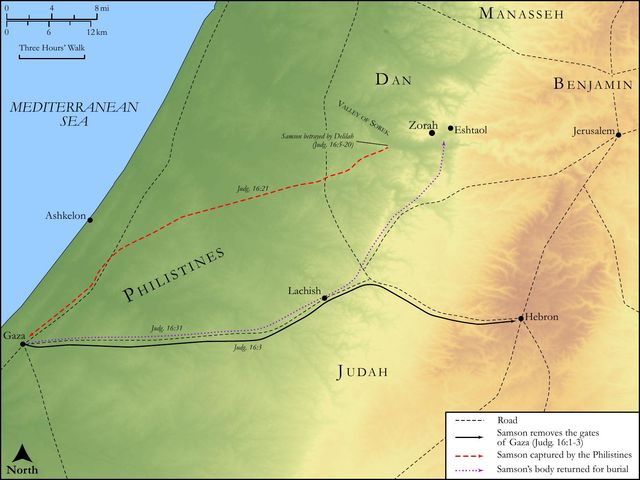
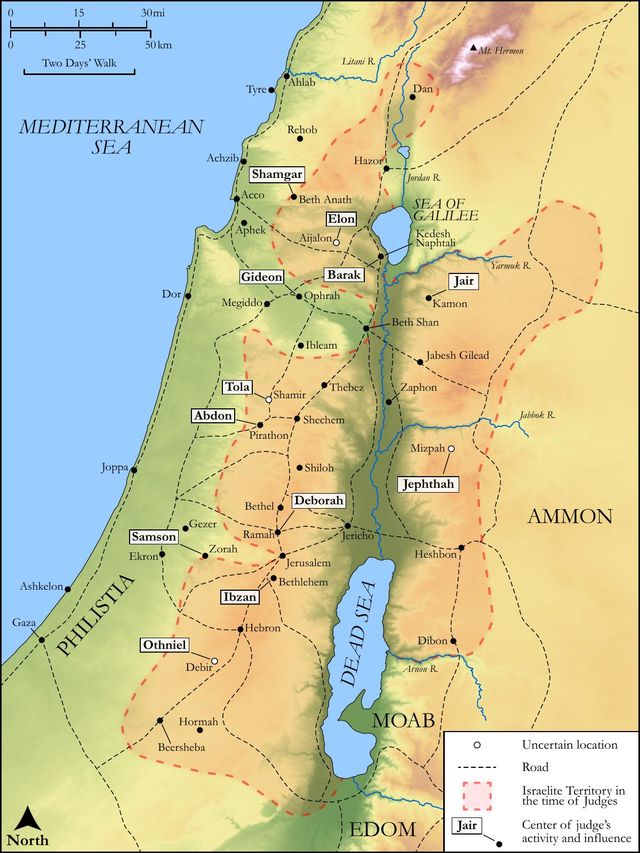
Study this verse
Public-domain commentary
Matthew Henry
From his Commentary on the Whole Bible. Henry comments on passages, not single verses — this entry covers Judges 16:4–17. His three-level outline is real structure in the source text, so it is rendered as structure.
The burnt child dreads the fire; yet Samson, that has more than the strength of a man, in this comes short of the wisdom of a child; for, though he had been more than once brought into the highest degree of mischief and danger by the love of women and lusting after them, yet he would not take warning, but is here again taken in the same snare, and this third time pays for all. Solomon seems to refer especially to this story of Samson when, in his caution against uncleanness, he gives this account of a whorish woman (Pro 7:26), that she hath cast down many wounded, yea, many strong men have been slain by her; and (Pro 6:26) that the adulteress will hunt for the precious life. This bad woman, that brought Samson to ruin, is here named Delilah, an infamous name, and fitly used to express the person, or thing, that by flattery or falsehood brings mischief and destruction on those to whom kindness is pretended. See here,
I.The affection Samson had for Delilah:
he loved her, Jdg 16:4. Some think she was his wife, but then he would have had her home to his own house; others that he courted her to make her his wife; but there is too much reason to suspect that it was a sinful affection he had for her, and that he lived in uncleanness with her. Whether she was an Israelite or a Philistine is not certain. If an Israelite, which is scarcely probable, yet she had the heart of a Philistine.
II.The interest which the lords of the Philistines made with her to betray Samson, Jdg 16:5.
1.That which they told her they designed was to humble him, or afflict him; they would promise not to do him any hurt, only they would disable him not to do them any. And so much conscience it should seem they made of this promise that even then, when he lay ever so much at their mercy, they would not kill him, no, not when the razor that cut his hair might sooner and more easily have cut his throat.
2.That which they desired, in order hereunto, was to know where his great strength lay, and by what means he might be bound. Perhaps they imagined he had some spell or charm which he carried about with him, by the force of which he did these great things, and doubted not but that, if they could get this from him, he would be manageable; and therefore, having had reason enough formerly to know which was his blind side, hoped to find out his riddle a second time by ploughing with his heifer. They engaged Delilah to get it out of him, telling her what a kindness it would be to them, and perhaps assuring her it should not be improved to any real mischief, either to him or her.
3.For this they bid high, promised to give her each of them 1100 pieces of silver, 5500 in all. So many shekels amounted to above 1000l. sterling; with this she was hired to betray one she pretended to love. See what horrid wickedness the love of money is the root of. Our blessed Saviour was thus betrayed by one whom he called friend, and with a kiss too, for filthy lucre. No marvel if those who are unchaste, as Delilah, be unjust; such as lose their honesty in one instance will in another.
III.The arts by which he put her off from time to time, and kept his own counsel a great while.
She asked him where his great strength lay, and whether it were possible for him to be bound and afflicted (Jdg 16:6), pretending that she only desired he would satisfy her curiosity in that one thing, and that she thought it was impossible he should be bound otherwise than by her charms.
1.When she urged him very much, he told her,
(1.)That he might be bound with seven green withs, Jdg 16:7. The experiment was tried (Jdg 16:8), but it would not do: he broke the withs as easily as a thread of tow is broken when it toucheth the fire, Jdg 16:9.
(2.)When she still continued her importunity (Jdg 16:10) he told her that with two new ropes he might be so cramped and hampered that he might be as easily dealt with as any other man, Jdg 16:11. This experiment was tried too, but it failed: the new ropes broke from off his arm like a thread, Jdg 16:12.
(3.)When she still pressed him to communicate the secret, and upbraided him with it as an unkindness that he had bantered her so long, he then told her that the weaving of the seven locks of his head would make a great alteration in him, Jdg 16:13. This came nearer the matter than any thing he had yet said, but it would not do: his strength appeared to be very much in his hair, when, upon the trial of this, purely by the strength of his hair, he carried away the pin of the beam and the web.
2.In the making of all these experiments, it is hard to say whether there appears more of Samson's weakness or Delilah's wickedness.
(1.)Could any thing be more wicked than her restless and unreasonable importunity with him to discover a secret which she knew would endanger his life if ever it were lodged any where but in his own breast? What could be more base and disingenuous, more false and treacherous, than to lay his head in her lap, as one whom she loved, and at the same time to design the betraying of him to those by whom he was mortally hated?
(2.)Could any thing be more weak than for him to continue a parley with one who, he so plainly saw, was aiming to do him a mischief, - that he should lend an ear so long to such an impudent request, that she might know how to do him a mischief, - that when he perceived liers in wait for him in the chamber, and that they were ready to apprehend him if they had been able, he did not immediately quit the chamber, with a resolution never to come into it any more, - nay, that he should again lay his head in that lap out of which he had been so often roused with that alarm, The Philistines are upon thee, Samson? One can hardly imagine a man so perfectly besotted, and void of all consideration, as Samson now was; but whoredom is one of those things that take away the heart. It is hard to say what Samson meant in suffering her to try so often whether she could weaken and afflict him; some think he did not certainly know himself where his strength lay, but, it should seem, he did know, for, when he told her that which would disable him indeed, it is said, He told her all his heart. It seems, he designed to banter her, and to try if he could turn it off with a jest, and to baffle the liers in wait, and make fools of them; but it was very unwise in him that he did not quit the field as soon as ever he perceived that he was not able to keep the ground.
IV.The disclosure he at last made of this great secret; and, if the disclosure proved fatal to him, he must thank himself, who had not power to keep his own counsel from one that manifestly sought his ruin. Surely in vain is the net spread in the sight of any bird, but in Samson's sight is the net spread, and yet he is taken in it. If he had not been blind before the Philistines put out his eyes, he might have seen himself betrayed. Delilah signifies a consumer; she was so to him. Observe,
1.How she teazed him, telling him she would not believe he loved her, unless he would gratify her in this matter (Jdg 16:15): How canst thou say, I love thee, when they heart is not with me? That is, "when thou canst not trust me with the counsels of they heart?" Passionate lovers cannot bear to have their love called in question; they would do any thing rather than their sincerity should be suspected. Here therefore Delilah had this fond fool (excuse me that I call him so) at an advantage. This expostulation is indeed grounded upon a great truth, that those only have our love, not that have our good words or our good wishes, but that have our hearts. That is love without dissimulation; but it is falsehood and flattery in the highest degree to say we love those with whom our hearts are not. How can we say we love either our brother, whom we have seen, or God, whom we have not seen, if our hearts be not with him? She continued many days vexatious to him with her importunity, so that he had no pleasure of his life with her (Jdg 16:16); why then did he not leave her? It was because he was captivated to her by the power of love, falsely so called, but truly lust. This bewitched and perfectly intoxicated him, and by the force of it see,
2.How she conquered him (Jdg 16:17): He told her all his heart. God left him to himself to do this foolish thing, to punish him for indulging himself in the lusts of uncleanness. The angel that foretold his birth said nothing of his great strength, but only that he should be a Nazarite, and particularly that no razor should come upon his head, Jdg 13:5. His consecration to God was to be his strength, for he was to be strengthened according to the glorious power of that Spirit which wrought in him mightily, that his strength, by promise, not by nature, might be a type and figure of the spiritual strength of believers, Col 1:11, Col 1:29. Therefore the badge of his consecration was the pledge of his strength; if he lose the former, he knows he forfeits the latter. "If I be shaven, I shall no longer be a Nazarite, and then my strength will be lost." The making of his bodily strength to depend so much on his hair, which could have no natural influence upon it either one way or other, teaches us to magnify divine institutions, and to expect God's grace, and the continuance of it, only the use of those means of grace wherein he has appointed us to attend upon him, the word, sacraments, and prayer. In these earthen vessels is this treasure.
Historical interpretation
Historical reception
5 surviving comments on this verse. Each one is dated, so this reads as a timeline rather than a list.
Select a marker to jump to its quote. Markers stagger vertically where authors wrote within a few decades of each other.
This having failed, Delilah, as if she had been mocked began with complaints to renew her arts and to require a pledge of his love. Samson, still firm of purpose, intimated to her that, if he were bound by seven ropes which had never been used, he would fall into the hands of the enemy, but this also was in vain. The third time he disclosed part of the secret, and now drawing nearer to his fall, told her that, if the seven locks of his head were unfastened and woven to about a cubit's length, his strength would depart from him. But herein also he deluded those who were plotting against his life.
But last of all the wanton woman complaining that she had been so often deceived, and grieving that her lover deemed her unworthy to be entrusted with his secret, and that under her pretext of succour her treacherous purpose was suspected, won his confidence by her tears. By this means, and because also it was ordained that this man of hitherto unshaken fortitude should fall into calamity, Samson was touched and opened to her his heart. He told her that he possessed within him the power of God, that he was sanctified to the Lord, and that by His command he let his hair grow, and that if it were shorn, he would cease to be a Nazarite, and lose the use of his strength. The Philistines having discoverd through her means the man's weakness, bring her the reward of her perfidy, thus binding her to the commission of the crime.
He was faced with a third battle: he had lost everything he had, that is, his inheritance with his sons; his flesh was enduring wounds; he remained to conquer the temptations of words. No ordinary battle. Adam was deceived by speech, Samson was overcome by words. For nothing penetrates the soul like deceitful speech, and nothing bites as hard as harsh words. Many, after overcoming physical torment, could not endure the harshness of words.
Is that, then, Samson who broke ropes twisted with thongs, and new cords like weak threads? Is that Samson who did not feel the bonds of his hair fastened to the beam, so long as he had the grace of the Spirit? He, I say, after the Spirit of God departed from him, was greatly changed from that Samson Who returned clothed in the spoils of the aliens, but fallen from his greatness on the knees of a woman, caressed and deceived, is shorn of his hair.
Was, then, the hair of his head of such importance that, so long as it remained, his strength should endure unconquered, but when his head was shorn the man should suddenly lose all his strength? It is not so, nor may we think that the hair of his head has such power. There is the hair of religion and faith; the hair of the Nazarite perfect in the Law, consecrated in sparingness and abstinence, with which she (a type of the Church), who poured ointment on the feet of the Lord, wiped the feet of the heavenly Word, for then she knew Christ also after the flesh. That hair it is of which it is said: "Thy hair is as flocks of goats," growing on that head of which it is said: "The head of the man is Christ," and in another place: "His head is as fine gold, and his locks like black pine-trees."
And so, also, in the Gospel our Lord, pointing out that some hairs are seen and known, says: "But even the hairs of your head are all numbered," implying, indeed, acts of spiritual virtues, for God does not take care for our hair. Though, indeed, it is not absurd to believe that literally, seeing that according to His divine Majesty nothing can be hidden from Him.
But what does it profit me, if God Himself knows all my hairs? That rather abounds and profits me, if the watchful witness of good works reward me with the gift of eternal life. And, in fine, Samson himself, declaring that these hairs are not mystical, says: "If I be shorn my strength will depart from me."
Like the famed Samson, whose power lay in the strength of his hair, whose locks were endowed with sacred might, he must throttle and bring low the lion by means of the strong arms of prayers and pluck the sweet fruit of notable victory from its dead mouth.But this triumph must be a lesson to him not to make alliances with foreigners. That woman of another race I interpret as the law of the flesh, so wily with its alluring nets. If this law proves stronger than the law of the mind, it will drag him into the dominion of sin. The evil counsel of its pleasant words weakens with its deceitful guile the male spirit. It blinds the eyes of the mind and shaves the head; it plunders and disarms faith. I would not have our boy a Samson in this respect, becoming involved in a love encounter immediately followed by captivity, enervation and blindness, even though the strong Samson later recovered his strength when his hair grew again. For he was led by the hand from the mill to be the sport of the vaunting enemy, and though physically blind he used his mind’s eye and summoned God to take vengeance. Then, when his hair restored his strength, he brought down that house of the enemy. Once his hands, more powerful than any stone, gripped the pillars of the house in their fierce embrace, the roof collapsed upon him when its props were torn from the earth. Yet even in his death God’s powerful hero involved the foe in destruction, and by a glorious death [he] avenged the disgrace of his life as a slave. He had lived a life of subservience under an exultant foe, but even as he fell he conquered the eclipsed enemy, destroying more thousands at his death than he had killed in his life.
I pray that our son may imitate Samson’s death by his own, that while remaining in the flesh he may conquer that flesh and live for God, subduing the sins of the flesh. I would not have him devoting his heart in enslavement to the flesh’s joys as to the wiles of that criminal woman, to become subsequently the property of the foe, stripped of the strength of grace.
What was the meaning of Samson? If I say he signified Christ, it seems to me that I speak the truth. However, the thought immediately occurs to anyone who reflects: Was Christ overcome by the flattery of a woman? How is Christ understood to have gone in to a prostitute? Then, again, when did Christ have his head uncovered or his hair shaved, himself robbed of courage, bound, blinded and mocked? Watch, faithful soul. Notice why it is Christ, not only what Christ did, but also what he suffered. What did he do? He worked as a strong man and suffered as a weak one. In the one person I understand both qualities; I see the strength of the Son of God and the weakness of the Son of man. Moreover, when the Scriptures extol him, Christ is entire, both head and body. Just as Christ is the head of the church, so the church is his body; and in order that it might not be alone, it is the whole Christ with the head. Now the church contains within itself both strong and weak members. It has some who are fed on bread alone, and others who must still be nourished with milk. There is a further fact which must be admitted: in association at the sacraments, the imparting of baptism or participation at the altar, the church has both just and unjust people. At present the body of Christ is a threshing floor, as you know, but afterwards it will be a granary. While it is a threshing floor, it does not refuse to tolerate chaff, but when the time of storage comes it will separate the wheat from the chaff. Thus, some things Samson did as the head and others as the body, but all in the person of Christ. Inasmuch as Samson performed virtues and miracles, he prefigured Christ, the head of the church. When he acted prudently, he was an image of those who live justly in the church, but when he was overtaken and acted carelessly, he represented those who are sinners in the church. The prostitute whom Samson married is the church which committed fornication with idols before knowing one God, but which Christ afterwards united to himself. However, when she was enlightened and received faith from him, she even merited to learn the mysteries of salvation through him, and he further revealed to her the mysteries of heavenly secrets.
Continue studying Judges 16:10 across the web’s major study libraries — every link below opens this exact verse, chapter, or book on the destination site.
Read & Compare
 BibleGatewayThis verse in more than 200 translations and 70 languages.
 Bible.comThe YouVersion reader — hundreds of translations, reading plans, and highlights.
 ESV.orgCrossway's official English Standard Version reader.
 NET BibleThe NET translation with 60,000+ translators' notes on every rendering decision.
 STEP BibleTyndale House's free study tool — original text, vocabulary, and scholarly resources.
 BibliaLogos Bible Software's free web reader.
 USCCBThe New American Bible (Revised Edition) with the U.S. bishops' study notes.
Commentaries
 BibleHub CommentariesDozens of classic commentaries on this verse, gathered on one page.
 StudyLightMore than 100 commentary sets — the largest collection on the web.
 BibleRefPlain-English commentary on what this verse means, verse by verse.
 Enduring WordDavid Guzik's free commentary on this chapter, widely used by Bible teachers.
 Bible Study ToolsVerse commentary alongside Greek and Hebrew study aids.
Original Language & Research
- BibleHub InterlinearThe verse word by word — original language, transliteration, and English.
- BibleHub LexiconEvery word's original-language definition and Strong's entry.
 Blue Letter BibleDeep-study tools — Strong's numbers, concordance, and word studies.
 SefariaThe Hebrew text with Rashi and centuries of Jewish commentary.
Sermons, Hymns & Audio


TrulyRandomVerse is not affiliated with these sites and doesn’t control their content. They’re linked because they’re genuinely useful.
Summary
Judges 16:10 marks a pivotal and increasingly dangerous moment in the manipulative relationship between Samson and Delilah, revealing Delilah's escalating frustration and unwavering determination to uncover the source of Samson's supernatural strength. Despite Samson's repeated deceptions and mockery, Delilah, driven by the Philistine lords' substantial bribe, relentlessly presses him, highlighting his perilous complacency and the insidious nature of temptation that ultimately leads to his tragic downfall.
Context
ShowHideLiterary Context
This verse is situated within the dramatic climax of the Samson narrative, which dominates the latter portion of the Book of Judges (chapters 13-16). Judges 16 specifically details Samson's entanglement with Delilah, a Philistine woman bribed by the Philistine rulers to discover the secret of his immense strength. Prior to this verse, Samson has already deceived Delilah twice. His first lie involved claiming he could be bound with "seven fresh bowstrings that have not been dried" (Judges 16:7), and his second involved "new ropes that have never been used" (Judges 16:11). In both instances, Delilah, after attempting to subdue him, would cry out, "The Philistines are upon you, Samson!" only for him to effortlessly break his bonds. Judges 16:10 thus represents Delilah's third, more direct, and emotionally charged confrontation, where her exasperation is palpable, yet her resolve to betray him remains unbroken. This repetitive cycle of deception and near-capture builds intense dramatic tension, foreshadowing the inevitable revelation and Samson's ultimate capture and blinding, as described in Judges 16:21.
Historical & Cultural Context
The era of the Judges (approximately 12th-11th centuries BC) was a tumultuous period for Israel, characterized by cycles of disobedience, oppression by foreign powers, and God raising up deliverers. The Philistines, a formidable "Sea Peoples" group who had settled in the southwestern coastal plain of Canaan, were a dominant and technologically advanced (possessing iron weaponry) adversary to Israel during Samson's time. Bribery was a common and effective tactic in political and military intrigue, as evidenced by the Philistine lords' substantial payment to Delilah. Samson's unique status as a Nazirite from birth (Judges 13:5) involved specific vows, including abstinence from grape products, avoiding contact with dead bodies, and not cutting his hair. His uncut hair was not the inherent source of his strength but rather the visible sign of his consecrated relationship with God, through whom his miraculous strength flowed. Delilah's persistent inquiry about "wherewith thou mightest be bound" was a direct attempt to uncover the means to neutralize his power, thereby removing a major obstacle to Philistine dominance over Israel.
Key Themes
ShowHideJudges 16:10 powerfully contributes to several overarching themes within the Book of Judges and the broader biblical narrative. Firstly, it vividly illustrates the Insidious Nature of Temptation and Manipulation. Delilah's relentless questioning, despite Samson's repeated deceptions, demonstrates how temptation, once given an opening, will persistently pursue its goal, adapting its tactics to wear down resistance. Her emotional appeal ("thou hast mocked me") is a classic manipulative ploy. Secondly, the verse highlights the destructive theme of Deception and Betrayal. Both Samson and Delilah are engaged in a perilous dance of dishonesty; Samson's lies mock his divine calling and the sacred trust of his strength, while Delilah's actions are a calculated betrayal for monetary gain. This dynamic underscores the corrosive power of dishonesty in relationships, especially when spiritual integrity is at stake. Thirdly, and most tragically, it reveals Human Weakness and Spiritual Complacency. Despite his extraordinary physical strength and divine anointing, Samson exhibits profound spiritual and emotional vulnerability. His repeated willingness to play with the secret of his strength, even after experiencing the peril of Delilah's attempts, demonstrates a dangerous overconfidence and spiritual blindness, tragically foreshadowing his eventual capture and blinding, as vividly described in Judges 16:21. This verse serves as a microcosm of the spiritual decline within Israel during the Judges period, where even divinely appointed leaders were susceptible to moral compromise and the allure of sin.
Exposition and Analysis
ShowHideKey Word Analysis
ShowHideThe Hebrew verb תָּעַל (hâthal) carries a stronger connotation than mere deception; it implies derision, treating with contempt, or making sport of someone. When Delilah accuses Samson of having "mocked" her, it suggests that he not only lied but also treated her (and, by extension, the serious nature of her inquiry and his own vulnerability) with disdain and levity. This word choice underscores Samson's casual attitude towards the sacred trust of his strength and the dangerous game he was playing, reflecting a profound spiritual carelessness that bordered on irreverence for his divine calling.
The word כָּזָב (kâzâb) is a direct and unambiguous term for falsehood, deceit, or an untruth. Its use here reinforces the clear and established pattern of deliberate deception on Samson's part. It highlights the stark contrast between his outward display of miraculous strength and his internal moral compromise. The repetition of "lies" emphasizes the consistent nature of his deceptive behavior and Delilah's growing exasperation, yet it also underscores her unwavering determination to uncover the truth, as she knows he has repeatedly withheld it.
The verb אָסַר (ʼâçar) means to bind, tie, or imprison. In this context, it signifies the ultimate goal of control, subjugation, and neutralization. Delilah's persistent question about how Samson "mightest be bound" goes far beyond simple curiosity; it is a direct and urgent inquiry into the precise means of rendering him helpless and subject to the Philistines. This word is central to the conflict, representing the Philistines' ultimate objective: to strip Samson of his freedom, his power, and his ability to resist them, thus eliminating their most formidable enemy.
Verse Breakdown
ShowHide"And Delilah said unto Samson,"
This opening clause immediately establishes the ongoing, tense dialogue and highlights Delilah's relentless pursuit. Her direct address indicates a shift from subtle persuasion to a more confrontational and demanding tone, signaling her growing impatience and determination to extract the truth.
"Behold, thou hast mocked me, and told me lies:"
Delilah's accusation is a calculated blend of genuine frustration and manipulative strategy. The interjection "Behold" (הִנֵּה, hinneh) serves to draw Samson's immediate and undivided attention, emphasizing the gravity of her complaint. By accusing him of "mocking" and "lies," she attempts to shame him, leverage his guilt, and perhaps provoke him into revealing the truth out of a desire to appease her or prove his sincerity. This emotional appeal is a key part of her strategy to wear down his resistance and exploit his personal attachment to her.
"now tell me, I pray thee, wherewith thou mightest be bound."
This is the core of Delilah's persistent demand. The phrase "I pray thee" (נָא, na') is an earnest plea, an appeal to his affection, his honor, or his sense of obligation to her. Despite her accusations of mockery and deceit, she immediately reverts to her central objective: discovering the secret of his strength. This demonstrates her unwavering focus and the depth of her commitment to her treacherous mission for the Philistines, highlighting the dangerous complacency of Samson who continues to entertain her inquiries.
Literary Devices
ShowHideJudges 16:10 is rich with Dramatic Irony, as the reader possesses full knowledge of Samson's immense, divinely-granted strength and the sacred nature of his Nazirite vow, while Samson himself appears to treat this divine gift with a dangerous flippancy. His extraordinary physical power is starkly contrasted with his profound spiritual and moral weakness, creating a tragic tension that permeates the narrative. Repetition is a crucial literary device at play, with Delilah's persistent questioning and Samson's repeated deceptions building an inescapable sense of inevitability towards his ultimate downfall. This cyclical pattern emphasizes the relentless nature of temptation and Samson's increasing vulnerability to its allure. The dialogue also employs overt Emotional Manipulation on Delilah's part, as she skillfully uses accusations of mockery and lies to elicit a different, more truthful response from Samson, attempting to shame him into revealing his secret. Furthermore, this scene serves as powerful Foreshadowing, clearly indicating that Samson's continued dalliance with Delilah, despite her obvious treacherous intentions, will inevitably lead to his ultimate betrayal, capture, and the tragic loss of his freedom and sight.
Theological and Thematic Connections
ShowHideJudges 16:10 serves as a potent theological warning about the insidious nature of temptation and the dire consequences of spiritual compromise. Samson's repeated engagement with Delilah's manipulative inquiries, despite knowing her treacherous intentions and the inherent danger, illustrates a perilous complacency and a profound lack of spiritual discernment. This verse highlights how sin, when entertained and not decisively resisted, becomes a relentless pursuer, subtly eroding one's defenses until a critical vulnerability is exposed. The narrative underscores the sobering principle that divine anointing and extraordinary gifts do not negate human responsibility or the perpetual need for vigilance against the schemes of the enemy. Samson's folly reminds us that even those uniquely gifted by God can fall prey to their own desires and the persistent allure of sin, leading to a forfeiture of spiritual power, purpose, and ultimately, freedom. It is a stark reminder of the critical importance of integrity, discernment, and diligently guarding one's heart and sacred commitments, for playing with sin is never a harmless game; it is a spiritual battle with eternal consequences.
Reflection and Application
ShowHideJudges 16:10 offers profound and timeless lessons for contemporary believers navigating the complexities of their spiritual walk. Samson's dangerous game with Delilah vividly illustrates the persistent, cunning, and often emotionally manipulative nature of temptation. Just as Delilah relentlessly probed Samson's weakness, spiritual adversaries will persistently seek out our vulnerabilities, often through seemingly innocuous appeals, emotional blackmail, or the gradual erosion of our boundaries. This verse calls us to cultivate acute spiritual discernment, enabling us to recognize manipulative influences and the subtle, incremental ways sin seeks to gain a foothold in our lives. It serves as a stern warning against complacency and overconfidence in our spiritual strength, reminding us that even great anointing or past victories do not exempt us from the ongoing need for vigilance, integrity, and humble dependence on God. Playing with sin, even in seemingly minor or "harmless" ways, can desensitize us to its true dangers, leading to a gradual erosion of our spiritual defenses and potentially catastrophic consequences for our faith and witness. We are therefore called to actively guard our hearts, uphold our sacred commitments to God, and decisively flee from temptation, rather than entertaining or negotiating with it.
Questions for Reflection
ShowHideFAQ
ShowHideWhy did Samson continue to play this dangerous game with Delilah, even after her repeated betrayals?
ShowHideSamson's continued engagement with Delilah, despite her obvious and repeated treachery, is a perplexing and tragic aspect of his character, revealing a dangerous combination of overconfidence, spiritual complacency, and perhaps a perverse enjoyment of the "game." He may have been so assured of his extraordinary physical strength that he believed he could always escape, profoundly underestimating the spiritual danger and the depth of Delilah's manipulative resolve. His repeated deceptions suggest a lack of integrity and a casual, almost contemptuous, attitude towards his Nazirite vow, which was the covenantal sign and channel of his strength. This spiritual blindness, coupled with his carnal desires and emotional attachment, made him exceptionally vulnerable to Delilah's persistent emotional and physical manipulation. His actions powerfully illustrate the insidious nature of sin, which can gradually dull one's spiritual senses and lead to a tragic underestimation of its ultimate, devastating consequences, as vividly seen in his eventual capture, blinding, and humiliation in Judges 16:20-21.
What does Delilah's persistence in this verse teach us about the nature of temptation?
ShowHideDelilah's relentless persistence in Judges 16:10 provides a powerful and sobering illustration of the nature of temptation. It teaches us that temptation is often not a singular, isolated event but a persistent, adaptive, and cunning force. Like Delilah, temptation will not easily give up; it will probe, accuse, manipulate, and wear down resistance over time, often through emotional appeals or by exploiting our perceived weaknesses. It targets our vulnerabilities, exploits our emotional attachments, and can even use our own complacency or overconfidence against us. Just as Delilah changed her tactics from simple requests to emotional accusations ("thou hast mocked me"), temptation often shifts its approach and intensity when initial attempts fail. This highlights the crucial need for constant vigilance, spiritual sobriety, and a firm, unwavering resolve in our faith, as emphasized in passages like 1 Peter 5:8, which warns believers to be sober and watchful because the devil prowls like a roaring lion, seeking whom he may devour.
Christ-Centered Fulfillment
ShowHideJudges 16:10, with Samson's tragic display of spiritual weakness, dangerous complacency, and susceptibility to persistent temptation, stands in stark and illuminating contrast to the perfect obedience and unwavering resolve of Jesus Christ. Samson, despite being uniquely endowed with supernatural strength for Israel's deliverance, repeatedly played with sin, mocked sacred commitments, and ultimately succumbed to the relentless allure of temptation, leading to his own downfall and a temporary defeat for Israel. His failure to guard his heart and his divine calling underscores humanity's desperate need for a deliverer who is not only strong but also perfectly righteous, utterly pure, and unyielding to any form of temptation. Jesus, the true and ultimate Deliverer, faced temptation in its most intense and insidious forms, as powerfully demonstrated in His wilderness encounter with Satan (Matthew 4:1-11), yet He never wavered, never mocked His divine mission, and never succumbed to lies or manipulation. Unlike Samson, whose strength was tied to a vow he tragically broke, Christ's power was inherent in His divine nature and expressed through His perfect, unbroken obedience to the Father, culminating in His ultimate sacrifice on the cross. Through His death and resurrection, Christ perfectly triumphed over the powers of sin, death, and the devil, truly binding their authority (Colossians 2:15). Where Samson failed to fully deliver his people due to his own moral compromise, Christ, the Lamb of God, perfectly fulfilled His mission, taking away the sin of the world and offering true freedom, spiritual strength, and eternal life to all who believe in Him (John 1:29).