


Judges 16:11
Bible text: King James Version (1769 Blayney text) · Public domain
Bible text: Berean Standard Bible · Public domain
Bible text: American Standard Version (1901) · Public domain
Bible text: World English Bible, Messianic edition · Public domain
Bible text: Geneva Bible (1599) · Public domain
Bible text: Young's Literal Translation · Public domain
- וַיֹּאמֶרvai·Yo·merand he saidH559Conj-w ¦ V-Qal-ConsecImperf-3msVerb Qal Consecutive Imperfect 3rd Singular Masculineוַandיֹּאמֶרhe said
- אֵלֶיהָ'e·Lei·hato herH413Prep ¦ 3fsPreposition Definiteאֵלֶיtoהָher
- אִם'im<if>H518PrtParticle Conditional
- אָסוֹר'a·Sorcertainly [if] <to bind>H631V-Qal-InfAbsVerb Qal Infinitive Absolute
- יַאַסְרוּנִיya·'as·Ru·nithey will bind meH631V-Qal-Imperf-3mp ¦ 1csVerb Qal Imperfect 3rd Plural Masculineיַאַסְרוּthey will bindנִיme
- בַּעֲבֹתִיםba·'a·vo·Timwith ropesH5688Prep-b ¦ N-mpNoun Plural Masculine Absoluteבַּwithעֲבֹתִיםropes
- חֲדָשִׁיםcha·da·ShimnewH2319Adj-mpAdjective Plural Masculine Absolute
- אֲשֶׁר'a·SherwhichH834RelParticle Relative
- לֹאlo'notH3808NegParticle Negative
- נַעֲשָׂהna·'a·Sahit has been doneH6213V-Niphal-Perf-3msVerb Niphal Perfect 3rd Singular Masculine
- בָהֶםva·Hemwith <the> themPrep-b ¦ 3mpSuffix Personal 3rd Plural Masculineבָwith <the>הֶםthem
- מְלָאכָהme·la·KhahworkH4399N-fsNoun Singular Feminine Absolute
- וְחָלִיתִיve·cha·Li·tiand I will be weakH2470Conj-w ¦ V-Qal-ConsecPerf-1csVerb Qal Consecutive Perfect 1st Singular common genderוְandחָלִיתִיI will be weak
- וְהָיִיתִיve·ha·Yi·tiand I will beH1961Conj-w ¦ V-Qal-ConsecPerf-1csVerb Qal Consecutive Perfect 1st Singular common genderוְandהָיִיתִיI will be
- כְּאַחַדke·'a·Chadlike one ofH259Prep-k ¦ N-fscNoun Singular Feminine Constructכְּlikeאַחַדone of
- הָאָדָםha·'a·Dam<the> humankindH120Art ¦ N-msNoun Singular Masculine Absoluteהָ<the>אָדָםhumankind
English is a literal word-by-word gloss of the Hebrew, not the KJV's wording. Why?
This is the original text the KJV's translators worked from — each Hebrew word with its own literal English meaning in this verse, prepared by scholars at Tyndale House, Cambridge. The KJV translates whole sentences, not word by word, so its wording differs: one Hebrew word can become several English words, and the KJV may choose “the LORD” where the gloss reads “Yahweh”. Both are faithful — they answer different questions. For the KJV's own rendering, switch to the KJV text.
Details
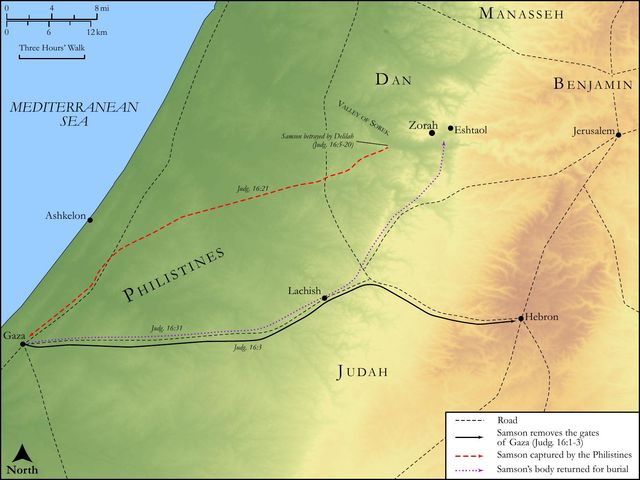
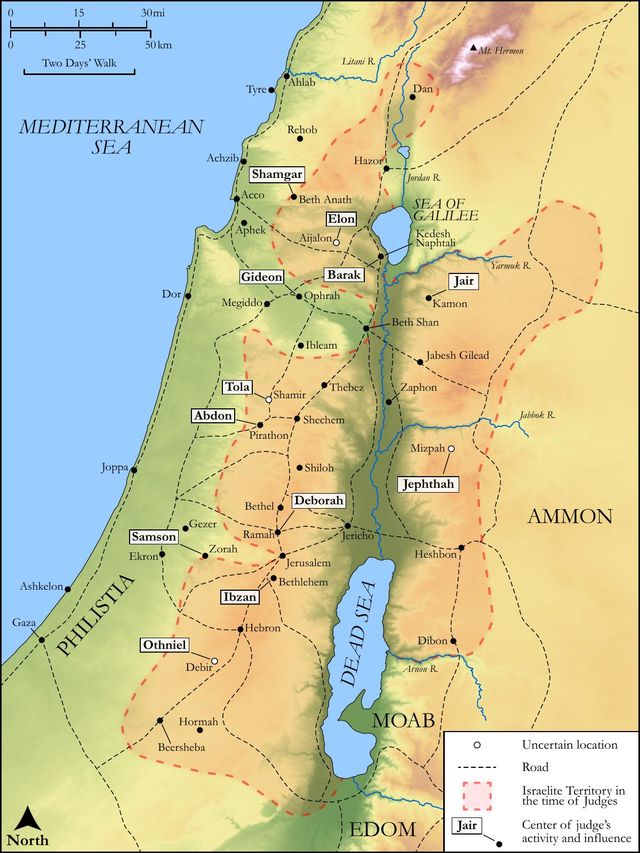
See on the biblical-era maps
Study this verse
Public-domain commentary
Matthew Henry
From his Commentary on the Whole Bible. Henry comments on passages, not single verses — this entry covers Judges 16:4–17. His three-level outline is real structure in the source text, so it is rendered as structure.
The burnt child dreads the fire; yet Samson, that has more than the strength of a man, in this comes short of the wisdom of a child; for, though he had been more than once brought into the highest degree of mischief and danger by the love of women and lusting after them, yet he would not take warning, but is here again taken in the same snare, and this third time pays for all. Solomon seems to refer especially to this story of Samson when, in his caution against uncleanness, he gives this account of a whorish woman (Pro 7:26), that she hath cast down many wounded, yea, many strong men have been slain by her; and (Pro 6:26) that the adulteress will hunt for the precious life. This bad woman, that brought Samson to ruin, is here named Delilah, an infamous name, and fitly used to express the person, or thing, that by flattery or falsehood brings mischief and destruction on those to whom kindness is pretended. See here,
I.The affection Samson had for Delilah:
he loved her, Jdg 16:4. Some think she was his wife, but then he would have had her home to his own house; others that he courted her to make her his wife; but there is too much reason to suspect that it was a sinful affection he had for her, and that he lived in uncleanness with her. Whether she was an Israelite or a Philistine is not certain. If an Israelite, which is scarcely probable, yet she had the heart of a Philistine.
II.The interest which the lords of the Philistines made with her to betray Samson, Jdg 16:5.
1.That which they told her they designed was to humble him, or afflict him; they would promise not to do him any hurt, only they would disable him not to do them any. And so much conscience it should seem they made of this promise that even then, when he lay ever so much at their mercy, they would not kill him, no, not when the razor that cut his hair might sooner and more easily have cut his throat.
2.That which they desired, in order hereunto, was to know where his great strength lay, and by what means he might be bound. Perhaps they imagined he had some spell or charm which he carried about with him, by the force of which he did these great things, and doubted not but that, if they could get this from him, he would be manageable; and therefore, having had reason enough formerly to know which was his blind side, hoped to find out his riddle a second time by ploughing with his heifer. They engaged Delilah to get it out of him, telling her what a kindness it would be to them, and perhaps assuring her it should not be improved to any real mischief, either to him or her.
3.For this they bid high, promised to give her each of them 1100 pieces of silver, 5500 in all. So many shekels amounted to above 1000l. sterling; with this she was hired to betray one she pretended to love. See what horrid wickedness the love of money is the root of. Our blessed Saviour was thus betrayed by one whom he called friend, and with a kiss too, for filthy lucre. No marvel if those who are unchaste, as Delilah, be unjust; such as lose their honesty in one instance will in another.
III.The arts by which he put her off from time to time, and kept his own counsel a great while.
She asked him where his great strength lay, and whether it were possible for him to be bound and afflicted (Jdg 16:6), pretending that she only desired he would satisfy her curiosity in that one thing, and that she thought it was impossible he should be bound otherwise than by her charms.
1.When she urged him very much, he told her,
(1.)That he might be bound with seven green withs, Jdg 16:7. The experiment was tried (Jdg 16:8), but it would not do: he broke the withs as easily as a thread of tow is broken when it toucheth the fire, Jdg 16:9.
(2.)When she still continued her importunity (Jdg 16:10) he told her that with two new ropes he might be so cramped and hampered that he might be as easily dealt with as any other man, Jdg 16:11. This experiment was tried too, but it failed: the new ropes broke from off his arm like a thread, Jdg 16:12.
(3.)When she still pressed him to communicate the secret, and upbraided him with it as an unkindness that he had bantered her so long, he then told her that the weaving of the seven locks of his head would make a great alteration in him, Jdg 16:13. This came nearer the matter than any thing he had yet said, but it would not do: his strength appeared to be very much in his hair, when, upon the trial of this, purely by the strength of his hair, he carried away the pin of the beam and the web.
2.In the making of all these experiments, it is hard to say whether there appears more of Samson's weakness or Delilah's wickedness.
(1.)Could any thing be more wicked than her restless and unreasonable importunity with him to discover a secret which she knew would endanger his life if ever it were lodged any where but in his own breast? What could be more base and disingenuous, more false and treacherous, than to lay his head in her lap, as one whom she loved, and at the same time to design the betraying of him to those by whom he was mortally hated?
(2.)Could any thing be more weak than for him to continue a parley with one who, he so plainly saw, was aiming to do him a mischief, - that he should lend an ear so long to such an impudent request, that she might know how to do him a mischief, - that when he perceived liers in wait for him in the chamber, and that they were ready to apprehend him if they had been able, he did not immediately quit the chamber, with a resolution never to come into it any more, - nay, that he should again lay his head in that lap out of which he had been so often roused with that alarm, The Philistines are upon thee, Samson? One can hardly imagine a man so perfectly besotted, and void of all consideration, as Samson now was; but whoredom is one of those things that take away the heart. It is hard to say what Samson meant in suffering her to try so often whether she could weaken and afflict him; some think he did not certainly know himself where his strength lay, but, it should seem, he did know, for, when he told her that which would disable him indeed, it is said, He told her all his heart. It seems, he designed to banter her, and to try if he could turn it off with a jest, and to baffle the liers in wait, and make fools of them; but it was very unwise in him that he did not quit the field as soon as ever he perceived that he was not able to keep the ground.
IV.The disclosure he at last made of this great secret; and, if the disclosure proved fatal to him, he must thank himself, who had not power to keep his own counsel from one that manifestly sought his ruin. Surely in vain is the net spread in the sight of any bird, but in Samson's sight is the net spread, and yet he is taken in it. If he had not been blind before the Philistines put out his eyes, he might have seen himself betrayed. Delilah signifies a consumer; she was so to him. Observe,
1.How she teazed him, telling him she would not believe he loved her, unless he would gratify her in this matter (Jdg 16:15): How canst thou say, I love thee, when they heart is not with me? That is, "when thou canst not trust me with the counsels of they heart?" Passionate lovers cannot bear to have their love called in question; they would do any thing rather than their sincerity should be suspected. Here therefore Delilah had this fond fool (excuse me that I call him so) at an advantage. This expostulation is indeed grounded upon a great truth, that those only have our love, not that have our good words or our good wishes, but that have our hearts. That is love without dissimulation; but it is falsehood and flattery in the highest degree to say we love those with whom our hearts are not. How can we say we love either our brother, whom we have seen, or God, whom we have not seen, if our hearts be not with him? She continued many days vexatious to him with her importunity, so that he had no pleasure of his life with her (Jdg 16:16); why then did he not leave her? It was because he was captivated to her by the power of love, falsely so called, but truly lust. This bewitched and perfectly intoxicated him, and by the force of it see,
2.How she conquered him (Jdg 16:17): He told her all his heart. God left him to himself to do this foolish thing, to punish him for indulging himself in the lusts of uncleanness. The angel that foretold his birth said nothing of his great strength, but only that he should be a Nazarite, and particularly that no razor should come upon his head, Jdg 13:5. His consecration to God was to be his strength, for he was to be strengthened according to the glorious power of that Spirit which wrought in him mightily, that his strength, by promise, not by nature, might be a type and figure of the spiritual strength of believers, Col 1:11, Col 1:29. Therefore the badge of his consecration was the pledge of his strength; if he lose the former, he knows he forfeits the latter. "If I be shaven, I shall no longer be a Nazarite, and then my strength will be lost." The making of his bodily strength to depend so much on his hair, which could have no natural influence upon it either one way or other, teaches us to magnify divine institutions, and to expect God's grace, and the continuance of it, only the use of those means of grace wherein he has appointed us to attend upon him, the word, sacraments, and prayer. In these earthen vessels is this treasure.
Historical interpretation
Historical reception
5 surviving comments on this verse. Each one is dated, so this reads as a timeline rather than a list.
Select a marker to jump to its quote. Markers stagger vertically where authors wrote within a few decades of each other.
This having failed, Delilah, as if she had been mocked began with complaints to renew her arts and to require a pledge of his love. Samson, still firm of purpose, intimated to her that, if he were bound by seven ropes which had never been used, he would fall into the hands of the enemy, but this also was in vain. The third time he disclosed part of the secret, and now drawing nearer to his fall, told her that, if the seven locks of his head were unfastened and woven to about a cubit's length, his strength would depart from him. But herein also he deluded those who were plotting against his life.
But last of all the wanton woman complaining that she had been so often deceived, and grieving that her lover deemed her unworthy to be entrusted with his secret, and that under her pretext of succour her treacherous purpose was suspected, won his confidence by her tears. By this means, and because also it was ordained that this man of hitherto unshaken fortitude should fall into calamity, Samson was touched and opened to her his heart. He told her that he possessed within him the power of God, that he was sanctified to the Lord, and that by His command he let his hair grow, and that if it were shorn, he would cease to be a Nazarite, and lose the use of his strength. The Philistines having discoverd through her means the man's weakness, bring her the reward of her perfidy, thus binding her to the commission of the crime.
He was faced with a third battle: he had lost everything he had, that is, his inheritance with his sons; his flesh was enduring wounds; he remained to conquer the temptations of words. No ordinary battle. Adam was deceived by speech, Samson was overcome by words. For nothing penetrates the soul like deceitful speech, and nothing bites as hard as harsh words. Many, after overcoming physical torment, could not endure the harshness of words.
Is that, then, Samson who broke ropes twisted with thongs, and new cords like weak threads? Is that Samson who did not feel the bonds of his hair fastened to the beam, so long as he had the grace of the Spirit? He, I say, after the Spirit of God departed from him, was greatly changed from that Samson Who returned clothed in the spoils of the aliens, but fallen from his greatness on the knees of a woman, caressed and deceived, is shorn of his hair.
Was, then, the hair of his head of such importance that, so long as it remained, his strength should endure unconquered, but when his head was shorn the man should suddenly lose all his strength? It is not so, nor may we think that the hair of his head has such power. There is the hair of religion and faith; the hair of the Nazarite perfect in the Law, consecrated in sparingness and abstinence, with which she (a type of the Church), who poured ointment on the feet of the Lord, wiped the feet of the heavenly Word, for then she knew Christ also after the flesh. That hair it is of which it is said: "Thy hair is as flocks of goats," growing on that head of which it is said: "The head of the man is Christ," and in another place: "His head is as fine gold, and his locks like black pine-trees."
And so, also, in the Gospel our Lord, pointing out that some hairs are seen and known, says: "But even the hairs of your head are all numbered," implying, indeed, acts of spiritual virtues, for God does not take care for our hair. Though, indeed, it is not absurd to believe that literally, seeing that according to His divine Majesty nothing can be hidden from Him.
But what does it profit me, if God Himself knows all my hairs? That rather abounds and profits me, if the watchful witness of good works reward me with the gift of eternal life. And, in fine, Samson himself, declaring that these hairs are not mystical, says: "If I be shorn my strength will depart from me."
Like the famed Samson, whose power lay in the strength of his hair, whose locks were endowed with sacred might, he must throttle and bring low the lion by means of the strong arms of prayers and pluck the sweet fruit of notable victory from its dead mouth.But this triumph must be a lesson to him not to make alliances with foreigners. That woman of another race I interpret as the law of the flesh, so wily with its alluring nets. If this law proves stronger than the law of the mind, it will drag him into the dominion of sin. The evil counsel of its pleasant words weakens with its deceitful guile the male spirit. It blinds the eyes of the mind and shaves the head; it plunders and disarms faith. I would not have our boy a Samson in this respect, becoming involved in a love encounter immediately followed by captivity, enervation and blindness, even though the strong Samson later recovered his strength when his hair grew again. For he was led by the hand from the mill to be the sport of the vaunting enemy, and though physically blind he used his mind’s eye and summoned God to take vengeance. Then, when his hair restored his strength, he brought down that house of the enemy. Once his hands, more powerful than any stone, gripped the pillars of the house in their fierce embrace, the roof collapsed upon him when its props were torn from the earth. Yet even in his death God’s powerful hero involved the foe in destruction, and by a glorious death [he] avenged the disgrace of his life as a slave. He had lived a life of subservience under an exultant foe, but even as he fell he conquered the eclipsed enemy, destroying more thousands at his death than he had killed in his life.
I pray that our son may imitate Samson’s death by his own, that while remaining in the flesh he may conquer that flesh and live for God, subduing the sins of the flesh. I would not have him devoting his heart in enslavement to the flesh’s joys as to the wiles of that criminal woman, to become subsequently the property of the foe, stripped of the strength of grace.
What was the meaning of Samson? If I say he signified Christ, it seems to me that I speak the truth. However, the thought immediately occurs to anyone who reflects: Was Christ overcome by the flattery of a woman? How is Christ understood to have gone in to a prostitute? Then, again, when did Christ have his head uncovered or his hair shaved, himself robbed of courage, bound, blinded and mocked? Watch, faithful soul. Notice why it is Christ, not only what Christ did, but also what he suffered. What did he do? He worked as a strong man and suffered as a weak one. In the one person I understand both qualities; I see the strength of the Son of God and the weakness of the Son of man. Moreover, when the Scriptures extol him, Christ is entire, both head and body. Just as Christ is the head of the church, so the church is his body; and in order that it might not be alone, it is the whole Christ with the head. Now the church contains within itself both strong and weak members. It has some who are fed on bread alone, and others who must still be nourished with milk. There is a further fact which must be admitted: in association at the sacraments, the imparting of baptism or participation at the altar, the church has both just and unjust people. At present the body of Christ is a threshing floor, as you know, but afterwards it will be a granary. While it is a threshing floor, it does not refuse to tolerate chaff, but when the time of storage comes it will separate the wheat from the chaff. Thus, some things Samson did as the head and others as the body, but all in the person of Christ. Inasmuch as Samson performed virtues and miracles, he prefigured Christ, the head of the church. When he acted prudently, he was an image of those who live justly in the church, but when he was overtaken and acted carelessly, he represented those who are sinners in the church. The prostitute whom Samson married is the church which committed fornication with idols before knowing one God, but which Christ afterwards united to himself. However, when she was enlightened and received faith from him, she even merited to learn the mysteries of salvation through him, and he further revealed to her the mysteries of heavenly secrets.
Continue studying Judges 16:11 across the web’s major study libraries — every link below opens this exact verse, chapter, or book on the destination site.
Read & Compare
 BibleGatewayThis verse in more than 200 translations and 70 languages.
 Bible.comThe YouVersion reader — hundreds of translations, reading plans, and highlights.
 ESV.orgCrossway's official English Standard Version reader.
 NET BibleThe NET translation with 60,000+ translators' notes on every rendering decision.
 STEP BibleTyndale House's free study tool — original text, vocabulary, and scholarly resources.
 BibliaLogos Bible Software's free web reader.
 USCCBThe New American Bible (Revised Edition) with the U.S. bishops' study notes.
Commentaries
 BibleHub CommentariesDozens of classic commentaries on this verse, gathered on one page.
 StudyLightMore than 100 commentary sets — the largest collection on the web.
 BibleRefPlain-English commentary on what this verse means, verse by verse.
 Enduring WordDavid Guzik's free commentary on this chapter, widely used by Bible teachers.
 Bible Study ToolsVerse commentary alongside Greek and Hebrew study aids.
Original Language & Research
- BibleHub InterlinearThe verse word by word — original language, transliteration, and English.
- BibleHub LexiconEvery word's original-language definition and Strong's entry.
 Blue Letter BibleDeep-study tools — Strong's numbers, concordance, and word studies.
 SefariaThe Hebrew text with Rashi and centuries of Jewish commentary.
Sermons, Hymns & Audio


TrulyRandomVerse is not affiliated with these sites and doesn’t control their content. They’re linked because they’re genuinely useful.
Summary
Judges 16:11 presents Samson's second deceptive response to Delilah concerning the secret of his extraordinary strength. He falsely claims that if bound tightly with "new ropes that never were occupied," he would become as weak as any ordinary man. This verse underscores Samson's perilous overconfidence and his dangerous game of deception, as he continues to toy with the persistent temptation and betrayal orchestrated by Delilah and the Philistines, setting the stage for his eventual downfall.
Context
ShowHideLiterary Context
Judges 16:11 is deeply embedded within the dramatic and tragic narrative of Samson and Delilah, following her initial failed attempt to uncover the source of Samson's superhuman strength. In the preceding verses, Delilah, under immense pressure and financial inducement from the Philistine lords, first entices Samson, who fabricates a lie, asserting that he would be weakened if bound with seven fresh bowstrings that had not been dried (Judges 16:6-7). Delilah, after testing this false premise and finding it ineffective (Judges 16:8-9), immediately presses him again for the truth. Judges 16:11 represents Samson's second fabricated answer, escalating the dangerous game of cat and mouse. This pattern of deception and testing continues through a third lie (Judges 16:13-14) before Samson finally reveals his true weakness, leading directly to his capture, blinding, and humiliation (Judges 16:15-21). The verse thus functions as a critical, incremental step in the unraveling of Samson's life, demonstrating his gradual surrender to temptation and his tragic underestimation of Delilah's relentless resolve.
Historical & Cultural Context
The book of Judges chronicles a tumultuous period in Israelite history characterized by a cyclical pattern of apostasy, oppression by foreign powers, cries for deliverance, and the raising of judges by God to rescue His people. Samson's story, set against the backdrop of Philistine domination, reflects the constant tension and conflict between Israel and its powerful, technologically superior neighbors. The Philistines, a maritime people who settled in the coastal plain of Canaan, were a formidable military and political force, often subjugating the Israelites and posing a significant threat to their independence. Delilah, likely a Philistine woman or at least aligned with their interests, acts as an agent of the Philistine lords, who offer her a substantial sum of money to betray Samson (Judges 16:5). This cultural context underscores the high stakes involved: Samson was a divinely appointed deliverer for Israel, and his capture was a strategic victory for the Philistines, aimed at neutralizing a significant threat to their hegemony. The use of ropes for binding was a common and practical method for restraining captives in ancient times, and Samson's repeated claims about specific types of bonds highlight the Philistines' persistent and practical attempts to subdue him.
Key Themes
ShowHideJudges 16:11 contributes to several overarching themes evident throughout the book of Judges and the broader biblical narrative. Firstly, it powerfully illustrates the theme of deception and temptation. Samson's repeated engagement in this perilous game, despite his divine calling and the clear danger, highlights the insidious nature of persistent temptation and the dangers of playing with sin rather than fleeing from it, a concept echoed in James 1:14-15. Secondly, the verse underscores misplaced confidence. Samson's actions suggest a dangerous overconfidence in his own invincibility or his ability to outwit Delilah, rather than relying on God's wisdom and protection. This hubris ultimately leads to his downfall, serving as a cautionary tale against self-reliance and spiritual arrogance. Thirdly, it speaks to the nature of divine strength. Samson's strength was not inherent but a miraculous, supernatural endowment, tied to his Nazarite vow and the Spirit of the Lord. His statement, "then shall I be weak, and be as another man," foreshadows the loss of this supernatural ability, reducing him to ordinary human limits and contrasting sharply with his previous feats of divine power, such as the slaying of a thousand Philistines with a jawbone (as seen in Judges 15:15).
Exposition and Analysis
ShowHideKey Word Analysis
ShowHideThis adjective (חָדָשׁ, châdâsh, appearing in the plural form חֲדָשִׁים, ḥăḏāšîm in the verse) emphasizes the pristine, unused, and therefore supposedly strongest condition of the ropes. Samson specifies "new ropes that never were occupied," implying that their strength would be uncompromised by prior use or wear. This detail adds a layer of superficial plausibility to his lie, suggesting a very specific and seemingly robust condition under which his strength would fail. Ironically, the true "newness" required for his strength was the unbroken nature of his Nazarite vow, not the physical state of the binding material.
The verb (חָלָה, châlâh, appearing as וְחָלִיתִי, wəḥālîṯî in the verse) here means "to be weak," "to be sick," or "to be feeble." Samson's declaration, "then shall I be weak," indicates a complete loss of his supernatural power, reducing him to a state of utter vulnerability, indistinguishable from any ordinary person. This word choice highlights the dramatic contrast between his divinely empowered state and the common human condition, underscoring the profound nature of the strength he possessed and the catastrophic implications of its potential loss.
This noun (אָדָם, ʾāḏām) refers to a human being, an individual, or mankind in general. Samson's declaration that he would be "as another man" (כְּאַחַד הָאָדָם, kəʾaḥaḏ hāʾāḏām) signifies a return to a state of ordinary human vulnerability and limitation, stripped of his divinely endowed strength. It starkly contrasts his previous superhuman abilities, emphasizing the profound nature of the loss he describes. The phrase highlights the dramatic reduction from a unique, empowered individual to a common, unexceptional human being, underscoring the spiritual and physical consequences of his potential weakening.
Verse Breakdown
ShowHide"And he said unto her,"
This opening clause indicates Samson's direct response to Delilah's renewed and relentless interrogation. It highlights the ongoing, intimate, yet deeply deceptive dialogue between them, emphasizing Samson's active and willing participation in this dangerous game. His continued engagement in further deception, rather than severing ties or revealing the truth, demonstrates his persistent entanglement with temptation and his underestimation of the grave spiritual and physical peril he faces.
"If they bind me fast with new ropes that never were occupied,"
This is Samson's second specific, yet entirely false, condition for losing his strength. The phrase "new ropes that never were occupied" (חֲבָלִים חֲדָשִׁים אֲשֶׁר לֹא־נַעֲשָׂה בָהֶם מְלָאכָה, ḥăḇālîm ḥăḏāšîm ʾăšer lōʾ-naʿăśâ bāhem məlāʾḵâ) specifies ropes that are not merely new but have never been used for any work, implying maximum tensile strength and integrity. This elaborate detail makes the lie seem more credible, yet it is another test of Delilah's credulity and persistence, as Samson continues to underestimate her resolve and the Philistines' desperation to subdue him.
"then shall I be weak, and be as another man."
This concluding clause describes the supposed outcome of the binding. Samson claims he would become "weak" (וְחָלִיתִי, wəḥālîṯî), losing his extraordinary, divinely empowered strength, and be reduced to the state of "another man" (וְהָיִיתִי כְּאַחַד הָאָדָם, wəhāyîṯî kəʾaḥaḏ hāʾāḏām). This phrase underscores the supernatural nature of his strength; without it, he is merely human, subject to the same limitations and vulnerabilities as anyone else. It also serves as a poignant foreshadowing of his eventual, true loss of strength, when he indeed becomes as "another man" after his hair is cut, unable to resist his enemies and suffering profound humiliation.
Literary Devices
ShowHideJudges 16:11 employs several literary devices to enhance its narrative impact and thematic depth. Irony is profoundly present, as Samson, the divinely empowered deliverer of Israel, repeatedly lies about the source of his strength, using plausible but ultimately false conditions for his weakness. The irony deepens when considering that his true vulnerability lay not in external bonds but in his internal spiritual compromise and the eventual revelation of his Nazarite vow's secret. His statement, "then shall I be weak, and be as another man," also functions as a powerful instance of foreshadowing. It precisely describes the tragic fate that awaits him when Delilah finally discovers his true secret and his hair is shorn, rendering him truly "weak" and "as another man" in the hands of his enemies. Furthermore, the recurring motif of binding with different materials (fresh bowstrings, new ropes, and later, hair woven into a loom) functions as symbolism, representing the escalating attempts to control and subdue Samson, mirroring his own increasing entanglement in sin and his diminishing spiritual freedom.
Theological and Thematic Connections
ShowHideJudges 16:11, as an integral part of Samson's tragic narrative, offers profound theological insights into the nature of divine gifting, human responsibility, and the perils of spiritual compromise. Samson's repeated flirtation with temptation and his casual disregard for the sacred trust of his Nazarite vow underscore the principle that even extraordinary divine endowments do not negate the need for personal obedience and vigilance against sin. His overconfidence in his physical strength and cunning blinded him to the spiritual dangers he faced, ultimately leading to the loss of his anointing and his capture. The passage serves as a stark reminder that true strength, particularly spiritual strength, is not a static possession but is maintained through faithful adherence to God's will and a humble reliance on His power, not our own. The narrative warns against the deceptive nature of sin, which often appears harmless or controllable, but relentlessly seeks to erode one's spiritual foundations and lead to devastating consequences.
Reflection and Application
ShowHideSamson's story, particularly his actions in Judges 16:11, serves as a powerful and enduring cautionary tale for believers today. His repeated engagement with temptation, his deceptive games, and his gradual compromise highlight the insidious nature of sin and its ability to erode even the most profound divine anointing. We learn that spiritual strength is not an automatic, unlosable possession, but rather a dynamic gift that requires constant vigilance, obedience, and a humble reliance on God. To "play with sin" or to underestimate the persistence and cunning of temptation, as Samson did with Delilah, is to invite spiritual weakening and potentially devastating consequences. This narrative compels us to examine our own lives: where might we be tolerating small compromises, overestimating our own resilience, or failing to flee from situations that threaten our spiritual integrity? True spiritual power comes not from our own abilities or cleverness, but from an unwavering commitment to God's will and a recognition that His strength is made perfect in our weakness.
Questions for Reflection
ShowHideFAQ
ShowHideWhy did Samson keep lying to Delilah instead of simply leaving her?
ShowHideSamson's repeated lies and his continued engagement with Delilah, despite the obvious danger, reveal a complex mix of overconfidence, arrogance, and perhaps a fatal attraction. He was a man of immense physical strength but significant moral weakness. He likely believed he was invincible and could outwit Delilah, enjoying the thrill of the dangerous game without truly believing she could uncover his secret. This pattern reflects a common human tendency to underestimate the power of persistent temptation and the destructive nature of sin. His actions demonstrate a profound lack of spiritual discernment and a disregard for his divine calling, ultimately leading him to believe he could control the situation, even as he was being drawn deeper into a trap. His failure to flee from temptation, as encouraged in 1 Corinthians 6:18, ultimately proved to be his undoing.
Christ-Centered Fulfillment
ShowHideWhile Samson's story is fraught with human failure and tragic compromise, Judges 16:11, read through a Christ-centered lens, offers profound insights into the nature of true strength and deliverance. Samson, as a judge, was a type of deliverer for Israel, yet his strength was external and tied to a vow he ultimately broke. His declaration, "then shall I be weak, and be as another man," foreshadows his physical humiliation and the loss of his supernatural power, reducing him to an ordinary, vulnerable human. This contrasts sharply with Jesus Christ, the ultimate Deliverer, whose strength was not merely physical but divine, inherent, and perfect. Christ willingly "made himself nothing, taking the very nature of a servant, being made in human likeness" (Philippians 2:7), truly becoming "as another man" in His incarnation, yet without sin. He allowed Himself to be bound, mocked, and crucified, not because of a weakness or broken vow, but out of perfect obedience and boundless love, willingly laying down His life for the redemption of humanity (John 10:18). Unlike Samson, whose strength was restored for a final, self-sacrificial act in death, Christ's power was demonstrated supremely in His resurrection, conquering death and sin once and for all (Romans 1:4). Thus, Samson's flawed strength and eventual weakness point to the perfect, sinless strength of Christ, who truly became weak for our sake so that we might become strong in Him (2 Corinthians 13:4), enabling us to live in His resurrected power.