


Judges 16:8
Bible text: King James Version (1769 Blayney text) · Public domain
Bible text: Berean Standard Bible · Public domain
Bible text: American Standard Version (1901) · Public domain
Bible text: World English Bible, Messianic edition · Public domain
Bible text: Geneva Bible (1599) · Public domain
Bible text: Young's Literal Translation · Public domain
- וַיַּעֲלוּvai·ya·'a·luand they brought upH5927Conj-w ¦ V-Hiphil-ConsecImperf-3mpVerb Hiphil Consecutive Imperfect 3rd Plural Masculineוַandיַּעֲלוּthey brought up
- לָהּlahto <the> herPrep-l ¦ 3fsSuffix Personal 3rd Singular Feminineלָto <the>הּher
- סַרְנֵיsar·Nei[the] rulers ofH5633N-mpcNoun Plural Masculine Construct
- פְלִשְׁתִּיםfe·lish·Tim[the] PhilistinesH6430N-mpNoun Gentilic Plural Masculine Absolute
- שִׁבְעָהshiv·'AhsevenH7651N-csNoun Singular common gender Absolute
- יְתָרִיםye·ta·RimcordsH3499N-mpNoun Plural Masculine Absolute
- לַחִיםla·ChimfreshH3892Adj-mpAdjective Plural Masculine Absolute
- אֲשֶׁר'a·SherwhichH834RelParticle Relative
- לֹאlo'notH3808NegParticle Negative
- חֹרָבוּcho·Ra·vuthey had been driedH2717V-Pual-Perf-3cpVerb Pual Perfect 3rd Plural common gender
- וַתַּאַסְרֵהוּva·ta·'as·Re·huand she bound himH631Conj-w ¦ V-Qal-ConsecImperf-3fs ¦ 3msVerb Qal Consecutive Imperfect 3rd Singular Feminineוַandתַּאַסְרֵshe boundהוּhim
- בָּהֶםba·Hemwith <the> themPrep-b ¦ 3mpSuffix Personal 3rd Plural Masculineבָּwith <the>הֶםthem
English is a literal word-by-word gloss of the Hebrew, not the KJV's wording. Why?
This is the original text the KJV's translators worked from — each Hebrew word with its own literal English meaning in this verse, prepared by scholars at Tyndale House, Cambridge. The KJV translates whole sentences, not word by word, so its wording differs: one Hebrew word can become several English words, and the KJV may choose “the LORD” where the gloss reads “Yahweh”. Both are faithful — they answer different questions. For the KJV's own rendering, switch to the KJV text.
Details
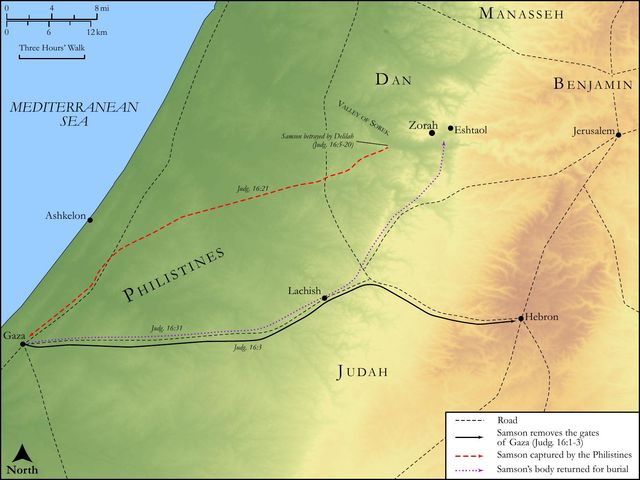
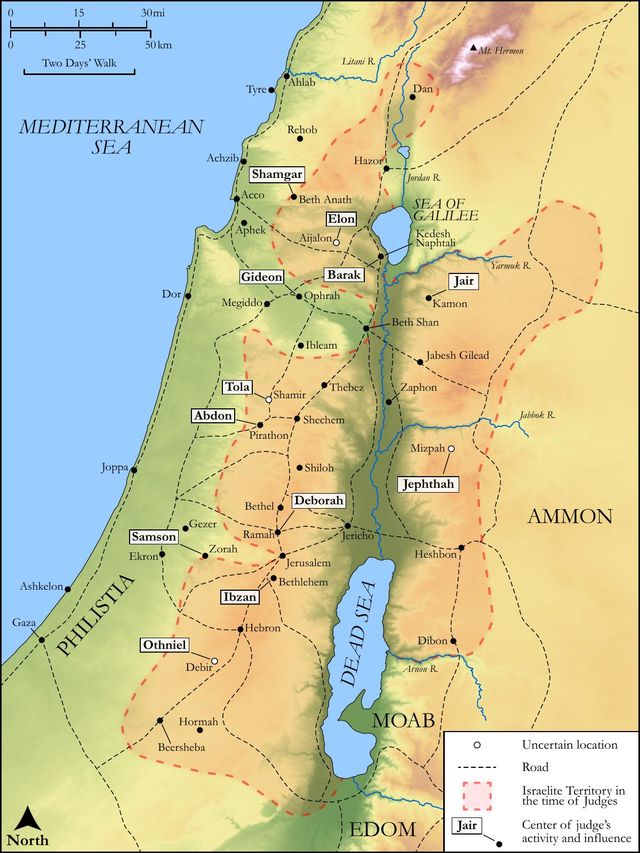
See on the biblical-era maps
Study this verse
Public-domain commentary
Matthew Henry
From his Commentary on the Whole Bible. Henry comments on passages, not single verses — this entry covers Judges 16:4–17. His three-level outline is real structure in the source text, so it is rendered as structure.
The burnt child dreads the fire; yet Samson, that has more than the strength of a man, in this comes short of the wisdom of a child; for, though he had been more than once brought into the highest degree of mischief and danger by the love of women and lusting after them, yet he would not take warning, but is here again taken in the same snare, and this third time pays for all. Solomon seems to refer especially to this story of Samson when, in his caution against uncleanness, he gives this account of a whorish woman (Pro 7:26), that she hath cast down many wounded, yea, many strong men have been slain by her; and (Pro 6:26) that the adulteress will hunt for the precious life. This bad woman, that brought Samson to ruin, is here named Delilah, an infamous name, and fitly used to express the person, or thing, that by flattery or falsehood brings mischief and destruction on those to whom kindness is pretended. See here,
I.The affection Samson had for Delilah:
he loved her, Jdg 16:4. Some think she was his wife, but then he would have had her home to his own house; others that he courted her to make her his wife; but there is too much reason to suspect that it was a sinful affection he had for her, and that he lived in uncleanness with her. Whether she was an Israelite or a Philistine is not certain. If an Israelite, which is scarcely probable, yet she had the heart of a Philistine.
II.The interest which the lords of the Philistines made with her to betray Samson, Jdg 16:5.
1.That which they told her they designed was to humble him, or afflict him; they would promise not to do him any hurt, only they would disable him not to do them any. And so much conscience it should seem they made of this promise that even then, when he lay ever so much at their mercy, they would not kill him, no, not when the razor that cut his hair might sooner and more easily have cut his throat.
2.That which they desired, in order hereunto, was to know where his great strength lay, and by what means he might be bound. Perhaps they imagined he had some spell or charm which he carried about with him, by the force of which he did these great things, and doubted not but that, if they could get this from him, he would be manageable; and therefore, having had reason enough formerly to know which was his blind side, hoped to find out his riddle a second time by ploughing with his heifer. They engaged Delilah to get it out of him, telling her what a kindness it would be to them, and perhaps assuring her it should not be improved to any real mischief, either to him or her.
3.For this they bid high, promised to give her each of them 1100 pieces of silver, 5500 in all. So many shekels amounted to above 1000l. sterling; with this she was hired to betray one she pretended to love. See what horrid wickedness the love of money is the root of. Our blessed Saviour was thus betrayed by one whom he called friend, and with a kiss too, for filthy lucre. No marvel if those who are unchaste, as Delilah, be unjust; such as lose their honesty in one instance will in another.
III.The arts by which he put her off from time to time, and kept his own counsel a great while.
She asked him where his great strength lay, and whether it were possible for him to be bound and afflicted (Jdg 16:6), pretending that she only desired he would satisfy her curiosity in that one thing, and that she thought it was impossible he should be bound otherwise than by her charms.
1.When she urged him very much, he told her,
(1.)That he might be bound with seven green withs, Jdg 16:7. The experiment was tried (Jdg 16:8), but it would not do: he broke the withs as easily as a thread of tow is broken when it toucheth the fire, Jdg 16:9.
(2.)When she still continued her importunity (Jdg 16:10) he told her that with two new ropes he might be so cramped and hampered that he might be as easily dealt with as any other man, Jdg 16:11. This experiment was tried too, but it failed: the new ropes broke from off his arm like a thread, Jdg 16:12.
(3.)When she still pressed him to communicate the secret, and upbraided him with it as an unkindness that he had bantered her so long, he then told her that the weaving of the seven locks of his head would make a great alteration in him, Jdg 16:13. This came nearer the matter than any thing he had yet said, but it would not do: his strength appeared to be very much in his hair, when, upon the trial of this, purely by the strength of his hair, he carried away the pin of the beam and the web.
2.In the making of all these experiments, it is hard to say whether there appears more of Samson's weakness or Delilah's wickedness.
(1.)Could any thing be more wicked than her restless and unreasonable importunity with him to discover a secret which she knew would endanger his life if ever it were lodged any where but in his own breast? What could be more base and disingenuous, more false and treacherous, than to lay his head in her lap, as one whom she loved, and at the same time to design the betraying of him to those by whom he was mortally hated?
(2.)Could any thing be more weak than for him to continue a parley with one who, he so plainly saw, was aiming to do him a mischief, - that he should lend an ear so long to such an impudent request, that she might know how to do him a mischief, - that when he perceived liers in wait for him in the chamber, and that they were ready to apprehend him if they had been able, he did not immediately quit the chamber, with a resolution never to come into it any more, - nay, that he should again lay his head in that lap out of which he had been so often roused with that alarm, The Philistines are upon thee, Samson? One can hardly imagine a man so perfectly besotted, and void of all consideration, as Samson now was; but whoredom is one of those things that take away the heart. It is hard to say what Samson meant in suffering her to try so often whether she could weaken and afflict him; some think he did not certainly know himself where his strength lay, but, it should seem, he did know, for, when he told her that which would disable him indeed, it is said, He told her all his heart. It seems, he designed to banter her, and to try if he could turn it off with a jest, and to baffle the liers in wait, and make fools of them; but it was very unwise in him that he did not quit the field as soon as ever he perceived that he was not able to keep the ground.
IV.The disclosure he at last made of this great secret; and, if the disclosure proved fatal to him, he must thank himself, who had not power to keep his own counsel from one that manifestly sought his ruin. Surely in vain is the net spread in the sight of any bird, but in Samson's sight is the net spread, and yet he is taken in it. If he had not been blind before the Philistines put out his eyes, he might have seen himself betrayed. Delilah signifies a consumer; she was so to him. Observe,
1.How she teazed him, telling him she would not believe he loved her, unless he would gratify her in this matter (Jdg 16:15): How canst thou say, I love thee, when they heart is not with me? That is, "when thou canst not trust me with the counsels of they heart?" Passionate lovers cannot bear to have their love called in question; they would do any thing rather than their sincerity should be suspected. Here therefore Delilah had this fond fool (excuse me that I call him so) at an advantage. This expostulation is indeed grounded upon a great truth, that those only have our love, not that have our good words or our good wishes, but that have our hearts. That is love without dissimulation; but it is falsehood and flattery in the highest degree to say we love those with whom our hearts are not. How can we say we love either our brother, whom we have seen, or God, whom we have not seen, if our hearts be not with him? She continued many days vexatious to him with her importunity, so that he had no pleasure of his life with her (Jdg 16:16); why then did he not leave her? It was because he was captivated to her by the power of love, falsely so called, but truly lust. This bewitched and perfectly intoxicated him, and by the force of it see,
2.How she conquered him (Jdg 16:17): He told her all his heart. God left him to himself to do this foolish thing, to punish him for indulging himself in the lusts of uncleanness. The angel that foretold his birth said nothing of his great strength, but only that he should be a Nazarite, and particularly that no razor should come upon his head, Jdg 13:5. His consecration to God was to be his strength, for he was to be strengthened according to the glorious power of that Spirit which wrought in him mightily, that his strength, by promise, not by nature, might be a type and figure of the spiritual strength of believers, Col 1:11, Col 1:29. Therefore the badge of his consecration was the pledge of his strength; if he lose the former, he knows he forfeits the latter. "If I be shaven, I shall no longer be a Nazarite, and then my strength will be lost." The making of his bodily strength to depend so much on his hair, which could have no natural influence upon it either one way or other, teaches us to magnify divine institutions, and to expect God's grace, and the continuance of it, only the use of those means of grace wherein he has appointed us to attend upon him, the word, sacraments, and prayer. In these earthen vessels is this treasure.
Historical interpretation
Three Centuries of Reception
3 surviving comments on this verse. Each one is dated, so this reads as a timeline rather than a list.
Select a marker to jump to its quote. Markers stagger vertically where authors wrote within a few decades of each other.
Overcome by love of money, Achan led to destruction all the people of the fathers. So Joshua the son of Nun, who could stay the sun from setting, could not stay the love of money in people from creeping on. At the sound of his voice the sun stood still, but love of money stayed not. When the sun stood still, Joshua completed his triumph, but when love of money went on, he almost lost the victory.Why? Did not the woman Delilah’s love of money deceive Samson, the bravest man of all? So he who had torn apart the roaring lion with his hands; who, when bound and handed over to his enemies, alone, without help, burst his bonds and killed a thousand of them; who broke the cords interwoven with sinews as though they were but the slight threads of a net; he, I say, having laid his head on the woman’s knee, was robbed of the decoration of his victory-bringing hair, that which gave him his might. Money flowed into the lap of the woman, and the favor of God forsook the man.
Love of money, then, is deadly. Money is seductive, as it defiles those who have it and does not help those who do not.
But now his licence transgressed the limits not only of his paternal territory, but of good morals, such as ancient discipline had prescribed, and this brought upon him destruction in the end. For although he had experienced in his first marriage the treachery of a foreign wife, and ought to have avoided it in future, he did not shun connecting himself with the harlot Delilah, and by his passionate love of her opened a way for the craft of his enemies to assail him. For the Philistines came up to her, and promised each of them to give her eleven hundred pieces of silver if she would disclose to them wherein his assurance of strength lay, that by means of this knowledge they might entrap and take him.
But she having once prostituted herself for money, began during the banquet and the blandishments of love, cunningly and craftily to inquire of him in what respect his strength excelled that of others, and at the same time, as if solicitous and fearful for his safety, to entreat him to confide to his beloved by what means he could be bound and subdued into the power of others. But he, still self-possessed and unshaken, opposed craft to the allurements of the harlot, and told her that if he were bound with withs yet green and not dried, his strength would be like that of other men. When the Philistines learnt this from Delilah, they bound him while asleep with green withs, and then awoke him as though on a sudden, but found that he had not fallen off from his accustomed fortitude, but bursting its bonds his freed strength was able to resist and drive back a host of assailants.
Why was the mighty man Samson rejected by God, he who was set apart and consecrated to God while still in the womb; whose birth was announced by an angel, like John, the son of Zacharias; who was granted great power and worked great wonders [and who by the supernatural strength which God poured into his body smote a thousand men with the jawbone of an ass and became a saviour and judge unto Israel]? Was it not because he defiled his holy members by union with a harlot? For this reason God departed from him and surrendered him to his enemies.
Continue studying Judges 16:8 across the web’s major study libraries — every link below opens this exact verse, chapter, or book on the destination site.
Read & Compare
 BibleGatewayThis verse in more than 200 translations and 70 languages.
 Bible.comThe YouVersion reader — hundreds of translations, reading plans, and highlights.
 ESV.orgCrossway's official English Standard Version reader.
 NET BibleThe NET translation with 60,000+ translators' notes on every rendering decision.
 STEP BibleTyndale House's free study tool — original text, vocabulary, and scholarly resources.
 BibliaLogos Bible Software's free web reader.
 USCCBThe New American Bible (Revised Edition) with the U.S. bishops' study notes.
Commentaries
 BibleHub CommentariesDozens of classic commentaries on this verse, gathered on one page.
 StudyLightMore than 100 commentary sets — the largest collection on the web.
 BibleRefPlain-English commentary on what this verse means, verse by verse.
 Enduring WordDavid Guzik's free commentary on this chapter, widely used by Bible teachers.
 Bible Study ToolsVerse commentary alongside Greek and Hebrew study aids.
Original Language & Research
- BibleHub InterlinearThe verse word by word — original language, transliteration, and English.
- BibleHub LexiconEvery word's original-language definition and Strong's entry.
 Blue Letter BibleDeep-study tools — Strong's numbers, concordance, and word studies.
 SefariaThe Hebrew text with Rashi and centuries of Jewish commentary.
Sermons, Hymns & Audio


TrulyRandomVerse is not affiliated with these sites and doesn’t control their content. They’re linked because they’re genuinely useful.
Summary
Judges 16:8 vividly portrays the immediate and methodical response of the Philistine lords to Delilah's first attempt to uncover the secret of Samson's strength. Following Samson's deceptive claim that he could be weakened if bound with "seven green withs which had not been dried," this verse details the Philistines' prompt provision of these specific materials to Delilah, who then actively binds Samson with them. This pivotal moment marks a significant escalation in the narrative of Samson's betrayal, underscoring the Philistines' relentless determination to subdue their formidable Israelite adversary and highlighting Delilah's unwavering commitment to their treacherous scheme. It sets the stage for a series of escalating tests, revealing Samson's dangerous complacency and foreshadowing the tragic consequences of his spiritual compromise.
Context
ShowHideLiterary Context
Judges 16:8 is deeply embedded within the climactic and tragic narrative of Samson and Delilah, forming a crucial link in the chain of events leading to Samson's downfall. It directly follows Delilah's initial agreement with the Philistine lords in Judges 16:5 to betray Samson for a substantial sum of silver. In the preceding verse, Judges 16:7, Samson, under Delilah's persistent questioning, offers his first deceptive answer, claiming that if he were bound with "seven green withs that were never dried," his strength would depart. Judges 16:8 immediately demonstrates the Philistines' and Delilah's swift and literal execution of this instruction. This rapid response underscores the Philistines' desperate desire to capture Samson and Delilah's immediate commitment to their agenda. The verse thus sets up the subsequent test in Judges 16:9, where Samson easily breaks the bonds, revealing Delilah's treachery and his own continued, dangerous game of deception. This sequence establishes the pattern of Delilah's persistent probing and Samson's playful, yet ultimately fatal, disclosures.
Historical & Cultural Context
The Philistines, a formidable "sea people" who had settled on the southwestern coast of Canaan, were perennial antagonists to the Israelites during the period of the Judges. Their military and political dominance is a pervasive theme throughout the Book of Judges, and Samson's exploits represent a divinely empowered, albeit flawed, resistance against their oppressive rule. The "withs" mentioned in the text refer to flexible branches, cords, or fresh vine shoots, which were common binding materials in Israel, used for securing livestock, prisoners, or goods. The specification that these withs were "green" and "not dried" is a significant detail, reflecting the practical knowledge of the time; fresh, pliable materials were often considered stronger and less prone to snapping than brittle, dried ones. This detail lends a sense of plausibility to Samson's deceptive claim within the narrative, even though his strength was supernatural. The direct involvement of the Philistine lords in bringing these materials emphasizes the high stakes involved in capturing Samson and their collective, strategic effort to neutralize this significant threat to their power.
Key Themes
ShowHideThis verse powerfully illustrates several key themes within the broader narrative of Judges and Samson's life. Firstly, it highlights the theme of deception and persistent testing. Delilah's cunning, coupled with the Philistine lords' relentless pursuit of Samson's weakness, is vividly portrayed as they methodically follow up on every piece of information, even when it is a lie. This relentless pressure foreshadows the insidious nature of temptation that will ultimately lead to Samson's tragic downfall, as seen in Judges 16:16. Secondly, the superficiality of human attempts to control divine power is starkly revealed. The "green withs" represent a physical, external means of control that is utterly inadequate against Samson's divinely granted strength. This initial, easily overcome test underscores the profound contrast between human limitations and the extraordinary, supernatural power bestowed by God. It subtly questions the true source of Samson's power; while Delilah and the Philistines focus on physical bonds, Samson's strength is rooted in his Nazarite vow and the enabling power of God's Spirit, which no mere physical restraint can contain, as demonstrated in his earlier exploits in Judges 14:6 and Judges 15:14.
Exposition and Analysis
ShowHideKey Word Analysis
ShowHideThis term (H3499) properly refers to an overhanging, or by implication, an excess or remainder. More specifically in this context, it denotes a "small rope" or "cord," and by extension, a "string" or "with." The choice of this material, as suggested by Samson, points to a common binding agent in Israel, likely made from plant fibers or pliable branches. Its selection here highlights the mundane, physical nature of the Philistines' attempt to contain Samson's supernatural strength, making its eventual failure all the more dramatic.
This adjective (H3892) directly translates to "fresh," "moist," or "green," stemming from an unused root meaning "to be new." It emphasizes the pliable, undried state of the "withs." The implication is that fresh, unseasoned materials might be perceived as stronger, more resilient, or more difficult to break than brittle, dried ones. This specific detail adds to the verisimilitude of Samson's deceptive claim, making it sound plausible to Delilah and the Philistines, thereby drawing them further into his dangerous game.
This primitive root (H631) means "to yoke or hitch," and by analogy, "to fasten in any sense," "to tie," or "to put in bonds." It signifies the act of physically restraining someone. Delilah's immediate action of binding Samson with the "withs" directly fulfills Samson's deceptive instructions, highlighting her active and eager participation in the Philistine plot and her literal, unhesitating response to his words. This act of binding sets the stage for the dramatic display of Samson's unbroken strength.
Verse Breakdown
ShowHide"Then the lords of the Philistines brought up to her"
This clause immediately follows Samson's deceptive revelation in the previous verse, indicating the Philistine lords' swift and direct involvement in the scheme. Their action demonstrates their eagerness to test Samson's claim and their unwavering commitment to the plan to capture him. It also highlights Delilah's pivotal role as their agent, as they provide her with the specific materials needed for the test, underscoring the collaborative nature of the plot against Samson.
"seven green withs which had not been dried"
This specifies the exact materials Samson had mentioned in his deceptive instruction. The number "seven" often carries symbolic weight in the Bible, suggesting completeness, perfection, or a definitive act; here, it might imply a thorough or comprehensive attempt to bind Samson, according to his own false claim. The description "green" and "not been dried" emphasizes their freshness, pliability, and presumed strength, making them seem like a robust, though ultimately inadequate, binding material in the eyes of the Philistines and Delilah.
"and she bound him with them"
This final clause describes Delilah's direct and immediate action. She wastes no time in putting Samson's deceptive words into practice, demonstrating her resolve and the dangerous game Samson is playing. Her act of binding him is a literal fulfillment of his false condition, setting the stage for the dramatic reveal of his unbroken strength in the subsequent verse and further entangling Samson in her web of betrayal.
Literary Devices
ShowHideJudges 16:8 employs several potent literary devices that enrich its narrative impact. Irony is profoundly evident, as Samson, the man of immense, divinely-granted strength, allows himself to be bound by trivial, easily broken "green withs" based on his own deceptive words. The audience, privy to Samson's true power, experiences a deep sense of dramatic irony as Delilah earnestly attempts to bind him and the Philistines anticipate his capture, unaware of the futility of their efforts against his supernatural might. There is also a strong element of Foreshadowing within this initial, failed attempt. This incident establishes a dangerous pattern of Samson revealing partial truths or outright lies, only for Delilah to test them meticulously. This escalating series of deceptions and tests ultimately leads to his genuine betrayal and capture, making this first instance a clear precursor to his eventual, tragic downfall. Furthermore, the "seven green withs" function as potent Symbolism, representing human attempts to control or contain divine power through mundane, physical means. These physical bonds are utterly incapable of restraining Samson's strength, which is rooted in a spiritual vow and God's enabling power, thus symbolizing the futility of human efforts against divine might and the sacred nature of Samson's Nazarite consecration.
Theological and Thematic Connections
ShowHideJudges 16:8, while seemingly a straightforward narrative detail, underscores profound theological truths about the nature of strength, the insidious power of temptation, and the devastating consequences of spiritual compromise. Samson's strength was not inherent to his physical being but was a direct result of his Nazarite vow and the enabling power of the Spirit of the Lord. His willingness to engage in this deceptive game with Delilah, even playfully, reveals a dangerous complacency and a profound disregard for the sacred source of his power. The Philistines' methodical approach, using a woman to exploit a man's weakness, reflects the spiritual warfare where the enemy persistently seeks to uncover and exploit vulnerabilities. This verse serves as a cautionary tale, demonstrating how even those gifted by God can be susceptible to persistent temptation and how seemingly minor compromises can set a trajectory toward significant spiritual failure. It highlights that true spiritual strength is not merely physical prowess but unwavering fidelity to God's covenant and reliance on His divine empowerment.
Reflection and Application
ShowHideJudges 16:8 offers a sobering reflection on the subtle yet destructive nature of compromise and the inherent dangers of playing with sin. Samson, despite his extraordinary strength and divine calling, allowed himself to be drawn into a perilous game of deception with Delilah. His initial lies, though seemingly harmless and easily overcome, created a pattern of engagement that normalized his vulnerability and emboldened his adversary. For us, this verse serves as a powerful reminder that persistent temptation, even when initially resisted, can gradually wear down our defenses if we continue to entertain it. It highlights the critical importance of recognizing and fleeing from situations, relationships, or even internal thought patterns that seek to undermine our spiritual strength or uncover our weaknesses for nefarious purposes. True strength lies not in our ability to resist external pressures alone, but in our unwavering commitment to God's commands and our consistent reliance on His power, rather than our own cleverness, resilience, or perceived invincibility. We must be vigilant against the "daily pressing" of the world and our own sinful desires, lest we, like Samson, find our spiritual vitality slowly eroded by compromise and our consecrated lives laid waste.
Questions for Reflection
ShowHideFAQ
ShowHideWhy did Samson give Delilah a false answer instead of simply refusing to tell her?
ShowHideSamson's behavior throughout his life, particularly in his interactions with women, suggests a consistent pattern of recklessness, overconfidence in his own strength, and a certain spiritual blindness. He frequently played with danger, whether it was marrying a Philistine woman (Judges 14:1-3) or engaging in riddles and wagers (Judges 14:12-18). In this instance, giving a false answer allowed him to maintain his secret while seemingly appeasing Delilah, perhaps believing he could control the situation, that his strength was invincible, or that he could outsmart her. This approach highlights his moral decline and spiritual complacency, as he repeatedly toys with the very source of his divine power, rather than guarding it as sacred. This pattern of playful deception and self-reliance ultimately led him down a path of increasing vulnerability and, eventually, to his tragic downfall.
Christ-Centered Fulfillment
ShowHideSamson, in his divinely-granted strength and eventual betrayal, serves as a complex type of Christ, yet also highlights the profound superiority and perfection of our Savior. Judges 16:8 depicts Delilah and the Philistines attempting to bind Samson with physical cords—"seven green withs"—a futile effort against his divinely empowered might. This scene powerfully foreshadows the world's ultimately futile attempts to bind, control, or defeat Christ. Though Jesus willingly submitted to human hands, allowing himself to be bound and led away to be crucified, His power was never diminished. He could have effortlessly called upon legions of angels to His defense, but He chose the path of self-sacrifice and obedience to His Father's will. Unlike Samson, who was betrayed by a woman he loved for money, Christ was betrayed by a disciple for silver (Matthew 26:14-16), yet His betrayal led not to personal downfall but to the redemption of humanity. Samson's physical strength could not be contained by mere "green withs," but Christ's divine power truly broke the ultimate bonds of death, rising victoriously from the grave (Acts 2:24). Thus, Judges 16:8, in its depiction of a powerful figure seemingly bound by trivial means, points forward to the ultimate, willing submission of the Son of God, whose strength was not in resisting human bonds but in conquering sin and death through His obedient, sacrificial love.