


Joshua 13:4
Bible text: King James Version (1769 Blayney text) · Public domain
Bible text: Berean Standard Bible · Public domain
Bible text: American Standard Version (1901) · Public domain
Bible text: World English Bible, Messianic edition · Public domain
Bible text: Geneva Bible (1599) · Public domain
Bible text: Young's Literal Translation · Public domain
- מִתֵּימָןmi·tei·Manfrom [the] southH8486Prep-m ¦ N-fsNoun Singular Feminine Absoluteמִfromתֵּימָן[the] south
- כָּלkolallH3605N-mscNoun Singular Masculine Construct
- אֶרֶץ'E·retz[the] land ofH776N-fscNoun Singular Feminine Construct
- הַכְּנַעֲנִיha·ke·na·'a·Nithe Canaanite[s]H3669Art ¦ N-msNoun Gentilic Singular Masculine AbsoluteהַtheכְּנַעֲנִיCanaanite[s]
- וּמְעָרָהu·me·'a·Rahand MearahH4632Conj-w ¦ N-properNoun Proper LocationוּandמְעָרָהMearah
- אֲשֶׁר'a·SherwhichH834RelParticle Relative
- לַצִּידֹנִיםla·tzi·do·Nim[belongs] to the SidoniansH6722Prep-l ¦ N-mpNoun Gentilic Plural Masculine Absoluteלַ[belongs] to theצִּידֹנִיםSidonians
- עַד'adtoH5704PrepPreposition
- אֲפֵקָה'a·Fe·kahAphek towardsH663N-proper ¦ SfxNoun Proper LocationאֲפֵקָAphekהtowards
- עַד'adtoH5704PrepPreposition
- גְּבוּלge·Vul[the] border ofH1366N-mscNoun Singular Masculine Construct
- הָאֱמֹרִיha·'e·mo·Rithe Amorite[s]H567Art ¦ N-msNoun Gentilic Singular Masculine AbsoluteהָtheאֱמֹרִיAmorite[s]
English is a literal word-by-word gloss of the Hebrew, not the KJV's wording. Why?
This is the original text the KJV's translators worked from — each Hebrew word with its own literal English meaning in this verse, prepared by scholars at Tyndale House, Cambridge. The KJV translates whole sentences, not word by word, so its wording differs: one Hebrew word can become several English words, and the KJV may choose “the LORD” where the gloss reads “Yahweh”. Both are faithful — they answer different questions. For the KJV's own rendering, switch to the KJV text.
Details
See on the biblical-era maps
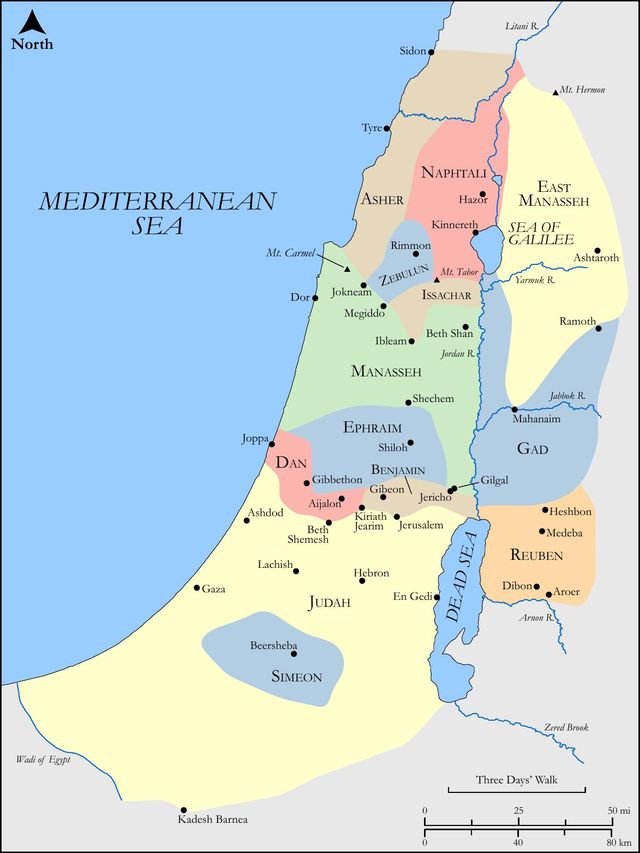
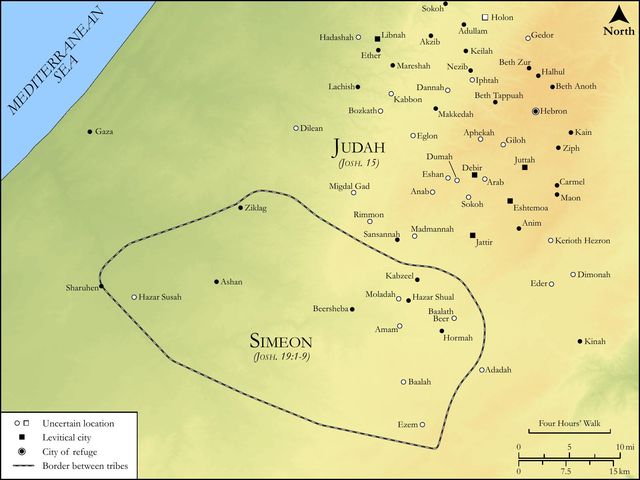
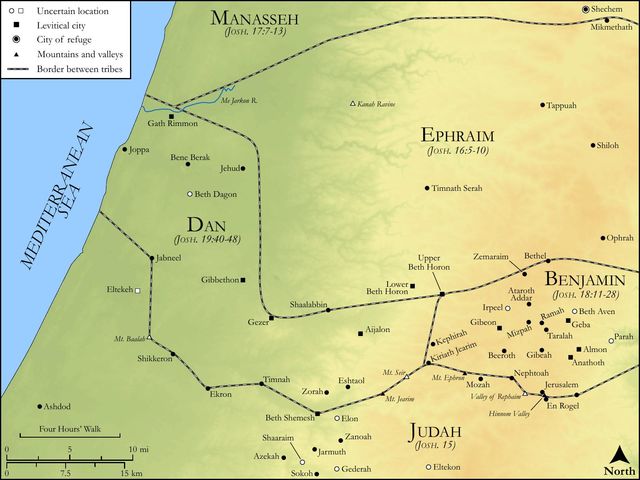
Study this verse
Public-domain commentary
Matthew Henry
From his Commentary on the Whole Bible. Henry comments on passages, not single verses — this entry covers Joshua 13:1–6. His two-level outline is real structure in the source text, so it is rendered as structure.
Here, I. God puts Joshua in mind of his old age, v. 1. 1. It is said that Joshua was old and stricken in years, and he and Caleb were at this time the only old men among the thousands of Israel, none except them of all those who were numbered at Mount Sinai being now alive. He had been a man of war from his youth (Exo 17:10); but now he yielded to the infirmities of age, with which it is in vain for the stoutest to think of contesting. It should seem Joshua had not the same strength and vigour in his old age that Moses had; all that come to old age do not find it alike good; generally, the days of old age are evil days, and such as there is no pleasure in, nor expectation of service from. 2. God takes notice of it to him: God said to him, Thou art old. Note, It is good for those who are old and stricken in years to be put in remembrance of their being so. Some have gray hairs here and there upon them, and perceive it not (Hos 7:9); they do not care to think of it, and therefore need to be told of it, that they may be quickened to do the work of life, and make preparation for death, which is coming towards them apace. But God mentions Joshua's age and growing infirmities, (1.) As a reason why he should now lay by the thoughts of pursuing the war; he cannot expect to see an end of it quickly, for there remained much land, more perhaps than he thought, to be possessed, in several parts remote from each other: and it was not fit that at his age he should be put upon the fatigue of renewing the war, and carrying it to such distant places; no, it was enough for him that he had reduced the body of the country. "Let him be gathered to rest with honour and the thanks of his people for the good services he had done them, and let the conquering of the skirts of the country be left for those that shall come after." As he had entered into the labours of Moses, so let others enter into his, and bring forth the top-stone, the doing of which was reserved for David long after. Observe, God considers the frame of his people, and would not have them burdened with work above their strength. It cannot be expected that old people should do as they have done for God and their country. (2.) As a reason why he should speedily apply himself to the dividing of that which he had conquered. That work must be done, and done quickly; it was necessary that he should preside in the doing of it, and therefore, he being old and stricken in years, and not likely to continue long, let him make this his concluding piece of service to God and Israel. All people, but especially old people, should set themselves to do that quickly which must be done before they die, lest death prevent them, Ecc 9:10.
II.He gives him a particular account of the land that yet remained unconquered, which was intended for Israel, and which, in due time, they should be masters of if they did not put a bar in their own door. Divers places are here mentioned, some in the south, as the country of the Philistines, governed by five lords, and the land that lay towards Egypt (Jos 13:2, Jos 13:3), some westward, as that which lay towards the Sidonians (Jos 13:4), some eastward, as all Lebanon (Jos 13:5), some towards the north, as that in the entering in of Hamath, Jos 13:5. Joshua is told this, and he made the people acquainted with it,
1.That they might be the more affected with God's goodness to them in giving them this good land, and might thereby be engaged to love and serve him; for, if this which they had was too little, God would moreover give them such and such things, Sa2 12:8.
2.That they might not be tempted to make any league, or contract any dangerous familiarity with these their neighbours so as to learn their way, but might rather be jealous of them, as a people that kept them from their right and that they had just cause of quarrel with.
3.That they might keep themselves in a posture for war, and not think of putting off the harness so long as there remained any land to be possessed. Nor must we lay aside our spiritual armour, nor be off our watch, till our victory be completed in the kingdom of glory.
III.He promises that he would make the Israelites masters of all those countries that were yet unsubdued, though Joshua was old and not able to do it, old and not likely to live to see it done. Whatever becomes of us, and however we may be laid aside as despised broken vessels, God will do his own work in his own time (Jos 13:6): I will drive them out. The original is emphatic: "It is I that will do it, I that can do it when thou are dead and gone, and will do it if Israel be not wanting to themselves." "I will do it by my Word," so the Chaldee here, as in many other places, "by the eternal Word, the captain of the hosts of the Lord." This promise that he would drive them out from before the children of Israel plainly supposes it as the condition of the promise that the children of Israel must themselves attempt their extirpation, must go up against them, else they could not be said to be driven out before them; if afterwards Israel, through sloth, or cowardice, or affection to these idolaters, sit still and let them alone, they must blame themselves, and not God, if they be not driven out. We must work out our salvation, and then God will work in us and work with us; we must resist our spiritual enemies, and then God will tread them under our feet; we must go forth to our Christian work and warfare, and then God will go forth before us.
Continue studying Joshua 13:4 across the web’s major study libraries — every link below opens this exact verse, chapter, or book on the destination site.
Read & Compare
 BibleGatewayThis verse in more than 200 translations and 70 languages.
 Bible.comThe YouVersion reader — hundreds of translations, reading plans, and highlights.
 ESV.orgCrossway's official English Standard Version reader.
 NET BibleThe NET translation with 60,000+ translators' notes on every rendering decision.
 STEP BibleTyndale House's free study tool — original text, vocabulary, and scholarly resources.
 BibliaLogos Bible Software's free web reader.
 USCCBThe New American Bible (Revised Edition) with the U.S. bishops' study notes.
Commentaries
 BibleHub CommentariesDozens of classic commentaries on this verse, gathered on one page.
 StudyLightMore than 100 commentary sets — the largest collection on the web.
 BibleRefPlain-English commentary on what this verse means, verse by verse.
 Enduring WordDavid Guzik's free commentary on this chapter, widely used by Bible teachers.
 Bible Study ToolsVerse commentary alongside Greek and Hebrew study aids.
Original Language & Research
- BibleHub InterlinearThe verse word by word — original language, transliteration, and English.
- BibleHub LexiconEvery word's original-language definition and Strong's entry.
 Blue Letter BibleDeep-study tools — Strong's numbers, concordance, and word studies.
 SefariaThe Hebrew text with Rashi and centuries of Jewish commentary.
Sermons, Hymns & Audio


TrulyRandomVerse is not affiliated with these sites and doesn’t control their content. They’re linked because they’re genuinely useful.
Summary
Joshua 13:4 details a specific segment of the unconquered territory God commanded Joshua to divide among the tribes of Israel, even as Joshua was old and much land remained to be possessed. This verse outlines a significant northern and western boundary of this remaining land, stretching from the general region of the Canaanites in the south, encompassing the enigmatic "Mearah" near the powerful Sidonians, extending to Aphek, and reaching the borders of the Amorites. It underscores the vastness of the inheritance God had promised and the ongoing human responsibility in claiming it, highlighting the partial nature of the initial conquest despite significant victories.
Context
ShowHideLiterary Context
Joshua 13 marks a pivotal transition in the Book of Joshua. Chapters 1-12 recount the initial, decisive military campaigns led by Joshua, culminating in a general statement that the land was "at rest from war" as recorded in Joshua 11:23. However, chapter 13 immediately opens with God's direct instruction to an aging Joshua: "You are old and advanced in years, and there remains yet very much land to possess" in Joshua 13:1. This striking juxtaposition sets the stage for the detailed geographical descriptions of the unconquered territories that follow, including Joshua 13:4. The shift from conquest to the administrative task of land division (chapters 13-21) underscores that the full inheritance of the Promised Land was a process requiring continued faith and obedience, not merely a single military triumph. This verse, therefore, serves as a crucial geographical marker within God's comprehensive directive for the tribal allotments.
Historical & Cultural Context
The peoples mentioned in Joshua 13:4—the Canaanites, Sidonians, and Amorites—represent significant inhabitants of the land whom Israel was commanded to dispossess. The "land of the Canaanites" broadly refers to the indigenous population of the region, known for their polytheistic worship, including Baal and Asherah, and their fortified city-states. The Sidonians were a powerful Phoenician people, renowned maritime traders and craftsmen, whose major city, Sidon, was a prominent coastal hub north of Israel's eventual territory. Their presence "beside" Mearah indicates the northern reach of the unconquered land extended into their sphere of influence. Aphek was a strategic city, often a battleground, located in various places in ancient Israel, but here likely referring to one in the northern coastal plain or Lebanon, marking a western or northern boundary. The Amorites, though often used broadly for pre-Israelite inhabitants, here likely refers to specific Amorite kingdoms or enclaves, particularly those east of the Jordan or in the northern mountainous regions, defining the eastern or inland frontier of the described territory. The continued presence of these groups meant ongoing cultural and religious challenges for Israel, as seen in the subsequent period of the Judges, where the failure to fully dispossess these nations led to cycles of apostasy and oppression, as detailed in Judges 1:27-36.
Key Themes
ShowHideJoshua 13:4 contributes significantly to several key themes within the book and broader biblical narrative. Firstly, it highlights the theme of Unfinished Conquest and Partial Obedience. Despite God's mighty acts and Israel's victories, a substantial portion of the Promised Land remained under pagan control, illustrating that divine provision often requires sustained human effort and faithfulness to fully realize. Secondly, it reinforces the tension between Divine Promise and Human Responsibility. God had promised the entire land from the outset, as recorded in Genesis 15:18, and His faithfulness in delivering much of it was undeniable. Yet, the detailed description of unconquered areas in this verse underscores Israel's ongoing responsibility to act in faith, dispossess the inhabitants, and fully claim their inheritance. Thirdly, the detailed Geographical Scope of the verse emphasizes the vastness of God's promised inheritance and the specific boundaries He laid out, demonstrating His meticulous plan and the comprehensive nature of His covenant with Israel. The inclusion of specific, strategically important locations like Mearah and Aphek, near powerful entities like the Sidonians and Amorites, underscores the formidable nature of the remaining task and the strategic importance of these areas for Israel's future security and spiritual purity.
Exposition and Analysis
ShowHideKey Word Analysis
ShowHideThis term, meaning "cave" or "den," is used as a specific place name in Joshua 13:4. Its inclusion suggests a locality known for such geological features, situated "beside the Sidonians." While its precise location is debated, it likely refers to a region or town in the northern coastal area, possibly near the modern Lebanese coast, indicating the furthest northern reach of the territory God was describing for division. The mention of such a specific, perhaps minor, geographical feature within a list of broader regions emphasizes the meticulous detail of God's instructions regarding the land.
This term refers to a "Kenaanite or inhabitant of Kenaan." While often used broadly for all the peoples of the land, it also designates a specific ethnic group, particularly associated with the coastal plains and valleys. Their inclusion here signifies that even in the northern and western reaches, the land was still occupied by the very people Israel was commanded to dispossess, highlighting the ongoing challenge and the extent of the incomplete conquest.
This term identifies a "Tsidonian or inhabitant of Tsidon," a major Phoenician city-state located on the Mediterranean coast, north of Israel's territory. Sidon was a powerful maritime and commercial center, known for its trade and its influence among the nations. The phrase "Mearah that is beside the Sidonians" clearly defines the northern boundary of the unconquered land as extending into the sphere of this prominent, non-Israelite power, indicating areas that Israel had not yet, and in many cases would not, fully subdue.
Verse Breakdown
ShowHide"From the south, all the land of the Canaanites"
This phrase establishes the starting point and general scope of the unconquered territory being described. It indicates that the land to be divided stretched northward from a southern point within the general region inhabited by the Canaanites, implying a vast expanse that was still under their control, or at least not yet fully settled by Israel.
"and Mearah that [is] beside the Sidonians"
This specifies a key northern marker of the unconquered territory. "Mearah" (meaning "cave") points to a specific locality or region, geographically positioned in close proximity to the powerful Phoenician city of Sidon. This indicates that the land still to be possessed extended significantly northward along the Mediterranean coast, beyond the immediate reach of Israel's initial conquests.
"unto Aphek"
Aphek serves as another significant boundary marker, likely pointing to a strategic city or region that defined the western or northwestern extent of the unconquered land. There were several locations named Aphek in ancient Israel, but in this context, it refers to one in the northern coastal plain or southern Lebanon, further delineating the vastness of the territory yet to be taken.
"to the borders of the Amorites"
This final phrase defines the eastern or inland extent of the described unconquered territory. The Amorites, though sometimes used broadly, here likely refer to specific Amorite enclaves or kingdoms in the northern mountainous regions or east of the Jordan, indicating that the land to be divided stretched eastward to their boundaries, encompassing a wide swath of land from the coast inland.
Literary Devices
ShowHideJoshua 13:4 primarily employs Geographical Delimitation and Enumeration to precisely outline the remaining unconquered territory. The verse meticulously lists specific points and peoples ("From the south," "Mearah," "Sidonians," "Aphek," "Amorites") to create a detailed mental map of the land God commanded Joshua to divide. This precise Topographical Description serves to emphasize the vastness and specific nature of the task ahead for Israel. The use of Synecdoche is also present, where "the land of the Canaanites" represents the broader indigenous population of the region, and "Sidonians" and "Amorites" stand for their respective spheres of influence, indicating that the unconquered areas were still firmly under the control of powerful, non-Israelite entities. This precise detailing underscores the reality of the incomplete conquest and the significant challenge that lay before the tribes of Israel.
Theological and Thematic Connections
ShowHideJoshua 13:4, in its detailed description of unconquered land, powerfully illustrates the ongoing tension between God's sovereign promise and human responsibility. While God had faithfully delivered Israel into the Promised Land and given them rest from war, this verse reminds us that the full realization of His promises often requires sustained faith, obedience, and active engagement from His people. The remaining land was not a sign of God's failure, but an invitation for Israel to continue to trust Him and act on His commands, demonstrating that inheritance is both a gift and a task. This concept resonates throughout scripture, where God's covenant faithfulness is always met with the expectation of human response, whether in the Old Testament pursuit of the physical land or the New Testament pursuit of spiritual maturity and the Kingdom of God.
Reflection and Application
ShowHideJoshua 13:4, situated within the broader context of God's command to divide unconquered land, offers profound lessons for believers today. Just as Israel had an inheritance yet to fully possess despite God's faithfulness, Christians are called to continually claim and live out their spiritual inheritance in Christ. This verse challenges us to examine areas in our lives where we might have settled for partial victory or complacency. While God has provided "everything pertaining to life and godliness through the true knowledge of Him who called us by His own glory and excellence" in 2 Peter 1:3, there are still spiritual battles to be fought, character traits to be transformed, and divine purposes to be pursued. It reminds us that spiritual growth is an ongoing process of dispossessing the "giants" of sin, fear, and unbelief in our personal lives, and actively engaging in the mission of God in the world. We are not to be content with mere survival, but to press forward in faith, trusting in God's power to enable us to fully experience and manifest the promises of His Kingdom.
Questions for Reflection
ShowHideFAQ
ShowHideWhy did God command the division of unconquered land?
ShowHideGod's command to divide unconquered land, as seen in Joshua 13:1-7, served several crucial purposes. Firstly, it reaffirmed His covenant faithfulness: the land was a divine gift, and its distribution underscored that the promise was sure, even if its full realization was progressive. Secondly, it provided a clear mandate and motivation for the tribes to continue the conquest. By assigning specific territories, God gave each tribe a tangible inheritance to fight for, preventing complacency and ensuring that the task of dispossessing the remaining inhabitants would continue. Thirdly, it established the legal and administrative framework for Israel's future, laying the groundwork for their national identity and tribal boundaries. It taught them that their inheritance was not merely a military acquisition but a divinely ordained possession, requiring ongoing faith and effort.
Who were the Sidonians and Amorites in this context, and why are they mentioned?
ShowHideThe Sidonians were a prominent Phoenician people, primarily inhabiting the coastal city of Sidon and its environs, north of Israel. They were renowned maritime traders and powerful in their region. Their mention in Joshua 13:4 indicates that the unconquered land extended far north, into their sphere of influence, areas Israel had not yet subdued and largely would not. The Amorites, while sometimes used broadly for pre-Israelite inhabitants, here likely refer to specific Amorite kingdoms or enclaves, perhaps in the northern mountainous regions or east of the Jordan. Their mention further delineates the eastern or inland boundaries of the remaining territory. Both groups represent powerful, non-Israelite peoples whose continued presence posed a challenge to Israel's full possession of the land and, as seen in the Book of Judges, often led to cultural and religious syncretism.
What does "Mearah" mean, and why is it included in this list of unconquered territory?
ShowHide"Mearah" (מְעָרָה) is a Hebrew word meaning "cave" or "den." In Joshua 13:4, it is used as a specific place name, likely referring to a town or region known for its caves, situated "beside the Sidonians" in the northern coastal area (modern Lebanon). Its inclusion, alongside more general terms like "land of the Canaanites" and specific cities like "Aphek," highlights the meticulous detail of God's geographical instructions. It serves to precisely define the northernmost extent of the territory that was still to be divided and possessed by the tribes of Israel, emphasizing that even specific, perhaps less prominent, geographical features were part of God's comprehensive plan for their inheritance.
Christ-Centered Fulfillment
ShowHideJoshua 13:4, with its depiction of an unfinished conquest and a promised inheritance yet to be fully possessed, finds its ultimate fulfillment and spiritual transformation in Christ. While Israel struggled to fully dispossess the physical land, believers in Christ inherit a spiritual reality that is already fully secured through His finished work on the cross. Jesus is the true Joshua, leading His people into a greater inheritance and a more profound rest. He has already conquered the ultimate enemies: sin, death, and the devil, as Colossians 2:15 declares, "He disarmed the rulers and authorities and put them to open shame, by triumphing over them in Him." Our "Promised Land" is not a geographical territory but the Kingdom of God, a spiritual reality that is "already" present in Christ but "not yet" fully realized in its consummation, as Jesus taught in Luke 17:21. We are called to "possess our possessions," as echoed in Obadiah 1:17, not by physical warfare, but by faith, obedience, and spiritual warfare against the "spiritual forces of evil in the heavenly places" described in Ephesians 6:12. Christ has given us "every spiritual blessing in the heavenly places" in Ephesians 1:3, and through Him, we are "more than conquerors" according to Romans 8:37. The "unconquered land" in our lives represents areas where we have not yet fully yielded to Christ's Lordship or appropriated the victory He has already won, calling us to walk by the Spirit and lay hold of the fullness of our inheritance in Him, as encouraged in Galatians 5:16.