


Joshua 11:16
Bible text: King James Version (1769 Blayney text) · Public domain
Bible text: King James Version with Strong's numbers · Public domain
Bible text: Berean Standard Bible · Public domain
Bible text: American Standard Version (1901) · Public domain
Bible text: World English Bible, Messianic edition · Public domain
Bible text: Geneva Bible (1599) · Public domain
Bible text: Young's Literal Translation · Public domain
- וַיִּקַּחvai·yi·Kachand he tookH3947Conj-w ¦ V-Qal-ConsecImperf-3msVerb Qal Consecutive Imperfect 3rd Singular Masculineוַandיִּקַּחhe took
- יְהוֹשֻׁעַye·ho·Shu·a'JoshuaH3091N-proper-mNoun Proper Masculine
- אֶת'et<obj.>H853DirObjMParticle Object Indicator
- כָּלkolallH3605N-mscNoun Singular Masculine Construct
- הָאָרֶץha·'A·retzthe landH776Art ¦ N-fsNoun Singular Feminine Absoluteהָtheאָרֶץland
- הַזֹּאתha·Zot<the> thisH2063Art ¦ PrtParticle Demonstrativeהַ<the>זֹּאתthis
- הָהָרha·Harthe hill countryH2022Art ¦ N-msNoun Singular Masculine Absoluteהָtheהָרhill country
- וְאֶתve·'Etand <obj.>H853Conj-w ¦ DirObjMParticle Object Indicatorוְandאֶת<obj.>
- כָּלkolallH3605N-mscNoun Singular Masculine Construct
- הַנֶּגֶבha·Ne·gevthe NegevH5045Art ¦ N-properNoun Proper LocationהַtheנֶּגֶבNegev
- וְאֵתve·'Etand <obj.>H853Conj-w ¦ DirObjMParticle Object Indicatorוְandאֵת<obj.>
- כָּלkolallH3605N-mscNoun Singular Masculine Construct
- אֶרֶץ'E·retz[the] land ofH776N-fscNoun Singular Feminine Construct
- הַגֹּשֶׁןha·Go·shen<the> GoshenH1657Art ¦ N-properNoun Proper Locationהַ<the>גֹּשֶׁןGoshen
- וְאֶתve·'Etand <obj.>H853Conj-w ¦ DirObjMParticle Object Indicatorוְandאֶת<obj.>
- הַשְּׁפֵלָהha·she·fe·Lahthe ShephelahH8219Art ¦ N-fsNoun Singular Feminine AbsoluteהַtheשְּׁפֵלָהShephelah
- וְאֶתve·'Etand <obj.>H853Conj-w ¦ DirObjMParticle Object Indicatorוְandאֶת<obj.>
- הָעֲרָבָהha·'a·ra·Vahthe ArabahH6160Art ¦ N-properNoun Proper LocationהָtheעֲרָבָהArabah
- וְאֶתve·'Etand <obj.>H853Conj-w ¦ DirObjMParticle Object Indicatorוְandאֶת<obj.>
- הַרhar[the] hill country ofH2022N-mscNoun Singular Masculine Construct
- יִשְׂרָאֵלYis·ra·'ElIsraelH3478N-properNoun Proper Location
- וּשְׁפֵלָתֹהu·she·fe·la·Tohand its ShephelahH8219Conj-w ¦ N-fsc ¦ 3msNoun Singular Feminine ConstructוּandשְׁפֵלָתֹShephelahהits
English is a literal word-by-word gloss of the Hebrew, not the KJV's wording. Why?
This is the original text the KJV's translators worked from — each Hebrew word with its own literal English meaning in this verse, prepared by scholars at Tyndale House, Cambridge. The KJV translates whole sentences, not word by word, so its wording differs: one Hebrew word can become several English words, and the KJV may choose “the LORD” where the gloss reads “Yahweh”. Both are faithful — they answer different questions. For the KJV's own rendering, switch to the KJV text.
Details
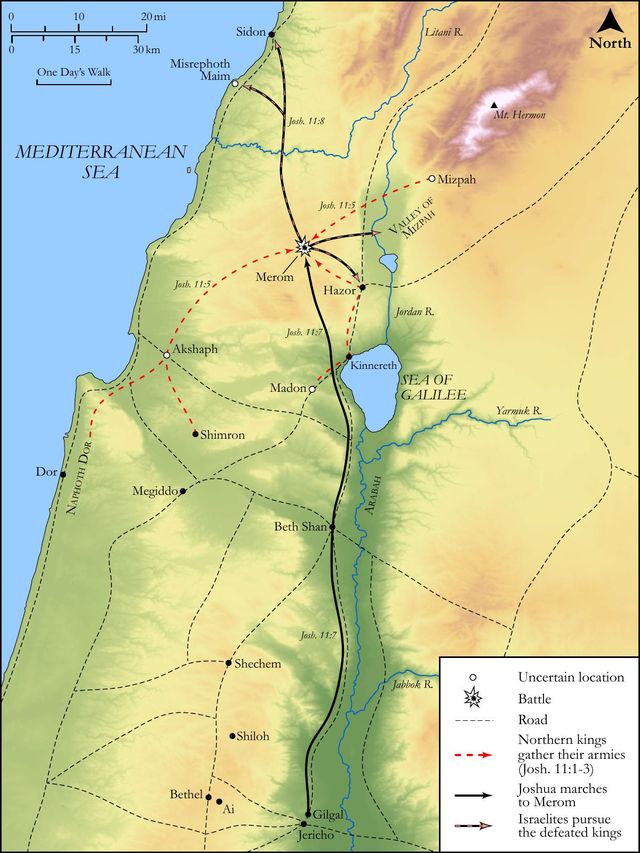
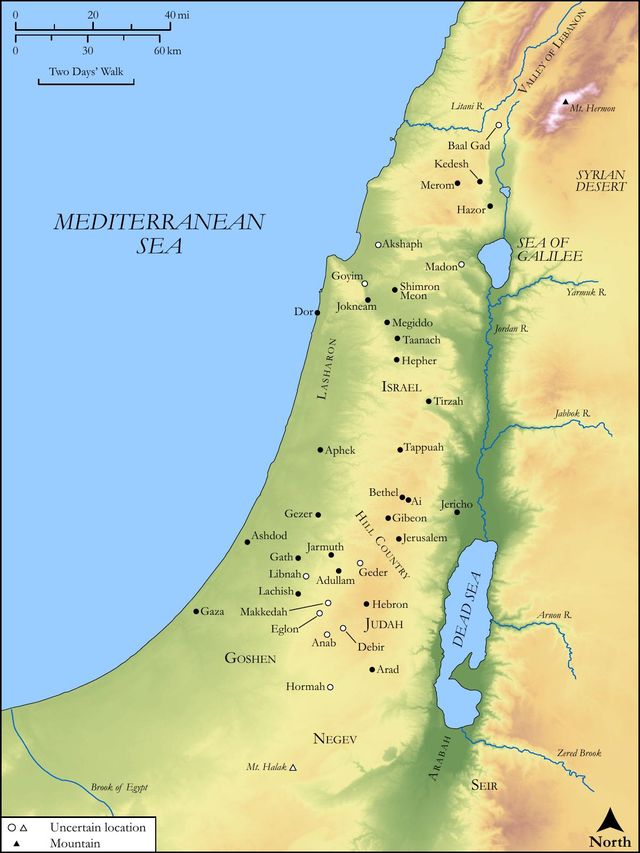
See on the biblical-era maps
Study this verse
Public-domain commentary
Matthew Henry
From his Commentary on the Whole Bible. Henry comments on passages, not single verses — this entry covers Joshua 11:15–23. His two-level outline is real structure in the source text, so it is rendered as structure.
We have here the conclusion of this whole matter.
I.A short account is here given of what was done in four things:
- 1. The obstinacy of the Canaanites in their opposition to the Israelites. It was strange that though it appeared so manifestly that God fought for Israel, and in every engagement the Canaanites had the worst of it, yet they stood it out to the last; not one city made peace with Israel, but the Gibeonites only, who understood the things that belonged to their peace better than their neighbours, Jos 11:19. It is intimated that other cities might have made as good terms for themselves, without ragged clothes and clouted shoes, if they would have humbled themselves, but they never so much as desired conditions of peace. We here are told whence this unaccountable infatuation came: It was of the Lord to harden their hearts, Jos 11:20. As Pharaoh's heart was hardened by his own pride and wilfulness first, and afterwards by the righteous judgment of God, to his destruction, so were the hearts of these Canaanites. To punish them for all their other follies, God left them to this, to make those their enemies whom they might have made their friends. This was it that ruined them: they came against Israel in battle, and gave the first blow, and therefore might have no favour shown them. Those know not what they do who give the provocation to divine justice, or the authorized instruments of it. Are we stronger than God? Observe here, That hardness of heart is the ruin of sinners. Those that are stupid and secure, and heedless of divine warnings, are already marked for destruction. What hope is there of those concerning whom God has said, Go, make their hearts fat? 2. The constancy of the Israelites in prosecuting this war (Jos 11:18): Joshua made war a long time; some reckon it five years, others seven, that were spent in subduing this land: so long God would train up Israel to war, and give them repeated instances of his power and goodness in every new victory that he gave them. 3. The conquest of the Anakim at last, Jos 11:21, Jos 11:22. Either this was done as they met with them where they were dispersed, as some think, or rather it should seem the Anakim had retired to their fastnesses, and so were hunted out and cut off at last, after all the rest of Israel's enemies. The mountains of Judah and Israel were the habitations of those mountains of men; but not their height, nor the strength of their caves, nor the difficulty of the passes to them, could secure, no, not these mighty men, from the sword of Joshua. The cutting off of the sons of Anak is particularly mentioned because these had been such a terror to the spies forty years before, and their bulk and strength had been thought an insuperable difficulty in the way of the reducing of Canaan, Num 13:28, Num 13:33. Even that opposition which seemed invincible was got over. Never let the sons of Anak be a terror to the Israel of God, for even their day will come to fall. Giants are dwarfs to Omnipotence; yet this struggle with the Anakim was reserved for the latter end of the war, when the Israelites had become more expert in the arts of war, and had had more experience of the power and goodness of God. Note, God sometimes reserves the sharpest trials of his people by affliction and temptation for the latter end of their days. Therefore let not him that girds on the harness boast as he that puts it off. Death, that tremendous son of Anak, is the last enemy that is to be encountered; but it is to be destroyed, Co1 15:26. Thanks be to God, who will give us the victory. 4. The end and issue of this long war. The Canaanites were rooted out, not perfectly (as we shall find after in the book of Judges), but in a good measure; they were not able to make any head either, (1.) So as to keep the Israelites out of possession of the land: Joshua took all that land, Jos 11:16, Jos 11:17. And we may suppose the people dispersed themselves and their families into the countries they had conquered, at least those that lay nearest to the head-quarters at Gilgal, until an orderly distribution should be made by lot, that every man might know his own. Or, (2.) So as to keep them in action, or give them any molestation (Jos 11:23): The land rested from war. It ended not in a peace with the Canaanites (that was forbidden), but in a peace from them. There is a rest, a rest from war, remaining for the people of God, into which they shall enter when their warfare is accomplished.
II.That which was now done is here compared with that which had been said to Moses.
God's word and his works, if viewed and considered together, will mutually illustrate each other. It is here observed in the close,
1.That all the precepts God had given to Moses relating to the conquest of Canaan were obeyed on the people's part, at least while Joshua lived. See how solemnly this is remarked (Jos 11:15): As the Lord commanded Moses his servant, by whose hand the law was given, so did Moses command Joshua, for Moses was faithful, as a law-giver, to him that appointed him; he did his part, and then he died: but were the commands of Moses observed when he was in his grave? Yes, they were: So did Joshua, who was, in his place, as faithful as Moses in his. He left nothing undone (Heb. he removed nothing) of all that the Lord commanded Moses. Those that leave their duty undone do what they can to remove or make void the command of God, by which they are bound to do it; but Joshua, by performing the precept, confirmed it, as the expression is, Deu 27:26. Joshua was himself a great commander, and yet nothing was more his praise than his obedience. Those that rule others at their will must themselves be ruled by the divine will; then their power is indeed their honour, and not otherwise. The pious obedience for which Joshua is here commended respects especially the command to destroy the Canaanites, and to break down their altars and burn their images, Deu 7:2-5; Exo 23:24; Exo 34:13. Joshua, in his zeal for the Lord of hosts, spared neither the idols nor the idolaters. Saul's disobedience, or rather his partial obedience, to the command of God, for the utter destruction of the Amalekites, cost him his kingdom. It should seem Joshua himself gives this account of his most careful and punctual observance of his orders in the execution of his commission, that in all respects he had done as Moses commanded him; and then it intimates that he had more pleasure and satisfaction in reflecting upon his obedience to the commands of God in all this war, and valued himself more upon that, than upon all the gains and triumphs with which he was enriched and advanced.
2.That all the promises God had given to Moses relating to this conquest were accomplished on his part, Jos 11:23. Joshua took the whole land, conquered it, and took possession of it, according to all that the Lord said unto Moses. God had promised to drive out the nations before them (Exo 33:2; Exo 34:11), and to bring them down, Deu 9:3. And now it was done. There failed not one word of the promise. Our successes and enjoyments are then doubly sweet and comfortable to us when we see them flowing to us from the promise (this is according to what the Lord said), as our obedience is then acceptable to God when it has an eye to the precept. And, if we make conscience of our duty, we need not question the performance of the promise.
Historical interpretation
Historical reception
1 surviving comment on this verse from the historical church.
It is asked how this can be true, since the Hebrews were not altogether able to capture all the cities of those seven nations either in the times after the judges or in the times of the kings. But one must understand it to mean that Joshua never approached any city with hostile intent that he did not capture. Or it may mean that no city remained uncaptured except for those which were in the regions mentioned above. For those regions were enumerated in which there were cities concerning which the conclusion was made: “and he captured all of them in war.”
Continue studying Joshua 11:16 across the web’s major study libraries — every link below opens this exact verse, chapter, or book on the destination site.
Read & Compare
 BibleGatewayThis verse in more than 200 translations and 70 languages.
 Bible.comThe YouVersion reader — hundreds of translations, reading plans, and highlights.
 ESV.orgCrossway's official English Standard Version reader.
 NET BibleThe NET translation with 60,000+ translators' notes on every rendering decision.
 STEP BibleTyndale House's free study tool — original text, vocabulary, and scholarly resources.
 BibliaLogos Bible Software's free web reader.
 USCCBThe New American Bible (Revised Edition) with the U.S. bishops' study notes.
Commentaries
 BibleHub CommentariesDozens of classic commentaries on this verse, gathered on one page.
 StudyLightMore than 100 commentary sets — the largest collection on the web.
 BibleRefPlain-English commentary on what this verse means, verse by verse.
 Enduring WordDavid Guzik's free commentary on this chapter, widely used by Bible teachers.
 Bible Study ToolsVerse commentary alongside Greek and Hebrew study aids.
Original Language & Research
- BibleHub InterlinearThe verse word by word — original language, transliteration, and English.
- BibleHub LexiconEvery word's original-language definition and Strong's entry.
 Blue Letter BibleDeep-study tools — Strong's numbers, concordance, and word studies.
 SefariaThe Hebrew text with Rashi and centuries of Jewish commentary.
Sermons, Hymns & Audio


TrulyRandomVerse is not affiliated with these sites and doesn’t control their content. They’re linked because they’re genuinely useful.
Summary
Joshua 11:16 serves as a pivotal summary statement within the Book of Joshua, encapsulating the extensive and decisive success of the Israelite conquest of Canaan under Joshua's divinely empowered leadership. Following detailed accounts of specific military campaigns in both the southern and northern regions, this verse provides a sweeping geographical overview of the vast territory that had been brought under Israelite control, signifying the substantial fulfillment of God's ancient covenant promises regarding the land. It underscores the thoroughness of the conquest, setting the stage for the subsequent division of the land among the twelve tribes of Israel.
Context
ShowHideLiterary Context
Joshua 11:16 functions as a grand summary following the climactic northern campaign described in Joshua 11:1-15. Prior to this, Joshua 10 detailed the conquest of the southern kings, culminating in the complete defeat of their coalition. This verse, therefore, serves as a comprehensive overview of the entire land-taking phase, bridging the narrative from active warfare to the subsequent phase of land distribution and settlement, which begins in Joshua 13. It marks a significant transition, signaling that the primary military objectives of securing the land have been achieved, even as pockets of resistance remained. The detailed geographical listing not only summarizes what has been conquered but also emphasizes the vastness of the inheritance God was providing.
Historical & Cultural Context
The conquest described in Joshua must be understood within the setting of Canaan in the days of Joshua, a land of many city-states under their own kings, marked by frequent military campaigns and shifting alliances. The Israelite conquest, however, was unique in its divine mandate, often referred to as "holy war" or "herem" (devotion to destruction), where God commanded the complete dispossessing of the Canaanite inhabitants due to their pervasive idolatry and moral corruption, as detailed in Deuteronomy 7:1-6. The geographical terms listed—"hills," "south country," "Goshen," "valley," "plain," "mountain of Israel"—refer to specific, identifiable regions within Canaan, from the central highlands to the Negev desert, illustrating the diverse topography and strategic importance of the land. "Goshen" here refers to a region in southern Judah, distinct from the Egyptian Goshen. The thoroughness implied by the listing of these diverse regions reflects the comprehensive nature of the divinely ordained task.
Key Themes
ShowHideThis verse powerfully reinforces several overarching themes found throughout the book of Joshua and the Pentateuch. Foremost is the Fulfillment of Divine Promise, as God's ancient covenant with Abraham, Isaac, and Jacob concerning the land, first articulated in Genesis 12:7, is seen coming to fruition. The detailed geographical enumeration highlights the Thoroughness of Conquest, emphasizing that Israel did not merely occupy a small portion but took substantial possession of diverse and strategically important regions, from the central highlands to the southern plains. This thoroughness was crucial for establishing their national identity and religious distinctiveness. Furthermore, the success is presented as a direct result of Divine Sovereignty and Human Obedience. While Joshua's leadership was instrumental, the ultimate victory is attributed to God's power and faithfulness, contingent upon Joshua's unwavering obedience to God's commands, a principle stressed from the very beginning of the book in Joshua 1:7-9. Finally, the verse serves as a Foundation for Inheritance, setting the stage for the detailed division of the land among the tribes, confirming their rightful possession of the promised inheritance, as seen in Joshua 14:1-5.
Exposition and Analysis
ShowHideKey Word Analysis
ShowHideThe verb "took" (H3947, lâqach) is a primitive root meaning "to take" in the widest variety of applications, including to accept, bring, buy, carry away, seize, or win. In this context, it signifies a decisive and complete act of acquisition and conquest, not merely a casual occupation. It emphasizes Joshua's active and successful role as the military leader, executing God's will to dispossess the Canaanites and establish Israel's dominion over the land. This word choice underscores the intentional and successful nature of the military campaigns.
The word "land" (H776, ʼerets) refers to the earth at large or partitively, a specific country or field. In this phrase, "all that land" (Hebrew, kol ha'aretz), it is crucial for understanding the comprehensive scope of the conquest. While not implying every square inch was immediately settled or every single inhabitant eradicated (as later chapters like Joshua 13:1 will clarify), it signifies that the major strategic territories and strongholds had been subdued. It conveys the idea of comprehensive military victory and the establishment of Israelite hegemony over the vast majority of the promised territory, making it available for tribal allotment.
The term "hills" (H2022, har) is a shortened form of הָרָר (harar), referring to a mountain or range of hills. This region, often synonymous with the central mountain range or highlands of Canaan, running north to south, was strategically vital and often heavily fortified. Its inclusion signifies the conquest of the rugged, elevated terrain that formed the backbone of the land, demonstrating that even the most challenging geographical areas had been brought under Israelite control. This contrasts with the "valley" and "plain," indicating a comprehensive taking of diverse topographies.
Verse Breakdown
ShowHide"So Joshua took all that land"
This opening clause provides the overarching summary, attributing the comprehensive conquest directly to Joshua's leadership. It signifies the successful execution of God's command to possess the land, indicating a decisive military victory.
"the hills"
This refers to the central mountain range, encompassing areas like the hill country of Judah and Ephraim, which were often difficult to conquer due to their natural defenses. Its inclusion shows the depth and challenge of the conquest that was overcome.
"and all the south country"
This designates the Negeb (H5045, negeb) desert region, the semi-arid southern part of Canaan, indicating that Israel's dominion extended to the southern borders of the promised land.
"and all the land of Goshen"
This specifies a fertile region within southern Judah, distinct from the Goshen in Egypt. Its mention highlights the acquisition of specific, agriculturally valuable areas within the broader southern conquest.
"and the valley, and the plain"
These terms refer to the low-lying areas. The "valley" (H8219, shᵉphêlâh) denotes the maritime slope or low country, while the "plain" (H6160, ʻărâbâh) refers to a desert or, specifically, the sterile valley of the Jordan. Their inclusion alongside the "hills" and "mountain" demonstrates the conquest of diverse topographical features, from elevated to low-lying regions.
"and the mountain of Israel, and the valley of the same;"
"The mountain of Israel" likely refers to the central highlands of Ephraim and Manasseh, the heartland of Israel. The repetition of "and the valley of the same" emphasizes that the surrounding valleys and lower areas associated with this central mountain range were also taken, reinforcing the thoroughness and completeness of the conquest in the most vital areas.
Literary Devices
ShowHideJoshua 11:16 employs several literary devices to convey its message of comprehensive conquest. The most prominent is Merism, where contrasting or complementary parts are listed to represent a totality. By listing "the hills," "the south country," "the land of Goshen," "the valley," "the plain," and "the mountain of Israel," the text uses diverse geographical features to signify that the entirety of the land, from its highest points to its lowest, from north to south, was taken. This creates a powerful sense of completeness and thoroughness. Repetition is also evident, particularly with the word "all" ("all that land," "all the south country," "all the land of Goshen") and the pairing of "valley" with "mountain," which reinforces the idea of comprehensive dominion. Finally, the verse functions as a powerful Summary Statement, providing a concise and definitive overview of the military phase of the conquest, effectively closing one major narrative section and preparing the reader for the next.
Theological and Thematic Connections
ShowHideJoshua 11:16 stands as a powerful testament to the unwavering faithfulness of God in fulfilling His ancient promises. For centuries, the descendants of Abraham had awaited the inheritance of the land promised to their patriarch, as recorded in Genesis 12:7 and reaffirmed in Genesis 15:18-21. This verse declares that, through Joshua's obedient leadership, God had indeed delivered on His word, establishing Israel as a nation in their own sovereign territory. It highlights the divine initiative behind the conquest, emphasizing that Israel's success was not merely a result of military prowess but a miraculous act of God's power and commitment to His covenant. The comprehensive nature of the conquest, encompassing diverse geographical regions, underscores the magnitude of God's provision and the thoroughness of His work in dispossessing the nations, as commanded in Deuteronomy 7:1-2. This fulfillment culminates in the declaration of Joshua 21:43-45, affirming that "not one word of all the good promises that the LORD had made to the house of Israel had failed; all came to pass."
Reflection and Application
ShowHideJoshua 11:16 offers profound lessons for believers today, primarily centered on the faithfulness of God and the importance of obedience. Just as God meticulously fulfilled His ancient promises to Israel concerning the physical land, we can trust in His unchanging character and His unwavering commitment to His promises in our lives. This verse reminds us that God is a promise-keeping God, and His word is utterly reliable. Furthermore, Joshua's success was directly tied to his diligent obedience to God's commands. Similarly, our spiritual progress, our ability to "take possession" of the spiritual blessings and callings God has for us, is often contingent upon our willingness to listen to and obey His Word. While we do not inherit a physical land, believers have a rich spiritual inheritance in Christ—salvation, peace, purpose, and eternal life. This verse encourages us to actively appropriate these spiritual realities, living out our faith boldly and confidently in the knowledge that God has already secured our victory in Christ.
Questions for Reflection
ShowHideFAQ
ShowHideWhat is the significance of the detailed geographical list in Joshua 11:16?
ShowHideThe detailed geographical list ("the hills, and all the south country, and all the land of Goshen, and the valley, and the plain, and the mountain of Israel, and the valley of the same") is highly significant. It serves as a literary device (merism) to emphasize the comprehensive nature of the conquest. By naming diverse topographical regions, from rugged mountains to fertile valleys and arid plains, the text conveys that the Israelites had established dominion over the vast majority of the promised land. It is not an exhaustive list of every single territory, but it powerfully communicates that the main strategic and populated areas were under Israelite control, fulfilling God's promise to give them the land, as seen in Genesis 15:18. This thoroughness was crucial for the subsequent tribal allotments and the establishment of Israel as a nation.
Was the conquest truly 'complete' at this point, given later passages in Joshua?
ShowHideJoshua 11:16 describes a comprehensive military victory, signifying that the major strategic strongholds and coalitions of kings had been defeated, and the land was largely brought under Israelite hegemony. However, it does not mean every single Canaanite inhabitant was expelled or every square inch of territory was fully settled. Joshua 13:1 explicitly states, "Now Joshua was old and stricken in years; and the LORD said unto him, Thou art old and stricken in years, and there remaineth yet very much land to be possessed." This indicates that while the military phase of the conquest was largely complete, and the land was now available for inheritance, the settlement phase and the complete dispossessing of all inhabitants would be an ongoing process for the individual tribes. Joshua 11:16 serves as a summary of the primary military success, making the land available for inheritance, rather than a declaration of absolute, immediate, and total occupation of every last village.
How does 'the land of Goshen' mentioned here relate to the Goshen in Egypt?
ShowHideThe "land of Goshen" in Joshua 11:16 refers to a specific, fertile region located in the southern part of the land of Judah, within Canaan. This is distinct from the "land of Goshen" in Egypt, where the Israelites settled during their time there before the Exodus, as described in Genesis 47:6. While both share the same name, they are geographically separate and historically unrelated. The mention of Goshen in Joshua 11:16 simply identifies another specific area within the conquered territory of Canaan, highlighting the breadth of the Israelite conquest.
Christ-Centered Fulfillment
ShowHideJoshua 11:16, a powerful declaration of a physical conquest and the fulfillment of a land promise, finds its ultimate and spiritual fulfillment in Jesus Christ. Joshua, whose name (Yeshua) is the Hebrew equivalent of Jesus, foreshadows Christ as the greater leader who leads His people into their true inheritance. Just as Joshua led Israel to conquer and possess the promised land, Jesus, through His death and resurrection, has conquered sin, death, and the powers of darkness, leading His people into a far greater spiritual inheritance. The "all that land" taken by Joshua prefigures the comprehensive spiritual dominion Christ has secured for believers. Our inheritance is not a physical territory but "all spiritual blessings in heavenly places in Christ" (Ephesians 1:3). Through Christ, we are brought into the "kingdom of his dear Son" (Colossians 1:13), a spiritual realm of peace, righteousness, and joy. The thoroughness of Joshua's conquest points to the absolute and complete victory of Christ, who "made a public spectacle of them, triumphing over them by the cross" (Colossians 2:15). Believers are called to "take possession" of this spiritual inheritance by faith, living out the reality of Christ's victory in their lives, knowing that our true rest and eternal dwelling place are found not in an earthly land but in Him, our ultimate Sabbath rest.