


Jeremiah 8:5
- מַדּוּעַma·Du·a'why?H4069InterrogParticle Interrogative
- שׁוֹבְבָהsho·Vahhas it turned awayH7725V-Qal-Prtcpl-fsVerb Qal Participle Singular Feminine Absolute
- הָעָםha·'Amthe peopleH5971Art ¦ N-msNoun Singular Masculine Absoluteהָtheעָםpeople
- הַזֶּהha·Zeh<the> thisH2088Art ¦ PrtParticle Demonstrativeהַ<the>זֶּהthis
- יְרוּשָׁלִַםye·ru·sha·LimJerusalemH3389N-properNoun Proper Location
- מְשֻׁבָהme·shu·VahapostasyH4878N-fsNoun Singular Feminine Absolute
- נִצַּחַתni·Tza·chatenduringH5329V-Niphal-Prtcpl-fsVerb Niphal Participle Singular Feminine Absolute
- הֶחֱזִיקוּhe·che·Zi·kuthey have kept holdH2388V-Hiphil-Perf-3cpVerb Hiphil Perfect 3rd Plural common gender
- בַּתַּרְמִיתba·tar·Miton <the> deceitfulnessH8649Prep-b ¦ N-fsNoun Singular Feminine Absoluteבַּon <the>תַּרְמִיתdeceitfulness
- מֵאֲנוּme·'a·Nuthey have refusedH3985V-Piel-Perf-3cpVerb Piel Perfect 3rd Plural common gender
- לָשׁוּבla·Shuvto returnH7725Prep-l ¦ V-Qal-InfVerb Qal Infinitive Constructלָtoשׁוּבreturn
English is a literal word-by-word gloss of the Hebrew, not the KJV's wording. Why?
This is the original text the KJV's translators worked from — each Hebrew word with its own literal English meaning in this verse, prepared by scholars at Tyndale House, Cambridge. The KJV translates whole sentences, not word by word, so its wording differs: one Hebrew word can become several English words, and the KJV may choose “the LORD” where the gloss reads “Yahweh”. Both are faithful — they answer different questions. For the KJV's own rendering, switch to the KJV text.
Details
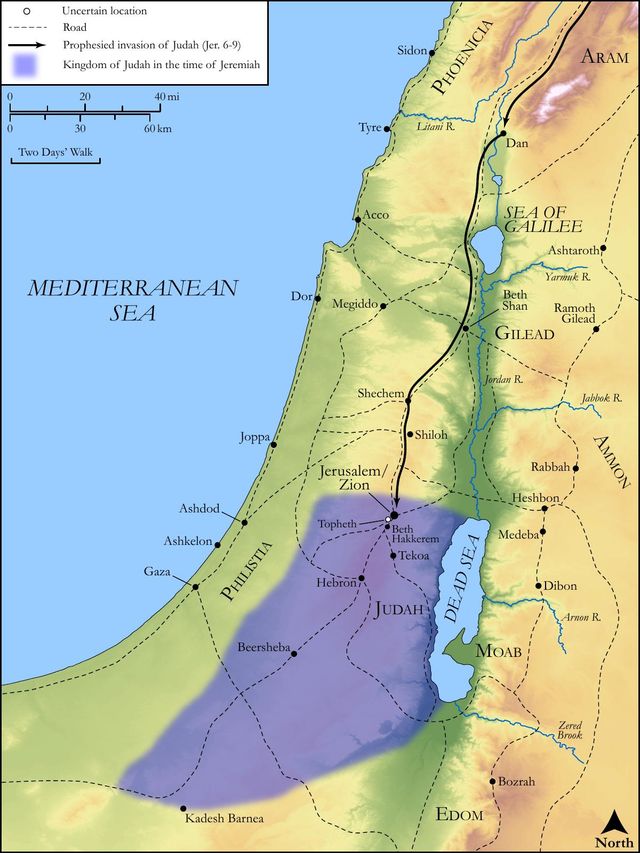
See on the biblical-era map
Study this verse
Public-domain commentary
Matthew Henry
From his Commentary on the Whole Bible. Henry comments on passages, not single verses — this entry covers Jeremiah 8:4–12. His three-level outline is real structure in the source text, so it is rendered as structure.
The prophet here is instructed to set before this people the folly of their impenitence, which was it that brought this ruin upon them. They are here represented as the most stupid senseless people in the world, that would not be made wise by all the methods that Infinite Wisdom took to bring them to themselves and their right mind, and so to prevent the ruin that was coming upon them.
I.They would not attend to the dictates of reason.
They would not act in the affairs of their souls with the same common prudence with which they acted in other things. Sinners would become saints if they would but show themselves men, and religion would soon rule them if right reason might. Observe it here. Come, and let us reason together, saith the Lord (Jer 8:4, Jer 8:5): Shall men fall and not arise? If men happen to fall to the ground, to fall into the dirt, will they not get up again as fast as they can? They are not such fools as to lie still when they are down. Shall a man turn aside out of the right way? Yes, the most careful traveller may miss his way; but then, as soon as he is aware of it, will he not return? Yes, certainly he will, with all speed, and will thank him that showed him his mistake. Thus men do in other things. Why then has this people of Jerusalem slidden back by a perpetual backsliding? Why do not they, when they have fallen into sin, hasten to get up again by repentance? Why do not they, when they see they have missed their way, correct their error and reform? No man in his wits will go on in a way that he knows will never bring him to his journey's end; why then has this people slidden back by a perpetual backsliding? See the nature of sin - it is a backsliding it is going back from the right way, not only into a by-path, but into a contrary path, back from the way that leads to life to that which leads to utter destruction. And this backsliding, if almighty grace do not interpose to prevent it, will be a perpetual backsliding. The sinner not only wanders endlessly, but proceeds end-ways towards ruin. The same subtlety of the tempter that brings men to sin holds them fast in it, and they contribute to their own captivity: They hold fast deceit. Sin is a great cheat, and they hold it fast; they love it dearly, and resolve to stick to it, and baffle all the methods God takes to separate between them and their sins. The excuses they make for their sins are deceits, and so are all their hopes of impunity; yet they hold fast these, and will not be undeceived, and therefore they refuse to return. Note, There is some deceit or other which those hold fast that go on wilfully in sinful ways, some lie in their right hand, by which they keep hold of their sins.
II.They would not attend to the dictates of conscience, which is our reason reflecting upon ourselves and our own actions, Jer 8:6. Observe,
1.What expectations there were from them, that they would bethink themselves: I hearkened and heard. The prophet listened to see what effect his preaching had upon them; God himself listened, as one that desires not the death of sinners, that would have been glad to hear any thing that promised repentance, that would certainly have heard it if there had been any thing said of that tendency, and would soon have answered it with comfort, as he did David when he said, I will confess, Psa 32:5. God looks upon men when they have done amiss (Job 33:27), to see what they will do next; he hearkens and hears.
2.How these expectations were disappointed: They spoke not aright, as I thought they would have done. They did not only not do right, but not so much as speak right; God could not get a good word from them, nothing on which to ground any favour to them or hopes concerning them. There was none of them that spoke aright, none that repented him of his wickedness. those that have sinned then, and then only, speak aright when they speak of repenting; and it is sad when those that have made so much work for repentance do not say a word of repenting. Not only did God not find any repenting of the national wickedness, which might have helped to empty the measure of public guilt, but none repented of that particular wickedness which he knew himself guilty of.
(1.)They did not so much as take the first step towards repentance; they did not so much as say, What have I done? There was no motion towards it, not the least sign or token of it. Note, True repentance beings in a serious and impartial inquiry into ourselves, what have we done, arising from a conviction that we have done amiss.
(2.)They were so far from repenting of their sins that they went on resolutely in their sins: Every one turned to his course, his wicked course, that course of sin which he had chosen and accustomed himself to, as the horse rushes into the battle, eager upon action, and scorning to be curbed. How the horse rushes into the battle is elegantly described, Job 39:21, etc. He mocks at fear and is not affrighted. Thus the daring sinner laughs at the threatenings of the word as bugbears, and runs violently upon the instruments of death and slaughter, and nothing will be restrained from him.
III.They would not attend to the dictates of providence, nor understand the voice of God in them, Jer 8:7.
It is an instance of their sottishness that, though they are God's people, and therefore should readily understand his mind upon every intimation of it, yet they know not the judgment of the Lord; they apprehend not the meaning either of a mercy or an affliction, not how to accommodate themselves to either, nor to answer God's intention in either. They know not how to improve the seasons of grave that God affords them when he sends them his prophets, nor how to make use of the rebukes they are under when his voice cries in the city. They discern not the signs of the times (Mat 16:3), nor are aware how God is dealing with them. They know not that way of duty which God had prescribed them, though it be written both in their hearts and in their books. 2. It is an aggravation of their sottishness that there is so much sagacity in the inferior creatures. The stork in the heaven knows her appointed times of coming and continuing; so do other season-birds, the turtle, the crane, and the swallow. These by a natural instinct change their quarters, as the temper of the air alters; they come when the spring comes, and go, we know not whither, when the winter approaches, probably into warmer climates, as some birds come with winter and go when that is over.
IV.They would not attend to the dictates of the written word.
They say, We are wise; but how can they say so? Jer 8:8. With what face can they pretend to any thing of wisdom, when they do not understand themselves so well as the brute-creatures? Why, truly, they think they are wise because the law of the Lord is with them, the book of the law and the interpreters of it; and their neighbours, for the same reason, conclude they are wise, Deu 4:6. But their pretensions are groundless for all this: Lo, certainly in vain made he it; surely never any people had Bibles to so little purpose as they have. They might as well have been without the law, unless they had made a better use of it. God has indeed made it able to make men wise to salvation, but as to them it is made so in vain, for they are never the wiser for it: The pen of the scribes, of those that first wrote the law and of those that now write expositions of it, is in vain. Both the favour of their God and the labour of their scribes are lost upon them; they receive the grace of God therein in vain. Note, There are many that enjoy abundance of the means of grace, that have great plenty of Bibles and ministers, but they have them in vain; they do not answer the end of their having them. But it might be said, They have some wise men among them, to whom the law and the pen of the scribes are not in vain. To this it is answered (Jer 8:9): The wise men are ashamed, that is, they have reasons to be so, that they have not made a better use of their wisdom, and lived more up to it. They are confounded and taken; all their wisdom has not served to keep them from those courses that tend to their ruin. They are taken in the same snares that others of their neighbours, who have not pretended to so much wisdom, are taken in, and filled with the same confusion. Those that have more knowledge than others, and yet do no better than others for their own souls, have reason to be ashamed. They talk of their wisdom, but, Lo, they have rejected the word of the Lord; they would not be governed by it, would not follow its direction, would not do what they knew; and then what wisdom is in them? None to any purpose; none that will be found to their praise at the great day, how much soever it is found to their pride now. The pretenders to wisdom, who said, "We are wise and the law of the Lord is with us," were the priests and the false prophets; with them the prophet here deals plainly.
1.He threatens the judgments of God against them. Their families and estates shall be ruined (Jer 8:10): Their wives shall be given to others, when they are taken captives, and their fields. shall be taken from them by their victorious enemy and shall be given to those that shall inherit them, not only strip them for once, but take possession of them as their own and acquire a property in them as their own and acquire a property in them, which they shall transmit to their posterity. And (Jer 8:12), notwithstanding all their pretensions to wisdom and sanctity, they shall fall among those that fall; for, if the blind lead the blind, both shall fall together into the ditch. In the time of their visitation, when the wickedness of the land comes to be enquired into, it will be found that they have contributed to it more than any, and therefore they shall be sure to be cast down and cast out.
2.He gives a reason for these judgments (Jer 8:10-12), even the same account of their badness which we meet with before (Jer 6:13-15), where it was opened at large.
(1.)They were greedy of the wealth of this world, which is bad enough in any, but worst in prophets and priests, who should be best acquainted with another world and therefore should be most dead to this. But these, from the least to the greatest, were given to covetousness. The priests teach for hire and the prophets divine for money, Mic 3:11.
(2.)They made no conscience of speaking truth, no, not when they spoke as priests and prophets: Every one deals falsely, looks one way and rows another. There is no such thing as sincerity among them.
(3.)They flattered people in their sins, and so flattered them into destruction. They pretended to be the physicians of the state, but knew not how to apply proper remedies to its growing maladies; they healed them slightly, killed the patient with palliative cures, silencing their fears and complaints with, "Peace, peace, all is well, and there is no danger," when the God of heaven was proceeding in his controversy with them, so that there could be no peace to them.
(4.)When it was made to appear how basely they prevaricated they were not at all ashamed of it, but rather gloried in it, (Jer 8:12): They could not blush, so perfectly lost were they to all sense of virtue and honour. When they were convicted of the grossest forgeries they would justify what they had done, and laugh at those whom they had imposed upon. Such as these were ripe for ruin.
Historical interpretation
Historical reception
4 surviving comments on this verse. Each one is dated, so this reads as a timeline rather than a list.
Select a marker to jump to its quote. Markers stagger vertically where authors wrote within a few decades of each other.
They have all abandoned him. There is no one who speaks well and does penance for his sins. They follow their own wills like a horse ready for battle. They bend their tongue as a bow. They invent everything, and there is no truth in them.
(Verse 5) Therefore, why is this people in Jerusalem turned away with contentious turning away? They have grasped falsehood and did not want to return. As much as I have provoked them to repentance, they have turned away from me, not so much out of a desire to sin, but to overcome me. For they have strongly grasped falsehood, whether idols or every corrupt thing that is contrary to truth and justice, and they did not want to return. It is not said: they were not able; but they have eagerly followed unjust things.
Those then who perish, perish against his will. This he testifies against each one of them day by day: “Turn from your evil ways. Why will you die, O house of Israel?” And again: “How often would I have gathered your children together as a hen gathers her chickens under her wings, but you would not.” And: “Why has this people in Jerusalem turned away with a stubborn revolting? They have hardened their faces and refused to return.” The grace of the Christ then is at hand every day. For it “wills all to be saved and to come to the knowledge of the truth.” It calls all without any exception, saying, “Come to me, all you who labor and are heavy laden, and I will refresh you.”
Just as there is no illness that is incurable for our physician, so the heavenly medicine cannot be powerless in any wound or for any length of time. Therefore, the physician testifies that he is always able to restore health to the one converted. He says, “In returning and rest, you shall be saved.” Hence God, through Jeremiah, does not cease to reprove the hardheartedness of certain ones. Instead he says in this way: “When people fall, do they not get up again? If they go astray, do they not turn back? Why then has this people turned away in perpetual backsliding? They have held fast to deceit. They have refused to return.” God does not punish the sins in the sinner, if the neck of the sinner is not stiffened.
Continue studying Jeremiah 8:5 across the web’s major study libraries — every link below opens this exact verse, chapter, or book on the destination site.
Read & Compare
 BibleGatewayThis verse in more than 200 translations and 70 languages.
 Bible.comThe YouVersion reader — hundreds of translations, reading plans, and highlights.
 ESV.orgCrossway's official English Standard Version reader.
 NET BibleThe NET translation with 60,000+ translators' notes on every rendering decision.
 STEP BibleTyndale House's free study tool — original text, vocabulary, and scholarly resources.
 BibliaLogos Bible Software's free web reader.
 USCCBThe New American Bible (Revised Edition) with the U.S. bishops' study notes.
Commentaries
 BibleHub CommentariesDozens of classic commentaries on this verse, gathered on one page.
 StudyLightMore than 100 commentary sets — the largest collection on the web.
 BibleRefPlain-English commentary on what this verse means, verse by verse.
 Enduring WordDavid Guzik's free commentary on this chapter, widely used by Bible teachers.
 Bible Study ToolsVerse commentary alongside Greek and Hebrew study aids.
Original Language & Research
- BibleHub InterlinearThe verse word by word — original language, transliteration, and English.
- BibleHub LexiconEvery word's original-language definition and Strong's entry.
 Blue Letter BibleDeep-study tools — Strong's numbers, concordance, and word studies.
 SefariaThe Hebrew text with Rashi and centuries of Jewish commentary.
Sermons, Hymns & Audio


TrulyRandomVerse is not affiliated with these sites and doesn’t control their content. They’re linked because they’re genuinely useful.
Summary
Jeremiah 8:5 captures the Lord's profound lament and rhetorical question concerning the persistent spiritual decline of the people of Jerusalem and Judah. Through the prophet Jeremiah, God expresses His dismay at their stubborn refusal to repent and their deep-seated commitment to falsehoods, despite continuous warnings and gracious calls to return to Him. The verse powerfully encapsulates the nation's chronic apostasy, their active embrace of deception, and their willful rejection of divine restoration.
Context
ShowHideLiterary Context
Jeremiah 8:5 is situated within a series of prophetic pronouncements (Jeremiah 7-10) where God, through Jeremiah, delivers a scathing indictment against Judah for its pervasive idolatry, moral corruption, and false security in the Temple. Chapter 8 specifically intensifies the theme of Judah's incorrigible rebellion, contrasting their stubbornness with the instinctive wisdom of migratory birds (Jeremiah 8:7). The preceding verses (Jeremiah 8:1-3) describe the gruesome desecration of graves as a consequence of their sin, while Jeremiah 8:4 sets the stage for the rhetorical question of verse 5 by asking why, if people fall, they do not rise again, or if they turn away, they do not return. This verse, therefore, serves as a climactic expression of divine exasperation at their persistent, irrational refusal to repent in the face of impending judgment, highlighting the profound disconnect between their actions and any semblance of reason.
Historical & Cultural Context
The book of Jeremiah is set during the tumultuous final decades of the Kingdom of Judah, spanning the reigns of Josiah, Jehoiakim, and Zedekiah (late 7th to early 6th centuries BC), leading up to the Babylonian exile. This period was marked by political instability, the rise of the Neo-Babylonian Empire, and a severe spiritual decline within Judah. Despite Josiah's reforms, the people quickly reverted to idolatry and syncretistic practices after his death. Culturally, the people had adopted the worship of Baal and other foreign deities, engaged in child sacrifice (Jeremiah 7:31), and practiced oppression, all while maintaining a superficial adherence to Temple rituals, believing it would protect them (Jeremiah 7:4). Jeremiah 8:5 highlights the deep-seated spiritual sickness that permeated society, where covenant unfaithfulness was not merely a lapse but an ingrained way of life, demonstrating a profound disconnect from the covenant established at Mount Sinai.
Key Themes
ShowHideJeremiah 8:5 powerfully contributes to several overarching themes in the book of Jeremiah. The primary theme is Judah's Incorrigible Rebellion and Apostasy, emphasizing a chronic and deep-seated turning away from God, not a momentary lapse. This is underscored by the phrase "perpetual backsliding," which signifies an ingrained pattern of disobedience, contrasting sharply with the natural order of repentance and return (as implied in Jeremiah 8:4). Another crucial theme is the Deception and False Security prevalent among the people, who "hold fast deceit." This refers to their reliance on false prophets who promised peace (Jeremiah 6:14) and their own self-deception regarding their spiritual condition, refusing to acknowledge the truth of God's impending judgment. Finally, the verse highlights God's Lament and Persistent Call to Repentance, even in the face of their stubbornness. Despite their refusal to "return," God consistently calls His people back to Himself, as seen throughout the prophetic literature (e.g., Hosea 6:1). The rhetorical question expresses divine sorrow and exasperation over their irrational and self-destructive choices.
Exposition and Analysis
ShowHideKey Word Analysis
ShowHideDerived from the root shûwb (H7725, to turn back), this noun specifically denotes "apostasy" or "turning away." In Jeremiah 8:5, when combined with "perpetual" (from H5329, nâtsach, meaning permanent or enduring), it emphasizes that Judah's departure from God was not an isolated incident or a temporary lapse but a chronic, deeply ingrained, and persistent state of spiritual rebellion. It signifies a deliberate and ongoing deviation from the covenant path, a fundamental turning away from the Lord.
This primitive root means "to fasten upon," "to seize," or "to be strong." Here, it conveys an active, firm, and stubborn grip. The people are not passively misled; they actively "strengthen themselves in" or "cling obstinately to" deceit. This implies a willful embrace and retention of falsehoods, whether from false prophets or their own self-justifying narratives, rather than yielding to divine truth. It suggests a determined, almost defiant, commitment to their chosen path of error.
This primitive root means "to refuse" or "to utterly deny." Its use here underscores the deliberate and intentional nature of Judah's disobedience. It is not a matter of ignorance or inability, but a conscious, stubborn, and unyielding rejection of God's call to repentance and restoration. This refusal highlights their hardened hearts and their active resistance to divine grace, indicating a profound and willful opposition to God's will.
Verse Breakdown
ShowHide"Why [then] is this people of Jerusalem slidden back by a perpetual backsliding?"
This opening rhetorical question expresses God's profound lament, exasperation, and bewilderment. It is not a question seeking information but rather a rhetorical device to highlight the utter irrationality and self-destructive nature of Judah's behavior. The phrase "perpetual backsliding" (literally "backsliding of perpetuity" or "enduring backsliding") emphasizes the chronic, unwavering, and ingrained nature of their apostasy. It signifies a deep-seated spiritual condition, not a temporary deviation, where the people of Jerusalem have consistently turned away from God, defying all logical expectation of return.
"they hold fast deceit"
This clause reveals the underlying cause and active choice behind their perpetual backsliding. The people are not merely misled; they actively and stubbornly "hold fast" or cling to "deceit." This "deceit" (Hebrew, tormâh, H8649) can refer to the false prophecies that promised peace and prosperity despite their sin, or more broadly, to their own self-deception and rationalizations that allowed them to persist in their wickedness without acknowledging their true spiritual state before God. It implies a willful embrace of lies over divine truth, a conscious preference for comforting falsehoods over uncomfortable realities.
"they refuse to return."
This final clause underscores the deliberate and unyielding nature of their rebellion. Despite God's persistent calls for repentance and restoration, the people make a conscious and stubborn choice to "refuse to return" (Hebrew, shûwb, H7725). This refusal is not born of ignorance but of a hardened heart and a defiant will, rejecting the very path that would lead to life and covenant faithfulness. It is a powerful statement of their willful disobedience and their ultimate rejection of God's gracious invitation, sealing their fate.
Literary Devices
ShowHideJeremiah 8:5 employs several potent literary devices to convey its message of divine lament and human stubbornness. The verse begins with a Rhetorical Question ("Why then is this people of Jerusalem slidden back by a perpetual backsliding?"), which serves not to elicit an answer but to express God's profound sorrow, exasperation, and the sheer irrationality of Judah's persistent rebellion. This question highlights the illogical and self-destructive nature of their choices, implying that their actions defy reason and natural instinct. Furthermore, there is a striking use of Wordplay or Repetition with "slidden back" (a form of shûwb) and "backsliding" (mᵉshûwbâh), both derived from the same Hebrew root. This emphasizes the continuous, chronic, and ingrained nature of their apostasy, underscoring that their turning away was not an accident but a perpetual state, a deeply embedded pattern of behavior. The phrase "they hold fast deceit" uses Personification or Metaphor, treating "deceit" as a tangible object that can be clung to, illustrating the people's active and stubborn embrace of falsehoods. This vivid imagery portrays their deep commitment to lies over truth, suggesting a willful and tenacious grip on error.
Theological and Thematic Connections
ShowHideJeremiah 8:5 profoundly illustrates the tragic consequences of a hardened heart and the human capacity for persistent rebellion against divine truth. It speaks to the theological reality of humanity's fallen nature, which, left unchecked, gravitates towards self-deception and a refusal to acknowledge sin or God's call to repentance. The "perpetual backsliding" of Judah serves as a stark warning that spiritual decline can become an entrenched state, where the embrace of "deceit" leads to a willful "refusal to return" to the source of life and truth. This verse highlights God's justice in holding His people accountable for their deliberate choices, even as His lament reveals His enduring love and desire for their restoration. It underscores the critical importance of repentance as the pathway back to God, a path that Judah stubbornly rejected, demonstrating the profound tragedy of unyielding human will against divine grace.
Reflection and Application
ShowHideJeremiah 8:5 offers a timeless mirror for self-examination, challenging us to honestly assess the state of our own hearts and our walk with God. The "perpetual backsliding" of Judah serves as a potent warning against spiritual apathy and the insidious nature of unaddressed sin. It prompts us to consider whether we, too, might be clinging to "deceit"—perhaps rationalizing our shortcomings, believing comforting lies about our spiritual health, or ignoring the clear truth of God's Word in favor of personal preferences or cultural norms. The "refusal to return" is a call to vigilance against stubbornness and pride, reminding us that God continually invites us to repentance and deeper communion. True spiritual health requires a humble and responsive heart, quick to confess sin, eager to embrace truth, and willing to turn back to the Lord when His Spirit convicts. This verse urges us to cultivate a posture of continuous repentance and a firm grip on the truth of Christ, rather than the deceptive allure of the world or our own fallen inclinations, ensuring our hearts remain pliable and receptive to divine grace.
Questions for Reflection
ShowHideFAQ
ShowHideWhat does "perpetual backsliding" mean in this context?
ShowHide"Perpetual backsliding" refers to a continuous, chronic, and ingrained state of apostasy or turning away from God. It signifies that the people of Jerusalem were not experiencing a temporary lapse in faith or an occasional stumble, but rather a deep-seated and unwavering pattern of disobedience and rebellion against the covenant relationship they had with Yahweh. It highlights the persistent nature of their spiritual decline, indicating a hardened heart and a consistent rejection of divine instruction and grace, making their condition appear fixed and unyielding.
What kind of "deceit" were the people holding fast to?
ShowHideThe "deceit" (tormâh) the people held fast to could refer to several things. Primarily, it likely refers to the false prophecies being proclaimed by prophets who promised peace and prosperity even as Judah plunged deeper into sin and judgment loomed (e.g., Jeremiah 6:14). These messages provided a comforting but ultimately destructive illusion of security. Additionally, it could encompass their own self-deception and rationalizations, where they convinced themselves that their idolatry and oppression were acceptable, or that their superficial adherence to Temple rituals would protect them from God's judgment (e.g., Jeremiah 7:4). This "deceit" represented a willful embrace of lies over divine truth, preventing them from acknowledging their true spiritual state and their urgent need for repentance.
Why did God express His dismay as a rhetorical question?
ShowHideGod's use of a rhetorical question ("Why then is this people...?") is a common prophetic device used to express profound lament, exasperation, and bewilderment, rather than seeking an actual answer. It highlights the utter irrationality and self-destructive nature of Judah's behavior. From a divine perspective, their continued rebellion in the face of clear warnings and impending judgment was illogical and indefensible. The question underscores God's sorrow over their choices and His desire for them to turn back, even as He acknowledges their stubborn refusal. It serves to emphasize the depth of their spiritual blindness and the tragedy of their chosen path, inviting the reader to likewise ponder the senselessness of rejecting divine grace.
Christ-Centered Fulfillment
ShowHideJeremiah 8:5, with its poignant description of a people in "perpetual backsliding" who "hold fast deceit" and "refuse to return," powerfully foreshadows humanity's universal spiritual condition apart from Christ. Just as Judah stubbornly clung to falsehoods and rejected God's call, so too does fallen humanity naturally gravitate away from God, embracing sin and self-deception. The "deceit" they held fast to is ultimately the lie that we can find life and fulfillment apart from our Creator, a lie that originated in the Garden of Eden (Genesis 3:4-5). However, the very "return" that Judah refused is gloriously fulfilled in Jesus Christ. He is the ultimate "way back" to God (John 14:6), the one who conquers the "deceit" of sin and death through His atoning sacrifice (Colossians 2:13-14). Through His resurrection, Christ offers not merely a temporary respite from backsliding, but a new creation (2 Corinthians 5:17) and the indwelling Holy Spirit, who empowers believers to turn from deceit and walk in newness of life (Romans 6:4). Thus, what Judah tragically refused—a genuine return to God—is made possible and eternally secured for all who believe in the Lamb of God, who takes away the sin of the world (John 1:29).