


Jeremiah 27:12
- וְאֶלve·'eland toH413Conj-w ¦ PrepPrepositionוְandאֶלto
- צִדְקִיָּהtzid·ki·YahZedekiahH6667N-proper-mNoun Proper Masculine
- מֶלֶךְMe·lekh[the] king ofH4428N-mscNoun Singular Masculine Construct
- יְהוּדָהye·hu·DahJudahH3063N-properNoun Proper Location
- דִּבַּרְתִּיdi·Bar·tiI spokeH1696V-Piel-Perf-1csVerb Piel Perfect 1st Singular common gender
- כְּכָלke·kholaccording to allH3605Prep-k ¦ N-mscNoun Singular Masculine Constructכְּaccording toכָלall
- הַדְּבָרִיםha·de·va·Rimthe wordsH1697Art ¦ N-mpNoun Plural Masculine Absoluteהַtheדְּבָרִיםwords
- הָאֵלֶּהha·'E·leh<the> theseH428Art ¦ PrtParticle Demonstrativeהָ<the>אֵלֶּהthese
- לֵאמֹרle·Mor<to> sayingH559Prep-l ¦ V-Qal-InfVerb Qal Infinitive Constructלֵ<to>אמֹרsaying
- הָבִיאוּha·Vi·'ubringH935V-Hiphil-Imp-2mpVerb Hiphil Imperative 2nd Plural Masculine
- אֶת'et<obj.>H853DirObjMParticle Object Indicator
- צַוְּארֵיכֶםtza·ve·rei·Khemyour necksH6677N-mpc ¦ 2mpNoun Plural Masculine Constructצַוְּארֵיnecksכֶםyour
- בְּעֹלbe·'Olin [the] yoke ofH5923Prep-b ¦ N-mscNoun Singular Masculine Constructבְּinעֹל[the] yoke of
- מֶלֶךְMe·lekh[the] king ofH4428N-mscNoun Singular Masculine Construct
- בָּבֶלba·VelBabylonH894N-properNoun Proper Location
- וְעִבְדוּve·'iv·Duand serveH5647Conj-w ¦ V-Qal-Imp-2mpVerb Qal Imperative 2nd Plural Masculineוְandעִבְדוּserve
- אֹתוֹ'o·To<obj.> himH853DirObjM ¦ 3msParticle Object Indicatorאֹת<obj.>וֹhim
- וְעַמּוֹve·'a·Moand his peopleH5971Conj-w ¦ N-msc ¦ 3msNoun Singular Masculine Constructוְandעַמּpeopleוֹhis
- וִחְיוּVich·Yuand liveH2421Conj-w ¦ V-Qal-Imp-2mpVerb Qal Imperative 2nd Plural Masculineוִandחְיוּlive
English is a literal word-by-word gloss of the Hebrew, not the KJV's wording. Why?
This is the original text the KJV's translators worked from — each Hebrew word with its own literal English meaning in this verse, prepared by scholars at Tyndale House, Cambridge. The KJV translates whole sentences, not word by word, so its wording differs: one Hebrew word can become several English words, and the KJV may choose “the LORD” where the gloss reads “Yahweh”. Both are faithful — they answer different questions. For the KJV's own rendering, switch to the KJV text.
Details
See on the biblical-era map
Study this verse
Public-domain commentary
Matthew Henry
From his Commentary on the Whole Bible. Henry comments on passages, not single verses — this entry covers Jeremiah 27:12–22.
What was said to all the nations is here with a particular tenderness applied to the nation of the Jews, for whom Jeremiah was sensibly concerned. The case at present stood thus: Judah and Jerusalem had often contested with the king of Babylon, and still were worsted; many both of their valuable persons and their valuable goods were carried to Babylon already, and some of the vessels of the Lord's house particularly. Now how this struggle would issue was the question. They had those among them at Jerusalem who pretended to be prophets, who bade them hold out and they should, in a little time, be too hard for the king of Babylon and recover all that they had lost. Now Jeremiah is sent to bid them yield and knock under, for that, instead of recovering what they had lost, they should otherwise lose all that remained; and to press them to this is the scope of these verses.
I.Jeremiah humbly addresses the king of Judah, to persuade him to surrender to the king of Babylon.
His act would be the people's and would determine them, and therefore he speaks to him as to them all (Jer 27:12): Bring your necks under the yoke of the king of Babylon and live. Is it their wisdom to submit to the heavy iron yoke of a cruel tyrant, that they may secure the lives of their bodies? And is it not much more our wisdom to submit to the sweet and easy yoke of our rightful Lord and Master Jesus Christ, that we may secure the lives of our souls? Bring down your spirits to repentance and faith, and that is the way to bring up your spirits to heaven and glory. And with much more cogency and compassion may we expostulate with perishing souls than Jeremiah here expostulates with a perishing people: "Why will you die by the sword and the famine - miserable deaths, which you inevitably run yourselves upon, under pretence of avoiding miserable lives?" What God had spoken, in general, of all those that would not submit to the king of Babylon, he would have them to apply to themselves and be afraid of. It were well if sinners would, in like manner, be afraid of the destruction threatened against all those that will not have Christ to reign over them, and reason thus with themselves, "Why should we die the second death, which is a thousand times worse than that by sword and famine, when we might submit and live?"
II.He addresses himself likewise to the priests and the people (Jer 27:16), to persuade them to serve the king of Babylon, that they might live, and might prevent the desolation of the city (Jer 27:17): "Wherefore should it be laid waste, as certainly it will be if you stand it out?" The priests had been Jeremiah's enemies, and had sought his life to destroy it, yet he approves himself their friend, and seeks their lives, to preserve and secure them, which is an example to us to render good for evil. When the blood-thirsty hate the upright, yet the just seek his soul, and the welfare of it, Pro 29:10. The matter was far gone here; they were upon the brink of ruin, which they would not have been brought to if they would have taken Jeremiah's counsel; yet he continues his friendly admonitions to them, to save the last stake and manage that wisely, and now at length in this their day to understand the things that belong to their peace, when they had but one day to turn them in.
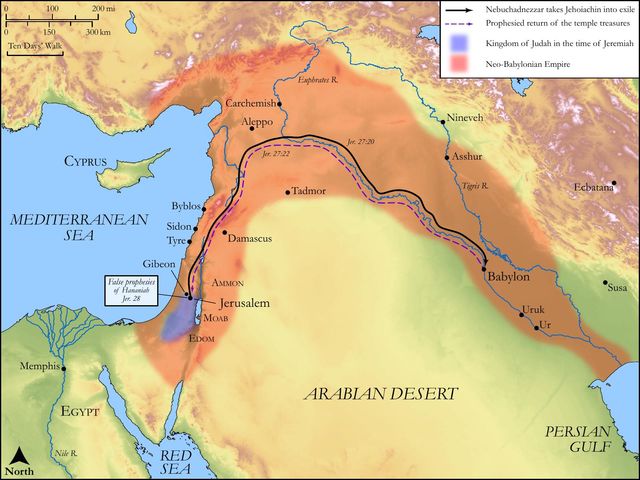
III.In both these addresses he warns them against giving credit to the false prophets that rocked them asleep in their security, because they saw that they loved to slumber: "Hearken not to the words of the prophets (Jer 27:14), your prophets, Jer 27:16. They are not God's prophets; he never sent them; they do not serve him, nor seek to please him; they are yours, for they say what you would have them say, and aim at nothing but to please you." Two things their prophets flattered them into the belief of: - 1. That the power which the king of Babylon had gained over them should now shortly be broken. They said (Jer 27:14), "You shall not serve the king of Babylon; you need not submit voluntarily, for you shall not be compelled to submit." This they prophesied in the name of the Lord (Jer 27:15), as if God had sent them to the people on this errand, in kindness to them, that they might not disparage themselves by an inglorious surrender. But it was a lie. They said that God sent them; but that was false; he disowns it: I have not sent them, saith the Lord. They said that they should never be brought into subjection to the king of Babylon; but that was false too, the event proved it so. They said that to hold out to the last would be the way to secure themselves and their city; but that was false, for it would certainly end in their being driven out and perishing. So that it was all a lie, from first to last; and the prophets that deceived the people with these lies did, in the issue, but deceive themselves; the blind leaders and the blind followers fell together into the ditch: That you might perish, you, and the prophets that prophesy unto you, who will be so far from warranting your security that they cannot secure themselves. Note, Those that encourage sinners to go on in their sinful ways will in the end perish with them. 2. They prophesied that the vessels of the temple, which the king of Babylon had already carried away, should now shortly be brought back (Jer 27:16); this they fed the priests with the hopes of, knowing how acceptable it would be to them, who loved the gold of the temple better than the temple that sanctified the gold. These vessels were taken away when Jeconiah was carried captive into Babylon, Jer 27:20. We have the story, and it is a melancholy one, Kg2 24:13, Kg2 24:15; Ch2 36:10. All the goodly vessels (that is, all the vessels of gold that were in the house of the Lord), with all the treasures, were taken as prey, and brought to Babylon. This was grievous to them above any thing; for the temple was their pride and confidence, and the stripping of that was too plain an indication of that which the true prophet told them, that their God had departed from them. Their false prophets therefore had no other way to make them easy than by telling them that the king of Babylon should be forced to restore them in a little while. Now here, (1.) Jeremiah bids them think of preserving the vessels that remained by their prayers, rather than of bringing back those that were gone by their prophecies (Jer 27:18): If they be prophets, as they pretend, and if the word of the Lord be with them - if they have any intercourse with heaven and any interest there, let them improve it for the stopping of the progress of the judgment; let them step into the gap, and stand with their censer between the living and the dead, between that which is carried away and that which remains, that the plague may be stayed; let them make intercession with the Lord of hosts, that the vessels which are left go not after the rest. [1.] Instead of prophesying, let them pray. Note, Prophets must be praying men; by being much in prayer they must make it to appear that they keep up a correspondence with heaven. We cannot think that those do, as prophets, ever hear thence, who do not frequently by prayer send thither. By praying for the safety and prosperity of the sanctuary they must make it to appear that, as becomes prophets, they are of a public spirit; and by the success of their prayers it will appear that God favours them. [2.] Instead of being concerned for the retrieving of what they had lost, they must bestir themselves for the securing of what was left, and take it as a great favour if they can gain that point. When God's judgments are abroad we must not seek great things, but be thankful for a little. (2.) He assures them that even this point should not be gained, but the brazen vessels should go after the golden ones, Jer 27:19, Jer 27:22. Nebuchadnezzar had found so good a booty once that he would be sure to come again and take all he could find, not only in the house of the Lord, but in the king's house. They shall all be carried to Babylon in triumph, and there shall they be. But he concludes with a gracious promise that the time should come when they should all be returned: Until the day that I visit them in mercy, according to appointment, and then I will bring those vessels up again, and restore them to this place, to their place. Surely they were under the protection of a special Providence, else they would have been melted down and put to some other use; but there was to be a second temple, for which they were to be reserved. We read particularly of the return of them, Ezr 1:8. Note, Though the return of the church's prosperity do not come in our time, we must not therefore despair of it, for it will come in God's time. Though those who said, The vessels of the Lord's house shall shortly be brought again, prophesied a lie (Jer 27:16), yet he that said, They shall at length be brought again, prophesied the truth. We are apt to set our clock before God's dial, and then to quarrel because they do not agree; but the Lord is a God of judgment, and it is fit that we should wait for him.
Historical interpretation
Historical reception
1 surviving comment on this verse from the historical church.
(Verse 12, 13.) And to King Zedekiah of Judah I spoke according to all these words, saying: Submit your necks under the yoke of the king of Babylon, and serve him and his people, and you shall live. Why will you die, you and your people, by the sword, by famine, and by pestilence, as the Lord has spoken against the nation that will not serve the king of Babylon? Do not listen to the words of the prophets who say to you, 'You shall not serve the king of Babylon,' for they prophesy a lie to you. I have not sent them, says the Lord, but they prophesy falsely in my name, in order to drive you out and make you perish, you and the prophets who are prophesying to you. After all the nations pass over to King Zedekiah of Judah, he speaks with the same nations he threatened, saying: for the nation of Israel does not deserve the privilege, who has sinned either similar or greater than the other nations. Finally, because the rebellious people refused to listen, they were destroyed by sword, famine, and pestilence. It should be noted in the holy Scripture that it refers to false prophets as prophets who prophesy falsely in the name of the Lord. But they, says he, do this, in order that they may cast you out, and bring destruction upon you, as well as upon the prophets who prophesy to you. And therefore the destruction is alike of those who are deceived and of those who deceive. This is what we have put from the Hebrew: Serve under the yoke of the king of Babylon, and serve him and his people, and you shall live. Why will you die, you and your people, by the sword, and by famine, and by pestilence, as the Lord has spoken concerning the nation that will not serve the king of Babylon? Do not listen to the words of the prophets who say to you, 'In the Septuagint it is not found.' And therefore I advise, so that the intelligent reader may understand how much is lacking in each Greek and Latin codex.
Continue studying Jeremiah 27:12 across the web’s major study libraries — every link below opens this exact verse, chapter, or book on the destination site.
Read & Compare
 BibleGatewayThis verse in more than 200 translations and 70 languages.
 Bible.comThe YouVersion reader — hundreds of translations, reading plans, and highlights.
 ESV.orgCrossway's official English Standard Version reader.
 NET BibleThe NET translation with 60,000+ translators' notes on every rendering decision.
 STEP BibleTyndale House's free study tool — original text, vocabulary, and scholarly resources.
 BibliaLogos Bible Software's free web reader.
 USCCBThe New American Bible (Revised Edition) with the U.S. bishops' study notes.
Commentaries
 BibleHub CommentariesDozens of classic commentaries on this verse, gathered on one page.
 StudyLightMore than 100 commentary sets — the largest collection on the web.
 BibleRefPlain-English commentary on what this verse means, verse by verse.
 Enduring WordDavid Guzik's free commentary on this chapter, widely used by Bible teachers.
 Bible Study ToolsVerse commentary alongside Greek and Hebrew study aids.
Original Language & Research
- BibleHub InterlinearThe verse word by word — original language, transliteration, and English.
- BibleHub LexiconEvery word's original-language definition and Strong's entry.
 Blue Letter BibleDeep-study tools — Strong's numbers, concordance, and word studies.
 SefariaThe Hebrew text with Rashi and centuries of Jewish commentary.
Sermons, Hymns & Audio


TrulyRandomVerse is not affiliated with these sites and doesn’t control their content. They’re linked because they’re genuinely useful.
Summary
Jeremiah 27:12 presents a critical divine mandate delivered through the prophet Jeremiah to King Zedekiah of Judah. This pivotal message urges the king and his people to willingly submit to the dominion of Nebuchadnezzar, the king of Babylon. Far from being a sign of weakness or defeat, this act of surrender is portrayed as God's prescribed path to national preservation and continued existence amidst His sovereign judgment. The verse encapsulates the profound spiritual and political dilemma facing Judah, highlighting the stark choice between divine wisdom and the perilous path of rebellion and false hope.
Context
ShowHideLiterary Context
Jeremiah 27:12 is a direct, personal address to King Zedekiah, embedded within a larger prophetic oracle spanning Jeremiah 27-28. Prior to this specific verse, Jeremiah has been divinely commanded to craft and wear a physical wooden yoke, symbolizing the impending servitude under Babylonian rule. This symbolic action is not limited to Judah; Jeremiah is instructed to send similar yokes to the kings of surrounding nations—Edom, Moab, Ammon, Tyre, and Sidon—to underscore the universal scope of God's decree that all these nations, including Judah, will serve Nebuchadnezzar (Jeremiah 27:2-7). The message to Zedekiah in verse 12, therefore, is a specific application of this overarching divine judgment, following a general warning to Judah in Jeremiah 27:11. The immediate literary context also sets the stage for the dramatic confrontation between Jeremiah's unpopular, God-given message and the comforting, yet deceitful, prophecies of Hananiah, who promised an imminent breaking of the Babylonian yoke, a conflict vividly detailed in Jeremiah 28.
Historical & Cultural Context
The historical setting for Jeremiah 27:12 is the early 6th century BCE, a period of immense geopolitical upheaval dominated by the ascendant Neo-Babylonian Empire. Under the formidable leadership of Nebuchadnezzar, Babylon had decisively defeated Egypt at the Battle of Carchemish in 605 BCE, solidifying its hegemony over the Near East. Judah had already experienced a significant blow in 597 BCE with the first major deportation of its elite, including King Jehoiachin and the prophet Ezekiel, to Babylon. Zedekiah, Jehoiachin's uncle, was subsequently installed as a vassal king by Nebuchadnezzar. Despite this imposed subservience, there was a palpable undercurrent of political intrigue and a desire for rebellion among the smaller nations, often encouraged by Egyptian promises of support. Culturally, the "yoke" was a universally understood metaphor for servitude, burden, or subjugation, commonly used in agricultural and political contexts. Jeremiah's act of wearing a physical yoke would have been a profoundly shocking and unmistakable visual sermon, vividly communicating the gravity and inevitability of God's decree.
Key Themes
ShowHideThis verse powerfully contributes to several foundational themes prevalent throughout the book of Jeremiah and broader biblical theology. Firstly, it emphatically underscores Divine Sovereignty, illustrating God's absolute control over the destinies of nations, even utilizing a pagan empire like Babylon as His instrument of judgment against His own disobedient people, a concept echoed in the broader prophecies against nations found in Jeremiah 25. Secondly, it highlights the intricate balance of Judgment and Mercy. While God's judgment against Judah for its persistent idolatry and covenant unfaithfulness is severe and unavoidable, a path to "life" is paradoxically offered through submission, revealing God's enduring mercy even amidst His righteous wrath. Thirdly, the passage emphasizes the critical importance of Obedience to God's Word, regardless of how difficult, unpopular, or counter-intuitive it may seem. The choice presented to Zedekiah was not merely a political calculation but a profound spiritual decision: to obey God's difficult command and live, or to rebel and face utter destruction, as explicitly warned in Jeremiah 27:8.
Exposition and Analysis
ShowHideKey Word Analysis
ShowHideThis primitive root, though sometimes meaning "to arrange," is primarily used figuratively to signify "to speak." It denotes a deliberate, authoritative utterance, often implying a divine command or declaration. In Jeremiah 27:12, it emphasizes that Jeremiah's words to Zedekiah are not his own counsel but God's divinely "arranged" and "spoken" message, carrying the full weight of divine authority and immutable intention.
Derived from a root suggesting "to go up" or "to impose," this noun literally refers to a wooden bar placed on the neck of an animal to facilitate work. Figuratively, it powerfully symbolizes servitude, burden, or submission. Its deployment here is a potent metaphor for the political and economic subjugation Judah is divinely called to accept under Babylon, representing a burdensome, yet divinely ordained, reality.
A primitive root meaning "to live," "to revive," or "to preserve alive." This word is critically important as it presents the ultimate consequence and divine promise for obedience. It stands in stark contrast to the death, famine, and pestilence threatened for rebellion, indicating that submission, though humiliating, is the only path to physical preservation and the continued existence of the nation.
Verse Breakdown
ShowHide"I spake also to Zedekiah king of Judah according to all these words, saying,"
This opening clause establishes Jeremiah's direct, personal address to Zedekiah, the reigning monarch of Judah. The phrase "according to all these words" explicitly links this specific message to the broader divine oracle and symbolic actions (such as Jeremiah wearing the yoke) that the prophet has been performing and proclaiming throughout Jeremiah 27. It underscores Jeremiah's role as a faithful messenger, conveying God's precise and authoritative instructions without alteration or personal bias.
"Bring your necks under the yoke of the king of Babylon,"
This is the core command, delivered as a vivid and forceful metaphor. To "bring your necks under the yoke" signifies a complete, willing, and humble submission to the authority and dominion of Nebuchadnezzar, the king of Babylon. It demands a posture of humility and acceptance of a divinely imposed servitude, unequivocally rejecting any notion of armed resistance or rebellion against the decreed foreign power.
"and serve him and his people,"
This clause specifies the practical nature and ongoing requirement of the commanded submission: active and continuous service to Babylon. This would entail paying tribute, refraining from any rebellious alliances, and formally acknowledging Babylonian suzerainty. It implies a practical, sustained relationship of subservience, not merely a one-time act of surrender, but an enduring state of affairs.
"and live."
This final, concise clause presents the profound, life-affirming consequence and divine promise for obedience. "Live" here refers to the preservation of physical life for the nation, the avoidance of the utter destruction, famine, pestilence, and the sword that would inevitably accompany rebellion. It is a promise of national survival, albeit under foreign rule, contrasting sharply with the complete desolation and eradication that would result from defying God's explicit will.
Literary Devices
ShowHideJeremiah 27:12 employs powerful Metaphor and Symbolism through the central image of the "yoke." The literal agricultural implement, designed to harness oxen for arduous labor, is transformed into a potent symbol of forced servitude and complete submission to a foreign power. Jeremiah's message is a direct call for Judah to metaphorically place its "neck" under this "yoke," signifying a humble and total surrender to Babylonian dominion. This imagery is powerfully reinforced by the prophet's own dramatic act of wearing a physical yoke earlier in the chapter, making the abstract concept of submission tangible and inescapable for his audience. The stark contrast between the command to "serve him... and live" and the implied alternative of rebellion leading to death creates a powerful Antithesis, highlighting the life-or-death stakes of Judah's choice and God's paradoxical path to preservation through surrender. The direct address to King Zedekiah, as well as the preceding instructions to Jeremiah, also functions as a Prophetic Directive, a clear and unambiguous command from God conveyed through His chosen prophet, demanding immediate and decisive action.
Theological and Thematic Connections
ShowHideJeremiah 27:12 profoundly illustrates God's sovereign control over human history and His strategic use of nations, even pagan ones, as instruments to fulfill His divine purposes. It reveals a paradoxical truth: genuine life and preservation often emerge through humble submission to God's difficult will, rather than through self-reliant rebellion or resistance against perceived hardship. This passage challenges the common notion that God's people should always be exempt from suffering or foreign rule, demonstrating instead that judgment can serve as a potent means of discipline and purification, with a clear path to survival offered through obedience. The choice presented to Zedekiah mirrors the perennial human struggle between trusting God's wisdom, even when it appears counter-intuitive, and relying on human strength, political alliances, or deceptive promises.
Reflection and Application
ShowHideJeremiah 27:12 offers a profound and enduring lesson on the nature of divine sovereignty and the profound wisdom found in submission, even when God's path seems counter-intuitive, humiliating, or deeply undesirable. For believers today, this verse challenges us to prayerfully consider where we might be resisting God's will, particularly in circumstances that feel burdensome, oppressive, or contrary to our expectations. Just as Judah was called to accept a difficult geopolitical reality as an integral part of God's overarching plan, we too are called to trust God's wisdom and sovereign hand, even when His methods are not what we expect or desire. True life, spiritual flourishing, and enduring peace are often discovered not in fighting against the "yoke" God permits or places upon us, but in humbly submitting to His sovereign hand, believing with unwavering faith that He orchestrates all things for our ultimate good and His supreme glory. This requires a discerning spirit, enabling us to hear God's true voice amidst the clamor of worldly advice, false promises, and self-serving desires, choosing radical obedience over rebellious defiance, and finding profound peace in complete surrender.
Questions for Reflection
ShowHideFAQ
ShowHideWhy would God command His people to serve a pagan king, rather than deliver them through miraculous intervention?
ShowHideGod commanded Judah to serve the king of Babylon as an act of divine judgment and discipline for their persistent idolatry, covenant unfaithfulness, and deep-seated rebellion against Him. While it may seem counter-intuitive for God to use a pagan nation as His instrument, the Bible consistently demonstrates God's absolute sovereignty extending over all nations, using them to accomplish His righteous purposes (for example, Isaiah 10:5-6). This command was not a sign of God's weakness or inability to deliver, but rather a powerful demonstration of His justice and His unwavering commitment to His covenant, even if it meant severe discipline for His beloved people. Furthermore, the command to submit was also an act of profound mercy, offering a clear path to "live" and preserve a remnant of the nation, rather than face utter annihilation through continued rebellion, as explicitly warned in Jeremiah 27:8).
Christ-Centered Fulfillment
ShowHideJeremiah 27:12, with its stark call to "bring your necks under the yoke... and live," finds its ultimate and most profound Christ-centered fulfillment in the person and redemptive work of Jesus Christ. While Judah was called to submit to an earthly king for the sake of physical preservation, Christ extends an invitation to His followers for a spiritual submission that leads to eternal life and true freedom. Jesus Himself tenderly invites us, "Come to me, all you who are weary and burdened, and I will give you rest. Take my yoke upon you and learn from me, for I am gentle and humble in heart, and you will find rest for your souls. For my yoke is easy and my burden is light" (Matthew 11:28-30). This divine invitation stands in stark contrast to the burdensome yokes of legalism, sin, and worldly anxieties. The "yoke" of Christ is not one of oppressive servitude but of loving discipleship, intimate partnership in His kingdom work, and profound spiritual rest. Furthermore, Jesus perfectly embodied this principle of humble submission, emptying Himself and becoming obedient even to the point of death on a cross (Philippians 2:8). Through His ultimate act of self-sacrificial submission, He secured true "life" for all who believe, delivering them from the crushing yoke of sin and the eternal consequence of death (Romans 6:23). Thus, Jeremiah's difficult message to Judah foreshadows the paradoxical truth that true freedom, abundant life, and ultimate salvation are found not in resisting God's sovereign will, but in humble, obedient surrender to the One who bore the ultimate burden and broke the power of sin for us all.