


Jeremiah 27:22
Bible text: King James Version (1769 Blayney text) · Public domain
Bible text: King James Version with Strong's numbers · Public domain
Bible text: Berean Standard Bible · Public domain
Bible text: American Standard Version (1901) · Public domain
Bible text: World English Bible, Messianic edition · Public domain
Bible text: Geneva Bible (1599) · Public domain
Bible text: Young's Literal Translation · Public domain
- בָּבֶלָהba·Ve·lahBabylon towardsH894N-proper ¦ SfxNoun Proper LocationבָּבֶלָBabylonהtowards
- יוּבָאוּyu·Va·'uthey will be takenH935V-Hophal-Imperf-3mpVerb Hophal Imperfect 3rd Plural Masculine
- וְשָׁמָּהve·Sha·mahand there <towards>H8033Conj-w ¦ Adv ¦ SfxAdverbוְandשָׁמָּthereה<towards>
- יִהְיוּyih·Yuthey will remainH1961V-Qal-Imperf-3mpVerb Qal Imperfect 3rd Plural Masculine
- עַד'aduntilH5704PrepPreposition
- יוֹםYom[the] dayH3117N-mscNoun Singular Masculine Construct
- פָּקְדִיpa·ke·DiI give attention toH6485V-Qal-Inf ¦ 1csVerb Qal Infinitive Constructפָּקְדִgive attention toיI
- אֹתָם'o·Tam<obj.> themH853DirObjM ¦ 3mpParticle Object Indicatorאֹתָ<obj.>םthem
- נְאֻםne·'um[the] utterance ofH5002N-mscNoun Singular Masculine Construct
- יְהוָהYah·wehYahwehH3068N-properNoun Proper Title
- וְהַעֲלִיתִיםve·ha·'a·li·Timand I will bring up themH5927Conj-w ¦ V-Hiphil-ConsecPerf-1cs ¦ 3mpVerb Hiphil Consecutive Perfect 1st Singular common genderוְandהַעֲלִיתִיI will bring upםthem
- וַהֲשִׁיבֹתִיםva·ha·Shi·vo·Timand I will bring back themH7725Conj-w ¦ V-Hiphil-ConsecPerf-1cs ¦ 3mpVerb Hiphil Consecutive Perfect 1st Singular common genderוַandהֲשִׁיבֹתִיI will bring backםthem
- אֶל'eltoH413PrepPreposition
- הַמָּקוֹםha·ma·Komthe placeH4725Art ¦ N-msNoun Singular Masculine Absoluteהַtheמָּקוֹםplace
- הַזֶּהha·Zeh<the> thisH2088Art ¦ PrtParticle Demonstrativeהַ<the>זֶּהthis
English is a literal word-by-word gloss of the Hebrew, not the KJV's wording. Why?
This is the original text the KJV's translators worked from — each Hebrew word with its own literal English meaning in this verse, prepared by scholars at Tyndale House, Cambridge. The KJV translates whole sentences, not word by word, so its wording differs: one Hebrew word can become several English words, and the KJV may choose “the LORD” where the gloss reads “Yahweh”. Both are faithful — they answer different questions. For the KJV's own rendering, switch to the KJV text.
Details
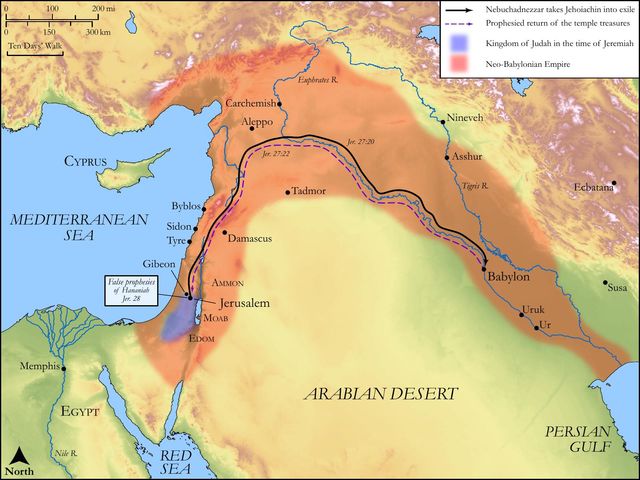
See on the biblical-era map
Study this verse
Public-domain commentary
Matthew Henry
From his Commentary on the Whole Bible. Henry comments on passages, not single verses — this entry covers Jeremiah 27:12–22.
What was said to all the nations is here with a particular tenderness applied to the nation of the Jews, for whom Jeremiah was sensibly concerned. The case at present stood thus: Judah and Jerusalem had often contested with the king of Babylon, and still were worsted; many both of their valuable persons and their valuable goods were carried to Babylon already, and some of the vessels of the Lord's house particularly. Now how this struggle would issue was the question. They had those among them at Jerusalem who pretended to be prophets, who bade them hold out and they should, in a little time, be too hard for the king of Babylon and recover all that they had lost. Now Jeremiah is sent to bid them yield and knock under, for that, instead of recovering what they had lost, they should otherwise lose all that remained; and to press them to this is the scope of these verses.
I.Jeremiah humbly addresses the king of Judah, to persuade him to surrender to the king of Babylon.
His act would be the people's and would determine them, and therefore he speaks to him as to them all (Jer 27:12): Bring your necks under the yoke of the king of Babylon and live. Is it their wisdom to submit to the heavy iron yoke of a cruel tyrant, that they may secure the lives of their bodies? And is it not much more our wisdom to submit to the sweet and easy yoke of our rightful Lord and Master Jesus Christ, that we may secure the lives of our souls? Bring down your spirits to repentance and faith, and that is the way to bring up your spirits to heaven and glory. And with much more cogency and compassion may we expostulate with perishing souls than Jeremiah here expostulates with a perishing people: "Why will you die by the sword and the famine - miserable deaths, which you inevitably run yourselves upon, under pretence of avoiding miserable lives?" What God had spoken, in general, of all those that would not submit to the king of Babylon, he would have them to apply to themselves and be afraid of. It were well if sinners would, in like manner, be afraid of the destruction threatened against all those that will not have Christ to reign over them, and reason thus with themselves, "Why should we die the second death, which is a thousand times worse than that by sword and famine, when we might submit and live?"
II.He addresses himself likewise to the priests and the people (Jer 27:16), to persuade them to serve the king of Babylon, that they might live, and might prevent the desolation of the city (Jer 27:17): "Wherefore should it be laid waste, as certainly it will be if you stand it out?" The priests had been Jeremiah's enemies, and had sought his life to destroy it, yet he approves himself their friend, and seeks their lives, to preserve and secure them, which is an example to us to render good for evil. When the blood-thirsty hate the upright, yet the just seek his soul, and the welfare of it, Pro 29:10. The matter was far gone here; they were upon the brink of ruin, which they would not have been brought to if they would have taken Jeremiah's counsel; yet he continues his friendly admonitions to them, to save the last stake and manage that wisely, and now at length in this their day to understand the things that belong to their peace, when they had but one day to turn them in.
III.In both these addresses he warns them against giving credit to the false prophets that rocked them asleep in their security, because they saw that they loved to slumber: "Hearken not to the words of the prophets (Jer 27:14), your prophets, Jer 27:16. They are not God's prophets; he never sent them; they do not serve him, nor seek to please him; they are yours, for they say what you would have them say, and aim at nothing but to please you." Two things their prophets flattered them into the belief of: - 1. That the power which the king of Babylon had gained over them should now shortly be broken. They said (Jer 27:14), "You shall not serve the king of Babylon; you need not submit voluntarily, for you shall not be compelled to submit." This they prophesied in the name of the Lord (Jer 27:15), as if God had sent them to the people on this errand, in kindness to them, that they might not disparage themselves by an inglorious surrender. But it was a lie. They said that God sent them; but that was false; he disowns it: I have not sent them, saith the Lord. They said that they should never be brought into subjection to the king of Babylon; but that was false too, the event proved it so. They said that to hold out to the last would be the way to secure themselves and their city; but that was false, for it would certainly end in their being driven out and perishing. So that it was all a lie, from first to last; and the prophets that deceived the people with these lies did, in the issue, but deceive themselves; the blind leaders and the blind followers fell together into the ditch: That you might perish, you, and the prophets that prophesy unto you, who will be so far from warranting your security that they cannot secure themselves. Note, Those that encourage sinners to go on in their sinful ways will in the end perish with them. 2. They prophesied that the vessels of the temple, which the king of Babylon had already carried away, should now shortly be brought back (Jer 27:16); this they fed the priests with the hopes of, knowing how acceptable it would be to them, who loved the gold of the temple better than the temple that sanctified the gold. These vessels were taken away when Jeconiah was carried captive into Babylon, Jer 27:20. We have the story, and it is a melancholy one, Kg2 24:13, Kg2 24:15; Ch2 36:10. All the goodly vessels (that is, all the vessels of gold that were in the house of the Lord), with all the treasures, were taken as prey, and brought to Babylon. This was grievous to them above any thing; for the temple was their pride and confidence, and the stripping of that was too plain an indication of that which the true prophet told them, that their God had departed from them. Their false prophets therefore had no other way to make them easy than by telling them that the king of Babylon should be forced to restore them in a little while. Now here, (1.) Jeremiah bids them think of preserving the vessels that remained by their prayers, rather than of bringing back those that were gone by their prophecies (Jer 27:18): If they be prophets, as they pretend, and if the word of the Lord be with them - if they have any intercourse with heaven and any interest there, let them improve it for the stopping of the progress of the judgment; let them step into the gap, and stand with their censer between the living and the dead, between that which is carried away and that which remains, that the plague may be stayed; let them make intercession with the Lord of hosts, that the vessels which are left go not after the rest. [1.] Instead of prophesying, let them pray. Note, Prophets must be praying men; by being much in prayer they must make it to appear that they keep up a correspondence with heaven. We cannot think that those do, as prophets, ever hear thence, who do not frequently by prayer send thither. By praying for the safety and prosperity of the sanctuary they must make it to appear that, as becomes prophets, they are of a public spirit; and by the success of their prayers it will appear that God favours them. [2.] Instead of being concerned for the retrieving of what they had lost, they must bestir themselves for the securing of what was left, and take it as a great favour if they can gain that point. When God's judgments are abroad we must not seek great things, but be thankful for a little. (2.) He assures them that even this point should not be gained, but the brazen vessels should go after the golden ones, Jer 27:19, Jer 27:22. Nebuchadnezzar had found so good a booty once that he would be sure to come again and take all he could find, not only in the house of the Lord, but in the king's house. They shall all be carried to Babylon in triumph, and there shall they be. But he concludes with a gracious promise that the time should come when they should all be returned: Until the day that I visit them in mercy, according to appointment, and then I will bring those vessels up again, and restore them to this place, to their place. Surely they were under the protection of a special Providence, else they would have been melted down and put to some other use; but there was to be a second temple, for which they were to be reserved. We read particularly of the return of them, Ezr 1:8. Note, Though the return of the church's prosperity do not come in our time, we must not therefore despair of it, for it will come in God's time. Though those who said, The vessels of the Lord's house shall shortly be brought again, prophesied a lie (Jer 27:16), yet he that said, They shall at length be brought again, prophesied the truth. We are apt to set our clock before God's dial, and then to quarrel because they do not agree; but the Lord is a God of judgment, and it is fit that we should wait for him.
Historical interpretation
Historical reception
1 surviving comment on this verse from the historical church.
(Verse 19 onwards) O Lord of hosts, let the vessels that were left behind in the house of the Lord, and in the house of the king of Judah, and in Jerusalem, and in Babylon, not come back. For thus says the Lord of hosts concerning the pillars, and concerning the sea, and concerning the bases (which are written as Mechonoth in Hebrew) and concerning the remaining vessels that are in this city, which Nebuchadnezzar, the king of Babylon, did not take when he took Jeconiah, the son of Jehoiakim, the king of Judah, from Jerusalem to Babylon, along with all the nobles of Judah and Jerusalem. Because this is what the Lord of hosts, the God of Israel, says about the vessels that have been left behind in the house of the Lord, and in the house of the king of Judah and Jerusalem: They will be carried to Babylon and there they will remain until the day of their visitation, says the Lord. And I will bring them back and restore them to this place. These things, as we have said, are not found in the Septuagint, but have been translated from the Hebrew truth: for they have added something that was not written, saying, 'Thus says the Lord to me: And the rest of the vessels that the king of Babylon did not take when he carried Jeconiah from Jerusalem to Babylon, they will enter, says the Lord,' putting more emphasis on the meaning than on the words, perhaps thinking it irrational that God would speak to columns and to the sea, and to the bases, and to the remaining vessels in Jerusalem, as if we did not read that the Lord rebuked the morning worm and spoke to the sea, saying, 'Be silent and be still.' (Jonah 4). And he says: Let them come to me, whether it be the Lord of armies (Mark 4:39), this shows that a true Prophet can resist the Lord with prayers, just as Moses stood in opposition to the Lord, in order to turn away the anger of his fury. Samuel also did the same (1 Samuel 8). And the Lord said to Moses: Let me alone, he said, that I may strike this people (Exodus 32:10). But when he says, Let me alone, he shows that he can be held back by the prayers of the saints. The prophets, he says, and whatever they predict, should demonstrate their fulfillment through their actions; and then the prophecy will be confirmed by truth. However, we read about the pillars, sea, bases, and other vessels in the book of Malachi and in the final volume of this prophet (2 Kings, chapter 25). And the vessels that were carried away to Babylon are listed, when Zedekiah was captured, the city was burned, and the temple was destroyed.
Continue studying Jeremiah 27:22 across the web’s major study libraries — every link below opens this exact verse, chapter, or book on the destination site.
Read & Compare
 BibleGatewayThis verse in more than 200 translations and 70 languages.
 Bible.comThe YouVersion reader — hundreds of translations, reading plans, and highlights.
 ESV.orgCrossway's official English Standard Version reader.
 NET BibleThe NET translation with 60,000+ translators' notes on every rendering decision.
 STEP BibleTyndale House's free study tool — original text, vocabulary, and scholarly resources.
 BibliaLogos Bible Software's free web reader.
 USCCBThe New American Bible (Revised Edition) with the U.S. bishops' study notes.
Commentaries
 BibleHub CommentariesDozens of classic commentaries on this verse, gathered on one page.
 StudyLightMore than 100 commentary sets — the largest collection on the web.
 BibleRefPlain-English commentary on what this verse means, verse by verse.
 Enduring WordDavid Guzik's free commentary on this chapter, widely used by Bible teachers.
 Bible Study ToolsVerse commentary alongside Greek and Hebrew study aids.
Original Language & Research
- BibleHub InterlinearThe verse word by word — original language, transliteration, and English.
- BibleHub LexiconEvery word's original-language definition and Strong's entry.
 Blue Letter BibleDeep-study tools — Strong's numbers, concordance, and word studies.
 SefariaThe Hebrew text with Rashi and centuries of Jewish commentary.
Sermons, Hymns & Audio


TrulyRandomVerse is not affiliated with these sites and doesn’t control their content. They’re linked because they’re genuinely useful.
Summary
Jeremiah 27:22 presents a definitive prophetic declaration concerning the fate of the sacred Temple vessels and the people of Judah, foretelling their inevitable deportation to Babylon. This verse, however, transcends a mere pronouncement of judgment by simultaneously delivering a divine, unwavering assurance from the LORD that this exile would not be permanent. It promises that in His appointed time, God would actively intervene to bring His people and their precious articles back, fully restoring them to their homeland, thereby powerfully underscoring His sovereignty over judgment and His ultimate faithfulness to His covenant promises.
Context
ShowHideLiterary Context
Jeremiah 27:22 serves as the climactic conclusion to a specific prophetic oracle found in Jeremiah 27:19-22. In this immediate section, Jeremiah directly confronts and refutes the false prophets who were actively assuring King Zedekiah and the populace that the remaining temple articles, which Nebuchadnezzar had not yet carried off during previous deportations (as detailed in 2 Kings 24:13), would soon be returned from Babylon. Jeremiah's divinely inspired message is starkly contrary: not only would those items not return, but the remaining ones—specifically the bronze pillars, the great bronze Sea, and the stands (Jeremiah 27:19)—would also be taken to Babylon. This verse thus functions as the definitive statement of their immediate, grim future, immediately followed by the long-term, hopeful promise of restoration, setting a crucial thematic foundation for the broader prophecies of exile and return that permeate the book of Jeremiah.
Historical & Cultural Context
This prophecy was delivered during the precarious early reign of King Zedekiah, likely around 594-593 BC. This period was marked by profound political instability and spiritual apostasy in Judah, following the first two deportations to Babylon (the most significant being in 597 BC, which included King Jehoiachin and many prominent citizens). Judah existed as a vulnerable tributary of the formidable Babylonian Empire, and various nations round about were actively contemplating or forming alliances for rebellion against Nebuchadnezzar. Within Jerusalem, false prophets and foreign envoys were highly influential, advocating for resistance against Babylon and promising a swift return of exiles and temple treasures. Jeremiah's counter-message, which vehemently urged submission to Babylon as God's divinely appointed instrument of judgment, was profoundly unpopular and often perceived as treasonous. Culturally, the concept of "place"—specifically Jerusalem and the Temple—was inextricably linked to Israelite identity, worship, and their covenant relationship with Yahweh. Therefore, the promise of return to "this place" carried immense significance, implying a comprehensive restoration of their national, spiritual, and communal life.
Key Themes
ShowHideJeremiah 27:22 encapsulates several overarching and foundational themes present throughout the book of Jeremiah and the broader Old Testament prophetic tradition. Firstly, it powerfully underscores Divine Sovereignty and Judgment. The impending Babylonian exile is not portrayed as a random geopolitical misfortune but as a divinely orchestrated consequence of Judah's persistent idolatry, covenant unfaithfulness, and moral corruption. This demonstrates God's absolute justice and His sovereign control over world empires, even using them as instruments of His wrath (Jeremiah 25:9). Secondly, the verse introduces the crucial theme of Promise of Restoration and Hope. Despite the severity and certainty of the impending judgment, the latter part of the verse offers a beacon of future deliverance, signifying that God's discipline has a set duration and an ultimate redemptive purpose. This promise of return is foundational to the hope offered in later chapters, particularly the prophecy of the seventy years of Babylonian captivity. Finally, it highlights God's unwavering Faithfulness to His Covenant. Even in the midst of severe punishment and apparent abandonment, God does not permanently forsake His people. The restoration spoken of here is a profound testament to His enduring love, His steadfast commitment to His chosen people, and His ultimate plan for their redemption, echoing earlier covenant promises of return from exile found in passages like Deuteronomy 30:1-5.
Exposition and Analysis
ShowHideKey Word Analysis
ShowHideThis word is remarkably rich in semantic range, encompassing both friendly and hostile intervention. While it can certainly signify judgment (e.g., "I will visit their iniquity upon them"), in the specific context of Jeremiah 27:22, it unequivocally denotes a positive, redemptive intervention. It implies God's active remembrance, decisive action, and compassionate care for His people, culminating in their deliverance and restoration. This is not a casual observation but a purposeful, impactful, and transformative visitation.
This is the sacred, covenant name of God, often transliterated as Yahweh. Its prominent use here, particularly in the phrase "saith the LORD," profoundly emphasizes that the speaker is the self-existent, eternal, and unchanging God who is utterly faithful to His covenant promises. The inclusion of this divine speech marker underscores the ultimate authority, infallibility, and certainty of the prophetic word, indicating that this is not merely Jeremiah's human opinion or prediction but a direct, authoritative declaration from the sovereign God who governs all history and infallibly fulfills His every word.
This primitive root means "to turn back," "return," or "bring back." It signifies a complete reversal of a previous state, implying a comprehensive and intentional act of bringing something or someone to their original, rightful place or condition. In this verse, it speaks powerfully to God's active and deliberate role in reversing the exile, bringing His people and their sacred vessels back to Jerusalem. This signifies not merely a physical return but a profound spiritual and national renewal, a re-establishment of their relationship with God and their covenant identity.
Verse Breakdown
ShowHide"They shall be carried to Babylon,"
This opening clause delivers the immediate, harsh, and unavoidable reality of the prophecy. The pronoun "They" refers primarily to the remaining Temple vessels explicitly mentioned in Jeremiah 27:19 and, by clear implication, to the people of Judah themselves. This statement confirms the absolute inevitability of the impending exile, directly contradicting the false prophets' deceptive assurances and reinforcing Jeremiah's unpopular but divinely mandated message of submission to God's judgment through the instrument of Babylon.
"and there shall they be until the day that I visit them, saith the LORD;"
This is the pivotal clause, introducing both the precise duration of the exile and the divine intervention that will bring it to an end. The phrase "until the day that I visit them" establishes a divinely appointed limit to the exile, emphasizing that the captivity is not a permanent state but has a definite, God-ordained duration. The "visitation" by the LORD, as elucidated in the Key Word Analysis, signals a benevolent, redemptive, and decisive action by God, marking the turning point from judgment to restoration. The authoritative declaration "saith the LORD" authenticates the entire promise as a direct, infallible word from the covenant-keeping God.
"then will I bring them up, and restore them to this place."
This final clause articulates the glorious and certain promise of future deliverance and return. "Bring them up" signifies a physical ascent, most likely from the lower elevations of Mesopotamia back to the elevated city of Jerusalem and the mountainous region of Judah. "Restore them to this place" explicitly names Jerusalem/Judah as the ultimate destination, signifying a full and complete reversal of their displacement. This implies not just a physical repatriation but a comprehensive re-establishment of their national, religious, and spiritual life, fulfilling God's enduring commitment to His people and their promised land.
Literary Devices
ShowHideJeremiah 27:22 masterfully employs several significant literary devices to convey its profound message. Prophecy is the overarching device, as the verse declares future events with divine certainty and authority. The repeated use of "saith the LORD" functions as a powerful Divine Speech Marker, lending ultimate authority, infallibility, and undeniable truth to the pronouncement, distinguishing it from human speculation. A clear Contrast is established between the immediate, grim reality of exile ("They shall be carried to Babylon") and the future, glorious hope of return ("then will I bring them up, and restore them to this place"), highlighting God's overarching plan that extends beyond immediate suffering and includes ultimate redemption. The phrase "the day that I visit them" serves as a potent Metonymy for the specific, divinely appointed time of God's redemptive intervention, a period of decisive divine action that will fundamentally alter their circumstances. Furthermore, the explicit mention of "Babylon" and "this place" (referring to Jerusalem/Judah) functions as powerful Symbolism, representing the opposing poles of judgment and grace, exile and restoration, and divine wrath and enduring covenant faithfulness.
Theological and Thematic Connections
ShowHideJeremiah 27:22 stands as a powerful testament to God's sovereign control over history and His unwavering faithfulness to His covenant people, even in the midst of severe judgment. It profoundly reveals that divine discipline is not an act of abandonment but a purposeful, time-limited process designed to bring about repentance and ultimately, restoration. The promise of "visitation" and "restoration" underscores God's active, personal, and redemptive involvement in the affairs of humanity, ensuring that His ultimate redemptive plan for His people will be fulfilled. This verse provides a foundational truth: even when God's people face the painful consequences of their sin and experience displacement or hardship, their hope is anchored in the unchanging character of a God who remembers His promises and orchestrates their return.
Reflection and Application
ShowHideJeremiah 27:22 offers enduring encouragement and profound lessons for believers navigating seasons of difficulty, discipline, or displacement in their own lives. It powerfully reminds us that even when we face the painful consequences of our choices, or experience trials that feel like a spiritual or physical "exile," God's sovereign purposes are always at work, and His faithfulness remains steadfast. Our hardships, much like the Babylonian captivity, have a divinely appointed purpose and a definite end. We are called to cultivate patient trust in God's perfect timing and His unwavering promise of "visitation," knowing that He will intervene to bring about His intended restoration, renewal, and ultimate good. This verse cultivates a resilient hope, urging us to look beyond immediate, often bleak, circumstances to the sovereign God who is supremely capable of turning even the most desolate situations into opportunities for His glorious return and the re-establishment of His presence among His people. It challenges us to maintain unwavering faith in His prophetic word, even when it contradicts popular opinion, defies human logic, or seems utterly impossible, and to remember that God's ultimate plan is always for the good of those who are called according to His purpose.
Questions for Reflection
ShowHideFAQ
ShowHideWhat was the significance of the Temple vessels being taken to Babylon?
ShowHideThe Temple vessels were far more than mere utilitarian objects; they were sacred items consecrated for the worship of the LORD, symbolizing God's holy presence and the covenant relationship with Israel. Their removal to Babylon, as detailed in 2 Kings 25:13-17, was a profound act of desecration and a visible, tangible sign of God's severe judgment against Judah's pervasive idolatry and unfaithfulness. It signified the temporary suspension of Temple worship in Jerusalem and the deep humiliation of God's chosen people. However, Jeremiah 27:22 offers the counter-promise of their eventual return, which was partially fulfilled under Cyrus the Great (Ezra 1:7-11), symbolizing the restoration of God's favor and the re-establishment of true, unhindered worship.
How long did the exile to Babylon last, and how does this verse relate to that timeframe?
ShowHideThe Babylonian exile, from its initial major deportation, lasted approximately 70 years, a precise period explicitly prophesied by Jeremiah himself in Jeremiah 29:10. Jeremiah 27:22's phrase "until the day that I visit them" directly foreshadows and perfectly aligns with this divinely appointed 70-year timeframe. It confirms that the exile had a definite, God-ordained duration and would not be an indefinite or permanent punishment. The "visitation" refers to God's sovereign intervention at the culmination of this period, prompting the Persian King Cyrus to issue a decree allowing the Jews to return to Jerusalem and rebuild their Temple (Ezra 1:1-4).
Christ-Centered Fulfillment
ShowHideJeremiah 27:22, with its profound promise of divine "visitation" and "restoration" following a period of exile, finds its ultimate and most profound fulfillment in the person and work of Jesus Christ. The historical, physical exile of Israel to Babylon and their subsequent return serves as a powerful type and shadow of humanity's deeper spiritual exile from God due to sin, and Christ's redemptive work as the ultimate "visitation" and "restoration." Just as God promised to "bring them up, and restore them to this place," so too did He "visit" His people in the person of Jesus, the Lamb of God who takes away the sin of the world. Through Christ's atoning sacrifice on the cross and His glorious resurrection, humanity is offered a definitive way out of spiritual captivity and restored to a right, living relationship with God, no longer exiled but brought near through His precious blood (Ephesians 2:13). The "place" of restoration is no longer merely an earthly Jerusalem, but a spiritual dwelling in Christ Himself (Ephesians 2:19-22) and the glorious promise of a future, eternal heavenly Jerusalem where God's redeemed people will dwell with Him forever, completely free from the effects of sin, judgment, and spiritual displacement. Thus, the temporal promise given to Israel points forward to the eternal spiritual reality achieved through Christ, who is the true and lasting "restoration."