


2 Kings 17:2
Bible text: King James Version (1769 Blayney text) · Public domain
Bible text: Berean Standard Bible · Public domain
Bible text: American Standard Version (1901) · Public domain
Bible text: World English Bible, Messianic edition · Public domain
Bible text: Geneva Bible (1599) · Public domain
Bible text: Young's Literal Translation · Public domain
- וַיַּעַשׂvai·Ya·'asand he didH6213Conj-w ¦ V-Qal-ConsecImperf-3msVerb Qal Consecutive Imperfect 3rd Singular Masculineוַandיַּעַשׂhe did
- הָרַעha·Ra'the evilH7451Art ¦ Adj-msAdjective Singular Masculine Absoluteהָtheרַעevil
- בְּעֵינֵיbe·'ei·Neiin [the] eyes ofH5869Prep-b ¦ N-fdcNoun Dual Feminine Constructבְּinעֵינֵי[the] eyes of
- יְהוָהYah·wehYahwehH3068N-properNoun Proper Title
- רַקRakonlyH7535AdvAdverb
- לֹאlo'notH3808NegParticle Negative
- כְּמַלְכֵיke·mal·Kheilike [the] kings ofH4428Prep-k ¦ N-mpcNoun Plural Masculine Constructכְּlikeמַלְכֵי[the] kings of
- יִשְׂרָאֵלYis·ra·'ElIsraelH3478N-properNoun Proper Location
- אֲשֶׁר'a·SherwhoH834RelParticle Relative
- הָיוּha·Yuthey wereH1961V-Qal-Perf-3cpVerb Qal Perfect 3rd Plural common gender
- לְפָנָיוle·fa·Nav<to> before himH6440Prep-l ¦ N-mpc ¦ 3msNoun Plural Masculine Constructלְ<to>פָנָיbeforeוhim
English is a literal word-by-word gloss of the Hebrew, not the KJV's wording. Why?
This is the original text the KJV's translators worked from — each Hebrew word with its own literal English meaning in this verse, prepared by scholars at Tyndale House, Cambridge. The KJV translates whole sentences, not word by word, so its wording differs: one Hebrew word can become several English words, and the KJV may choose “the LORD” where the gloss reads “Yahweh”. Both are faithful — they answer different questions. For the KJV's own rendering, switch to the KJV text.
Details
See on the biblical-era map
Study this verse
Public-domain commentary
Matthew Henry
From his Commentary on the Whole Bible. Henry comments on passages, not single verses — this entry covers 2 Kings 17:1–6. His three-level outline is real structure in the source text, so it is rendered as structure.
We have here the reign and ruin of Hoshea, the last of the kings of Israel, concerning whom observe,
I.That, though he forced his way to the crown by treason and murder (as we read Kg2 15:30), yet he gained not the possession of it till seven or eight years after; for it was in the fourth year of Ahaz that he slew Pekah, but did not himself begin to reign till the twelfth year of Ahaz, Kg2 17:1. Whether by the king of Assyria, or by the king of Judah, or by some of his own people, does not appear, but it seems so long he was kept out of the throne he aimed at. Justly were his bad practices thus chastised, and the word of the prophet was thus fulfilled (Hos 10:3), Now they shall say We have no king, because we feared not the Lord.
II.That, though he was bad, yet not so bad as the kings of Israel had been before him (Kg2 17:2), not so devoted to the calves as they had been. One of them (that at Dan), the Jews say, had been, before this, carried away by the king of Assyria in the expedition recorded Kg2 15:29, (to which perhaps the prophet refers, Hos 8:5, Thy calf, O Samaria! has cast thee off), which made him put the less confidence in the other. And some say that this Hoshea took off the embargo which the former kings had put their subjects under, forbidding them to go up to Jerusalem to worship, which he permitted those to do that had a mind to it. But what shall we think of this dispensation of providence, that the destruction of the kingdom of Israel should come in the reign of one of the best of its kings? Thy judgments, O God! are a great deep. God would hereby show that in bringing this ruin upon them he designed to punish,
1.Not only the sins of that generation, but of the foregoing ages, and to reckon for the iniquities of their fathers, who had been long in filing the measure and treasuring up wrath against this day of wrath.
2.Not only the sins of their kings, but the sins of the people. If Hoshea was not so bad as the former kings, yet the people were as bad as those that went before them, and it was an aggravation of their badness, and brought ruin the sooner, that their king did not set them so bad an example as the former kings had done, nor hinder them from reforming; he gave them leave to do better, but they did as bad as ever, which laid the blame of their sin and ruin wholly upon themselves.
III.That the destruction came gradually.
They were for some time made tributaries before they were made captives to the king of Assyria (Kg2 17:3), and, if that less judgment had prevailed to humble and reform them, the greater would have been prevented.
IV.That they brought it upon themselves by the indirect course they took to shake off the yoke of the king of Assyria, Kg2 17:4.
Had the king and people of Israel applied to God, made their peace with him and their prayers to him, they might have recovered their liberty, ease, and honour; but they withheld their tribute, and trusted to the king of Egypt to assist them in their revolt, which, if it had taken effect, would have been but to change their oppressors. But Egypt became to them the staff of a broken reed. This provoked the king of Assyria to proceed against them with the more severity. Men get nothing by struggling with the net, but entangle themselves the more.
V.That it was an utter destruction that came upon them.
1.The king of Israel was made a prisoner; he was shut up and bound, being, it is probable, taken by surprise, before Samaria was besieged.
2.The land of Israel was made a prey. The army of the king of Assyria came up throughout all the land, made themselves master of it (Kg2 17:5), and treated the people as traitors to be punished with the sword of justice rather than as fair enemies.
3.The royal city of Israel was besieged, and at length taken. Three years it held out after the country was conquered, and no doubt a great deal of misery was endured at that time which is not particularly recorded; but the brevity of the story, and the passing of this matter over lightly, methinks, intimate that they were abandoned of God and he did not now regard the affliction of Israel, as sometimes as he had done.
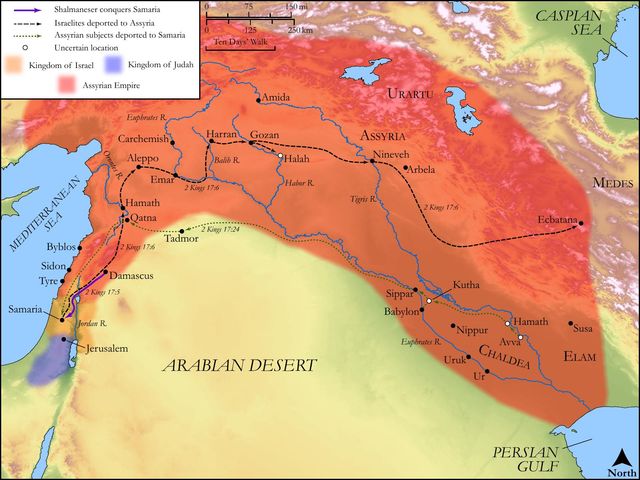
4.The people of Israel were carried captives into Assyria, Kg2 17:6. The generality of the people, those that were of any note, were forced away into the conqueror's country, to be slaves and beggars there.
(1.)Thus he was pleased to exercise a dominion over them, and to show that they were entirely at his disposal.
(2.)By depriving them of their possessions and estates, real and personal, and exposing them to all the hardships and reproaches of a removal to a strange country, under the power of an imperious army, he chastised them for their rebellion and their endeavour to shake off his yoke.
(3.)Thus he effectually prevented all such attempts for the future and secured their country to himself.
(4.)Thus he got the benefit of their service in his own country, as Pharaoh did that of their fathers; and so this unworthy people were lost as they were found, and ended as they began, in servitude and under oppression.
(5.)Thus he made room for those of his own country that had little, and little to do, at home, to settle in a good land, a land flowing with milk and honey. In all these several ways he served himself by this captivity of the ten tribes. We are here told in what places of his kingdom he disposed of them - in Halah and Habor, in places, we may suppose, far distant from each other, lest they should keep up a correspondence, incorporate again, and become formidable. There, we have reason to think, after some time they were so mingled with the nations that they were lost, and the name of Israel was no more in remembrance. Those that forgot God were themselves forgotten; those that studied to be like the nations were buried among them; and those that would not serve God in their own land were made to serve their enemies in a strange land. It is probable that they were the men of honour and estates who were carried captive, and that many of the meaner sort of people were left behind, many of every tribe, who either went over to Judah or became subject to the Assyrian colonies, and their posterity were Galileans or Samaritans. But thus ended Israel as a nation; now they became Lo-ammi - not a people, and Lo-ruhamah - unpitied. Now Canaan spued them out. When we read of their entry under Hoshea the son of Nun who would have thought that such as this should be their exit under Hoshea the son of Elah? Thus Rome's glory in Augustus sunk, many ages after, in Augustulus. Providence so ordered the eclipsing of the honour of the ten tribes that the honour of Judah (the royal tribe) and Levi (the holy tribe), which yet remained, might shine the brighter. Yet we find a number sealed of every one of the twelve tribes (Rev. 7) except Dan. James writes to the twelve tribes scattered abroad (Jam 1:1) and Paul speaks of the twelve tribes which instantly served God day and night (Act 26:7); so that though we never read of those that were carried captive, nor have any reason to credit the conjecture of some (that they yet remain a distinct body in some remote corner of the world), yet a remnant of them did escape, to keep up the name of Israel, till it came to be worn by the gospel church, the spiritual Israel, in which it will ever remain, Gal 6:16.
Historical interpretation
Historical reception
1 surviving comment on this verse from the historical church.
At this point it is also appropriate to tell where the Samaritans originated. I say this because the entire region is called Samaria. From what source, then, did they derive this name? The mountain is called Semer from the man who had taken possession of it, as Isaiah also said: “And the head of Samaria, Ephraim.” The inhabitants, however, were called not Samaritans but Israelites. But as time went on, they transgressed against God, and during the reign of Pekah, Tiglath-pileser went up and seized many cities. After attacking and killing Elah, he gave the kingdom over to Hoshea. Later, Shalmaneser came and captured other cities and made them subject and tributary. However, though Hoshea at first yielded, he revolted afterwards from subjection and took refuge in the aid of the Ethiopians. The Assyrian learned this and, having made an expedition and taken them captive, forbade the nation to remain there any longer, because he suspected the possibility of another such revolt. These inhabitants, moreover, he transported to Babylon and Medea and, having brought from various regions the people dwelling in that vicinity, he caused them to dwell in Samaria so that his power might be safeguarded for the future, with loyal inhabitants in possession of the place.When these things had taken place, God, wishing to show his power and that he had given over the Jews not because of any lack of power on his part but because of the sins of those whom he had surrendered to their enemies, sent lions on the barbarians, and these preyed on the entire nation. This was reported to the king, and he sent a certain priest to give to them the laws of God. Nevertheless, not even then were they freed entirely from their impiety, but only partly. However, as time went on they turned away from idols and worshiped God. When things had reached this point, the Jews, finally returning, showed a contentious spirit toward them as foreigners and enemies and named them “Samaritans” after the mountain.
Continue studying 2 Kings 17:2 across the web’s major study libraries — every link below opens this exact verse, chapter, or book on the destination site.
Read & Compare
 BibleGatewayThis verse in more than 200 translations and 70 languages.
 Bible.comThe YouVersion reader — hundreds of translations, reading plans, and highlights.
 ESV.orgCrossway's official English Standard Version reader.
 NET BibleThe NET translation with 60,000+ translators' notes on every rendering decision.
 STEP BibleTyndale House's free study tool — original text, vocabulary, and scholarly resources.
 BibliaLogos Bible Software's free web reader.
 USCCBThe New American Bible (Revised Edition) with the U.S. bishops' study notes.
Commentaries
 BibleHub CommentariesDozens of classic commentaries on this verse, gathered on one page.
 StudyLightMore than 100 commentary sets — the largest collection on the web.
 BibleRefPlain-English commentary on what this verse means, verse by verse.
 Enduring WordDavid Guzik's free commentary on this chapter, widely used by Bible teachers.
 Bible Study ToolsVerse commentary alongside Greek and Hebrew study aids.
Original Language & Research
- BibleHub InterlinearThe verse word by word — original language, transliteration, and English.
- BibleHub LexiconEvery word's original-language definition and Strong's entry.
 Blue Letter BibleDeep-study tools — Strong's numbers, concordance, and word studies.
 SefariaThe Hebrew text with Rashi and centuries of Jewish commentary.
Sermons, Hymns & Audio


TrulyRandomVerse is not affiliated with these sites and doesn’t control their content. They’re linked because they’re genuinely useful.
Summary
Second Kings 17:2 delivers a concise yet profound divine assessment of King Hoshea, the final monarch of the Northern Kingdom of Israel. It declares that he "did [that which was] evil in the sight of the LORD," placing him within the long lineage of unfaithful kings who preceded him. However, the verse introduces a unique qualifier: "but not as the kings of Israel that were before him," suggesting a comparative distinction in the nature or degree of his wickedness, though this nuance in no way absolves him of guilt or prevents the ultimate judgment that befell the kingdom during his reign.
Context
ShowHideLiterary Context
This verse immediately follows the introduction of Hoshea's reign in 2 Kings 17:1, serving as the customary divine evaluation of a new king, a recurring motif throughout the Books of Kings. The narrative structure of 2 Kings systematically assesses each monarch against God's covenant standards, frequently employing the phrase "did evil in the sight of the LORD." Chapter 17 is a pivotal turning point, detailing the climactic conquest of Samaria by the Assyrian Empire and the subsequent exile of the Northern Kingdom of Israel. This catastrophic event is presented not as a mere geopolitical occurrence, but as the direct and inevitable consequence of centuries of pervasive apostasy and covenant unfaithfulness. Later in the chapter, verses such as 2 Kings 17:22 explicitly state that the Israelites "walked in all the sins of Jeroboam which he did; they departed not from them," underscoring that the foundational idolatry established by Jeroboam I at Bethel and Dan persisted throughout the kingdom's history, culminating in the judgment under Hoshea.
Historical & Cultural Context
Hoshea's reign (c. 732-722 BC) unfolded during a period of intense geopolitical instability and existential threat for Israel and the smaller nations round about. The formidable Assyrian Empire was the dominant global power, relentlessly expanding its dominion through military might and the exaction of tribute. Israel, already internally weakened by chronic political instability, frequent regicides, and a succession of ungodly kings, found itself precariously positioned between the rising power of Assyria and the declining influence of Egypt. Hoshea initially attempted to navigate this treacherous landscape by paying tribute to Assyria, but his subsequent clandestine conspiracy with Egypt ultimately provoked Assyria's final, decisive invasion. The phrase "the kings of Israel that were before him" refers to the entire lineage of 19 kings who ruled the Northern Kingdom from its inception after the division of the monarchy. From Jeroboam I onward, every single one of these kings had led the nation into idolatry, primarily through the state-sanctioned worship of golden calves at Bethel and Dan, often incorporating elements of Baal worship and other pagan practices. This consistent and pervasive deviation from the Mosaic Covenant had been the constant subject of prophetic condemnation, setting the stage for the inevitable divine judgment that materialized during Hoshea's reign.
Key Themes
ShowHideThis verse contributes significantly to several overarching themes within 2 Kings 17 and the broader Deuteronomistic History. First is the Divine Evaluation of Rulership, where every king's reign is meticulously measured by God's unwavering standard of covenant faithfulness. The phrase "evil in the sight of the LORD" functions as a profound theological verdict, asserting that God's perspective, not human political success or popular opinion, is the ultimate arbiter of a ruler's righteousness. Second, the theme of Degrees of Wickedness is uniquely highlighted by the qualification "but not as the kings of Israel that were before him." While Hoshea's actions were unequivocally deemed evil, this nuance suggests that his specific transgressions, or the extent of his active promotion of idolatry, might have differed in nature or severity from the more egregious sins of notorious predecessors like Ahab, Jezebel, or Manasseh. This distinction does not imply righteousness but rather a comparative difference within the spectrum of sin. Finally, the verse underscores the Culmination of Judgment, as Hoshea's reign, despite any perceived lesser degree of evil, ultimately precipitates the final downfall and exile of the Northern Kingdom. This demonstrates that persistent, pervasive sin, even if not always manifesting in the most extreme forms, inevitably brings about divine consequences, as powerfully articulated in 2 Kings 17:18, where the Lord "was very angry with Israel and removed them from his presence."
Exposition and Analysis
ShowHideKey Word Analysis
ShowHideFrom the primitive root רָעַע (ra'a'), this term is a foundational moral descriptor in the Old Testament, signifying that which is displeasing to God, contrary to His revealed will, and destructive to the covenant relationship. It encompasses a wide range of actions, from idolatry and injustice to general disobedience. In the context of kings, it specifically denotes a failure to uphold the covenantal obligations of a righteous ruler, leading the nation astray from YHWH.
This word, literally meaning "eye," is used here figuratively in the phrase "in the sight of," emphasizing that the assessment of a king's reign is not based on human perception or political success, but on God's direct, omniscient, and righteous judgment. It highlights the theological framework of the Deuteronomistic History, where YHWH is the ultimate arbiter of morality and the sovereign over all human affairs, holding rulers accountable to His divine standards.
This is the sacred, personal, covenantal name of God, often transliterated as Yahweh. It signifies the self-existent, eternal God who revealed Himself to Israel and entered into a covenant relationship with them. The phrase "in the sight of the LORD" underscores that the standard against which Hoshea is judged is not a human ethical code, but the perfect, holy, and unwavering character and commands of the one true God, YHWH.
Verse Breakdown
ShowHide"And he did [that which was] evil in the sight of the LORD"
This clause delivers the customary divine verdict on King Hoshea's reign. Despite any political maneuvering or attempts to navigate the Assyrian threat, his actions, policies, and ultimately his leadership were fundamentally contrary to God's will and covenant law. This assessment is a profound theological judgment, indicating a failure to lead the nation in faithfulness to YHWH and a perpetuation of the spiritual rebellion that had characterized the Northern Kingdom since its inception.
"but not as the kings of Israel that were before him."
This qualifying clause introduces a crucial comparative element, distinguishing Hoshea's evil from that of his predecessors. While still unequivocally condemned, the text implies that his specific brand of wickedness might have been less egregious in certain respects, or perhaps he did not introduce new forms of idolatry or actively promote the most heinous practices seen under kings like Ahab. This nuance, however, does not negate the overall "evil" assessment; it merely places his specific transgressions within a spectrum of wickedness, highlighting that even a "lesser" evil still constitutes a profound rebellion against God, leading to severe consequences.
Literary Devices
ShowHideThe verse primarily employs Divine Assessment and Contrast. The recurring phrase "did evil in the sight of the LORD" is a formulaic Divine Assessment used consistently throughout the Books of Kings to provide a theological evaluation of each monarch's reign, underscoring God's role as the ultimate judge of human conduct. The subsequent phrase "but not as the kings of Israel that were before him" introduces a stark Contrast, distinguishing Hoshea's particular brand of evil from the more extreme or active idolatry of some of his predecessors. This contrast, while subtle, serves to highlight the nuanced nature of sin and divine judgment, even within a consistent pattern of disobedience. It also functions as a form of Historical Summary, concisely evaluating the final king in light of the entire lineage of Northern Kingdom rulers, emphasizing the pervasive nature of their collective apostasy.
Theological and Thematic Connections
ShowHideThe theological significance of 2 Kings 17:2 lies in its powerful reiteration of God's unchanging standard for human leadership and His consistent judgment of sin, even while acknowledging degrees of wickedness. It reminds us that all actions, particularly those of leaders, are ultimately weighed in the divine scales, not merely by human comparison or political expediency. While Hoshea's evil might have been less overt or actively aggressive than some, it still represented a fundamental rejection of God's covenant, leading to the ultimate consequence of national destruction. This verse underscores the pervasive nature of sin and the immutable principle that persistent disobedience, regardless of its specific manifestation, inevitably leads to divine judgment. It serves as a stark reminder that God's patience has limits, and His justice will ultimately prevail, bringing about the consequences for a people who consistently reject His ways.
Reflection and Application
ShowHideKing Hoshea's story, encapsulated in this succinct verse, offers a potent and timeless lesson for believers today. It challenges us to examine our own lives not merely by comparing ourselves to others, but by God's absolute and perfect standard of righteousness. It is a common human tendency to fall into the trap of thinking, "I'm not as bad as X" or "My sins aren't as egregious as Y," but this verse serves as a stark reminder that "evil in the sight of the LORD" is still evil, regardless of its comparative degree. Our walk with God demands wholehearted devotion and unwavering obedience, not partial compliance or a calculated, "lesser" form of compromise. The narrative of Israel's downfall under Hoshea demonstrates that the consequences of persistent, even if seemingly "lesser," sin are still severe, both individually and corporately. This passage calls us to a radical self-assessment: are we truly striving for holiness and seeking to please God in all things, or are we content with merely being "not as bad" as someone else? Our ultimate aim should be to live lives that genuinely honor and obey God, seeking His approval above all else, understanding that true freedom and blessing come from complete surrender to His will, not from a calculated minimization of our shortcomings.
Questions for Reflection
ShowHideFAQ
ShowHideWhat does "not as the kings of Israel that were before him" specifically mean?
ShowHideThe text does not explicitly detail how Hoshea's evil differed, leading to scholarly speculation. It generally implies that while he was still unfaithful and led the nation in sin, his reign might not have featured the same aggressive promotion of Baal worship, persecution of prophets, or initiation of new, more heinous idolatrous practices seen under some of his predecessors (e.g., Ahab, Manasseh). His primary sin might have been more political, such as his conspiracy with Egypt against Assyria, rather than a zealous religious apostasy. However, it's crucial to understand that the foundational sin of Jeroboam's golden calves likely persisted, as indicated by 2 Kings 17:22, meaning the nation remained in a state of rebellion against YHWH. The phrase highlights a comparative distinction, not an exoneration, within the broader context of Israel's pervasive disobedience.
Christ-Centered Fulfillment
ShowHideThe assessment of King Hoshea in 2 Kings 17:2, like all evaluations of Old Testament kings, ultimately points to the profound and desperate need for a perfect King, one who would not merely be "not as bad as" his predecessors, but entirely righteous and without blemish. The consistent failure of Israel's kings, even those with nuanced degrees of evil, underscores humanity's inherent inability to meet God's perfect standard and to lead His people in true righteousness. This narrative finds its ultimate and glorious fulfillment in Jesus Christ, the only King who "did no sin, neither was guile found in his mouth" (1 Peter 2:22), and who "in every respect has been tempted as we are, yet without sin" (Hebrews 4:15). Unlike Hoshea, whose reign ended in judgment, national destruction, and exile, Jesus, the true Son of David and the promised Messiah, establishes an everlasting kingdom of righteousness and peace that will never end (Isaiah 9:6-7). He is the Lamb of God who takes away the sin of the world (John 1:29), offering forgiveness and reconciliation for the very "evil in the sight of the LORD" that plagued Israel's kings and continues to plague humanity. Through His perfect life, atoning death on the cross, and glorious resurrection, Christ fulfills the law and provides the means for all who believe to be declared righteous in God's sight, not by their own flawed efforts or comparative goodness, but by His perfect sacrifice and imputed righteousness (2 Corinthians 5:21). He is the King who perfectly embodies God's standard, offering salvation and true life to all who submit to His reign.