


2 Chronicles 10:4
- אָבִיךָ'a·Vi·khayour fatherH1N-msc ¦ 2msNoun Singular Masculine Constructאָבִיfatherךָyour
- הִקְשָׁהhik·Shahhe made hardH7185V-Hiphil-Perf-3msVerb Hiphil Perfect 3rd Singular Masculine
- אֶת'et<obj.>H853DirObjMParticle Object Indicator
- עֻלֵּנוּ'u·Le·nuour yokeH5923N-msc ¦ 1cpNoun Singular Masculine Constructעֻלֵּyokeנוּour
- וְעַתָּהve·'a·Tahand thereforeH6258Conj-w ¦ AdvAdverbוְandעַתָּהtherefore
- הָקֵלha·KellightenH7043V-Hiphil-Imp-2msVerb Hiphil Imperative 2nd Singular Masculine
- מֵעֲבֹדַתme·'a·vo·Datsome of [the] labor ofH5656Prep-m ¦ N-fscNoun Singular Feminine Constructמֵsome ofעֲבֹדַת[the] labor of
- אָבִיךָ'a·Vi·khayour fatherH1N-msc ¦ 2msNoun Singular Masculine Constructאָבִיfatherךָyour
- הַקָּשָׁהha·ka·Shah<the> hardH7186Art ¦ Adj-fsAdjective Singular Feminine Absoluteהַ<the>קָּשָׁהhard
- וּמֵעֻלּוֹu·me·'u·Loand some of his yokeH5923Conj-w ¦ Prep-m ¦ N-msc ¦ 3msNoun Singular Masculine Constructוּandמֵsome ofעֻלּyokeוֹhis
- הַכָּבֵדha·ka·Ved<the> heavyH3515Art ¦ Adj-msAdjective Singular Masculine Absoluteהַ<the>כָּבֵדheavy
- אֲשֶׁר'a·SherwhichH834RelParticle Relative
- נָתַןna·Tanhe putH5414V-Qal-Perf-3msVerb Qal Perfect 3rd Singular Masculine
- עָלֵינוּ'a·Lei·nuon usH5921Prep ¦ 1cpPrepositionעָלֵיonנוּus
- וְנַעַבְדֶךָּve·Na·'av·De·kaand we will serve youH5647Conj-w ¦ V-Qal-ConjImperf-1cp ¦ 2msVerb Qal Conjunction+Imperfect 1st Plural common genderוְandנַעַבְדֶwe will serveךָּyou
English is a literal word-by-word gloss of the Hebrew, not the KJV's wording. Why?
This is the original text the KJV's translators worked from — each Hebrew word with its own literal English meaning in this verse, prepared by scholars at Tyndale House, Cambridge. The KJV translates whole sentences, not word by word, so its wording differs: one Hebrew word can become several English words, and the KJV may choose “the LORD” where the gloss reads “Yahweh”. Both are faithful — they answer different questions. For the KJV's own rendering, switch to the KJV text.
Details
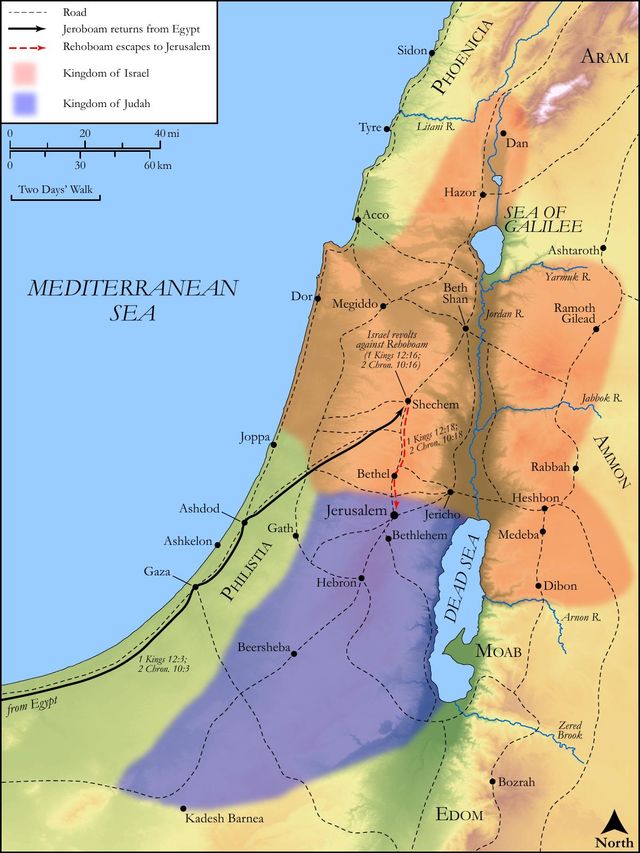
See on the biblical-era map
Study this verse
Public-domain commentary
Matthew Henry
From his Commentary on the Whole Bible. Henry comments on passages, not single verses — this entry covers 2 Chronicles 10:1–11.
We may observe here, 1. The wisest and best cannot give every body content. Solomon enriched and advanced his kingdom, did all (one would think) that could be done to make then happy and easy; and yet either he was indiscreet in burdening them with the imposition of taxes and services, or at least there was some colour of reason to think him so. No man is perfectly wise. It is probable that it was when Solomon had declined from God and his duty that his wisdom failed him, and God left him to himself to act in this impolitic manner. Even Solomon's treasures were exhausted by his love of women; and probably it was to maintain them, and their pride, luxury, and idolatry, that he burdened his subjects. 2. Turbulent and ungrateful spirits will find fault with the government, and complain of grievances, when they have very little reason to do so. Had they not peace in Solomon's time? They were never plundered by invaders, as formerly, never put in fear by the alarms of war, nor obliged to hazard their lives in the high places of the field. Had they not plenty - meat enough, and money enough? What would they more? O fortunatos nimium, sua si bona norint! - O happy, if they knew their happy state! And yet they complain that Solomon made their yoke grievous. If any complain thus of the yoke of Christ, that they might have a pretence to break his bands in sunder and cast away his cords from them, we are sure that he never gave them any cause at all for the complaint, whatever Solomon did. His yoke is easy, and his burden is light. He never made us serve with an offering, nor wearied us with incense. 3. Many ruin themselves and their interests by trampling upon and provoking their inferiors. Rehoboam thought that because he was king he might assume as much authority as his father had done, might have what he would, and do what he would, and carry all before him. But, though he wore his father's crown, he wanted his father's brains, and ought to have considered that, being quite a different man from what his father was, he ought to take other measures. Such a wise man as Solomon may do as we will, but such a fool as Rehoboam must do as he can. The high-mettled horse may be kicked and spurred by him that has the art of managing him; but, if an unskilful horseman do it, it is at his peril. Rehoboam paid dearly for threatening, and talking big, and thinking to carry matters with a high hand. It was Job's wisdom, as well as his virtue, that he despised not the cause of his man-servant or maid-servant, when they argued with him (Job 31:13), but heard them patiently, considered their reasons, and gave them a soft answer. And a similar tender consideration of those in subjection, and a forwardness to make them easy, will be the comfort and praise of all in authority, in the church, in the state, and in families. 4. Moderate counsels are generally wisest and best. Gentleness will do what violence will not do. Most people love to be accosted mildly. Rehoboam's old experienced counsellors directed him to this method (v. 7): "Be kind to this people, and please them, and speak good words to them, and thou art sure of them for ever." Good words cost nothing but a little self-denial, and yet they purchase good things. 5. God often fulfils the counsels of his own wisdom by infatuating men, and giving them up to the counsels of their own folly. No more needs to be done to ruin men than to leave them to themselves, and their own pride and passion.
Continue studying 2 Chronicles 10:4 across the web’s major study libraries — every link below opens this exact verse, chapter, or book on the destination site.
Read & Compare
 BibleGatewayThis verse in more than 200 translations and 70 languages.
 Bible.comThe YouVersion reader — hundreds of translations, reading plans, and highlights.
 ESV.orgCrossway's official English Standard Version reader.
 NET BibleThe NET translation with 60,000+ translators' notes on every rendering decision.
 STEP BibleTyndale House's free study tool — original text, vocabulary, and scholarly resources.
 BibliaLogos Bible Software's free web reader.
 USCCBThe New American Bible (Revised Edition) with the U.S. bishops' study notes.
Commentaries
 BibleHub CommentariesDozens of classic commentaries on this verse, gathered on one page.
 StudyLightMore than 100 commentary sets — the largest collection on the web.
 BibleRefPlain-English commentary on what this verse means, verse by verse.
 Enduring WordDavid Guzik's free commentary on this chapter, widely used by Bible teachers.
 Bible Study ToolsVerse commentary alongside Greek and Hebrew study aids.
Original Language & Research
- BibleHub InterlinearThe verse word by word — original language, transliteration, and English.
- BibleHub LexiconEvery word's original-language definition and Strong's entry.
 Blue Letter BibleDeep-study tools — Strong's numbers, concordance, and word studies.
 SefariaThe Hebrew text with Rashi and centuries of Jewish commentary.
Sermons, Hymns & Audio


TrulyRandomVerse is not affiliated with these sites and doesn’t control their content. They’re linked because they’re genuinely useful.
Summary
At a critical juncture in Israel's history, the united tribes confront Rehoboam, Solomon's successor, at Shechem. This pivotal verse encapsulates their collective plea, articulating the profound burden of forced labor and heavy taxation imposed by King Solomon. They implore Rehoboam to alleviate this oppressive "grievous servitude" and "heavy yoke," promising their loyal service in return for a more benevolent rule. This request sets the stage for the kingdom's dramatic division, highlighting the critical juncture of leadership choice and its far-reaching consequences for the nation.
Context
ShowHideLiterary Context
This verse immediately follows the death of King Solomon and precedes the formal coronation of his son, Rehoboam, in Shechem. The Chronicler, in 2 Chronicles 9, has just detailed the unparalleled wealth, wisdom, and glory of Solomon's reign, including his immense building projects. However, 2 Chronicles 10:1-3 sets the scene for the people's confrontation, indicating that the grandeur came at a significant cost. Verse 4 is the people's direct articulation of their grievance, a plea for relief from the burdens that underpinned Solomon's splendor. It directly parallels 1 Kings 12:4, serving as the critical turning point where the future of the united monarchy hangs in the balance, leading directly to the kingdom's division as seen in 2 Chronicles 10:16-19.
Historical & Cultural Context
Solomon's reign (c. 970-931 BCE) was marked by extensive building programs, including the magnificent Temple in Jerusalem, his own opulent palace, and various fortified cities. These projects required vast resources and, crucially, a system of forced labor (corvée) and heavy taxation, often levied disproportionately on the northern tribes. The "yoke" metaphor was a common ancient Near Eastern symbol for servitude and oppression, frequently used to describe the burdens imposed by rulers or foreign powers, reflecting a widespread understanding of its meaning among the populace. Shechem, where this encounter takes place, was a historically significant tribal center, particularly for the northern tribes, making it a fitting location for their collective voice to be heard. The people's demand reflects a deeply ingrained expectation of justice and relief from excessive burdens, a principle often articulated in Israelite law and prophetic tradition, such as the warnings against oppressive kings in 1 Samuel 8:10-18.
Key Themes
ShowHideThe verse powerfully contributes to several overarching themes within Chronicles and the broader biblical narrative. It highlights the burden of leadership, demonstrating how a ruler's decisions regarding taxation and labor directly impact the populace, and the critical need for wise, compassionate governance. It underscores the consequences of oppression, showing how unchecked power and disregard for the people's welfare can lead to widespread discontent and, ultimately, national fragmentation. Furthermore, it reveals the conditional nature of loyalty in a monarchy, where the people's allegiance is contingent upon the king's willingness to act in their perceived best interest. This moment also implicitly raises themes of justice and mercy in governance, contrasting the harshness of Solomon's later reign with a hope for a more benevolent and equitable future under Rehoboam, a hope that is tragically dashed, leading to the fulfillment of prophetic warnings about the consequences of unrighteous rule, as seen in 1 Kings 11:29-39.
Exposition and Analysis
ShowHideKey Word Analysis
ShowHideThis term (H5923), derived from a root meaning "to bear" or "to carry," literally refers to a wooden beam placed across the necks of oxen to harness them for plowing or pulling heavy loads. In the biblical context, as used here, it is a powerful metaphor for servitude, bondage, and oppressive burdens. The "yoke" symbolizes the crushing weight of forced labor, taxation, and the loss of freedom experienced by the people under Solomon's reign. Its usage evokes a visceral image of being bound and compelled to arduous tasks, highlighting the people's profound suffering and the severity of the king's demands.
This adjective (H7186) means "severe," "difficult," "hard," or "cruel" in various applications. When applied to the "yoke" and "servitude," it intensifies the sense of oppression. It's not merely a "heavy" burden, but one that is exceedingly difficult to bear, causing distress, hardship, and a feeling of being "hard-pressed." The repetition of "grievous" (twice) and "heavy" emphasizes the severity of the people's plight and their desperate need for relief from this harsh reality.
This noun (H5656), derived from the verb "to work" or "to serve," refers to "work of any kind," encompassing labor, bondage, and service. In this context, it specifically denotes the oppressive "bondage" and "labor" imposed by Solomon, particularly the forced labor (corvée) and heavy service that characterized his massive building projects. It highlights the extent to which the people felt reduced to mere laborers under a system that demanded their toil without adequate consideration for their well-being.
Verse Breakdown
ShowHide"Thy father made our yoke grievous:"
This opening clause immediately establishes the core complaint and its direct attribution. The people directly link their suffering to Solomon's policies and actions. The "yoke" here is a potent metaphor for the oppressive rule of taxation and forced labor that supported Solomon's extensive building projects and lavish lifestyle. The term "grievous" (קָשֶׁה, qasheh) signifies the extreme hardship and severity of this burden, indicating that it was not merely difficult but truly unbearable for the populace, causing profound distress.
"now therefore ease thou somewhat the grievous servitude of thy father, and his heavy yoke that he put upon us,"
This is the heart of their plea, a direct and urgent appeal to Rehoboam for relief. The phrase "ease thou somewhat" (הָקֵל מֵעָלֵינוּ, haqel me'aleinu) means "lighten from upon us" or "make light for us," expressing their desperate desire for a significant reduction in the oppressive demands. They reiterate the nature of their suffering, referring to both "grievous servitude" (עֲבֹדָה קָשָׁה, 'avodah qashah – hard labor/service) and "his heavy yoke," reinforcing the unbearable nature of Solomon's policies. This demonstrates their clear understanding of the source of their distress and their fervent hope that the new king will reverse these burdensome policies.
"and we will serve thee."
This final clause presents the condition of their loyalty and allegiance. Their willingness to serve Rehoboam as king is explicitly tied to his positive response to their request. It is a promise of allegiance, but one that is conditional upon the alleviation of their burdens. This highlights the transactional nature of the relationship between the monarch and his subjects in this context, where the people's support is not absolute but dependent on the king's benevolent and just governance.
Literary Devices
ShowHideThe verse is rich in Metaphor, primarily through the repeated use of "yoke" (עֹל, ʻôl'). This powerful image, drawn from agricultural life, vividly conveys the crushing burden of forced labor and taxation. The "yoke" symbolizes the oppressive policies of Solomon, making the abstract concept of governmental burden tangible and relatable. The people's speech also functions as a Plea or Supplication, a direct and desperate appeal to authority for relief. It is structured as a Conditional Statement, where their promised "service" is explicitly contingent upon Rehoboam's willingness to "ease" their burdens. This rhetorical strategy places the onus on the new king, highlighting the high stakes of his decision and the immediate consequences of his choice. The Repetition of "grievous" and "yoke" further emphasizes the severity of their suffering and the central nature of their complaint, underscoring their profound distress and the urgency of their appeal.
Theological and Thematic Connections
ShowHideThis pivotal verse exposes the tension between a monarch's pursuit of glory and the well-being of his subjects, a recurring theme in biblical wisdom literature and prophetic critique. It underscores the theological principle that true leadership, especially among God's covenant people, must be characterized by justice, mercy, and a genuine concern for the vulnerable, rather than self-aggrandizement or oppression. The people's plea for relief echoes a broader biblical longing for liberation from bondage, a desire rooted in Israel's foundational exodus from Egyptian slavery. Their conditional loyalty also foreshadows the consequences of unrighteous rule, where divine judgment often manifests through the instability and division of earthly kingdoms. Ultimately, it reminds us that earthly authority, though divinely ordained, is accountable for its stewardship and its profound impact on those under its care, reflecting God's own character of justice and compassion.
Reflection and Application
ShowHideThe plea of the people in 2 Chronicles 10:4 serves as a timeless reminder of the delicate balance between leadership and the led. For those in positions of authority—whether in government, business, family, or ministry—it is a stark warning against the dangers of becoming disconnected from the burdens of those under their care. True leadership is not about accumulating power or glory for oneself, but about serving the needs of others, easing their legitimate burdens, and fostering an environment of justice and well-being. Ignoring the cries of the oppressed, or increasing their burdens, inevitably leads to alienation, resentment, and ultimately, breakdown. For individuals, this verse highlights the importance of respectfully articulating grievances and advocating for just treatment, even when faced with overwhelming power. It also invites us to consider what "yokes" we carry, both imposed by others and self-imposed, and to seek the true freedom found in righteous living and reliance on divine grace, understanding that God desires our flourishing, not our oppression.
Questions for Reflection
ShowHideFAQ
ShowHideWhy did Solomon's reign, despite its glory, result in such a "grievous yoke" for the people?
ShowHideSolomon's reign was indeed glorious, marked by immense wealth, wisdom, and the construction of the First Temple. However, this grandeur came at a significant cost. His extensive building projects, including the Temple, his opulent palace, and numerous fortified cities, required vast resources and a massive labor force. To fund these endeavors and maintain his lavish court, Solomon imposed heavy taxes and instituted a system of forced labor (corvée), particularly on the non-Israelite population but also on the Israelite tribes, as indicated in 1 Kings 5:13-18 and 1 Kings 9:15-23. While the Chronicler tends to focus on Solomon's positive aspects, the parallel account in 1 Kings 12:4 explicitly states that Solomon had made their "grievous servitude" and "heavy yoke" a reality. The people's complaint in 2 Chronicles 10:4 confirms that these burdens were perceived as oppressive and unsustainable, leading to widespread discontent and ultimately, the division of the kingdom.
Christ-Centered Fulfillment
ShowHideThe "grievous yoke" described in 2 Chronicles 10:4 stands in stark contrast to the liberating offer of Jesus Christ. While Rehoboam chose to intensify the people's burdens, leading to national division and continued oppression, Jesus, the ultimate King and Son of David, offers a fundamentally different kind of reign. He invites all who are weary and burdened to come to Him, promising rest for their souls and declaring, "For my yoke is easy, and my burden is light" (Matthew 11:28-30). This "light yoke" is not an absence of discipleship or responsibility, but a life lived in humble obedience to a King who bore the ultimate burden of sin and suffering on the cross (Isaiah 53:4-6). Jesus, unlike Rehoboam, is the compassionate Shepherd who lays down His life for His sheep (John 10:11), freeing them from the oppressive yokes of sin, legalism, and human tyranny. His kingdom is one of righteousness, peace, and joy in the Holy Spirit (Romans 14:17), offering true spiritual freedom and an eternal inheritance that no earthly king could ever provide (Colossians 1:13-14).