


1 Samuel 20:5
Bible text: King James Version (1769 Blayney text) · Public domain
Bible text: King James Version with Strong's numbers · Public domain
Bible text: Berean Standard Bible · Public domain
Bible text: American Standard Version (1901) · Public domain
Bible text: World English Bible, Messianic edition · Public domain
Bible text: Geneva Bible (1599) · Public domain
Bible text: Young's Literal Translation · Public domain
- וַיֹּאמֶרvai·Yo·merand he saidH559Conj-w ¦ V-Qal-ConsecImperf-3msVerb Qal Consecutive Imperfect 3rd Singular Masculineוַandיֹּאמֶרhe said
- דָּוִדda·VidDavidH1732N-proper-mNoun Proper Masculine
- אֶל'eltoH413PrepPreposition
- יְהוֹנָתָןye·ho·na·TanJonathanH3083N-proper-mNoun Proper Masculine
- הִנֵּהhi·nehhere!H2009PrtParticle Interjection
- חֹדֶשׁcho·desha new moonH2320N-msNoun Singular Masculine Absolute
- מָחָרma·Char[will be] tomorrowH4279N-msNoun Singular Masculine Absolute
- וְאָנֹכִיve·'a·no·Khiand IH595Conj-w ¦ Pro-1csPronoun Personal 1st Singular common genderוְandאָנֹכִיI
- יָשֹׁבya·shovcertainly <to sit>H3427V-Qal-InfAbsVerb Qal Infinitive Absolute
- אֵשֵׁב'e·ShevI will sitH3427V-Qal-Imperf-1csVerb Qal Imperfect 1st Singular common gender
- עִם'imwithH5973PrepPreposition
- הַמֶּלֶךְha·Me·lekhthe kingH4428Art ¦ N-msNoun Singular Masculine Absoluteהַtheמֶּלֶךְking
- לֶאֱכוֹלle·'e·Kholto eatH398Prep-l ¦ V-Qal-InfVerb Qal Infinitive Constructלֶtoאֱכוֹלeat
- וְשִׁלַּחְתַּנִיve·shi·lach·Ta·niand you will let go meH7971Conj-w ¦ V-Piel-ConsecPerf-2ms ¦ 1csVerb Piel Consecutive Perfect 2nd Singular Masculineוְandשִׁלַּחְתַּyou will let goנִיme
- וְנִסְתַּרְתִּיve·nis·tar·Tiand I will hide myselfH5641Conj-w ¦ V-Niphal-ConsecPerf-1csVerb Niphal Consecutive Perfect 1st Singular common genderוְandנִסְתַּרְתִּיI will hide myself
- בַשָּׂדֶהva·sa·Dehin the fieldH7704Prep-b ¦ N-msNoun Singular Masculine Absoluteבַin theשָּׂדֶהfield
- עַד'aduntilH5704PrepPreposition
- הָעֶרֶבha·'E·revthe eveningH6153Art ¦ N-msNoun Singular Masculine Absoluteהָtheעֶרֶבevening
- הַשְּׁלִשִׁיתha·she·li·Shit<the> thirdH7992Art ¦ Adj-fsAdjective Numerical Position Singular Feminine Absoluteהַ<the>שְּׁלִשִׁיתthird
English is a literal word-by-word gloss of the Hebrew, not the KJV's wording. Why?
This is the original text the KJV's translators worked from — each Hebrew word with its own literal English meaning in this verse, prepared by scholars at Tyndale House, Cambridge. The KJV translates whole sentences, not word by word, so its wording differs: one Hebrew word can become several English words, and the KJV may choose “the LORD” where the gloss reads “Yahweh”. Both are faithful — they answer different questions. For the KJV's own rendering, switch to the KJV text.
Details
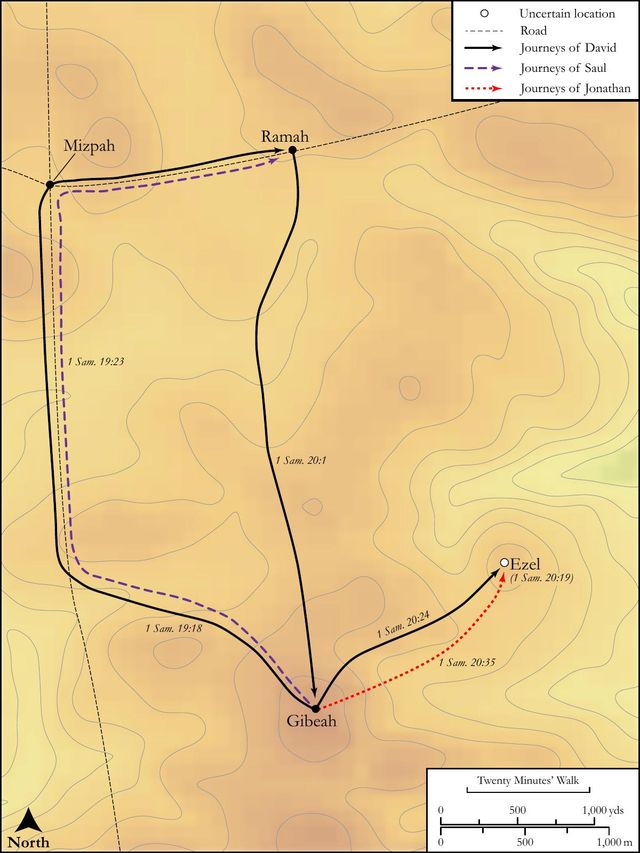
See on the biblical-era map
Study this verse
Public-domain commentary
Matthew Henry
From his Commentary on the Whole Bible. Henry comments on passages, not single verses — this entry covers 1 Samuel 20:1–8. His three-level outline is real structure in the source text, so it is rendered as structure.
Here, I. David makes a representation to Jonathan of his present troubles. While Saul lay bound by his trance at Naioth David escaped to the court, and got to speak with Jonathan. And it was happy for him that he had such a friend at court, when he had such an enemy on the throne. If there be those that hate and despise us, let us not be disturbed at that, for there are those also that love and respect us. God hath set the one over against the other, and so must we. Jonathan was a friend that loved at all times, loved David as well now in his distress, and bade him as welcome into his arms, as he had done when he was in his triumph (Sa1 18:1), and he was a brother that was born for adversity, Pro 17:17. Now, 1. David appeals to Jonathan himself concerning his innocency, and he needed not say much to him for the proof of it, only he desired him that if he knew of any just offence he had given his father he would tell him, that he might humble himself and beg his pardon: What have I done? Sa1 20:1. 2. He endeavors to convince him that, notwithstanding his innocency, Saul sought his life. Jonathan, from a principal of filial respect to his father, was very loth to believe that he designed or would ever do so wicked a thing, Sa1 20:2. He the rather hoped so because he knew nothing of any such design, and he had usually been made privy to all his counsels. Jonathan, as became a dutiful son, endeavored to cover his father's shame, as far as was consistent with justice and fidelity to David. Charity is not forward to think evil of any, especially of a parent, Co1 13:5. David therefore gives him the assurance of an oath concerning his own danger, swears the peace upon Saul, that he was in fear of his life by him: "As the Lord liveth, than which nothing more sure in itself, and as thy soul liveth, than which nothing more certain to thee, whatever thou thinkest, there is but a step between me and death," Sa1 20:3. And, as for Saul's concealing it from Jonathan, it was easy to account for that; he knew the friendship between him and David, and therefore, though in other things he advised with him, yet not in that. None more fit than Jonathan to serve him in every design that was just and honourable, but he knew him to be a man of more virtue than to be his confidant in so base a design as the murder of David.
II.Jonathan generously offers him his service (Sa1 20:4):
Whatsoever thou desirest, he needed not insert the proviso of lawful and honest (for he knew David too well to think he would ask any thing that was otherwise), I will even do it for thee. This is true friendship. Thus Christ testifies his love to us: Ask, and it shall be done for you; and we must testify ours to him by keeping his commandments.
III.David only desires him to satisfy himself, and then to satisfy him whether Saul did really design his death or no.
Perhaps David proposed this more for Jonathan's conviction than his own, for he himself was well satisfied.
1.The method of trial he proposed was very natural, and would certainly discover how Saul stood affected to him. The two next days Saul was to dine publicly, upon occasion of the solemnities of the new moon, when extraordinary sacrifices were offered and feasts made upon the sacrifices. Saul was rejected of God, and the Spirit of the Lord had departed from him, yet he kept up his observance of the holy feasts. There may be the remains of external devotion where there is nothing but the ruins of real virtue. At these solemn feasts Saul had either all his children to sit with him, and David had a seat as one of them, or all his great officers, and David had a seat as one of them. However it was, David resolved his seat should be empty (and that it never used to be at a sacred feast) those two days (Sa1 20:5), and he would abscond till the solemnity was over, and put it upon this issue: if Saul admitted an excuse for his absence, and dispensed with it, he would conclude he had changed his mind and was reconciled to him; but if he resented it, and was put into a passion by it, it was easy to conclude he designed him a mischief, since it was certain he did not love him so well as to desire his presence for any other end than that he might have an opportunity to do him a mischief, Sa1 20:7.
2.The excuse he desired Jonathan to make for his absence, we have reason to think, was true, that he was invited by his elder brother to Bethlehem, his own city, to celebrate this new moon with his relations there, because, besides the monthly solemnity in which they held communion with all Israel, they had now a yearly sacrifice, and a holy feast upon it, for all the family, Sa1 20:6. They kept a day of thanksgiving in their family for the comforts they enjoyed, and of prayer for the continuance of them. By this it appears that the family David was of was a very religious family, a house that had a church in it.
3.The arguments he used with Jonathan to persuade him to do this kindness for him were very pressing, Sa1 20:8.
(1.)That he had entered into a league of friendship with him, and it was Jonathan's own proposal: Thou hast brought thy servant into a covenant of the Lord with thee.
(2.)That he would by no means urge him to espouse his cause if he was not sure that it was a righteous cause: "If there be iniquity in me, I am so far from desiring or expecting that the covenant between us should bind thee to be a confederate with me in that iniquity that I freely release thee from it, and wish that my hand may be first upon me: Slay me thyself." No honest man will urge his friend to do a dishonest thing for his sake.
Historical interpretation
Ten Centuries of Reception
2 surviving comments on this verse. Each one is dated, so this reads as a timeline rather than a list.
Select a marker to jump to its quote. Markers stagger vertically where authors wrote within a few decades of each other.
And Jonathan said to him: Tomorrow is the New Moon, etc. The holy Scripture does not denote those unequal beginnings of the months, which the Romans have annually, twelve in number, but the new moons, which are called Neomenia by the Greeks; which the Hebrews solemnly celebrated according to the institution of the law, with sacrifices, feasts, and the rest of the Sabbath, that is, of rest. This is signified by the Holy Spirit, as often as Christ sprinkles the Church, as often as any faithful soul, like the sun, with the new light of his grace, immediately spiritual sacrifices of life are to be offered more solemnly to God, immediately sweetly indulging in the feasts of divine sayings, immediately all the commotions of external cares must be put aside in happy rest. Wherefore Jonathan now speaks to David about coming tomorrow on the Calends.
Tomorrow is the new moon: The neomenia, or first day of the moon, kept according to the law, as a festival; and therefore Saul feasted on that day: and expected the attendance of his family.
Continue studying 1 Samuel 20:5 across the web’s major study libraries — every link below opens this exact verse, chapter, or book on the destination site.
Read & Compare
 BibleGatewayThis verse in more than 200 translations and 70 languages.
 Bible.comThe YouVersion reader — hundreds of translations, reading plans, and highlights.
 ESV.orgCrossway's official English Standard Version reader.
 NET BibleThe NET translation with 60,000+ translators' notes on every rendering decision.
 STEP BibleTyndale House's free study tool — original text, vocabulary, and scholarly resources.
 BibliaLogos Bible Software's free web reader.
 USCCBThe New American Bible (Revised Edition) with the U.S. bishops' study notes.
Commentaries
 BibleHub CommentariesDozens of classic commentaries on this verse, gathered on one page.
 StudyLightMore than 100 commentary sets — the largest collection on the web.
 BibleRefPlain-English commentary on what this verse means, verse by verse.
 Enduring WordDavid Guzik's free commentary on this chapter, widely used by Bible teachers.
 Bible Study ToolsVerse commentary alongside Greek and Hebrew study aids.
Original Language & Research
- BibleHub InterlinearThe verse word by word — original language, transliteration, and English.
- BibleHub LexiconEvery word's original-language definition and Strong's entry.
 Blue Letter BibleDeep-study tools — Strong's numbers, concordance, and word studies.
 SefariaThe Hebrew text with Rashi and centuries of Jewish commentary.
Sermons, Hymns & Audio


TrulyRandomVerse is not affiliated with these sites and doesn’t control their content. They’re linked because they’re genuinely useful.
Summary
1 Samuel 20:5 vividly portrays David's perilous situation and his ingenious strategy to ascertain King Saul's true intentions towards him. Facing relentless and escalating threats to his life, David reveals to Jonathan his customary obligation to attend the upcoming new moon feast at the royal court. He then proposes a plan to deliberately absent himself, choosing instead to hide in the open field for three days, relying on Jonathan to observe Saul's reaction and report back, thereby confirming the king's murderous resolve or the possibility of reconciliation. This verse encapsulates David's shrewdness, his profound trust in Jonathan's unshakeable loyalty, and the extreme danger that forces the anointed future king into a life of evasion.
Context
ShowHideLiterary Context
This verse is a pivotal moment following a series of increasingly violent attempts by King Saul to kill David, detailed throughout 1 Samuel 19. Jonathan, David's loyal friend, had previously intervened on David's behalf, temporarily reconciling them with Saul after a heartfelt plea (1 Samuel 19:1-7). However, Saul's deep-seated jealousy, exacerbated by an evil spirit, resurfaced, forcing David to flee for his life again (1 Samuel 19:9-10). Chapter 20 opens with David seeking Jonathan to understand the persistence of Saul's animosity, leading directly to David's proposed test in verse 5. This crucial conversation sets the stage for the elaborate signal system and Jonathan's ultimate, heartbreaking confirmation of his father's murderous intent, culminating in David's permanent flight from the royal court and the beginning of his life as a fugitive.
Historical & Cultural Context
The "new moon" (Hebrew: Rosh Chodesh) was a significant religious and social observance in ancient Israel. It marked the beginning of each lunar month and was celebrated with special sacrifices (Numbers 28:11-15) and often a communal feast, particularly for prominent families and the royal court. Kings and high-ranking officials were expected to attend these feasts, making David's presence at the royal table customary and his absence exceptionally noticeable. As Saul's son-in-law, a celebrated military hero, and a high-ranking commander, David held a position of honor at court. Therefore, his proposed absence from such a public and important event was a deliberate act designed to provoke a clear reaction from Saul. The concept of "hiding" in the field was a practical necessity for fugitives, utilizing the natural landscape for concealment, underscoring the severity of the threat David faced.
Key Themes
ShowHideThis verse powerfully underscores the theme of imminent danger to David's life, necessitating a strategic and proactive response rather than passive waiting for an attack. It highlights David's strategic planning and discerning wisdom, as he devises a precise test to confirm Saul's intentions, demonstrating a reliance on God's guidance while also exercising human prudence in navigating a perilous situation. Central to 1 Samuel 20 is the profound theme of covenant friendship between David and Jonathan, a bond so strong it transcends familial loyalty and political allegiance. Jonathan's willingness to risk his own standing and safety for David's sake, as seen in his agreement to the plan, epitomizes this theme, echoing their initial covenant in 1 Samuel 18:3. Finally, David's decision to prioritize his survival over the expected observance of custom (sitting at the king's table) reveals a practical wisdom and reliance on God's protection in the face of extreme threat, demonstrating that sometimes spiritual discernment requires departing from social expectations.
Exposition and Analysis
ShowHideKey Word Analysis
ShowHideThis term refers to the first day of the lunar month, which was observed as a significant religious festival in ancient Israel. It involved special sacrifices and was a time for communal gathering and feasting, often including the king and his court. David's expected presence at this specific event underscores his prominent position and the social and religious significance of his potential absence, making it a perfect occasion to test Saul's disposition.
Derived from a root meaning "to sit down," "to dwell," or "to remain," this word emphasizes David's customary and expected presence at the royal table. The phrase "I should not fail to sit" highlights his established position and the social obligation tied to it. His deliberate absence, therefore, would be a clear and undeniable deviation from norm, designed to elicit a strong reaction from King Saul.
This verb, meaning "to hide (by covering), literally or figuratively," conveys David's vulnerable state and the absolute necessity of his evasion. It implies a deliberate and protective concealment, underscoring the severity of the threat from Saul that forces David, a national hero and God's anointed, into a clandestine existence. This act of hiding is not merely a preference but a matter of survival.
Verse Breakdown
ShowHide"And David said unto Jonathan, Behold, to morrow [is] the new moon"
This clause initiates the crucial dialogue between David and Jonathan, immediately establishing the temporal context of the upcoming new moon festival. David highlights the significance of the timing, as this event, with its public and customary attendance, will serve as the perfect backdrop for testing Saul's true intentions towards him.
"and I should not fail to sit with the king at meat"
David acknowledges his expected duty and customary place at the royal table during this important feast. This statement confirms his high status and the social expectation of his presence, making his proposed absence a deliberate and noticeable act, a clear signal that something is amiss.
"but let me go, that I may hide myself in the field unto the third [day] at even"
This is David's strategic proposal for his absence. He intends to absent himself from the feast and conceal himself in the open field, indicating the extreme measures he must take for his safety. The duration, "unto the third day at even," suggests a calculated period long enough to observe Saul's consistent reaction over multiple days and ensure a thorough, reliable assessment of the king's murderous intent.
Literary Devices
ShowHideThe verse effectively employs several literary devices to convey its meaning and emotional weight. Foreshadowing is powerfully evident as David's decision to "hide myself in the field" directly foreshadows his prolonged life as a fugitive, constantly evading Saul's relentless pursuit throughout the subsequent chapters of 1 Samuel. There is a profound sense of irony in the situation: David, the divinely chosen future king and national hero, who has faithfully served Saul and even spared his life, is now forced to hide from the very king he serves. The entire chapter is driven by dialogue, with this verse marking the opening of David's crucial proposition to Jonathan, allowing the reader direct insight into the characters' thoughts, fears, and strategic plans. Finally, a stark contrast is drawn between David's expected public duty at a royal feast, a place of honor and visibility, and the necessary, life-saving act of private concealment in the wilderness, highlighting the extreme tension between custom and survival, and the profound disruption of David's life.
Theological and Thematic Connections
ShowHide1 Samuel 20:5 profoundly illustrates the interplay between divine providence and human agency in the life of faith. While God had already designated David as king and promised him the throne, David actively engages in strategic planning and seeks wisdom to navigate the immediate, life-threatening dangers. This demonstrates that faith does not negate the need for practical discernment, wise action, and reliance on God-given intellect in perilous times. This verse also powerfully speaks to the value of loyal, covenantal friendship, reflecting the biblical principle that "a friend loves at all times, and a brother is born for adversity" (Proverbs 17:17). David's reliance on Jonathan underscores the indispensable role of trusted allies in times of trial, mirroring the concept of "iron sharpens iron" (Proverbs 27:17). The "new moon" feast, a significant religious observance, connects to the broader Old Testament sacrificial system and the rhythm of Israel's worship, which consistently pointed forward to a greater fulfillment in the coming Messiah.
Reflection and Application
ShowHideDavid's predicament in 1 Samuel 20:5 offers profound insights for navigating challenging relationships and discerning dangerous situations in our own lives. His proactive approach to testing Saul's intentions, rather than passively waiting for disaster to strike, reminds us of the importance of spiritual discernment and practical wisdom. We are called to be "wise as serpents and innocent as doves" (Matthew 10:16), understanding when to engage directly, when to strategically withdraw for safety, or when to seek alternative solutions. Furthermore, David's profound reliance on Jonathan exemplifies the invaluable role of true, loyal friendships in times of crisis. These are the friends who, like Jonathan, are willing to stand with us, even at personal cost, offering counsel, protection, and unwavering support as we navigate life's most treacherous paths. Sometimes, wisdom dictates that adherence to rigid custom or expectation must yield to the higher priority of personal safety, the pursuit of truth, or a greater divine purpose, especially when lives or spiritual well-being are at stake.
Questions for Reflection
ShowHideFAQ
ShowHideWhy was the "new moon" feast so important, and why was David's presence expected?
ShowHideThe "new moon" (Hebrew: Rosh Chodesh) was a highly significant religious and social observance in ancient Israel, marking the beginning of each new lunar month. It was celebrated with special sacrifices, as detailed in Numbers 28:11-15, and often included a communal feast. It was a time for corporate worship, fellowship, and a break from regular labor, as indicated by references like Amos 8:5. Attendance at such royal feasts was customary and expected for prominent members of the king's court. As King Saul's son-in-law, a celebrated military commander, and a high-ranking official, David held a customary and visible place at the royal table. His absence from such a public and important event would be immediately noticeable and would serve as a clear indicator of his relationship with the king, which David intended to test. This tradition of observing new moons is mentioned throughout the Old Testament, emphasizing its importance in Israelite religious life (1 Chronicles 23:31; Isaiah 66:23).
Christ-Centered Fulfillment
ShowHide1 Samuel 20:5, with David's desperate need to hide from a murderous king, powerfully foreshadows the experience of Jesus Christ. Just as David, God's anointed future king, was rejected and relentlessly pursued by Saul, so too was Jesus, the true King of Israel and the Son of David, rejected by His own people and pursued by those in power who sought His life (John 1:11; John 5:18). David's strategic decision to "hide myself in the field" to avoid Saul's wrath finds echoes in Christ's own strategic withdrawals from those who sought to harm Him or force His hand prematurely before His appointed time (John 6:15; Matthew 12:15). Ultimately, David's temporary concealment points to Christ's own ultimate "hiding" in the tomb, a temporary concealment that led not to permanent flight, but to His glorious resurrection and the establishment of His eternal, unshakable kingdom (Acts 2:24; Revelation 11:15). The "new moon" feast, part of the Old Covenant's ceremonial law and a shadow of things to come, finds its ultimate fulfillment in Christ, who is our true "new beginning" and the substance to which all Old Testament shadows pointed (Colossians 2:16-17). Through His perfect sacrifice, He inaugurated a new and better covenant, rendering the old observances obsolete in their salvific power (Hebrews 8:13). David's reliance on Jonathan's perfect loyalty and intercession also prefigures Christ's perfect friendship and His role as our faithful advocate and intercessor before the Father (1 John 2:1; Hebrews 7:25).