


1 Chronicles 16:21
Bible text: King James Version (1769 Blayney text) · Public domain
Bible text: Berean Standard Bible · Public domain
Bible text: American Standard Version (1901) · Public domain
Bible text: World English Bible, Messianic edition · Public domain
Bible text: Geneva Bible (1599) · Public domain
Bible text: Young's Literal Translation · Public domain
- לֹאlo'notH3808NegParticle Negative
- הִנִּיחַhi·Ni·achhe permittedH5117V-Hiphil-Perf-3msVerb Hiphil Perfect 3rd Singular Masculine
- לְאִישׁle·'Ish<to> anyoneH376Prep-l ¦ N-msNoun Singular Masculine Absoluteלְ<to>אִישׁanyone
- לְעָשְׁקָםle·'a·she·Kamto oppress themH6231Prep-l ¦ V-Qal-Inf ¦ 3mpVerb Qal Infinitive Constructלְtoעָשְׁקָoppressםthem
- וַיּוֹכַחvai·Yo·khachand he rebukedH3198Conj-w ¦ V-Hiphil-ConsecImperf-3msVerb Hiphil Consecutive Imperfect 3rd Singular Masculineוַandיּוֹכַחhe rebuked
- עֲלֵיהֶם'a·lei·Hemon themH5921Prep ¦ 3mpPrepositionעֲלֵיonהֶםthem
- מְלָכִיםme·la·KhimkingsH4428N-mpNoun Plural Masculine Absolute
English is a literal word-by-word gloss of the Hebrew, not the KJV's wording. Why?
This is the original text the KJV's translators worked from — each Hebrew word with its own literal English meaning in this verse, prepared by scholars at Tyndale House, Cambridge. The KJV translates whole sentences, not word by word, so its wording differs: one Hebrew word can become several English words, and the KJV may choose “the LORD” where the gloss reads “Yahweh”. Both are faithful — they answer different questions. For the KJV's own rendering, switch to the KJV text.
Details
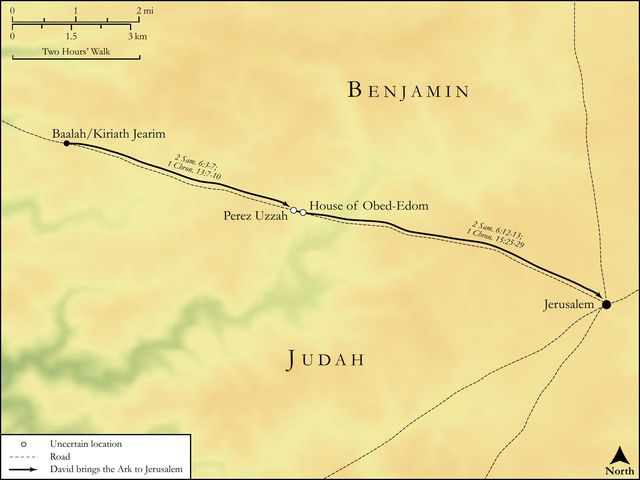
See on the biblical-era map
Study this verse
Public-domain commentary
Matthew Henry
From his Commentary on the Whole Bible. Henry comments on passages, not single verses — this entry covers 1 Chronicles 16:7–36.
We have here the thanksgiving psalm which David, by the Spirit, composed, and delivered to the chief musician, to be sung upon occasion of the public entry the ark made into the tent prepared for it. Some think he appointed this hymn to be daily used in the temple service, as duly as the day came; whatever other psalms they sung, they must not omit this. David had penned many psalms before this, some in the time of his trouble by Saul. This was composed before, but was now first delivered into the hand of Asaph, for the use of the church. It is gathered out of several psalms (from the beginning to Ch1 16:23 is taken from Psa 105:1, etc.; and then Ch1 16:23 is the whole 96th psalm, with little variation; Ch1 16:34 is taken from Psa 136:1 and divers others; and then the last two verses are taken from the close of Ps. 106), which some think warrants us to do likewise, and make up hymns out of David's psalms, a part of one and a part of another put together so as may be most proper to express and excite the devotion of Christians. These psalms will be best expounded in their proper places (if the Lord will); here we take them as they are put together, with a design to thank the Lord (Ch1 16:7), a great duty, to which we need to be excited and in which we need to be assisted. 1. Let God be glorified in our praises; let his honour be the centre in which all the lines meet. Let us glorify him by our thanksgivings (Give thanks to the Lord), by our prayers (Call on his name, Ch1 16:8), by our songs (Sing psalms unto him), by our discourse - Talk of all his wondrous works, Ch1 16:9. Let us glorify him as a great God, and greatly to be praised (Ch1 16:25), as supreme God (above all gods), as sole God, for all others are idols, Ch1 16:26. Let us glorify him as most bright and blessed in himself (Glory and honour are in his presence, Ch1 16:27), as creator (The Lord made the heavens), as the ruler of the whole creation (His judgments are in all the earth, Ch1 16:14), and as ours - He is the Lord our God. Thus must we give unto the Lord the glory due to his name (Ch1 16:28, Ch1 16:29), and own it, and much more, his due. 2. Let other be edified and instructed: Make known his deeds among the people (Ch1 16:8), declare his glory among the heathen (Ch1 16:24), that those who are strangers to him may be led into acquaintance with him, allegiance to him, and the adoration of him. Thus must we serve the interests of his kingdom among men, that all the earth may fear before him, Ch1 16:30. 3. Let us be ourselves encouraged to triumph and trust in God. Those that give glory to God's name are allowed to glory in it (Ch1 16:10), to value themselves upon their relation to God and venture themselves upon his promise to them. Let the heart of those rejoice that seek the Lord, much more of those that have found him. Seek him, and his strength, and his face: that is, seek him by the ark of his strength, in which he manifests himself. 4. Let the everlasting covenant be the great matter of our joy and praise (Ch1 16:15): Be mindful of his covenant. In the parallel place it is, He will be ever mindful of it, Psa 105:8. Seeing God never will forget it, we never must. The covenant is said to be commanded, because God has obliged us to obey the conditions of it, and because he has both authority to make the promise and ability to make it good. This covenant was ancient, yet never to be forgotten. It was made with Abraham, Isaac, and Jacob, who were long since dead (Ch1 16:16-18), yet still sure to the spiritual seed, and the promises of it pleadable. 5. Let God's former mercies to his people of old, to our ancestors and our predecessors in profession, be commemorated by us now with thankfulness to his praise. Let it be remembered how God protected the patriarchs in their unsettled condition. When they came strangers to Canaan and were sojourners in it, when they were few and might easily have been swallowed up, when they were continually upon the remove and so exposed, when there were many that bore them ill-will and sought to do them mischief, yet no man was suffered to do them wrong - not the Canaanites, Philistines, Egyptians. Kings were reproved and plagued for their sakes. Pharaoh was so, and Abimelech. They were the anointed of the Lord, sanctified by his grace, sanctified by his glory, and had received the unction of the Spirit. They were his prophets, instructed in the things of God themselves and commissioned to instruct others (and prophets are said to be anointed, Kg1 19:16; Isa 61:1); therefore, if any touch them, they touch the apple of God's eye; if any harm them, it is at their peril, Ch1 16:19-22. 6. Let the great salvation of the Lord be especially the subject of our praises (Ch1 16:23): Show forth from day to day his salvation, that is (says bishop Patrick), his promised salvation by Christ. We have reason to celebrate that from day to day; for we daily receive the benefits of it, and it is a subject that can never be exhausted. 7. Let God be praised by a due and constant attendance upon him in the ordinances he has appointed: Bring an offering, then the fruit of the ground, now the fruit of the lips, of the heart (Heb 13:15), and worship him in the beauty of holiness, in the holy places and in a holy manner, Ch1 16:29. Holiness is the beauty of the Lord, the beauty of all sanctified souls and all religious performances. 8. Let God's universal monarchy be the fear and joy of all people. Let us reverence it: Fear before him, all the earth. And let us rejoice in it: Let the heavens be glad and rejoice, because the Lord reigns, and by his providence establishes the world, so that, though it be moved, it cannot be removed, nor the measures broken which Infinite Wisdom has taken in the government of it, Ch1 16:30, Ch1 16:31. 9. Let the prospect of the judgment to come inspire us with an awful pleasure, Let earth and sea, fields and woods, though in the great day of the Lord they will all be consumed, yet rejoice that he will come, doth come, to judge the earth, Ch1 16:32, Ch1 16:33. 10. In the midst of our praises we must not forget to pray for the succour and relief of those saints and servants of God that are in distress (Ch1 16:35): Save us, gather us, deliver us from the heathen, those of us that are scattered and oppressed. When we are rejoicing in God's favours to us we must remember our afflicted brethren, and pray for their salvation and deliverance as our own. We are members one of another; and therefore when we mean, "Lord, save them," it is not improper to say, "Lord, save us." Lastly, Let us make God the Alpha and Omega of our praises. David begins with (Ch1 16:8), Give thanks to the Lord; he concludes (Ch1 16:36), Blessed be the Lord. And whereas in the place whence this doxology is taken (Psa 106:48) it is added, Let all the people say, Amen, Hallelujah, here we find they did according to that directory: All the people said, Amen, and praised the Lord. When the Levites had finished this psalm or prayer and praise, then, and not till then, the people that attended signified their consent and concurrence by saying, Amen, And so they praised the Lord, much affected no doubt with this newly instituted way of devotion, which had been hitherto used in the schools of the prophets only, Sa1 10:5. And, if this way of praising God please the Lord better than an ox or a bullock that has horns and hoofs, the humble shall see it and be glad, Psa 69:31, Psa 69:32.
Continue studying 1 Chronicles 16:21 across the web’s major study libraries — every link below opens this exact verse, chapter, or book on the destination site.
Read & Compare
 BibleGatewayThis verse in more than 200 translations and 70 languages.
 Bible.comThe YouVersion reader — hundreds of translations, reading plans, and highlights.
 ESV.orgCrossway's official English Standard Version reader.
 NET BibleThe NET translation with 60,000+ translators' notes on every rendering decision.
 STEP BibleTyndale House's free study tool — original text, vocabulary, and scholarly resources.
 BibliaLogos Bible Software's free web reader.
 USCCBThe New American Bible (Revised Edition) with the U.S. bishops' study notes.
Commentaries
 BibleHub CommentariesDozens of classic commentaries on this verse, gathered on one page.
 StudyLightMore than 100 commentary sets — the largest collection on the web.
 BibleRefPlain-English commentary on what this verse means, verse by verse.
 Enduring WordDavid Guzik's free commentary on this chapter, widely used by Bible teachers.
 Bible Study ToolsVerse commentary alongside Greek and Hebrew study aids.
Original Language & Research
- BibleHub InterlinearThe verse word by word — original language, transliteration, and English.
- BibleHub LexiconEvery word's original-language definition and Strong's entry.
 Blue Letter BibleDeep-study tools — Strong's numbers, concordance, and word studies.
 SefariaThe Hebrew text with Rashi and centuries of Jewish commentary.
Sermons, Hymns & Audio


TrulyRandomVerse is not affiliated with these sites and doesn’t control their content. They’re linked because they’re genuinely useful.
Summary
1 Chronicles 16:21, a profound declaration within David's psalm of thanksgiving, powerfully asserts God's active and unwavering protection over His chosen people, specifically the patriarchs Abraham, Isaac, and Jacob, during their vulnerable sojourning period. It highlights God's direct and authoritative intervention, preventing any harm from befalling them and demonstrating His ultimate sovereignty by rebuking powerful earthly kings for their sake. This verse serves as a historical testament to God's covenant faithfulness and His vigilant, sovereign care for those He has called.
Context
ShowHideLiterary Context
This verse is embedded within King David's extensive psalm of thanksgiving and praise, which he recited before the Lord after the Ark of the Covenant was brought to Jerusalem. This momentous event, detailed in 1 Chronicles 15, marked a pivotal shift in Israel's history, establishing Jerusalem as the central place of worship and formalizing the nation's spiritual life. Verses 8-22 of this chapter are nearly identical to Psalm 105:1-15, a historical psalm that recounts God's faithfulness to Israel from the time of Abraham through the Exodus. Verse 21, therefore, functions as a direct echo of Psalm 105:14, emphasizing God's consistent historical care for His people, particularly during their formative years as vulnerable sojourners before the establishment of the nation. The Chronicler's inclusion of this psalm underscores God's enduring covenant promises and His active role in Israel's history, providing both assurance and a foundational narrative for future generations.
Historical & Cultural Context
The "them" in verse 21 refers primarily to the patriarchs—Abraham, Isaac, and Jacob—and their nascent families, as explicitly detailed in the preceding verses (1 Chronicles 16:19-20). During this early period, these individuals were numerically small, nomadic sojourners in foreign lands such as Canaan, Egypt, and Gerar. They possessed no political power, military might, or established homeland, rendering them highly vulnerable to the whims of local rulers, the dangers of the wilderness, and the potential for exploitation. Among the kings of that day, power was often absolute and royal decrees were held irreversible, as in "the law of the Medes and Persians, which altereth not." For God to "reprove kings" for the sake of a small, seemingly insignificant, and unestablished family was an extraordinary demonstration of divine authority. This divine intervention directly challenged the conventional power structures of the time, highlighting the miraculous nature of God's protection and His unique, covenantal relationship with His chosen partners, setting them apart from all other peoples.
Key Themes
ShowHideThis verse significantly contributes to several major theological and narrative themes within 1 Chronicles and the broader biblical narrative. Firstly, it powerfully illustrates the theme of Divine Protection, showcasing God as a vigilant and active guardian of His chosen people, ensuring their safety and survival even when they are few and vulnerable. Secondly, it highlights God's Sovereignty Over Rulers, demonstrating that God holds ultimate authority, even over earthly kings and nations. He can rebuke, control, and even afflict powerful rulers for the sake of His purposes and His people, as vividly seen in His warnings to Pharaoh concerning Abraham (Genesis 12:17) and Abimelech concerning Abraham and Isaac (Genesis 20:6, Genesis 26:11). Thirdly, the verse underscores Covenant Faithfulness, emphasizing God's unwavering commitment to His promises, particularly the covenant made with Abraham. He defends His people because of His unbreakable word, ensuring the preservation of the lineage through which His redemptive plan would unfold. Finally, it speaks to God's Care for the Vulnerable, highlighting His special attention to those who are seemingly powerless, providing a strong defense against oppressive forces.
Exposition and Analysis
ShowHideKey Word Analysis
ShowHideThe Hebrew verb H3240 (יָנַח, yânach) means "to deposit; by implication, to allow to stay; bestow, cast down, lay (down, up), leave (off), let alone (remain), pacify, place, put, set (down), suffer, withdraw, withhold." In this context, the KJV translation "suffered" accurately captures the sense of "He did not allow" or "He did not permit." This emphasizes God's active, conscious decision and authoritative intervention to prevent any harm from befalling His chosen ones. It is not a passive allowance but a deliberate, powerful restriction on the actions of others, demonstrating His complete control.
The Hebrew verb H3198 (יָכַח, yâkach) is robust and carries significant weight. It means "to be right (i.e. correct); reciprocal, to argue; causatively, to decide, justify or convict; appoint, argue, chasten, convince, correct(-ion), daysman, dispute, judge, maintain, plead, reason (together), rebuke, reprove(-r), surely, in any wise." This word signifies a forceful, authoritative divine confrontation or intervention, demonstrating God's ultimate power and the seriousness with which He dealt with those who threatened His people. It was not a gentle suggestion but a decisive act of divine justice and protection, often involving judgment or chastisement.
Verse Breakdown
ShowHide"He suffered no man to do them wrong"
This initial clause profoundly emphasizes God's proactive and absolute prevention of harm. The "He" refers unequivocally to God, and "them" refers to the patriarchs (Abraham, Isaac, Jacob) and their families. Despite their numerical insignificance and inherent vulnerability as nomadic sojourners, God ensured that no human agent could inflict lasting or covenant-breaking harm upon them. This speaks to God's omnipresent watchfulness, His meticulous care, and His direct, sovereign involvement in the affairs of His chosen people, safeguarding their existence and the unfolding of His redemptive plan.
"yea, he reproved kings for their sakes"
This second clause provides specific, compelling evidence and intensifies the declaration of God's protection. It highlights that God's intervention extended even to the most powerful earthly rulers of the time. The "reproving" was not merely a verbal warning but a demonstration of divine displeasure and often involved tangible judgment, such as plagues or direct divine communication, as seen in the accounts of Pharaoh (Genesis 12:17-20) and Abimelech (Genesis 20:3-7). God intervened directly, not for the kings' benefit, but "for their sakes"—for the sake of His covenant people, to ensure their safety, the preservation of their lineage, and the ultimate fulfillment of His divine promises.
Literary Devices
ShowHideThe verse employs several powerful literary devices to convey its profound message. Anthropomorphism is evident in the description of God "suffering" (or not allowing) and "reproving," attributing human-like actions and emotions (or the lack thereof) to God to make His divine intervention understandable and relatable to human experience. The phrase "no man" functions as a form of hyperbole, emphasizing the completeness and absolute effectiveness of God's protection, even though attempts to harm them did occur (e.g., Abimelech's actions). The verse also powerfully demonstrates Divine Sovereignty as a pervasive thematic device, showcasing God's absolute control over earthly powers and His unwavering commitment to His covenant purposes. Furthermore, the nearly identical phrasing to Psalm 105:14 creates a powerful intertextual echo, reinforcing the historical truth and theological significance of God's consistent protection across different biblical texts, highlighting a unified divine narrative.
Theological and Thematic Connections
ShowHide1 Chronicles 16:21 profoundly illustrates God's active sovereignty and unwavering covenant faithfulness. It reveals a God who is not distant or passive but intimately involved in the lives of His people, particularly when they are vulnerable and seemingly defenseless. This divine protection is deeply rooted in His unbreakable promises and His ultimate purpose to establish a people for Himself through whom His redemptive plan would unfold. The "reproving of kings" underscores that no earthly power, however mighty or oppressive, can ultimately thwart God's plans or inflict lasting harm upon His chosen ones without His divine permission. This theme resonates powerfully throughout the entirety of Scripture, affirming God's ultimate control over history, nations, and all circumstances for the sake of His redemptive purposes, providing immense comfort and assurance to believers across generations.
Reflection and Application
ShowHideFor believers today, 1 Chronicles 16:21 serves as a profound and enduring reminder of God's steadfast protection and unwavering faithfulness. Just as He vigilantly guarded the patriarchs in their vulnerable wanderings, He continues to watch over His people, the Church, even in the face of powerful adversaries, spiritual opposition, or challenging life circumstances. This verse profoundly encourages deep and abiding trust in God's sovereign control over all earthly powers and spiritual forces, assuring us that His ultimate purposes for His children will prevail, and He will steadfastly defend those who are His. It calls us to live with a confident assurance, knowing that our ultimate security, both spiritual and often physical, rests not in human strength, political systems, or personal might, but in the unshakeable power and unwavering love of our covenant-keeping God. When we face opposition, feel vulnerable, or grapple with fear, we can recall God's historical interventions on behalf of His people and find profound peace and courage in His unchanging character and omnipotent care.
Questions for Reflection
ShowHideFAQ
ShowHideWho are "them" that God suffered no man to wrong?
ShowHideThe "them" refers specifically and primarily to the patriarchs—Abraham, Isaac, and Jacob—and their immediate families. The preceding verses in 1 Chronicles 16:19-20 (and the parallel in Psalm 105:12) explicitly describe them as "few in number, yea, very few, and strangers in it." This highlights their extreme vulnerability as nomadic sojourners in foreign lands, underscoring the extraordinary and direct nature of God's intervention on behalf of a small, unestablished, and seemingly defenseless group.
How did God "reprove kings" for their sakes?
ShowHideGod reproved kings through various powerful means, often involving divine warnings, plagues, or direct supernatural intervention. Key biblical examples include God afflicting Pharaoh's house with severe plagues when Abraham's wife, Sarah, was taken into his palace (Genesis 12:17). Similarly, God appeared to King Abimelech in a dream, sternly warning him not to touch Sarah and threatening him with death if he did not restore her to Abraham (Genesis 20:3-7). Later, Abimelech also warned his people not to touch Isaac or Rebekah, recognizing God's protective hand upon them (Genesis 26:11). These were not gentle suggestions but powerful, authoritative divine confrontations that unequivocally demonstrated God's ultimate sovereignty over earthly rulers.
Does this verse imply that believers today will never suffer harm or wrong?
ShowHideNo, this verse does not guarantee a life free from suffering, harm, or persecution for believers in the New Covenant era. While God's protection is undeniably real and enduring, the nature of that protection has evolved and broadened. In the Old Testament, God's protection of the patriarchs was often physical and immediate, crucial for the preservation of the covenant line through which the Messiah would come. For New Testament believers, God's protection is primarily spiritual, ensuring our ultimate salvation, spiritual perseverance, and eternal security in Christ (John 10:28-29). While God can and does intervene to protect physically, He also sovereignly allows suffering, trials, and persecution for various redemptive purposes, including refining faith, conforming us to Christ's image, and advancing His kingdom (Romans 8:28, 2 Timothy 3:12). The core message remains God's unwavering faithfulness, His ultimate control over all circumstances, and His guarantee of our eternal well-being in Him.
Christ-Centered Fulfillment
ShowHide1 Chronicles 16:21 finds its ultimate and most profound fulfillment in the person and work of Jesus Christ. The patriarchs were God's "anointed" and "prophets" in a nascent, foreshadowing sense, protected by divine decree for the sake of the covenant lineage that would ultimately culminate in the Messiah. Jesus Christ is the quintessential "anointed one" (Psalm 2:2), the true Son of David, and the ultimate embodiment of God's covenant faithfulness. God "suffered no man to do Him wrong" until His appointed time, demonstrating divine protection over His Son throughout His earthly ministry, even when kings like Herod sought His life (Matthew 2:13). Jesus Himself exercised absolute authority over earthly powers, spiritual forces, and even the elements, powerfully rebuking demons (Mark 1:27) and declaring His ultimate authority to Pilate, affirming it came "from above" (John 19:11). Moreover, through Christ's redemptive work, God's people become part of a new, eternal covenant, eternally secure in Him. Just as God protected the physical lineage of Israel, He now protects the spiritual lineage—the Church, His body—from ultimate destruction, ensuring that "the gates of hell shall not prevail against it" (Matthew 16:18). Christ's finished work on the cross and His glorious resurrection are the supreme demonstration of God's protective power, conquering sin and death for His chosen ones, and guaranteeing their eternal inheritance and ultimate triumph in Him (Ephesians 1:13-14).