TRV
TRV
- English
- King James KJV
- Complete Jewish CJB
- World English WEBM
- Berean Standard BSB
- American Standard ASV
- Geneva GNV
- Young's Literal YLT
- Douay-Rheims DRC
- International
- Shqip ALB
- العربية SVD
- বাংলা BN-IRV
- မြန်မာ Judson
- 简体文 CUV-S
- 繁體中文 CUV-T
- Čeština BKR
- Nederlands STVE
- Français LSG
- Deutsch SCH
- Ελληνικά Vamvas
- ગુજરાતી GU-IRV
- Hausa HCB
- עברית Hebrew
- हिन्दी HCV
- Magyar KAROLI
- Bahasa Indonesia INDO-TB
- Italiano Diodati
- 日本語 Kougo
- 한국어 Korean
- മലയാളം MAL
- मराठी MRCV
- Norsk DNB
- فارسی OPV
- Polski BG
- Português Almeida
- Română Cornilescu
- Русский Synodal
- Español RVG
- Kiswahili Neno
- Svenska SV1917
- Tagalog TAG-ADB
- தமிழ் TCV
- తెలుగు TSA
- ภาษาไทย THAI-KJV
- Українська Ohienko
- Tiếng Việt CADMAN
- Yorùbá YCB
The Kings of the South and North
The Kings of the South and North
Study this passage
Commentary written on this passage, not on a single verse.
- Who
- Where
- When
- About
Where else Scripture says this.
Daniel 11:13
For the king of the North will raise another army, larger than the first, and after some years he will advance with a great army and many supplies.from verse 6Daniel 8:9
From one of these horns a little horn emerged and grew extensively toward the south and the east and toward the Beautiful Land.from verse 16Hosea 12:14
Ephraim has provoked bitter anger, so his Lord will leave his bloodguilt upon him and repay him for his contempt.from verse 18Ezekiel 26:21
I will make you an object of horror, and you will be no more. You will be sought, but will never be found,’ declares the Lord GOD.”from verse 19Psalms 37:36
yet he passed away and was no more; though I searched, he could not be found.from verse 19Daniel 11:3
Then a mighty king will arise, who will rule with great authority and do as he pleases.from verse 5Isaiah 37:19
They have cast their gods into the fire and destroyed them, for they were not gods, but only wood and stone—the work of human hands.from verse 8Isaiah 46:1
Bel crouches; Nebo cowers. Their idols weigh down beasts and cattle. The images you carry are burdensome, a load to the weary animal.from verse 8Isaiah 46:2
The gods cower; they crouch together, unable to relieve the burden; but they themselves go into captivity.from verse 8Daniel 8:7
I saw him approach the ram in a rage against him, and he struck the ram and shattered his two horns. The ram was powerless to stand against him, and the goat threw him to the ground and trampled him, and no one could deliver the ram from his power.from verse 11Daniel 4:16
Let his mind be changed from that of a man, and let him be given the mind of a beast till seven times pass him by.from verse 13Ezekiel 17:17
Pharaoh with his mighty army and vast horde will not help him in battle, when ramps are built and siege walls constructed to destroy many lives.from verse 15
Public-domain commentary
Matthew Henry
From his Commentary on the Whole Bible. Henry comments on passages, not single verses — this entry covers Daniel 11:5–20. His three-level outline is real structure in the source text, so it is rendered as structure.
Here are foretold,
I.The rise and power of two great kingdoms out of the remains of Alexander's conquests, Dan 11:5.
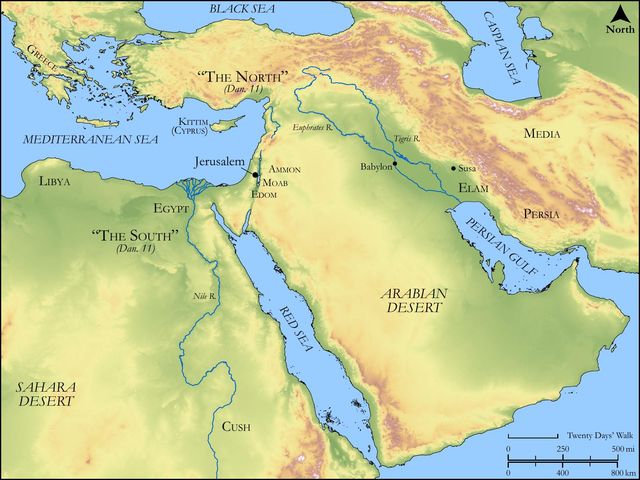
1.The kingdom of Egypt, which was made considerable by Ptolemaeus Lagus, one of Alexander's captains, whose successors were, from him, called the Lagidae. He is called the king of the south, that is, Egypt, named here, Dan 11:8, Dan 11:42, Dan 11:43. The countries that at first belonged to Ptolemy are reckoned to be Egypt, Phoenicia, Arabia, Libya, Ethiopia, etc. Theocr. Idyl. 17.
2.The kingdom of Syria, which was set up by Seleucus Nicanor, or the conqueror; he was one of Alexander's princes, and became stronger than the other, and had the greatest dominion of all, was the most powerful of all Alexander's successors. It was said that he had no fewer than seventy-two kingdoms under him. Both these were strong against Judah (the affairs of which are particularly eyed in this prediction); Ptolemy, soon after he gained Egypt, invaded Judea, and took Jerusalem on a sabbath, pretending a friendly visit. Seleucus also gave disturbance to Judea.
II.The fruitless attempt to unite these two kingdoms as iron and clay in Nebuchadnezzar's image (Dan 11:6):
"At the end of certain years, about seventy after Alexander's death, the Lagidae and the Seleucidae shall associate, but not in sincerity. Ptolemy Philadelphus, king of Egypt, shall marry his daughter Berenice to Antiochus Theos, king of Syria," who had already a wife called Laodice. "Berenice shall come to the king of the north, to make an agreement, but it shall not hold: She shall not retain the power of the arm; neither she nor her posterity shall establish themselves in the kingdom of the north, neither shall Ptolemy her father, nor Antiochus her husband (between whom there was to be a great alliance), stand, nor their arm, but she shall be given up and those that brought her," all that projected that unhappy marriage between her and Antiochus, which occasioned so much mischief, instead of producing a coalition between the northern and southern crowns, as was hoped. Antiochus divorced Berenice, took his former wife Laodice again, who soon after poisoned him, procured Berenice and her son to be murdered, and set up her own son by Antiochus to be king, who was called Seleucus Callinicus.
III.A war between the two kingdoms, Dan 11:7, Dan 11:8.
A branch from the same root with Berenice shall stand up in his estate. Ptolemaeus Euergetes, the son and successor of Ptolemaeus Philadelphus, shall come with an army against Seleucus Callinicus, king of Syria, to avenge his sister's quarrel, and shall prevail; and he shall carry away a rich booty both of persons and goods into Egypt, and shall continue more years than the king of the north. This Ptolemy reigned forty-six years; and Justin says that if his own affairs had not called him home he would, in this war, have made himself master of the whole kingdom of Syria. But (Dan 11:9) he shall be forced to come into his kingdom and return into his own land, to keep peace there, so that he can no longer carry on the war abroad. Note, It is very common for a treacherous peace to end in a bloody war.
IV.The long and busy reign of Antiochus the Great, king of Syria.
Seleucus Callinicus, that king of the north that was overcome (Dan 11:7) and died miserably, left two sons, Seleucus and Antiochus; these are his sons, the sons of the king of the north, that shall be stirred up, and shall assemble a multitude of great forces, to recover what their father had lost, Dan 11:10. But Seleucus the elder, being weak, and unable to rule his army, was poisoned by his friends, and reigned only two years; and his brother Antiochus succeeded him, who reigned thirty-seven years, and was called the Great. And therefore the angel, though he speaks of sons at first, goes on with the account of one only, who was but fifteen years old when he began to reign, and he shall certainly come, and overflow, and over-run, and shall be restored at length to what his father lost.
1.The king of the south, in this war, shall at first have very great success. Ptolemaeus Philopater, moved with indignation at the indignities done by Antiochus the Great, shall (though otherwise a slothful prince) come forth, and fight with him, and shall bring a vast army into the field of 70,000 foot, and 5000 horse, and seventy-three elephants. And the other multitude (the army of Antiochus, consisting of 62,000 foot, and 6000 horse, and 102 elephants) shall be given into his hand. Polybius, who lived with Scipio, has given a particular account of this battle of Raphia. Ptolemaeus Philopater, having gained this victory, grew very insolent; his heart was lifted up; then he went into the temple of God at Jerusalem, and, in defiance of the law, entered the most holy place, for which God has a controversy with him, so that, though he shall cast down many myriads, yet he shall not be strengthened by it, so as to secure his interest. For,
2.The king of the north, Antiochus the Great, shall return with a greater army than the former; and, at the end of times (that is, years) he shall come with a mighty army, and great riches, against the king of the south, that is, Ptolemaeus Epiphanes, who succeeded Ptolemaeus Philopater his father, when he was a child, which gave advantage to Antiochus the Great. In this expedition he had some powerful allies (Dan 11:14): Many shall stand up against the king of the south. Philip of Macedon was confederate with Antiochus against the king of Egypt, and Scopas his general, whom he sent into Syria; Antiochus routed him, destroyed a great part of his army; whereupon the Jews willingly yielded to Antiochus, joined with him, helped him to besiege Ptolemaeus's garrisons. They the robbers of thy people shall exalt themselves to establish the vision, to help forward the accomplishment of this prophecy; but they shall fall, and shall come to nothing, Dan 11:14. Hereupon (Dan 11:15) the king of the north, this same Antiochus Magnus, shall carry on his design against the king of the south another way.
(1.)He shall surprise his strong-holds; all that he has got in Syria and Samaria, and the arms of the south, all the power of the king of Egypt, shall not be able to withstand him. See how dubious and variable the turns of the scale of war are; like buying and selling, it is winning and losing; sometimes one side gets the better and sometimes the other; yet neither by chance; it is not, as they call it, the fortune of war, but according to the will and counsel of God, who brings some low and raises others up.
(2.)He shall make himself master of the land of Judea (Dan 11:16): He that comes against him (that is, the king of the north) shall carry all before him and do what he pleases, and he shall stand and get footing in the glorious land; so the land of Israel was, and by his hand it was wasted and consumed, for with the spoil of that good land he victualled his vast army. The land of Judea lay between these two potent kingdoms of Egypt and Syria, so that in all the struggles between them that was sure to suffer, for to it they both bore ill will. Yet some read this, By his hand it shall be perfected; as if it intimated that the land of Judea, being taken under the protection of this Antiochus, shall flourish, and be in better condition than it had been.
(3.)He shall still push on his war against the king of Egypt, and set his face to enter with the strength of his whole kingdom, taking advantage of the infancy of Ptolemy Epiphanes, and the upright ones, many of the pious Israelites, siding with him, Dan 11:17. In prosecution of his design, he shall give him his daughter Cleopatra to wife, designing, as Saul in giving his daughter Cleopatra to David, that she should be a snare to him, and do him a mischief; but she shall not stand on her father's side, nor be for him, but for her husband, and so that plot failed him.
(4.)His war with the Romans is here foretold (Dan 11:18): He shall turn his face to the isles (Dan 11:18), the isles of the Gentiles (Gen 10:5), Greece and Italy. He took many of the isles about the Hellespont-Rhodes, Samos, Delos, etc., which by war or treaty he made himself master of; but a prince, or state (so some), even the Roman senate, or a leader, even the Roman general, shall return his reproach with which he abused the Romans upon himself, or shall make his shame rest on himself, and without his own shame, or any disgrace to himself, shall pay him again. This was fulfilled when the two Scipios were sent with an army against Antiochus. Hannibal was then with him, and advised him to invade Italy and waste it as he had done; but he did not take hid advice; and Scipio joined battle with him, and gave him a total defeat, though Antiochus had 70,000 men and the Romans but 30,000. Thus he caused the reproach offered by him to cease.
(5.)His fall. When he was totally routed by the Romans, and was forced to abandon to them all he had in Europe, and had a very heavy tribute exacted from him, he turned to his own land, and, not knowing which way to raise money to pay his tribute, he plundered a temple of Jupiter, which so incensed his own subjects against him that they set upon him, and killed him; so he was overthrown, and fell, and was no more found, Dan 11:19.
(6.)His next successor, Dan 11:20. There rose up one in his place, a raiser of taxes, a sender forth of the extortioner, or extorter. This character was remarkably answered in Seleucus Philopater, the elder son of Antiochus the Great, who was a great oppressor of his own subjects, and exacted abundance of money from them; and, when he was told he would thereby lose his friends, he said he knew no better friend he had then money. He likewise attempted to rob the temple at Jerusalem, which this seems especially to refer to. But within a few days he shall be destroyed, neither in anger nor in battle, but poisoned by Heliodorus, one of his own servants, when he had reigned but twelve years, and done nothing remarkable.
V.From all this let us learn,
1.That God in his providence sets up one, and pulls down another, as he pleases, advances some from low beginnings and depresses others that were very high. Some have called great men the foot-balls of fortune; or, rather, they are the tools of Providence.
2.This world is full of wars and fightings, which come from men's lusts, and make it a theatre of sin and misery.
3.All the changes and revolutions of states and kingdoms, and every event, even the most minute and contingent, were plainly and perfectly foreseen by the God of heaven, and to him nothing is new.
4.No word of God shall fall to the ground; but what he has designed, what he has declared, shall infallibly come to pass; and even the sins of men shall be made to serve his purpose, and contribute to the b ringing of his counsels to birth in their season; and yet God is not the author of sin.
5.That, for the right understanding of some parts of scripture, it is necessary that heathen authors be consulted, which give light to the scripture, and show the accomplishment of what is there foretold; we have therefore reason to bless God for the human learning with which many have done great service to divine truths.
Historical interpretation
Two Centuries of Reception
16 surviving comments on this passage. Each one is dated, so this reads as a timeline rather than a list.
Select a marker to jump to its quote. Markers stagger vertically where authors wrote within a few decades of each other.
“And a king shall stand up and shall enter into the fortress of the king of Egypt.” For Antiochus became king of Syria. He held the sovereignty in the 107th year of the kingdom of the Greeks. And in those same times indeed he made war against Ptolemy king of Egypt, and conquered him and won the power. On returning from Egypt he went up to Jerusalem, in the 103rd year, and carrying off with him all the treasures of the Lord’s house, he marched to Antioch.
Verse 6. "And at the end of the years they shall be leagued together (or, as Theodotion renders: And after his years they shall be united). And the daughter of the king of the South shall come to the king of the North in order to make friendship, but she shall not obtain strength of arm nor shall her seed endure. And she herself shall be handed over, as well as her young men (Vulgate: youths) who brought her and who were strengthening her in (these) times." As we have already said, it was Seleucus, surnamed Nicanor, who first ruled over Syria. The second king was Antiochus, who was called Soter. The third was Antiochus himself, who was called Theos, that is the Divine. He was the one who waged numerous wars with Ptolemy Philadelphus, who was the second ruler in Egypt, and he also fought with all the Babylonians and the men of the East, And so after many years Ptolemy Philadelphus wished to have done with this vexatious struggle, and so he gave his daughter, named Berenice, in marriage to Antiochus, who had already had by a previous wife, named Laodice, two sons, namely Seleucus, surnamed Callinicus, and the other, Antiochus. And Philadelphus conducted her as far as Pelusium and bestowed countless thousands of gold and silver by way of a dowry, from which circumstance he acquired the nickname of phernophoros or Dowry-giver (dotalis). But as for Antiochus, even though he had said he would regard Berenice as his royal consort and keep Laodice in the status of a concubine, he was finally prevailed upon by his love for Laodice to restore her to the status of queen, along with her children. But she was fearful that her husband might in his fickleness restore Berenice to favor once more, and so she had him put to death by her servants with the use of poison. And she handed over Berenice and the son whom she had born by Antiochus to Icadio and Genneus, princes of Antiochus, and then set up her elder son, Seleucus Callinicus, as king in his father's place. And so this is the matter referred to in this passage, namely that after many years Ptolemy Philadelphus and Antiochus Theos would conclude a friendship, and the daughter of the king of the South, that is Ptolemy, would go to the king of the North, that is Antiochus, in order to cement friendly relations between her father and her husband. And the text says that she will not be able to gain her end, nor shall her posterity remain upon the throne of Syria, but instead both Berenice and the men who had escorted her thither shall be put to death. And also the king, Antiochus, who had strengthened her, that is, through whom she could have obtained the mastery, was killed by his wife's poison.
Verses 11, 12. "And the king of the South, being provoked, shall go forth and shall prepare an exceeding great multitude, and a multitude shall be given into his hand. And he shall take a multitude, and his heart shall be lifted up, because (Vulgate: and) he shall cast down many thousands. But he shall not prevail." The Ptolemy surnamed Philopator, having lost Syria through the betrayal of Theodotius, gathered together a very great multitude and launched an invasion against Antiochus the Great, who now bears the title of king of the North, at the region where Egypt borders upon the province of Judaea. For owing to the nature of the region, this locality lies partly to the south and partly to the north. If we speak of Judaea, it lies to the north of Egypt and to the south of Syria. And so when he had joined battle near the town of Raphia at the gateway of Egypt, Antiochus lost his entire army and was almost captured as he fled through the desert. And after he had conceded the loss of Syria, the conflict was finally brought to an end upon the basis of a treaty and certain conditions of peace. And this is what the Scripture means here by the statement that Ptolemy Philopator "shall cast down many thousands" and yet shall not prevail. For he was unable to capture his adversary. The sequel now follows.
Verse 20. "And there shall stand up in his place one most vile and unworthy of kingly honor, and in a few days he shall be destroyed, not in rage nor in a battle." The reference is to the Seleucus surnamed Philopator, the son of Antiochus the Great, who during his reign performed no deeds worthy of Syria or of his father, but perished ingloriously without fighting a single battle. Porphyry, however, claims that it was not this Seleucus who is referred to, but rather Ptolemy Epiphanes, who contrived a plot against Seleucus and prepared an army to fight against him, with the result that Seleucus was poisoned by his own generals. They did this because when someone asked Seleucus where he was going to get the financial resources for the great enterprises he was planning, he answered that his financial resources consisted in his friends. When this remark was publicly noised abroad, the generals became apprehensive that he would deprive them of their property and for that reason did him to death by nefarious means. Yet how could Ptolemy be said to rise up in the place of Antiochus the Great, since he did nothing of the sort? This is especially improbable since the Septuagint translated: "And there shall stand up a plant from his root," that is, "of his issue and seed," who should deal a severe blow to the prestige of the empire; "and within a few days he shall be destroyed without wrath or battle." The Hebrews claim that it is Trypho who was intended by the man who was most vile and unworthy of kingly honor, for as the boy-king's guardian he seized the throne for himself.
Verses 15, 16. "And the king of the North shall come, and shall cast up a mound and capture the best fortified cities, and the arms of the South shall not withstand. And his chosen ones shall rise up to resist, and they shall have no strength. And he shall come upon him and do according to his own desire, and there shall be none to stand against his face. And he shall stand in the glorious land and it shall be consumed by his hand." Purposing to retake Judaea and the many cities of Syria, Antiochus joined battle with Scopas, Ptolemy's general, near the sources of the Jordan near where the city now called Paneas was founded, and he put him to flight and besieged him in Sidon together with ten thousand of his soldiers. In order to free him, Ptolemy dispatched the famous generals, Eropus, Menocles and Damoxenus (Vulgate: Damoxeus). Yet he was unable to lift the siege, and finally Scopas, overcome by famine, had to surrender and was sent away with his associates, despoiled of all he had. And as for the statement, "He shall cast up a mound," this indicates that Antiochus is going to besiege the garrison of Scopas in the citadel of Jerusalem for a long time, while the Jews add their exertions as well. And he is going to capture other cities which had formerly been held by the Ptolemaic faction in Syria, Cilicia and Lycia (variant: Lydia). For at that time Aphrodisias, Soloe, Zephrion, Mallos, Anemurium (variant: Anemurum), Selenus, Coracesium, Coricus, Andriace, Lymira, Patara (variant: Patra), Xanthus, and finally Ephesus were all captured. These things are related by both Greek and Roman historians. And as for the statement, "And he shall stand in the glorious land, and it shall be consumed (or, finished) by his hand," the term "glorious land," or, as the Septuagint interprets it, "the land of desire" (that is, in which God takes pleasure) signifies Judaea, and particularly Jerusalem, to which Antiochus pursued those men of Scopas's party who had been honorably received there. Instead of the phrase, "glorious land," as Aquila rendered it, Theodotion simply puts the Hebrew word itself, Sabin; instead of that Symmachus translated it "land of bravery."
Verses 17-19. "And he shall set his face to come and possess all his kingdom, and he shall make upright conditions with him. And he shall give him the daughter of women, that she may overthrow him" (Vulgate: it). That is to say, the intention is to overthrow him, that is, Ptolemy, or else to overthrow it, that is, his kingdom. Antiochus not only wished to take possession of Syria, Cilicia, and Lycia, and the other provinces which had belonged to Ptolemy's party, but also to extend his empire to Egypt. He therefore used the good offices of Eucles of Rhodes to betroth his daughter, Cleopatra, to young Ptolemy in the seventh year of his reign; and in his thirteenth year she was given to him in marriage, professedly endowed with all of Coele-syria and Judaea as her marriage-portion. By pleonasm she is called a daughter of women, just as the poet says:
...Thus she spake with her mouth... And with these ears did I drink in her voice.
"And she shall not stand, neither shall she be for him. And he shall turn his face to the islands and shall capture many; and she shall cause the prince of her reproach to cease, and his reproach shall be turned upon him. And he shall turn his face to the empire of his own land; and he shall stumble and fall, and shall not be found." For he was unable to take possession of Egypt, because Ptolemy Epiphanes and his generals detected the strategem and followed a cautious policy. And besides, Cleopatra inclined more to her husband's side than to her father's. And so he turned his attention to Asia Minor, and by carrying on naval warfare against a large number of islands, he seized Rhodes, Samos, Colophon (variant: Colophonia and Bocla), Phocea and many other islands. But he was opposed by Lucius Scipio Nasica and also his brother, Publius Scipio Africanus, who had vanquished Hannibal. For since the consul Nasica, the brother of Africanus, was of a somewhat sluggish disposition, the Roman senate was unwilling to entrust to him a war against so mighty a king as Antiochus. Africanus therefore offered to assume the post of deputy on a voluntary basis, in order to obviate any damage that his brother might cause. Consequently Antiochus was vanquished and commanded to confine his rule to the other side of the Taurus range. And so he took refuge in Apamia and Susa and advanced to the easternmost cities of his realm. And during a war against the Elymaeans he was destroyed together with his entire army. And so this is what the Scripture refers to in this passage, when it states that he would capture many islands, and yet because of the Roman conqueror he would lose the kingdom of Asia; and that the disgrace he had inflicted would come back upon his own head; and that in the end he would flee from Asia Minor and return to the empire of his own land, and would then stumble and fall, so that his place would not be found.