


Numbers 34:24
Bible text: King James Version (1769 Blayney text) · Public domain
Bible text: Berean Standard Bible · Public domain
Bible text: American Standard Version (1901) · Public domain
Bible text: World English Bible, Messianic edition · Public domain
Bible text: Geneva Bible (1599) · Public domain
Bible text: Young's Literal Translation · Public domain
- וּלְמַטֵּהu·le·ma·Tehand of [the] tribe ofH4294Conj-w ¦ Prep-l ¦ N-mscNoun Singular Masculine Constructוּandלְofמַטֵּה[the] tribe of
- בְנֵיve·nei[the] descendants ofH1121N-mpcNoun Plural Masculine Construct
- אֶפְרַיִם'ef·Ra·yimEphraimH669N-proper-mNoun Proper Masculine
- נָשִׂיאna·Si'a leaderH5387N-msNoun Singular Masculine Absolute
- קְמוּאֵלke·mu·'ElKemuelH7055N-proper-mNoun Proper Masculine
- בֶּןben[the] son ofH1121N-mscNoun Singular Masculine Construct
- שִׁפְטָןshif·TanShiphtanH8204N-proper-mNoun Proper Masculine
English is a literal word-by-word gloss of the Hebrew, not the KJV's wording. Why?
This is the original text the KJV's translators worked from — each Hebrew word with its own literal English meaning in this verse, prepared by scholars at Tyndale House, Cambridge. The KJV translates whole sentences, not word by word, so its wording differs: one Hebrew word can become several English words, and the KJV may choose “the LORD” where the gloss reads “Yahweh”. Both are faithful — they answer different questions. For the KJV's own rendering, switch to the KJV text.
Details
See on the biblical-era map
Study this verse
Continue studying Numbers 34:24 across the web’s major study libraries — every link below opens this exact verse, chapter, or book on the destination site.
Read & Compare
 BibleGatewayThis verse in more than 200 translations and 70 languages.
 Bible.comThe YouVersion reader — hundreds of translations, reading plans, and highlights.
 ESV.orgCrossway's official English Standard Version reader.
 NET BibleThe NET translation with 60,000+ translators' notes on every rendering decision.
 STEP BibleTyndale House's free study tool — original text, vocabulary, and scholarly resources.
 BibliaLogos Bible Software's free web reader.
 USCCBThe New American Bible (Revised Edition) with the U.S. bishops' study notes.
Commentaries
 BibleHub CommentariesDozens of classic commentaries on this verse, gathered on one page.
 StudyLightMore than 100 commentary sets — the largest collection on the web.
 BibleRefPlain-English commentary on what this verse means, verse by verse.
 Enduring WordDavid Guzik's free commentary on this chapter, widely used by Bible teachers.
 Bible Study ToolsVerse commentary alongside Greek and Hebrew study aids.
Original Language & Research
- BibleHub InterlinearThe verse word by word — original language, transliteration, and English.
- BibleHub LexiconEvery word's original-language definition and Strong's entry.
 Blue Letter BibleDeep-study tools — Strong's numbers, concordance, and word studies.
 SefariaThe Hebrew text with Rashi and centuries of Jewish commentary.
Sermons, Hymns & Audio


TrulyRandomVerse is not affiliated with these sites and doesn’t control their content. They’re linked because they’re genuinely useful.
Summary
Numbers 34:24 precisely names Kemuel, son of Shiphtan, as the prince appointed from the tribe of Ephraim. This verse is part of a detailed divine mandate outlining the specific individuals chosen by God to oversee the equitable and orderly distribution of the Promised Land of Canaan among the Israelite tribes, underscoring God's meticulous planning and faithfulness in fulfilling His covenant promises.
Context
ShowHideLiterary Context
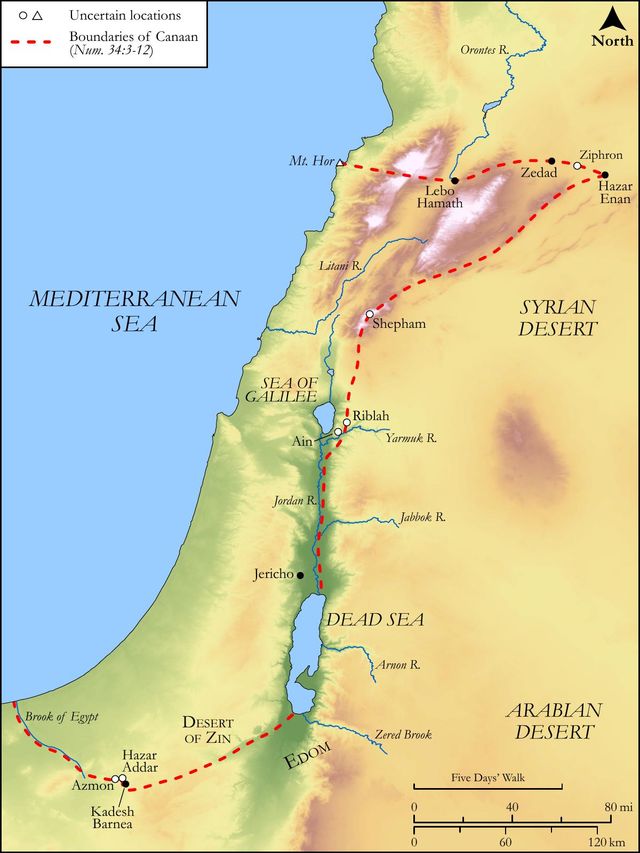
Numbers 34:24 is embedded within a highly administrative and prescriptive section of the Book of Numbers, specifically in chapters 33-36. Following the recounting of Israel's wilderness journeys and a new census (Numbers 26), God shifts focus to the imminent entry into Canaan. Chapter 34 meticulously defines the geographical boundaries of the land, establishing the precise borders of the inheritance. Immediately preceding this verse, God instructs Moses to appoint a commission of twelve leaders—one prince from each of the ten tribes designated to receive land west of the Jordan, plus one for the half-tribe of Manasseh (Numbers 34:16-29). This detailed list, including Kemuel, serves to legitimize and formalize the process of land allocation, ensuring divine authorization and preventing future disputes.
Historical & Cultural Context
The setting is the plains of Moab, on the cusp of entering Canaan, approximately 40 years after the Exodus. This generation, unlike their rebellious predecessors, is poised to inherit the land promised to Abraham (e.g., Genesis 15:18). Land ownership was not merely economic; it was foundational to Israel's identity, security, and covenant relationship with God. The tribal structure was the primary social and political unit, and the "prince" (Hebrew: nasi') was a significant figure, representing his tribe in national affairs and holding judicial and administrative authority. The meticulous appointment of these leaders for land distribution reflects the care in Israel to formalize property rights and ensure orderly succession, as in the case of the daughters of Zelophehad, but here it is uniquely divinely ordained, emphasizing God's direct involvement in Israel's national formation.
Key Themes
ShowHideThis verse, within its broader context, highlights several crucial themes. Firstly, it underscores Divine Order and Administration, revealing God as a deity who governs with precision and provides clear structures for His people's endeavors, from national boundaries to leadership appointments. Secondly, it powerfully illustrates the Fulfillment of Promise, as the detailed preparations for land distribution signify the imminent realization of God's long-standing covenant to bring Israel into the land flowing with milk and honey, as promised in Exodus 3:8. Thirdly, the appointment of a prince from each tribe emphasizes Tribal Representation and Unity, ensuring that each tribal entity had a voice and a stake in the monumental task of inheritance, thereby fostering cohesion and preventing internal strife. Finally, it speaks to the theme of Leadership and Responsibility, as individuals like Kemuel were entrusted with a weighty, divinely mandated task essential for the nation's future stability and adherence to God's will.
Exposition and Analysis
ShowHideKey Word Analysis
ShowHideThis term (H5387) properly refers to "an exalted one," such as a king or sheik, but in this context, it signifies a chief or ruler. The nasi' was a person of considerable authority and prominence within their community, often representing their tribe in broader national affairs and holding administrative or judicial functions. Their authority was derived from God's appointment, making their role sacred and binding, particularly in the critical task of land division.
This word (H4294) literally means "a branch" but is used figuratively to denote a "tribe." It refers to the primary social and political unit of Israel, a distinct family group descended from one of Jacob's sons. The concept of "tribe" was central to Israel's identity and the structure of their society, especially concerning the allocation of land, as each tribe was to receive its own designated inheritance.
Meaning "double fruit" or "doubly fruitful," Ephraim (H669) was one of the two sons of Joseph (along with Manasseh) who received a tribal inheritance in Israel. The tribe of Ephraim quickly became one of the most populous and influential tribes, particularly in the northern kingdom, often representing the entire northern confederacy in later biblical texts. Its prominence meant that its appointed prince, Kemuel, would hold significant influence and responsibility in the land division, reflecting the tribe's future importance in Israelite history.
Verse Breakdown
ShowHide"And the prince of the tribe of the children of Ephraim"
This phrase precisely identifies the office and tribal affiliation of the individual. It highlights the structured nature of Israelite society, where leadership was organized tribally, and each tribe had a designated representative. The "children of Ephraim" refers to the entire tribal collective, emphasizing that Kemuel represents the whole lineage and its interests in the monumental task of land distribution.
"Kemuel the son of Shiphtan"
This provides the exact personal identification of the prince. The inclusion of his father's name (Shiphtan) is a common biblical genealogical practice, establishing his lineage, legitimacy, and place within his tribe. This meticulous detail underscores the divine precision and human accountability in the process of land allocation, ensuring that the appointed individual was known, recognized, and had the proper authority for this divinely mandated task.
Literary Devices
ShowHideThe primary literary device at play in Numbers 34:24, and indeed throughout the entire chapter, is Enumeration and Cataloging. The systematic listing of tribal boundaries and appointed leaders creates a sense of divine order and meticulous planning. This detailed Precision serves to emphasize God's absolute sovereignty and His intention to fulfill His promises in an exact and orderly manner, leaving no room for ambiguity or dispute regarding the land inheritance. The verse also functions as a specific point within a larger Genealogy or lineage record, connecting individuals to their tribal heritage and established authority, reinforcing the legitimacy of their roles.
Theological and Thematic Connections
ShowHideNumbers 34:24, though a seemingly minor detail, powerfully illustrates God's commitment to order, justice, and the meticulous fulfillment of His covenant promises. The divine appointment of specific leaders for a crucial administrative task reveals that God is not only concerned with grand theological narratives but also with the practical, orderly execution of His will in the lives of His people. This attention to detail ensures fairness and prevents chaos, laying the groundwork for a stable society rooted in divine principles. It teaches us that even administrative details can be sacred when undertaken under God's direction and for His purposes, contributing to the overall flourishing of His people.
Reflection and Application
ShowHideThe naming of Kemuel, the prince of Ephraim, in the context of land division, serves as a profound reminder that God's grand purposes are often accomplished through the faithful, detailed work of individuals. It highlights the sacredness of even seemingly mundane administrative tasks when they are part of God's plan. For us today, this means recognizing that every role, no matter how specific or seemingly small, can be a vital contribution to God's kingdom when undertaken with diligence and integrity. It calls us to embrace our responsibilities, whether in our homes, workplaces, or communities, as opportunities to participate in God's ongoing work of bringing order, justice, and blessing. Just as Kemuel was entrusted with a specific portion of God's promise, we too are entrusted with various gifts, talents, and spheres of influence that are meant to be stewarded faithfully for His glory and the good of others. Our faithfulness in the small, often unseen, details can have profound and lasting impact on the fulfillment of God's larger purposes.
Questions for Reflection
ShowHideFAQ
ShowHideWho was Kemuel the son of Shiphtan, and why is his mention significant?
ShowHideKemuel the son of Shiphtan was the designated prince, or chief, of the tribe of Ephraim. His mention in Numbers 34:24 is significant because he was one of the twelve divinely appointed leaders responsible for overseeing the equitable division of the Promised Land of Canaan among the Israelite tribes. This appointment underscores God's meticulous planning and commitment to order as Israel transitioned from nomadic wanderers to a settled nation. It highlights that God's promises are fulfilled not only through miraculous intervention but also through the careful, administrative work of chosen human agents. His specific naming ensures accountability and legitimacy in this monumental task, which is further detailed in Joshua 14.
Why was the division of the land so important, and how does Kemuel's role fit into that?
ShowHideThe division of the land was critically important for several reasons: it fulfilled God's ancient covenant promise to Abraham that his descendants would inherit the land (e.g., Genesis 12:7); it established Israel as a sovereign nation with a defined territory; and it provided each tribe and family with a secure inheritance, vital for their economic stability and identity. Kemuel, as the prince of the influential tribe of Ephraim, played a crucial role in this process. He was part of the commission that ensured the land was distributed fairly by lot, according to God's instructions, preventing disputes and laying the foundation for a stable, divinely ordered society. This careful administration was essential for the long-term well-being and covenant faithfulness of the nation.
Christ-Centered Fulfillment
ShowHideWhile Kemuel's role in Numbers 34:24 is specific to the Old Covenant's physical inheritance, it beautifully foreshadows the ultimate fulfillment of God's promises in Jesus Christ. Just as Kemuel was an appointed leader overseeing the distribution of a physical inheritance, Christ is the divinely appointed Head of the Church, distributing a spiritual inheritance to His people. The Promised Land, with its meticulous boundaries and orderly distribution, points to the greater spiritual inheritance found in Christ – a heavenly dwelling and an eternal kingdom that is "imperishable, undefiled, and unfading" (1 Peter 1:4). Furthermore, the theme of divine order and meticulous planning in Numbers finds its pinnacle in God's perfect plan of salvation, orchestrated "before the foundation of the world" (Ephesians 1:4). Jesus, the true "prince" and "chief shepherd" (1 Peter 5:4), leads His people not into a physical land, but into spiritual rest and the fullness of God's presence, becoming the ultimate fulfillment of all God's promises and the one through whom we receive our eternal, secure inheritance (Hebrews 4:9-10; Colossians 1:12). He is the one who truly secures and distributes the ultimate, eternal portion for all who believe.