


Numbers 34:23
Bible text: King James Version (1769 Blayney text) · Public domain
Bible text: Berean Standard Bible · Public domain
Bible text: American Standard Version (1901) · Public domain
Bible text: World English Bible, Messianic edition · Public domain
Bible text: Geneva Bible (1599) · Public domain
Bible text: Young's Literal Translation · Public domain
- לִבְנֵיliv·Neiof [the] sons ofH1121Prep-l ¦ N-mpcNoun Plural Masculine Constructלִofבְנֵי[the] sons of
- יוֹסֵףyo·SefJosephH3130N-proper-mNoun Proper Masculine
- לְמַטֵּהle·ma·Tehof [the] tribe ofH4294Prep-l ¦ N-mscNoun Singular Masculine Constructלְofמַטֵּה[the] tribe of
- בְנֵיve·nei[the] descendants ofH1121N-mpcNoun Plural Masculine Construct
- מְנַשֶּׁהme·na·ShehManassehH4519N-proper-mNoun Proper Masculine
- נָשִׂיאna·Si'a leaderH5387N-msNoun Singular Masculine Absolute
- חַנִּיאֵלcha·ni·'ElHannielH2592N-proper-mNoun Proper Masculine
- בֶּןben[the] son ofH1121N-mscNoun Singular Masculine Construct
- אֵפֹד'e·FodEphodH641N-proper-mNoun Proper Masculine
English is a literal word-by-word gloss of the Hebrew, not the KJV's wording. Why?
This is the original text the KJV's translators worked from — each Hebrew word with its own literal English meaning in this verse, prepared by scholars at Tyndale House, Cambridge. The KJV translates whole sentences, not word by word, so its wording differs: one Hebrew word can become several English words, and the KJV may choose “the LORD” where the gloss reads “Yahweh”. Both are faithful — they answer different questions. For the KJV's own rendering, switch to the KJV text.
Details
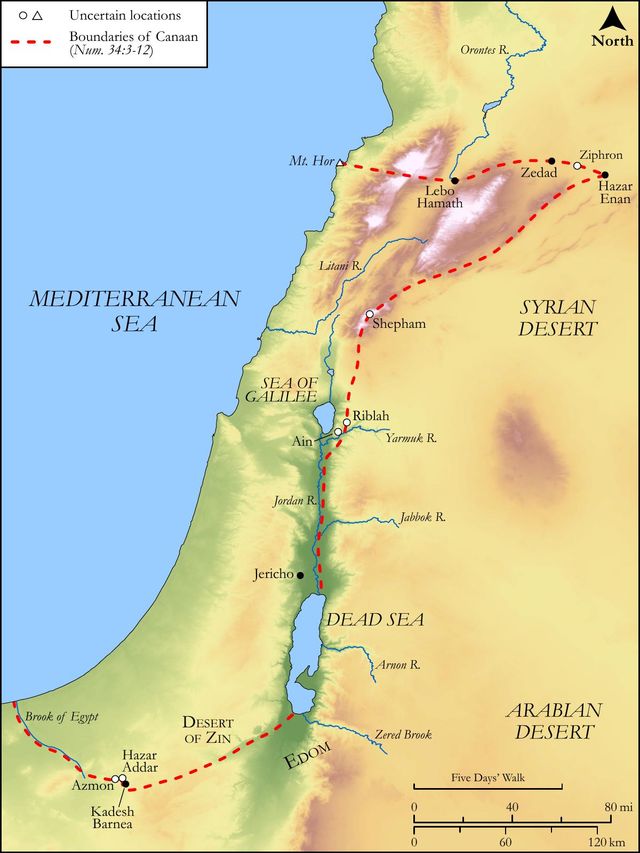
See on the biblical-era map
Study this verse
Continue studying Numbers 34:23 across the web’s major study libraries — every link below opens this exact verse, chapter, or book on the destination site.
Read & Compare
 BibleGatewayThis verse in more than 200 translations and 70 languages.
 Bible.comThe YouVersion reader — hundreds of translations, reading plans, and highlights.
 ESV.orgCrossway's official English Standard Version reader.
 NET BibleThe NET translation with 60,000+ translators' notes on every rendering decision.
 STEP BibleTyndale House's free study tool — original text, vocabulary, and scholarly resources.
 BibliaLogos Bible Software's free web reader.
 USCCBThe New American Bible (Revised Edition) with the U.S. bishops' study notes.
Commentaries
 BibleHub CommentariesDozens of classic commentaries on this verse, gathered on one page.
 StudyLightMore than 100 commentary sets — the largest collection on the web.
 BibleRefPlain-English commentary on what this verse means, verse by verse.
 Enduring WordDavid Guzik's free commentary on this chapter, widely used by Bible teachers.
 Bible Study ToolsVerse commentary alongside Greek and Hebrew study aids.
Original Language & Research
- BibleHub InterlinearThe verse word by word — original language, transliteration, and English.
- BibleHub LexiconEvery word's original-language definition and Strong's entry.
 Blue Letter BibleDeep-study tools — Strong's numbers, concordance, and word studies.
 SefariaThe Hebrew text with Rashi and centuries of Jewish commentary.
Sermons, Hymns & Audio


TrulyRandomVerse is not affiliated with these sites and doesn’t control their content. They’re linked because they’re genuinely useful.
Summary
Numbers 34:23 precisely identifies Hanniel the son of Ephod as the divinely appointed prince for the tribe of Manasseh, a key leader tasked with overseeing the equitable distribution of the Promised Land of Canaan among the Israelite tribes. This verse, embedded within a larger divine mandate, highlights God's meticulous planning, His unwavering commitment to fulfilling His covenant promises, and the crucial role of faithful, divinely-commissioned leadership in establishing order and justice within His people as they prepared to inherit their promised dwelling.
Context
ShowHideLiterary Context
This verse is strategically placed within Numbers chapter 34, a pivotal section that transitions Israel from their wilderness wanderings to the threshold of entering Canaan. The preceding verses (Numbers 34:1-15) meticulously detail the divinely ordained geographical boundaries of the land Israel is to inherit, emphasizing the specificity and divine origin of their future territory. Following this detailed land description, God instructs Moses to appoint specific men from each tribe (Numbers 34:16-29) who would be responsible for its equitable division by lot. Hanniel is named here as one of these twelve tribal princes, serving under the primary oversight of Eleazar the priest and Joshua, as introduced in Numbers 34:17. The inclusion of such a detailed list of names underscores the solemnity, divine order, and historical reality of the land distribution process, ensuring that every tribe and family would receive their rightful inheritance as promised by God.
Historical & Cultural Context
Historically, Israel stood on the verge of completing their forty-year wilderness journey, poised to enter Canaan, a land promised to their patriarchs centuries earlier, as seen in Genesis 12:7. The division of land was not merely a logistical exercise but the foundational act of establishing Israel as a settled nation, thereby fulfilling God's covenant. Culturally, tribal identity and the concept of inheritance were paramount in ancient Israelite society. Land was the primary source of wealth, security, and identity, passed down through families and tribes. The role of a "prince" (nasi) was that of a respected tribal chief or leader, responsible for the welfare and administration of his people. The appointment of these specific individuals, chosen by divine instruction rather than popular vote, reflects a theocratic model of governance where God's will was paramount, and human leaders served as instruments of His detailed plan for His people's settlement and flourishing.
Key Themes
ShowHideNumbers 34:23 contributes significantly to several overarching themes found throughout the book of Numbers and the Pentateuch. Firstly, it highlights Divine Order and Preparation, demonstrating God's meticulous foresight and planning in every aspect of His covenant fulfillment, from defining precise boundaries to appointing specific leaders for the task. This stands in stark contrast to the earlier disarray and rebellion witnessed during the wilderness journey, for example, in Numbers chapter 14. Secondly, it emphasizes Leadership and Responsibility, showcasing the importance of faithful, divinely-commissioned individuals like Hanniel who were entrusted with the weighty task of implementing God's will. Their integrity and diligence were crucial for ensuring justice and preventing disputes in the land allocation. Lastly, the verse reinforces Tribal Identity and Inheritance, specifically mentioning "the children of Joseph" and "the tribe of the children of Manasseh." This underscores the enduring significance of Jacob's blessing and the unique status granted to Joseph's sons, Manasseh and Ephraim, who were counted as full tribes within Israel, destined to inherit their own distinct territories, as prophesied in Genesis 48:5.
Exposition and Analysis
ShowHideKey Word Analysis
ShowHideDerived from a root meaning "to lift up" or "to be exalted," this term denotes a tribal chief, leader, or head. In the context of Numbers, a nāśîyʼ was a prominent figure, often representing his tribe in national assemblies, censuses, or, as here, in the distribution of the land. Their authority was significant, and their appointment by divine decree underscored the sacred nature of their task. Hanniel's role as nāśîyʼ for Manasseh meant he was the primary representative and administrator for his tribe in this critical undertaking.
This personal name is derived from the Hebrew words for "favor" (חָנַן, chanan) and "God" (אֵל, el), thus meaning "favor of God" or "God is my grace." The naming of such an individual to a position of leadership in the land distribution highlights the divine hand in selecting those through whom His purposes would be accomplished. Hanniel's name itself could be seen as a reminder of God's gracious provision in giving the land to His people.
One of the two sons of Joseph, along with Ephraim, who were adopted by Jacob and granted full tribal status, receiving their own inheritances (Genesis 48). Manasseh's name means "causing to forget," referring to Joseph's declaration that God had made him forget all his toil and his father's house (Genesis 41:51). The tribe of Manasseh was significant, later splitting its inheritance on both sides of the Jordan River (Numbers 32:33; Joshua 17:1-6), highlighting its large size and importance within the Israelite confederation.
Verse Breakdown
ShowHide"The prince of the children of Joseph"
This introductory phrase immediately establishes the high office and tribal affiliation of the individual to be named. "The children of Joseph" refers collectively to the two tribes descended from Joseph: Ephraim and Manasseh. By specifying "the prince of the children of Joseph," the text highlights the unique position of these two tribes as direct descendants of one of Jacob's most prominent sons, who received a double portion of inheritance.
"for the tribe of the children of Manasseh"
This clarifies which of Joseph's two tribes Hanniel represents. It narrows the focus from the broader "children of Joseph" to the specific tribal entity of Manasseh, indicating Hanniel's direct responsibility and authority within that particular lineage. This precision is crucial for the orderly and just allocation of land to each distinct tribal unit.
"Hanniel the son of Ephod"
This provides the specific name and patronymic of the appointed leader. Hanniel, meaning "God is my grace" or "grace of God," and his father Ephod, are identified, grounding this divine appointment in a specific family lineage. The inclusion of the father's name (patronymic) was a common way to distinguish individuals in Israel and further emphasizes the concrete, historical reality of these appointments.
Literary Devices
ShowHideThe primary literary device at play in Numbers 34:23, and indeed throughout the list of tribal leaders in Numbers 34:16-29, is Enumeration. This involves the systematic listing of names and offices, which serves to emphasize the meticulous detail and comprehensive nature of God's plan. The Precision of the naming—specifying not just the tribe, but the specific prince and his father—reinforces the divine order and the concrete, historical reality of these appointments. It underscores that God's promises are fulfilled not vaguely, but through specific individuals and well-defined processes, leaving no room for ambiguity in the distribution of the sacred inheritance. This detailed listing also serves as a form of Legal Documentation, validating the legitimacy of the land distribution and the authority of those overseeing it.
Theological and Thematic Connections
ShowHideNumbers 34:23, though a single name in a list, powerfully illustrates God's faithfulness, His commitment to order, and His provision for His people. It reveals a God who is not distant or chaotic but intimately involved in the practical details of His covenant promises, ensuring that His people receive their inheritance justly and without dispute. The appointment of Hanniel and the other princes underscores the principle that divine blessings often flow through human instruments, highlighting the importance of faithful leadership in stewarding God's gifts and purposes. This meticulous planning for the physical inheritance foreshadows God's equally detailed provision for the spiritual inheritance of His people in all generations.
Reflection and Application
ShowHideNumbers 34:23 invites us to consider the profound implications of God's detailed planning and the indispensable role of human responsibility in fulfilling His purposes. Just as God meticulously prepared for Israel's physical inheritance, He has a detailed plan for our lives and for the church today. This verse reminds us that God values order, justice, and faithful stewardship. It challenges us to embrace our own roles, however seemingly small or specific, within God's larger design, recognizing that every task, when undertaken with diligence and integrity, contributes to the unfolding of His divine will. It also calls us to trust in God's provision, knowing that He has appointed the right people and established the right processes to bring His promises to fruition. We are encouraged to seek and support wise leadership, and to participate actively in the orderly processes that facilitate the flourishing of God's people and the advancement of His kingdom. Our faithfulness in small matters reflects our readiness for greater responsibilities in God's grand plan.
Questions for Reflection
ShowHideFAQ
ShowHideWhy is it important for the Bible to list seemingly obscure names like Hanniel?
ShowHideThe inclusion of specific names like Hanniel the son of Ephod in Numbers 34:23 is crucial for several reasons. Firstly, it underscores the historical authenticity and meticulous detail of the biblical narrative. These are not generic figures but real individuals chosen by God for a specific, vital task. Secondly, it highlights God's personal involvement in the lives of His people; He knows them by name and calls them to specific service. Thirdly, it emphasizes the importance of accountability and responsibility within God's divine plan. Each prince was uniquely tasked with overseeing a portion of the land division, ensuring that the inheritance was distributed fairly and according to God's decree. This level of detail reinforces the idea that God's promises are fulfilled with precision and order, not through vague generalities, providing a concrete example of divine administration in action as Israel prepared to enter the Promised Land (as detailed in Numbers chapter 34).
Christ-Centered Fulfillment
ShowHideNumbers 34:23, with its focus on divine appointment, meticulous planning, and the securement of an inheritance through faithful leadership, finds its ultimate fulfillment and deepest meaning in Jesus Christ. Just as Hanniel was appointed to ensure the just distribution of a physical inheritance, Christ is the divinely appointed "heir of all things" (Hebrews 1:2), through whom the spiritual inheritance of eternal life and fellowship with God is secured for all believers. The precise boundaries of Canaan foreshadow the boundless spiritual territory and eternal dwelling prepared for us in Christ, a "better country—a heavenly one" (Hebrews 11:16). Moreover, Christ is the ultimate faithful leader, the "Good Shepherd" (John 10:11) and "chief cornerstone" (Ephesians 2:20), who not only guides His people but also perfectly executes the Father's will, ensuring that every promise of the new covenant is fulfilled. Through His atoning sacrifice, He has secured our spiritual inheritance, which is "imperishable, undefiled, and unfading, kept in heaven for you" (1 Peter 1:4). Thus, the meticulous order of Numbers 34:23 points forward to the perfect order and secure reality of God's redemptive plan, fully realized in the person and work of Jesus Christ.