


Nehemiah 6:3
Bible text: King James Version (1769 Blayney text) · Public domain
Bible text: King James Version with Strong's numbers · Public domain
Bible text: Berean Standard Bible · Public domain
Bible text: American Standard Version (1901) · Public domain
Bible text: World English Bible, Messianic edition · Public domain
Bible text: Geneva Bible (1599) · Public domain
Bible text: Young's Literal Translation · Public domain
- וָאֶשְׁלְחָהva·'esh·le·Chahand I sent !H7971Conj-w ¦ V-Qal-ConsecImperf-1cs ¦ SfxVerb Qal Consecutive Imperfect 1st Singular common genderוָandאֶשְׁלְחָI sentה!
- עֲלֵיהֶם'a·lei·Hemto themH5921Prep ¦ 3mpPreposition Definiteעֲלֵיtoהֶםthem
- מַלְאָכִיםmal·'a·KhimmessengersH4397N-mpNoun Plural Masculine Absolute
- לֵאמֹרle·Mor<to> sayingH559Prep-l ¦ V-Qal-InfVerb Qal Infinitive Constructלֵ<to>אמֹרsaying
- מְלָאכָהme·la·Khaha workH4399N-fsNoun Singular Feminine Absolute
- גְדוֹלָהge·do·LahgreatH1419Adj-fsAdjective Singular Feminine Absolute
- אֲנִי'a·NiIH589Pro-1csPronoun Personal 1st Singular common gender
- עֹשֶׂה'o·Seh[am] doingH6213V-Qal-Prtcpl-msVerb Qal Participle Singular Masculine Absolute
- וְלֹאve·Lo'and notH3808Conj-w ¦ NegParticle Negativeוְandלֹאnot
- אוּכַל'u·KhalI am ableH3201V-Qal-Imperf-1csVerb Qal Imperfect 1st Singular common gender
- לָרֶדֶתla·Re·detto go downH3381Prep-l ¦ V-Qal-InfVerb Qal Infinitive Constructלָtoרֶדֶתgo down
- לָמָּהLa·mah<to> why?H4100Prep-l ¦ InterrogPronoun Interrogativeלָ<to>מָּהwhy?
- תִשְׁבַּתtish·Batwill it ceaseH7673V-Qal-Imperf-3fsVerb Qal Imperfect 3rd Singular Feminine
- הַמְּלָאכָהha·me·la·Khahthe workH4399Art ¦ N-fsNoun Singular Feminine Absoluteהַtheמְּלָאכָהwork
- כַּאֲשֶׁרka·'a·Sher<just> whenH834Prep-k ¦ RelParticle Relativeכַּ<just>אֲשֶׁרwhen
- אַרְפֶּהָ'ar·Pe·haI will let drop itH7503V-Hiphil-Imperf-1cs ¦ 3fsVerb Hiphil Imperfect 1st Singular common genderאַרְפֶּI will let dropהָit
- וְיָרַדְתִּיve·ya·rad·Tiand I will go downH3381Conj-w ¦ V-Qal-ConsecPerf-1csVerb Qal Consecutive Perfect 1st Singular common genderוְandיָרַדְתִּיI will go down
- אֲלֵיכֶם'a·lei·Khemto youH413Prep ¦ 2mpPrepositionאֲלֵיtoכֶםyou
English is a literal word-by-word gloss of the Hebrew, not the KJV's wording. Why?
This is the original text the KJV's translators worked from — each Hebrew word with its own literal English meaning in this verse, prepared by scholars at Tyndale House, Cambridge. The KJV translates whole sentences, not word by word, so its wording differs: one Hebrew word can become several English words, and the KJV may choose “the LORD” where the gloss reads “Yahweh”. Both are faithful — they answer different questions. For the KJV's own rendering, switch to the KJV text.
Details
See on the biblical-era map
Study this verse
Public-domain commentary
Matthew Henry
From his Commentary on the Whole Bible. Henry comments on passages, not single verses — this entry covers Nehemiah 6:1–9. His two-level outline is real structure in the source text, so it is rendered as structure.
Two plots upon Nehemiah we have here an account of, how cunningly they were laid by his enemies and how happily frustrated by God's good providence and his prudence.
I.A plot to trepan him into a snare.
The enemies had an account of the good forwardness the work was in, that all the breaches of the wall were made up, so that they considered it as good as done, though at that time the doors of the gates were off the hinges (Neh 6:1); they must therefore now or never, by one bold stroke, take off Nehemiah. They heard how well guarded he was, so that there was no attacking him upon the spot; they will therefore try by all the arts of wheedling to get him among them. Observe,
1.With what hellish subtlety they courted him to meet them, not in any city, lest that should excite a suspicion that they intended to secure him, but in a village in the lot of Benjamin: "Come, let us meet together to consult about the common interests of our provinces." Or they would have him think that they coveted his friendship, and would be glad to be better acquainted with him, in order to a good understanding between them and the settling of a good correspondence. But they thought to do him a mischief. It is probable that he had some secret intelligence given him that they designed to imprison or murder him; or he knew them so well that, without breach of charity, he concluded they aimed at his life, and therefore, when they spoke fair, he believed them not.
2.See with what heavenly wisdom he declined the motion. His God did instruct him to give them that prudent answer by messengers of his own: "I am doing a great work, am very busy, and am loth to let the work stand still while I leave it to come down to you," Neh 6:3. His care was that the work might not cease; he knew it would if he left it ever so little; and why should it cease while I come down to you? He says nothing of his jealousies, nor reproaches them for their treacherous design, but gives them a good reason and one of the true reasons why he would not come. Compliment must always give way to business. Let those that are tempted to idle merry meetings by their vain companions thus answer the temptation, "We have work to do, and must not neglect it." Four times they attacked him with the same solicitation, and he as often returned the same answer, which, we may suppose, was very vexatious to them; for really it was the ceasing of the work that they aimed at, and it would make them despair of breaking the undertaking to see the undertaker so intent upon it. I answered them (says he) after the same manner, Neh 6:4. Note, We must never suffer ourselves to be overcome by the greatest importunity to do any thing sinful or imprudent; but, when we are attacked with the same temptation, must still resist it with the same reason and resolution.
II.A plot to terrify him from his work.
Could they but drive him off, the work would cease of course. This therefore Sanballat attempts, but in vain. 1. he endeavours to possess Nehemiah with an apprehension that his undertaking to build the walls of Jerusalem was generally represented as factious and seditious, and would be resented accordingly at court, Neh 6:5-7. The best men, even in their most innocent and excellent performances, have lain under this imputation. This is written to him in an open letter, as a thing generally known and talked of, that it was reported among the nations, and Gashmu will aver it for truth, that Nehemiah was aiming to make himself king and to shake off the Persian yoke. Note, It is common for that which is the sense only of the malicious to be falsely represented by them as the sense of the many. Now Sanballat pretends to inform Nehemiah of this as a friend, that he might hasten to court to clear himself, or stay his proceedings, for fear they should be thus misconstrued; at least, upon this surmise, he urges him to give him the meeting - "Let us take counsel together how to quell the report," hoping by this means either to take him off, or at least to take him off from his business. Thus were his words softer than oil, and yet war was in his heart, and he hoped, like Judas, to kiss and kill. But surely in vain is the net spread in the sight of any bird. Nehemiah was soon aware what they aimed at, to weaken their hands from the work (Neh 6:9), and therefore not only denied that such things were true, but that they were reported; he was better known than to be thus suspected. 2. Thus he escaped the snare and kept his ground, nor would he be frightened by winds and clouds from sowing and reaping. Suppose it was thus reported, we must never omit known duty merely for fear it should be misconstrued; but, while we keep a good conscience, let us trust God with our good name. But indeed it was not thus reported. God's people, though sufficiently loaded with reproach, yet are not really so low in reputation as some would have them thought to be.
In the midst of his complaint of their malice, in endeavouring to frighten him, and so weaken his hands, he lifts up his heart to Heaven in this short prayer: Now therefore, O God! strengthen my hands. It is the great support and relief of good people that in all their straits and difficulties they have a good God to go to, from whom, by faith and prayer, they may fetch in grace to silence their fears and strengthen their hands when their enemies are endeavouring to fill them with fears and weaken their hands. When, in our Christian work and warfare, we are entering upon any particular services or conflicts, this is a good prayer for us to put up: "I have such a duty to do, such a temptation to grapple with; now therefore, O God! strengthen my hands." Some read it, not as a prayer, but as a holy resolution (for O God is supplied in our translation): Now therefore I will strengthen my hands. Note, Christian fortitude will be sharpened by opposition. Every temptation to draw us from duty should quicken us so much the more to duty.
Continue studying Nehemiah 6:3 across the web’s major study libraries — every link below opens this exact verse, chapter, or book on the destination site.
Read & Compare
 BibleGatewayThis verse in more than 200 translations and 70 languages.
 Bible.comThe YouVersion reader — hundreds of translations, reading plans, and highlights.
 ESV.orgCrossway's official English Standard Version reader.
 NET BibleThe NET translation with 60,000+ translators' notes on every rendering decision.
 STEP BibleTyndale House's free study tool — original text, vocabulary, and scholarly resources.
 BibliaLogos Bible Software's free web reader.
 USCCBThe New American Bible (Revised Edition) with the U.S. bishops' study notes.
Commentaries
 BibleHub CommentariesDozens of classic commentaries on this verse, gathered on one page.
 StudyLightMore than 100 commentary sets — the largest collection on the web.
 BibleRefPlain-English commentary on what this verse means, verse by verse.
 Enduring WordDavid Guzik's free commentary on this chapter, widely used by Bible teachers.
 Bible Study ToolsVerse commentary alongside Greek and Hebrew study aids.
Original Language & Research
- BibleHub InterlinearThe verse word by word — original language, transliteration, and English.
- BibleHub LexiconEvery word's original-language definition and Strong's entry.
 Blue Letter BibleDeep-study tools — Strong's numbers, concordance, and word studies.
 SefariaThe Hebrew text with Rashi and centuries of Jewish commentary.
Sermons, Hymns & Audio


TrulyRandomVerse is not affiliated with these sites and doesn’t control their content. They’re linked because they’re genuinely useful.
Summary
Nehemiah 6:3 encapsulates Nehemiah's unwavering resolve and strategic discernment in the face of persistent opposition. As the rebuilding of Jerusalem's walls neared completion, his adversaries, Sanballat and Tobiah, sought to lure him away from the critical task under the guise of a meeting. This verse records Nehemiah's firm and concise refusal, emphasizing the paramount importance of the "great work" he was undertaking and his absolute commitment to its completion, thereby safeguarding the divine commission from cunning distraction and sabotage.
Context
ShowHideLiterary Context
Nehemiah 6:3 serves as the pivotal response to the escalating tactics of Nehemiah's enemies, primarily Sanballat, Tobiah, and Geshem. Chapters 4 and 5 detail their initial ridicule, threats of physical assault, and internal economic exploitation, all of which Nehemiah countered with prayer, armed vigilance, and righteous reform. By the beginning of chapter 6, the walls are almost complete, with only the gates needing to be set in place (Nehemiah 6:1). Frustrated by their inability to halt the physical construction, the adversaries shift to psychological warfare and deception. They invite Nehemiah to a meeting in the plain of Ono (Nehemiah 6:2), a seemingly innocuous invitation that was, in reality, a trap designed to either harm him or distract him, thereby causing the work to cease. Nehemiah's succinct and powerful declaration in verse 3, repeated four times (Nehemiah 6:4), highlights his spiritual insight and unyielding dedication, setting the stage for subsequent attempts on his life and reputation (Nehemiah 6:5-14).
Historical & Cultural Context
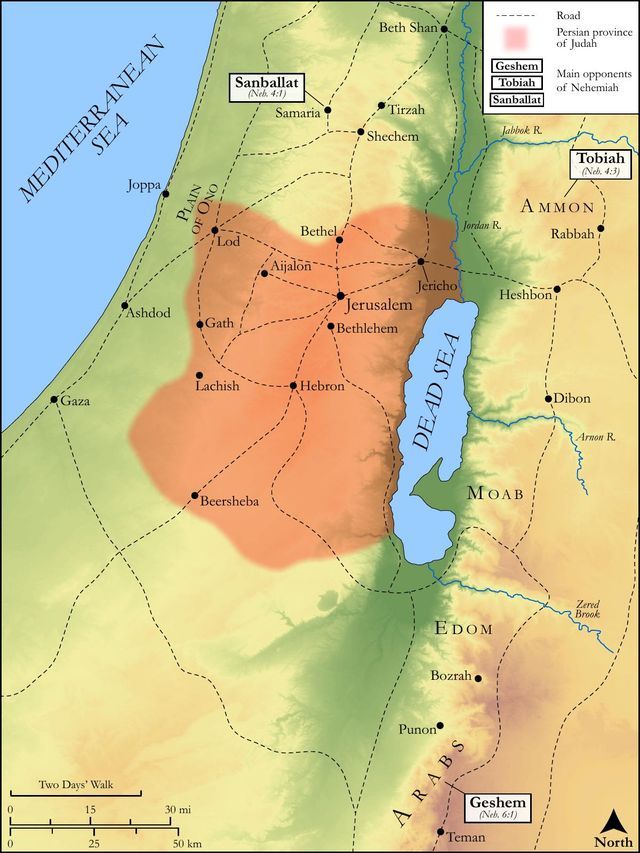
The historical setting is the mid-5th century BCE, during the post-exilic period under the Persian Empire. The Jewish community, having returned from Babylonian captivity, was vulnerable and lacked the security and national identity symbolized by fortified walls. Rebuilding Jerusalem's walls was far more than a civil engineering project; it was a profound act of national and spiritual restoration, signifying the re-establishment of a divinely covenanted people in their land. Sanballat (governor of Samaria), Tobiah (a prominent Ammonite official), and Geshem (an Arab chieftain) represented the hostile regional powers who viewed a strong, independent Judah as a direct threat to their political and economic influence. The "plain of Ono" was located a significant distance northwest of Jerusalem, near modern-day Lod, making it an isolated and dangerous location for Nehemiah to travel to, away from the protection of his people and the ongoing construction. In that era, political negotiations often involved face-to-face meetings, but Nehemiah's enemies had already demonstrated their treacherous character, making any such invitation highly suspect and demanding extreme caution.
Key Themes
ShowHideNehemiah 6:3 profoundly articulates several core themes central to the book of Nehemiah and broader biblical narratives. Foremost is the theme of unwavering commitment to God's calling, as Nehemiah prioritizes the "great work" above personal safety, political maneuvering, or deceptive overtures. This highlights the vital importance of spiritual discernment in leadership, as Nehemiah astutely perceives the true, malevolent intent behind the seemingly benign invitation, recognizing it as a ploy to derail the divinely appointed task (compare the wisdom of Proverbs 14:15). The verse also powerfully underscores the theme of perseverance in the face of opposition, demonstrating that significant spiritual work often attracts spiritual resistance, which can manifest in various forms, from overt threats to subtle, cunning distractions. Nehemiah's rhetorical question, "why should the work cease," emphasizes the sacred priority of God's work, viewing it not merely as a civic project but as a divine mandate that must not be interrupted. This steadfastness serves as an enduring model for believers to maintain singular focus on their God-given tasks, refusing to be sidetracked by the "schemes of the devil" (as described in Ephesians 6:11).
Exposition and Analysis
ShowHideKey Word Analysis
ShowHideThis term (H4399) denotes not just a job or task, but often a significant undertaking, a business, or even a divinely appointed mission. In the context of the tabernacle and temple construction, mᵉlâʼkâh refers to sacred labor commanded by God (e.g., Exodus 31:3). Here, Nehemiah's use of "great work" (מְלָאכָה גְדֹלָה, mᵉlâʼkâh gâdôwl) elevates the rebuilding of Jerusalem's walls beyond a mere construction project to a task of immense spiritual, national, and covenantal significance. It implies that this is God's work, not merely Nehemiah's own initiative, demanding his full devotion.
The verb "come down" (H3381) literally means to descend, to go downwards. In this context, it carries profound metaphorical weight. It implies descending from his position of leadership, focus, and dedication to the work, to engage in a lower, distracting, and potentially dangerous activity. It signifies a relinquishing of his high calling and commitment to the task at hand, to stoop to the level of his enemies' deceptive tactics. Nehemiah's refusal to "come down" is a refusal to compromise his integrity, abandon his divine mandate, or jeopardize the integrity of the mission.
This verb (H7673) means to stop, rest, or desist from exertion. It is notably the root word for "Shabbat" (Sabbath), implying a complete cessation of activity or a state of rest. Nehemiah's rhetorical question, "why should the work cease," highlights the direct, immediate, and detrimental consequence of his potential departure. He understands that his presence, leadership, and unwavering focus are vital to the continuous progress of the work, and his absence would lead to its immediate halt, thereby fulfilling his enemies' objective of stopping the divine project.
Verse Breakdown
ShowHide"And I sent messengers unto them, saying,"
This opening clause establishes Nehemiah's prudent and strategic communication. He does not ignore the summons, which would be culturally disrespectful, but responds directly, albeit through intermediaries. This action demonstrates wise leadership and a refusal to personally engage in a known trap, maintaining his distance and control over the situation while still acknowledging the communication.
"I [am] doing a great work, so that I cannot come down:"
This is the resolute core of Nehemiah's refusal and the justification for his unavailability. He appeals to the magnitude, importance, and divine nature of his current task. The "great work" (rebuilding the walls) is paramount, consuming his full attention and presence. The phrase "cannot come down" signifies not merely a physical inability, but a moral and spiritual refusal to abandon his high calling or descend to the level of their deceptive schemes, emphasizing his unwavering focus and commitment to God's agenda.
"why should the work cease, whilst I leave it, and come down to you?"
This rhetorical question serves as a powerful and incisive rhetorical flourish, underscoring the absurdity and detrimental nature of their request. Nehemiah clearly articulates the direct and inevitable consequence of his absence: the cessation of the vital work. This reveals his profound understanding of his indispensable role and his unyielding dedication, prioritizing the completion of God's work above all personal considerations or the appeasement of adversaries, while simultaneously exposing the true, malicious intent of his enemies.
Literary Devices
ShowHideNehemiah 6:3 is rich in literary devices that amplify its message of resolute dedication and spiritual discernment. The most prominent is the Rhetorical Question, "why should the work cease, whilst I leave it, and come down to you?" This question is not posed to elicit information but to make a forceful, declarative statement, highlighting the obvious and unacceptable consequence of Nehemiah's departure. It serves to expose the enemies' malicious intent and to reaffirm Nehemiah's unwavering commitment to the divine task. Furthermore, the phrase "come down" functions as a powerful Metaphor or Symbolism. While literally meaning to descend from a higher physical place (the wall), it metaphorically represents a descent from a position of authority, spiritual focus, and high ground to engage in a distracting, dangerous, and compromising diversion. Nehemiah's refusal to "come down" symbolizes his refusal to compromise his mission or stoop to the level of his adversaries' deceitful tactics. The verse also employs Contrast between Nehemiah's singular, unwavering focus on the "great work" and his enemies' persistent, multifaceted attempts at distraction and sabotage, emphasizing the spiritual battle being waged. Finally, there is an element of Irony in the enemies' "invitation," which is presented as a friendly overture but is, in reality, a deadly trap, a truth Nehemiah astutely discerns and exposes.
Theological and Thematic Connections
ShowHideNehemiah 6:3 stands as a profound theological statement on the principle of prioritizing God's divine calling above all personal distractions and external opposition. Nehemiah's steadfastness models a crucial aspect of faithful living: discerning the true nature of challenges and refusing to compromise a sacred mission for temporary relief or deceptive overtures. His declaration that he is engaged in "a great work" underscores the inherent value and divine significance of the task, elevating it beyond mere human endeavor. This commitment reflects a deep trust in God's provision and purpose, recognizing that true success lies in unwavering obedience to His will, even when it demands immense sacrifice and singular focus. The verse serves as an enduring reminder that those engaged in God's work will inevitably face attempts to derail their efforts, necessitating vigilance, discernment, and an unyielding resolve to complete the task, understanding that the work's cessation would be a victory for the forces opposing God's kingdom.
Reflection and Application
ShowHideNehemiah 6:3 offers timeless wisdom for believers navigating the complexities of life and ministry in a world brimming with distractions, both overt and subtle. Nehemiah's example calls us to a profound level of intentionality, discernment, and unwavering commitment to our God-given callings. We are all called to "great works"—whether in our vocations, families, communities, or direct ministry—that demand our full attention and dedication. This verse challenges us to identify what truly constitutes our "great work" in God's eyes and to guard it fiercely against anything that threatens to derail our progress. Just as Nehemiah refused to "come down" from his wall, we must learn to say a firm "no" to opportunities, invitations, or even seemingly urgent demands that are, in reality, distractions designed to pull us away from our core purpose. This requires spiritual discernment to recognize the true motives behind such diversions and the courage to prioritize God's agenda over personal comfort, the appeasement of others, or the allure of less significant pursuits. Our steadfastness in these "great works" is not merely about productivity; it is an act of worship, demonstrating our trust in God's calling and our unwavering commitment to His kingdom's advance.
Questions for Reflection
ShowHideFAQ
ShowHideWhat was the "great work" Nehemiah was doing?
ShowHideThe "great work" Nehemiah was doing was the monumental task of rebuilding the walls of Jerusalem. This was far more than a physical construction project; it was a divinely commissioned mission to restore the security, dignity, and national identity of the Jewish people after their return from Babylonian exile. The walls symbolized the re-establishment of a covenant community and the protection of the holy city, essential for the proper worship of God and the flourishing of His people. Nehemiah viewed it as a sacred undertaking, essential for the spiritual and physical well-being of Judah, and a direct act of obedience to God's will.
Who were the "them" Nehemiah sent messengers to?
ShowHideThe "them" refers to Nehemiah's persistent adversaries, primarily Sanballat the Horonite, Tobiah the Ammonite official, and Geshem the Arab. These individuals, along with their allies, were regional leaders who vehemently opposed the rebuilding of Jerusalem's walls because they perceived a strong, independent Judah as a threat to their own political and economic influence in the region. They had previously attempted to stop the work through ridicule, threats, and even armed attacks, and now resorted to cunning deception by inviting Nehemiah to a meeting in the plain of Ono, intending to harm him or distract him from his vital work, as detailed in Nehemiah 6:1-2.
Why was it so important that the work not "cease"?
ShowHideIt was critically important that the work not cease for several profound reasons. First, the rebuilding of Jerusalem's walls was nearing completion, and any interruption would have jeopardized the entire project, potentially leading to its abandonment and the demoralization of the people. Second, the cessation of the work was precisely what Nehemiah's enemies desired; it would have been a significant victory for them and a devastating blow to the morale and security of the Jewish community. Third, Nehemiah understood this work as a divine mandate, and allowing it to cease would have been an act of disobedience to God and a failure in his leadership. His unwavering presence and singular focus were essential to maintaining momentum and inspiring the people to complete the task, as highlighted throughout Nehemiah 4.
Christ-Centered Fulfillment
ShowHideNehemiah's unwavering focus on "a great work" and his resolute refusal to "come down" from it powerfully foreshadow the singular devotion of Jesus Christ to His Father's will and the ultimate "great work" of redemption. Just as Nehemiah faced relentless opposition and deceptive ploys designed to derail his mission, Jesus encountered constant attempts to sidetrack Him from His divine purpose. From the wilderness temptations where He refused to "come down" to the devil's level by turning stones into bread or seeking worldly power (Matthew 4:1-11), to the persistent efforts of religious leaders to trap Him in their questions and undermine His authority (Matthew 22:15-46), Jesus remained singularly fixed on His purpose. He declared, "My food is to do the will of Him who sent Me, and to finish His work" (John 4:34), echoing Nehemiah's commitment to a divine task. The "great work" for Jesus was not the rebuilding of physical walls, but the spiritual restoration and reconciliation of humanity through His atoning sacrifice on the cross. He "set His face to go to Jerusalem" (Luke 9:51), resolute in His path to Calvary, refusing to be distracted by Peter's well-meaning but misguided advice to avoid suffering (Matthew 16:21-23). Ultimately, on the cross, Jesus proclaimed, "It is finished!" (John 19:30), signifying the successful completion of the greatest work of all—the work of salvation, making Nehemiah's steadfastness a poignant Old Testament shadow of Christ's perfect obedience and unwavering resolve.