


Nehemiah 6:4
Bible text: King James Version (1769 Blayney text) · Public domain
Bible text: Berean Standard Bible · Public domain
Bible text: American Standard Version (1901) · Public domain
Bible text: World English Bible, Messianic edition · Public domain
Bible text: Geneva Bible (1599) · Public domain
Bible text: Young's Literal Translation · Public domain
- וַיִּשְׁלְחוּvai·yish·le·Chuand they sentH7971Conj-w ¦ V-Qal-ConsecImperf-3mpVerb Qal Consecutive Imperfect 3rd Plural Masculineוַandיִּשְׁלְחוּthey sent
- אֵלַי'e·Laito meH413Prep ¦ 1csPrepositionאֵלַtoיme
- כַּדָּבָרka·da·Varaccording to the mannerH1697Prep-k ¦ N-msNoun Singular Masculine Absoluteכַּaccording to theדָּבָרmanner
- הַזֶּהha·Zeh<the> thisH2088Art ¦ PrtParticle Demonstrativeהַ<the>זֶּהthis
- אַרְבַּע'ar·Ba'fourH702Adj-csAdjective Numerical Singular common gender Absolute
- פְּעָמִיםpe·'a·MimtimesH6471N-mpNoun Plural Masculine Absolute
- וָאָשִׁיבva·'a·Shivand I sent back toH7725Conj-w ¦ V-Hiphil-ConsecImperf-1csVerb Hiphil Consecutive Imperfect 1st Singular common genderוָandאָשִׁיבI sent back to
- אוֹתָם'o·Tam<obj.> themH853DirObjM ¦ 3mpParticle Object Indicatorאוֹתָ<obj.>םthem
- כַּדָּבָרka·da·Varaccording to the mannerH1697Prep-k ¦ N-msNoun Singular Masculine Absoluteכַּaccording to theדָּבָרmanner
- הַזֶּהha·Zeh<the> thisH2088Art ¦ PrtParticle Demonstrativeהַ<the>זֶּהthis
English is a literal word-by-word gloss of the Hebrew, not the KJV's wording. Why?
This is the original text the KJV's translators worked from — each Hebrew word with its own literal English meaning in this verse, prepared by scholars at Tyndale House, Cambridge. The KJV translates whole sentences, not word by word, so its wording differs: one Hebrew word can become several English words, and the KJV may choose “the LORD” where the gloss reads “Yahweh”. Both are faithful — they answer different questions. For the KJV's own rendering, switch to the KJV text.
Details
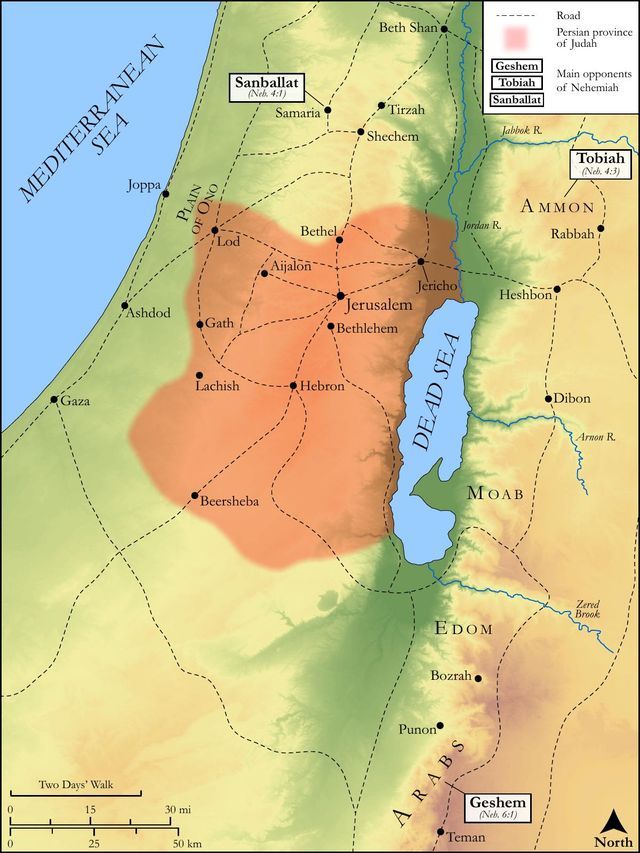
See on the biblical-era map
Study this verse
Public-domain commentary
Matthew Henry
From his Commentary on the Whole Bible. Henry comments on passages, not single verses — this entry covers Nehemiah 6:1–9. His two-level outline is real structure in the source text, so it is rendered as structure.
Two plots upon Nehemiah we have here an account of, how cunningly they were laid by his enemies and how happily frustrated by God's good providence and his prudence.
I.A plot to trepan him into a snare.
The enemies had an account of the good forwardness the work was in, that all the breaches of the wall were made up, so that they considered it as good as done, though at that time the doors of the gates were off the hinges (Neh 6:1); they must therefore now or never, by one bold stroke, take off Nehemiah. They heard how well guarded he was, so that there was no attacking him upon the spot; they will therefore try by all the arts of wheedling to get him among them. Observe,
1.With what hellish subtlety they courted him to meet them, not in any city, lest that should excite a suspicion that they intended to secure him, but in a village in the lot of Benjamin: "Come, let us meet together to consult about the common interests of our provinces." Or they would have him think that they coveted his friendship, and would be glad to be better acquainted with him, in order to a good understanding between them and the settling of a good correspondence. But they thought to do him a mischief. It is probable that he had some secret intelligence given him that they designed to imprison or murder him; or he knew them so well that, without breach of charity, he concluded they aimed at his life, and therefore, when they spoke fair, he believed them not.
2.See with what heavenly wisdom he declined the motion. His God did instruct him to give them that prudent answer by messengers of his own: "I am doing a great work, am very busy, and am loth to let the work stand still while I leave it to come down to you," Neh 6:3. His care was that the work might not cease; he knew it would if he left it ever so little; and why should it cease while I come down to you? He says nothing of his jealousies, nor reproaches them for their treacherous design, but gives them a good reason and one of the true reasons why he would not come. Compliment must always give way to business. Let those that are tempted to idle merry meetings by their vain companions thus answer the temptation, "We have work to do, and must not neglect it." Four times they attacked him with the same solicitation, and he as often returned the same answer, which, we may suppose, was very vexatious to them; for really it was the ceasing of the work that they aimed at, and it would make them despair of breaking the undertaking to see the undertaker so intent upon it. I answered them (says he) after the same manner, Neh 6:4. Note, We must never suffer ourselves to be overcome by the greatest importunity to do any thing sinful or imprudent; but, when we are attacked with the same temptation, must still resist it with the same reason and resolution.
II.A plot to terrify him from his work.
Could they but drive him off, the work would cease of course. This therefore Sanballat attempts, but in vain. 1. he endeavours to possess Nehemiah with an apprehension that his undertaking to build the walls of Jerusalem was generally represented as factious and seditious, and would be resented accordingly at court, Neh 6:5-7. The best men, even in their most innocent and excellent performances, have lain under this imputation. This is written to him in an open letter, as a thing generally known and talked of, that it was reported among the nations, and Gashmu will aver it for truth, that Nehemiah was aiming to make himself king and to shake off the Persian yoke. Note, It is common for that which is the sense only of the malicious to be falsely represented by them as the sense of the many. Now Sanballat pretends to inform Nehemiah of this as a friend, that he might hasten to court to clear himself, or stay his proceedings, for fear they should be thus misconstrued; at least, upon this surmise, he urges him to give him the meeting - "Let us take counsel together how to quell the report," hoping by this means either to take him off, or at least to take him off from his business. Thus were his words softer than oil, and yet war was in his heart, and he hoped, like Judas, to kiss and kill. But surely in vain is the net spread in the sight of any bird. Nehemiah was soon aware what they aimed at, to weaken their hands from the work (Neh 6:9), and therefore not only denied that such things were true, but that they were reported; he was better known than to be thus suspected. 2. Thus he escaped the snare and kept his ground, nor would he be frightened by winds and clouds from sowing and reaping. Suppose it was thus reported, we must never omit known duty merely for fear it should be misconstrued; but, while we keep a good conscience, let us trust God with our good name. But indeed it was not thus reported. God's people, though sufficiently loaded with reproach, yet are not really so low in reputation as some would have them thought to be.
In the midst of his complaint of their malice, in endeavouring to frighten him, and so weaken his hands, he lifts up his heart to Heaven in this short prayer: Now therefore, O God! strengthen my hands. It is the great support and relief of good people that in all their straits and difficulties they have a good God to go to, from whom, by faith and prayer, they may fetch in grace to silence their fears and strengthen their hands when their enemies are endeavouring to fill them with fears and weaken their hands. When, in our Christian work and warfare, we are entering upon any particular services or conflicts, this is a good prayer for us to put up: "I have such a duty to do, such a temptation to grapple with; now therefore, O God! strengthen my hands." Some read it, not as a prayer, but as a holy resolution (for O God is supplied in our translation): Now therefore I will strengthen my hands. Note, Christian fortitude will be sharpened by opposition. Every temptation to draw us from duty should quicken us so much the more to duty.
Continue studying Nehemiah 6:4 across the web’s major study libraries — every link below opens this exact verse, chapter, or book on the destination site.
Read & Compare
 BibleGatewayThis verse in more than 200 translations and 70 languages.
 Bible.comThe YouVersion reader — hundreds of translations, reading plans, and highlights.
 ESV.orgCrossway's official English Standard Version reader.
 NET BibleThe NET translation with 60,000+ translators' notes on every rendering decision.
 STEP BibleTyndale House's free study tool — original text, vocabulary, and scholarly resources.
 BibliaLogos Bible Software's free web reader.
 USCCBThe New American Bible (Revised Edition) with the U.S. bishops' study notes.
Commentaries
 BibleHub CommentariesDozens of classic commentaries on this verse, gathered on one page.
 StudyLightMore than 100 commentary sets — the largest collection on the web.
 BibleRefPlain-English commentary on what this verse means, verse by verse.
 Enduring WordDavid Guzik's free commentary on this chapter, widely used by Bible teachers.
 Bible Study ToolsVerse commentary alongside Greek and Hebrew study aids.
Original Language & Research
- BibleHub InterlinearThe verse word by word — original language, transliteration, and English.
- BibleHub LexiconEvery word's original-language definition and Strong's entry.
 Blue Letter BibleDeep-study tools — Strong's numbers, concordance, and word studies.
 SefariaThe Hebrew text with Rashi and centuries of Jewish commentary.
Sermons, Hymns & Audio


TrulyRandomVerse is not affiliated with these sites and doesn’t control their content. They’re linked because they’re genuinely useful.
Summary
Nehemiah 6:4 powerfully illustrates the relentless and deceptive opposition faced by Nehemiah during the critical rebuilding of Jerusalem's walls, and his unwavering, discerning commitment to his divinely appointed mission. Despite repeated attempts by his adversaries to distract, intimidate, and harm him, Nehemiah consistently refused to be diverted, prioritizing the "great work" of God above all personal concerns or political machinations. This verse underscores the spiritual nature of the conflict and the essential virtue of steadfastness in the face of persistent adversity.
Context
ShowHideLiterary Context
This verse is situated at a pivotal moment in the book of Nehemiah, specifically within a series of escalating threats and deceptions orchestrated by Sanballat, Tobiah, and Geshem. Chapters 4 and 5 detail the initial ridicule, threats of violence, and internal economic strife that Nehemiah skillfully navigated. Chapter 6 opens with the enemies' shift in strategy from overt confrontation to cunning deception. In Nehemiah 6:1-3, they invite Nehemiah to a meeting in the plain of Ono, ostensibly for discussion, but with the stated malicious intent to "do me mischief." Nehemiah, discerning their true motives, famously responds, "I am doing a great work, so that I cannot come down: why should the work cease, whilst I leave it, and come down to you?" Nehemiah 6:4 reveals that this was not a one-off attempt but a sustained campaign of psychological warfare, with the enemies sending the same deceptive invitation four times, each time met with Nehemiah's identical, resolute refusal. This repetition highlights the intensity of the spiritual battle and Nehemiah's unshakeable resolve as the wall nears completion (Nehemiah 6:15).
Historical & Cultural Context
The events of Nehemiah unfold around 445 BC, during the Persian Empire's dominion over the former Judean kingdom. Nehemiah, a high-ranking cupbearer to King Artaxerxes I, received royal permission and resources to return to Jerusalem and rebuild its walls, which had lain in ruins since the Babylonian destruction in 586 BC. This task was not merely architectural; it was deeply symbolic, representing the restoration of Israel's national identity, security, and covenant faithfulness. The primary adversaries—Sanballat, the governor of Samaria; Tobiah, an Ammonite official; and Geshem, an Arabian chieftain—were powerful regional figures whose influence and control over Judea were threatened by a strong, fortified Jerusalem. Their opposition stemmed from political ambition, economic interests, and likely religious animosity towards the returning Jewish community. The plain of Ono, located northwest of Jerusalem, was a strategic choice for a meeting: it was remote, providing an isolated setting for an ambush, and far enough from the city to draw Nehemiah away from the protective presence of his people and the ongoing work.
Key Themes
ShowHideNehemiah 6:4 encapsulates several profound themes central to the book and applicable to the life of faith. Firstly, it vividly portrays Persistent Opposition to God's work. The "four times" underscores the relentless, unyielding nature of the enemy's efforts to thwart divine purposes, illustrating that spiritual and divinely appointed endeavors often attract sustained and varied forms of resistance. Secondly, Nehemiah's consistent response highlights Unwavering Focus and Steadfastness. His refusal to be distracted, even by seemingly reasonable invitations, demonstrates a singular devotion to the "great work" God had called him to. This steadfastness is a crucial virtue for those engaged in ministry or pursuing God's will, echoing the biblical call to be "steadfast, immovable, always abounding in the work of the Lord". Thirdly, the verse showcases Wisdom and Discernment. Nehemiah's ability to see through the deceptive facade of the enemies' invitations was not mere stubbornness but a profound spiritual insight into their malicious intent. This discernment allowed him to avoid their traps and protect the integrity of the rebuilding effort, demonstrating the importance of being "shrewd as snakes and innocent as doves" in navigating a hostile world.
Exposition and Analysis
ShowHideKey Word Analysis
ShowHideThis word, H702, denotes the specific quantity of four. Its use here emphasizes the multiplicity and repetition of the adversaries' attempts. It's not a single, isolated incident but a deliberate, sustained campaign of psychological pressure, highlighting the persistent nature of the opposition Nehemiah faced.
Meaning "a stroke" or "time," indicates distinct instances or occurrences. When combined with "four," it underscores the sequential and deliberate nature of the enemy's efforts. Each "time" represents a renewed attempt to divert Nehemiah, revealing their determination and the prolonged nature of the spiritual conflict.
A versatile word meaning "word," "matter," or "thing," is used here to describe the nature or method of communication. "After this sort" refers to the deceptive and malicious nature of the enemies' invitations, while "after the same manner" highlights Nehemiah's consistent, identical refusal, signifying his unwavering resolve and clear discernment of their true intentions.
Verse Breakdown
ShowHide"Yet they sent unto me four times after this sort;"
This clause reveals the relentless and strategic nature of the opposition Nehemiah faced. The adversaries, having failed with overt threats, shifted to a cunning, deceptive tactic: repeated invitations to a meeting in Ono. The specific number "four times" emphasizes their persistence and determination to wear Nehemiah down, exhaust his resolve, or create an opportunity for ambush. The phrase "after this sort" confirms that each of these four attempts carried the same underlying malicious intent, despite their outward appearance of diplomacy or negotiation.
"and I answered them after the same manner."
This clause highlights Nehemiah's remarkable consistency, spiritual discernment, and unwavering resolve. His response was not a varied negotiation or a hesitant refusal, but an identical, firm rejection based on his clear understanding of their true motives and his steadfast commitment to the "great work" of rebuilding the walls. It demonstrates his spiritual wisdom in prioritizing God's mission above all else, refusing to be drawn into a trap that would halt the crucial rebuilding effort.
Literary Devices
ShowHideThe primary literary device at play in Nehemiah 6:4 is Repetition. The phrases "four times" and "after the same manner" are central to this. The numerical repetition of the enemy's attempts ("four times") emphasizes their relentless persistence and the intensity of the psychological warfare. This is mirrored by the repetition of Nehemiah's response ("after the same manner"), which underscores his unwavering steadfastness and consistent discernment. Furthermore, there is a clear Contrast established: the persistent, deceptive, and malicious actions of the adversaries are set against Nehemiah's consistent, discerning, and righteous refusal. This contrast highlights the spiritual battle between those who seek to hinder God's purposes and those who are committed to fulfilling them. The entire narrative of the wall's rebuilding, and Nehemiah's resistance to diversion, also functions as Symbolism, representing the ongoing spiritual warfare faced by believers as they endeavor to advance God's kingdom, often encountering opposition disguised as opportunities or necessities.
Theological and Thematic Connections
ShowHideNehemiah 6:4 offers profound theological insights into the nature of spiritual warfare and the character required for faithful service. It affirms that those engaged in God's work will inevitably face persistent, often cunning, opposition from forces that seek to derail divine purposes. This opposition is not merely human but has a spiritual dimension, aiming to distract, discourage, or destroy the work of the Kingdom. Nehemiah's response serves as a powerful model of discernment, unwavering focus, and steadfastness, demonstrating that prioritizing God's call and maintaining integrity are essential for overcoming such challenges. His refusal to be drawn away from the "great work" underscores the importance of guarding one's calling and resisting diversions, no matter how subtly they are presented.
Reflection and Application
ShowHideNehemiah 6:4 provides timeless lessons for believers navigating the complexities of modern life and ministry. We, too, are often faced with "four times" or more of persistent attempts to pull us away from our core responsibilities, whether spiritual, professional, or personal. These distractions can come in many forms: tempting offers, seemingly urgent but ultimately unproductive tasks, subtle criticisms, or even well-intentioned but misdirected advice. Like Nehemiah, it is crucial for us to cultivate spiritual discernment to recognize the true motives behind such diversions and to understand their potential to halt the "great work" God has called us to. This requires a clear understanding of our God-given priorities, a steadfast commitment to them, and the courage to consistently say "no" to anything that compromises our devotion. Our unwavering focus and consistent response, rooted in prayer and reliance on God, become a powerful testimony to our faith and a bulwark against the enemy's schemes, enabling us to persevere and complete the tasks entrusted to us.
Questions for Reflection
ShowHideFAQ
ShowHideWhy did Nehemiah's enemies persist despite his clear refusal?
ShowHideNehemiah's enemies, Sanballat, Tobiah, and Geshem, were driven by deep-seated political and personal animosity. Their goal was not genuine negotiation but to disrupt, intimidate, and ultimately harm Nehemiah, thereby halting the rebuilding of Jerusalem's walls. They persisted because they believed that repeated attempts, even if initially rebuffed, might eventually wear Nehemiah down, expose him to danger, or create an opportunity for their malicious plans to succeed. Their persistence underscores the relentless nature of opposition to God's work, which often employs various tactics until a weakness is found or the target is diverted.
What does "after this sort" and "after the same manner" imply about the communication?
ShowHideThe phrase "after this sort" (or "in this manner") refers to the nature of the enemies' repeated invitation to meet in the plain of Ono. As revealed in Nehemiah 6:2, their intent was to "do me mischief" (to harm him). So, "after this sort" implies that each of the four invitations carried the same deceptive facade and malicious intent. Conversely, "after the same manner" describes Nehemiah's consistent, unwavering response. It means he gave them the identical refusal each time, based on his clear discernment of their true intentions and his firm commitment to the "great work" he was doing (Nehemiah 6:3). This highlights his steadfastness and refusal to be swayed or distracted.
Christ-Centered Fulfillment
ShowHideNehemiah's steadfastness in the face of persistent, deceptive opposition powerfully foreshadows the ultimate unwavering focus of Jesus Christ on His redemptive mission. Just as Nehemiah refused to be diverted from building the physical walls of Jerusalem, Christ, the true Builder, consistently rejected every attempt to pull Him away from His divine task of building His spiritual church, against which the gates of hell shall not prevail. From the wilderness temptations where He rebuffed Satan's cunning offers to divert Him from the Father's will (Matthew 4:1-11), to His resolute journey towards Jerusalem and the cross despite the pleas of His disciples (Mark 8:31-33), Jesus maintained an unparalleled focus. His discernment of the true nature of opposition, whether from religious leaders or the "prince of this world" (John 14:30), allowed Him to consistently answer "after the same manner" – with unwavering obedience to God's will. Ultimately, Nehemiah's commitment to a temporary physical structure points to Christ's perfect and complete fulfillment of God's eternal plan, culminating in His sacrifice as the Lamb of God who takes away the sin of the world, a mission from which He could not be, and was not, diverted.