


Matthew 26:62
Bible text: King James Version (1769 Blayney text) · Public domain
Bible text: Berean Standard Bible · Public domain
Bible text: American Standard Version (1901) · Public domain
Bible text: World English Bible, Messianic edition · Public domain
Bible text: Geneva Bible (1599) · Public domain
Bible text: Young's Literal Translation · Public domain
- καὶkaiAndG2532CONJConjunction
- ἀναστὰςanastashaving stood upG450V-2AAP-NSMVerb 2nd Aorist Active Participle Nominative Singular Masculine
- ὁhotheG3588T-NSMDefinite article Nominative Singular Masculine
- ἀρχιερεὺςarchiereushigh priestG749N-NSMNoun Nominative Singular Masculine
- εἶπενeipensaidG2036V-2AAI-3SVerb 2nd Aorist Active Indicative 3rd Singular
- αὐτῷ·autōto HimG846P-DSMPersonal pronoun Dative Singular Masculine
- οὐδὲνoudenNo [thing]G3762A-ASNAdjective Accusative Singular Neuter
- ἀποκρίνῃ;apokrinēanswer you?G611V-PNI-2SVerb Present Middle Or Passive Deponent Indicative 2nd Singular
- τίtiWhatG5101I-ASNInterrogative pronoun Accusative Singular Neuter
- οὗτοίhoutoitheseG3778D-NPMDemonstrative pronoun Nominative Plural Masculine
- σουsouyouG4771P-2GSPersonal pronoun Genitive 2nd Singular
- καταμαρτυροῦσιν;katamarturousindo witness against?G2649V-PAI-3PVerb Present Active Indicative 3rd Plural
English is a literal word-by-word gloss of the Greek, not the KJV's wording. Why?
This is the original text the KJV's translators worked from — each Greek word with its own literal English meaning in this verse, prepared by scholars at Tyndale House, Cambridge. The KJV translates whole sentences, not word by word, so its wording differs: one Greek word can become several English words, and the KJV may choose “charity” where the gloss reads “love”. Both are faithful — they answer different questions. For the KJV's own rendering, switch to the KJV text.
Details
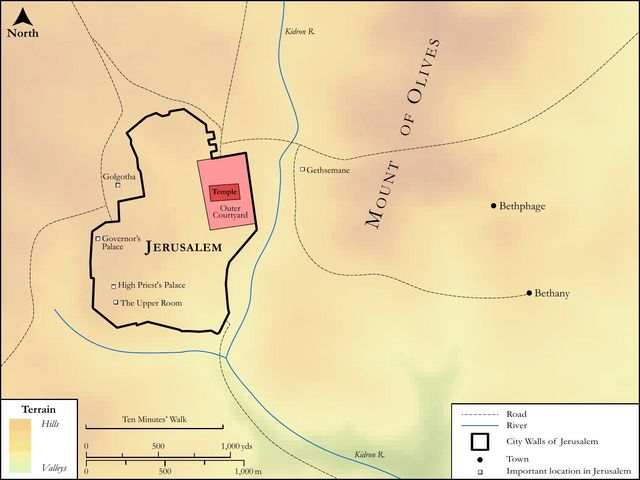
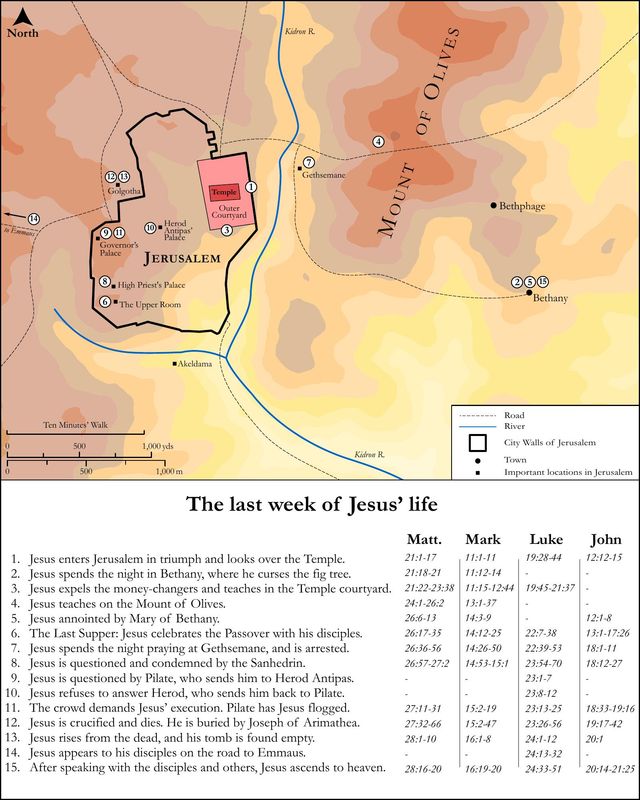
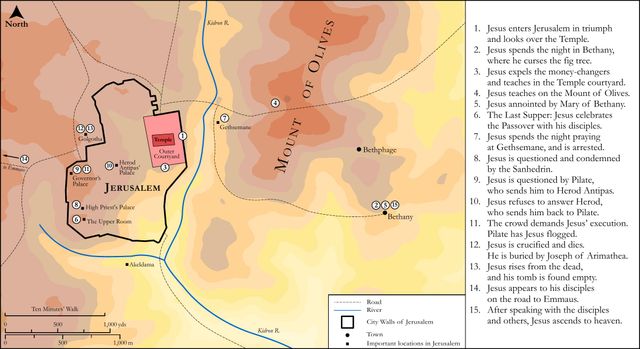
See on the biblical-era maps
Study this verse
Historical interpretation
Nine Centuries of Reception
6 surviving comments on this verse. Each one is dated, so this reads as a timeline rather than a list.
Select a marker to jump to its quote. Markers stagger vertically where authors wrote within a few decades of each other.
Wherefore also they were all assembled together, and it was a council of pestilent men, and they ask some questions, wishing to invest this plot with the appearance of a court of justice. For "neither did their testimonies agree together;" so feigned was the court of justice, and all things full of confusion and disorder.
"But false witnesses came, and said, This fellow said, I will destroy this temple, and in three days I will raise it." And indeed He had said, "In three days," but He said not, "I will destroy," but, "Destroy," and not about that temple but about His own body.
What then doth the high priest? Willing to press Him to a defense, that by that he might take Him, he saith, "Hearest Thou not what these witness against Thee? But He held His peace."
For the attempts at defense were unprofitable, no man hearing. For this was a show only of a court of justice, but in truth an onset of robbers, assailing Him without cause, as in a cave, or on a road.
Wherefore "He held His peace," but the other continued, saying, "I adjure Thee by the living God, that Thou tell us whether Thou be the Christ, the Son of the living God. But He said, Thou hast said. Nevertheless I say unto you, Hereafter shall ye see the Son of Man sitting at the right hand of power, and coming in the clouds. Then the high priest rent his clothes, saying, He hath spoken blasphemy." And this he did to add force to the accusation, and to aggravate what He said, by the act. For since what had been said moved the hearers to fear, what they did about Stephen, stopping their ears, this high priest doth here also.
And yet what kind of blasphemy was this? For indeed before He had said, when they were gathered together, "The Lord said unto my Lord. Sit Thou on my right hand," and interpreted the saying, and they dared say nothing, but held their peace, and from that time forth gainsaid Him no more. Why then did they now call the saying a blasphemy? And wherefore also did Christ thus answer them? To take away all their excuse, because unto the last day He taught that He was Christ, and that He sitteth at the right hand of the Father, and that He will come again to judge the world, which was the language of one manifesting His full accordance with the Father.
Having rent therefore his clothes, he saith, "What think ye?" He gives not the sentence from himself, but invites it from them, as in a case of confessed sins, and manifest blasphemy. For, inasmuch as they knew that if the thing came to be inquired into, and carefully decided, it would free Him from all blame, they condemn Him amongst themselves, and anticipate the hearers by saying, "Ye have heard the blasphemy;" all but necessitating and forcing them to deliver the sentence. What then say they? "He is guilty of death;" that having taken Him as condemned, they should thus work upon Pilate thereupon to pass sentence. In which matter those others also being accomplices say, "He is guilty of death;" themselves accusing, themselves judging, themselves passing sentence, themselves being everything then.
But wherefore did they not bring forward the Sabbaths? Because He had often stopped their mouths; and moreover they wanted to take Him, and condemn Him by the things then said. And the high priest anticipated them, and gave the sentence as from them, and drew them all on by rending his vestments, and having led Him away as now condemned unto Pilate, thus did all.
When the Chief Priests were thus assembled, this conventicle of ruffians sought to give their conspiracy the character of a legal trial. But it was entirely a scene of confusion and uproar, as what follows shows, Though many false witnesses came, yet found they none.
Why did they not bring forward now His breaking the Sabbath? Because He had so often confuted them on this point.
He said this with a design to draw from Him some indefensible answer which might be made a snare for Him. But Jesus held his peace, for defence had availed nothing when none would listen to it. For here was only a mockery of justice, it was in truth nothing more than the anarchy of a den of robbers.
This He did to give weight to the accusation, and to confirm by deeds what He taught in words.
Then, after rending his garment, he did not give sentence of himself, but asked of others, saying, What think ye? As was always done in undeniable cases of sin, and manifest blasphemy, and as by force driving them to a certain opinion, he anticipates the answer, What need we any further witnesses? Behold, now ye have heard his blasphemy. What was this blasphemy? For before He had interpreted to them as they were gathered together that text, The Lord said unto my Lord, Sit thou on my right hand, (Matt. 22:44.) and they had held their peace, and had not contradicted Him. How then do they call what He now says blasphemy? They answered and said, He is guilty of death, the same persons at once accusers, examiners, and sentencers.
(Hom. lxxxv.) As hunters who have started their game, so they exhibit a wild and drunken exultation.
Observe how circumstantially the Evangelist recounts all those particulars even which seem most disgraceful, hiding or extenuating nothing, but thinking it the highest glory that the Lord of the earth should endure such things for us. This let us read continually, let us imprint in our minds, and in these things let us boast.
(Verse 62) And the high priest stood up and said to Him, 'Do You answer nothing? What is it that these men testify against You?' But Jesus kept silent. And the high priest became furious and impatient, unable to find a place for false accusations, he threw the high priest off his seat, in order to demonstrate his madness of mind through the movement of his body. The more Jesus remained silent in response to unworthy individuals, false witnesses, and wicked priests, the more the high priest, overcome with rage, provoked Him to respond, so that he could find an opportunity in any occasion of conversation to accuse Him. Nevertheless, Jesus remained silent. For he knew, as if God, whatever response he gave would be twisted into a false accusation.
How can they be false witnesses if they said what we read the Lord had said before? Because a false witness takes the truth and twists its meaning. The Lord had spoken of the temple of his body, but they falsely accused him with those very words. With a few things added or changed, they made it into an understandably false accusation. The Savior had said, “Destroy this temple.” They changed his words to say, “I can destroy God’s temple.” … But the Lord, indicating the living and breathing temple, had said, “And in three days I will raise it up.” It is one thing to build and another to raise up.
He went in, either out of the attachment of a disciple, or natural curiosity, seeking to know what sentence the High Priest would pass, whether death, or scourging.
At last came two false witnesses. How are they false witnesses, when they repeat only what we read that the Lord spoke? A false witness is one who takes what is said in a different sense from that in which it was said. Now this the Lord had spoken of the temple of His Body, and they cavil at His expressions, and by a slight change and addition produce a plausible charge. The Lord's words were, Destroy this temple; (John 2:19.) this they make into, I can destroy the Temple of God. He said, Destroy, not 'I will destroy,' because it is unlawful to lay hands on ourselves. Also they phrased it, And build it again, making it apply to the temple of the Jews; but the Lord had said, And I will raise it up again, thus clearly pointing out a living and breathing temple. For to build again, and to raise again, are two different things.
Headlong and uncontrolled rage, unable to find even a false accusation, moves the High Priest from his throne, the motion of his body showing the emotion of his mind. And the High Priest arose, and said unto him, Answerest thou nothing to the things which these witness against Thee?
For as God, He knew that whatever He said would be twisted into an accusation against Him. But at this His silence before false witnesses and ungodly Priests, the High Priest was exasperated, and summons Him to answer, that from anything He says he may raise a charge against Him.
The same fury which drew the High Priest from his seat, impels him now to rend his clothes; for so it was customary with the Jews to do whenever they heard any blasphemy, or any thing against God.
And by this rending his garments, he shows that the Jews have lost the priestly glory, and that their High Priest's throne was vacant. For by rending his garment he rent the veil of the Law which covered him.
They spit in his face, and buffeted him, to fulfil the prophecy of Esaias, I gave my cheek to the smiters, and turned not away my face from shame and spitting. (Isa. 50:6.)
But it would have been foolish to have answered them that smote Him, and to have declared the smiter, seeing that in their madness they seem to have struck Him openly.
(ord) Prophesy unto us is said in ridicule of His claim to be held as a Prophet by the people.
Continue studying Matthew 26:62 across the web’s major study libraries — every link below opens this exact verse, chapter, or book on the destination site.
Read & Compare
 BibleGatewayThis verse in more than 200 translations and 70 languages.
 Bible.comThe YouVersion reader — hundreds of translations, reading plans, and highlights.
 ESV.orgCrossway's official English Standard Version reader.
 NET BibleThe NET translation with 60,000+ translators' notes on every rendering decision.
 STEP BibleTyndale House's free study tool — original text, vocabulary, and scholarly resources.
 BibliaLogos Bible Software's free web reader.
 USCCBThe New American Bible (Revised Edition) with the U.S. bishops' study notes.
Commentaries
 BibleHub CommentariesDozens of classic commentaries on this verse, gathered on one page.
 StudyLightMore than 100 commentary sets — the largest collection on the web.
 BibleRefPlain-English commentary on what this verse means, verse by verse.
 Enduring WordDavid Guzik's free commentary on this chapter, widely used by Bible teachers.
 Bible Study ToolsVerse commentary alongside Greek and Hebrew study aids.
Original Language & Research
- BibleHub InterlinearThe verse word by word — original language, transliteration, and English.
- BibleHub LexiconEvery word's original-language definition and Strong's entry.
 Blue Letter BibleDeep-study tools — Strong's numbers, concordance, and word studies.
 CNTR CollationThe earliest Greek manuscripts of this verse, collated letter by letter.
Sermons, Hymns & Audio


TrulyRandomVerse is not affiliated with these sites and doesn’t control their content. They’re linked because they’re genuinely useful.
Summary
Matthew 26:62 captures the high priest Caiaphas's exasperated challenge to Jesus during His illegal night trial before the Sanhedrin. Following a series of inconsistent and legally insufficient testimonies from false witnesses, Caiaphas, frustrated by Jesus' profound silence, directly demands a response from Him regarding the accusations leveled against Him, revealing the desperation of the Jewish leaders to secure a conviction.
Context
ShowHideLiterary Context
This verse is situated within the dramatic narrative of Jesus' arrest and trial before the Jewish high court, the Sanhedrin, immediately following His betrayal in the Garden of Gethsemane and His apprehension (Matthew 26:47-56). The preceding verses (Matthew 26:57-61) describe the assembly of the chief priests and elders, the search for false testimony, and the ultimate failure of multiple witnesses to provide a consistent or legally viable accusation against Jesus. Caiaphas's intervention in verse 62 marks a pivotal moment where the proceedings shift from relying on external, fabricated evidence to a direct confrontation, highlighting the leaders' inability to secure a conviction through conventional (albeit corrupted) means.
Historical & Cultural Context
The trial of Jesus before the Sanhedrin was highly irregular and illegal by Jewish law. It was held at night, on a feast day (Passover), without proper notice, and without the required two consistent witnesses for a capital charge (Deuteronomy 19:15). The high priest, Caiaphas, was the presiding officer, a powerful figure appointed by the Roman authorities, and deeply invested in maintaining religious and political order, which he perceived Jesus to be disrupting. His frustration in this verse underscores the Sanhedrin's desperate need to find a charge, preferably blasphemy, which was punishable by death under Jewish law, to justify handing Jesus over to the Roman authorities for execution.
Key Themes
ShowHideThis verse contributes to several key themes within Matthew's Gospel and the broader Passion narrative. Firstly, it highlights Jesus' Sovereign Silence, which is not a sign of guilt or fear, but a deliberate act fulfilling prophetic expectations of the suffering servant who "opened not his mouth" (Isaiah 53:7). Secondly, it underscores the Illegitimacy and Corruption of the Trial, as the high priest's direct intervention reveals the failure of the false witnesses and the court's desperation to condemn Jesus by any means necessary, even resorting to forcing a self-incriminating statement. Finally, it foreshadows the Divine Necessity of the Passion, demonstrating that despite human machinations and injustice, God's plan for redemption through Christ's suffering and death was unfolding precisely as ordained (Matthew 26:54).
Exposition and Analysis
ShowHideKey Word Analysis
ShowHideThis verb (G450) signifies a physical act of standing up, but in this context, it carries the nuance of assuming an authoritative posture or taking decisive action. Caiaphas's act of rising from his seat indicates a shift in the trial's dynamic, moving from passive reception of testimony to active, direct interrogation, born out of his mounting frustration and a desire to take control of the failing proceedings.
The verb "answerest" (G611, apokrínomai) means to reply or respond, often implying a conclusion reached. Coupled with "nothing" (G3762, oudeís), which means "not even one" or "none," the phrase forms a forceful rhetorical question. It expresses Caiaphas's astonishment and impatience at Jesus' complete silence in the face of grave accusations, demanding a verbal defense where none had been offered.
This compound verb (G2649) combines "against" (κατά) with "to bear witness" (μαρτυρέω), specifically meaning "to testify to the detriment of someone" or "to bear witness against." It emphasizes the accusatory, hostile, and condemning nature of the testimonies being presented, highlighting that the witnesses were not merely observing but actively seeking to incriminate Jesus.
Verse Breakdown
ShowHide"And the high priest arose"
This marks a significant turning point in the trial. Caiaphas, the chief magistrate of the Sanhedrin, physically stands up, signaling his personal intervention and profound frustration with the inability of the false witnesses to provide a consistent and legally sufficient case against Jesus. His action denotes a shift from a formal, albeit corrupted, judicial process to a direct, personal confrontation.
"and said unto him, Answerest thou nothing?"
This is a direct, impatient, and perhaps incredulous question posed by Caiaphas to Jesus. It reveals the high priest's exasperation with Jesus' steadfast silence in the face of serious accusations. It is a rhetorical question designed not to elicit information about Jesus' guilt or innocence, but to provoke a response, hoping Jesus would incriminate Himself or provide a statement that could be twisted into blasphemy.
"what [is it which] these witness against thee?"
This second part of Caiaphas's question is a direct challenge for Jesus to refute the accusations. It implicitly acknowledges the failure of the false witnesses to present a coherent or credible case, as Caiaphas himself must now summarize or prompt a response regarding the vague "what" that "these" (the false witnesses) have testified. It underscores the desperation of the court to find a legal basis for condemnation.
Literary Devices
ShowHideThe passage employs several potent literary devices. Rhetorical Question is prominently featured in Caiaphas's "Answerest thou nothing?" and "what is it which these witness against thee?" These are not genuine inquiries for information but expressions of frustration and attempts to pressure Jesus into speaking, highlighting the high priest's desperation and the trial's illegitimacy. Contrast is evident between the chaotic, inconsistent, and ultimately failed testimonies of the false witnesses and Jesus' profound, dignified, and strategic silence. This stark opposition underscores Jesus' sovereignty and control even in His apparent vulnerability. Furthermore, there is an element of Dramatic Irony: Caiaphas, in his attempt to condemn Jesus, unknowingly fulfills Old Testament prophecy regarding the silent suffering servant, and his desperate questioning ultimately sets the stage for Jesus' powerful, albeit brief, self-identification as the Son of God in the subsequent verses.
Theological and Thematic Connections
ShowHideMatthew 26:62 profoundly illustrates the divine sovereignty at play even amidst human injustice and corruption. Jesus' silence is not a sign of weakness but a deliberate act of submission to the Father's will and a fulfillment of prophetic scripture. It underscores His identity as the suffering servant, who, though innocent, willingly endures false accusation for the sake of humanity. This moment highlights the profound contrast between human attempts to control and condemn, and God's ultimate plan of redemption unfolding, demonstrating that even the most desperate acts of evil can be woven into the fabric of divine purpose. Jesus' silence speaks volumes, testifying to the truth of His mission and the corrupt nature of His accusers.
Reflection and Application
ShowHideJesus' profound silence in the face of overwhelming and unjust accusations in Matthew 26:62 offers a powerful and counter-intuitive lesson for believers. In a world that often demands immediate self-defense and eloquent rebuttals, Jesus demonstrates that there are times when silence, coupled with unwavering trust in God's ultimate justice and sovereignty, is the most powerful response. His composure under immense pressure teaches us to discern when to speak and when to remain silent, not out of fear or inability, but out of a deeper reliance on God's plan. It encourages us to find our strength not in our own words or arguments, but in quiet submission to divine will, even when facing misunderstanding, false accusations, or intense scrutiny. This passage challenges us to cultivate a spirit of quiet trust and patient endurance, mirroring the Lord's example, knowing that God will ultimately vindicate His truth and His people.
Questions for Reflection
ShowHideFAQ
ShowHideWhy did Jesus remain silent before Caiaphas's initial questions and the false witnesses?
ShowHideJesus' initial silence (prior to Caiaphas's direct question in Matthew 26:62) was multifaceted and deeply significant. Theologically, it was a deliberate fulfillment of Old Testament prophecy, particularly Isaiah 53:7, which describes the suffering servant as "like a lamb that is led to the slaughter, and like a sheep that before its shearers is silent, so he opened not his mouth." This silence underscored His identity as the sacrificial Lamb of God. Practically, it exposed the utter illegitimacy and corruption of the trial; the testimonies of the false witnesses were so inconsistent and contradictory that no coherent case could be built, rendering any defense from Jesus unnecessary and futile. His silence highlighted the court's desperation and their predetermined intent to condemn Him, regardless of the truth. It was a powerful, dignified, and sovereign act that revealed the injustice of the proceedings more effectively than any verbal defense could have.
Christ-Centered Fulfillment
ShowHideMatthew 26:62, with Caiaphas's frustrated demand for Jesus to speak, powerfully foreshadows and illuminates Christ's ultimate fulfillment as the silent, suffering servant. Jesus' profound silence in the face of overwhelming injustice and false accusation is not a sign of weakness, but a deliberate act of sovereign will, perfectly aligning with the prophetic portrait of the Lamb of God who takes away the sin of the world. His refusal to defend Himself underscores His unique mission: He came not to argue His innocence, but to willingly offer Himself as a blameless sacrifice. This moment anticipates the cross, where His silence would be broken only by words of forgiveness and submission to the Father's will, ultimately securing redemption. His silence speaks volumes about His humility and obedience, even "becoming obedient to the point of death, even death on a cross" (Philippians 2:8). He is the one who, though reviled, "did not revile in return; when he suffered, he did not threaten, but continued entrusting himself to him who judges justly" (1 Peter 2:23). Thus, Caiaphas's frustrated question inadvertently highlights the profound depth of Christ's redemptive work, where His quiet endurance became the loud declaration of God's saving grace.