


Matthew 17:17
Bible text: King James Version (1769 Blayney text) · Public domain
Bible text: King James Version with Strong's numbers · Public domain
Bible text: Berean Standard Bible · Public domain
Bible text: American Standard Version (1901) · Public domain
Bible text: World English Bible, Messianic edition · Public domain
Bible text: Geneva Bible (1599) · Public domain
Bible text: Young's Literal Translation · Public domain
- ἈποκριθεὶςApokritheisAnsweringG611V-AOP-NSMVerb Aorist Passive Deponent Participle Nominative Singular Masculine
- δὲdenowG1161CONJConjunction
- ὁho<the>G3588T-NSMDefinite article Nominative Singular Masculine
- ἸησοῦςIēsousJesusG2424N-NSM-PNoun Nominative Singular Masculine Individual
- εἶπεν·eipensaidG2036V-2AAI-3SVerb 2nd Aorist Active Indicative 3rd Singular
- ὦōOG5599INJInterjection
- γενεὰgeneagenerationG1074N-VSFNoun Vocative Singular Feminine
- ἄπιστοςapistosunbelievingG571A-VSFAdjective Vocative Singular Feminine
- καὶkaiandG2532CONJConjunction
- διεστραμμένηdiestrammenēpervertedG1294V-RPP-VSFVerb Perfect Passive Participle Vocative Singular Feminine
- ἕωςhe'ōsuntilG2193PREPPreposition
- πότεpotewhenG4219PRT-IInterrogative Particle Interrogative
- μεθ᾽meth᾽withG3326PREPPreposition
- ὑμῶνhumōnyouG4771P-2GPPersonal pronoun Genitive 2nd Plural
- ἔσομαι;esomaiwill I be?G1510V-FDI-1SVerb Future Middle Deponent Indicative 1st Singular
- ἕωςhe'ōsUntilG2193PREPPreposition
- πότεpotewhenG4219PRT-IInterrogative Particle Interrogative
- ἀνέξομαιanexomaiwill I bear withG430V-FDI-1SVerb Future Middle Deponent Indicative 1st Singular
- ὑμῶν;humōnyou?G4771P-2GPPersonal pronoun Genitive 2nd Plural
- φέρετέpheretedo bringG5342V-PAM-2PVerb Present Active Imperative 2nd Plural
- μοιmoito MeG3165P-1DSPersonal pronoun Dative 1st Singular
- αὐτὸνautonhimG846P-ASMPersonal pronoun Accusative Singular Masculine
- ὧδεhōdehereG5602ADVAdverb
English is a literal word-by-word gloss of the Greek, not the KJV's wording. Why?
This is the original text the KJV's translators worked from — each Greek word with its own literal English meaning in this verse, prepared by scholars at Tyndale House, Cambridge. The KJV translates whole sentences, not word by word, so its wording differs: one Greek word can become several English words, and the KJV may choose “charity” where the gloss reads “love”. Both are faithful — they answer different questions. For the KJV's own rendering, switch to the KJV text.
Details
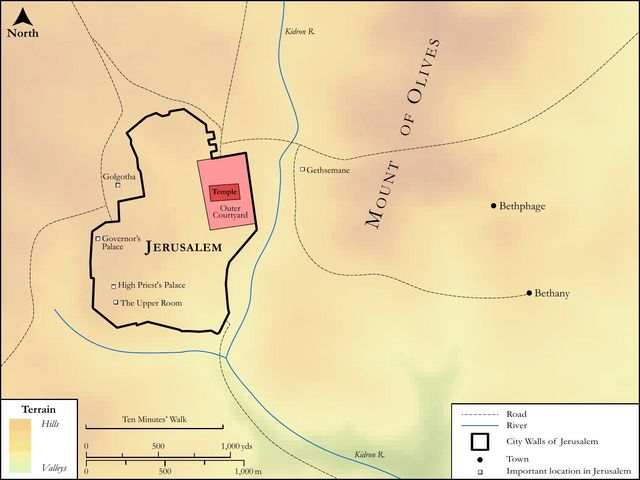
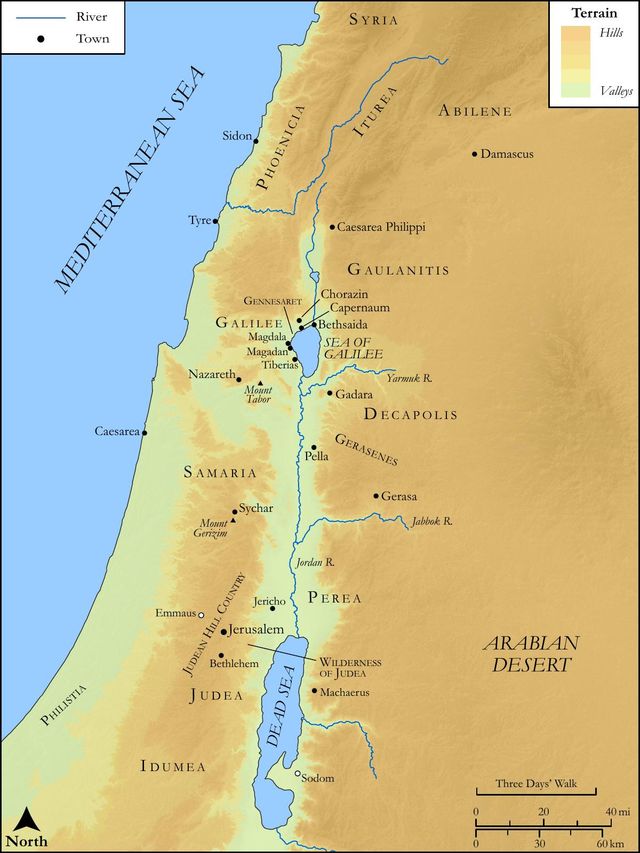
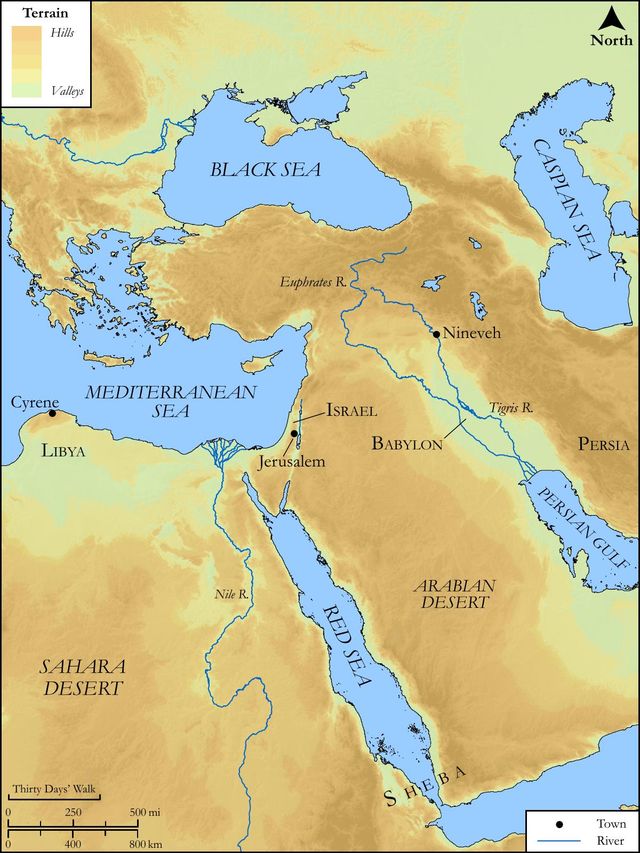
See on the biblical-era maps
Study this verse
Public-domain commentary
Matthew Henry
From his Commentary on the Whole Bible. Henry comments on passages, not single verses — this entry covers Matthew 17:14–21. His four-level outline is real structure in the source text, so it is rendered as structure.
We have here the miraculous cure of a child that was lunatic and vexed with a devil. Observe,
I.A melancholy representation of the case of this child, made to Christ by the afflicted father.
This was immediately upon his coming down from the mountain where he was transfigured. Note, Christ's glories do not make him unmindful of us and of our wants and miseries. Christ, when he came down from the mount, where had conversation with Moses and Elias, did not take state upon him, but was as easy of access, as ready to poor beggars, and as familiar with the multitude, as ever he used to be. This poor man's address was very importunate; he came kneeling to Christ. Note, Sense of misery will bring people to their knees. Those who see their need of Christ will be earnest, will be in good earnest, in their applications to him; and he delights to be thus wrestled with.
Two things the father of the child complains of.
1.The distress of his child (Mat 17:15); Lord have mercy on my son. The affliction of the children cannot but affect the tender parents, for they are pieces of themselves. And the case of afflicted children should be presented to God by faithful and fervent prayer. This child's distemper, probably, disabled him to pray for himself. Note, Parents are doubly concerned to pray for their children, not only that are weak and cannot, but much more that are wicked and will not, pray for themselves. Now, (1.). The nature of this child's disease was very sad; He was lunatic and sore vexed. A lunatic is properly one whose distemper lies in the brain, and returns with the change of the moon. The devil, by the divine permission, either caused this distemper, or at least concurred with it, to heighten and aggravate it. The child had the falling-sickness, and the hand of Satan was in it; by it he tormented then, and made it much more grievous than ordinarily it is. Those whom Satan got possession of, he afflicted by those diseases of the body which do most affect the mind; for it is the soul that he aims to do mischief to. The father, in his complain, saith, He is lunatic, taking notice of the effect; but Christ, in the cure, rebuked the devil, and so struck at the cause. Thus he doth in spiritual cures. (2.) The effects of the disease were very deplorable; He oft falls into the fire, and into the water. If the force of the disease made him to fall, the malice of the devil made him to fall into the fire or water; so mischievous is he where he gains possession and power in any soul. He seeks to devour, Pe1 5:8.
2.The disappointment of his expectation from the disciples (Mat 17:16); I brought him to thy disciples, and they could not cured him. Christ gave his disciples power to cast out devils (Mat 10:1, Mat 10:8), and therein they were successful (Luk 10:17); yet at this time they failed in the operation, though there were nine of them together, and before a great multitude. Christ permitted this,
(1.)To keep them humble, and to show their dependence upon him, that without him they could do nothing.
(2.)To glorify himself and his own power. It is for the honour of Christ to come in with help at a dead-lift, when other helpers cannot help. Elisha's staff in Gehazi's hand will not raise the child: he must come himself. Note, There are some special favours which Christ reserves the bestowment of to himself; and sometimes he keeps the cistern empty; that he may bring us to himself, the Fountain. But the failures of instruments shall not hinder the operations of his grace, which will work, if not by them, yet without them.
II.The rebukes that Christ gave to the people first, and then to the devil.
1.He chid those about him (Mat 17:17); O faithless and perverse generation! This is not spoken to the disciples, but to the people, and perhaps especially to the scribes, who are mentioned in Mar 9:14, and who, as it should seem, insulted over the disciples, because they had now met with a case that was too hard for them. Christ himself could not do many mighty works among a people in whom unbelief reigned. It was here owing to the faithlessness of this generation, that they could not obtain those blessings from God, which otherwise they might have had; as it was owing to the weakness of the disciples' faith, that they could not do those works for God, which otherwise they might have done. They were faithless and perverse. Note, Those that are faithless will be perverse; and perverseness is sin in its worst colours. Faith is compliance with God, unbelief is opposition and contradiction to God. Israel of old was perverse, because faithless (Psa 95:9), forward, for in them is no faith, Deu 32:20.
Two things he upbraids them with. (1.) His presence with them so long; "How long shall I be with you? Will you always need my bodily presence, and never come to such maturity as to be fit to be left, the people to the conduct of the disciples, and the disciples to the conduct of the Spirit and of their commission? Must the child be always carried, and will it never learn to go alone?" (2.) His patience with them so long; How long shall I suffer you? Note, [1.] The faithlessness and perverseness of those who enjoy the means of grace are a great grief to the Lord Jesus. Thus did he suffer the manners of Israel of old, Act 13:18. [2.] The longer Christ has borne with a perverse and faithless people, the more he is displeased with their perverseness and unbelief; and he is God, and not man, else he would not suffer so long, nor bear so much, as he doth.
2.He cured the child, and set him to-rights again. He called, Bring him hither to me. Though the people were perverse, and Christ was provoked, yet care was taken of the child. Note, Though Christ may be angry, he is never unkind, nor doth he, in the greatest of his displeasure, shut up the bowels of his compassion from the miserable; Bring him to me. Note, When all other helps and succours fail, we are welcome to Christ, and may be confident in him and in his power and goodness.
See here an emblem of Christ's undertaking as our Redeemer.
(1.)He breaks the power of Satan (Mat 17:18); Jesus rebuked the devil, as one having authority, who could back with force his word of command. Note, Christ's victories over Satan are obtained by the power of his word, the sword that comes out of his mouth, Rev 19:21. Satan cannot stand before the rebukes of Christ, though his possession has been ever so long. It is comfortable to those who are wrestling with principalities and powers, that Christ hath spoiled them, Col 2:15. The lion of the tribe of Judah will be too hard for the roaring lion that seeks to devour.
(2.)He redresses the grievances of the children of men; The child was cured from that very hour. It was an immediate cure, and a perfect one. This is an encouragement to parents to bring their children to Christ, whose souls are under Satan's power; he is able to heal them, and as willing as he is able. Not only bring them to Christ by prayer, but bring them to the word of Christ, the ordinary means by which Satan's strongholds are demolished in the soul. Christ's rebukes, brought home to the heart, will ruin Satan's power there.
III.Christ's discourse with his disciples hereupon.
1.They ask the reason why they could not cast out the devil at this time (Mat 17:19); They came to Jesus apart. Note, Ministers, who are to deal for Christ in public, have need to keep up a private communion with him, that they may in secret, where no eye sees, bewail their weakness and straitness, their follies and infirmities, in their public performances, and enquire into the cause of them. We should make use of the liberty of access we have to Jesus apart, where we may be free and particular with him. Such questions as the disciples put to Christ, we should put to ourselves, in communing with our own hearts upon our beds; Why were we so dull and careless at such a time? Why came we so much short in such a duty? That which is amiss may, when found out, be amended.
2.Christ gives them two reasons why they failed.
(1.)It was because of their unbelief, Mat 17:20. When he spake to the father of the child and to the people, he charged it upon their unbelief; when he spake to his disciples, he charged it upon theirs; for the truth was, there were faults on both sides; but we are more concerned to hear of our own faults than of other people's, and to impute what is amiss to ourselves than to others. When the preaching of the word seems not to be so successful as sometimes it has been, the people are apt to lay all the fault upon the ministers, and the ministers upon the people; whereas, it is more becoming for each to own his own faultiness, and to say, "It is owing to me." Ministers, in reproving, must learn thus to give to each his portion of the word; and to take people off from judging others, by teaching all to judge themselves; It is because of your unbelief. Though they had faith, yet that faith was weak and ineffectual. Note,
[1.]As far as faith falls short of its due strength, vigour, and activity, it may truly be said, "There is unbelief." Many are chargeable with unbelief, who yet are not to be called unbelievers.
[2.]It is because of our unbelief, that we bring so little to pass in religion, and so often miscarry, and come short, in that which is good.
Our Lord Jesus takes this occasion to show them the power of faith, that they might not be defective in that, another time, as they were now; If ye have faith as a grain of mustard-seed, ye shall do wonders, Mat 17:20. Some make the comparison to refer to the quality of the mustard-seed, which is, when bruised, sharp and penetrating; "If you have an active growing faith, not dead, flat, or insipid, you will not be baffled thus." But it rather refers to the quantity; "If you had but a grain of true faith, though so little that it were like that which is the least of all seeds, you would do wonders." Faith in general is a firm assent to, a compliance with, and a confidence in, all divine revelation. The faith here required, is that which had for its object that particular revelation by which Christ gave his disciples power to work miracles in his name, for the confirmation of the doctrine they preached. It was a faith in this revelation that they were defective in; either doubting the validity of their commission, or fearing that it expired with their first mission, and was not to continue when they were returning to their Master; or that it was some way or other forfeited or withdrawn. Perhaps their Master's absence with the three chief of his disciples, with a charge to the rest not to follow them, might occasion some doubts concerning their power, or rather the power of the Lord with them, to do this; however, there were not, at present, such a strong actual dependence upon, and confidence in, the promise of Christ's presence with them, as there should have been. It is good for us to be diffident of ourselves and of our own strength; but it is displeasing to Christ, when we distrust any power derived from him or granted by him.
If ye have ever so little of this faith in sincerity, if ye truly rely upon the powers committed to you, ye shall say to this mountain, Remove. This is a proverbial expression, denoting that which follows, and no more, Nothing shall be impossible to you. They had a full commission, among other things, to cast out devils without exception; but, this devil being more than ordinarily malicious and inveterate, they distrusted the power they had received, and so failed. To convince them of this, Christ shows them what they might have done. Note, An active faith can remove mountains, not of itself, but in the virtue of a divine power engaged by a divine promise, both which faith fastens upon.
(2.)Because there was something in the kind of the malady, which rendered the cure more than ordinarily difficult (Mat 17:21); "This kind goes not out but by prayer and fasting. This possession, which works by a falling-sickness, or this kind of devils that are thus furious, is not cast out ordinarily but by great acts of devotion, and wherein ye were defective." Note,
[1.]Though the adversaries we wrestle, be all principalities and powers, yet some are stronger than others, and their power more hardly broken.
[2.]The extraordinary power of Satan must not discourage our faith, but quicken us to a greater intenseness in the acting of it, and more earnestness in praying to God for the increase of it; so some understand it here; "This kind of faith (which removeth mountains) doth not proceed, is not obtained, from God, nor is it carried up to its full growth, nor drawn out into act and exercise, but by earnest prayer." [3.] Fasting and prayer are proper means for the bringing down of Satan's power against us, and the fetching in of divine power to our assistance. Fasting is of use to put an edge upon prayer; it is an evidence and instance of humiliation which is necessary in prayer, and is a means of mortifying some corrupt habits, and of disposing the body to serve the soul in prayer. When the devil's interest in the soul is confirmed by the temper and constitution of the body, fasting must be joined with prayer, to keep under the body.
Historical interpretation
Six Centuries of Reception
8 surviving comments on this verse. Each one is dated, so this reads as a timeline rather than a list.
Select a marker to jump to its quote. Markers stagger vertically where authors wrote within a few decades of each other.
Or; Because the disciples could not heal him as being weak in faith, He said to them, O faithless generation, adding perverse, to show that their perverseness had introduced evil beyond their nature. But I suppose, that because of the perverseness of the whole human race, as it were oppressed with their evil nature, He said, How long shall I be with you?
When the Savior says, “O faithless and perverse generation,” he shows that wickedness has entered us through perversity, that it is contrary to nature and makes us perverse. And I think that he was irked at the whole human race on earth for its wickedness. So he said, “How long am I to bear with you?”
"And when they were come to the multitude, there came to Him a man, kneeling down to Him, and saying, Lord, have mercy on my son, for he is lunatic, and sore vexed; for ofttimes he falleth into the fire, and oft into the water. And I brought him unto Thy disciples, and they could not cure him."
This man the Scripture signifies to be exceedingly weak in faith; and this is many ways evident; from Christ's saying, "All things are possible to him that believeth;" from the saying of the man himself that approached, "Help Thou mine unbelief:" from Christ's commanding the devil to "enter no more into him;" and from the man's saying again to Christ, "If Thou canst." "Yet if his unbelief was the cause," it may be said, "that the devil went not out, why doth He blame the disciples?" Signifying, that even without persons to bring the sick in faith, they might in many instances work a cure. For as the faith of the person presenting oftentimes availed for receiving the cure, even from inferior ministers; so the power of the doers oftentimes sufficed, even without belief in those who came to work the miracle.
And both these things are signified in the Scripture. For both they of the company of Cornelius by their faith drew unto themselves the grace of the Spirit; and in the case of Eliseus again, when none had believed, a dead man rose again. For as to those that cast him down, not for faith but for cowardice did they cast him, unintentionally and by chance, for fear of the band of robbers, and so they fled: while the person himself that was cast in was dead, yet by the mere virtue of the holy body the dead man arose.
Whence it is clear in this case, that even the disciples were weak; but not all; for the pillars were not present there. And see this man's want of consideration, from another circumstance again, how before the multitude he pleads to Jesus against His disciples, saying, "I brought him to Thy disciples, and they could not cure him."
But He, acquitting them of the charges before the people, imputes the greater part to him. For, "O faithless and perverse generation," these are His words, "how long shall I be with you?" not aiming at his person only, lest He should confound the man, but also at all the Jews. For indeed many of those present might probably be offended, and have undue thoughts of them.
But when He said, "How long shall I be with you," He indicates again death to be welcome to Him, and the thing an object of desire, and His departure longed for, and that not crucifixion, but being with them, is grievous.
He stopped not however at the accusations; but what saith He? "Bring him hither to me." And Himself moreover asks him, "how long time he is thus;" both making a plea for His disciples, and leading the other to a good hope, and that he might believe in his attaining deliverance from the evil.
And He suffers him to be torn, not for display (accordingly, when a crowd began to gather, He proceeded to rebuke him), but for the father's own sake, that when he should see the evil spirit disturbed at Christ's mere call, so at least, if in no other way, he might be led to believe the coming miracle.
And because he had said, "Of a child," and, "If thou canst help me," Christ saith, "To him that believeth, all things are possible," again giving the complaint a turn against him. And whereas when the leper said, "If Thou wilt, Thou canst make me clean," bearing witness to His authority Christ commending him, and confirming His words, said, "I will, be thou clean;" in this man's case, upon his uttering a speech in no way worthy of His power,-"If Thou canst, help me,"-see how He corrects it, as not rightly spoken. For what saith He? "If thou canst believe, all things are possible to him that believeth." What He saith is like this: "Such abundance of power is with me, that I can even make others work these miracles. So that if thou believe as one ought, even thou thyself art able," saith He, "to heal both this one, and many others." And having thus said, He set free the possessed of the devil.
But do thou not only from this observe His providence and His beneficence, but also from that other time, during which He allowed the devil to be in him. Since surely, unless the man had been favored with much providential care even then, he would have perished long ago; for "it cast him both into the fire," so it is said, "and into the water." And he that dared this would assuredly have destroyed the man too, unless even in so great madness God had put on him His strong curb: as indeed was the case with those naked men that were running in the deserts and cutting themselves with stones.
And if he call him "a lunatic," trouble not thyself at all, for it is the father of the possessed who speaks the word. How then saith the evangelist also, "He healed many that were lunatic?" Denominating them according to the impression of the multitude. For the evil spirit, to bring a reproach upon nature, both attacks them that are seized, and lets them go, according to the courses of the moon; not as though that were the worker of it;-away with the thought;-but himself craftily doing this to bring a reproach on nature. And an erroneous opinion hath gotten ground among the simple, and by this name do they call such evil spirits, being deceived; for this is by no means true.
is to be noted, that were not man fortified here by Providence, he would long since have perished; for the dæmons who cast him into the fire, and into the water, would have killed him outright, had God not restrained him.
See herein also his folly, in that before the multitude he appeals to Jesus against His disciples. But He clears them from shame, inputing their failure to the patient himself; for many things show that he was weak in faith. But He addresses His reproof not to the man singly, that He may not trouble him, but to the Jews in general. For many of those present, it is likely, had improper thoughts concerning the disciples, and therefore it follows, Jesus answered and said, O faithless and perverse generation, how long shall I be with you, how long shall I suffer you? His How long shall I be with you? shows that death was desired by Him, and that He longed for His withdrawal.
When He had vindicated His disciples, He leads the boy's father to a cheering hope of believing that he shall be delivered out of this evil and that the father might be led to believe the miracle that was coming, seeing the dæmons was disturbed even when the child was only called;
In saying, And I brought him to thy disciples, and they could not heal him, he covertly accuses the Apostles, whereas that a cure is impossible is sometimes the effect not of want of power in those that undertake it, but of want of faith in those that are to be healed,
Not that we must think that He was overcome by weariness of them, and that The meek and gentle broke out into words of wrath, but as a physician who might see the sick man acting against his injunctions, would say, How long shall I frequent your chamber? How long throw away the exercise of my skill, while I prescribe one thing, and you do another? That it is the sin, and not the man with whom He is angry, and that in the person of this one man He convicts the Jews of unbelief, is clear from what He adds, Bring him to me.
He rebuked him, that is, not the sufferer, but the dæmons.
Or, His reproof was to the child, because for his sins he had been seized on by the dæmons.
(Verse 17) And Jesus rebuked him, and the demon came out of him, and the boy was healed from that hour. It was not the boy who suffered, but rather the demon who ought to be rebuked. Whether he rebuked the boy, and the demon came out of him: because he had been oppressed by the demon due to his own sins.
It may be known also, that not now for the first time, but of a long time, the Lord had borne the Jews' stubbornness, whence He says, How long shall I suffer you? because I have now a long while endured your iniquities, and ye are unworthy of My presence.
In which deed He left an example to preachers to attack sins, but to assist men.
The lunatic is figuratively one who is hurried into fresh vices every hour, one while is cast into the fire, with which the hearts of the adulterers burn; or again into the waters of pleasures or lusts, which yet have not strength to quench love. (Hos. 7:4, 6.)
Continue studying Matthew 17:17 across the web’s major study libraries — every link below opens this exact verse, chapter, or book on the destination site.
Read & Compare
 BibleGatewayThis verse in more than 200 translations and 70 languages.
 Bible.comThe YouVersion reader — hundreds of translations, reading plans, and highlights.
 ESV.orgCrossway's official English Standard Version reader.
 NET BibleThe NET translation with 60,000+ translators' notes on every rendering decision.
 STEP BibleTyndale House's free study tool — original text, vocabulary, and scholarly resources.
 BibliaLogos Bible Software's free web reader.
 USCCBThe New American Bible (Revised Edition) with the U.S. bishops' study notes.
Commentaries
 BibleHub CommentariesDozens of classic commentaries on this verse, gathered on one page.
 StudyLightMore than 100 commentary sets — the largest collection on the web.
 BibleRefPlain-English commentary on what this verse means, verse by verse.
 Enduring WordDavid Guzik's free commentary on this chapter, widely used by Bible teachers.
 Bible Study ToolsVerse commentary alongside Greek and Hebrew study aids.
Original Language & Research
- BibleHub InterlinearThe verse word by word — original language, transliteration, and English.
- BibleHub LexiconEvery word's original-language definition and Strong's entry.
 Blue Letter BibleDeep-study tools — Strong's numbers, concordance, and word studies.
 CNTR CollationThe earliest Greek manuscripts of this verse, collated letter by letter.
Sermons, Hymns & Audio


TrulyRandomVerse is not affiliated with these sites and doesn’t control their content. They’re linked because they’re genuinely useful.
Summary
Matthew 17:17 captures Jesus' profound frustration and divine authority in the face of spiritual impotence and pervasive unbelief. Following His Transfiguration, Jesus encounters a demon-possessed boy whom His disciples were unable to heal. His sharp rebuke, "O faithless and perverse generation," encompasses both the unbelieving crowd and, implicitly, His own disciples, highlighting the deep-seated spiritual blindness and moral corruption that hindered God's power. Jesus' subsequent command to "bring him hither to me" underscores His unique and immediate authority as the ultimate source of healing and deliverance.
Context
ShowHideLiterary Context
This verse immediately follows the dramatic Transfiguration of Jesus, where Peter, James, and John witnessed His divine glory on a high mountain. Upon descending, Jesus and the three disciples rejoin the larger group of disciples and a great crowd. The scene shifts abruptly from the mountaintop revelation of divine power to the valley of human suffering and spiritual failure. A distraught father approaches Jesus, explaining that his son, afflicted by a demon causing severe seizures, was brought to the disciples, but "they could not cure him" (Matthew 17:16). Jesus' exasperated words in Matthew 17:17 are a direct response to this public display of spiritual impotence and the pervasive unbelief He observed among the people and, by extension, within His own followers. The subsequent healing of the boy in Matthew 17:18 starkly contrasts with the disciples' failure, setting the stage for their later private inquiry about their inability to cast out the demon (Matthew 17:19-20).
Historical & Cultural Context
Jesus' ministry occurred within a complex socio-religious landscape in first-century Judea and Galilee. The Jewish people, under Roman occupation, held diverse expectations for the Messiah, often focusing on political deliverance rather than spiritual transformation. The religious leaders, such as the Pharisees and Sadducees, represented a spectrum of legalism and skepticism, often prioritizing human traditions over divine revelation. Demonic possession was a recognized phenomenon, and exorcism was practiced by various individuals and groups, though often with limited success or through dubious means. Jesus' consistent power over demons, as seen throughout the Gospels, set Him apart. His reference to "this generation" (G1074, geneá) likely refers not merely to a specific age group but to the prevailing spiritual and moral character of the Jewish people of that era, characterized by a general resistance to God's redemptive work through Him, despite the miraculous signs He performed. This generation was marked by a lack of genuine faith and a spiritual "perversity" that turned away from divine truth.
Key Themes
ShowHideThis passage powerfully underscores several critical themes central to Matthew's Gospel and the broader New Testament. Firstly, it highlights The Hindrance of Unbelief, demonstrating how a lack of genuine faith, even among those close to Jesus, can impede the manifestation of God's power. The disciples' failure to heal the boy directly illustrates this, leading to Jesus' subsequent teaching on faith the size of a mustard seed (Matthew 17:20). Secondly, Jesus' rhetorical questions, "how long shall I be with you? how long shall I suffer you?" reveal The Burden of Divine Patience and Human Resistance. These words convey a deep sorrow and weariness over the spiritual dullness and moral corruption of the people, who, despite witnessing His miracles and hearing His teachings, remained resistant to true faith and repentance. Finally, the passage unequivocally asserts Jesus' Unquestionable Divine Authority. In stark contrast to the disciples' impotence, Jesus immediately commands, "bring him hither to me," and effortlessly casts out the demon (Matthew 17:18), demonstrating that true power and deliverance flow solely from Him.
Exposition and Analysis
ShowHideKey Word Analysis
ShowHideMeaning "disbelieving" or "without Christian faith." It describes a state of spiritual unbelief, not merely intellectual doubt, but an active unwillingness or inability to trust in God's power and promises. In this context, it points to a spiritual deficiency that prevents divine intervention.
Meaning "to distort," "misinterpret," or "corrupt." It implies a moral crookedness, a turning away from what is right, true, or morally upright. This word suggests that the generation's unbelief was not just a lack of understanding but a stubborn, morally twisted resistance to God's revealed truth and His Son.
Meaning "a generation" or "an age." Here, it refers to the people living at that time, characterized by their collective spiritual and moral disposition. Jesus' use of this term indicts the prevailing spiritual climate and the general character of the people who were resistant to His message and power.
Verse Breakdown
ShowHide"Then Jesus answered and said,"
This phrase indicates Jesus' direct and authoritative response to the situation He encountered. It marks a pivotal moment where He addresses the spiritual failure and unbelief that had just been demonstrated by the disciples and the surrounding crowd.
"O faithless and perverse generation,"
Jesus' exclamation is a powerful indictment. "Faithless" (G571, ápistos) highlights their lack of trust in God's power, while "perverse" (G1294, diastréphō) points to their moral and spiritual corruption, a turning away from divine truth. The term "generation" (G1074, geneá) refers to the people of that era, characterized by their collective spiritual blindness and resistance to God's work through Him.
"how long shall I be with you?"
This rhetorical question expresses Jesus' deep weariness and sorrow over the spiritual dullness and persistent unbelief He constantly encountered. It conveys a sense of divine patience stretched to its limits, longing for a genuine response of faith from His people.
"how long shall I suffer you?"
This parallel rhetorical question intensifies the previous one, revealing Jesus' profound endurance of their spiritual obstinacy and moral corruption. The word "suffer" (G430, anéchomai) implies bearing with, enduring, or putting up with their resistance, underscoring the burden of their unbelief on the Son of God.
"bring him hither to me."
In stark contrast to His expressed frustration, Jesus immediately issues a command that demonstrates His absolute authority and readiness to act. This direct instruction bypasses the disciples' inability and asserts His unique power as the only one capable of delivering the boy, highlighting His role as the ultimate healer and deliverer.
Literary Devices
ShowHideMatthew 17:17 is rich with Rhetorical Questions, "how long shall I be with you? how long shall I suffer you?", which are not meant to elicit an answer but to express Jesus' deep anguish, frustration, and weariness with the spiritual dullness and unbelief of the people. The use of the interjection "O" (G5599, ō) at the beginning of His address, "O faithless and perverse generation," functions as an Exclamation, conveying intense emotion—a mixture of sorrow, disappointment, and indignation. The strong, almost hyperbolic language of "faithless and perverse" serves as a powerful Indictment, condemning the spiritual state of the generation. The abrupt shift from the rhetorical questions to the direct, authoritative command, "bring him hither to me," creates a dramatic Contrast, highlighting Jesus' immediate and decisive power in the face of human impotence and spiritual failure.
Theological and Thematic Connections
ShowHideMatthew 17:17 serves as a profound theological statement on the nature of faith, divine power, and human resistance. Jesus' lament over a "faithless and perverse generation" underscores the pervasive spiritual condition of humanity, prone to unbelief and moral corruption, even in the presence of divine revelation. This passage highlights that while God's power is absolute, its manifestation in human experience is often contingent upon faith. The disciples' failure, despite their proximity to Jesus, reveals that spiritual authority and miraculous power are not inherent but are mediated through a living, active trust in God. Jesus' ultimate command to "bring him hither to me" reaffirms His unique role as the sole source of true deliverance and healing, emphasizing that all spiritual power ultimately resides in and flows from Him. It also implicitly teaches that true ministry involves bringing people directly to Christ, rather than relying solely on one's own limited abilities.
Reflection and Application
ShowHideMatthew 17:17 stands as a poignant challenge to every believer, urging us to deeply examine the quality and depth of our own faith. In a world that often prioritizes self-reliance and skepticism, Jesus' words remind us that spiritual impotence stems from a lack of trust in God's boundless power. Are we, like the "faithless and perverse generation," limiting God's work in our lives and through us because of our own unbelief or moral compromise? This verse calls us to cultivate a vibrant, active faith that is not merely intellectual assent but a radical dependence on Christ. When faced with seemingly insurmountable obstacles, personal struggles, or spiritual battles, our first and ultimate response should be to "bring him hither to me"—to bring our needs, our failures, and our desperate situations directly to Jesus, recognizing that true power and deliverance reside in Him alone. It challenges us to move beyond spiritual apathy and embrace the transformative power of genuine, unwavering faith in the Son of God.
Questions for Reflection
ShowHideFAQ
ShowHideWho is Jesus referring to when He says "O faithless and perverse generation"?
ShowHideWhile Jesus' immediate frustration is sparked by the disciples' inability to heal the boy, His rebuke "O faithless and perverse generation" (G1074, geneá) extends beyond them to encompass the broader spiritual climate of the people He ministered to. This phrase describes the prevailing character of the Jewish people of that era, marked by a general lack of genuine faith in Him as the Messiah, despite the many signs and wonders He performed (Matthew 12:39). It highlights their spiritual dullness, moral corruption, and stubborn resistance to divine truth, which prevented them from receiving God's power and experiencing His kingdom in its fullness. The disciples, though His followers, were not entirely immune to this pervasive unbelief, as evidenced by their failure to cast out the demon.
Why was Jesus so frustrated or exasperated in this verse?
ShowHideJesus' frustration stems from several layers of spiritual failure and human resistance. Firstly, He had just descended from the Transfiguration, a moment of profound divine revelation, only to be confronted with a scene of human suffering and spiritual impotence. Secondly, His own disciples, whom He had empowered to cast out demons (Matthew 10:1), failed to heal the boy, revealing their lack of faith. Thirdly, the broader "generation" was characterized by a deep-seated unbelief and moral perversity, consistently resisting His message and miracles. Jesus' rhetorical questions, "how long shall I be with you? how long shall I suffer you?" convey His weariness and sorrow over their spiritual blindness and stubbornness, which hindered God's redemptive work among them. It's a divine lament over humanity's persistent turning away from God.
Christ-Centered Fulfillment
ShowHideMatthew 17:17, with Jesus' lament over a "faithless and perverse generation," powerfully foreshadows His ultimate mission and sacrifice. His deep weariness ("how long shall I suffer you?") reveals the profound burden of human sin and unbelief that He, as the Son of God, willingly bore. Unlike the disciples who failed to deliver, Jesus' immediate command, "bring him hither to me," underscores His unique and singular authority as the only one capable of confronting and conquering the powers of darkness. This moment prefigures His greater work on the cross, where He would fully "suffer" the consequences of humanity's faithlessness and perversity, taking upon Himself the sin of the world (John 1:29). His victory over the demon in Matthew 17:18 is a microcosm of His ultimate triumph over sin, death, and the devil (Colossians 2:15). The "faithless and perverse generation" finds its hope and redemption only in the One who, though exasperated by their unbelief, nevertheless laid down His life to reconcile them to God, demonstrating His enduring love and unwavering commitment to save those who turn to Him in faith (Romans 5:8). He is the Great Physician to whom all the sick and demon-possessed must be brought, for in Him alone is true healing and eternal life found (Luke 4:40).