


Mark 4:35
Bible text: King James Version (1769 Blayney text) · Public domain
Bible text: Berean Standard Bible · Public domain
Bible text: American Standard Version (1901) · Public domain
Bible text: World English Bible, Messianic edition · Public domain
Bible text: Geneva Bible (1599) · Public domain
Bible text: Young's Literal Translation · Public domain
- ΚαὶKaiAndG2532CONJConjunction
- λέγειlegeiHe saysG3004V-PAI-3SVerb Present Active Indicative 3rd Singular
- αὐτοῖςautoisto themG846P-DPMPersonal pronoun Dative Plural Masculine
- ἐνenonG1722PREPPreposition
- ἐκείνῃekeinēthat [very]G1565D-DSFDemonstrative pronoun Dative Singular Feminine
- τῇtēa<the>G3588T-DSFDefinite article Dative Singular Feminine
- ἡμέρᾳhēmeradayG2250N-DSFNoun Dative Singular Feminine
- ὀψίαςopsiaseveningG3798A-GSFAdjective Genitive Singular Feminine
- γενομένης·genomenēshaving comeG1096V-2ADP-GSFVerb 2nd Aorist Middle Deponent Participle Genitive Singular Feminine
- διέλθωμενdielthōmenlet us pass overG1330V-2AAS-1PVerb 2nd Aorist Active Subjunctive 1st Plural
- εἰςeistoG1519PREPPreposition
- τὸtotheG3588T-ASNDefinite article Accusative Singular Neuter
- πέρανperanother sideG4008PREPPreposition
English is a literal word-by-word gloss of the Greek, not the KJV's wording. Why?
This is the original text the KJV's translators worked from — each Greek word with its own literal English meaning in this verse, prepared by scholars at Tyndale House, Cambridge. The KJV translates whole sentences, not word by word, so its wording differs: one Greek word can become several English words, and the KJV may choose “charity” where the gloss reads “love”. Both are faithful — they answer different questions. For the KJV's own rendering, switch to the KJV text.
Details
See on the biblical-era maps
Study this verse
Public-domain commentary
Matthew Henry
From his Commentary on the Whole Bible. Henry comments on passages, not single verses — this entry covers Mark 4:35–41. His three-level outline is real structure in the source text, so it is rendered as structure.
This miracle which Christ wrought for the relief of his disciples, in stilling the storm, we had before (Mat 8:23, etc.); but it is here more fully related. Observe,
1.It was the same day that he had preached out of a ship, when the even was come, Mar 4:35. When he had been labouring in the word and doctrine all day, instead of reposing himself, he exposeth himself, to teach us not to think of a constant remaining rest till we come to heaven. The end of a toil may perhaps be but the beginning of a toss. But observe, the ship that Christ made his pulpit is taken under his special protection, and, though in danger, cannot sink. What is used for Christ, he will take particular care of.
2.He himself proposed putting to sea at night, because he would lose no time; Let us pass over to the other side; for we shall find, in the next chapter, he has work to do there. Christ went about doing good, and no difficulties in his way should hinder him; thus industrious we should be in serving him, and our generation according to his will.
3.They did not put to sea, till they had sent away the multitude, that is, had given to each of them that which they came for, and answered all their requests; for he sent none home complaining that they had attended him in vain. Or, They sent them away with a solemn blessing; for Christ came into the world, not only to pronounce, but to command, and to give, the blessing.
4.They took him even as he was, that is, in the same dress that he was in when he preached, without any cloak to throw over him, which he ought to have had, to keep him warm, when he went to sea at night, especially after preaching. We must not hence infer that we may be careless of our health, but we may learn hence not to be over nice and solicitous about the body.
5.The storm was so great, that the ship was full of water (Mar 4:37), not by springing a leak, but perhaps partly with the shower, for the word here used signifies a tempest of wind with rain; however, the ship being little, the waves beat into it so that it was full. Note, It is no new thing for that ship to be greatly hurried and endangered, in which Christ and his disciples, Christ and his name and gospel, are embarked.
6.There were with him other little ships, which, no doubt, shared in the distress and danger. Probably, these little ships carried those who were desirous to go along with Christ, for the benefit of his preaching and miracles on the other side. The multitude went away when he put to sea, but some there were, that would venture upon the water with him. Those follow the Lamb aright, that follow him wherever he goes. And those that hope for a happiness in Christ, must be willing to take their lot with him, and run the same risks that he runs. One may boldly and cheerfully put to sea in Christ's company, yea though we foresee a storm.
7.Christ was asleep in this storm; and here we are told that it was in the hinder part of the ship, the pilot's place: he lay at the helm, to intimate that, as Mr. George Herbert expresses it,
When winds and waves assault my keel,
He doth preserve it, he doth steer,
Ev'n when the boat seems most to reel.
Storms are the triumph of his art;
Though he may close his eyes, yet not his heart.
He had a pillow there, such a one as a fisherman's ship would furnish him with. And he slept, to try the faith of his disciples and to stir up prayer: upon the trial, their faith appeared weak, and their prayers strong. Note, Sometimes when the church is in a storm, Christ seems as if he were asleep, unconcerned in the troubles of his people, and regardless of their prayers, and doth not presently appear for their relief. Verily he is a God that hideth himself, Isa 45:15. But as, when he tarries, he doth not tarry (Hab 2:3), so when he sleeps he doth not sleep; the keeper of Israel doth not so much as slumber (Psa 121:3, Psa 121:4); he slept, but his heart was awake, as the spouse, Sol 5:2.
8.His disciples encouraged themselves with their having his presence, and thought it the best way to improve that, and appeal to that, and ply the oar of prayer rather than their other oars. Their confidence lay in this, that they had their Master with them; and the ship that has Christ in it, though it may be tossed, cannot sink; the bush that has God in it, though it may burn, shall not consume. Caesar encouraged the master of the ship, that had him on board, with this, Caesarem vehis, et fortunam Caesaris - Thou hast Caesar on board, and Caesar's fortune. They awoke Christ. Had not the necessity of the case called for it, they would not have stirred up or awoke their Master, till he had pleased (Sol 2:7); but they knew he would forgive them this wrong. When Christ seems as if he slept in a storm, he is awaked by the prayers of his people; when we know not what to do, our eye must be to him (Ch2 20:12); we may be at our wits' end, but not at our faith's end, while we have such a Saviour to go to. Their address to Christ is here expressed very emphatically; Master, carest thou not that we perish? I confess this sounds somewhat harsh, rather like chiding him for sleeping than begging him to awake. I know no excuse for it, but the great familiarity which he was pleased to admit them into, and the freedom he allowed them; and the present distress they were in, which put them into such a fright, that they knew not what they said. They do Christ a deal of wrong, who suspect him to be careless of his people in distress. The matter is not so; he is not willing that any should perish, much less any of his little ones, Mat 18:14.
9.The word of command with which Christ rebuked the storm, we have here, and had not in Matthew, Mar 4:39. He says, Peace, be still - Siōpa,̇pephimōso - be silent, be dumb. Let not the wind any longer roar, nor the sea rage. Thus he stills the noise of the sea, the noise of her waves; a particular emphasis is laid upon the noisiness of them, Psa 65:7, and Psa 93:3, Psa 93:4. The noise is threatening and terrifying; let us hear no more of it. This is,
(1.)A word of command to us; when our wicked hearts are like the troubled sea which cannot rest (Isa 57:20); when our passions are up, and are unruly, let us think we hear the law of Christ, saying, Be silent, be dumb. Think not confusedly, speak not unadvisedly; but be still.
(2.)A word of comfort to us, that, be the storm of trouble ever so loud, ever so strong, Jesus Christ can lay it with a word's speaking. When without are fightings, and within are fears, and the spirits are in a tumult, Christ can create the fruit of the lips, peace. If he say, Peace, be still, there is a great calm presently. It is spoken of as God's prerogative to command the seas, Jer 31:35. By this therefore Christ proves himself to be God. He that made the seas, can make them quiet.
10.The reproof Christ gave them for their fears, is here carried further than in Matthew. There it is, Why are ye fearful? Here, Why are ye so fearful? Though there may be cause for some fear, yet not for fear to such a degree as this. There it is, O ye of little faith. Here it is, How is it that ye have no faith? Not that the disciples were without faith. No, they believed that Jesus is the Christ, the Son of God; but at this time their fears prevailed so that they seemed to have no faith at all. It was out of the way, when they had occasion for it, and so it was as if they had not had it. "How is it, that in this matter ye have no faith, that ye think I would not come in with seasonable and effectual relief?" Those may suspect their faith, who can entertain such a thought as that Christ careth not though his people perish, and Christ justly takes it ill.
Lastly, The impression this miracle made upon the disciples, is here differently expressed. In Matthew it is said, The men marvelled; here it is said, They feared greatly. They feared a great fear; so the original reads it. Now their fear was rectified by their faith. When they feared the winds and the seas, it was for want of the reverence they ought to have had for Christ. But now that they saw a demonstration of his power over them, they feared them less, and him more. They feared lest they had offended Christ by their unbelieving fears; and therefore studied now to give him honour. They had feared the power and wrath of the Creator in the storm, and that fear had torment and amazement in it; but now they feared the power and grace of the Redeemer in the calm; they feared the Lord and his goodness, and it had pleasure and satisfaction in it, and by it they gave glory to Christ, as Jonah's mariners, who, when the sea ceased from her raging, feared the Lord exceedingly, and offered a sacrifice unto the Lord, Jon 1:16. This sacrifice they offered to the honour of Christ; they said, What manner of man is this? Surely more than a man, for even the winds and the seas obey him.
Historical interpretation
Nine Centuries of Reception
7 surviving comments on this verse. Each one is dated, so this reads as a timeline rather than a list.
Select a marker to jump to its quote. Markers stagger vertically where authors wrote within a few decades of each other.
For they were worthy to hear mysteries apart, in the most secret haunt of wisdom, for they were men, who, removed from the crowds of evil thoughts, remained in the solitude of virtue; and wisdom is received in a time of quiet.
After His teaching, they come from that place to the sea, and are tossed by the waves. Wherefore it is said, And the same day, when the even was come, &c.
Mystically, however, the hinder part of the ship is the beginning of the Church, in which the Lord sleeps in the body only, for He never sleepeth who keepeth Israel; for the ship with its skins of dead animals keeps in the living, and keeps out the waves, and is bound together by wood, that is, by the cross and the death of the Lord the Church is saved. The pillow is the body of the Lord, on which His Divinity, which is as His head, has come down. But the wind and the sea are devils and persecutors, to whom He says Peace, when He restrains the edicts of impious kings, as He will. The great calm is the peace of the Church after oppression, or a contemplative after an active life.
(Hom. in Matt. 28) The Lord took the disciples indeed, that they might be spectators of the miracle which was coming, but He took them alone, that no others might see that they were of such little faith. Wherefore, to show that others went across separately, it is said, And there were also with him other ships. Lest again the disciples might be proud of being alone taken, He permits them to be in danger; and besides this, in order that they might learn to bear temptations manfully. Wherefore it goes on, And there arose a great storm of wind; and that He might impress upon them a greater sense of the miracle which was to be done, He gives time for their fear, by sleeping. Wherefore there follows, And he was himself in the hinder part of the ship, &c. For if He had been awake, they would either not have feared, nor have asked Him to save them when the storm arose, or they would not have thought that He could do any such things.
(Hom. in Matt. 28) showing His humility, and thus teaching us many lessons of wisdom. But not yet did the disciples who remained about Him know His glory; they thought indeed that if He arose He could command the winds, but could by no means do so reposing or asleep. And therefore there follows, And they awake him, and say unto him, Master, carest thou not that we perish?
For the Lord is said to have had three places of refuge, namely, the ship, the mountain, and the desert. As often as He was pressed upon by the multitude, he used to fly to one of these. When therefore the Lord saw many crowds about Him, as man, He wished to avoid their importunity, and ordered His disciples to go over to the other side. There follows: And sending away the multitudes, they took him, &c,
(ubi sup.) Or else the ship into which He embarked, is taken to mean the tree of His passion, by which the faithful attain to the security of the safe shore. The other ships which are said to have been with the Lord, signify those, who are imbued with faith in the cross of Christ, and are not beaten about by the whirlwind of tribulation; or who, after the storms of temptation, are enjoying the serenity of peace. And whilst His disciples are sailing on, Christ is asleep, because the time of our Lord's Passion came on His faithful ones, when they were meditating on the rest of His future reign. Wherefore it is related, that it took place late, that not only the sleep of our Lord, but the hour itself of departing light, might signify the setting of the true Sun. Again, when He ascended the cross, of which the stern of the ship was a type, His blaspheming persecutors rose like the waves against Him, driven on by the storms of the devils, by which, however, His own patience is not disturbed, but His foolish disciples are struck with amazement. The disciples awake the Lord, because they sought, with most earnest wishes, the resurrection of Him whom they had seen die. Rising up, He threatened the wind, because when He had triumphed in His resurrection, He prostrated the pride of the devil. He ordered the sea to be still, that is, in rising again, He cast down the rage of the Jews. The disciples are blamed, because after His resurrection, He chid them for their unbelief. And we also when being marked with the sign of the Lord's cross, we determine to quit the world, embark in the ship with Christ; we attempt to cross the sea; but, He goes to sleep, as we are sailing amidst the roaring of the waters, when amidst the strivings of our virtues, or amidst the attacks of evil spirits, of wicked men, or of our own thoughts, the flame of our love grows cold. Amongst storms of this sort, let us diligently strive to awake Him; He will soon restrain the tempest, pour down peace upon us, give us the harbour of salvation.
And he said to them that day when evening had come: Let us cross over. And dismissing the crowd, they took him along in the boat just as he was, and other boats were with him. In this passage, the Lord deigns to show both natures of his one and the same person, when he, who as a man sleeps in the boat, calms the fury of the sea with a word as God. Furthermore, by allegory, the sea which he desires to cross with his own is taken as the dark and bitter turbulence of the present world. But the little boat he boards is best understood as the wood of his most holy passion. By whose benefit, all the faithful, aided, rise above the waves of the world and reach the abode of the heavenly homeland, as if to the stability of a secure shore. However, the other boats said to have been with the Lord, but not brought into the deep or reported to have endured any storm, clearly signify those who, having been imbued with the faith of the Lord's cross, have not yet been struck by the whirlwind of tribulations, and only preserve the mysteries of faith received in the peace of the Church; or indeed, those who, after repeated gales of temptations, use a little granted calm of peace for a time. It is uncertain whether those boats, recently made, were brought into port or returned to port after experiencing the dangers of the sea. Hence, they can rightly denote both those who have not yet been tested by temptations, and those who, after frequent examination by tribulations for Christ, now, with temptations somewhat stilled, enjoy the tranquility of things.
Therefore He allowed them to fall into the fear of danger, that they might experience His power in themselves, who saw others benefitted by Him. But He was sleeping upon the pillow of the ship, that is, on a wooden one.
But He arising, rebukes first the wind, which was raising the tempest of the sea, and causing the waves to swell, and this is expressed in what follows, And he arose, and rebuked the wind; then He commands the sea; wherefore it goes on, And he said to the sea, Peace, be still.
He rebuked His disciples, for not having faith; for it goes on, And he said unto them, Why are ye so fearful? How is it that ye have not faith? For if they had had faith, they would have believed that even when sleeping, He could preserve them safe. There follows, And they feared with a great fear, and said one to another, &c. For they were in doubt about Him, for since He stilled the sea, not with a rod like Moses, nor with prayers as Elisha at the Jordan, nor with the ark as Joshua, the son of Nun, on this account they thought Him truly God, but since He was asleep, they thought Him a man.
(non occ.) For from the troubling of the sea there arises a certain sound, which appears to be its voice threatening danger, and therefore, by a sort of metaphor, He fitly commands tranquillity by a word signifying silence: just as in the restraining of the winds, which trouble the sea with their violence, He uses a rebuke. For men who are in power are accustomed to curb those, who rudely disturb the peace of mankind, by threatening to punish them; by this, therefore, we are given to understand, that, as a king can repress violent men by threats, and by his edicts sooth the murmurs of his people, so Christ, the King of all creatures, by His threats restrained the violence of the winds, and compelled the sea to be silent. And immediately the effect followed, for it continues, And the wind ceased, which He had threatened, and there arose a great calm, that is, in the sea, to which He had commanded silence.
Continue studying Mark 4:35 across the web’s major study libraries — every link below opens this exact verse, chapter, or book on the destination site.
Read & Compare
 BibleGatewayThis verse in more than 200 translations and 70 languages.
 Bible.comThe YouVersion reader — hundreds of translations, reading plans, and highlights.
 ESV.orgCrossway's official English Standard Version reader.
 NET BibleThe NET translation with 60,000+ translators' notes on every rendering decision.
 STEP BibleTyndale House's free study tool — original text, vocabulary, and scholarly resources.
 BibliaLogos Bible Software's free web reader.
 USCCBThe New American Bible (Revised Edition) with the U.S. bishops' study notes.
Commentaries
 BibleHub CommentariesDozens of classic commentaries on this verse, gathered on one page.
 StudyLightMore than 100 commentary sets — the largest collection on the web.
 BibleRefPlain-English commentary on what this verse means, verse by verse.
 Enduring WordDavid Guzik's free commentary on this chapter, widely used by Bible teachers.
 Bible Study ToolsVerse commentary alongside Greek and Hebrew study aids.
Original Language & Research
- BibleHub InterlinearThe verse word by word — original language, transliteration, and English.
- BibleHub LexiconEvery word's original-language definition and Strong's entry.
 Blue Letter BibleDeep-study tools — Strong's numbers, concordance, and word studies.
 CNTR CollationThe earliest Greek manuscripts of this verse, collated letter by letter.
Sermons, Hymns & Audio


TrulyRandomVerse is not affiliated with these sites and doesn’t control their content. They’re linked because they’re genuinely useful.
Summary
Mark 4:35 serves as a pivotal transitional verse, strategically placed to shift the narrative from Jesus' extensive public teaching ministry, characterized by parables delivered from a boat on the Sea of Galilee, to a dramatic demonstration of His divine authority and power over the natural world. This simple command to cross the lake sets the immediate stage for the harrowing storm and miraculous calming of the sea, thereby preparing the disciples for a deeper revelation of Jesus' identity and equipping them for future challenges and the expansion of the Kingdom.
Context
ShowHideLiterary Context
This verse immediately follows a concentrated period of Jesus' parabolic teaching, as detailed in Mark 4:1-34. Throughout this chapter, Jesus has been expounding on the mysteries of the Kingdom of God, using illustrative stories like the Parable of the Sower, the Parable of the Lamp on a Stand, and the Parable of the Mustard Seed. The narrative flow indicates a shift from the crowds to a more intimate setting with His disciples, as Jesus now initiates a journey that will test their understanding and faith in ways His parables could only foreshadow. The journey itself directly precedes the famous account of Jesus calming the storm, found in Mark 4:35-41, making this verse the crucial launching point for a profound display of divine power.
Historical & Cultural Context
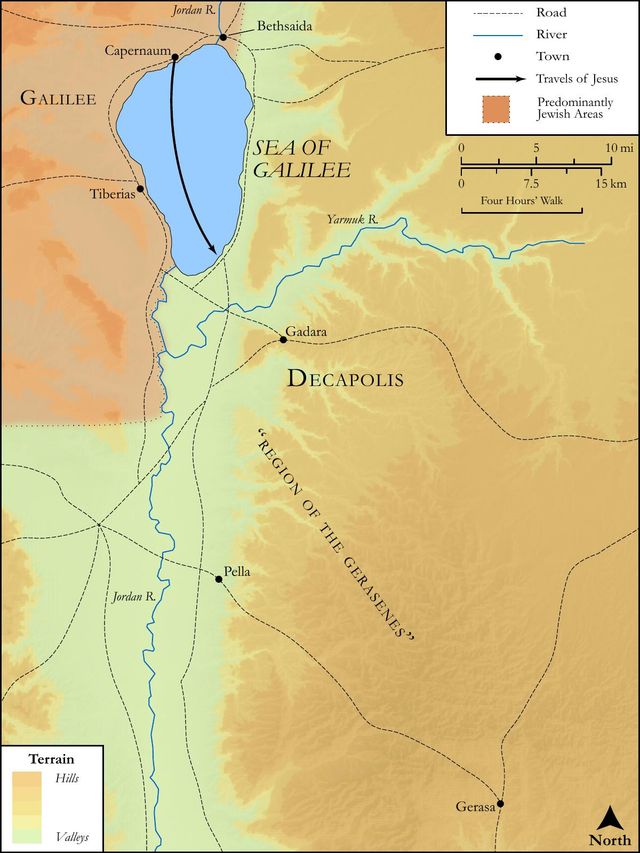
The Sea of Galilee, a freshwater lake approximately 13 miles long and 8 miles wide, was notorious for its sudden and violent storms. This phenomenon was due to cold air currents descending rapidly from the surrounding hills (such as the Golan Heights) and colliding with the warm, humid air over the lake, creating powerful squalls. Travel by boat was a common and efficient mode of transport between the various towns and villages on its shores. "The other side" (Greek: peran) typically referred to the eastern shore, which was predominantly Gentile territory, specifically the region of the Decapolis. This destination is significant as it foreshadows Jesus' ministry extending beyond Jewish boundaries, as seen in the subsequent encounter with the Gerasene demoniac in Mark 5:1-20. The choice to depart "when the even was come" (late afternoon/early evening) was also a common practice for travel, as it avoided the heat of the day, though it also increased the likelihood of encountering the very storms for which the lake was known.
Key Themes
ShowHideMark 4:35 contributes to several overarching themes within the Gospel of Mark. Firstly, it highlights Jesus' Divine Initiative and Authority, as He is the one who issues the command to depart, demonstrating His sovereign control over events and His disciples' itinerary, not merely reacting to circumstances. Secondly, it underscores the theme of Discipleship and Spiritual Formation, as Jesus intentionally leads His followers into experiences that will test and deepen their faith, moving them from passive listening to active engagement with His power. This journey is a pedagogical tool, preparing them for the realities of ministry. Thirdly, it subtly introduces the theme of Missionary Expansion, as the destination "the other side" points towards the Gentile world, signaling the universal scope of Jesus' redemptive work, a theme that becomes more explicit in Mark 5. This transition from teaching to demonstration is crucial for the disciples' understanding of who Jesus truly is, as a teacher of truth and a master of creation.
Exposition and Analysis
ShowHideKey Word Analysis
ShowHideThis word, translated as "was come" in "when the even was come," signifies a process of "becoming" or "coming into being." It is not merely a passive state but implies a dynamic occurrence. In this context, it emphasizes the natural progression of time into evening, yet within Mark's narrative, even the timing of natural events is often imbued with divine purpose. The evening "became," setting the stage for the dramatic events that would unfold under the cover of darkness and storm, highlighting the precise timing of Jesus' actions.
Translated as "pass over," this verb means "to traverse" or "to go through." It suggests a deliberate and purposeful movement from one point to another, implying a complete journey across a space. It's more than just "going to"; it's "going all the way through" to the destination. Jesus' command to "pass over" indicates an intentional, directed journey, not a casual or aimless crossing, underscoring His leadership and the predetermined nature of their destination and the experiences awaiting them.
This word, meaning "beyond" or "across," is translated as "the other side." It refers to a distinct, separate geographical location. The use of "the other side" implies a departure from the familiar and an arrival at a new, often challenging, territory. Symbolically, it represents a transition into new spiritual ground, both for the disciples in their understanding of Jesus' power and for the scope of His ministry extending beyond the Jewish heartland into Gentile regions.
Verse Breakdown
ShowHide"And the same day,"
This phrase firmly anchors the events of Mark 4:35 to the preceding narrative, specifically the day of extensive parabolic teaching by the Sea of Galilee. It emphasizes the continuity of Jesus' ministry, showing that the shift from teaching to demonstration of power is not random but part of a continuous, divinely orchestrated sequence. It highlights Jesus' tireless commitment to His mission.
"when the even was come,"
This specifies the time of day, late afternoon or early evening. This detail is crucial for setting the scene, as it explains why Jesus and the disciples would be seeking rest or a change of location after a long day. More significantly, it provides the natural conditions (the onset of darkness and the typical time for sudden storms on the Sea of Galilee) that will allow for the subsequent miraculous display of Jesus' authority over creation.
"he saith unto them,"
This clause underscores Jesus' initiative and authority. It is not the disciples' suggestion or a spontaneous decision; it is a direct command from Jesus to His chosen followers. This highlights His role as the leader and guide, intentionally directing their path and experiences. The "them" refers specifically to the disciples, indicating a more intimate and instructive phase of their training.
"Let us pass over unto the other side."
This is Jesus' direct command, an invitation to a journey that is both physical and profoundly spiritual. "Pass over" implies a complete traversal, and "the other side" points to a new geographical and theological frontier (the Gentile Decapolis region). This command initiates a sequence of events designed to reveal deeper truths about Jesus' identity and power, pushing the disciples beyond their current understanding and comfort zone.
Literary Devices
ShowHideMark 4:35 effectively employs several literary devices to convey its significance. Firstly, it functions as a clear Transition, marking a pivotal shift in Mark's narrative from Jesus' extensive teaching ministry (primarily through parables) to a series of powerful demonstrations of His authority (over nature, demons, and sickness). This verse acts as a narrative bridge, preparing the reader for the dramatic events that immediately follow. Secondly, the phrase "Let us pass over unto the other side" serves as potent Foreshadowing. It subtly hints at the challenges and revelations awaiting the disciples, particularly the impending storm and the encounter with the Gerasene demoniac on the eastern shore. This foreshadowing builds anticipation and underscores the purposeful nature of Jesus' journey. Thirdly, Jesus' direct command, "Let us pass over," utilizes the Imperative Mood, emphasizing His absolute authority and initiative. This is not a suggestion but a directive, highlighting Jesus' sovereign control over His disciples' movements and the unfolding of His divine plan, even when it leads them into difficult circumstances.
Theological and Thematic Connections
ShowHideMark 4:35, though brief, is rich in theological implications, primarily highlighting Jesus' divine sovereignty and His intentionality in shaping the faith of His disciples. It demonstrates that Jesus, far from being a passive figure, actively directs the course of events and the experiences of His followers. The command to cross to "the other side" is not merely a logistical decision but a purposeful act designed to lead the disciples into a situation where their faith would be tested and, consequently, deepened. This divine initiative in leading His people through challenging "journeys" is a recurring theme throughout biblical history, reminding us that God often uses trials and transitions to reveal more of His character and power. The journey across the lake, fraught with danger, becomes a crucible for faith, revealing Jesus' mastery over creation and His unwavering presence amidst chaos.
Reflection and Application
ShowHideMark 4:35 offers profound lessons for contemporary believers. Just as Jesus intentionally led His disciples into a journey that would test their faith and reveal more of His power, so too does He guide our lives. We often find ourselves in transitional moments, called by Christ to "pass over unto the other side" – whether that means moving into a new season of life, facing an unexpected challenge, or embracing a call to ministry that stretches our comfort zones. This verse reminds us that these transitions are not random but are often divinely orchestrated opportunities for spiritual growth. Our response should be one of trust and obedience, even when the destination is unknown or the path ahead promises difficulty. The "other side" may indeed bring storms, but it is precisely in those storms that we are given the opportunity to witness Jesus' sovereign power and deepen our reliance on Him. This verse encourages us to embrace the journey, knowing that Jesus is always with us, leading us to a greater revelation of His glory and purpose.
Questions for Reflection
ShowHideFAQ
ShowHideWhy did Jesus choose to cross the Sea of Galilee "when the even was come"?
ShowHideJesus' choice of timing was likely multi-faceted. Practically, traveling in the evening would have been cooler and potentially less crowded after a long day of teaching. Theologically, however, the timing is significant. The onset of evening, and subsequently night, often symbolizes a time of darkness, uncertainty, or testing in biblical narratives. By initiating the journey at this time, Jesus sets the stage for the dramatic display of His power over the elements, demonstrating His authority even in the midst of chaos and darkness. It also allows for a more intimate setting with His disciples, away from the crowds, for this profound lesson in faith.
What is the significance of going to "the other side" of the lake?
ShowHideGeographically, "the other side" of the Sea of Galilee refers to the eastern shore, which was primarily Gentile territory, specifically the region of the Decapolis. This destination holds immense significance as it foreshadows the expansion of Jesus' ministry beyond the Jewish heartland to include Gentiles, a crucial aspect of His redemptive mission. Thematically, it represents a movement from the familiar to the unfamiliar, from a place of teaching to a place of powerful demonstration. It symbolizes Jesus leading His disciples into new spiritual territory, preparing them for the universal scope of the gospel and for encounters that would challenge their preconceived notions about the Kingdom of God, as seen with the healing of the Gerasene demoniac in Mark 5:1-20.
Christ-Centered Fulfillment
ShowHideMark 4:35, with Jesus' deliberate command to "pass over unto the other side," finds its Christ-centered fulfillment not merely in a physical journey but in the overarching trajectory of Christ's redemptive mission. Jesus, the Son of God, intentionally embarked on the ultimate "passing over" from the glory of heaven to the humility of earth, to reconcile a fallen humanity to God. His journey across the Sea of Galilee, confronting the forces of nature, foreshadows His ultimate victory over the powers of darkness, sin, and death. He is the divine leader who guides His people, not around the storms of life, but through them, demonstrating His sovereignty and revealing His saving power. Just as He led His disciples to the Gentile "other side" to extend His grace, so too did He commission His church to go to "all the world" (Mark 16:15) to preach the gospel. Every "other side" we are called to cross, every trial we face, is a participation in His ongoing mission, revealing more of the Lamb of God who takes away the sin of the world (John 1:29) and the Good Shepherd who leads His sheep through the valley of the shadow of death (Psalm 23:4) to the safety of His eternal presence (John 10:11).