


Luke 8:25
Bible text: King James Version (1769 Blayney text) · Public domain
Bible text: King James Version with Strong's numbers · Public domain
Bible text: Berean Standard Bible · Public domain
Bible text: American Standard Version (1901) · Public domain
Bible text: World English Bible, Messianic edition · Public domain
Bible text: Geneva Bible (1599) · Public domain
Bible text: Young's Literal Translation · Public domain
- ΕἶπενEipenHe saidG2036V-2AAI-3SVerb 2nd Aorist Active Indicative 3rd Singular
- δὲdethenG1161CONJConjunction
- αὐτοῖς·autoisto themG846P-DPMPersonal pronoun Dative Plural Masculine
- ποῦpouWhereG4226ADV-IAdverb Interrogative
- ἐστινestinisG1510V-PAI-3SVerb Present Active Indicative 3rd Singular
- ἡhētheG3588T-NSFDefinite article Nominative Singular Feminine
- πίστιςpistisfaithG4102N-NSFNoun Nominative Singular Feminine
- ὑμῶν;humōnof you?G4771P-2GPPersonal pronoun Genitive 2nd Plural
- φοβηθέντεςphobēthentesHaving been afraidG5399V-AOP-NPMVerb Aorist Passive Deponent Participle Nominative Plural Masculine
- δὲdethenG1161CONJConjunction
- ἐθαύμασανethaumasanthey marveledG2296V-AAI-3PVerb Aorist Active Indicative 3rd Plural
- λέγοντεςlegontessayingG3004V-PAP-NPMVerb Present Active Participle Nominative Plural Masculine
- πρὸςprostoG4314PREPPreposition
- ἀλλήλους·allēlousone anotherG240C-APMReciprocal pronoun Accusative Plural Masculine
- τίςtisWhoG5101I-NSMInterrogative pronoun Nominative Singular Masculine
- ἄραarathenG686CONJConjunction
- οὗτόςhoutosthisG3778D-NSMDemonstrative pronoun Nominative Singular Masculine
- ἐστινestinisG1510V-PAI-3SVerb Present Active Indicative 3rd Singular
- ὅτιhotiforG3754CONJConjunction
- καὶkaievenG2532CONJConjunction
- τοῖςtoisto theG3588T-DPMDefinite article Dative Plural Masculine
- ἀνέμοιςanemoiswindsG417N-DPMNoun Dative Plural Masculine
- ἐπιτάσσειepitasseiHe commandsG2004V-PAI-3SVerb Present Active Indicative 3rd Singular
- καὶkaiandG2532CONJConjunction
- τῷtōto theG3588T-DSNDefinite article Dative Singular Neuter
- ὕδατιhudatiwaterG5204N-DSNNoun Dative Singular Neuter
- καὶkaiandG2532CONJConjunction
- ὑπακούουσινhupakouousinthey obeyG5219V-PAI-3PVerb Present Active Indicative 3rd Plural
- αὐτῷ;autōHim?G846P-DSMPersonal pronoun Dative Singular Masculine
English is a literal word-by-word gloss of the Greek, not the KJV's wording. Why?
This is the original text the KJV's translators worked from — each Greek word with its own literal English meaning in this verse, prepared by scholars at Tyndale House, Cambridge. The KJV translates whole sentences, not word by word, so its wording differs: one Greek word can become several English words, and the KJV may choose “charity” where the gloss reads “love”. Both are faithful — they answer different questions. For the KJV's own rendering, switch to the KJV text.
Details
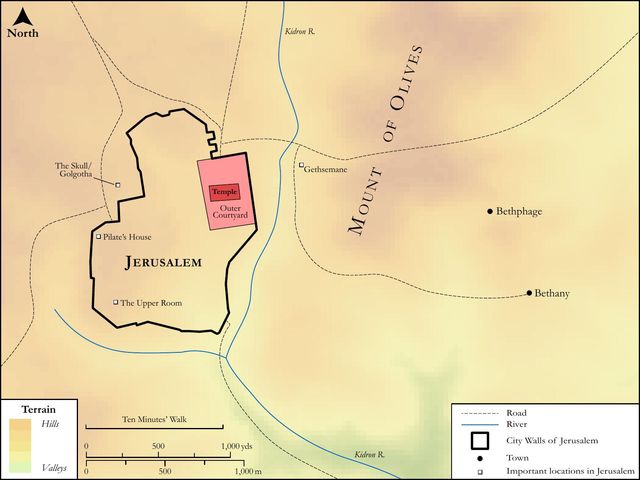
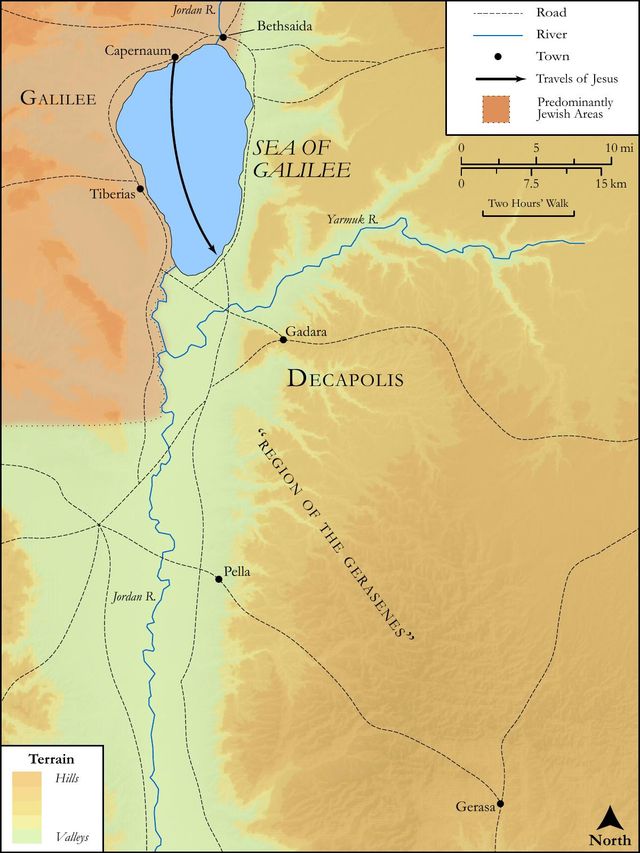
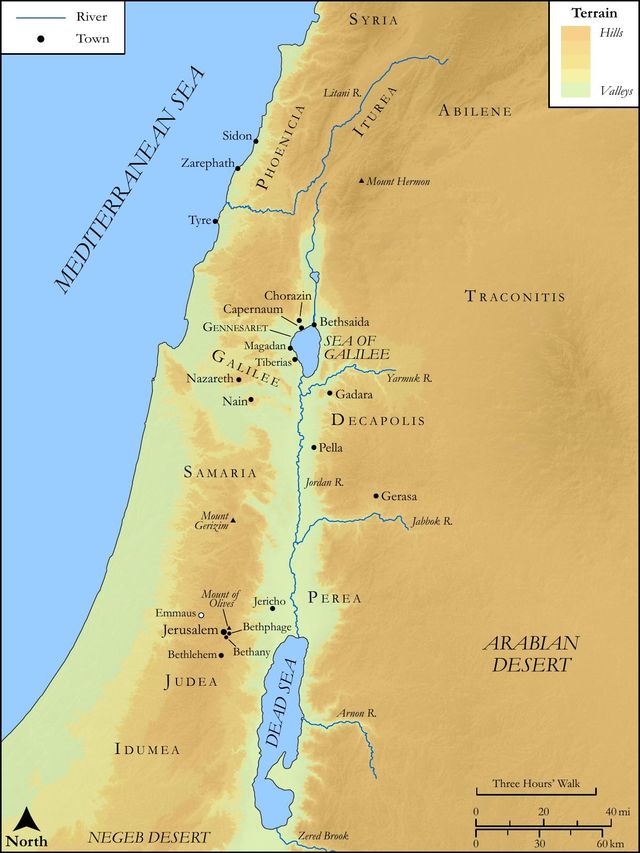
See on the biblical-era maps
Study this verse
Public-domain commentary
Matthew Henry
From his Commentary on the Whole Bible. Henry comments on passages, not single verses — this entry covers Luke 8:22–39. His three-level outline is real structure in the source text, so it is rendered as structure.
We have here two illustrious proofs of the power of our Lord Jesus which we had before - his power over the winds, and his power over the devils. See Mk. 4 and 5.
I.His power over the winds, those powers of the air that are so much a terror to men, especially upon sea, and occasion the death of such multitudes. Observe,
1.Christ ordered his disciples to put to sea, that he might show his glory upon the water, in stilling the waves, and might do an act of kindness to a poor possessed man on the other side the water: He went into a ship with his disciples, Luk 8:22. They that observe Christ's orders may assure themselves of his presence. If Christ sends his disciples, he goes with them. And those may safely and boldly venture any where that have Christ accompanying them. He said, Let us go over unto the other side; for he had a piece of good work to do there. He might have gone by land, a little way about; but he chose to go by water, that he might show his wonders in the deep.
2.Those that put to sea in a calm, yea, and at Christ's word, must yet prepare for a storm, and for the utmost peril in that storm; There came down a storm of wind on the lake (Luk 8:23), as if it were there, and no where else; and presently their ship was so tossed that it was filled with water, and they were in jeopardy of their lives. Perhaps the devil, who is the prince of the power of the air, and who raiseth winds by the permission of God, had some suspicion, from some words which Christ might let fall, that he was coming over the lake now on purpose to cast that legion of devils out of the poor man on the other side, and therefore poured this storm upon the ship he was in, designing, if possible, to have sunk him and prevented that victory.
3.Christ was asleep in the storm, Luk 8:23. Some bodily refreshment he must have, and he chose to take it when it would be least a hindrance to him in his work. The disciples of Christ may really have his gracious presence with them at sea, and in a storm, and yet he may seem as if he were asleep; he may not immediately appear for their relief, no, not when things seem to be brought even to the last extremity. Thus he will try their faith and patience, and quicken them by prayer to awake, and make their deliverance the more welcome when it comes at last.
4.A complaint to Christ of our danger, and the distress his church is in, is enough to engage him to awake, and appear for us, Luk 8:24. They cried, Master, master, we perish! The way to have our fears silenced is to bring them to Christ, and lay them before him. Those that in sincerity call Christ Master, and with faith and fervency call upon him as their Master, may be sure that he will not let them perish. There is no relief for poor souls that are under a sense of guilt, and a fear of wrath, like this, to go to Christ, and call him Master, and say, "I am undone, if thou do not help me."
5.Christ's business is to lay storms, as it is Satan's business to raise them. He can do it; he has done it; he delights to do it: for he came to proclaim peace on earth. He rebuked the wind and the raging of the water, and immediately they ceased (Luk 8:24); not, as at other times, by degrees, but all of a sudden, there was a great calm. Thus Christ showed that, though the devil pretends to be the prince of the power of the air, yet even there he has him in a chain.
6.When our dangers are over, it becomes us to take to ourselves the shame of our own fears and to give to Christ the glory of his power. When Christ had turned the storm into a calm, then were they glad because they were quiet, Psa 107:30. And then,
(1.)Christ gives them a rebuke for their inordinate fear: Where is your faith? Luk 8:25. Note, Many that have true faith have it to seek when they have occasion to use it. They tremble, and are discouraged, if second causes frown upon them. A little thing disheartens them; and where is their faith then?
(2.)They give him the glory of his power: They, being afraid, wondered. Those that had feared the storm, now that the danger was over with good reason feared him that had stilled it, and said one to another, What manner of man is this! They might as well have said, Who is a God like unto thee? For it is God's prerogative to still the noise of the seas, the noise of their waves, Psa 65:7.
II.His power over the devil, the prince of the power of the air.
In the next passage of story he comes into a closer grapple with him than he did when he commanded the winds. Presently after the winds were stilled they were brought to their desired haven, and arrived at the country of the Gadarenes, and there went ashore (Luk 8:26, Luk 8:27); and he soon met with that which was his business over, and which he thought it worth his while to go through a storm to accomplish.
We may learn a great deal out of this story concerning this world of infernal, malignant spirits, which, though not working now ordinarily in the same way as here, yet we are all concerned at all times to stand upon our guard against.
1.These malignant spirits are very numerous. They that had taken possession of this one man called themselves Legion (Luk 8:30), because many devils were entered into him: he had had devils a long time, Luk 8:27. But perhaps those that had been long in possession of him, upon some foresight of our Saviour's coming to make an attack upon them, and finding they could not prevent it by the storm they had raised, sent for recruits, intending this to be a decisive battle, and hoping now to be too hard for him that had cast out so many unclean spirits, and to give him a defeat. They either were, or at least would be thought to be, a legion, formidable as an army with banners; and now, at least, to be, what the twentieth legion of the Roman army, which was long quartered at Chester, was styled, legio victrix - a victorious legion.
2.They have an inveterate enmity to man, and all his conveniences and comforts. This man in whom the devils had got possession, and kept it long, being under their influence, wore no clothes, neither abode in any house (Luk 8:27), though clothing and a habitation are two of the necessary supports of this life. Nay, and because man has a natural dread of the habitations of the dead, they forced this man to abide in the tombs, to make him so much the more a terror to himself and to all about him, so that his soul had as much cause as ever any man's had to be weary of his life, and to choose strangling and death rather.
3.They are very strong, fierce, and unruly, and hate and scorn to be restrained: He was kept bound with chains and in fetters, that he might not be mischievous either to others or to himself, but he broke the bands, Luk 8:29. Note, Those that are ungovernable by any other thereby show that they are under Satan's government; and this is the language of those that are so, even concerning God and Christ, their best friends, that would not either bind them from or bind them to any thing but for their own good: Let us break their bands in sunder. He was driven of the devil. Those that are under Christ's government are sweetly led with the cords of a man and the bands of love; those that are under the devil's government are furiously driven.
4.They are much enraged against our Lord Jesus, and have a great dread and horror of him: When the man whom they had possession of, and who spoke as they would have him, saw Jesus, he roared out as one in an agony, and fell down before him, to deprecate his wrath, and owned him to be the Son of God most high, that was infinitely above him and too hard for him; but protested against having any league or confederacy with him (which might sufficiently have silenced the blasphemous cavils of the scribes and Pharisees): What have I to do with thee? The devils have neither inclination to do service to Christ nor expectation to receive benefit by him: What have we to do with thee? But they dreaded his power and wrath: I beseech thee, torment me not. They do not say, I beseech thee, save me, but only, Torment me not. See whose language they speak that have only a dread of hell as a place of torment, but no desire of heaven as a place of holiness and love.
5.They are perfectly at the command, and under the power, of our Lord Jesus; and they knew it, for they besought him that he would not command them to go eis ton abusson - into the deep, the place of their torment, which they acknowledge he could easily and justly do. O what a comfort is this to the Lord's people, that all the powers of darkness are under the check and control of the Lord Jesus! He has them all in a chain. He can send them to their own place, when he pleaseth.
6.They delight in doing mischief. When they found there was no remedy, but they must quit their hold of this poor man, they begged they might have leave to take possession of a herd of swine, Luk 8:32. When the devil at first brought man into a miserable state he brought a curse likewise upon the whole creation, and that became subject to enmity. And here, as an instance of that extensive enmity of his, when he could not destroy the man, he would destroy the swine. If he could not hurt them in their bodies, he would hurt them in their goods, which sometimes prove a great temptation to men to draw them from Christ, as here. Christ suffered them to enter into the swine, to convince the country what mischief the devil could do in it, if he should suffer him. No sooner had the devils leave than they entered into the swine; and no sooner had they entered into them than the herd ran violently down a steep place into the lake, and were drowned. For it is a miracle of mercy if those whom Satan possesses are not brought to destruction and perdition. This, and other instances, show that that roaring lion and red dragon seeks what and whom he may devour.
7.When the devil's power is broken in any soul that soul recovers itself, and returns into a right frame, which supposes that those whom Satan gets possession of are put out of the possession of themselves: The man out of whom the devils were departed sat at the feet of Jesus, Luk 8:35. While he was under the devil's power he was ready to fly in the face of Jesus; but now he sits at his feet, which is a sign that he is come to his right mind. If God has possession of us, he preserves to us the government and enjoyment of ourselves; but, if Satan has possession of us, he robs us of both. Let his power therefore in our souls be overturned, and let him come whose right our hearts are, and let us give them to him; for we are never more our own than when we are his.
Let us now see what was the effect of this miracle of casting the legion of devils out of this man.
(1.)What effect it had upon the people of that country who had lost their swine by it: The swineherds went and told it both in city and country (Luk 8:34), perhaps with a design to incense people against Christ. They told by what means he that was possessed of the devils was healed (Luk 8:36), that it was by sending the devils into the swine, which was capable of an invidious representation, as if Christ could not have delivered the man out of their hands, but by delivering the swine into them. The people came out, to see what was done, and to enquire into it; and they were afraid (Luk 8:35); they were taken with great fear (Luk 8:37); they were surprised and amazed at it, and knew not what to say to it. They thought more of the destruction of the swine than of the deliverance of their poor afflicted neighbour, and of the country from the terror of his frenzy, which was become a public nuisance; and therefore the whole multitude besought Christ to depart from them for fear he should bring some other judgment upon them; whereas indeed none need to be afraid of Christ that are willing to forsake their sins and give up themselves to him. But Christ took them at their word: He went up into the ship, and returned back again. Those lose their Saviour, and their hopes in him, that love their swine better.
(2.)What effect it had upon the poor man who had recovered himself by it. He desired Christ's company as much as others dreaded it: he besought Christ that he might be with him as others were that had been healed by him of evil spirits and infirmities (Luk 8:2), that Christ might be to him a protector and teacher, and that he might be to Christ for a name and a praise. He was loth to stay among those rude and brutish Gadarenes that desired Christ to depart from them. O gather not my soul with these sinners! But Christ would not take him along with him, but sent him home, to publish among those that knew him the great things God had done for him, that so he might be a blessing to his country, as he had been a burden to it. We must sometimes deny ourselves the satisfaction even of spiritual benefits and comforts, to gain an opportunity of being serviceable to the souls of others. Perhaps Christ knew that, when the resentment of the loss of their swine was a little over, they would be better disposed to consider the miracle, and therefore left the man among them to be a standing monument, and a monitor to them of it.
Historical interpretation
Four Centuries of Reception
11 surviving comments on this verse. Each one is dated, so this reads as a timeline rather than a list.
Select a marker to jump to its quote. Markers stagger vertically where authors wrote within a few decades of each other.
He who was sleeping was awakened and cast the sea into a sleep. He reveals the wakefulness of his divinity that never sleeps by the wakefulness of the sea that was now sleeping. He rebuked the wind and it became still. What is this power, or what is this goodness of Jesus? See, he subjected by force that which was not his. Our Lord showed that he was the Son of the Creator by means of the wind of the sea and by the spirits and demons that he silenced.
We are told above, moreover, that He passed the night in prayer. How then does He here fall asleep in a storm? The security of power is expressed, that while all were afraid, He alone lay fearless; but He lay asleep in the body, while in the mind he was in the mystery of divinity. For nothing happens without the Word.
Our Lord therefore, who knew that He came upon earth for a divine mystery, having left His kinsfolk, went up into the ship.
You must remember that no one can pass from the course of this life without temptations, for temptation is the trial of faith. We are therefore subject to the storms of spiritual wickedness, but as watchful sailors we must awake the Pilot, who does not obey but commands the winds, who although He now no longer sleeps in the sleep of His own body, yet let us beware, lest through the sleep of our bodies He is to us asleep and at rest. But they are rightly reproved who feared, when Christ was present; since he surely who clings to Him can in no wise perish.
(Hom. 27. in Matt.) Luke indeed avoids the question which might be put to him with regard to the order of time, saying, that He went into a ship on a certain day. Now if the storm had arisen when our Lord was awake, the disciples either had not feared, or not believed that He could do such a thing. For this cause He sleeps, giving them an occasion for fear; for it follows, But as they sailed he fell asleep; and there came down a storm of wind on the lake.
We are also sailing on a voyage, not from one land to another but from earth to heaven. Let us prepare our power of reasoning as a pilot able to conduct us on high, and let us gather a crew obedient to it. Let us prepare a strong ship, the kind that the buffeting and discouragements of this life will not submerge, or the wind of false pretense raise up, but will be sleek and swift. If we prepare the ship, pilot and the crew in this way, we will sail with a favoring wind and draw to ourselves the Son of God, the true Pilot. He will not permit our ship to be overwhelmed, even if countless winds blow. He will rebuke the winds and the sea and will bring about a great calm in place of the tempest. COMMENTARY ON ST.
(de Con. Ev. ut sup.) Now this is related by the other Evangelists in different words. For Matthew says, that Jesus said, Why are ye fearful, O ye of little faith? (Matt. 8.) but Mark as follows, Why are ye so fearful? How is it that ye have no faith? (Mark 4.) i. e. that perfect faith like the grain of mustard seed. Mark then also says, O ye of little faith; but Luke, Where is your faith? And indeed all these may have been said, Why are ye fearful? Where is your faith? O ye of little faith. Hence one Evangelist relates one, another another.
When the disciples saw that all men received help from Christ, it seemed fitting that they themselves also should in turn rejoice in the benefits of Christ. For no one regards that which happens in the person of another equally with that to himself. The Lord therefore exposed the disciples to the sea and the winds, as it follows, Now it came to pass on a certain day that he went into a ship with his disciples; and he said unto them, Let us go over unto the other side of the lake: and they launched forth.
(ubi sup.) But it seems to have been especially and wonderfully ordained that they should not seek His assistance when first the storm began to affect the boat, but after the danger had increased, in order that the power of the Divine Majesty might be made more manifest. Hence it is said, And they were filled with water, and were in jeopardy. This indeed our Lord allowed for the sake of trial, that having confessed their danger they should acknowledge the greatness of the miracle. Hence when their great danger had driven them into intolerable fear, having no other hope of safety but the Lord of power Himself, they awoke Him. It follows, And they came to him, and awoke him, saying, Master, we perish.
But it could not be that they should perish while the Almighty was with them. Christ then arose, Who has power over all things, and immediately quells the storm and the violence of the wind, and the tempest ceased, and there was a calm. Herein He shows Himself to be God, to Whom it is said, Thou rulest the raging of the sea: when the waves thereof arise, thou stillest them (Ps. 89:10.). So then as He sailed, our Lord manifested both natures in one and the same person, seeing that He who as man slept in the ship, as God by His word stilled the raging of the sea.
But together with the raging of the waters, He quiets also the tumult of their souls, as it follows, And he said unto them, Where is your faith? By which word He showed, that it is not so much the assault of temptation which causes fear, as faint-heartedness. For as gold is proved in the fire, so is faith in temptation.
When the tempest was quelled at the command of Christ, the disciples in astonishment whispered one to the other, as it follows, And they being afraid wondered, &c. Now the disciples said not this as ignorant of Him, for they knew that He was God, and Jesus the Son of God. But they marvel at the exceeding vastness of His natural power, and the glory of His divinity, although He was like to us, and visible in the flesh. Hence they say, Who is this? that is, of what manner of man? how great, and with what great power and majesty? for it is a mighty work, a lordly command, no abject petition.
When Christ calmed the storm, he also changed the faith of the holy disciples that was shaken along with the ship into confidence. He no longer permitted it to be in doubt. He worked a calm in them, smoothing the waves of their weak faith. He said, "Where is your faith?" Another Evangelist, however, affirms that he said, "Why are you fearful, O you of little faith?" When the fear of death unexpectedly befalls people, it sometimes troubles even a well-established mind and exposes it to the blame of smallness of faith. This is also the effect of any other trouble too great to bear upon those it tries.
There is also much in this for the admiration and improvement of those who hear. Creation is obedient to whatever Christ chooses to command. What excuse can help us if we do not submit to do the same? What excuse can deliver from the fire and condemnation one who is disobedient and not easily led? He sets up, so to speak, the neck of his haughty mind against Christ's commands, and his heart is impossible to soften. Understanding that all those things that have been brought into existence by God entirely agree with his will, it is our duty to become like the rest of creation and avoid disobedience as a thing that leads to perdition. Let us rather submit to him who summons us to salvation and to the desire of living uprightly and lawfully, that is, evangelically. Christ will fill us with the gifts that come from above and from him.
Or, it was not His disciples, but the sailors and others in the ship who wondered.
But allegorically, the sea or lake is the dark and bitter tide of the world, the ship is the wood of the cross, by help of which the faithful, having passed the waves of this world, reach the shore of a heavenly country.
His disciples also, when summoned, enter in with Him. Hence He says, If any one will come after me, let him deny himself, and take up his cross, and follow me. (Mat. 16:24.) While His disciples are sailing, that is, the faithful passing through this world, and meditating in their minds the rest of the world to come, and by the breath of the Holy Spirit, or also their own exertions, eagerly leaving behind them the unbelieving pride of the world, suddenly our Lord fell asleep, that is, the time of our Lord's passion was come, and the storm descended. For when our Lord entered the sleep of death upon the cross, the waves of persecution rose, stirred up by the breath of the devil, but while the patience of the Lord is not disturbed by the waves, the faint hearts of the disciples are shaken and tremble. They awoke our Lord lest they should perish while He slept, because having seen His death they wish for His resurrection, for if that were delayed they would perish for ever. He rises therefore and rebukes the wind, since by His sudden rising again He put down the pride of the devil who had the power of death. (Heb. 2:14.) But He makes the tempest of nature to cease, since by His resurrection He baffled the rage of the Jews, who plotted His death.
In like manner, when He appeared after His death to His disciples, He upbraided them with their unbelief, (Mark 16:14.) and thus having calmed the swelling waves, He made plain to all the power of His divinity.
Those who feared were amazed, saying to one another, "Who then is this, that he commands even the winds and the sea, and they obey him?" Matthew writes thus: "But the men were amazed, saying, 'What sort of man is this?' etc." Therefore, it was not the disciples, but the sailors and others who were on the ship who marveled. However, if anyone contentiously insists that those who marveled were the disciples, we will rightly respond that men are called those who had not yet known the power of the Savior. And we too, when individually imprinted with the sign of the Lord’s cross, set out intending to leave the world, undoubtedly board the ship with Jesus, attempting to cross the lake. But He who neither slumbers nor sleeps, always guarding Israel (Psalm 121), although He seems to slumber for us often while sailing amidst the roaring of the sea, when amidst the efforts of virtues, or the repeated assaults of unclean spirits or wicked men, or the very rush of our thoughts, the splendor of faith grows dim, the height of hope fades, the flame of love cools. However, in such storms, it is necessary to flee to that helmsman, to diligently rouse Him who does not serve but commands the winds. He will soon quell the tempests, restore tranquility, and grant the harbor of salvation.
But he said to them: Where is your faith? They are rightly reproved who feared with Christ present, since indeed he who clings to him cannot perish. Similar to this is that after the sleep of death, appearing to the disciples, he reproached their unbelief and hardness of heart, because they did not believe those who had seen him risen. And again he said to them: O foolish and slow of heart to believe in all that the prophets have spoken. Was it not necessary for the Christ to suffer these things and so enter into his glory (Luke 24)? As if by a metaphor of the ship he were saying: Was it not necessary for the Christ to be asleep, while the waves were tossing the ship in which he was resting here and there, and so with the swelling heaps of the abyss immediately calmed, to reveal to all the power of his divinity?
Continue studying Luke 8:25 across the web’s major study libraries — every link below opens this exact verse, chapter, or book on the destination site.
Read & Compare
 BibleGatewayThis verse in more than 200 translations and 70 languages.
 Bible.comThe YouVersion reader — hundreds of translations, reading plans, and highlights.
 ESV.orgCrossway's official English Standard Version reader.
 NET BibleThe NET translation with 60,000+ translators' notes on every rendering decision.
 STEP BibleTyndale House's free study tool — original text, vocabulary, and scholarly resources.
 BibliaLogos Bible Software's free web reader.
 USCCBThe New American Bible (Revised Edition) with the U.S. bishops' study notes.
Commentaries
 BibleHub CommentariesDozens of classic commentaries on this verse, gathered on one page.
 StudyLightMore than 100 commentary sets — the largest collection on the web.
 BibleRefPlain-English commentary on what this verse means, verse by verse.
 Enduring WordDavid Guzik's free commentary on this chapter, widely used by Bible teachers.
 Bible Study ToolsVerse commentary alongside Greek and Hebrew study aids.
Original Language & Research
- BibleHub InterlinearThe verse word by word — original language, transliteration, and English.
- BibleHub LexiconEvery word's original-language definition and Strong's entry.
 Blue Letter BibleDeep-study tools — Strong's numbers, concordance, and word studies.
 CNTR CollationThe earliest Greek manuscripts of this verse, collated letter by letter.
Sermons, Hymns & Audio


TrulyRandomVerse is not affiliated with these sites and doesn’t control their content. They’re linked because they’re genuinely useful.
Summary
Luke 8:25 captures the disciples' bewildered awe and Jesus' pointed question following His miraculous calming of a violent storm on the Sea of Galilee. This pivotal moment reveals Jesus' unparalleled divine authority over creation, prompting the disciples to question His identity, while simultaneously exposing their own struggle with fear and a nascent, yet insufficient, faith in the face of overwhelming natural forces. The verse serves as a profound testament to Christ's sovereignty and a challenge to the depth of His followers' trust.
Context
ShowHideLiterary Context
This verse immediately follows the dramatic event of Jesus calming the storm. The narrative begins in Luke 8:22 with Jesus and His disciples embarking on a boat trip across the Sea of Galilee. A sudden, violent squall descends, filling the boat with water and putting the disciples in grave danger. While they are panicking, Jesus is asleep, demonstrating His human weariness and divine peace. The disciples, many of whom were seasoned fishermen, awaken Him in terror, crying out for help. In Luke 8:24, Jesus rises and, with a simple command, rebukes the wind and the raging water, bringing about an immediate and profound calm. Verse 25 then records Jesus' direct challenge to their faith and the disciples' astonished reaction, forming the climax and interpretive key to the preceding miracle. This event is strategically placed by Luke, along with the subsequent encounters with the Gerasene demoniac (Luke 8:26-39) and the healing of Jairus's daughter and the woman with the hemorrhage (Luke 8:40-56), to progressively reveal Jesus' authority over nature, demons, disease, and death.
Historical & Cultural Context
The Sea of Galilee (also known as Lake Gennesaret or Tiberias) is notorious for its sudden, violent storms. Situated in a deep basin surrounded by hills, cold air currents can sweep down from the surrounding heights, funneling through ravines and colliding with the warm, moist air over the lake, creating intense and unpredictable squalls. Fishermen, even experienced ones like Peter, James, and John, would have been intimately familiar with these dangers, and their terror indicates the severity of this particular storm. In Israel, control over the natural elements was a divine prerogative, for the LORD alone "maketh the storm a calm." For a human to command the winds and waves and be obeyed was an act that transcended human capability and pointed directly to divine power. This context heightens the disciples' astonishment and the profound theological implications of Jesus' actions, as it challenges their preconceived notions of who He was and what He could do.
Key Themes
ShowHideThis passage powerfully contributes to several overarching themes in Luke's Gospel. Firstly, it underscores the Sovereignty and Authority of Jesus Christ. By commanding the wind and water, Jesus demonstrates an authority that is not merely human or prophetic, but truly divine, a power traditionally ascribed only to God (e.g., Psalm 89:9 and Psalm 107:29). Secondly, it highlights the theme of Faith Versus Fear. Jesus' question, "Where is your faith?", directly contrasts their panic with the trust He expected, even in life-threatening circumstances. This tension between human fear and the call to unwavering faith is a recurring motif in Luke, often seen in the disciples' journey of understanding (e.g., Luke 12:22-34). Thirdly, the event serves as a crucial moment in the Disciples' Developing Understanding of Jesus' Identity. Their astonished question, "What manner of man is this!", reveals their dawning realization that Jesus is far more than a prophet or teacher; He possesses a unique and awe-inspiring power that demands a re-evaluation of who He truly is, moving them closer to acknowledging Him as the Son of God.
Exposition and Analysis
ShowHideKey Word Analysis
ShowHideMeaning "persuasion, i.e., credence; moral conviction (of religious truth, or the truthfulness of God or a religious teacher), especially reliance upon Christ for salvation; abstractly, constancy in such profession." Jesus' question, "Where is your faith?", is not merely asking for the location of their belief, but challenging its very presence and efficacy in the face of the storm. It implies a lack of trust in His power and presence, despite His demonstrated authority.
Meaning "to wonder; by implication, to admire." This word captures the disciples' profound astonishment and awe. It's a reaction of deep surprise and amazement at something extraordinary and unexpected, indicating that Jesus' command over nature was utterly beyond their comprehension of human ability. Their wonder is a mix of fear and a dawning realization of Jesus' unique power.
Meaning "to arrange upon, i.e., order; charge, command, injoin." This term emphasizes the authoritative and direct nature of Jesus' action. He doesn't merely pray or request; He issues a direct, sovereign order to the elements, which immediately obey Him. This highlights His inherent authority, not a delegated one, over creation, solidifying the disciples' realization that He is no ordinary man.
Verse Breakdown
ShowHide"And he said unto them, ‹Where is your faith?›"
Following the immediate cessation of the storm, Jesus turns to His disciples not with comfort, but with a sharp, rhetorical question. This is a direct challenge to their spiritual state, probing the depth of their trust in Him. Despite His presence and previous miracles, their panic revealed a profound lack of reliance on His power and sovereignty in the face of danger. The question implies that their faith, if present, was not active or sufficient for the crisis.
"And they being afraid wondered, saying one to another, What manner of man is this!"
The disciples' initial fear, which prompted them to wake Jesus, now transforms into a deeper, reverential awe and wonder. This is not the fear of the storm, but a holy fear in the presence of overwhelming divine power. Their internal dialogue, "What manner of man is this!", expresses their profound bewilderment and the dawning realization that Jesus transcends all human categories. They are grappling with His unique identity, recognizing His extraordinary nature but not yet fully comprehending His divinity.
"for he commandeth even the winds and water, and they obey him."
This clause provides the reason for their astonishment. The disciples articulate the core of Jesus' extraordinary act: His authoritative command over the most unpredictable and powerful forces of nature. The immediate and absolute obedience of the winds and water to His word is the irrefutable evidence that sets Him apart. This is a power that belongs only to God, forcing the disciples to confront the true identity of the one they have been following.
Literary Devices
ShowHideLuke's account in Luke 8:22-25 masterfully employs several literary devices to convey its profound theological message. Dramatic Irony is present as Jesus sleeps peacefully while the experienced fishermen panic, highlighting His divine calm amidst human chaos. The Rhetorical Question "Where is your faith?" serves as a powerful didactic tool, directly challenging the disciples' spiritual state and prompting self-reflection, both for them and for the reader. The disciples' subsequent bewildered question, "What manner of man is this!", functions as a form of Anagnorisis (recognition), marking a pivotal moment in their understanding of Jesus' identity, even if it's still incomplete. The immediate Obedience of the elements to Jesus' word is a powerful Symbolism of His absolute sovereignty, portraying Him as the Lord of creation. The narrative also uses Contrast between the raging storm and the sudden, profound calm, mirroring the contrast between the disciples' fear and Jesus' unwavering authority.
Theological and Thematic Connections
ShowHideLuke 8:25 stands as a powerful theological statement about the person and power of Jesus Christ. It unequivocally demonstrates His divine authority over creation, a prerogative exclusively attributed to God in the Old Testament. This miracle is not merely a display of power but a revelation of His very nature, forcing those present to grapple with the reality that the man sleeping in their boat is indeed the Lord of the universe. The passage also highlights the persistent struggle between human fear and the call to unwavering faith, even for those who walk closely with Christ. It underscores that true faith is not the absence of storms, but the unwavering trust in Christ's presence and power to command them, whether literally or metaphorically.
Reflection and Application
ShowHideLuke 8:25 offers profound and timeless lessons for believers navigating the "storms" of life. Just as the disciples faced a literal tempest, we frequently encounter metaphorical storms—crises, uncertainties, anxieties, and overwhelming circumstances that threaten to capsize our peace. Jesus' question, "Where is your faith?", resonates across the centuries, inviting us to honestly examine the depth of our trust in Him when our world feels out of control. This passage reminds us that Christ's presence, even when seemingly quiet or "asleep" to our immediate distress, is the ultimate guarantee of our security. Our focus should not be on the magnitude of the storm, but on the immeasurable power of the One who commands it. Cultivating a robust faith means choosing to believe in His sovereignty and care, even when circumstances defy our understanding, allowing His peace to quell our inner turmoil just as He quieted the raging sea.
Questions for Reflection
ShowHideFAQ
ShowHideWhy did Jesus ask "Where is your faith?" immediately after calming the storm?
ShowHideJesus' question was a rhetorical rebuke, designed to challenge the disciples' lack of trust and their panic in the face of the storm. Despite having witnessed numerous miracles and experiencing His presence, they succumbed to fear, indicating a deficiency in their understanding of His divine power and their reliance on Him. His question wasn't about the physical location of their faith, but its active presence and strength during a crisis. It served as a teaching moment, highlighting the contrast between their fear and the unwavering faith He expected from those who followed Him, urging them to grow in their comprehension of His identity and authority, as seen throughout Luke's Gospel.
Christ-Centered Fulfillment
ShowHideLuke 8:25 powerfully foreshadows the ultimate revelation of Christ's sovereignty, not just over creation, but over sin and death itself. The disciples' bewildered question, "What manner of man is this!", finds its complete answer in the cross and resurrection. The One who commanded the winds and waves is the same One who would later command demons to flee, sickness to depart, and ultimately, death to release its grip. His authority over the elements points to His divine nature, a truth fully unveiled when He conquered the ultimate storm of sin on the cross, offering peace that surpasses all understanding to those who believe (Philippians 4:7). The "faith" Jesus sought from His disciples on the boat is the same faith that saves us today—a complete reliance on Him as the sovereign Lord and Savior, whose power extends to every realm of existence, securing our eternal peace and assuring us that He is indeed "with us always, to the very end of the age" (Matthew 28:20). He is the true calming presence in all of life's storms, offering not just a temporary reprieve but an enduring peace rooted in His finished work.