


Matthew 8:18
Bible text: King James Version (1769 Blayney text) · Public domain
Bible text: Berean Standard Bible · Public domain
Bible text: American Standard Version (1901) · Public domain
Bible text: World English Bible, Messianic edition · Public domain
Bible text: Geneva Bible (1599) · Public domain
Bible text: Young's Literal Translation · Public domain
- ἸδὼνIdōnHaving seenG1492V-2AAP-NSMVerb 2nd Aorist Active Participle Nominative Singular Masculine
- δὲdenowG1161CONJConjunction
- ὁho<the>G3588T-NSMDefinite article Nominative Singular Masculine
- ἸησοῦςIēsousJesusG2424N-NSM-PNoun Nominative Singular Masculine Individual
- πολλοὺςpollousgreatG4183A-APMAdjective Accusative Plural Masculine
- ὄχλονochloncrowdG3793N-ASMNoun Accusative Singular Masculine
- περὶperiaroundG4012PREPPreposition
- αὐτὸνautonHimG846P-ASMPersonal pronoun Accusative Singular Masculine
- ἐκέλευσενekeleusenHe commandedG2753V-AAI-3SVerb Aorist Active Indicative 3rd Singular
- ἀπελθεῖνapeltheinto departG565V-2AANVerb 2nd Aorist Active Infinitive
- εἰςeistoG1519PREPPreposition
- τὸtotheG3588T-ASNDefinite article Accusative Singular Neuter
- πέρανperanother sideG4008PREPPreposition
English is a literal word-by-word gloss of the Greek, not the KJV's wording. Why?
This is the original text the KJV's translators worked from — each Greek word with its own literal English meaning in this verse, prepared by scholars at Tyndale House, Cambridge. The KJV translates whole sentences, not word by word, so its wording differs: one Greek word can become several English words, and the KJV may choose “charity” where the gloss reads “love”. Both are faithful — they answer different questions. For the KJV's own rendering, switch to the KJV text.
Details
See on the biblical-era maps
Study this verse
Public-domain commentary
Matthew Henry
From his Commentary on the Whole Bible. Henry comments on passages, not single verses — this entry covers Matthew 8:18–22. His four-level outline is real structure in the source text, so it is rendered as structure.
Here is, I. Christ's removing to the other side of the sea of Tiberias, and his ordering his disciples, whose boats attended him, to get their transport-vessels ready, in order to it, Mat 8:18. The influences of this Sun of righteousness were not to be confined to one place, but diffused all the country over; he must go about to do good; the necessities of souls called to him, Come over, and help us (Act 16:9); he removed when he saw great multitudes about him. Though by this it appeared that they were desirous to have him there, he knew there were others as desirous to have him with them, and they must have their share of him: his being acceptable and useful in one place was no objection against, but a reason for, his going to another. Thus he would try the multitudes that were about him, whether their zeal would carry them to follow him, and attend on him, when his preaching was removed to some distance. Many would be glad of such helps, if they could have them at next door, who will not be at the pains to follow them to the other side; and thus Christ shook off those who were less zealous, and the perfect were made manifest.
II.Christ's communication with two, who, upon his remove to the other side, were loth to stay behind, and had a mind to follow him, not as others, who were his followers at large, but to come into close discipleship, which the most were shy of; for it carried such a face of strictness as they could not like, nor be well reconciled to; but here is an account of two who seemed desirous to come into communion, and yet were not right; which is here given as a specimen of the hindrances by which many are kept from closing with Christ, and cleaving to him; and a warning to us, to set out in following Christ, so as that we may not come short; to lay such a foundation, as that our building may stand.
We have here Christ's managing of two different tempers, one quick and eager, the other dull and heavy; and his instructions are adapted to each of them, and designed for our use.
1.Here is one that was too hasty in promising; and he was a certain scribe (Mat 8:19), a scholar, a learned man, one of those that studied and expounded the law; generally we find them in the gospels to be men of no good character; usually coupled with the Pharisees, as enemies to Christ and his doctrine. Where is the scribe? Co1 1:20. He is very seldom following Christ; yet here was one that bid pretty fair for discipleship, a Saul among the prophets. Now observe,
(1.)How he expressed his forwardness; Master, I will follow thee, whithersoever thou goest. I know not how any man could have spoken better. His profession of a self-dedication to Christ is,
[1.]Very ready, and seems to be ex mero motu - from his unbiased inclination: he is not called to it by Christ, nor urged by any of the disciples, but, of his own accord, he proffers himself to be a close follower of Christ; he is not a pressed man, but a volunteer.
[2.]Very resolute; he seems to be at a point in this matter; he does not say, "I have a mind to follow thee;" but, "I am determined, I will do it." [3.] It was unlimited and without reserve; "I will follow thee whithersoever thou goest; not only to the other side of the country, but if it were to the utmost regions of the world." Now we should think ourselves sure of such a man as this; and yet it appears, by Christ's answer, that his resolution was rash, his ends low and carnal: either he did not consider at all, or not that which was to be considered; he saw the miracles Christ wrought, and hoped he would set up a temporal kingdom, and he wished to apply betimes for a share in it. Note, There are many resolutions for religion, produced by some sudden pangs of conviction, and taken up without due consideration, that prove abortive, and come to nothing: soon ripe, soon rotten.
(2.)How Christ tried his forwardness, whether it were sincere or not, Mat 8:20. He let him know that this Son of man, whom he is so eager to follow, has not where to lay his head, Mat 8:20. Now from this account of Christ's deep poverty, we observe,
[1.]That it is strange in itself, that the Son of God, when he came into the world, should put himself into such a very low condition, as to want the convenience of a certain resting-place, which the meanest of the creatures have. If he would take our nature upon him, one would think, he should have taken it in its best estate and circumstances: no, he takes it in its worst. See here, First, How well provided for the inferior creatures are: The foxes have holes; though they are not only not useful, but hurtful, to man, yet God provides holes for them in which they are earthed: man endeavours to destroy them, but thus they are sheltered; their holes are their castles. The birds of the air, though they take no care for themselves, yet are taken care of, and have nests (Psa 104:17); nests in the field; some of them nests in the house; in God's courts, Psa 84:3. Secondly, How poorly the Lord Jesus was provided for. it may encourage us to trust God for necessaries, that the beasts and birds have such good provision; and may comfort us, if we want necessaries, that our Master did so before us. Note, Our Lord Jesus, when he was here in the world, submitted to the disgraces and distresses of extreme poverty; for our sakes he became poor, very poor. He had not a settlement, had not a place of repose, not a house of his own, to put his head in, not a pillow of his own, to lay his head on. he and his disciples lived upon the charity of well-disposed people, that ministered to him of their substance, Luk 8:2. Christ submitted to this, not only that he might in all respects humble himself, and fulfil the scriptures, which spake of him as poor and needy, but that he might show us the vanity of worldly wealth, and teach us to look upon it with a holy contempt; that he might purchase better things for us, and so make us rich, Co2 8:9.
[2.]It is strange that such a declaration should be made on this occasion. When a scribe offered to follow Christ, one would think he would have encouraged him, and said, Come, and I will take care of thee; one scribe might be capable of doing him more credit and service than twelve fishermen: but Christ saw his heart, and answered to the thoughts of that, and therein teaches us all how to come to Christ. First, The scribe's resolve seems to have been sudden; and Christ would have us, when we take upon us a profession of religion, to sit down and count the cost (Luk 14:28), to do it intelligently, and with consideration, and choose the way of godliness, not because we know no other, but because we know no better. It is no advantage to religion, to take men by surprise, ere they are aware. They that take up a profession in a pang, will throw it off again in a fret; let them, therefore, take time, and they will have done the sooner: let him that will follow Christ know the worst of it, and expect to lie hard, and fare hard. Secondly, His resolve seems to have been from a worldly, covetous principle. He saw what abundance of cures Christ wrought, and concluded that he had large fees, and would get an estate quickly, and therefore he would follow him in hopes of growing rich with him; but Christ rectifies his mistake, and tells him, he was so far from growing rich, that he had not a place to lay his head on; and that if he follow him, he cannot expect to fare better than he fared. Note, Christ will accept none for his followers that aim at worldly advantages in following him, or design to make any thing but heaven of their religion. We have reason to think that this scribe, hereupon, went away sorrowful, being disappointed in a bargain which he thought would turn to account; he is not for following Christ, unless he can get by him.
2.Here is another that was too slow in performing. Delay in execution is as bad, on the one hand, as precipitancy in resolution is on the other hand; when we have taken time to consider, and then have determined, let it never be said, we left that to be done tomorrow, which we could do today. This candidate for the ministry was one of Christ's disciples already (Mat 8:21), a follower of him at large. Clemens Alexandrinus tells us, from an ancient tradition, that this was Philip; he seems to be better qualified and disposed than the former; because not so confident and presumptuous: a bold, eager, over-forward temper is not the most promising in religion; sometimes the last are first, and the first last. Now observe here,
(1.)The excuse that this disciple made, to defer an immediate attendance on Christ (Mat 8:21); "Lord, suffer me first to go and bury my father. Before I come to be a close and constant follower of thee, let me be allowed to perform this last office of respect to my father; and in the mean time, let it suffice to be a hearer of thee now and then, when I can spare time." His father (some think) was now sick, or dying, or dead; others think, he was only aged, and not likely in a course of nature, to continue long; and he desired leave to attend upon him in his sickness, at his death, and to his grave, and then he would be at Christ's service. This seemed a reasonable request, and yet it was not right. He had not the zeal he should have had for the work, and therefore pleaded this, because it seemed a plausible plea. Note, An unwilling mind never wants an excuse. The meaning of Non vacat is, Non placet - The want of leisure is the want of inclination. We will suppose it to come from a true filial affection and respect for his father, yet still the preference should have been given to Christ. Note, Many are hindered from and in the way of serious godliness, by an over-concern for their families and relations; these lawful things undo us all, and our duty to God is neglected, and postponed, under colour of discharging our debts to the world; here therefore we have need to double our guard.
(2.)Christ's disallowing of this excuse (Mat 8:22); Jesus said to him, Follow me; and, no doubt, power accompanied this word to him, as to others, and he did follow Christ, and cleaved to him, as Ruth to Naomi, when the scribe, in the verses before, like Orpah, took leave of him. That said, I will follow thee; to this Christ said, Follow me; comparing them together, it is intimated that we are brought to Christ by the force of his call to us, not of our promises to him; it is not of him that willeth, nor of him that runneth, but of God that showeth mercy; he calls whom he will, Rom 9:16. And further, Note, Though chosen vessels may make excuses, and delay their compliance with divine calls a great while, yet Christ will at length answer their excuses, conquer their unwillingness, and bring them to his feet; when Christ calls, he will overcome, and make the call effectual, Sa1 3:10. His excuse is laid aside as insufficient; Let the dead bury their dead. It is a proverbial expression; "Let one dead man bury another: rather let them lie unburied, than that the service of Christ should be neglected. Let the dead spiritually bury the dead corporally; let worldly offices be left to worldly people; do not thou encumber thyself with them. Burying the dead, and especially a dead father, is a good work, but it is not thy work at this time: it may be done as well by others, that are not called and qualified, as thou art, to be employed for Christ; thou hast something else to do, and must not defer that." Note, Piety to God must be preferred before piety to parents, though that is a great and needful part of our religion. The Nazarites, under the law, were not to mourn for their own parents, because they were holy to the Lord (Num 6:6-8); nor was the high priest to defile himself for the dead, no, not for his own father, Lev 21:11, Lev 21:12. And Christ requires of those who would follow him, that they hate father and mother (Luk 14:26); love them less than God; we must comparatively neglect and disesteem our nearest relations, when they come in competition with Christ, and either our doing for him, or our suffering for him.
Historical interpretation
Seven Centuries of Reception
11 surviving comments on this verse. Each one is dated, so this reads as a timeline rather than a list.
Select a marker to jump to its quote. Markers stagger vertically where authors wrote within a few decades of each other.
The name disciples is not to be supposed to be confined to the twelve Apostles; for we read of many disciples besides the twelve.
Otherwise; This Scribe being one of the doctors of the Law, asks if he shall follow Him, as though it were not contained in the Law that this is He whom it were gain to follow. Therefore He discovers the feeling of unbelief under the diffidence of his enquiry. For the taking up of the faith is not by question but by following.
The disciple does not ask whether he shall follow Him; for he already believed that he ought to follow, but prays to be suffered first to bury his father.
Also, because we are taught in the beginning of the Lord's prayer, first to say, Our Father, which art in heaven; and since this disciple represents the believing people; he is here reminded that he has one only Father in heaven (Mat. 23:9.), and that between a believing son and an unbelieving Father the filial relation does not hold good. We are also admonished that the unbelieving dead are not to be mingled with the memories of the saints, and that they are also dead who live out of God; and the dead are buried by the dead, because by the faith of God it behoves the living to cleave to the living (God.)
Because Christ not only healed the body, but purified the soul also, He desired to show forth true wisdom, not only by curing diseases, but by doing nothing with ostentation; and therefore it is said, Now when Jesus saw great multitudes about him, he commanded his disciples to cross over to the other side. This He did at once teaching us to be lowly, softening the ill-will of the Jews, and teaching us to do nothing with ostentation.
Observe that He does not dismiss the multitudes, that He may not offend them. He did say to them, Depart ye, but bade His disciples go away from thence, thus the crowds might hope to be able to follow.
Observe also how great his pride; approaching and speaking as though he disdained to be considered as one of the multitude; desiring to show that he was above the rest.
So Christ answers him not so much to what he had said, but to the obvious purpose of his mind. Jesus saith unto him, The foxes have holes, and the birds of the air have nests, but the Son of man hath not where to lay his head; as though He had said;
This was not to send him away, but rather to convict him of evil intentions; at the same time permitting him if he would to follow Christ with the expectation of poverty.
This saying does not condemn natural affection to our parents, but shows that nothing ought to be more binding on us than the business of heaven; that to this we ought to apply ourselves with all our endeavours, and not to be slack, however necessary or urgent are the things that draw us aside. For what could be more necessary than to bury a father? What more easy? For it could not need much time. But in this the Lord rescued him from much evil, weeping, and mourning, and from the pains of expectation. For after the funeral there must come examination of the will, division of the inheritance, and other things of the same sort; and thus trouble following trouble, like the waves, would have borne him far from the port of truth. But if you are not yet satisfied, reflect further that oftentimes the weak are not permitted to know the time, or to follow to the grave; even though the dead be father, mother, or son; yet are they not charged with cruelty that hinder them; it is rather the reverse of cruelty. And it is a much greater evil to draw one away from spiritual discourse; especially when there were who should perform the rites; as here, Leave the dead to bury their dead.
This moreover shows that this dead man was not his; for, I suppose, he that was dead was of the unbelieving. If you wonder at the young man, that in a matter so necessary he should have asked Jesus, and not have gone away of his own accord, wonder much more that he abode with Jesus after he was forbidden to depart; which was not from lack of affection, but that he might not interrupt a business yet more necessary.
"Now when Jesus saw great multitudes about Him, He gave commandment to depart unto the other side."
Seest thou again His freedom from ostentation? in that as the others say, "He charged the devils not to say it was He," so this writer saith, He repels the multitudes from Him. Now in so doing, He was at once both training us to be moderate, and at the same time allaying the envy of the Jews, and teaching us to do nothing for display. For He was not, we know, a healer to bodies only, but a curer also of the soul, and a teacher of self-restraint; by both disclosing Himself, both by putting away their diseases, and by doing nought for display. Because they indeed were cleaving unto Him, loving Him, and marvelling at Him, and desiring to look upon Him. For who would depart from one who was doing such miracles? Who would not long, were it only to see the face, and the mouth that was uttering such words?
For not by any means in working wonders only was He wonderful, but even when merely showing Himself, He was full of great grace; and to declare this the prophet said, "Fair in beauty beyond the children of men." And if Esaias saith, "He hath no form nor comeliness" he affirms it either in comparison of the glory of His Godhead, which surpasses all utterance and description; or as declaring what took place at His passion, and the dishonor which He underwent at the season of the cross, and the mean estate which throughout His life He exemplified in all respects.
Further: He did not first give "commandment to depart unto the other side," nor until He had healed them. For surely they could not have borne it. As therefore on the mountain they not only continued with Him while exhorting them, but also when it was silence followed Him; so here too, not in His miracles only did they wait on Him, but also when He had ceased again, from His very countenance receiving no small benefit. For if Moses had his face made glorious, and Stephen like that of an angel; consider thou our common Lord, what manner of person it was likely He would appear at such a time.
Many now perchance have fallen into a passionate desire of seeing that form; but if we are willing we shall behold one far better than that. For if we can pass through our present life with Christian boldness, we shall receive Him in the clouds, meeting Him in an immortal and incorruptible body.
But observe how He doth not simply drive them away, lest He should hurt them. For He did not say, "withdraw," but "gave commandment to depart to the other side," giving them to expect that He would surely come thither.
(Vers. 16-18.) But when evening came, they brought to him many who were demon-possessed; and he cast out the spirits with a word, and healed all who were sick. This was to fulfill what was spoken through the prophet Isaiah: “He took up our infirmities and carried our diseases.” And seeing great crowds around him, Jesus gave orders to go to the other side. Everyone is healed not in the morning, not in the afternoon, but in the evening, when the sun is setting: when a grain of wheat dies in the ground in order to bring forth many fruits (John 12).
This Scribe of the Law who knew but the perishing letter, would not have been turned away had his address been, 'Lord, I will follow Thee.' But because he esteemed the Saviour only as one of many masters, and was a 1man of the letter (which is better expressed in Greek, γραμματεὺς) not a spiritual hearer, therefore he had no place where Jesus might lay His head. It is suggested to us that he sought to follow the Lord, because of His great miracles, for the sake of the gain to be derived from them; and was therefore rejected; seeking the same thing as did Simon Magus when he would have given Peter money.
Why do you seek to follow Me for the sake of the riches and gain of this world, when My poverty is such that I have neither lodging nor home of My own?
In what one thing is this disciple like the Scribe? The one called Him Master, the other confesses Him as his Lord. The one from filial piety asks permission to go and bury his father; the other offers to follow, not seeking a master, but by means of his master seeking gain for himself.
But if the dead shall bury the dead, we ought not to be careful for the dead but for the living, lest while we are anxious for the dead, we ourselves should be counted dead.
(ubi sup.) It is clear that this day on which they went over the lake was another day, and not that which followed the one on which Peter's mother-in-law was healed, on which day Mark and Luke relate that He went out into the desert.
(De Cons. Ev. ii. 23.) Matthew relates that this was done when He gave them commandment that they should go over the lake, Luke, that it happened as they walked by the way; which is no contradiction, for they must have walked by the way that they might come to the lake.
But it is only to the disciples that Jesus “gave orders to cross over to the other side,” lest, from the crowds pressing about him, his disciples should be prevented from hearing those very teachings that were most appropriate for them. To the disciples he revealed God’s future mysteries more deeply than in the things that were spoken to the crowds only “in parables.” Only the disciples had left behind all present goods and followed him through love of learning. He commands them to cross over from temporary things to eternal things, from the earthly to the heavenly, from the carnal to the spiritual.
Or; He did this as one desiring to shun the thronging of the multitude. But they hung upon Him in admiration, crowding to see Him. For who would depart from one who did such miracles? Who would not wish to look upon His open face, to see His mouth that spoke such things? For if Moses' countenance was made glorious, and Stephen's as that of an Angel, gather from this how it was to have been supposed that their common Lord must have then appeared; of whom the Prophet speaks, Thy form is fair above the sons of men. (Ps. 45:2.)
What happened between the command of the Lord given, and their crossing over, the Evangelist purposes to relate in what follows; And one of the Scribes came to him and said, Master, I will follow thee whithersoever thou goest.
(Mor. xix. 1.) Otherwise; The fox is a crafty animal, lying hid in ditches and dens, and when it comes abroad never going in a straight path, but in crooked windings; birds raise themselves in the air. By the foxes then are meant the subtle and deceitful dæmons, by the birds the proud dæmons; as though He had said; Deceitful and proud dæmons have their abode in your heart; but my lowliness finds no rest in a proud spirit.
(Mor. iv. 27.) The dead also bury the dead, when sinners protect sinners. They who exalt sinners with their praises, hide the dead under a pile of words.
Sunset shadows forth the passion and death of Him Who said, While I am in the world, I am the light of the world. (John 9:5.) Who while He lived temporally in the flesh, taught only a few of the Jews; but having trodden under foot the kingdom of death, promised the gifts of faith to all the Gentiles throughout the world.
Heretics confiding in their art are signified by the foxes, the evil spirits by the birds of the air, who have their holes and their nests, that is, their abodes in the heart of the Jewish people. Another of his disciples saith unto him, Lord, suffer me first to go and bury my father.
From this we may also take occasion to observe, that lesser goods are to be sometimes forfeited for the sake of securing greater.
Jesus gave this order because He was not a seeker after glory, and also because He wished to avoid the spiteful envy of the Jews.
Continue studying Matthew 8:18 across the web’s major study libraries — every link below opens this exact verse, chapter, or book on the destination site.
Read & Compare
 BibleGatewayThis verse in more than 200 translations and 70 languages.
 Bible.comThe YouVersion reader — hundreds of translations, reading plans, and highlights.
 ESV.orgCrossway's official English Standard Version reader.
 NET BibleThe NET translation with 60,000+ translators' notes on every rendering decision.
 STEP BibleTyndale House's free study tool — original text, vocabulary, and scholarly resources.
 BibliaLogos Bible Software's free web reader.
 USCCBThe New American Bible (Revised Edition) with the U.S. bishops' study notes.
Commentaries
 BibleHub CommentariesDozens of classic commentaries on this verse, gathered on one page.
 StudyLightMore than 100 commentary sets — the largest collection on the web.
 BibleRefPlain-English commentary on what this verse means, verse by verse.
 Enduring WordDavid Guzik's free commentary on this chapter, widely used by Bible teachers.
 Bible Study ToolsVerse commentary alongside Greek and Hebrew study aids.
Original Language & Research
- BibleHub InterlinearThe verse word by word — original language, transliteration, and English.
- BibleHub LexiconEvery word's original-language definition and Strong's entry.
 Blue Letter BibleDeep-study tools — Strong's numbers, concordance, and word studies.
 CNTR CollationThe earliest Greek manuscripts of this verse, collated letter by letter.
Sermons, Hymns & Audio


TrulyRandomVerse is not affiliated with these sites and doesn’t control their content. They’re linked because they’re genuinely useful.
Summary
Matthew 8:18 marks a significant transition in Jesus' ministry, depicting His decisive leadership amidst overwhelming popularity. Having performed numerous miracles and taught extensively, Jesus observes the immense crowds pressing upon Him and issues a direct command to His disciples to cross the Sea of Galilee to the "other side," initiating a new phase of His journey that would involve more focused instruction for His followers and encounters in Gentile territory.
Context
ShowHideLiterary Context
This verse immediately follows a concentrated period of intense healing and teaching ministry in Capernaum and the surrounding region, vividly described in Matthew 8:1-17. Jesus had just demonstrated His unparalleled authority over disease and infirmity by cleansing a leper, healing the Roman centurion's servant from a distance, and restoring Peter's mother-in-law. The narrative emphasizes the sheer volume of people who came to Him, fulfilling Isaiah's prophecy that He would "take our infirmities and bear our diseases" (Matthew 8:17). The "great multitudes" are a direct consequence of these powerful displays and the profound teachings, such as those found in the Sermon on the Mount, which had recently concluded. Jesus' command to depart, therefore, represents a strategic pivot from widespread public ministry to a more intimate and focused time with His disciples, foreshadowing the deeper lessons on discipleship that follow.
Historical & Cultural Context
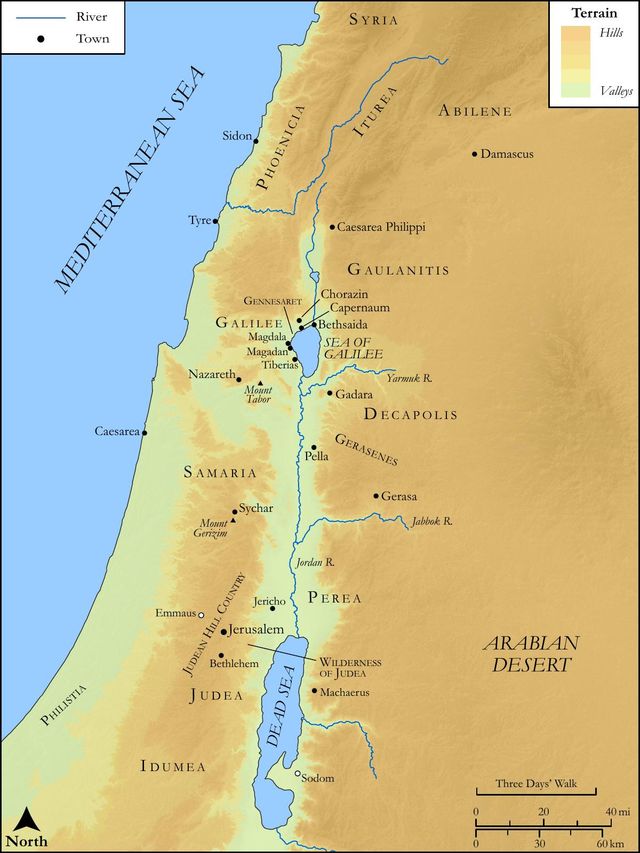
The setting is Capernaum, a bustling fishing village on the northwestern shore of the Sea of Galilee, which served as Jesus' primary base of operations during His Galilean ministry. The "great multitudes" were typical of the large gatherings that would form around popular teachers and miracle workers in ancient Israel. Privacy was scarce, and the demands on public figures were immense. The "other side" typically refers to the eastern shore of the Sea of Galilee, a region largely inhabited by Gentiles (e.g., the Decapolis cities like Gadara or Gergesa). Crossing to this side would mean leaving predominantly Jewish territory for areas with different cultural norms and religious practices, often considered unclean by strict Jewish standards. This geographical shift is not merely a change of scenery but carries significant theological implications, hinting at the universal scope of Jesus' mission beyond the confines of Israel.
Key Themes
ShowHideMatthew 8:18 contributes to several overarching themes within Matthew's Gospel. Firstly, it highlights Jesus' Strategic Movement and Sovereignty. His decision to cross the sea is not a reaction of exhaustion but a deliberate, proactive choice, demonstrating His control over His ministry's pace and direction. This move allows Him to escape the constant press of the crowds, find moments of rest, and prepare for further, more intensive teaching for His disciples, particularly concerning the nature of discipleship and His authority over creation, as seen in the subsequent calming of the storm (Matthew 8:23-27). Secondly, the verse subtly introduces the theme of The Cost of Discipleship, as Jesus' command to depart immediately precedes His challenging conversations with potential followers, underscoring that following Him involves leaving comfort zones and embracing difficult journeys (Matthew 8:19-22). Finally, it touches upon Managing Ministry Demands, illustrating Jesus' wise approach to the pressures of public life, ensuring time for focused instruction and, implicitly, for spiritual replenishment.
Exposition and Analysis
ShowHideKey Word Analysis
ShowHideThis is not merely a casual glance but implies a deep perception or understanding. Jesus "saw" the great multitudes not just with His physical eyes, but He perceived the implications of their presence—the overwhelming demand, the potential for misunderstanding His mission, and the need for a strategic shift. It suggests a knowing awareness of the situation and its spiritual dynamics.
This term refers to a large, unorganized, and often undifferentiated throng of people. It conveys the sense of a pressing, perhaps even chaotic, crowd rather than an orderly assembly. The use of "great" (polýs) further emphasizes the sheer scale and density of the people surrounding Jesus, highlighting the immense pressure and attention He was under.
This verb is a strong term, indicating a firm and decisive order, not a mere suggestion or request. It underscores Jesus' active leadership, authority, and sovereign control over His itinerary and the actions of His disciples. He is not being driven by the crowds but is intentionally initiating the next phase of His ministry journey.
Verse Breakdown
ShowHide"Now when Jesus saw great multitudes about him"
This clause sets the scene, indicating the immediate context of Jesus' decision. The "Now" (dé) serves as a connective particle, linking this action to the preceding events of healing and teaching. Jesus' perception of the "great multitudes" highlights the immense popularity and the constant demands placed upon Him, creating the impetus for His subsequent action.
"he gave commandment"
This phrase emphasizes Jesus' divine authority and proactive leadership. He is not reacting passively to the crowds but is taking authoritative initiative. The "commandment" (keleúō) signifies a clear, decisive order to His disciples, indicating a shift in their immediate mission and direction.
"to depart unto the other side"
This specifies the content and destination of Jesus' command. "To depart" (apérchomai) denotes a movement away from the current location, while "unto the other side" (eis péran) indicates the eastern shore of the Sea of Galilee. This physical relocation carries significant symbolic weight, representing a transition to new territory, often Gentile, and a new phase of ministry focused on deeper instruction for His disciples.
Literary Devices
ShowHideMatthew 8:18 functions as a pivotal Narrative Transition within the Gospel, shifting the focus from Jesus' widespread public ministry of healing and teaching to a more concentrated period of discipleship training and encounters in new, often challenging, environments. The verse also employs Foreshadowing, hinting at the demanding nature of discipleship and the universal scope of Jesus' mission. The act of crossing to "the other side" subtly foreshadows the inclusion of Gentiles in God's kingdom, a theme that becomes more explicit later in Matthew. Furthermore, there is an implicit Contrast between the overwhelming public demands (the "great multitudes") and Jesus' intentional withdrawal for more focused, private instruction with His inner circle, demonstrating a strategic approach to ministry.
Theological and Thematic Connections
ShowHideMatthew 8:18 reveals Jesus' profound wisdom and divine sovereignty in managing His earthly ministry. It underscores that His actions were not merely reactive but part of a deliberate, divinely orchestrated plan. His decision to withdraw from the pressing crowds and cross to "the other side" highlights His commitment to training His disciples, preparing them for future ministry, and revealing deeper truths about His identity and kingdom. This strategic withdrawal also serves as a model for spiritual leadership, demonstrating the importance of discernment, setting boundaries, and prioritizing focused instruction and personal replenishment over constant public engagement. It shows that even the Son of God, in His human form, recognized the need for strategic movement and focused time with His closest followers.
Reflection and Application
ShowHideMatthew 8:18 offers invaluable insights for contemporary believers regarding discernment, leadership, and the nature of discipleship. Just as Jesus recognized the need to shift His focus from the clamoring crowds to more intimate instruction and strategic movement, we too must cultivate spiritual discernment to understand when to engage and when to withdraw. This might mean setting healthy boundaries in our lives, prioritizing focused time with God, or investing deeply in a few key relationships rather than being constantly consumed by external demands. Following Jesus often calls us out of our comfort zones and into new territories, both physically and spiritually. We must be prepared to follow His leading, even when it means venturing into the "other side" of our expectations, fears, or familiar routines. True discipleship requires proactive decision-making and a willingness to embrace change, trusting that Jesus' commands always lead to His greater purposes.
Questions for Reflection
ShowHideFAQ
ShowHideWhy did Jesus give commandment to depart from the multitudes?
ShowHideJesus' decision to depart was multifaceted and strategic. Firstly, it allowed Him to escape the overwhelming pressure and constant demands of the "great multitudes" (Matthew 8:18). The crowds, while eager for healing and teaching, often misunderstood His messianic mission, sometimes seeking to make Him an earthly king (John 6:15). Secondly, departing to "the other side" provided an opportunity for more focused, intimate instruction with His disciples, preparing them for their future ministry. This is evident in the subsequent events, such as the calming of the storm (Matthew 8:23-27) and the encounter with the Gerasene demoniacs (Matthew 8:28-34), which offered crucial lessons on His authority and the nature of the spiritual realm. It was a strategic move to advance His kingdom purposes and deepen the understanding of His closest followers.
What is the significance of "the other side" in this context?
ShowHide"The other side" (Greek: péran) primarily refers to the eastern shore of the Sea of Galilee, a region largely populated by Gentiles, particularly the Decapolis cities. This geographical shift is significant because it marks Jesus' intentional movement into non-Jewish territory, foreshadowing the universal scope of His ministry and the eventual inclusion of Gentiles into the Kingdom of God. It also represents a departure from the familiar, predominantly Jewish, environment of Capernaum. Spiritually, "the other side" can symbolize a step into new, often challenging, spiritual territory, requiring faith and a willingness to confront unfamiliar circumstances, as exemplified by the storm they encounter on the way (Matthew 8:23-27) and the demon-possessed men they meet upon arrival (Matthew 8:28-34).
Christ-Centered Fulfillment
ShowHideMatthew 8:18, though seemingly a simple narrative detail, profoundly illustrates Christ's sovereign control over His mission and His deliberate preparation of His disciples for the unfolding of God's redemptive plan. Jesus, the Lord of all, was not swayed by the clamor of the "great multitudes" or driven by popular demand; rather, He "gave commandment" to depart, demonstrating His divine authority and strategic foresight. This act of withdrawal and transition to "the other side" foreshadows the broader scope of His redemptive work, extending beyond the confines of Israel to embrace the Gentiles, ultimately culminating in the Great Commission to make disciples of "all nations" (Matthew 28:19). His intentional separation from the crowds also highlights His commitment to nurturing His inner circle, imparting deeper truths to those who would carry on His ministry after His ascension. This prefigures the intimate fellowship and intensive training Christ provides to His Church, equipping them through His Holy Spirit to navigate the storms of life and proclaim the gospel to every corner of the earth, just as He prepared His disciples for the journey across the stormy sea to a new, challenging territory (Mark 4:35-41). In every strategic move, Jesus was fulfilling His Father's will, demonstrating the perfect wisdom of God in bringing about salvation for all who believe.