


Luke 23:55
Bible text: King James Version (1769 Blayney text) · Public domain
Bible text: King James Version with Strong's numbers · Public domain
Bible text: Berean Standard Bible · Public domain
Bible text: American Standard Version (1901) · Public domain
Bible text: World English Bible, Messianic edition · Public domain
Bible text: Geneva Bible (1599) · Public domain
Bible text: Young's Literal Translation · Public domain
- κατακολουθήσασαιkatakolouthēsasaiHaving followedG2628V-AAP-NPFVerb Aorist Active Participle Nominative Plural Feminine
- δὲdethenG1161CONJConjunction
- καὶkaiandG2532CONJConjunction
- γυναῖκεςgunaikeswomenG1135N-NPFNoun Nominative Plural Feminine
- αἵτινεςaitineswhoG3748R-NPFRelative pronoun Nominative Plural Feminine
- ἦσανēsanwereG1510V-IAI-3PVerb Imperfect Active Indicative 3rd Plural
- συνεληλυθυῖαιsunelēluthuiaihaving comeG4905V-2RAP-NPFVerb 2nd Perfect Active Participle Nominative Plural Feminine
- ἐκekfromG1537PREPPreposition
- τῆςtēs<the>G3588T-GSFDefinite article Genitive Singular Feminine
- ΓαλιλαίαςGalilaiasGalileeG1056N-GSF-LNoun Genitive Singular Feminine Location
- αὐτῷautōwith HimG846P-DSMPersonal pronoun Dative Singular Masculine
- ἐθεάσαντοetheasantosawG2300V-ADI-3PVerb Aorist Middle Deponent Indicative 3rd Plural
- τὸtotheG3588T-ASNDefinite article Accusative Singular Neuter
- μνημεῖονmnēmeiontombG3419N-ASNNoun Accusative Singular Neuter
- καὶkaiandG2532CONJConjunction
- ὡςhōshowG5613PRTParticle or Disjunctive
- ἐτέθηetethēwas laidG5087V-API-3SVerb Aorist Passive Indicative 3rd Singular
- τὸtotheG3588T-NSNDefinite article Nominative Singular Neuter
- σῶμαsōmabodyG4983N-NSNNoun Nominative Singular Neuter
- αὐτοῦautouof HimG846P-GSMPersonal pronoun Genitive Singular Masculine
English is a literal word-by-word gloss of the Greek, not the KJV's wording. Why?
This is the original text the KJV's translators worked from — each Greek word with its own literal English meaning in this verse, prepared by scholars at Tyndale House, Cambridge. The KJV translates whole sentences, not word by word, so its wording differs: one Greek word can become several English words, and the KJV may choose “charity” where the gloss reads “love”. Both are faithful — they answer different questions. For the KJV's own rendering, switch to the KJV text.
Details
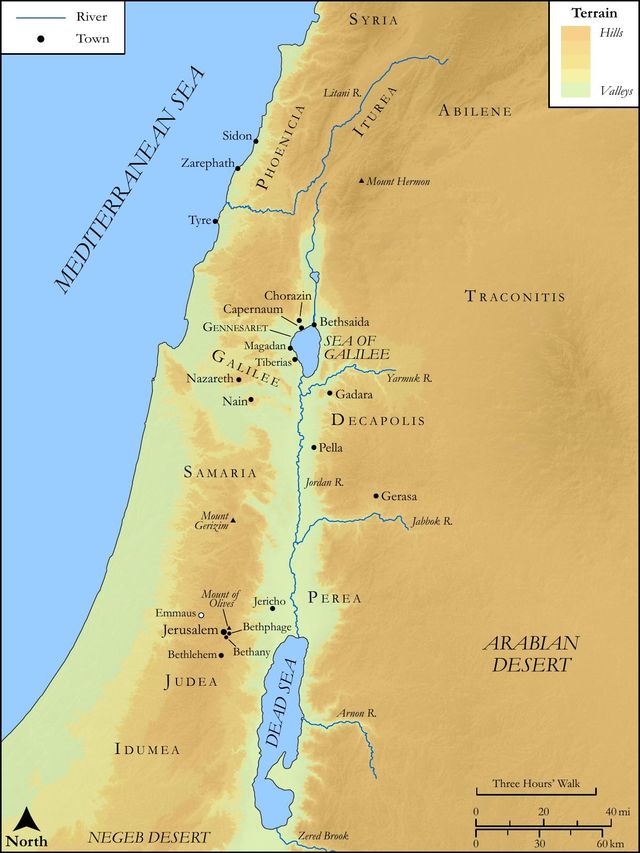
See on the biblical-era maps


Study this verse
Public-domain commentary
Matthew Henry
From his Commentary on the Whole Bible. Henry comments on passages, not single verses — this entry covers Luke 23:50–56. His two-level outline is real structure in the source text, so it is rendered as structure.
We have here an account of Christ's burial; for he must be brought not only to death, but to the dust of death (Psa 22:15), according to the sentence (Gen 3:19), To the dust thou shalt return. Observe,
I.Who buried him.
His acquaintance stood afar off; they had neither money to bear the charge nor courage to bear the odium of burying him decently; but God raised up one that had both, a man named Joseph, Luk 23:50. His character is that he was a good man and a just, a man of unspotted reputation for virtue and piety, not only just to all, but good to all that needed him (and care to bury the dead, as becomes the hope of the resurrection of the dead, is one instance of goodness and beneficence); he was a person of quality, a counsellor, a senator, a member of the sanhedrim, one of the elders of the Jewish church. Having said this of him, it was necessary to add that, though he was of that body of men who had put Christ to death, yet he had not consented to their counsel and deed (Luk 23:51), though it was carried by the majority, yet he entered his protest against it, and followed not the multitude to do evil. Note, That evil counsel or deed to which we have not consented shall not be reckoned our act. Nay, he not only dissented openly from those that were enemies to Christ, but be consented secretly with those that were his friends: He himself waited for the kingdom of God; he believed the Old Testament prophecies of the Messiah and his kingdom, and expected the accomplishment of them. This was the man that appears upon this occasion to have had a true respect for the Lord Jesus. Note, There are many who are hearty in Christ's interests, how, though they do not make any show in their outward profession of it, yet will be more ready to do him a piece of real service, when there is occasion, than others who make a greater figure and noise.
II.What he did towards the burying of him.
1.He went to Pilate, the judge that condemned him, and begged the body of Jesus, for it was at his disposal; and, though he might have raised a party sufficient to have carried off the body by violence, yet he would take the regular course, and do it peaceably.
2.He took it down, it should seem, with his own hands, and wrapped it in linen. They tell us that it was the manner of the Jews to roll the bodies of the dead, as we do little children in their swaddling-clothes, and that the word here used signifies as much; so that the piece of fine linen, which he bought whole, he cut into many pieces for this purpose. It is said of Lazarus, He was bound hand and foot, Joh 11:44. Grave-clothes are to the saints as swaddling-clothes, which they shall out-grow and put off, when they come to the perfect man.
III.Where he was buried.
In a sepulchre that was hewn in stone, that the prison of the grave might be made strong, as the church, when she was brought into darkness, had her way enclosed with hewn stone, Lam 3:2, Lam 3:9. But it was a sepulchre in which never man before was laid, for he was buried on such an account as never any one before him was buried, only in order to his rising again the third day by his own power; and he was to triumph over the grave as never any man did.
IV.When he was buried.
On the day of the preparation, when the sabbath drew on, Luk 23:54. This is given as a reason why they made such haste with the funeral, because the sabbath drew on, which required their attendance to other work, preparing for the sabbath, and going forth to welcome it. Note, Weeping must not hinder sowing. Though they were in tears for the death of Christ, yet they must apply themselves to the sanctifying of the sabbath; and, when the sabbath draws on, there must be preparation. Our worldly affairs must be so ordered that they may not hinder us from our sabbath work, and our holy affections must be so excited that they may carry us on in it.
V.Who attended the funeral; not any of the disciples, but only the women that came with him from Galilee (Luk 23:55), who, as they staid by him while he hung on the cross, so they followed him, all in tears no doubt, and beheld the sepulchre where it was, which was the way to it, and how his body was laid in it. They were led to this, not by their curiosity, but by their affection to the Lord Jesus, which was strong as death and which many waters could not quench. Here was a silent funeral, and not a solemn one, and yet his rest was glorious.
VI.What preparation was made for the embalming of his body after he was buried (Luk 23:56):
They returned, and prepared spices and ointments, which was more an evidence of their love than of their faith; for had they remembered and believed what he had so often told them, that he should rise again the third day, they would have spared their cost and pains herein, as knowing that in a short time there would be a greater honour put upon his body, by the glory of his resurrection, than they could put upon it with their most precious ointments; but, busy as they were in this preparation, they rested on the sabbath day, and did none of this servile work thereon, not only according to the custom of their nation, but according to the commandments of their God, which, though the day be altered, is still in full force: Remember the sabbath day, to keep it holy.
Historical interpretation
Nine Centuries of Reception
9 surviving comments on this verse. Each one is dated, so this reads as a timeline rather than a list.
Select a marker to jump to its quote. Markers stagger vertically where authors wrote within a few decades of each other.
(in Vit. Ant. 90.) They also act absurdly who embalm the bodies of their dead, and do not bury them, even supposing them to be holy. For what can be more holy or greater than our Lord's body? And yet this was placed in a tomb until it rose again the third day. For it follows, And he laid it in a hewn sepulchre.
Finally, not all were able to bury Christ: although religious women stood from afar, they diligently observed the place in order to bring ointments and pour them out. However, they are both anxious and depart from the tomb and return to the tomb: although constancy is lacking, diligence is not. The gender falters, devotion burns. Finally, at the time of the resurrection, they are present, and while the men were fleeing, only the women are admonished by the angel to not be afraid. The disciples call Peter and the others in earnest, but the later ones come with confidence. Finally, he comes without fear, and the one who came later enters first, as if he had received the keys of the kingdom to open them for others. The shaking of the earth is a resurrection for the faithful, but a fear for the wicked: for the former, because the lazy body stirs from the sleep of death; for the latter, because they are disturbed by the shaking of the body and the earthly movement, they turn away from the faith and trust in the resurrection.
Now mystically, the just man buries the body of Christ. For the burial of Christ is such as to have no guile or wickedness in it. But rightly did Matthew call the man rich, for by carrying Him that was rich he knew not the poverty of faith. The just man covers the body of Christ with linen. Do thou also clothe the body of Christ with His own glory, that thou mayest be thyself just. And if thou believest it to be dead, still cover it with the fulness of His own divinity. But the Church also is clothed with the grace of innocence.
Nor without meaning has one Evangelist spoken of a new tomb, another of the tomb of Joseph. For the grave is prepared by those who are under the law of death; the Conqueror of death has no grave of His own. For what fellowship hath God with the grave. He alone is enclosed in this tomb, because the death of Christ, although it was common according to the nature of the body, yet was it peculiar in respect of power. But Christ is rightly buried in the tomb of the just, that He may rest in the habitation of justice. For this monument the just man hews out with the piercing word in the hearts of Gentile hardness, that the power of Christ might extend over the nations. And very rightly is there a stone rolled against the tomb; for whoever has in himself truly buried Christ, must diligently guard, lest he lose Him, or lest there be an entrance for unbelief.
(de Con. Ev. lib. iii. c. 22.) Now John says, that Joseph was a disciple of Jesus. Hence it is also here added, Who also himself waited for the kingdom of God. But it naturally causes surprise how he who for fear was a secret disciple should have dared to beg our Lord's body, which none of those who openly followed Him dared to do; for it is said, This man went unto Pilate, and begged the body of Jesus. We must understand then, that he did this from confidence in his rank, by which he might be privileged to enter familiarly into Pilate's presence. But in performing that last funeral rite, he seems to have eared less for the Jews, although it was his custom in hearing our Lord to avoid their hostility.
Wise women followed our common Savior Christ, gathering whatever was both useful and necessary for faith in him. When he gave his flesh as a ransom for the life of us all, they wisely committed themselves to care for his body. They supposed that the corpse would continue to remain in the grave.
But the women who had come with him from Galilee followed, and saw the tomb, and how his body was laid. Above it is written that all his acquaintances stood at a distance, and the women who had followed him. Therefore, after his acquaintances of Jesus had returned to their own homes after his body was taken down, the women alone, who loved him more closely, followed the funeral to see how he was laid, so that at the appropriate time they might offer their gift of devotion to him. And even until now, holy women do the same on the day of Preparation, when humble souls, and those who are more conscious of their greater fragility, fervent with greater love for the Savior, diligently follow the footsteps of his passion in this world, where rest is to be prepared in the future, and carefully consider with diligent curiosity in what order the same passion was accomplished if perhaps they might be able to imitate it.
A counsellor, or decurio, is so called because he is of the order of the curia or council, and administers the office of the curia. He is also wont to be called curialis, from his management of civil duties. Joseph then is said to have been of high rank in the world, but of still higher estimation before God; as it follows, A good man, and a just, of Arimathæa, a city of the Jews, &c. Arimathæa is the same as Ramatha, the city of Helcanah and Samuel.
So then being fitted by the righteousness of his works for the burial of our Lord's body, he was worthy by the dignity of his secular power to obtain it. Hence it follows, And he took it down, and wrapped it in linen. By the simple burial of our Lord, the pride of the rich is condemned, who not even in their graves can be without their wealth.
That is, hewn out of a rock, lest if it had been built of many stones, and the foundations of the tomb being dug up after the resurrection, the body should be said to have been stolen away. It is laid also in a new tomb, wherein never man before was laid, lest when the rest of the bodies remained after the resurrection, it might be suspected that some other had risen again. But because man was created on the sixth day, rightly being crucified on the sixth day our Lord fulfilled the secret of man's restitution. It follows, And it was the day of the παρασκευὴ, which means the preparation, the name by which they called the sixth day, because on that day they prepared the things which were necessary for the Sabbath. But because on the seventh day the Creator rested from His work, the Lord on the Sabbath rested in the grave. Hence it follows, And the Sabbath was dawning. Now we said above, that all His acquaintance stood afar off, and the women which followed Him. These then of His acquaintance, after His body was taken down, returned to their homes, but the women who more tenderly loved Him, following His funeral, desired to see the place where He was laid. For it follows, And the women also, which came with him from Galilee, followed after, and beheld the sepulchre, and how his body was laid, that in truth they might make the offerings of their devotion at the proper time.
He also wraps Jesus in clean linen, who has received Him with a pure mind.
Now that the Lord is crucified on the sixth day and rests on the seventh, signifies that in the sixth age of the world we must of necessity suffer for Christ, and as it were be crucified to the world. (Gal. 6:14.) But in the seventh age, that is, after death, our bodies indeed rest in the tombs, but our souls with the Lord. But even at the present time also holy women, (that is, humble souls,) fervent in love, diligently wait upon the Passion of Christ, and if perchance they may be able to imitate Him, with anxious carefulness ponder each step in order, by which this Passion is fulfilled. And having read, heard, and called to mind all these, they next apply themselves to make ready the works of virtue, by which Christ may be pleased, in order that having finished the preparation of this present life, in a blessed rest they may at the time of the resurrection meet Christ with the frankincence of spiritual actions.
But the race of women formerly cursed remains and sees all these things; for it follows, And the women which followed him from Galilee, seeing these things. And thus they are the first to be renewed by justification, or by the blessing which flows from His passion, as also from His resurrection.
For they had not yet sufficient faith, but prepared as if for a mere man spices and ointments, after the manner of the Jews, who performed such duties to their dead. Hence it follows, And they returned, and prepared spices. For our Lord being buried, they were occupied as long as it was lawful to work, (that is, until sun-set,) in preparing ointments. But it was commanded to keep silence on the Sabbath, that is, rest from evening to evening. For it follows, And rested the sabbath day according to the commandment.
(Photius.) Joseph had been at one time a secret disciple of Christ, but at length bursting through the bonds of fear, and become very zealous, he took down the body of our Lord, basely hanging on the cross; thus gaining a precious jewel by the meekness of His words. Hence it follows, And, behold, there was a man named Joseph, a counsellor.
Continue studying Luke 23:55 across the web’s major study libraries — every link below opens this exact verse, chapter, or book on the destination site.
Read & Compare
 BibleGatewayThis verse in more than 200 translations and 70 languages.
 Bible.comThe YouVersion reader — hundreds of translations, reading plans, and highlights.
 ESV.orgCrossway's official English Standard Version reader.
 NET BibleThe NET translation with 60,000+ translators' notes on every rendering decision.
 STEP BibleTyndale House's free study tool — original text, vocabulary, and scholarly resources.
 BibliaLogos Bible Software's free web reader.
 USCCBThe New American Bible (Revised Edition) with the U.S. bishops' study notes.
Commentaries
 BibleHub CommentariesDozens of classic commentaries on this verse, gathered on one page.
 StudyLightMore than 100 commentary sets — the largest collection on the web.
 BibleRefPlain-English commentary on what this verse means, verse by verse.
 Enduring WordDavid Guzik's free commentary on this chapter, widely used by Bible teachers.
 Bible Study ToolsVerse commentary alongside Greek and Hebrew study aids.
Original Language & Research
- BibleHub InterlinearThe verse word by word — original language, transliteration, and English.
- BibleHub LexiconEvery word's original-language definition and Strong's entry.
 Blue Letter BibleDeep-study tools — Strong's numbers, concordance, and word studies.
 CNTR CollationThe earliest Greek manuscripts of this verse, collated letter by letter.
Sermons, Hymns & Audio


TrulyRandomVerse is not affiliated with these sites and doesn’t control their content. They’re linked because they’re genuinely useful.
Summary
Luke 23:55 offers a poignant snapshot of the unwavering devotion of the women who had accompanied Jesus from Galilee, highlighting their critical role as eyewitnesses to the precise details of His burial. Their careful observation of the sepulchre and how Jesus' body was laid within it establishes the undeniable reality of His death and interment, setting the foundational stage for the miraculous events of the resurrection.
Context
ShowHideLiterary Context
This verse immediately follows the account of Jesus' crucifixion and the compassionate actions of Joseph of Arimathea. Luke 23:50-54 details how Joseph, a respected member of the Jewish council, bravely requested Jesus' body from Pilate, prepared it for burial, and laid it in a new tomb. Luke 23:55 then shifts the focus to the women who had followed Jesus, emphasizing their presence and careful observation of the burial site. This transition is crucial, as these same women will be the first witnesses to the empty tomb and the resurrection, as narrated in Luke 24:1-12. Their meticulous attention to the burial details in this verse underscores the veracity of their later testimony regarding the empty tomb.
Historical & Cultural Context
The burial of Jesus occurred on the eve of the Sabbath, specifically the "Great Sabbath" of Passover, which began at sunset on Friday. Jewish law mandated that bodies not remain unburied overnight (Deuteronomy 21:22-23), and certainly not on the Sabbath. This urgency explains the swiftness of Joseph's actions. The women's presence, though unusual for such a public and somber event, reflects their deep loyalty and the cultural acceptance of women mourning at funerals. Their intention to return after the Sabbath to complete the anointing of the body (Luke 23:56) was a customary act of reverence and final preparation for the deceased, indicating their profound respect and love for Jesus.
Key Themes
ShowHideLuke 23:55 significantly contributes to several overarching themes in the Gospel of Luke. Firstly, it highlights the theme of Faithful Witness, as the women's presence and careful observation establish them as indispensable eyewitnesses to the burial, lending credibility to the later resurrection accounts. Secondly, it exemplifies Unwavering Devotion, showcasing the steadfast loyalty of these women who remained with Jesus through His suffering and death, even when many male disciples had fled (Matthew 26:56). Their commitment extended beyond His public ministry, persisting through profound grief. Thirdly, the verse subtly sets the stage for the Reality of the Resurrection, by meticulously documenting the burial. By "beholding the sepulchre, and how his body was laid," the women gained precise knowledge of Jesus' burial site, which was essential for their subsequent discovery of the empty tomb on Sunday morning (Luke 24:1-3). This detail firmly establishes the reality of Jesus' physical death and burial, countering any later claims that He merely swooned or that His body was not truly interred.
Exposition and Analysis
ShowHideKey Word Analysis
ShowHideThis term (G1135) refers to the female followers of Jesus, emphasizing their identity as distinct individuals who played a crucial role in His ministry and the events surrounding His death and resurrection. It highlights their active presence and participation, often in contrast to the male disciples who had scattered.
This compound verb (G2628) signifies more than a casual following; it implies accompanying closely or adhering steadfastly. It underscores the deep commitment and persistent loyalty of these women, who remained with Jesus even to the point of His burial, demonstrating an enduring discipleship.
This verb (G2300) denotes a deliberate, attentive, and careful observation, implying a gaze that seeks to perceive and understand, rather than a mere glance. It conveys that the women were not simply present but were actively and intently witnessing the details of Jesus' interment, making them reliable and precise witnesses.
Verse Breakdown
ShowHide"And the women also, which came with him from Galilee,"
This clause identifies the subjects of the verse – a group of women who had been part of Jesus' Galilean ministry. Their origin from Galilee signifies their long-standing association and commitment to Jesus, having followed Him throughout His public ministry and journey to Jerusalem. The inclusion of "also" (G2532, kaí) emphasizes their presence alongside Joseph of Arimathea, highlighting their distinct but equally important role in this somber event.
"followed after,"
This phrase emphasizes the women's persistent and close accompaniment. Despite the traumatic events of the crucifixion and the general dispersal of Jesus' followers, these women remained steadfast, demonstrating remarkable courage and devotion by staying near the body of their Lord.
"and beheld the sepulchre,"
This signifies their careful and intentional observation of the tomb itself. The word "beheld" (G2300, theáomai) implies a deep, contemplative gaze, indicating that they were meticulously noting the location and characteristics of the burial site, which would be crucial for their later return.
"and how his body was laid."
This final clause specifies the object of their careful observation: the manner in which Jesus' body was placed within the tomb. This detail is significant as it confirms the physical reality of the burial and provides precise information that would later corroborate the empty tomb, ensuring that there was no ambiguity about the fact of Jesus' death and interment.
Literary Devices
ShowHideLuke's account in this verse employs several literary devices to enhance its impact and theological significance. The use of Foreshadowing is prominent, as the meticulous observation by the women of the sepulchre and the body's placement directly anticipates their role as the first witnesses to the empty tomb and the resurrection in the following chapter. Their careful "beholding" is not merely descriptive but serves a narrative purpose. There is also a subtle Contrast between the scattered male disciples and the steadfast women, highlighting the latter's unwavering loyalty in the face of despair. The phrase "followed after" functions as Imagery, painting a picture of persistent devotion and courage, as these women literally trace the path of Jesus' final earthly journey. Furthermore, the emphasis on "beheld" and "how his body was laid" uses Verisimilitude, lending an air of factual accuracy and eyewitness credibility to the narrative, reinforcing the historical reality of Jesus' death and burial.
Theological and Thematic Connections
ShowHideLuke 23:55 profoundly underscores the theological necessity of Jesus' real death and burial for the truth of the resurrection. The women's careful witness ensures that the tomb was indeed occupied by Jesus' body, thus making the later discovery of its emptiness an undeniable miracle, not a misplacement or a swoon. Their devotion, even in the darkest hour, serves as a powerful testament to faithful discipleship, demonstrating that true commitment to Christ enduring through suffering and apparent defeat. This verse highlights the often-overlooked but vital role of women in the Gospel narrative, positioning them as key figures in bearing witness to the most pivotal events of salvation history.
Reflection and Application
ShowHideLuke 23:55 is a powerful reminder that faithfulness often manifests not in grand gestures, but in quiet, persistent presence, especially in times of sorrow and uncertainty. The women who followed Jesus to the tomb exemplify a profound level of discipleship, remaining steadfast when circumstances were bleakest and hope seemed lost. Their careful observation teaches us the importance of being attentive witnesses to God's work, even when it unfolds in unexpected, painful, or seemingly final ways. Just as their witness prepared them for the overwhelming joy of the resurrection, our faithful endurance and observation can prepare us to see God's purposes fulfilled, even beyond our current understanding. It encourages us to remain devoted, trusting that God's plan is always at work, even when it appears to be hidden in darkness, and that our quiet acts of loyalty are deeply seen and valued by Him.
Questions for Reflection
ShowHideFAQ
ShowHideWhy is the women's presence at the burial so important?
ShowHideThe women's presence is critically important for several reasons. First, they serve as crucial eyewitnesses to the reality of Jesus' death and burial, confirming that His body was indeed placed in a tomb. This detail is foundational to the Christian faith, as it establishes the undeniable fact that the tomb was later found empty. Second, their careful observation of "how his body was laid" provides precise details that would later validate their testimony about the empty tomb and the resurrection (Luke 24:1-10). Without their witness to the burial, there could be doubt about the identity of the body or the location of the tomb. Finally, their unwavering devotion, even when most male disciples had fled, highlights their profound loyalty and commitment to Jesus, underscoring the vital role of women in the early Christian movement.
Christ-Centered Fulfillment
ShowHideLuke 23:55, though seemingly a simple narrative detail, is profoundly Christ-centered in its implications. The women's witness to Jesus' burial underscores the absolute reality of His death, a non-negotiable component of the Gospel message. The fact that His body was truly laid in a tomb confirms the completeness of His sacrifice, fulfilling prophecies and demonstrating that He fully entered into the human experience, even unto death (Philippians 2:8). This verse, by meticulously detailing the burial, sets the stage for the ultimate triumph of Christ over death. The empty tomb, witnessed by these same women, would later proclaim that the one who was "laid" in the sepulchre could not be held by it, but rose victoriously (Acts 2:24). Thus, the burial is not an end, but a necessary prelude to the resurrection, which is the cornerstone of Christian hope and the very power of God for salvation (Romans 1:16). The careful observation of these women ensures the historical anchor of the resurrection, making it a verifiable event rooted in the tangible reality of Christ's death and burial, and ultimately pointing to His glorious victory as the Lamb of God who takes away the sin of the world (John 1:29).