


Matthew 27:61
Bible text: King James Version (1769 Blayney text) · Public domain
Bible text: Berean Standard Bible · Public domain
Bible text: American Standard Version (1901) · Public domain
Bible text: World English Bible, Messianic edition · Public domain
Bible text: Geneva Bible (1599) · Public domain
Bible text: Young's Literal Translation · Public domain
- ἦνēnWasG1510V-IAI-3SVerb Imperfect Active Indicative 3rd Singular
- δὲdenowG1161CONJConjunction
- ἐκεῖekeithereG1563ADVAdverb
- ΜαριὰμMariamMaryG3137N-NSF-PNoun Nominative Singular Feminine Individual
- ἡhē<the>G3588T-NSFDefinite article Nominative Singular Feminine
- ΜαγδαληνὴMagdalēnēMagdaleneG3094N-NSF-LGNoun Nominative Singular Feminine Location Gentilic
- καὶkaiandG2532CONJConjunction
- ἡhētheG3588T-NSFDefinite article Nominative Singular Feminine
- ἄλληallēotherG243A-NSFAdjective Nominative Singular Feminine
- ΜαρίαMariaMaryG3137N-NSF-PNoun Nominative Singular Feminine Individual
- καθήμεναιkathēmenaisittingG2521V-PNP-NPFVerb Present Middle Or Passive Deponent Participle Nominative Plural Feminine
- ἀπέναντιapenantioppositeG561PREPPreposition
- τοῦtoutheG3588T-GSMDefinite article Genitive Singular Masculine
- τάφουtaphoutombG5028N-GSMNoun Genitive Singular Masculine
English is a literal word-by-word gloss of the Greek, not the KJV's wording. Why?
This is the original text the KJV's translators worked from — each Greek word with its own literal English meaning in this verse, prepared by scholars at Tyndale House, Cambridge. The KJV translates whole sentences, not word by word, so its wording differs: one Greek word can become several English words, and the KJV may choose “charity” where the gloss reads “love”. Both are faithful — they answer different questions. For the KJV's own rendering, switch to the KJV text.
Details
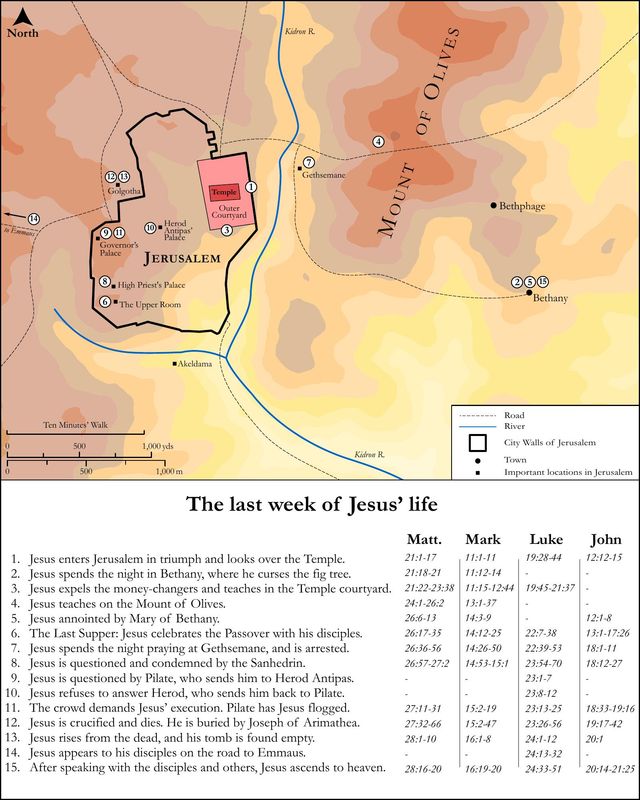
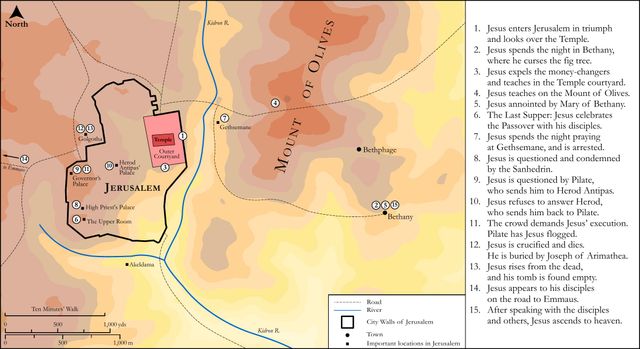
See on the biblical-era maps

Study this verse
Historical interpretation
Ten Centuries of Reception
11 surviving comments on this verse. Each one is dated, so this reads as a timeline rather than a list.
Select a marker to jump to its quote. Markers stagger vertically where authors wrote within a few decades of each other.
(Serm. App. 248. 4.) The Saviour was laid in a tomb belonging to another man, because He died for the salvation of others. For why should He who in Himself had no death, have been laid in His own tomb? Or He whose place was reserved for Him in heaven, have had a monument upon earth? He who remained but three days space in the tomb, not as dead, but as resting on His bed? A tomb is the necessary abode of death; Christ then, who is our life, could not have an abode of death; He that ever liveth had no need of the dwelling of the departed.
('Aug. in Serm.' non occ.) Had the tomb been in the earth, it might have been said they undermined the place, and so carried Him off. Had a small stone been laid thereon, they might have said, They carried Him off while we slept.
The mother of the sons of Zebedee is not mentioned as having sat over against the sepulchre. And perhaps she was able to endure as far as the cross only, but these as stronger in love were not absent even from the things that were afterwards done.
Mystically, Joseph affords a figure of the Apostles. He wraps the body in a clean linen cloth, in which same linen sheet were let down to Peter out of heaven all manner of living creatures; whence we understand, that under the representation of this linen cloth the Church is buried together with Christ. The Lord's body moreover is laid in a chamber hewn out of rock, empty and new; that is, by the teaching of the Apostles, Christ is conveyed into the hard breast of the Gentiles hewn out by the toil of teaching, rude and new, hitherto unpenetrated by any fear of God. And for that besides Him ought nothing to enter our breasts, a stone is rolled to the mouth, that as before Him we had received no author of divine knowledge, so after Him we should admit none.
"But Joseph went, and begged the body." This was Joseph, who was concealing his discipleship of late; now however he had become very bold after the death of Christ. For neither was he an obscure person, nor of the unnoticed; but one of the council, and highly distinguished; from which circumstance especially one may see his courage. For he exposed himself to death, taking upon him enmity with all, by his affection to Jesus, both having dared to beg the body, and not having desisted until he obtained it. But not by taking it only, nor by burying it in a costly manner, but also by laying it in his own new tomb, he showeth his love, and his courage. And this was not so ordered without purpose, but so there should not be any bare suspicion, that one had risen instead of another.
"And there was Mary Magdalene, and the other Mary, sitting over against the sepulchre." For what purpose do these wait by it? As yet they knew nothing great, as was meet, and high about Him, wherefore also they had brought ointments, and were waiting at the tomb, so that if the madness of the Jews should relax, they might go and embrace the body. Seest thou women's courage? seest thou their affection? seest thou their noble spirit in money? their noble spirit even unto death?
Let us men imitate the women; let us not forsake Jesus in temptations. For they for Him even dead spent so much and exposed their lives, but we (for again I say the same things) neither feed Him when hungry, nor clothe Him when naked, but seeing Him begging, we pass Him by. And yet if ye saw Himself, every one would strip himself of all his goods. But even now it is the same. For He Himself has said, I am he. Wherefore then dost thou not strip thyself of all? For indeed even now thou hearest Him say, Thou doest it unto me; and there is no difference whether thou givest to this man or to Him; thou hast nothing less than these women that then fed Him, but even much more. But be not perplexed! For it is not so much to have fed Him appearing in His own person, which would be enough to prevail with a heart of stone, as (because of His mere word) to wait upon the poor, the maimed, him that is bent down. For in the former case, the look and the dignity of Him who appears divides with thee that which is done; but here the reward is entire for thy benevolence; and there is the proof of the greater reverence towards Him, when at His mere word waiting upon thy fellow-servant thou refreshest him in all things. Refresh him, and believe Him, who receiveth it, and saith, Thou givest to me. For unless thou hadst given to Him, He would not have counted thee worthy of a kingdom. If thou hadst not turned away from Him, He would not have sent thee to hell, if thou hadst overlooked a chance person; but because it is He Himself that is despised, therefore great is the blame.
Consider this man's courage; he risked his life, and took upon him many enmities in order to render this service; and not only dares to ask for Christ's body, but also to bury it.
(V. 61 seqq.) Now there was there Mary Magdalene and the other Mary, sitting opposite the sepulchre. And on the next day, which followed the day of preparation, the chief priests and the Pharisees gathered together to Pilate, saying: Lord, we remember that that seducer said, while he was yet alive: After three days I will rise again. But the rest having left the Lord, the women persevered in their duty, expecting what Jesus had promised; and therefore they were the first to see the risen Lord, for he who perseveres to the end shall be saved (Matthew 10:22; 24:13).
He is described as rich, not out of any ambition on the part of the writer to represent so noble and rich a man as Jesus' disciple, but to show how he was able to obtain the body of Jesus from Pilate. For poor and unknown individuals would not have dared to approach Pilate, the representative of Roman power, and ask the body of a crucified malefactor. In another Gospel this Joseph is called a counsellor; and it is supposed that the first Psalm has reference to him, Blessed is the man that walketh not in the counsel of the ungodly. (Ps. 1:1.)
By this simple burial of the Lord is condemned the ostentation of the rich, who cannot dispense with lavish expense even in their tombs. But we may also consider in a spiritual sense, that the Lord's body was wrapped not in gold, jewels, or silk, but in clean linen; and that he who wrapped it, is he who embraces Jesus with a pure heart.
He is laid in a new tomb, lest after His resurrection it should be pretended that it was some other who had risen when they saw the other bodies there remaining. The new tomb may also signify the virgin womb of Mary. And He was laid in a tomb hewn out of the rock, lest had it been one raised of many stones, it might have been said that He was stolen away by undermining the foundations of the pile.
That a great stone was rolled there, shows that the tomb could not have been reopened without the united strength of many.
Or, when the rest left the Lord, the women continued in their attendance, looking for what Jesus had promised; and therefore they deserved to be the first to see the resurrection, because he that endureth to the end shall be saved. (Matt. 10:22.)
Arimathea is the same as Ramatha, the city of Helcana and Samuel, and is situated in the Chananitic country near Diospolis. This Joseph was a man of great dignity in respect of worldly station, but has the praise of much higher merit in God's sight, seeing he is described as righteous. Indeed he that should have the burial of the Lord's body ought to have been such, that he might be deserving of that office by righteous merit.
Or, otherwise; The linen is grown out of the ground, and is bleached to whiteness with great labour, and thus this signifies that His body which was taken of the earth, that is of a Virgin, through the toil of passion came to the whiteness of immortality.
When the Lord's body was buried, and the rest returned to their own places, the women alone, who had loved Him more attachedly adhered to Him, and with anxious care noted the place where the Lord's body was laid, that at fit time they might perform the service of their devotion to him.
And to this day the holy women, that is, the lowly souls of the saints, do the like in this present world, and with pious assiduity wait while Christ's passion is being completed.
From this also has prevailed in the Church the custom of celebrating the sacrifice of the altar not in silk, or in coloured robes, but in linen grown from the earth, as we read, was ordered by the Holy Pope Silvester.
. Joseph of Arimathea before had hidden himself, but now he dares to do a great deed, risking his life for his Teacher’s Body, and taking upon himself the enmity of all the Jews. Pilate gives him the Body as a great favor. As Christ had been put to death as a rebel, it is likely that they were going to throw His Body aside unburied. But Joseph was rich and probably gave gold to Pilate; then he took the Body and honored it by placing it in a new tomb in which no one else had ever been placed. This was by God’s providence, so that when the Lord had risen, no one could say that it was another dead man who had previously been buried there that had risen. For this reason the tomb was new. Mary Magdalene and "the other Mary," that is, the Theotokos, who above was called the mother of James and Joses, were sitting opposite the tomb and waiting for the frenzy of the Jews to subside, so that they could go and embrace the Body and anoint it with myrrh. Isaiah spoke concerning these women, "Ye women coming from the sight, come hither; for this is a people without understanding" (Is. 27:11). He is clearly saying that the Jewish people who crucified the Lord lacked understanding (Lk. 23:34). He is calling upon the women, then, to forsake the mindless people and to go to the apostles and bring them the good tidings of the Resurrection.
(non occ.) When the Evangelist had finished the order of the Lord's Passion and death, he treats of His burial.
Continue studying Matthew 27:61 across the web’s major study libraries — every link below opens this exact verse, chapter, or book on the destination site.
Read & Compare
 BibleGatewayThis verse in more than 200 translations and 70 languages.
 Bible.comThe YouVersion reader — hundreds of translations, reading plans, and highlights.
 ESV.orgCrossway's official English Standard Version reader.
 NET BibleThe NET translation with 60,000+ translators' notes on every rendering decision.
 STEP BibleTyndale House's free study tool — original text, vocabulary, and scholarly resources.
 BibliaLogos Bible Software's free web reader.
 USCCBThe New American Bible (Revised Edition) with the U.S. bishops' study notes.
Commentaries
 BibleHub CommentariesDozens of classic commentaries on this verse, gathered on one page.
 StudyLightMore than 100 commentary sets — the largest collection on the web.
 BibleRefPlain-English commentary on what this verse means, verse by verse.
 Enduring WordDavid Guzik's free commentary on this chapter, widely used by Bible teachers.
 Bible Study ToolsVerse commentary alongside Greek and Hebrew study aids.
Original Language & Research
- BibleHub InterlinearThe verse word by word — original language, transliteration, and English.
- BibleHub LexiconEvery word's original-language definition and Strong's entry.
 Blue Letter BibleDeep-study tools — Strong's numbers, concordance, and word studies.
 CNTR CollationThe earliest Greek manuscripts of this verse, collated letter by letter.
Sermons, Hymns & Audio


TrulyRandomVerse is not affiliated with these sites and doesn’t control their content. They’re linked because they’re genuinely useful.
Summary
Matthew 27:61 provides a poignant snapshot of two faithful women, Mary Magdalene and "the other Mary," maintaining a sorrowful yet steadfast vigil at the tomb of Jesus immediately following His burial. Their unwavering devotion is highlighted as they sit observing the sepulchre, serving as crucial eyewitnesses to the precise location of Christ's interment, a detail that would become profoundly significant in the unfolding narrative of the resurrection.
Context
ShowHideLiterary Context
This verse immediately follows the solemn account of Jesus' burial by Joseph of Arimathea, a wealthy and courageous disciple who secured permission from Pilate to lay Jesus' body in his own newly hewn tomb. The preceding verses detail the swiftness of the burial due to the approaching Sabbath, emphasizing the finality of the act. Matthew 27:61 then shifts focus from the men who performed the burial to the women who observed it, setting the stage for their pivotal role as the first witnesses to the empty tomb and the resurrection in Matthew 28:1-10. Their presence here is not incidental but foundational to the gospel's historical claims.
Historical & Cultural Context
The scene unfolds on the eve of the Sabbath (Friday afternoon), a time when all labor, including burial preparations, had to cease before sunset. Jewish burial customs typically involved washing, anointing, and wrapping the body, often with spices. The women's vigil suggests a desire to complete these rites, which they would attempt on Sunday morning (Luke 23:56). In a patriarchal society where women's testimony was often undervalued, their prominent role as eyewitnesses here and at the resurrection challenges cultural norms, underscoring the divine importance of their witness. The tomb itself, a "sepulchre," would have been a rock-hewn cave or chamber, typical for wealthy individuals like Joseph.
Key Themes
ShowHideThis verse powerfully contributes to several overarching themes within Matthew's Gospel and the broader Passion narrative. It highlights the unwavering devotion and faithfulness of these women, who, unlike many of the male disciples who had scattered, remained present even in the face of profound grief and apparent defeat. Their "sitting over against the sepulchre" underscores their role as eyewitnesses, a critical element for establishing the historical veracity of the burial and, subsequently, the empty tomb. This careful observation of the burial site in Matthew 27:60 and their continued vigil here directly links to their discovery of the resurrection in Matthew 28:1, transforming their sorrow into the first proclamation of hope.
Exposition and Analysis
ShowHideKey Word Analysis
ShowHideThis verb, derived from a root meaning "to sit down," denotes a posture of rest, waiting, or sustained presence. In this context, it conveys a deliberate, fixed position of observation and mourning, rather than a fleeting glance. It emphasizes their sustained vigil and focused attention on the burial site.
This preposition signifies "directly opposite," "in front of," or "facing." It is stronger than merely "near" and indicates that the women had a clear, unobstructed view of the sepulchre. This precise positioning is crucial for their later testimony regarding the empty tomb, confirming their accurate knowledge of where Jesus was laid.
Referring to a "grave" or "tomb," this noun specifically denotes the place of interment. Matthew's use of this term emphasizes the physical reality of Jesus' death and burial. The sepulchre is presented not as a metaphorical concept but as a tangible, observable location, reinforcing the historical grounding of the events.
Verse Breakdown
ShowHide"And there was Mary Magdalene,"
This introduces the first of the two named women, Mary Magdalene, a prominent follower of Jesus who had been healed by Him (Luke 8:2) and remained steadfastly devoted. Her consistent presence at key moments of the Passion (the cross, the tomb, the resurrection) highlights her significant role in the gospel narrative.
"and the other Mary,"
This refers to a second Mary, often identified as Mary, the mother of James and Joses (Matthew 27:56), who was also present at the crucifixion. Her inclusion underscores that the witness to these events was not singular but corroborated, providing a dual testimony to the burial.
"sitting over against the sepulchre."
This phrase describes their action and location. They are not merely passing by but are intentionally positioned directly opposite the tomb. Their "sitting" implies a sustained, sorrowful vigil, while "over against" emphasizes their direct observation of the burial place, making them authoritative witnesses to where Jesus' body was laid.
Literary Devices
ShowHideMatthew employs Foreshadowing in this verse, as the women's precise observation of the burial site directly sets the stage for their pivotal role as the first witnesses to the empty tomb and the resurrection. Their presence at this moment is not merely an act of mourning but a divinely orchestrated preparation for their future testimony. There is also an element of Irony at play: in a culture where women's testimony was often considered less reliable, these women are placed by the Gospel writer at the very heart of the historical verification of Jesus' death and burial, making them indispensable to the resurrection narrative. Their quiet vigil also carries Symbolism, representing steadfast devotion in the face of despair, and the sepulchre itself, a symbol of death's apparent victory, will soon be transformed into a symbol of life's triumph.
Theological and Thematic Connections
ShowHideThe unwavering presence of Mary Magdalene and "the other Mary" at the sepulchre offers a profound theological lesson on faithful discipleship, particularly in moments of profound loss and uncertainty. Their act of "sitting over against" the tomb is a powerful demonstration of loyalty and love that transcends the apparent defeat of the cross. They embody a quiet, persistent witness, choosing to remain close to their Lord even in His death, a testament to a faith that endures beyond immediate understanding or comfort. This steadfastness positions them uniquely to become the first bearers of the most glorious news—the resurrection of Christ.
Reflection and Application
ShowHideThe quiet, sorrowful vigil of Mary Magdalene and "the other Mary" at the tomb of Jesus offers a powerful paradigm for believers navigating seasons of grief, doubt, or apparent defeat. Their steadfast presence, even when hope seemed extinguished, reminds us that faithfulness is often demonstrated not in grand gestures but in enduring presence. In our own lives, when circumstances feel like a "sepulchre"—a place of death, loss, or buried dreams—this passage calls us to remain "over against" it, to stay anchored to the truth of Christ, even when the path forward is unclear. Their example encourages us to be present in our pain, to observe and acknowledge the reality of our circumstances, yet to do so with a quiet, persistent hope that God is still at work, even in the silence of the tomb. Their vigil ultimately led them to be the first witnesses of resurrection joy, teaching us that our deepest valleys can become the very places where God reveals His greatest victories.
Questions for Reflection
ShowHideFAQ
ShowHideWho were "the other Mary" and Mary Magdalene, and why are they highlighted here?
ShowHideMary Magdalene was a prominent female disciple of Jesus, from whom He had cast out seven demons (Luke 8:2). She was a devoted follower who remained with Him through the crucifixion and was the first to encounter the risen Christ. "The other Mary" is widely believed to be Mary, the mother of James and Joses, who is also mentioned at the cross in Matthew 27:56. These two women are highlighted because their unwavering devotion kept them at the tomb, making them crucial eyewitnesses to the burial's exact location. Their precise observation was essential for later verifying the empty tomb and the truth of the resurrection, lending historical credibility to the Gospel account.
Why was it important for them to be "sitting over against the sepulchre"?
ShowHideTheir specific positioning, "sitting over against" (meaning directly opposite or in clear view of) the sepulchre, was critically important for two main reasons. Firstly, it emphasizes their role as precise eyewitnesses. They were not merely in the vicinity but were deliberately observing the burial process and the exact location where Jesus' body was laid. This meticulous observation would later enable them to confidently identify the tomb on Sunday morning and confirm its emptiness (Matthew 28:1-6). Secondly, their presence underscores the historical reality of Jesus' death and burial. The fact that the tomb's location was known and observed by multiple, identifiable witnesses strengthens the historical foundation upon which the resurrection account rests, countering any claims that the disciples were unsure of the burial site.
Christ-Centered Fulfillment
ShowHideThe solemn vigil of Mary Magdalene and "the other Mary" at the sepulchre, a place of apparent defeat and death, finds its profound Christ-centered fulfillment in the glorious reality of the resurrection. Their sorrowful watch over the tomb of the crucified Messiah underscores the undeniable reality of Christ's death, a prerequisite for the power of His resurrection. The very tomb they observed, a symbol of humanity's ultimate enemy, was about to become the stage for Christ's decisive victory over sin and death. Their presence at this moment, witnessing the burial of the "Lamb of God who takes away the sin of the world" (John 1:29), foreshadows their role as the first witnesses to the empty tomb, where death's sting was forever removed. Christ's burial, observed by these faithful women, confirms that He truly died for our sins according to the Scriptures, and His subsequent resurrection on the third day (1 Corinthians 15:3-4) transforms their grief into unparalleled joy. Their vigil at the tomb, therefore, is not merely an act of mourning but a silent testament to the historical foundation of the Gospel—that Jesus truly died, was buried, and rose again, thereby fulfilling God's redemptive plan and securing eternal life for all who believe (Romans 6:4).