


Judges 20:5
Bible text: King James Version (1769 Blayney text) · Public domain
Bible text: King James Version with Strong's numbers · Public domain
Bible text: Berean Standard Bible · Public domain
Bible text: American Standard Version (1901) · Public domain
Bible text: World English Bible, Messianic edition · Public domain
Bible text: Geneva Bible (1599) · Public domain
Bible text: Young's Literal Translation · Public domain
- וַיָּקֻמוּvai·ya·Ku·muand they rose upH6965Conj-w ¦ V-Qal-ConsecImperf-3mpVerb Qal Consecutive Imperfect 3rd Plural Masculineוַandיָּקֻמוּthey rose up
- עָלַי'a·Laion meH5921Prep ¦ 1csPreposition Definiteעָלַonיme
- בַּעֲלֵיba·'a·Lei[the] citizens ofH1167N-mpcNoun Plural Masculine Construct
- הַגִּבְעָהha·giv·'Ah<the> GibeahH1390Art ¦ N-properNoun Proper Locationהַ<the>גִּבְעָהGibeah
- וַיָּסֹבּוּvai·ya·So·buand they surroundedH5437Conj-w ¦ V-Qal-ConsecImperf-3mpVerb Qal Consecutive Imperfect 3rd Plural Masculineוַandיָּסֹבּוּthey surrounded
- עָלַי'a·Laion meH5921Prep ¦ 1csPreposition Definiteעָלַonיme
- אֶת'et<obj.>H853DirObjMParticle Object Indicator
- הַבַּיִתha·Ba·yitthe houseH1004Art ¦ N-msNoun Singular Masculine Absoluteהַtheבַּיִתhouse
- לָיְלָהLa·ye·lahnightH3915N-msNoun Singular Masculine Absolute
- אוֹתִי'o·Ti<obj.> meH853DirObjM ¦ 1csParticle Object Indicatorאוֹתִ<obj.>יme
- דִּמּוּdi·Muthey intendedH1819V-Piel-Perf-3cpVerb Piel Perfect 3rd Plural common gender
- לַהֲרֹגla·ha·Rogto killH2026Prep-l ¦ V-Qal-InfVerb Qal Infinitive Constructלַtoהֲרֹגkill
- וְאֶתve·'Etand <obj.>H853Conj-w ¦ DirObjMParticle Object Indicatorוְandאֶת<obj.>
- פִּילַגְשִׁיpi·lag·Shimy concubineH6370N-fsc ¦ 1csNoun Singular Feminine Constructפִּילַגְשִׁconcubineיmy
- עִנּוּ'i·Nuthey abusedH6031V-Piel-Perf-3cpVerb Piel Perfect 3rd Plural common gender
- וַתָּמֹתva·ta·Motand she diedH4191Conj-w ¦ V-Qal-ConsecImperf-3fsVerb Qal Consecutive Imperfect 3rd Singular Feminineוַandתָּמֹתshe died
English is a literal word-by-word gloss of the Hebrew, not the KJV's wording. Why?
This is the original text the KJV's translators worked from — each Hebrew word with its own literal English meaning in this verse, prepared by scholars at Tyndale House, Cambridge. The KJV translates whole sentences, not word by word, so its wording differs: one Hebrew word can become several English words, and the KJV may choose “the LORD” where the gloss reads “Yahweh”. Both are faithful — they answer different questions. For the KJV's own rendering, switch to the KJV text.
Details
See on the biblical-era maps
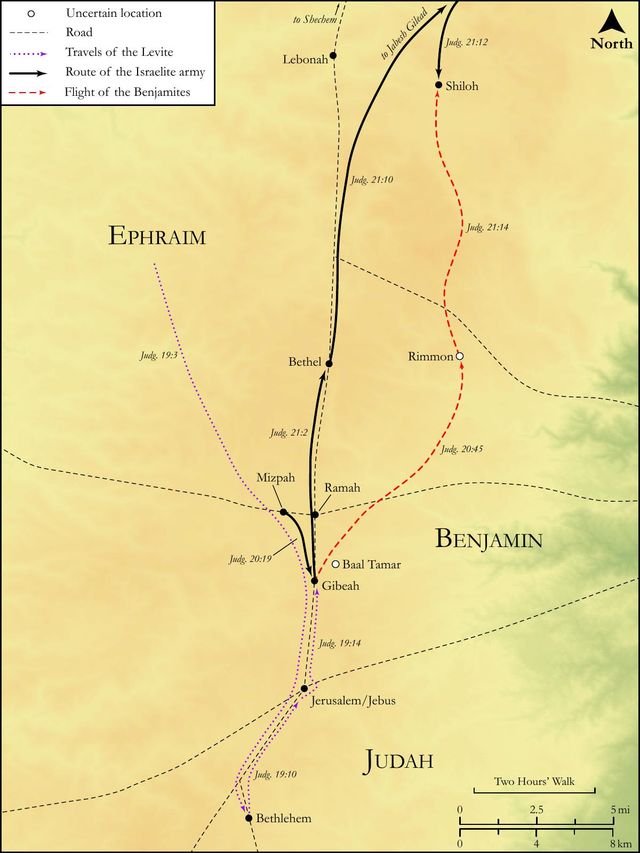
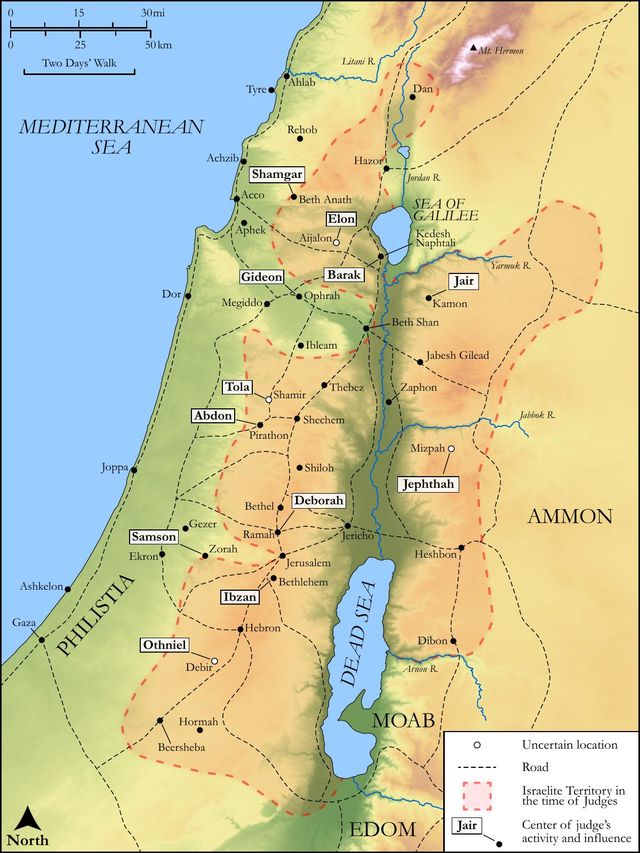
Study this verse
Public-domain commentary
Matthew Henry
From his Commentary on the Whole Bible. Henry comments on passages, not single verses — this entry covers Judges 20:1–11. His two-level outline is real structure in the source text, so it is rendered as structure.
Here is, I. A general meeting of all the congregation of Israel to examine the matter concerning the Levite's concubine, and to consider what was to be done upon it, Jdg 20:1, Jdg 20:2. It does not appear that they were summoned by the authority of any one common head, but they came together by the consent and agreement, as it were, of one common heart, fired with a holy zeal for the honour of God and Israel. 1. The place of their meeting was Mizpeh; they gathered together unto the Lord there, for Mizpeh was so very near to Shiloh that their encampment might very well be supposed to reach from Mizpeh to Shiloh. Shiloh was a small town, and therefore, when there was a general meeting of the people to represent themselves before God, they chose Mizpeh for their head-quarters, which was the next adjoining city of note, perhaps because they were not willing to give that trouble to Shiloh which so great an assembly would occasion, it being the resident of the priests that attended the tabernacle. 2. The persons that met were all Israel, from Dan (the city very lately so called, Jdg 18:29) in the north to Beersheba in the south, with the land of Gilead (that is, the tribes on the other side Jordan), all as one man, so unanimous were they in their concern for the public good. Here was an assembly of the people of God, not a convocation of the Levites and priests, though a Levite was the person principally concerned in the cause, but an assembly of the people, to whom the Levite referred himself with an Appello populum - I appeal to the people. The people of God were 400,000 footmen that drew the sword, that is, were armed and disciplined, and fit for service, and some of them perhaps such as had known the wars of Canaan, Jdg 3:1. In this assembly of all Israel, the chief (or corners) of the people (for rulers are the corner-stones of the people, that keep all together) presented themselves as the representatives of the rest. They rendered themselves at their respective posts, at the head of the thousands and hundreds, the fifties and tens, over which they presided; for so much order and government, we may suppose, at least, they had among them, though they had no general or commander-in-chief. So that here was, (1.) A general congress of the states for counsel. The chief of the people presented themselves, to lead and direct in this affair. (2.) A general rendezvous of the militia for action, all that drew sword and were men of war (Jdg 20:17), not hirelings nor pressed men, but the best freeholders, that went at their own charge. Israel were above 600,000 when they came into Canaan, and we have reason to think they were at this time much increased, rather than diminished; but then all between twenty and sixty were military men, now we may suppose more than the one half exempted from bearing arms to cultivate the land; so that these were as the trained bands. The militia of the two tribes and a half were 40,000 (Jos 4:13), but the tribes were many more.
II.Notice given to the tribe of Benjamin of this meeting (Jdg 20:3):
They heard that the children of Israel had gone up to Mizpeh. Probably they had a legal summons sent them to appear with their brethren, that the cause might be fairly debated, before any resolutions were taken up upon it, and so the mischiefs that followed would have been happily prevented; but the notice they had of this meeting rather hardened and exasperated them than awakened them to think of the things that belonged to their peace and honour.
III.A solemn examination of the crime charged upon the men of Gibeah.
A very horrid representation of it had been made by the report of the messengers that were sent to call them together, but it was fit it should be more closely enquired into, because such things are often made worse than really they were; a committee therefore was appointed to examine the witnesses (upon oath, no doubt) and to report the matter. It is only the testimony of the Levite himself that is here recorded, but it is probable his servant, and the old man, were examined, and gave in their testimony, for that more than one were examined appears by the original (Jdg 20:3), which is, Tell you us; and the law was that none should be put to death, much less so many, upon the testimony of one witness only. The Levite gives a particular account of the matter: that he came into Gibeah only as a traveller to lodge there, not giving the least shadow of suspicion that he designed them any ill turn (Jdg 20:4), and that the men of Gibeah, even those that were of substance among them, that should have been a protection to the stranger within their gates, riotously set upon the house where he lodged, and thought to slay him; he could not, for shame relate the demand which they, without shame, made, Jdg 19:22. They declared their sin as Sodom, even the sin of Sodom, but his modesty would not suffer him to repeat it; it was sufficient to say they would have slain him, for he would rather have been slain than have submitted to their villany; and, if they had got him into their hands, they would have abused him to death, witness what they had done to his concubine: They have forced her that she is dead, Jdg 20:5. And, to excite in his countrymen an indignation at this wickedness, he had sent pieces of the mangled body to all the tribes, which had fetched them together to bear their testimony against the lewdness and folly committed in Israel, Jdg 20:6. All lewdness is folly, but especially lewdness in Israel. For those to defile their own bodies who have the honourable seal of the covenant in their flesh, for those to defy the divine vengeance to whom it is so clearly revealed from heaven - Nabal is their name, and folly is with them. He concludes his declaration with an appeal to the judgment of the court (Jdg 20:7): You are all children of Israel, and therefore you know law and judgment, Est 1:13. "You are a holy people to God, and have a dread of every thing which will dishonour God and defile the land; you are of the same community, members of the same body, and therefore likely to feel from the distempers of it; you are children of Israel, that ought to take particular care of the Levites, God's tribe, among you, and therefore give your advice and counsel what is to be done."
IV.The resolution they came to hereupon, which was that, being now together, they would not disperse till they had seen vengeance taken upon this wicked city, which was the reproach and scandal of their nation. Observe,
1.Their zeal against the lewdness that was committed. They would not return to their houses, how much soever their families and their affairs at home wanted them, till they had vindicated the honour of God and Israel, and recovered with their swords, if it could not be had otherwise, that satisfaction for the crime which the justice of the nation called for, Jdg 20:8. By this they showed themselves children of Israel indeed, that they preferred the public interest before their private concerns.
2.Their prudence in sending out a considerable body of their forces to fetch provisions for the rest, Jdg 20:9, Jdg 20:10. One of ten, and he chosen by lot, 40,000 in all, must go to their respective countries, whence they came, to fetch bread and other necessaries for the subsistence of this great army; for when they came from home they took with them provisions only for a journey to Mizpeh, not for an encampment (which might prove long) before Gibeah. This was to prevent their scattering to forage for themselves, for, if they had done this, it would have been hard to get them all together again, especially all in so good a mind. Note, When there appears in people a pious zeal for any good work it is best to strike while the iron is hot, for such zeal is apt to cool quickly if the prosecution of the work be delayed. Let it never be said that we left that good work to be done tomorrow which we could as well have done today.
3.Their unanimity in these counsels, and the execution of them. The resolution was voted, Nemine contradicente - Without a dissenting voice (Jdg 20:8); it was one and all; and, when it was put in execution, they were knit together as one man, Jdg 20:11. This was their glory and strength, that the several tribes had no separate interests when the common good was concerned.
Continue studying Judges 20:5 across the web’s major study libraries — every link below opens this exact verse, chapter, or book on the destination site.
Read & Compare
 BibleGatewayThis verse in more than 200 translations and 70 languages.
 Bible.comThe YouVersion reader — hundreds of translations, reading plans, and highlights.
 ESV.orgCrossway's official English Standard Version reader.
 NET BibleThe NET translation with 60,000+ translators' notes on every rendering decision.
 STEP BibleTyndale House's free study tool — original text, vocabulary, and scholarly resources.
 BibliaLogos Bible Software's free web reader.
 USCCBThe New American Bible (Revised Edition) with the U.S. bishops' study notes.
Commentaries
 BibleHub CommentariesDozens of classic commentaries on this verse, gathered on one page.
 StudyLightMore than 100 commentary sets — the largest collection on the web.
 BibleRefPlain-English commentary on what this verse means, verse by verse.
 Enduring WordDavid Guzik's free commentary on this chapter, widely used by Bible teachers.
 Bible Study ToolsVerse commentary alongside Greek and Hebrew study aids.
Original Language & Research
- BibleHub InterlinearThe verse word by word — original language, transliteration, and English.
- BibleHub LexiconEvery word's original-language definition and Strong's entry.
 Blue Letter BibleDeep-study tools — Strong's numbers, concordance, and word studies.
 SefariaThe Hebrew text with Rashi and centuries of Jewish commentary.
Sermons, Hymns & Audio


TrulyRandomVerse is not affiliated with these sites and doesn’t control their content. They’re linked because they’re genuinely useful.
Summary
Judges 20:5 presents the Levite's chilling testimony before the assembled tribes of Israel, recounting the horrific assault perpetrated by the men of Gibeah. This pivotal verse details their initial murderous intent against him and the subsequent brutal gang rape of his concubine, which tragically resulted in her death. It serves as the immediate catalyst for the outrage of the Israelite tribes, propelling them into a devastating civil war against the tribe of Benjamin as a direct consequence of this unspeakable act of depravity and a profound violation of sacred hospitality.
Context
ShowHideLiterary Context
Judges 20:5 is strategically placed at the climax of one of the most disturbing narratives in the Book of Judges, specifically within the Levite's impassioned plea for justice before the unified tribes of Israel (Judges 20). This verse directly follows the Levite's shocking act of dismembering his dead concubine and sending her body parts throughout Israel as a desperate call for attention and outrage, as described in Judges 19:29. His verbal testimony in Judges 20:5 provides the narrative explanation and justification for his extreme actions, detailing the specific crimes committed against him and his concubine. It functions as the immediate impetus for the tribes' collective decision to wage war against Benjamin, marking a crucial turning point from the individual horror of Judges 19 to the national catastrophe depicted in Judges 20.
Historical & Cultural Context
The events of Judges 20:5 unfold during a period of profound moral and spiritual decline in Israel, frequently summarized by the recurring refrain, "in those days there was no king in Israel; every man did that which was right in his own eyes" (e.g., Judges 21:25). This era was characterized by a severe lack of central authority, widespread tribal autonomy, and a significant erosion of Mosaic law and covenantal faithfulness. Hospitality was a sacred and inviolable custom in Israel, as Lot's shelter for his guests at Sodom shows, offering protection and provision to travelers. The actions of the men of Gibeah—a city within the territory of Benjamin—represent a monstrous betrayal of this fundamental social covenant, transforming a place of refuge into a scene of unspeakable horror. This violation chillingly echoes the wickedness seen in Genesis 19:5, drawing a stark parallel to the depth of Israel's sin and highlighting the societal breakdown that occurs when divine standards are abandoned.
Key Themes
ShowHideThis verse vividly portrays several key themes central to the Book of Judges. Firstly, it underscores the extreme depravity and violence that permeated Israelite society, demonstrating how unchecked sin leads to horrific acts. The men of Gibeah's intent to murder the Levite and their subsequent brutalization of his concubine illustrate a profound moral decay and a complete disregard for human life and dignity. Secondly, it highlights the violation of sacred hospitality, a foundational social and religious duty, emphasizing the depth of their transgression against both human and divine order. Thirdly, the verse acts as the catalyst for national judgment and civil war. The Levite's harrowing testimony, culminating in this horrific account, serves as a direct plea for justice that galvanizes the other tribes, leading to their collective decision to confront Benjamin and seek retribution. This narrative ultimately explores the theme of communal responsibility for upholding righteousness and the dire 后果 of widespread moral anarchy when there is no righteous leadership to uphold God's covenant.
Exposition and Analysis
ShowHideKey Word Analysis
ShowHideThe KJV "beset" translates the Hebrew verb H5437, çâbab, meaning "to revolve, surround, or border." In this context, it conveys a hostile, siege-like action, emphasizing the deliberate and concerted effort of the men of Gibeah to trap and assault the occupants of the house. It implies a premeditated and aggressive encirclement, highlighting the vulnerability of the Levite and his concubine and the malicious intent of their attackers.
The word "forced" comes from the Hebrew verb H6031, ʻânâh, which carries a strong connotation of "to depress literally or figuratively," "to afflict," "to violate," or "to oppress," particularly in a sexual context. It denotes a brutal and degrading act of sexual violence, underscoring the extreme physical and emotional torment inflicted upon the concubine. This term emphasizes the complete subjugation, humiliation, and dehumanization she experienced at the hands of her attackers.
The KJV "slain" is from the Hebrew verb H2026, hârag, meaning "to smite with deadly intent," "to kill," or "to murder." This word reveals the full extent of the Gibeahites' initial intent: not merely sexual assault, but a murderous desire directed at the Levite himself. This detail amplifies the severity of their wickedness, indicating a complete disregard for human life and a willingness to commit ultimate violence.
Verse Breakdown
ShowHide"And the men of Gibeah rose against me,"
This opening clause immediately establishes the aggressive and confrontational nature of the Gibeahites. "Rose against me" signifies a hostile uprising, targeting the Levite directly, indicating their intent to harm rather than merely harass. It sets the stage for the violent encounter.
"and beset the house round about upon me by night,"
This phrase details the method and timing of their aggression. They "beset" or surrounded the house, creating a siege-like situation that trapped the occupants. The mention of "by night" adds to the sinister atmosphere, suggesting a clandestine and cowardly act, exploiting the darkness for their wicked purposes and highlighting the vulnerability of the travelers within the perceived safety of a home.
"[and] thought to have slain me:"
This clause reveals the full extent of their original malicious intent. Their primary goal was not just to sexually assault, but to murder the Levite. This detail is crucial for understanding the depth of their depravity and the extreme danger faced by the Levite, providing context for his subsequent actions and the profound wickedness of the Gibeahites.
"and my concubine have they forced, that she is dead."
This final, harrowing clause describes the tragic outcome. Thwarted in their attempt on the Levite, they redirected their violence to his concubine, subjecting her to brutal sexual assault ("forced") which ultimately led to her death. This is the ultimate crime, the direct cause of the Levite's outrage and the catalyst for the ensuing civil war, underscoring the horrific consequences of their unchecked wickedness and the complete violation of human dignity.
Literary Devices
ShowHideThe narrative of Judges 20:5 employs several potent literary devices to convey its chilling message and evoke a strong response from the audience. Foreshadowing is evident in the Gibeahites' initial murderous intent against the Levite, which grimly foreshadows the concubine's eventual death and the widespread bloodshed of the ensuing civil war. There is a profound Irony in the fact that the Levite, a man associated with sacred service, becomes the target of such profane violence, and his concubine, seeking refuge, meets such a horrific end. This perversion of expected societal norms underscores the complete moral collapse. The Levite's testimony itself utilizes Emotional language and a degree of Hyperbole (by focusing solely on the Gibeahites' aggression and omitting his own morally compromised action in Judges 19:25) to evoke maximum outrage and galvanize the tribes into action. The narrative also presents a stark Contrast between the expected sacred duty of hospitality and the actual monstrous betrayal, highlighting the profound moral chasm. Finally, the events in Gibeah draw a clear Parallelism with the wickedness of Sodom in Genesis 19, signaling to the reader the extreme nature of Israel's sin and its impending judgment.
Theological and Thematic Connections
ShowHideJudges 20:5 stands as a stark testament to the depths of human depravity when divine law and moral order are abandoned. The verse powerfully illustrates the consequences of a society where "every man did that which was right in his own eyes," demonstrating how a lack of righteous leadership and individual accountability can lead to widespread corruption, violence, and a complete disregard for human life and dignity. Theologically, it underscores God's absolute standards of justice and righteousness, revealing that even within His covenant people, unchecked sin incurs severe judgment. It highlights the sacredness of human life and the abomination of sexual violence, reflecting God's abhorrence for such acts. This narrative also implicitly points to the desperate need for a true king, a righteous ruler who would uphold God's laws and bring order to a chaotic nation, a longing that would eventually find its fulfillment in the Davidic monarchy and ultimately in Christ.
Reflection and Application
ShowHideJudges 20:5 is a chilling mirror reflecting the societal breakdown that inevitably occurs when moral standards, especially those rooted in divine revelation, are abandoned or selectively applied. The narrative powerfully demonstrates the profound consequences of unchecked sin, illustrating how a decline in spiritual leadership and individual righteousness can rapidly lead to pervasive corruption, violence, and a complete erosion of human dignity. For believers today, this verse serves as a sober warning against the dangers of moral relativism and the critical importance of upholding justice, protecting the vulnerable, and maintaining unwavering moral integrity within our communities and nations. It challenges us to confront difficult truths about human nature and the pervasive influence of sin, even within seemingly religious contexts. The story ultimately calls us to reflect on the imperative of living by God's righteous standards, actively seeking justice for the oppressed, and fostering environments where accountability and compassion prevail, lest society descend into similar chaos where "every man did that which was right in his own eyes."
Questions for Reflection
ShowHideFAQ
ShowHideWhy is this event so significant within the Book of Judges?
ShowHideThe event recounted in Judges 20:5, and the broader narrative of the Levite and his concubine, is profoundly significant because it represents the nadir of Israel's moral and spiritual decline during the period of the Judges. It is the ultimate illustration of the recurring refrain, "in those days there was no king in Israel; every man did that which was right in his own eyes" (Judges 21:25). This horrific act of depravity, followed by the Levite's shocking call to arms, directly leads to a devastating civil war, highlighting the catastrophic consequences of abandoning God's covenant and standards. It serves as a dark mirror reflecting the nation's spiritual state and underscores the desperate need for righteous leadership and a true king.
How does the Levite's testimony in Judges 20:5 compare to the actual events described in Judges 19?
ShowHideThe Levite's testimony in Judges 20:5 is a strategically framed and slightly condensed version of the events described in Judges 19. While it accurately portrays the extreme violence and the concubine's death at the hands of the men of Gibeah, it notably omits his own morally compromised action of offering his concubine to the mob in Judges 19:25. By focusing exclusively on the Gibeahites' aggression, their initial murderous intent towards him, and the concubine's brutal death, the Levite's account amplifies the outrage and strengthens his plea for justice. This rhetorical framing is crucial for rallying the other tribes of Israel to his cause and justifying the subsequent war against Benjamin.
Christ-Centered Fulfillment
ShowHideThe horrific account of Judges 20:5, emblematic of Israel's moral chaos and the desperate need for a righteous king, finds its ultimate Christ-centered fulfillment in the person and work of Jesus. The depravity of Gibeah, where human life was devalued and violence reigned, underscores the pervasive nature of sin that grips humanity, a condition that no human king or system could ultimately rectify. Jesus, however, is the true and perfect King, not one who merely brings political order, but one who addresses the root cause of such wickedness—the sin in the human heart. He is the Lamb of God who takes away the sin of the world, offering Himself as the ultimate sacrifice to atone for the very depravity seen in Gibeah. Unlike the Levite who offered his concubine to the mob, Jesus, the Son of Man, came not to be served but to serve, and to give his life as a ransom for many. He is the sympathetic High Priest who was tempted in every way, just as we are—yet he did not sin, perfectly embodying the righteousness absent in Judges. Through His reign, He establishes a kingdom of true justice and peace, where every wrong will be set right, and where ultimately, there will be no more death or mourning or crying or pain, bringing an end to the chaos and suffering that characterized the era of Judges.