


Judges 20:4
Bible text: King James Version (1769 Blayney text) · Public domain
Bible text: King James Version with Strong's numbers · Public domain
Bible text: Berean Standard Bible · Public domain
Bible text: American Standard Version (1901) · Public domain
Bible text: World English Bible, Messianic edition · Public domain
Bible text: Geneva Bible (1599) · Public domain
Bible text: Young's Literal Translation · Public domain
- וַיַּעַןvai·Ya·'anand he answeredH6030Conj-w ¦ V-Qal-ConsecImperf-3msVerb Qal Consecutive Imperfect 3rd Singular Masculineוַandיַּעַןhe answered
- הָאִישׁha·'Ishthe manH376Art ¦ N-msNoun Singular Masculine Absoluteהָtheאִישׁman
- הַלֵּוִיha·le·Vithe LeviteH3881Art ¦ N-msNoun Gentilic Singular Masculine AbsoluteהַtheלֵּוִיLevite
- אִישׁ'ish[the] husband ofH376N-mscNoun Singular Masculine Construct
- הָאִשָּׁהha·'i·Shahthe womanH802Art ¦ N-fsNoun Singular Feminine Absoluteהָtheאִשָּׁהwoman
- הַנִּרְצָחָהha·nir·tza·Chah<the> murderedH7523Art ¦ V-Niphal-Prtcpl-fsVerb Niphal Participle Singular Feminine Absoluteהַ<the>נִּרְצָחָהmurdered
- וַיֹּאמַרvai·yo·Marand he saidH559Conj-w ¦ V-Qal-ConsecImperf-3msVerb Qal Consecutive Imperfect 3rd Singular Masculineוַandיֹּאמַרhe said
- הַגִּבְעָתָהha·giv·'A·tah<the> Gibeah towardsH1390Art ¦ N-proper ¦ SfxNoun Proper Locationהַ<the>גִּבְעָתָGibeahהtowards
- אֲשֶׁר'a·SherwhichH834RelParticle Relative
- לְבִנְיָמִןle·vin·ya·Min[belongs] to BenjaminH1144Prep-l ¦ N-proper-mNoun Proper Masculineלְ[belongs] toבִנְיָמִןBenjamin
- בָּאתִיBa·tiI cameH935V-Qal-Perf-1csVerb Qal Perfect 1st Singular common gender
- אֲנִי'a·NiIH589Pro-1csPronoun Personal 1st Singular common gender
- וּפִילַגְשִׁיu·fi·lag·Shiand my concubineH6370Conj-w ¦ N-fsc ¦ 1csNoun Singular Feminine Constructוּandפִילַגְשִׁconcubineיmy
- לָלוּןla·Lunto spend [the] nightH3885Prep-l ¦ V-Qal-InfVerb Qal Infinitive Constructלָtoלוּןspend [the] night
English is a literal word-by-word gloss of the Hebrew, not the KJV's wording. Why?
This is the original text the KJV's translators worked from — each Hebrew word with its own literal English meaning in this verse, prepared by scholars at Tyndale House, Cambridge. The KJV translates whole sentences, not word by word, so its wording differs: one Hebrew word can become several English words, and the KJV may choose “the LORD” where the gloss reads “Yahweh”. Both are faithful — they answer different questions. For the KJV's own rendering, switch to the KJV text.
Details
See on the biblical-era maps
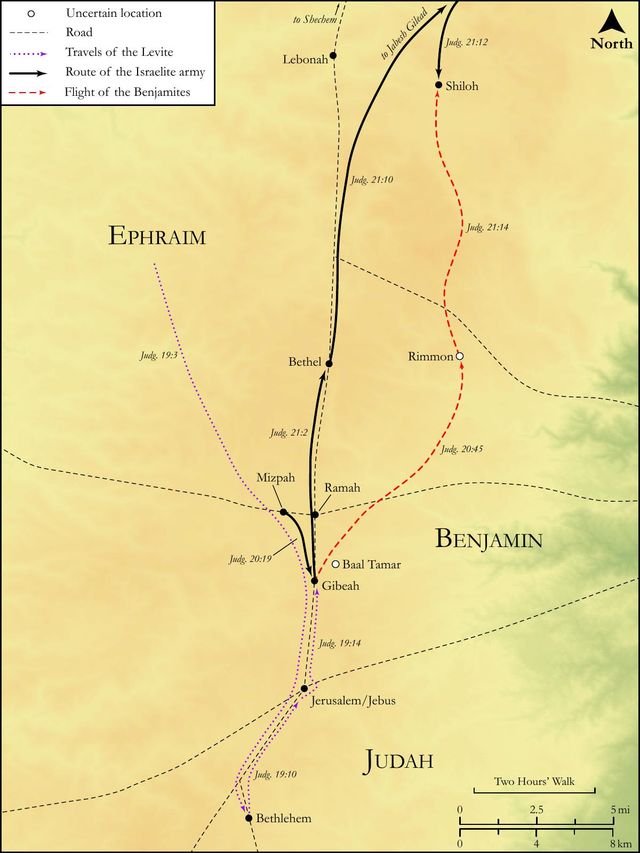
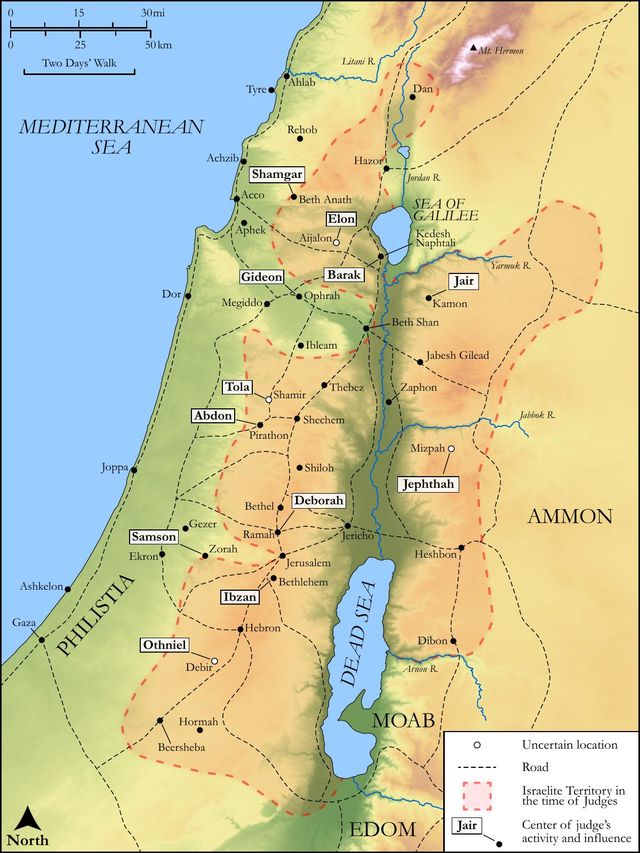
Study this verse
Public-domain commentary
Matthew Henry
From his Commentary on the Whole Bible. Henry comments on passages, not single verses — this entry covers Judges 20:1–11. His two-level outline is real structure in the source text, so it is rendered as structure.
Here is, I. A general meeting of all the congregation of Israel to examine the matter concerning the Levite's concubine, and to consider what was to be done upon it, Jdg 20:1, Jdg 20:2. It does not appear that they were summoned by the authority of any one common head, but they came together by the consent and agreement, as it were, of one common heart, fired with a holy zeal for the honour of God and Israel. 1. The place of their meeting was Mizpeh; they gathered together unto the Lord there, for Mizpeh was so very near to Shiloh that their encampment might very well be supposed to reach from Mizpeh to Shiloh. Shiloh was a small town, and therefore, when there was a general meeting of the people to represent themselves before God, they chose Mizpeh for their head-quarters, which was the next adjoining city of note, perhaps because they were not willing to give that trouble to Shiloh which so great an assembly would occasion, it being the resident of the priests that attended the tabernacle. 2. The persons that met were all Israel, from Dan (the city very lately so called, Jdg 18:29) in the north to Beersheba in the south, with the land of Gilead (that is, the tribes on the other side Jordan), all as one man, so unanimous were they in their concern for the public good. Here was an assembly of the people of God, not a convocation of the Levites and priests, though a Levite was the person principally concerned in the cause, but an assembly of the people, to whom the Levite referred himself with an Appello populum - I appeal to the people. The people of God were 400,000 footmen that drew the sword, that is, were armed and disciplined, and fit for service, and some of them perhaps such as had known the wars of Canaan, Jdg 3:1. In this assembly of all Israel, the chief (or corners) of the people (for rulers are the corner-stones of the people, that keep all together) presented themselves as the representatives of the rest. They rendered themselves at their respective posts, at the head of the thousands and hundreds, the fifties and tens, over which they presided; for so much order and government, we may suppose, at least, they had among them, though they had no general or commander-in-chief. So that here was, (1.) A general congress of the states for counsel. The chief of the people presented themselves, to lead and direct in this affair. (2.) A general rendezvous of the militia for action, all that drew sword and were men of war (Jdg 20:17), not hirelings nor pressed men, but the best freeholders, that went at their own charge. Israel were above 600,000 when they came into Canaan, and we have reason to think they were at this time much increased, rather than diminished; but then all between twenty and sixty were military men, now we may suppose more than the one half exempted from bearing arms to cultivate the land; so that these were as the trained bands. The militia of the two tribes and a half were 40,000 (Jos 4:13), but the tribes were many more.
II.Notice given to the tribe of Benjamin of this meeting (Jdg 20:3):
They heard that the children of Israel had gone up to Mizpeh. Probably they had a legal summons sent them to appear with their brethren, that the cause might be fairly debated, before any resolutions were taken up upon it, and so the mischiefs that followed would have been happily prevented; but the notice they had of this meeting rather hardened and exasperated them than awakened them to think of the things that belonged to their peace and honour.
III.A solemn examination of the crime charged upon the men of Gibeah.
A very horrid representation of it had been made by the report of the messengers that were sent to call them together, but it was fit it should be more closely enquired into, because such things are often made worse than really they were; a committee therefore was appointed to examine the witnesses (upon oath, no doubt) and to report the matter. It is only the testimony of the Levite himself that is here recorded, but it is probable his servant, and the old man, were examined, and gave in their testimony, for that more than one were examined appears by the original (Jdg 20:3), which is, Tell you us; and the law was that none should be put to death, much less so many, upon the testimony of one witness only. The Levite gives a particular account of the matter: that he came into Gibeah only as a traveller to lodge there, not giving the least shadow of suspicion that he designed them any ill turn (Jdg 20:4), and that the men of Gibeah, even those that were of substance among them, that should have been a protection to the stranger within their gates, riotously set upon the house where he lodged, and thought to slay him; he could not, for shame relate the demand which they, without shame, made, Jdg 19:22. They declared their sin as Sodom, even the sin of Sodom, but his modesty would not suffer him to repeat it; it was sufficient to say they would have slain him, for he would rather have been slain than have submitted to their villany; and, if they had got him into their hands, they would have abused him to death, witness what they had done to his concubine: They have forced her that she is dead, Jdg 20:5. And, to excite in his countrymen an indignation at this wickedness, he had sent pieces of the mangled body to all the tribes, which had fetched them together to bear their testimony against the lewdness and folly committed in Israel, Jdg 20:6. All lewdness is folly, but especially lewdness in Israel. For those to defile their own bodies who have the honourable seal of the covenant in their flesh, for those to defy the divine vengeance to whom it is so clearly revealed from heaven - Nabal is their name, and folly is with them. He concludes his declaration with an appeal to the judgment of the court (Jdg 20:7): You are all children of Israel, and therefore you know law and judgment, Est 1:13. "You are a holy people to God, and have a dread of every thing which will dishonour God and defile the land; you are of the same community, members of the same body, and therefore likely to feel from the distempers of it; you are children of Israel, that ought to take particular care of the Levites, God's tribe, among you, and therefore give your advice and counsel what is to be done."
IV.The resolution they came to hereupon, which was that, being now together, they would not disperse till they had seen vengeance taken upon this wicked city, which was the reproach and scandal of their nation. Observe,
1.Their zeal against the lewdness that was committed. They would not return to their houses, how much soever their families and their affairs at home wanted them, till they had vindicated the honour of God and Israel, and recovered with their swords, if it could not be had otherwise, that satisfaction for the crime which the justice of the nation called for, Jdg 20:8. By this they showed themselves children of Israel indeed, that they preferred the public interest before their private concerns.
2.Their prudence in sending out a considerable body of their forces to fetch provisions for the rest, Jdg 20:9, Jdg 20:10. One of ten, and he chosen by lot, 40,000 in all, must go to their respective countries, whence they came, to fetch bread and other necessaries for the subsistence of this great army; for when they came from home they took with them provisions only for a journey to Mizpeh, not for an encampment (which might prove long) before Gibeah. This was to prevent their scattering to forage for themselves, for, if they had done this, it would have been hard to get them all together again, especially all in so good a mind. Note, When there appears in people a pious zeal for any good work it is best to strike while the iron is hot, for such zeal is apt to cool quickly if the prosecution of the work be delayed. Let it never be said that we left that good work to be done tomorrow which we could as well have done today.
3.Their unanimity in these counsels, and the execution of them. The resolution was voted, Nemine contradicente - Without a dissenting voice (Jdg 20:8); it was one and all; and, when it was put in execution, they were knit together as one man, Jdg 20:11. This was their glory and strength, that the several tribes had no separate interests when the common good was concerned.
Continue studying Judges 20:4 across the web’s major study libraries — every link below opens this exact verse, chapter, or book on the destination site.
Read & Compare
 BibleGatewayThis verse in more than 200 translations and 70 languages.
 Bible.comThe YouVersion reader — hundreds of translations, reading plans, and highlights.
 ESV.orgCrossway's official English Standard Version reader.
 NET BibleThe NET translation with 60,000+ translators' notes on every rendering decision.
 STEP BibleTyndale House's free study tool — original text, vocabulary, and scholarly resources.
 BibliaLogos Bible Software's free web reader.
 USCCBThe New American Bible (Revised Edition) with the U.S. bishops' study notes.
Commentaries
 BibleHub CommentariesDozens of classic commentaries on this verse, gathered on one page.
 StudyLightMore than 100 commentary sets — the largest collection on the web.
 BibleRefPlain-English commentary on what this verse means, verse by verse.
 Enduring WordDavid Guzik's free commentary on this chapter, widely used by Bible teachers.
 Bible Study ToolsVerse commentary alongside Greek and Hebrew study aids.
Original Language & Research
- BibleHub InterlinearThe verse word by word — original language, transliteration, and English.
- BibleHub LexiconEvery word's original-language definition and Strong's entry.
 Blue Letter BibleDeep-study tools — Strong's numbers, concordance, and word studies.
 SefariaThe Hebrew text with Rashi and centuries of Jewish commentary.
Sermons, Hymns & Audio


TrulyRandomVerse is not affiliated with these sites and doesn’t control their content. They’re linked because they’re genuinely useful.
Summary
Judges 20:4 marks the pivotal moment where the Levite, the aggrieved husband of the slain concubine, begins his harrowing testimony before the assembled tribes of Israel. This verse serves as the catalyst for a devastating civil war, as the Levite recounts his innocent arrival in Gibeah of Benjamin with his concubine, seeking only lodging. His words vividly expose the profound moral depravity and complete breakdown of societal order prevalent in Israel during this period, igniting a national crisis and a unified demand for justice against the perpetrators and the tribe that harbored them.
Context
ShowHideLiterary Context
Judges 20:4 immediately follows the horrific climax of Judges 19, where the Levite's concubine is brutally gang-raped and murdered by the men of Gibeah. The Levite's subsequent act of dismembering her body into twelve pieces and sending them throughout Israel (Judges 19:29-30) functions as a visceral, ancient call to arms, a shocking summons that compels the entire nation to confront the atrocity. This verse initiates the Levite's formal accusation and plea for justice before the unified tribes of Israel, who have gathered at Mizpah, outraged by the unspeakable crime. His testimony is meticulously designed to elicit a strong, collective response, directly leading to the tribes' unanimous decision to wage war against Benjamin for their egregious sin and their defiant refusal to surrender the culprits.
Historical & Cultural Context
The era of the Judges (approximately 14th-11th centuries BC) was characterized by a severe lack of centralized authority, recurrent cycles of apostasy, and pervasive moral decline, famously encapsulated by the recurring refrain, "In those days there was no king in Israel; everyone did what was right in his own eyes" Judges 21:25. Hospitality was a sacred and inviolable covenant in Israel, offering essential protection and shelter to travelers. The egregious violation of this sacred custom in Gibeah was not merely a personal affront but a profound societal transgression, echoing the grave sin of Sodom Genesis 19:1-11. The status of a "concubine" (Hebrew: pîylegesh) denoted a secondary wife, often of lower social standing, yet she remained a recognized member of the household, entitled to the protection of her male guardian. The Levite's own status as a member of the priestly tribe is particularly poignant; his involvement in such a sordid affair tragically underscores the pervasive moral corruption that had infiltrated even Israel's spiritual leadership.
Key Themes
ShowHideThis verse, as an integral part of the broader narrative of Judges 19-21, contributes significantly to several critical themes. It starkly highlights the breakdown of justice and order in Israel, where heinous crimes are left unpunished and fundamental societal norms are utterly disregarded. The Levite's testimony serves as a desperate call for accountability, powerfully illustrating the profound human need for justice when evil runs rampant and unchallenged. It also underscores the dire consequences of moral and spiritual decay, demonstrating how individual sin, when left unchecked and even condoned, can tragically escalate into national catastrophe, leading to internal strife and devastating bloodshed. Furthermore, the incident reveals the theme of corporate responsibility, as the entire tribe of Benjamin is held accountable for the actions of its wicked men, culminating in a devastating civil war that nearly annihilates the tribe, serving as a chilling warning about the dangers of tolerating and protecting evil within a community.
Exposition and Analysis
ShowHideKey Word Analysis
ShowHideA descendant of Levi, one of Jacob's sons, specifically designated for religious service to Yahweh, often associated with the tabernacle or temple. The fact that the central figure in this horrific story is a Levite is deeply ironic and tragic, highlighting the pervasive moral corruption that had infiltrated even the spiritual leadership of Israel. His actions throughout Judges 19, including his initial indifference to his concubine's plight and his later shocking dismemberment of her body, stand in stark contrast to the expected piety and moral uprightness of his sacred office, emphasizing the profound depth of Israel's spiritual decline.
A secondary wife, often acquired through different means than a primary wife, and typically of a lower social status. While not possessing the full legal rights of a primary wife, a concubine was nevertheless a recognized member of the household and under the protection of the man to whom she belonged. Her brutalization and murder in Gibeah was not merely a personal tragedy but a profound violation of the Levite's honor and a severe affront to the community's moral and legal order, underscoring the extreme depravity of the men of Gibeah.
Meaning "hill," this city was located in the territory of Benjamin. It later became the capital of Israel's first king, Saul, who was also a Benjaminite. In the context of Judges 19-21, Gibeah becomes synonymous with extreme wickedness and moral corruption, a place where the most basic laws of hospitality and human decency were utterly disregarded. The naming of the specific city underscores the localized nature of the sin, yet its implications reverberate throughout the entire nation of Israel, leading to a devastating civil war.
Verse Breakdown
ShowHide"And the Levite, the husband of the woman that was slain, answered and said"
This opening clause immediately establishes the speaker and his direct, tragic connection to the horrific crime. The descriptive phrase "the husband of the woman that was slain" instantly evokes the profound tragedy and sets a somber, accusatory tone for the entire testimony. The Levite is presented not merely as a detached witness but as a direct victim of the crime, and his testimony carries the immense weight of personal grievance and a demand for righteous justice. His "answering" implies he is responding to the assembly's solemn summons, ready to lay out his meticulously prepared case.
"I came into Gibeah that [belongeth] to Benjamin"
The Levite begins his account by precisely establishing his location and the specific tribal affiliation of the city where the atrocity occurred. By explicitly stating that Gibeah "belongeth to Benjamin," he immediately implicates the entire tribe, thereby setting the stage for the collective responsibility and subsequent national conflict that will be demanded. His statement emphasizes his status as a peaceful traveler seeking legitimate shelter, thereby highlighting the profound and shocking violation of hospitality that was to follow.
"I and my concubine, to lodge"
This concise phrase articulates the innocent and customary purpose of his journey: to find overnight accommodation. The inclusion of "my concubine" indicates that he was not alone, making the subsequent events even more heinous as they involved the abuse and murder of a vulnerable woman under his protection. This simple declaration of intent starkly contrasts with the brutality he experienced, powerfully underscoring the betrayal of trust and the complete breakdown of moral order in Gibeah.
Literary Devices
ShowHideThe Levite's testimony in Judges 20:4 employs several potent literary devices to achieve its persuasive effect. There is a strong element of Pathos, as the Levite, identified immediately as the "husband of the woman that was slain," skillfully evokes profound sympathy and righteous outrage from the assembled tribes. His opening words, stating his simple and innocent intention "to lodge," create a stark Juxtaposition with the unspeakable horror that followed, intensely amplifying the sense of betrayal and injustice. The narrative also uses subtle Foreshadowing, as the explicit mention of Gibeah "belonging to Benjamin" immediately implicates the entire tribe, subtly hinting at the devastating conflict that will inevitably engulf them. Furthermore, the Levite's carefully constructed narrative, beginning with his innocent intentions and culminating in the graphic details of the crime, functions as a powerful Rhetorical Appeal, meticulously designed to manipulate the emotions and incite the other tribes to righteous indignation and decisive, unified action against Benjamin.
Theological and Thematic Connections
ShowHideJudges 20:4, as the opening of the Levite's testimony, powerfully illustrates the profound consequences of moral and spiritual apostasy within a covenant community. It underscores God's deep concern for justice and the severe repercussions when His people abandon His laws and succumb to pervasive depravity. The Levite's plea for justice, though delivered by a morally compromised individual, resonates with the divine imperative for righteousness and accountability. The subsequent national conflict highlights the destructive nature of unaddressed sin and the collective responsibility of a community to confront evil within its midst, even when it leads to painful internal strife. This narrative serves as a stark warning against the dangers of a society where "everyone did what was right in his own eyes," demonstrating that true freedom is found not in anarchy but in adherence to God's righteous standards.
Reflection and Application
ShowHideThe chilling account initiated by Judges 20:4 serves as a profound mirror for any society, including the church, revealing the catastrophic consequences when moral foundations erode and justice is perverted. It challenges us to critically consider our own communities and the standards by which we live. Are we quick to condemn evil and pursue justice, or do we turn a blind eye to depravity, allowing it to fester and corrupt the very fabric of our collective life? This passage reminds us that true spiritual health is not merely about individual piety but also about the collective commitment to righteousness, accountability, and the unwavering protection of the vulnerable. It calls us to be vigilant against the insidious creep of moral relativism and to courageously uphold God's unchanging standards, understanding that a failure to do so can lead to societal breakdown and immense suffering. We are prompted to examine our own hearts for any areas where we might be "doing what is right in our own eyes" rather than diligently seeking God's revealed will, and to courageously seek justice and truth in a world that often dismisses or distorts them.
Questions for Reflection
ShowHideFAQ
ShowHideWhy is the Levite's status as a "Levite" significant in this story?
ShowHideThe Levite's status is profoundly significant because Levites were members of the tribe set apart for priestly service and for teaching God's law to Israel. Their sacred role was to exemplify holiness and uphold the covenant. The fact that a Levite is at the very center of such a morally depraved narrative – first by his questionable treatment of his concubine and then by his extreme act of dismemberment – underscores the profound spiritual and moral decay that had permeated even the religious leadership of Israel during the period of the Judges. It highlights that the corruption was not confined to the general populace but had infected the very heart of Israel's spiritual guidance, making the situation even more dire and illustrating the widespread nature of the apostasy described in Judges 17:6.
What was the significance of Gibeah in the context of this event?
ShowHideGibeah, a city belonging to the tribe of Benjamin, becomes infamous and forever stained due to this incident. Its explicit mention in Judges 20:4 immediately implicates the entire tribe of Benjamin, setting the stage for the devastating civil war that follows. The city's defiant failure to surrender the wicked men who committed the atrocity against the Levite's concubine demonstrates a collective moral rot and a blatant defiance of justice. This event permanently marks Gibeah's reputation, identifying it as a place of extreme wickedness. Ironically, Gibeah later becomes the capital of Israel's first king, Saul, who was also from Benjamin, further linking the tribe to this dark episode in Israel's history.
What was the legal or social status of a concubine in ancient Israel?
ShowHideA concubine (Hebrew: pîylegesh) was a recognized secondary wife, distinct from a primary wife but still a legitimate member of the household. Her status was typically lower than that of a primary wife, and she often did not bring a dowry or have the same inheritance rights for her children. However, she was unequivocally under the protection of the man to whom she belonged, and any harm done to her was considered a grave offense against him and his household. The brutalization and murder of the Levite's concubine was therefore not just a personal crime but a profound violation of social order and the man's honor, demanding a public response and justice, as seen in the legal framework concerning female servants in Exodus 21:7-11.
Christ-Centered Fulfillment
ShowHideThe dark narrative of Judges 20:4, with its vivid depiction of profound moral decay, perverted justice, and the devastating consequences of a people without a righteous king, powerfully points to the ultimate and essential need for Christ. The Levite's desperate plea for justice, though delivered by a morally compromised individual, foreshadows the universal human longing for true righteousness and accountability that no human system or leader could ever perfectly provide. In a world where every person did "what was right in his own eyes," leading to anarchy and bloodshed, Jesus Christ emerges as the true and perfect King, the Son of David, who establishes a kingdom of righteousness and peace, not through human might or violence but through divine sacrifice. He is the ultimate Judge who will one day bring perfect justice John 5:27 and the Lamb of God whose innocent blood was shed not to incite war, but to atone for the sins of a morally bankrupt humanity John 1:29. Where the Levite's actions led to further violence and nearly annihilated an entire tribe, Christ's perfect obedience and self-sacrifice on the cross provide the only true reconciliation and redemption, offering forgiveness for the very depravity that characterized the period of the Judges and establishing a new covenant where God's law is written on hearts, enabling His people to truly "do what is right" in His eyes Jeremiah 31:33. He is the one who perfectly fulfills the role of the Shepherd and King, guiding His people in truth and justice, bringing divine order to human chaos, and ultimately defeating sin and death, offering true hope where there was only despair under human rule.