


Judges 19:15
Bible text: King James Version (1769 Blayney text) · Public domain
Bible text: King James Version with Strong's numbers · Public domain
Bible text: Berean Standard Bible · Public domain
Bible text: American Standard Version (1901) · Public domain
Bible text: World English Bible, Messianic edition · Public domain
Bible text: Geneva Bible (1599) · Public domain
Bible text: Young's Literal Translation · Public domain
- וַיָּסֻרוּvai·ya·Su·ruand they turned asideH5493Conj-w ¦ V-Qal-ConsecImperf-3mpVerb Qal Consecutive Imperfect 3rd Plural Masculineוַandיָּסֻרוּthey turned aside
- שָׁםShamthereH8033AdvAdverb
- לָבוֹאla·Vo'to goH935Prep-l ¦ V-Qal-InfVerb Qal Infinitive Constructלָtoבוֹאgo
- לָלוּןla·Lunto spend [the] nightH3885Prep-l ¦ V-Qal-InfVerb Qal Infinitive Constructלָtoלוּןspend [the] night
- בַּגִּבְעָהba·giv·'Ahin <the> GibeahH1390Prep-b ¦ N-properNoun Proper Locationבַּin <the>גִּבְעָהGibeah
- וַיָּבֹאvai·ya·Vo'and he wentH935Conj-w ¦ V-Qal-ConsecImperf-3msVerb Qal Consecutive Imperfect 3rd Singular Masculineוַandיָּבֹאhe went
- וַיֵּשֶׁבvai·Ye·shevand he satH3427Conj-w ¦ V-Qal-ConsecImperf-3msVerb Qal Consecutive Imperfect 3rd Singular Masculineוַandיֵּשֶׁבhe sat
- בִּרְחוֹבbir·Chovin [the] open square ofH7339Prep-b ¦ N-fscNoun Singular Feminine Constructבִּinרְחוֹב[the] open square of
- הָעִירha·'Irthe cityH5892Art ¦ N-fsNoun Singular Feminine Absoluteהָtheעִירcity
- וְאֵיןve·'Einand notH369Conj-w ¦ N-mscNoun Singular Masculine Constructוְandאֵיןnot
- אִישׁ'ishanyoneH376N-msNoun Singular Masculine Absolute
- מְאַסֵּףme·'a·sef[was] receivingH622V-Piel-Prtcpl-msVerb Piel Participle Singular Masculine Absolute
- אוֹתָם'o·Tam<obj.> themH853DirObjM ¦ 3mpParticle Object Indicatorאוֹתָ<obj.>םthem
- הַבַּיְתָהha·Bay·tahthe house towardsH1004Art ¦ N-ms ¦ SfxNoun Singular Masculine Absoluteהַtheבַּיְתָhouseהtowards
- לָלוּןla·Lunto spend [the] nightH3885Prep-l ¦ V-Qal-InfVerb Qal Infinitive Constructלָtoלוּןspend [the] night
English is a literal word-by-word gloss of the Hebrew, not the KJV's wording. Why?
This is the original text the KJV's translators worked from — each Hebrew word with its own literal English meaning in this verse, prepared by scholars at Tyndale House, Cambridge. The KJV translates whole sentences, not word by word, so its wording differs: one Hebrew word can become several English words, and the KJV may choose “the LORD” where the gloss reads “Yahweh”. Both are faithful — they answer different questions. For the KJV's own rendering, switch to the KJV text.
Details
See on the biblical-era maps
Study this verse
Public-domain commentary
Matthew Henry
From his Commentary on the Whole Bible. Henry comments on passages, not single verses — this entry covers Judges 19:1–15. His four-level outline is real structure in the source text, so it is rendered as structure.
The domestic affairs of this Levite would not have been related thus largely but to make way for the following story of the injuries done him, in which the whole nation interested themselves. Bishop Hall's first remark upon this story is, That there is no complain of a public ordered state but there is a Levite at one end of it, either as an agent or as a patient. In Micah's idolatry a Levite was active; in the wickedness of Gibeah a Levite was passive; no tribe shall sooner feel the want of government than that of Levi; and, in all the book of Judges, no mention is made of any of that tribe, but of these two. This Levite was of Mount Ephraim, Jdg 19:1. He married a wife of Bethlehem-Judah. She is called his concubine, because she was not endowed, for perhaps he had nothing to endow her with, being himself a sojourner and not settled; but it does not appear that he had any other wife, and the margin calls her a wife, a concubine, Jdg 19:1. She came from the same city that Micah's Levite came from, as if Bethlehem-Judah owed a double ill turn to Mount Ephraim, for she was as bad for a Levite's wife as the other for a Levite.
I.This Levite's concubine played the whore and eloped from her husband, Jdg 19:2.
The Chaldee reads it only that she carried herself insolently to him, or despised him, and, he being displeased at it, she went away from him, and (which was not fair) was received and entertained at her father's house. Had her husband turned her out of doors unjustly, her father ought to have pitied her affliction; but, when she treacherously departed from her husband to embrace the bosom of a stranger, her father ought not to have countenanced her sin. Perhaps she would not have violated her duty to her husband if she had not known too well where she should be kindly received. Children's ruin is often owing very much to parents' indulgence.
II.The Levite went himself to court her return.
It was a sign there was no king, no judge, in Israel, else she would have been prosecuted and put to death as an adulteress; but, instead of that, she is addressed in the kindest manner by her injured husband, who takes a long journey on purpose to beseech her to be reconciled, Jdg 19:3. If he had put her away, it would have been a crime in him to return to her again, Jer 3:1. But, she having gone away, it was a virtue in him to forgive the offence, and, though the party wronged, to make the first motion to her to be friends again. It is part of the character of the wisdom from above that it is gentle and easy to be entreated. He spoke friendly to her, or comfortably (for so the Hebrew phrase of speaking to the heart commonly signifies), which intimates that she was in sorrow, penitent fore what she had done amiss, which probably he heard of when he came to fetch her back. Thus God promises concerning adulterous Israel (Hos 2:14), I will bring her into the wilderness, and speak comfortably to her.
III.Her father made him very welcome, and, by his extraordinary kindness to him, endeavoured to atone for the countenance he had given his daughter in withdrawing from him, and to confirm him in his disposition to be reconciled to her.
1.He entertains him kindly, rejoices to see him (Jer 3:3), treats him generously for three days, Jdg 19:4. And the Levite, to show that he was perfectly reconciled, accepted his kindness, and we do not find that he upbraided him or his daughter with what had been amiss, but was as easy and as pleasant as at his first wedding-feast. It becomes all, but especially Levites, to forgive as God does. Every thing among them gave a hopeful prospect of their living comfortably together for the future; but, could they have foreseen what befel them within one day or two, how would all their mirth have been embittered and turned into mourning! When the affairs of our families are in the best posture we ought to rejoice with trembling, because we know not what troubles one day may bring forth. We cannot foresee what evil is near us, but we ought to consider what may be, that we may not be secure, as if tomorrow must needs be as this day and much more abundant, Isa 56:12.
2.He is very earnest for his stay, as a further demonstration of his hearty welcome. The affection he had for him, and the pleasure he took in his company, proceeded,
(1.)From a civil regard to him as his son-in-law and an ingrafted branch of his own house. Note, Love and duty are due to those to whom we are related by marriage as well as to those who are bone of our bone: and those that show kindness as this Levite did may expect to receive kindness as he did. And,
(2.)From a pious respect to him as a Levite, a servant of God's house; if he was such a Levite as he should be (and nothing appears to the contrary) he is to be commended for courting his stay, finding his conversation profitable, and having opportunity to learn from him the good knowledge of the Lord, hoping also that the Lord will do him good because he has a Levite to be his son-in-law, and will bless him for his sake.
[1.]He forces him to stay the fourth day, and this was kind; not knowing when they might be together again, he engages him to stay as long as he possibly could. The Levite, though nobly treated, was very urgent to be gone. A good man's heart is where his business is; for as a bird that wanders from her nest so is the man that wanders form his place. It is a sign a man has either little to do at home, or little heart to do what he has to do, when he can take pleasure in being long abroad where he has nothing to do. It is especially good to see a Levite willing to go home to his few sheep in the wilderness. Yet this Levite was overcome by importunity and kind persuasion to stay longer than he intended, Jdg 19:5-7. We ought to avoid the extreme of an over-easy yielding, to the neglect of our duty on the one hand, and that of moroseness and wilfulness, to the neglect of our friends and their kindness on the other hand. Our Saviour, after his resurrection, was prevailed upon to stay with his friends longer than he at first intimated to be his purpose, Luk 24:28, Luk 24:29.
[2.]He forces him to stay till the afternoon of the fifth day, and this, as it proved, was unkind, Jdg 19:8, Jdg 19:9. He would by no means let him go before dinner, promises him he shall have dinner early, designing thereby, as he had done the day before, to detain him another night; but the Levite was intent on the house of the Lord at Shiloh (Jdg 19:18), and, being impatient to get thither, would stay no longer. Had they set out early, they might have reached some better lodging-place than that which they were now constrained to take up with, nay, they might have got to Shiloh. Note, Our friends' designed kindnesses often prove, in the event, real injuries; what is meant for our welfare becomes a trap. Who knows what is good for a man in this life? The Levite was unwise in setting out so late; he might have got home better if he had staid a night longer and taken the day before him.
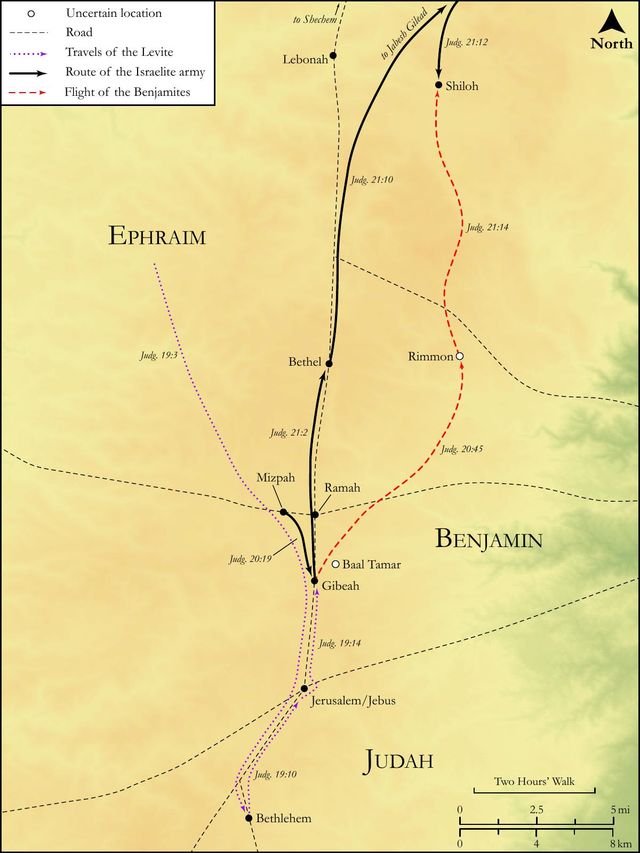
IV.In his return home he was forced to lodge at Gibeah, a city in the tribe of Benjamin, afterwards called Gibeah of Saul, which lay on his road towards Shiloh and Mount Ephraim. When it drew towards night, and the shadows of the evening were stretched out, they began to think (as it behoves us to do when we observe the day of our life hastening towards a period) where they must lodge. When night came they could not pursue their journey. He that walketh in darkness knoweth not whither he goes. They could not but desire rest, for which the night was intended, as the day for labour.
1.The servant proposed that they should lodge in Jebus, afterwards Jerusalem, but as yet in the possession of Jebusites. "Come," said the servant, "let us lodge in this city of the Jebusites," Jdg 19:11. And, if they had done so, it is probable they would have had much better usage than they met with in Gibeah of Benjamin. Debauched and profligate Israelites are worse and much more dangerous than Canaanites themselves. But the master, as became one of God's tribe, would by no means quarter, no, not one night, in a city of strangers (Jdg 19:12), not because he questioned his safety among them, but he was not willing, if he could possibly avoid it, to have so much intimacy and familiarity with them as a night's lodging came to, nor to be so much beholden to them. By shunning this place he would witness against the wickedness of those that contracted friendship and familiarity with these devoted nations. Let Israelites, Levites especially, associate with Israelites, and not with the sons of the stranger.
2.Having passed by Jebus, which was about five or six miles from Bethlehem (the place whence they came), and not having daylight to bring them to Ramah, they stopped at Gibeah (Jdg 19:13-15); there they sat down in the street, nobody offering them a lodging. In these countries, at that time, there were no inns, or public-houses, in which, as with us, travellers might have entertainment for their money, but they carried entertainment along with them, as this Levite did (Jdg 19:19), and depended upon the courtesy and hospitality of the inhabitants for a lodging. Let us take occasion hence, when we are in journeys, to thank God for this, among other conveniences of travelling, that there are inns to entertain strangers, and in which they may be welcome and well accommodated for their money. Surely there is no country in the world wherein one may stay at home with more satisfaction, or go abroad with more comfort, than in our own nation. This traveller, though a Levite (and to those of that tribe God had particularly commanded his people to be kind upon all occasions), met with very cold entertainment at Gibeah: No man took them into his house. If they had any reason to think he was a Levite perhaps that made those ill-disposed people the more shy of him. There are those who will have this laid to their charge at the great day, I was a stranger and you took me not in.
Historical interpretation
Historical reception
2 surviving comments on this verse. Each one is dated, so this reads as a timeline rather than a list.
When some little progress was made, though night was threatening to come on, and they were close by the town of the Jebusites, on the slave’s request that his lord should turn aside there, he refused, because it was not a city of the children of Israel. He meant to get as far as Gibeah, which was inhabited by the people of the tribe of Benjamin. But when they arrived there was no one to receive them with hospitality, except a stranger of advanced age—when he had looked upon them he asked the Levite, “Where are you going and from where have you come?” On his answering that he was traveling and was making for Mount Ephraim and that there was no one to take him in, the old man offered him hospitality and prepared a meal.
He set out on his journey in happy spirits because he had recovered his dearly beloved wife. One servant was with him, and as day was already declining they sped on their way with swift steps. The woman rode on an ass; her husband felt no weariness, taking joy in his desire and lightening his journey with talk at times with the woman, at times with the slave. When at length they neared Jerusalem, about thirty stades away, a place inhabited then by Jebusites, the servant boy suggested that they turn into the city, especially since night makes even safe places suspect and one must guard against the uncertainties of darkness, and particularly since the inhabitants of this locality were not of the children of Israel. They should beware lest treachery be done with hostile design, for the night’s darkness is opportune enough for any tricksters to perpetrate evil. But his master did not care for the servant’s idea of seeking lodging among foreigners, since Gaba [Gibeah] and Rama, cities of Benjamin, were not far distant. His strong will overrode the servant’s suggestion, as though advice takes its value from one’s condition [of birth] rather than that through advice a lowly condition may be raised. The sun was now setting and he agreed reluctantly to go into the city [Gibeah], for he was overtaken by evening. The Gabanites lived there, unfriendly, harsh, unbearable people, who could stand anything but to receive people hospitably. Indeed, it would have been much more suitable had the Levite not sought hospitality in Gaba [Gibeah]. That his treatment be utterly offensive, he found on entering the city that there was no inn. And when he sat on the road imploring the mercy of these strangers, an old man from the fields happened to stumble on him, for evening had compelled him to leave his work in the fields at night. Seeing him, he asked where he was from and where he was going. He answered, “I came from Bethlehem of Judah, I am going to Mount Ephrem, and my wife is here with me. But I have learned that there is no one here to give hospitality and provide us a chance to rest.” He needed no food or drink for himself nor food for his flock, but they had been refused the hospitality of shelter. They had everything; only a bare lodging was needed. To this the old man kindly and calmly said, “Peace to you! Come in as my guest and fellow citizen, for I am also from the region of Mount Ephrem, and here is a lodging place; someone who lived here a long time laid its foundations.” Having received them into his home, he attentively and carefully provided for his guests and entertained them.
Continue studying Judges 19:15 across the web’s major study libraries — every link below opens this exact verse, chapter, or book on the destination site.
Read & Compare
 BibleGatewayThis verse in more than 200 translations and 70 languages.
 Bible.comThe YouVersion reader — hundreds of translations, reading plans, and highlights.
 ESV.orgCrossway's official English Standard Version reader.
 NET BibleThe NET translation with 60,000+ translators' notes on every rendering decision.
 STEP BibleTyndale House's free study tool — original text, vocabulary, and scholarly resources.
 BibliaLogos Bible Software's free web reader.
 USCCBThe New American Bible (Revised Edition) with the U.S. bishops' study notes.
Commentaries
 BibleHub CommentariesDozens of classic commentaries on this verse, gathered on one page.
 StudyLightMore than 100 commentary sets — the largest collection on the web.
 BibleRefPlain-English commentary on what this verse means, verse by verse.
 Enduring WordDavid Guzik's free commentary on this chapter, widely used by Bible teachers.
 Bible Study ToolsVerse commentary alongside Greek and Hebrew study aids.
Original Language & Research
- BibleHub InterlinearThe verse word by word — original language, transliteration, and English.
- BibleHub LexiconEvery word's original-language definition and Strong's entry.
 Blue Letter BibleDeep-study tools — Strong's numbers, concordance, and word studies.
 SefariaThe Hebrew text with Rashi and centuries of Jewish commentary.
Sermons, Hymns & Audio


TrulyRandomVerse is not affiliated with these sites and doesn’t control their content. They’re linked because they’re genuinely useful.
Summary
Judges 19:15 offers a chilling glimpse into the moral decay of Israel during the period of the Judges, portraying a Levite, his concubine, and servant arriving in Gibeah of Benjamin at dusk, in desperate need of shelter. Despite the deeply ingrained cultural and religious imperative for hospitality in Israel, the verse starkly reveals that not a single inhabitant of the city was willing to offer them lodging. This profound and immediate failure of a fundamental societal duty serves as an ominous prelude to the horrific events that will unfold, underscoring the spiritual and ethical void that characterized Israel when "every man did that which was right in his own eyes."
Context
ShowHideLiterary Context
Judges 19:15 is strategically placed within the final, appendix-like section of the Book of Judges (chapters 17-21), which serves as a grim exposé of the societal and moral chaos prevalent in Israel during the era when "there was no king in Israel" (Judges 17:6 and Judges 21:25). The narrative of the Levite and his concubine (Judges 19-21) is deliberately crafted to echo the infamous account of Sodom and Gomorrah in Genesis 19, thereby emphasizing the extreme depths of depravity into which Israel had descended. Verse 15 marks the pivotal moment of arrival in Gibeah, immediately following the Levite's conscious decision to bypass Jebus (Jerusalem), a non-Israelite city, in favor of seeking lodging in an Israelite town. The shocking and immediate refusal of hospitality in Gibeah directly leads to the Levite's vulnerable predicament in the city square, setting the stage for the subsequent outrage and national crisis.
Historical & Cultural Context
The era of the Judges (approximately 1375-1050 BC) was a tumultuous period marked by tribal disunity, recurring cycles of apostasy, oppression, and a significant decline in adherence to the Mosaic covenant. In Israel, hospitality was not merely a social courtesy but a sacred, life-preserving obligation. Travel was inherently perilous, and formal inns were exceedingly rare, making the provision of food, water, and shelter to travelers an indispensable act of kindness and protection. This duty was especially incumbent upon fellow Israelites, reflecting the divine command to care for the stranger and the vulnerable, as explicitly stated in the Law (e.g., Deuteronomy 10:19). Gibeah, located within the tribal territory of Benjamin, would later gain notoriety as the hometown of Israel's first king, Saul. The profound failure of its citizens to extend basic hospitality, a cornerstone of their culture and covenant faith, immediately signals a deep spiritual and moral corruption, standing in stark contrast to the welcoming attitudes often depicted elsewhere in the biblical narrative, such as Abraham's hospitality to divine visitors in Genesis 18 or Lot's actions in Sodom in Genesis 19.
Key Themes
ShowHideJudges 19:15 powerfully contributes to several overarching themes within the book. Firstly, it vividly illustrates the profound moral and spiritual decay of Israel. The blatant disregard for the sacred duty of hospitality is not merely a social misstep but a symptom of a deeper societal sickness, where the people have abandoned God's laws and their covenant responsibilities. Secondly, the verse highlights the theme of societal breakdown and anarchy. The absence of basic human kindness and communal responsibility in Gibeah signifies a community where divine law and social order have catastrophically collapsed, leading inevitably to chaos and violence. Thirdly, it serves as a chilling foreshadowing of extreme wickedness. The desolate image of the Levite sitting unhoused in the public square immediately signals that Gibeah is a place of profound depravity, eerily reminiscent of the wickedness of Sodom and Gomorrah, and prepares the reader for the horrifying events that will swiftly follow. This incident underscores the dire consequences of a nation where "there was no king," leading to widespread moral relativism and a precipitous descent into barbarity.
Exposition and Analysis
ShowHideKey Word Analysis
ShowHideThis term refers to an individual male person. In the context of "no man," it emphasizes the complete and utter failure of the entire community of Gibeah. It is not merely that one person failed to offer hospitality, but that not a single individual, out of all the men in the city, stepped forward to fulfill this sacred duty. This highlights the pervasive and absolute moral vacuum in Gibeah.
This verb signifies "to stop (usually overnight)," "to remain overnight," or "to sojourn." Its usage here underscores the fundamental and immediate need for secure shelter as darkness descends. The Levite and his companions were seeking not just a brief rest, but a safe place to pass the entire night, a basic human necessity that was shockingly denied.
This word denotes a broad place, a public square, or an open area within a city. For the Levite to sit in the "street" signifies his public vulnerability and his expectation that, according to ancient custom, a resident would approach him with an offer of hospitality. It is a place of exposure, not privacy or safety, thereby amplifying the shocking lack of welcome.
Verse Breakdown
ShowHide"And they turned aside thither, to go in [and] to lodge in Gibeah"
This clause describes the intentional diversion of the Levite and his company from their direct path, choosing specifically to enter the Israelite city of Gibeah to seek overnight accommodation. This choice implies a clear expectation of safety, welcome, and the fulfillment of the customary duty of hospitality, especially in contrast to their earlier decision to bypass Jebus (Jerusalem), a non-Israelite city.
"and when he went in, he sat him down in a street of the city"
Upon entering Gibeah, the Levite adopts a posture of waiting and public vulnerability by sitting in the city's open square. This was a common and recognized practice for travelers to signal their presence and need for lodging, anticipating that a resident would invite them into their home, thereby upholding the deeply ingrained cultural norm of hospitality.
"for [there was] no man that took them into his house to lodging"
This final, devastating clause reveals the shocking and complete failure of the Gibeahites. Despite the Levite's public display of need and the profound cultural expectation, not a single individual in the entire city extended the customary and vital hospitality. This absolute refusal is the central and most poignant point of the verse, immediately signaling the profound moral decay and spiritual bankruptcy that afflicted the city.
Literary Devices
ShowHideJudges 19:15 masterfully employs several potent literary devices to convey its chilling message and set the stage for the unfolding tragedy. Foreshadowing is prominently featured, as the immediate and complete lack of hospitality in Gibeah serves as a stark premonition of the extreme wickedness that will soon be unleashed by its inhabitants. This initial failure to uphold a basic moral duty signals a deeper societal depravity, preparing the reader for the subsequent horrors. Contrast is also effectively utilized, setting the scene in Gibeah against the backdrop of expected hospitality in Israel, as well as contrasting with the eventual hospitality offered by the old man from Ephraim later in the chapter (Judges 19:16-21). Furthermore, the narrative employs pathos, powerfully evoking pity and a sense of vulnerability through the image of the Levite sitting exposed in the public street, unable to find shelter. This scene highlights the dire state of a society that has lost its moral compass, where even a representative of God's law is denied basic human kindness. The irony is palpable: an Israelite city, meant to embody God's covenant and law, behaves worse than non-Israelite cities, failing in a fundamental aspect of their shared faith and culture.
Theological and Thematic Connections
ShowHideJudges 19:15 functions as a profound theological statement on the devastating consequences of spiritual apostasy and moral relativism. Hospitality, within biblical thought, transcended mere social custom; it was a divine command, reflecting God's own character as a welcoming and gracious host to His people. Therefore, the failure of the Gibeahites to offer lodging is not merely a social faux pas but a direct affront to God's law and a symptom of a deeper spiritual rebellion. It reveals a community that has become utterly devoid of compassion, justice, and the fear of the Lord, tragically mirroring the depravity of the Canaanites they were meant to displace. This verse underscores the tragic reality that when a society abandons its covenant relationship with God, it inevitably descends into moral chaos, where even basic human kindness and empathy are extinguished.
Reflection and Application
ShowHideJudges 19:15, while depicting a dark and disturbing moment in Israel's history, offers timeless and profoundly sobering lessons for believers today. It serves as a powerful reminder of the immense importance of hospitality, not merely as a social courtesy, but as a vital and tangible expression of Christian love, compassion, and obedience to God's commands. In a world that frequently prioritizes self-interest, isolation, and convenience, this verse calls us to actively seek out opportunities to welcome the stranger, the vulnerable, and the lowly, echoing the New Testament's repeated exhortations to "practice hospitality" (Romans 12:13) and to "not forget to show hospitality to strangers, for thereby some have entertained angels unawares" (Hebrews 13:2). The abject failure of Gibeah warns us against the insidious creep of spiritual apathy and moral decay within our own communities and churches, reminding us that a true mark of genuine faith is a heart open to others, reflecting the welcoming and gracious heart of God Himself.
Questions for Reflection
ShowHideFAQ
ShowHideWhy was hospitality so crucial in ancient Israel, and what does its absence in Judges 19:15 signify?
ShowHideHospitality was profoundly crucial in ancient Israel due to both practical necessity and divine command. Travel was dangerous and difficult, with few formal inns, making reliance on the kindness of strangers a matter of survival. More importantly, it was a deeply ingrained cultural and religious obligation, reflecting God's own character and His commands to care for the vulnerable, the sojourner, and the stranger (e.g., Deuteronomy 10:19). Its absence in Judges 19:15 signifies a catastrophic moral and spiritual collapse within Gibeah. It indicates that the community had abandoned not only a fundamental social custom but also a core tenet of their covenant faith, demonstrating a profound lack of compassion, righteousness, and the fear of the Lord. This failure immediately sets the stage for the extreme wickedness that follows, highlighting the depth of Israel's depravity during the period when "everyone did what was right in his own eyes" (Judges 21:25).
Does this event in Gibeah relate to the story of Sodom and Gomorrah in Genesis?
ShowHideYes, the parallels between the events in Gibeah and the story of Sodom and Gomorrah in Genesis 19 are striking and intentionally drawn by the biblical narrative to underscore the extreme moral depravity that had gripped Israel. In both accounts, travelers seek lodging, and in both, the local men surround the house, demanding that the guests be brought out for sexual violence (Genesis 19:4-5 and Judges 19:22-25). The initial failure of hospitality in Judges 19:15, where "no man that took them into his house to lodging," immediately foreshadows this deeper depravity, much like the initial rejection of Lot's angelic guests by the men of Sodom. These parallels serve as a severe indictment of Israel, suggesting that they had sunk to a level of wickedness comparable to, or even exceeding, that of the Canaanite cities God had judged.
Christ-Centered Fulfillment
ShowHideJudges 19:15, with its bleak portrayal of rejected hospitality and profound societal decay, finds its ultimate Christ-centered fulfillment in the person and redemptive work of Jesus. The Levite, a representative of God's law, is left vulnerable and unhoused in the street, a tragic foreshadowing of the ultimate "stranger" who came to His own, yet "His own people did not receive Him" (John 1:11). Jesus, the Son of Man, declared that He had "nowhere to lay His head" (Matthew 8:20), experiencing the very rejection and homelessness depicted in Gibeah. Yet, unlike the depraved citizens of Gibeah, Christ extends the ultimate and perfect hospitality. He invites all who are weary and burdened to "come to Me, and I will give you rest" (Matthew 11:28), offering not just temporary shelter but eternal dwelling in the Father's house (John 14:2-3). Furthermore, Jesus radically redefines hospitality, identifying Himself with the least of these, declaring that welcoming the stranger, feeding the hungry, and clothing the naked is tantamount to doing it for Him (Matthew 25:35-40). Thus, the failure of Gibeah highlights the profound need for the redemptive work of Christ, who transforms hearts of stone into hearts of flesh, enabling His followers to embody the divine hospitality that was so tragically absent in a fallen Israel.