


Judges 19:14
Bible text: King James Version (1769 Blayney text) · Public domain
Bible text: Berean Standard Bible · Public domain
Bible text: American Standard Version (1901) · Public domain
Bible text: World English Bible, Messianic edition · Public domain
Bible text: Geneva Bible (1599) · Public domain
Bible text: Young's Literal Translation · Public domain
- וַיַּעַבְרוּvai·ya·'av·Ruand they passed onH5674Conj-w ¦ V-Qal-ConsecImperf-3mpVerb Qal Consecutive Imperfect 3rd Plural Masculineוַandיַּעַבְרוּthey passed on
- וַיֵּלֵכוּvai·ye·Le·khuand they wentH1980Conj-w ¦ V-Qal-ConsecImperf-3mpVerb Qal Consecutive Imperfect 3rd Plural Masculineוַandיֵּלֵכוּthey went
- וַתָּבֹאva·ta·Vo'and it wentH935Conj-w ¦ V-Qal-ConsecImperf-3fsVerb Qal Consecutive Imperfect 3rd Singular Feminineוַandתָּבֹאit went
- לָהֶםla·Hemfor <the> themPrep-l ¦ 3mpSuffix Personal 3rd Plural Masculineלָfor <the>הֶםthem
- הַשֶּׁמֶשׁha·She·meshthe sunH8121Art ¦ N-csNoun Singular common gender Absoluteהַtheשֶּׁמֶשׁsun
- אֵצֶל'E·tzelbesideH681N-cscNoun Singular common gender Construct
- הַגִּבְעָהha·giv·'Ah<the> GibeahH1390Art ¦ N-properNoun Proper Locationהַ<the>גִּבְעָהGibeah
- אֲשֶׁר'a·SherwhichH834RelParticle Relative
- לְבִנְיָמִןle·vin·ya·Min[belongs] to BenjaminH1144Prep-l ¦ N-proper-mNoun Proper Masculineלְ[belongs] toבִנְיָמִןBenjamin
English is a literal word-by-word gloss of the Hebrew, not the KJV's wording. Why?
This is the original text the KJV's translators worked from — each Hebrew word with its own literal English meaning in this verse, prepared by scholars at Tyndale House, Cambridge. The KJV translates whole sentences, not word by word, so its wording differs: one Hebrew word can become several English words, and the KJV may choose “the LORD” where the gloss reads “Yahweh”. Both are faithful — they answer different questions. For the KJV's own rendering, switch to the KJV text.
Details
See on the biblical-era maps

Study this verse
Public-domain commentary
Matthew Henry
From his Commentary on the Whole Bible. Henry comments on passages, not single verses — this entry covers Judges 19:1–15. His four-level outline is real structure in the source text, so it is rendered as structure.
The domestic affairs of this Levite would not have been related thus largely but to make way for the following story of the injuries done him, in which the whole nation interested themselves. Bishop Hall's first remark upon this story is, That there is no complain of a public ordered state but there is a Levite at one end of it, either as an agent or as a patient. In Micah's idolatry a Levite was active; in the wickedness of Gibeah a Levite was passive; no tribe shall sooner feel the want of government than that of Levi; and, in all the book of Judges, no mention is made of any of that tribe, but of these two. This Levite was of Mount Ephraim, Jdg 19:1. He married a wife of Bethlehem-Judah. She is called his concubine, because she was not endowed, for perhaps he had nothing to endow her with, being himself a sojourner and not settled; but it does not appear that he had any other wife, and the margin calls her a wife, a concubine, Jdg 19:1. She came from the same city that Micah's Levite came from, as if Bethlehem-Judah owed a double ill turn to Mount Ephraim, for she was as bad for a Levite's wife as the other for a Levite.
I.This Levite's concubine played the whore and eloped from her husband, Jdg 19:2.
The Chaldee reads it only that she carried herself insolently to him, or despised him, and, he being displeased at it, she went away from him, and (which was not fair) was received and entertained at her father's house. Had her husband turned her out of doors unjustly, her father ought to have pitied her affliction; but, when she treacherously departed from her husband to embrace the bosom of a stranger, her father ought not to have countenanced her sin. Perhaps she would not have violated her duty to her husband if she had not known too well where she should be kindly received. Children's ruin is often owing very much to parents' indulgence.
II.The Levite went himself to court her return.
It was a sign there was no king, no judge, in Israel, else she would have been prosecuted and put to death as an adulteress; but, instead of that, she is addressed in the kindest manner by her injured husband, who takes a long journey on purpose to beseech her to be reconciled, Jdg 19:3. If he had put her away, it would have been a crime in him to return to her again, Jer 3:1. But, she having gone away, it was a virtue in him to forgive the offence, and, though the party wronged, to make the first motion to her to be friends again. It is part of the character of the wisdom from above that it is gentle and easy to be entreated. He spoke friendly to her, or comfortably (for so the Hebrew phrase of speaking to the heart commonly signifies), which intimates that she was in sorrow, penitent fore what she had done amiss, which probably he heard of when he came to fetch her back. Thus God promises concerning adulterous Israel (Hos 2:14), I will bring her into the wilderness, and speak comfortably to her.
III.Her father made him very welcome, and, by his extraordinary kindness to him, endeavoured to atone for the countenance he had given his daughter in withdrawing from him, and to confirm him in his disposition to be reconciled to her.
1.He entertains him kindly, rejoices to see him (Jer 3:3), treats him generously for three days, Jdg 19:4. And the Levite, to show that he was perfectly reconciled, accepted his kindness, and we do not find that he upbraided him or his daughter with what had been amiss, but was as easy and as pleasant as at his first wedding-feast. It becomes all, but especially Levites, to forgive as God does. Every thing among them gave a hopeful prospect of their living comfortably together for the future; but, could they have foreseen what befel them within one day or two, how would all their mirth have been embittered and turned into mourning! When the affairs of our families are in the best posture we ought to rejoice with trembling, because we know not what troubles one day may bring forth. We cannot foresee what evil is near us, but we ought to consider what may be, that we may not be secure, as if tomorrow must needs be as this day and much more abundant, Isa 56:12.
2.He is very earnest for his stay, as a further demonstration of his hearty welcome. The affection he had for him, and the pleasure he took in his company, proceeded,
(1.)From a civil regard to him as his son-in-law and an ingrafted branch of his own house. Note, Love and duty are due to those to whom we are related by marriage as well as to those who are bone of our bone: and those that show kindness as this Levite did may expect to receive kindness as he did. And,
(2.)From a pious respect to him as a Levite, a servant of God's house; if he was such a Levite as he should be (and nothing appears to the contrary) he is to be commended for courting his stay, finding his conversation profitable, and having opportunity to learn from him the good knowledge of the Lord, hoping also that the Lord will do him good because he has a Levite to be his son-in-law, and will bless him for his sake.
[1.]He forces him to stay the fourth day, and this was kind; not knowing when they might be together again, he engages him to stay as long as he possibly could. The Levite, though nobly treated, was very urgent to be gone. A good man's heart is where his business is; for as a bird that wanders from her nest so is the man that wanders form his place. It is a sign a man has either little to do at home, or little heart to do what he has to do, when he can take pleasure in being long abroad where he has nothing to do. It is especially good to see a Levite willing to go home to his few sheep in the wilderness. Yet this Levite was overcome by importunity and kind persuasion to stay longer than he intended, Jdg 19:5-7. We ought to avoid the extreme of an over-easy yielding, to the neglect of our duty on the one hand, and that of moroseness and wilfulness, to the neglect of our friends and their kindness on the other hand. Our Saviour, after his resurrection, was prevailed upon to stay with his friends longer than he at first intimated to be his purpose, Luk 24:28, Luk 24:29.
[2.]He forces him to stay till the afternoon of the fifth day, and this, as it proved, was unkind, Jdg 19:8, Jdg 19:9. He would by no means let him go before dinner, promises him he shall have dinner early, designing thereby, as he had done the day before, to detain him another night; but the Levite was intent on the house of the Lord at Shiloh (Jdg 19:18), and, being impatient to get thither, would stay no longer. Had they set out early, they might have reached some better lodging-place than that which they were now constrained to take up with, nay, they might have got to Shiloh. Note, Our friends' designed kindnesses often prove, in the event, real injuries; what is meant for our welfare becomes a trap. Who knows what is good for a man in this life? The Levite was unwise in setting out so late; he might have got home better if he had staid a night longer and taken the day before him.
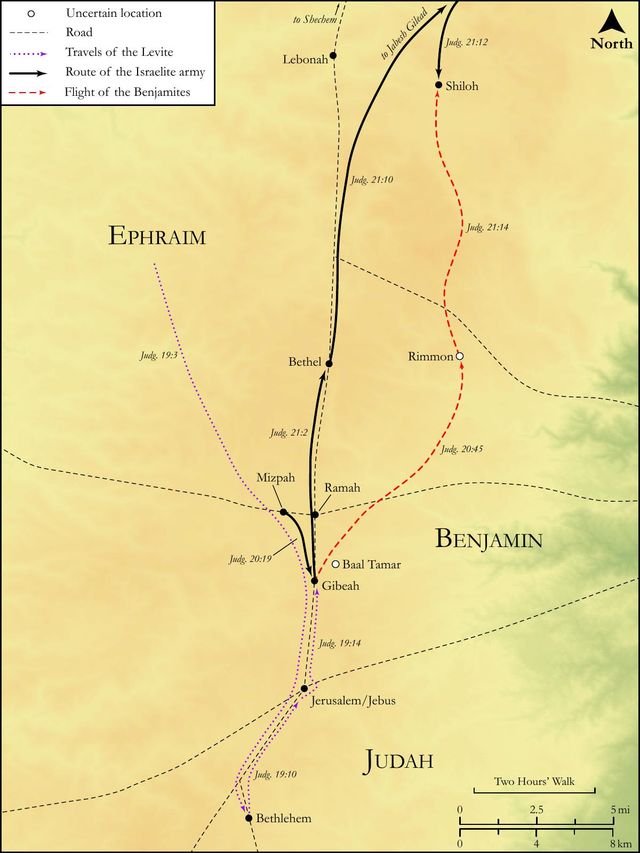
IV.In his return home he was forced to lodge at Gibeah, a city in the tribe of Benjamin, afterwards called Gibeah of Saul, which lay on his road towards Shiloh and Mount Ephraim. When it drew towards night, and the shadows of the evening were stretched out, they began to think (as it behoves us to do when we observe the day of our life hastening towards a period) where they must lodge. When night came they could not pursue their journey. He that walketh in darkness knoweth not whither he goes. They could not but desire rest, for which the night was intended, as the day for labour.
1.The servant proposed that they should lodge in Jebus, afterwards Jerusalem, but as yet in the possession of Jebusites. "Come," said the servant, "let us lodge in this city of the Jebusites," Jdg 19:11. And, if they had done so, it is probable they would have had much better usage than they met with in Gibeah of Benjamin. Debauched and profligate Israelites are worse and much more dangerous than Canaanites themselves. But the master, as became one of God's tribe, would by no means quarter, no, not one night, in a city of strangers (Jdg 19:12), not because he questioned his safety among them, but he was not willing, if he could possibly avoid it, to have so much intimacy and familiarity with them as a night's lodging came to, nor to be so much beholden to them. By shunning this place he would witness against the wickedness of those that contracted friendship and familiarity with these devoted nations. Let Israelites, Levites especially, associate with Israelites, and not with the sons of the stranger.
2.Having passed by Jebus, which was about five or six miles from Bethlehem (the place whence they came), and not having daylight to bring them to Ramah, they stopped at Gibeah (Jdg 19:13-15); there they sat down in the street, nobody offering them a lodging. In these countries, at that time, there were no inns, or public-houses, in which, as with us, travellers might have entertainment for their money, but they carried entertainment along with them, as this Levite did (Jdg 19:19), and depended upon the courtesy and hospitality of the inhabitants for a lodging. Let us take occasion hence, when we are in journeys, to thank God for this, among other conveniences of travelling, that there are inns to entertain strangers, and in which they may be welcome and well accommodated for their money. Surely there is no country in the world wherein one may stay at home with more satisfaction, or go abroad with more comfort, than in our own nation. This traveller, though a Levite (and to those of that tribe God had particularly commanded his people to be kind upon all occasions), met with very cold entertainment at Gibeah: No man took them into his house. If they had any reason to think he was a Levite perhaps that made those ill-disposed people the more shy of him. There are those who will have this laid to their charge at the great day, I was a stranger and you took me not in.
Historical interpretation
Historical reception
2 surviving comments on this verse. Each one is dated, so this reads as a timeline rather than a list.
When some little progress was made, though night was threatening to come on, and they were close by the town of the Jebusites, on the slave’s request that his lord should turn aside there, he refused, because it was not a city of the children of Israel. He meant to get as far as Gibeah, which was inhabited by the people of the tribe of Benjamin. But when they arrived there was no one to receive them with hospitality, except a stranger of advanced age—when he had looked upon them he asked the Levite, “Where are you going and from where have you come?” On his answering that he was traveling and was making for Mount Ephraim and that there was no one to take him in, the old man offered him hospitality and prepared a meal.
He set out on his journey in happy spirits because he had recovered his dearly beloved wife. One servant was with him, and as day was already declining they sped on their way with swift steps. The woman rode on an ass; her husband felt no weariness, taking joy in his desire and lightening his journey with talk at times with the woman, at times with the slave. When at length they neared Jerusalem, about thirty stades away, a place inhabited then by Jebusites, the servant boy suggested that they turn into the city, especially since night makes even safe places suspect and one must guard against the uncertainties of darkness, and particularly since the inhabitants of this locality were not of the children of Israel. They should beware lest treachery be done with hostile design, for the night’s darkness is opportune enough for any tricksters to perpetrate evil. But his master did not care for the servant’s idea of seeking lodging among foreigners, since Gaba [Gibeah] and Rama, cities of Benjamin, were not far distant. His strong will overrode the servant’s suggestion, as though advice takes its value from one’s condition [of birth] rather than that through advice a lowly condition may be raised. The sun was now setting and he agreed reluctantly to go into the city [Gibeah], for he was overtaken by evening. The Gabanites lived there, unfriendly, harsh, unbearable people, who could stand anything but to receive people hospitably. Indeed, it would have been much more suitable had the Levite not sought hospitality in Gaba [Gibeah]. That his treatment be utterly offensive, he found on entering the city that there was no inn. And when he sat on the road imploring the mercy of these strangers, an old man from the fields happened to stumble on him, for evening had compelled him to leave his work in the fields at night. Seeing him, he asked where he was from and where he was going. He answered, “I came from Bethlehem of Judah, I am going to Mount Ephrem, and my wife is here with me. But I have learned that there is no one here to give hospitality and provide us a chance to rest.” He needed no food or drink for himself nor food for his flock, but they had been refused the hospitality of shelter. They had everything; only a bare lodging was needed. To this the old man kindly and calmly said, “Peace to you! Come in as my guest and fellow citizen, for I am also from the region of Mount Ephrem, and here is a lodging place; someone who lived here a long time laid its foundations.” Having received them into his home, he attentively and carefully provided for his guests and entertained them.
Continue studying Judges 19:14 across the web’s major study libraries — every link below opens this exact verse, chapter, or book on the destination site.
Read & Compare
 BibleGatewayThis verse in more than 200 translations and 70 languages.
 Bible.comThe YouVersion reader — hundreds of translations, reading plans, and highlights.
 ESV.orgCrossway's official English Standard Version reader.
 NET BibleThe NET translation with 60,000+ translators' notes on every rendering decision.
 STEP BibleTyndale House's free study tool — original text, vocabulary, and scholarly resources.
 BibliaLogos Bible Software's free web reader.
 USCCBThe New American Bible (Revised Edition) with the U.S. bishops' study notes.
Commentaries
 BibleHub CommentariesDozens of classic commentaries on this verse, gathered on one page.
 StudyLightMore than 100 commentary sets — the largest collection on the web.
 BibleRefPlain-English commentary on what this verse means, verse by verse.
 Enduring WordDavid Guzik's free commentary on this chapter, widely used by Bible teachers.
 Bible Study ToolsVerse commentary alongside Greek and Hebrew study aids.
Original Language & Research
- BibleHub InterlinearThe verse word by word — original language, transliteration, and English.
- BibleHub LexiconEvery word's original-language definition and Strong's entry.
 Blue Letter BibleDeep-study tools — Strong's numbers, concordance, and word studies.
 SefariaThe Hebrew text with Rashi and centuries of Jewish commentary.
Sermons, Hymns & Audio


TrulyRandomVerse is not affiliated with these sites and doesn’t control their content. They’re linked because they’re genuinely useful.
Summary
Judges 19:14 serves as a chilling and pivotal moment in one of the Bible's most disturbing narratives, marking the arrival of the Levite, his concubine, and servant at Gibeah as dusk descends. This seemingly simple detail of time and location is profoundly significant, acting as a grim prelude to the horrific acts of depravity and violence that are about to unfold. The verse vividly exposes the profound moral and spiritual decay within Israel during a period when there was no righteous leadership, transforming a mundane travelogue into a foreboding signpost that signals the imminent descent into chaos and the tragic consequences of a society that has utterly abandoned divine standards.
Context
ShowHideLiterary Context
Judges 19:14 is situated within the harrowing narrative of the Levite and his concubine (Judges 19-21), which stands as the climactic and most shocking illustration of Israel's moral decline in the book of Judges. The preceding verses detail the Levite's journey from Bethlehem in Judah, where he had retrieved his concubine, to his intended destination in the hill country of Ephraim. The travelers had deliberately chosen to bypass the Jebusite city of Jerusalem, which was not yet fully under Israelite control, opting instead for an Israelite city, anticipating safety and hospitality among their own people. Their decision to press on past Bethlehem and Ramah, and specifically to Gibeah, a city belonging to the tribe of Benjamin, is presented as a fateful choice. The mention of the setting sun underscores the urgency of finding lodging and heightens the sense of impending doom, as the protective light of day gives way to the vulnerabilities of night.
Historical & Cultural Context
The book of Judges chronicles a tumultuous period in Israelite history following the conquest of Canaan, characterized by recurring cycles of apostasy, oppression, and deliverance through divinely appointed judges. The poignant and oft-repeated refrain, "In those days there was no king in Israel; everyone did what was right in his own eyes" (as seen in Judges 21:25), encapsulates the spiritual and political anarchy of the era. Hospitality was a sacred and deeply ingrained cultural norm in Israel, especially towards travelers, often considered a divine mandate (Genesis 18). The failure of this custom, particularly in an Israelite city, would have been a shocking transgression against both human decency and covenantal obligations. Gibeah itself, located in the territory of Benjamin, would later become the hometown of Israel's first king, Saul, adding a layer of tragic irony to its association with such profound depravity.
Key Themes
ShowHideThis verse, though concise, contributes significantly to several overarching themes in Judges. Firstly, it highlights Ill-Fated Choices, as the Levite's seemingly prudent decision to bypass a foreign city for an Israelite one ironically leads to catastrophic danger, exposing the deep corruption within Israel itself. Secondly, it foreshadows the shocking Breakdown of Hospitality, a fundamental societal and religious obligation, setting the stage for the unprecedented failure of welcome in Gibeah, a stark contrast to the divine and human expectation of care for sojourners (e.g., Genesis 19:1-3). Finally, and most profoundly, Judges 19:14 serves as a grim illustration of the pervasive Moral and Spiritual Decay of Israel. The events that follow in Gibeah become the ultimate demonstration of a society where "every man did that which was right in his own eyes" (Judges 17:6), leading to national sin and ultimately, civil war against the tribe of Benjamin (Judges 20).
Exposition and Analysis
ShowHideKey Word Analysis
ShowHideThis place name (H1390) literally means "hill" or "height." While a common geographical descriptor, its specific mention here is crucial. Gibeah was a significant city within the tribal territory of Benjamin. Its identification as the destination for the travelers, coupled with the setting sun, immediately imbues the location with a sense of foreboding. It is not just any hill, but the hill where Israel's moral nadir would be reached, a stark symbol of the depravity that had taken root even within the covenant community.
The verb (H935) "went down" or "came in" (referring to the sun) marks the transition from day to night. Beyond its literal meaning, it functions as a potent literary device. In biblical narratives, the onset of night often symbolizes danger, vulnerability, or the approach of evil (e.g., John 13:30). Here, the setting sun acts as a dramatic cue, signaling the end of any remaining hope for a safe and hospitable night and ushering in the darkness—both literal and moral—that will envelop the travelers and the city of Gibeah.
This name (H1144), meaning "son of (the) right hand," refers to the youngest son of Jacob and the tribe descended from him. The explicit mention of Gibeah belonging to Benjamin is highly significant. The subsequent horrific events in Gibeah will lead to a devastating civil war against the entire tribe of Benjamin by the other Israelite tribes, almost resulting in its annihilation. This detail immediately links the specific location to the broader tribal and national consequences of the impending wickedness, underscoring the profound collective responsibility and the far-reaching impact of the moral decay.
Verse Breakdown
ShowHide"And they passed on and went their way;"
This clause emphasizes the continuation of the journey, highlighting the Levite's determination to avoid Jebus (Jerusalem) and seek lodging among his own people. It underscores the active choice being made, a choice that, in hindsight, proves tragically misguided. The simple, almost mundane, description of their movement belies the momentous consequences of their chosen path, leading them inexorably towards a horrifying encounter.
"and the sun went down upon them"
This phrase establishes the critical timing of their arrival. The day is ending, forcing them to seek immediate shelter. This temporal marker is not merely descriptive; it creates a profound sense of urgency and vulnerability. The fading light symbolizes the fading hope of finding genuine hospitality and safety, as the darkness of night prepares the stage for the moral darkness that is about to engulf them and the city.
"[when they were] by Gibeah, which [belongeth] to Benjamin."
This final clause pinpoints the precise, fateful location. Gibeah, a city of Benjamin, is identified as their stopping point. The tribal affiliation is profoundly significant, as the subsequent events will lead to a devastating civil war against Benjamin, almost annihilating the tribe. The specificity of the location grounds the impending horror in a particular community within Israel, making the moral failure all the more shocking and tragic, demonstrating the extent of corruption even within the covenant people.
Literary Devices
ShowHideJudges 19:14 masterfully employs several literary devices to heighten the dramatic tension and underscore the verse's profound significance. Foreshadowing is prominently featured, as the setting sun and the specific choice of Gibeah immediately signal that something terrible is about to happen. The transition from day to night symbolically prepares the reader for the moral darkness that will soon descend upon the characters and the city. There is a deep Irony at play: the Levite deliberately bypasses a foreign, non-Israelite city (Jebus) in favor of what he presumes will be a safe, hospitable Israelite city, only to encounter unparalleled depravity among his own people. This subverts the expectation of covenantal solidarity and highlights the extent of Israel's internal corruption. Furthermore, the verse uses Symbolism, with the approaching night representing not just physical darkness but also the moral and spiritual decay that has consumed Gibeah and, by extension, much of Israel. The city of Gibeah itself becomes a Metonymy for the tribe of Benjamin and, more broadly, for the state of Israel's moral decline during this period of anarchy.
Theological and Thematic Connections
ShowHideJudges 19:14 serves as a stark theological commentary on the devastating consequences of spiritual and moral anarchy. The narrative it introduces powerfully illustrates the dangers inherent in a society that lacks righteous leadership and where individuals abandon God's law to "do what is right in their own eyes." The breakdown of fundamental societal norms, such as hospitality, directly reflects a deeper spiritual malaise—a pervasive rejection of covenantal obligations and a precipitous descent into self-serving depravity. This verse sets the stage for a narrative that exposes the profound need for divine order and justice, highlighting how far Israel had fallen from its calling as a holy nation. It underscores the timeless truth that when God's standards are abandoned, human society inevitably descends into chaos, violence, and injustice, demonstrating the inherent depravity of the human heart apart from divine restraint and guidance.
Reflection and Application
ShowHideJudges 19:14, though a brief verse, is a potent reminder of the profound impact of our choices and the moral climate of our communities. The Levite's decision to press on to Gibeah, seemingly a minor logistical detail, sets the stage for unspeakable tragedy, underscoring how seemingly small decisions can have monumental, unforeseen consequences. This compels us to cultivate discernment, especially when navigating uncertain paths or choosing our associations, recognizing that our environments profoundly shape our experiences. Furthermore, the narrative that unfolds from this verse serves as a grim warning about the societal decay that results when foundational moral and spiritual truths are abandoned. When a community, or even a nation, rejects objective standards of right and wrong, and when "everyone does what is right in his own eyes," the inevitable outcome is chaos, injustice, and depravity. For believers today, this story calls us to be vigilant guardians of truth and righteousness, to actively promote biblical values of hospitality, justice, and compassion, and to resist the seductive pull of moral relativism that can erode the very fabric of human decency and societal order.
Questions for Reflection
ShowHideFAQ
ShowHideWhy did they not stay in Jerusalem (Jebus)?
ShowHideAt this time, Jerusalem was still inhabited by the Jebusites, a non-Israelite people, as noted in Judges 1:21. The Levite, seeking hospitality and safety, likely preferred to stay in an Israelite city among his own people, expecting to find the customary welcome and protection. This decision highlights the tragic irony of the narrative, as the Levite finds far greater depravity and danger within an Israelite city than he might have encountered in a foreign one.
What is the significance of "the sun went down"?
ShowHideBeyond its literal meaning of the end of the day, "the sun went down" serves as a powerful literary device, creating a sense of foreboding and impending doom. The fading light symbolizes the onset of darkness—not just physical night, but the moral and spiritual darkness that is about to engulf the travelers and the city of Gibeah. It marks a critical turning point in the narrative, signaling the end of any perceived safety and the beginning of the horrific events that will unfold under the cover of night.
How does Gibeah relate to the tribe of Benjamin?
ShowHideGibeah was a prominent city located within the tribal territory of Benjamin. The horrific events that transpire in Gibeah, involving the Benjamites of the city, lead to a national outcry and ultimately provoke a devastating civil war against the entire tribe of Benjamin by the other Israelite tribes. This conflict, detailed in Judges 20, nearly results in the annihilation of Benjamin, making Gibeah a symbol of the tribe's profound moral failure and the extreme consequences of Israel's spiritual decay.
Christ-Centered Fulfillment
ShowHideJudges 19:14, with its foreboding depiction of a society devoid of righteous leadership and steeped in moral darkness, powerfully anticipates the desperate need for a true King. The chaos and depravity that consume Gibeah, where "every man did what was right in his own eyes," stand in stark contrast to the perfect reign of Jesus Christ. While the sun set on Gibeah, ushering in a night of unspeakable evil, Jesus arrived as the Light of the World, shining in the darkness that could not overcome Him (John 1:5). The failure of human hospitality in Gibeah, a grievous sin against God's covenant, is utterly redeemed by Christ, who offers ultimate hospitality and welcome to all who come to Him (Matthew 11:28). The absence of a king and the resulting moral anarchy in Judges highlight humanity's desperate need for a sovereign ruler who is both perfectly just and merciful. Jesus, the King of Kings and Lord of Lords, fulfills this need, establishing a kingdom of righteousness and peace where His subjects no longer do what is right in their own eyes, but live according to His perfect law of love. The tragic narrative of Judges 19:14 ultimately points to the glorious truth that in Christ, the true Son of David, humanity finds its ultimate King, its perfect Light, and its eternal refuge.