


Job 9:22
Bible text: King James Version (1769 Blayney text) · Public domain
Bible text: Berean Standard Bible · Public domain
Bible text: American Standard Version (1901) · Public domain
Bible text: World English Bible, Messianic edition · Public domain
Bible text: Geneva Bible (1599) · Public domain
Bible text: Young's Literal Translation · Public domain
- אַחַת'a·Chat[is] oneH259Adj-fsAdjective Numerical Singular Feminine Absolute
- הִיאhi'itH1931Pro-3fsPronoun Personal 3rd Singular Feminine
- עַל'althere-H5921PrepPreposition
- כֵּןken-foreH3651AdvAdverb
- אָמַרְתִּי'a·Mar·tiI sayH559V-Qal-Perf-1csVerb Qal Perfect 1st Singular common gender
- תָּםtam[the] blamelessH8535Adj-msAdjective Singular Masculine Absolute
- וְרָשָׁעve·ra·Sha'and [the] wickedH7563Conj-w ¦ N-msNoun Singular Masculine Absoluteוְandרָשָׁע[the] wicked
- הוּאhu'heH1931Pro-3msPronoun Personal 3rd Singular Masculine
- מְכַלֶּהme·kha·Leh[is] bringing to an endH3615V-Piel-Prtcpl-msVerb Piel Participle Singular Masculine Absolute
English is a literal word-by-word gloss of the Hebrew, not the KJV's wording. Why?
This is the original text the KJV's translators worked from — each Hebrew word with its own literal English meaning in this verse, prepared by scholars at Tyndale House, Cambridge. The KJV translates whole sentences, not word by word, so its wording differs: one Hebrew word can become several English words, and the KJV may choose “the LORD” where the gloss reads “Yahweh”. Both are faithful — they answer different questions. For the KJV's own rendering, switch to the KJV text.
Details
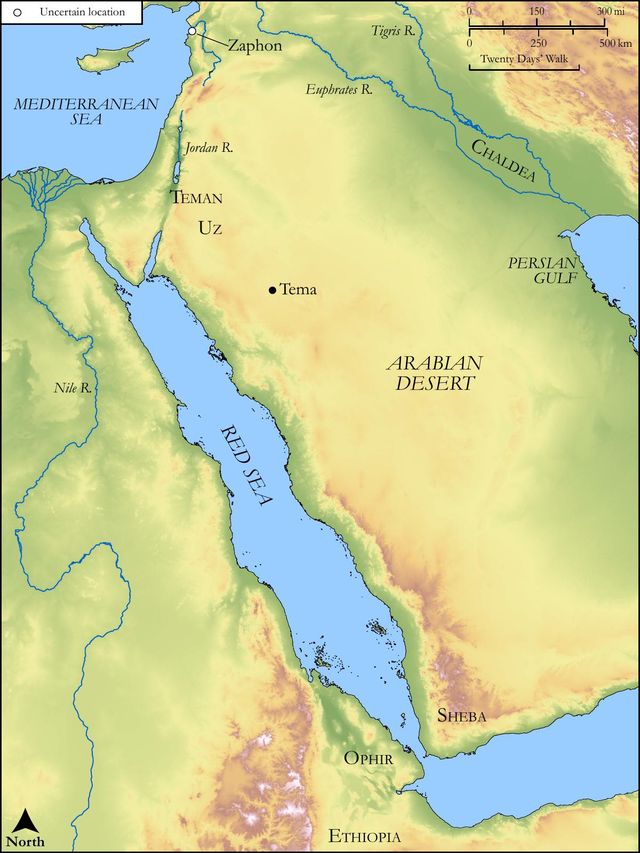
See on the biblical-era map
Study this verse
Public-domain commentary
Matthew Henry
From his Commentary on the Whole Bible. Henry comments on passages, not single verses — this entry covers Job 9:22–24.
Here Job touches briefly upon the main point now in dispute between him and his friends. They maintained that those who are righteous and good always prosper in this world, and none but the wicked are in misery and distress; he asserted, on the contrary, that it is a common thing for the wicked to prosper and the righteous to be greatly afflicted. This is the one thing, the chief thing, wherein he and his friends differed; and they had not proved their assertion, therefore he abides by his: "I said it, and day it again, that all things come alike to all." Now, 1. It must be owned that there is very much truth in what Job here means, that temporal judgments, when they are sent abroad, fall both upon good and bad, and the destroying angel seldom distinguishes (though once he did) between the houses of Israelites and the houses of Egyptians. In the judgment of Sodom indeed, which is called the vengeance of eternal fire (Jde 1:7), far be it from God to slay the righteous with the wicked, and that the righteous should be as the wicked (Gen 18:25); but, in judgments merely temporal, the righteous have their share, and sometimes the greatest share. The sword devours one as well as another, Josiah as well as Ahab. Thus God destroys the perfect and the wicked, involves them both in the same common ruin; good and bad were sent together into Babylon, Jer 24:5, Jer 24:9. If the scourge slay suddenly, and sweep down all before it, God will be well pleased to see how the same scourge which is the perdition of the wicked is the trial of the innocent and of their faith, which will be found unto praise, and honour, and glory, Pe1 1:7; Psa 66:10.
Against the just th' Almighty's arrows fly,
For he delights the innocent to try,
To show their constant and their Godlike mind,
Not by afflictions broken, but refined.
- Sir R. Blackmore
Let this reconcile God's children to their troubles; they are but trials, designed for their honour and benefit, and, if God be pleased with them, let not them be displeased; if he laugh at the trial of the innocent, knowing how glorious the issue of it will be, at destruction and famine let them also laugh (Job 5:22), and triumph over them, saying, O death! where is thy sting? On the other hand, the wicked are so far from being made the marks of God's judgments that the earth is given into their hand, Job 9:24 (they enjoy large possessions and great power, have what they will and do what they will), into the hand of the wicked one (in the original, the word is singular); the devil, that wicked one, is called the god of this world, and boasts that into his hands it is delivered, Luk 4:6. Or into the hand of a wicked man, meaning (as bishop Patrick and the Assembly's Annotations conjecture) some noted tyrant then living in those parts, whose great wickedness and great prosperity were well known both to Job and his friends. The wicked have the earth given them, but the righteous have heaven given them, and which is better - heaven without earth or earth without heaven? God, in his providence, advances wicked men, while he covers the faces of those who are fit to be judges, who are wise and good, and qualified for government, and buries them alive in obscurity, perhaps suffers them to be run down and condemned, and to have their faces covered as criminals by those wicked ones into whose hand the earth is given. We daily see that this is done; if it be not God that does it, where and who is he that does it? To whom can it be ascribed but to him that rules in the kingdoms of men, and gives them to whom he will? Dan 4:32. Yet, 2. It must be owned that there is too much passion in what Job here says. The manner of expression is peevish. When he meant that God afflicts he ought not to have said, He destroys both the perfect and the wicked; when he meant that God pleases himself with the trial of the innocent he ought not to have said, He laughs at it, for he doth not afflict willingly. When the spirit is heated, either with dispute or with discontent, we have need to set a watch before the door of our lips, that we may observe a due decorum in speaking of divine things.
Historical interpretation
Historical reception
2 surviving comments on this verse. Each one is dated, so this reads as a timeline rather than a list.
Select a marker to jump to its quote. Markers stagger vertically where authors wrote within a few decades of each other.
“The earth is given into the hand of the wicked.” With regard to the context of the passage, Job seems to state that his earthly part, that is, his body, is given to torments and vexations. The permission to afflict it is granted to the impious. Therefore, it certainly happens that those who see cannot express a fair judgment on the merits of the one who is afflicted. Passing to the prophetic aspect, that which vindicates the merits of the person, Job appears to wander from the context of the debate and to speak of future mysteries. The passion of the Lord is predicted. Job’s friends could not recognize this because the earthly vileness of Job’s external appearance is his internal dignity.
40. The ‘perfect man is destroyed’ by the Creator, in that whatever his pureness may have been, it is swallowed up by the pureness of the divine immensity. For though we take heed to preserve pureness, yet by consideration of the interior Perfection it is shown, that this which we practise is not purity; ‘the wicked’ likewise is ‘destroyed’ by the Creator, in that whilst God ordereth all things marvellously, his wickedness is caught in the noose of his own artifices. For he is even unwittingly involving himself in punishment on the same grounds whereon he wittingly exults in doing any thing. Whereas therefore Almighty God at once surpasses the perfection of the righteous by pureness, and penetrating the craft of the wicked condemns it, it is rightly said, This is one thing, therefore I said it; He destroyeth the perfect and the wicked. As if it were expressed in plain words; ‘I have spoken this word of reflection to myself, that neither being perfect, shall I appear perfect, if I be strictly examined; nor being wicked, if I would lie hid in myself, am I withdrawn from the piercings of heavenly probing, in that the strict Judge in comprehending all things, penetrates the subterfuges of wickedness in a marvellous way; and in ordering for the best, condemns the same by its ‘own devices.’ Or, indeed, He is Himself said to destroy both the perfect and the wicked, in that though they be separated in the life of the soul, yet in due of the first sin, they are alike dragged to the death of the flesh. And hence it is said by Solomon; The learned dieth equally as the unlearned. [Eccl. 2, 16] And again, All things are subject to vanity, and all go to one place; all are of the dust, and all turn to dust again. [Eccl. 3, 20]
Continue studying Job 9:22 across the web’s major study libraries — every link below opens this exact verse, chapter, or book on the destination site.
Read & Compare
 BibleGatewayThis verse in more than 200 translations and 70 languages.
 Bible.comThe YouVersion reader — hundreds of translations, reading plans, and highlights.
 ESV.orgCrossway's official English Standard Version reader.
 NET BibleThe NET translation with 60,000+ translators' notes on every rendering decision.
 STEP BibleTyndale House's free study tool — original text, vocabulary, and scholarly resources.
 BibliaLogos Bible Software's free web reader.
 USCCBThe New American Bible (Revised Edition) with the U.S. bishops' study notes.
Commentaries
 BibleHub CommentariesDozens of classic commentaries on this verse, gathered on one page.
 StudyLightMore than 100 commentary sets — the largest collection on the web.
 BibleRefPlain-English commentary on what this verse means, verse by verse.
 Enduring WordDavid Guzik's free commentary on this chapter, widely used by Bible teachers.
 Bible Study ToolsVerse commentary alongside Greek and Hebrew study aids.
Original Language & Research
- BibleHub InterlinearThe verse word by word — original language, transliteration, and English.
- BibleHub LexiconEvery word's original-language definition and Strong's entry.
 Blue Letter BibleDeep-study tools — Strong's numbers, concordance, and word studies.
 SefariaThe Hebrew text with Rashi and centuries of Jewish commentary.
Sermons, Hymns & Audio


TrulyRandomVerse is not affiliated with these sites and doesn’t control their content. They’re linked because they’re genuinely useful.
Summary
Job 9:22 encapsulates Job's profound and anguished declaration that God, in His overwhelming and often inscrutable power, appears to bring calamity indiscriminately upon both the blameless and the wicked. This statement serves as a direct and bitter challenge to the conventional retribution theology espoused by his friends, who insisted that suffering was solely a direct consequence of sin, and instead expresses Job's raw observation that earthly experience frequently defies such simplistic moral equations.
Context
ShowHideLiterary Context
This verse is a pivotal and provocative statement within Job's second extended response to his friends, specifically following Bildad's speech in Job 8. Bildad had confidently asserted a direct correlation between sin and suffering, implying that God's justice ensures the wicked perish and the righteous prosper, thus subtly accusing Job of hidden sin. Job, however, is grappling with his own severe and inexplicable suffering, which profoundly contradicts this simplistic view. He has already acknowledged God's immense, incomprehensible power and sovereignty in Job 9:4-10, describing God's might over all creation and his inability to contend with Him. Yet, he feels this power is exercised in a way that appears arbitrary and unjust from a human perspective, particularly when he, a man explicitly described as "perfect and upright" in Job 1:1, is being destroyed alongside those who are truly wicked. His lament here is a direct counter-argument, born of deep personal pain, to the rigid theological framework of his interlocutors.
Historical & Cultural Context
The book of Job is set among the wisdom books, which often explored life's fundamental questions, including the nature of suffering, divine justice, and the meaning of existence. Among many nations, and certainly within ancient Israelite thought, there was a prevalent "retribution theology" or "deuteronomic principle" (derived from passages like Deuteronomy 28) that posited a direct correlation between righteousness and prosperity, and wickedness and suffering. This worldview, deeply embedded in the thinking of Job's friends, struggled immensely to account for the suffering of the innocent. Job 9:22, therefore, represents a radical departure from, and a profound challenge to, this dominant cultural and theological paradigm, reflecting a deep existential and theological crisis in the face of inexplicable calamity that does not fit neatly into human-devised categories of justice.
Key Themes
ShowHideJob 9:22 directly confronts the age-old problem of suffering, particularly the suffering of the righteous. Job's statement is a raw expression of his inability to reconcile God's justice with his personal experience, where the traditional cause-and-effect relationship between sin and suffering seems utterly broken. It highlights the tension between divine sovereignty and human perception, as Job affirms God's absolute power and control over all things, yet struggles profoundly with how that power is exercised, perceiving it as lacking clear moral distinction between the innocent and the guilty in their earthly experience. This struggle is central to the book's exploration of God's ways, which are often "higher than our ways" as Isaiah 55:8-9 later articulates. Ultimately, this verse is a powerful expression of Job's despair and accusation, born of deep pain and a sense of injustice, functioning as a lament that challenges the rigid retribution theology held by his friends and forces a deeper consideration of God's mysterious and often unfathomable ways.
Exposition and Analysis
ShowHideKey Word Analysis
ShowHideFrom the root H259, this numeral signifies "united," "one," or "alike." In this context, "This is one thing" emphasizes the singularity and undeniable truth of Job's observation. It's not a complex argument but a stark, simple reality he perceives: the fate of the perfect and the wicked is, in his experience, indistinguishable in calamity.
From the primitive root H3615, meaning "to end," "to cease," "to perish," or "to consume." Here, it conveys a sense of comprehensive ruin, utter devastation, or complete annihilation. Job uses this strong verb to describe God's action, indicating not just suffering but a profound, active bringing to an end of life, health, and well-being, feeling utterly consumed by God's hand.
Meaning "complete," "pious," "gentle," "undefiled," or "upright." This term describes moral and spiritual integrity, not absolute sinless perfection. As used of Job in Job 1:1, it denotes a person of exemplary character who adheres to God's ways. Job's application of this term to himself underscores the perceived injustice of his suffering, as he sees himself as blameless in the face of such destruction.
This term refers to someone "morally wrong," "guilty," "ungodly," or "an actively bad person." It describes those who are morally corrupt, who act unjustly, and who disregard God's law. Job's observation is that the same devastating fate that befalls the "perfect" also befalls those who are unequivocally "wicked," blurring the lines of divine justice in the earthly realm.
Verse Breakdown
ShowHide"This [is] one [thing], therefore I said [it]"
This opening clause emphasizes Job's firm conviction and the definitive nature of his declaration. It suggests that this is a conclusion he has reached through his profound suffering and observation, a stark and undeniable truth from his perspective, perhaps even a summary of his entire argument against his friends' simplistic theology. It is a statement of profound certainty born of despair, indicating that this is his core, unshakeable observation.
"He destroyeth the perfect"
This is the shocking and deeply personal assertion. Job directly attributes the destruction of the blameless, upright individual (like himself) to God ("He"). This is not merely a statement about suffering in general, but about God's active, devastating role in bringing about the ruin of those who are righteous in their conduct, challenging the very premise of a just God who rewards the good and protects the innocent.
"and the wicked"
This crucial addition completes Job's bitter observation. The "and" implies a conjunction of fate, a lack of distinction, or even an indistinguishable outcome. Job sees God bringing the same comprehensive ruin upon the morally corrupt and unrighteous as He does upon the upright. This perceived indiscriminacy is the core of Job's lament, suggesting that in the face of overwhelming calamity, God makes no apparent differentiation between the two categories of humanity, at least in this earthly life.
Literary Devices
ShowHideJob 9:22 employs several potent literary devices to convey Job's profound anguish and theological challenge. The most prominent is Paradox, as Job presents the seemingly contradictory reality of God destroying both the "perfect" and the "wicked." This statement creates a jarring image that directly confronts the audience's (and Job's friends') expectation of divine justice, where the righteous should be preserved and the wicked punished. This paradox is further amplified by Hyperbole, as Job, in his deep despair, makes an extreme statement that might not represent a precise theological treatise for all time, but rather an emotional outcry reflecting his immediate, overwhelming experience of suffering. The verse also functions as a powerful Lament or Protest, serving as Job's bitter accusation against God, expressing his profound sense of injustice and the perceived arbitrariness of divine action in the world. This is a common feature of biblical lament, allowing for raw, honest expression before God.
Theological and Thematic Connections
ShowHideJob 9:22 plunges into the deepest theological waters, grappling with the apparent tension between God's justice and the reality of suffering in a fallen world. Job's declaration is not presented as a definitive, objective theological statement about God's ultimate character, but rather as a raw, subjective expression of human experience under duress, where divine actions seem inscrutable and even unjust from a limited perspective. It forces us to confront the complexity of God's sovereignty, which extends over all things, including calamity, without necessarily implying direct punitive action for every instance of suffering. While God's ultimate justice is assured and His moral character unwavering, Job's lament highlights that in the temporal realm, the righteous are not immune to the same misfortunes and consequences of a fallen world that befall the wicked, challenging simplistic notions of divine retribution. This verse underscores the mystery of God's ways and the limits of human understanding in comprehending His grand purposes.
Reflection and Application
ShowHideJob 9:22 offers profound validation for those wrestling with faith and suffering, reminding us that it is permissible to voice our deepest questions, frustrations, and even accusations to God, even when they challenge conventional understanding of His justice. The book of Job, through verses like this, validates honest lament and the raw expression of pain in the presence of the Almighty, showing that God can handle our anger and confusion. It also serves as a crucial reminder of the limited human perspective in comprehending God's vast and often mysterious ways. While Job's immediate observation was true for his earthly experience of indiscriminate calamity, the broader biblical narrative consistently teaches that God does make a distinction between the righteous and the wicked, especially in ultimate judgment and eternal destiny. This verse underscores that suffering is not always a direct punishment for sin, challenging the simplistic retribution theology and inviting us to consider the multifaceted purposes of suffering, such as character refinement, testing of faith, demonstrating God's glory, or simply being a consequence of living in a fallen world. It calls us to cultivate a deeper trust in God's ultimate goodness and justice, even when His immediate actions or the circumstances of life defy our expectations of fairness or our limited understanding.
Questions for Reflection
ShowHideFAQ
ShowHideDoes Job 9:22 mean God is unjust or arbitrary in His actions?
ShowHideJob 9:22 reflects Job's deeply anguished perspective in the midst of inexplicable suffering, not a definitive theological statement about God's ultimate character or justice. From Job's limited human viewpoint, God's actions appear indiscriminate, as both the righteous (like Job) and the wicked experience calamity. However, the broader narrative of Job and the consistent witness of Scripture reveal that God is perfectly just, though His ways are often inscrutable to human understanding (Isaiah 55:8-9). This verse highlights the mystery of suffering and the limits of human perception, rather than declaring God to be unjust. It is a human lament, not a divine pronouncement on God's character.
Does this verse contradict other biblical passages that promise blessings for the righteous and judgment for the wicked?
ShowHideNo, Job 9:22 does not contradict these passages, but rather adds a crucial layer of complexity to our understanding of divine justice. While the Bible certainly teaches that God blesses the righteous and judges the wicked, particularly in an ultimate, eternal sense (Malachi 3:18), Job 9:22 speaks to the reality of earthly experience where calamity, natural disasters, and the consequences of a fallen world can affect everyone indiscriminately. It challenges the simplistic notion that all suffering is direct punishment for sin, reminding us that God's purposes in allowing suffering are multifaceted and not always immediately discernible. It distinguishes between temporal suffering and ultimate, eternal justice.
Christ-Centered Fulfillment
ShowHideJob 9:22, with its stark declaration that God "destroyeth the perfect and the wicked," finds its most profound and paradoxical fulfillment in the person and work of Jesus Christ. Job, the "perfect" man in his generation, suffered inexplicably, but his suffering foreshadows the ultimate suffering of the truly perfect One, Jesus, who was "without sin" (Hebrews 4:15). On the cross, Jesus, the blameless Lamb of God, was "destroyed" alongside the wicked (crucified between two criminals), bearing the full weight of God's wrath against sin, not for His own transgressions, but for ours (2 Corinthians 5:21). In this ultimate act, the apparent indiscriminacy of suffering (the perfect dying with the wicked) was transformed into the most precise act of divine justice and mercy: God's judgment fell upon His Son so that the wicked who believe might be declared righteous. Through Christ's death, the distinction between the "perfect" and the "wicked" is not blurred, but eternally clarified, as He provides the way for the unrighteous to be made righteous and escape ultimate destruction, fulfilling the deeper purpose of God's justice and love (1 Peter 3:18). This is the ultimate answer to Job's lament: God's justice is not arbitrary; it was perfectly met in Christ, allowing mercy to triumph for those who believe (Romans 3:23-26).