


Genesis 8:8
Bible text: King James Version (1769 Blayney text) · Public domain
Bible text: Berean Standard Bible · Public domain
Bible text: American Standard Version (1901) · Public domain
Bible text: World English Bible, Messianic edition · Public domain
Bible text: Geneva Bible (1599) · Public domain
Bible text: Young's Literal Translation · Public domain
- וַיְשַׁלַּחvay·sha·Lachand he sent outH7971Conj-w ¦ V-Piel-ConsecImperf-3msVerb Piel Consecutive Imperfect 3rd Singular Masculineוַandיְשַׁלַּחhe sent out
- אֶת'et<obj.>H853DirObjMParticle Object Indicator
- הַיּוֹנָהhai·yo·Nahthe doveH3123Art ¦ N-fsNoun Singular Feminine Absoluteהַtheיּוֹנָהdove
- מֵאִתּוֹme·'i·Tofrom with <the> himH854Prep-m ¦ Prep ¦ 3msPreposition Definiteמֵfromאִתּwith <the>וֹhim
- לִרְאוֹתlir·'Otto seeH7200Prep-l ¦ V-Qal-InfVerb Qal Infinitive Constructלִtoרְאוֹתsee
- הֲקַלּוּha·Ka·lu¿ were they abatedH7043Interrog ¦ V-Qal-Perf-3cpVerb Qal Perfect 3rd Plural common genderהֲ¿קַלּוּwere they abated
- הַמַּיִםha·Ma·yimthe watersH4325Art ¦ N-mpNoun Plural Masculine Absoluteהַtheמַּיִםwaters
- מֵעַלme·'Alfrom onH5921Prep-m ¦ PrepPrepositionמֵfromעַלon
- פְּנֵיpe·Nei[the] surface ofH6440N-mpcNoun Plural Masculine Construct
- הָאֲדָמָהHa·'a·da·Mahthe groundH127Art ¦ N-fsNoun Singular Feminine Absoluteהָtheאֲדָמָהground
English is a literal word-by-word gloss of the Hebrew, not the KJV's wording. Why?
This is the original text the KJV's translators worked from — each Hebrew word with its own literal English meaning in this verse, prepared by scholars at Tyndale House, Cambridge. The KJV translates whole sentences, not word by word, so its wording differs: one Hebrew word can become several English words, and the KJV may choose “the LORD” where the gloss reads “Yahweh”. Both are faithful — they answer different questions. For the KJV's own rendering, switch to the KJV text.
Details
See on the biblical-era maps


Study this verse
Public-domain commentary
Matthew Henry
From his Commentary on the Whole Bible. Henry comments on passages, not single verses — this entry covers Genesis 8:6–12. His three-level outline is real structure in the source text, so it is rendered as structure.
We have here an account of the spies which Noah sent forth to bring him intelligence from abroad, a raven and a dove. Observe here,
I.That though God had told Noah particularly when the flood would come, even to a day (Gen 7:4), yet he did not give him a particular account by revelation at what times, and by what steps, it should go away,
1.Because the knowledge of the former was necessary to his preparing the ark, and settling himself in it; but the knowledge of the latter would serve only to gratify his curiosity, and the concealing of it from him would be the needful exercise of his faith and patience. And,
2.He could not foresee the flood, but by revelation; but he might, by ordinary means, discover the decrease of it, and therefore God was pleased to leave him to the use of them.
II.That though Noah by faith expected his enlargement, and by patience waited for it, yet he was inquisitive concerning it, as one that thought it long to be thus confined. Note, Desires of release out of trouble, earnest expectations of it, and enquiries concerning its advances towards us, will very well consist with the sincerity of faith and patience. He that believes does not make haste to run before God, but he does make haste to go forth to meet him, Isa 28:16. Particularly,
1.Noah sent forth a raven through the window of the ark, which went forth, as the Hebrew phrase is, going forth and returning, that is, flying about, and feeding on the carcases that floated, but returning to the ark for rest; probably not in it, but upon it. This gave Noah little satisfaction; therefore,
2.He sent forth a dove, which returned the first time with no good news, but probably wet and dirty; but, the second time, she brought an olive-leaf in her bill, which appeared to be first plucked off, a plain indication that now the trees, the fruit-trees, began to appear above water. Note here,
(1.)That Noah sent forth the dove the second time seven days after the first time, and the third time was after seven days too; and probably the first sending of her out was seven days after the sending forth of the raven. This intimates that it was done on the sabbath day, which, it should seem, Noah religiously observed in the ark. Having kept the sabbath in a solemn assembly of his little church, he then expected special blessings from heaven, and enquired concerning them. Having directed his prayer, he looked up, Psa 5:3.
(2.)The dove is an emblem of a gracious soul, which finding no rest for its foot, no solid peace or satisfaction in this world, this deluged defiling world, returns to Christ as to its ark, as to its Noah. The carnal heart, like the raven, takes up with the world, and feeds on the carrions it finds there; but return thou to thy rest, O my soul, to thy Noah, so the word is, Psa 116:7. O that I had wings like a dove, to flee to him! Psa 55:6. And as Noah put forth his hand, and took the dove, and pulled her in to him, into the ark, so Christ will graciously preserve, and help, and welcome, those that fly to him for rest.
(3.)The olive-branch, which was an emblem of peace, was brought, not by the raven, a bird of prey, nor by a gay and proud peacock, but by a mild, patient, humble dove. It is a dove-like disposition that brings into the world earnests of rest and joy.
(4.)Some make these things an allegory. The law was first sent forth like the raven, but brought no tidings of the assuaging of the waters of God's wrath, with which the world of mankind was deluged; therefore, in the fulness of time, God sent forth his gospel, as the dove, in the likeness of which the Holy Spirit descended, and this presents us with an olive-branch and brings in a better hope.
Historical interpretation
Three Centuries of Reception
3 surviving comments on this verse. Each one is dated, so this reads as a timeline rather than a list.
Select a marker to jump to its quote. Markers stagger vertically where authors wrote within a few decades of each other.
The Synagogue has not this oil, inasmuch as she has not the olive, and understood not that dove which brought back the olive branch after the deluge. For that Dove descended afterwards when Christ was baptized, and abode upon Him, as John testified in the Gospel, saying: "I saw the Spirit descending from heaven like a dove, and He abode upon Him."
Christ is a dove because he commands his holy ones to be as doves when he says, “Be simple as doves.” But the prophet speaks of what Christ the dove is when, in his person, he describes his return to heaven after his suffering: “Who will give me wings like a dove, and I shall fly away and be at rest?” When Christ the Lord, therefore, initiated the sacraments of the church a dove came down from heaven. I understand the mystery, and I recognize the sacrament. For the very dove that once hastened to Noah’s ark in the flood now comes to Christ’s church in baptism.
After [the raven] he sent a dove, and it came to him in the evening, carrying in its mouth an olive branch with green leaves.You are paying attention, I believe, and with your intellect you anticipate me as I speak. The olive branch with green leaves is the grace of the Holy Spirit, rich in the words of life, the fullness of which rests upon Christ, [as] the psalm says, “God, your God, has anointed you with the oil of gladness above your fellows.” Concerning this gift given to Christ’s fellows, John speaks: “You have the anointing from the holy one, and you know all things.” And by a most beautiful conjunction the figure is in agreement with the fulfillment—a corporeal dove brought the olive branch to the ark which was washed by the waters of the flood; the Holy Spirit descended in the form of a corporeal dove upon the Lord when he was baptized in the waters of the Jordan. Not only the human beings but also the living things which the ark contained, and also the very wood from which the ark was made, prefigure us members of Christ and of the church after our reception of the washing of the waters of regeneration. Through the anointing of the sacred chrism may we be signed with the grace of the Holy Spirit, and may he deign to keep it inviolate in us who himself gave it [to us], Jesus Christ our Lord who with the almighty Father in the unity of the same Holy Spirit lives and reigns for all ages. Amen.
Continue studying Genesis 8:8 across the web’s major study libraries — every link below opens this exact verse, chapter, or book on the destination site.
Read & Compare
 BibleGatewayThis verse in more than 200 translations and 70 languages.
 Bible.comThe YouVersion reader — hundreds of translations, reading plans, and highlights.
 ESV.orgCrossway's official English Standard Version reader.
 NET BibleThe NET translation with 60,000+ translators' notes on every rendering decision.
 STEP BibleTyndale House's free study tool — original text, vocabulary, and scholarly resources.
 BibliaLogos Bible Software's free web reader.
 USCCBThe New American Bible (Revised Edition) with the U.S. bishops' study notes.
Commentaries
 BibleHub CommentariesDozens of classic commentaries on this verse, gathered on one page.
 StudyLightMore than 100 commentary sets — the largest collection on the web.
 BibleRefPlain-English commentary on what this verse means, verse by verse.
 Enduring WordDavid Guzik's free commentary on this chapter, widely used by Bible teachers.
 Bible Study ToolsVerse commentary alongside Greek and Hebrew study aids.
Original Language & Research
- BibleHub InterlinearThe verse word by word — original language, transliteration, and English.
- BibleHub LexiconEvery word's original-language definition and Strong's entry.
 Blue Letter BibleDeep-study tools — Strong's numbers, concordance, and word studies.
 SefariaThe Hebrew text with Rashi and centuries of Jewish commentary.
Sermons, Hymns & Audio


TrulyRandomVerse is not affiliated with these sites and doesn’t control their content. They’re linked because they’re genuinely useful.
Summary
Genesis 8:8 meticulously records Noah's deliberate action of dispatching a dove from the ark, a pivotal moment in his methodical quest to ascertain the state of the earth after the cataclysmic Great Flood. This second avian reconnaissance mission, following the inconclusive flight of the raven, underscores Noah's patient and discerning approach, as he seeks definitive evidence that the vast, destructive waters had sufficiently receded, making the ground habitable once more for life to flourish.
Context
ShowHideLiterary Context
This verse is deeply embedded within the post-flood narrative of Genesis 8, immediately following Noah's initial attempt to gauge the earth's condition by sending a raven in Genesis 8:7. The sequential nature of these events—waiting, sending the raven, then the dove—highlights a deliberate, almost scientific, process of observation and testing. The raven's failure to return with a clear sign prompts Noah to employ a different creature, whose habits would provide more precise information about the dry land. This gradual revelation of the earth's recovery builds narrative tension and emphasizes the profound transition from judgment to restoration.
Historical & Cultural Context
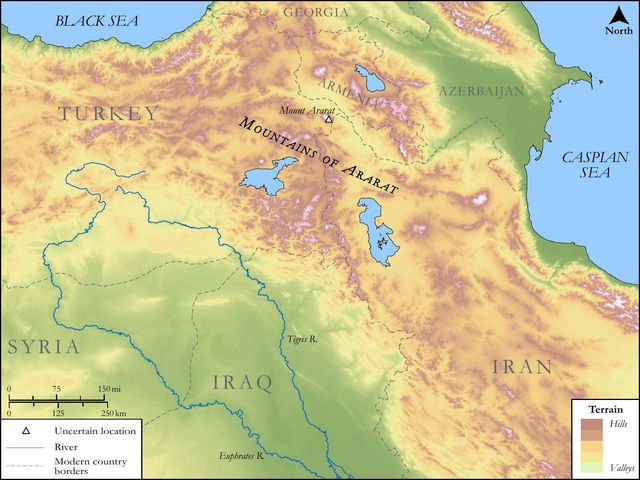
In that age, birds were often used for reconnaissance and communication, making Noah's actions culturally understandable. The ark itself, resting on Mount Ararat, represents a microcosm of humanity and creation preserved through divine judgment. The extended period of waiting—over a year since the flood began—would have tested Noah's faith and patience. The concept of "abating waters" would have resonated with ancient peoples familiar with seasonal floods and the subsequent emergence of fertile land. The choice of a dove, a clean bird often associated with purity and domesticity, contrasts sharply with the raven, a scavenger, and subtly introduces a symbolic dimension to Noah's quest for a new, clean beginning.
Key Themes
ShowHideGenesis 8:8 contributes significantly to several overarching themes within the book of Genesis and the broader biblical narrative. It powerfully illustrates God's sovereignty and faithfulness in preserving a remnant and fulfilling His promise of a new beginning, even after widespread judgment. Noah's actions embody themes of patience and perseverance in waiting for God's timing, demonstrating active faith through observation rather than passive inaction. The abating waters and the search for dry ground speak to the theme of new creation and restoration, foreshadowing God's ongoing work of renewal. Furthermore, the narrative subtly introduces the symbolism of the dove, which will echo throughout biblical history as a sign of peace and divine presence, particularly in the New Testament with the descent of the Spirit at Jesus' baptism, as seen in Matthew 3:16.
Exposition and Analysis
ShowHideKey Word Analysis
ShowHideThis word (H7971) signifies a purposeful dispatching or sending away, often with an objective in mind. In Noah's context, it indicates a deliberate, active step taken to gather information, not a casual release. It conveys Noah's agency and his methodical approach to discerning the earth's condition.
The term (H3123) specifically denotes a dove or pigeon. Unlike the raven, a scavenger that could find sustenance on floating carcasses, the dove is known for its preference for dry land and vegetation. This makes its behavior a more reliable indicator of the earth's habitability, signifying a search for a place of rest and sustenance on solid ground.
This word (H7043) means to be light, to lessen, or to become trifling. In the context of the waters, it implies not merely a receding, but a significant reduction in their depth and power, making them less oppressive and allowing the ground to emerge and become stable. It suggests a qualitative change in the water's presence, indicating a return to normalcy and a state where life could thrive again.
Verse Breakdown
ShowHide"Also he sent forth a dove from him"
This phrase emphasizes Noah's initiative and the specific choice of a dove. After the raven's inconclusive mission, Noah selects a different kind of bird, one whose natural habits would provide a clearer indication of the earth's condition. The phrase "from him" highlights Noah's personal involvement and the directness of his action from the ark.
"to see if the waters were abated"
This clause clearly states the purpose of sending the dove. Noah is not merely releasing the bird but is conducting an intentional reconnaissance. The verb "to see" (H7200, râʼâh') denotes a desire to perceive, discern, and gain understanding through direct observation. This reveals Noah's patient, investigative approach, seeking tangible proof of the flood's recession.
"from off the face of the ground"
This specifies the desired outcome of the observation. Noah wants to know if the waters had not just receded in general, but specifically from the "face" (H6440, pânîym'), or surface, of the "ground" (H127, ʼădâmâh'). This indicates a yearning for the earth to be fully exposed, dry, and ready for habitation, implying a return to a state where life could safely exist outside the ark.
Literary Devices
ShowHideThe verse employs several significant literary devices. Narrative Progression is evident as Noah systematically attempts to discern the earth's condition, moving from the raven to the dove, indicating a methodical and patient approach to the unfolding divine plan. The Symbolism of the dove is paramount; unlike the scavenging raven, the dove is often associated with purity, peace, and new beginnings. Its dispatch carries a profound sense of hope and anticipation for a clean, restored world. This act also serves as Foreshadowing, subtly hinting at the dove's future significance in biblical narrative, particularly as a symbol of the Holy Spirit and divine presence, as seen at Jesus' baptism. The repeated action of sending birds creates a sense of Suspense, building anticipation for the eventual revelation of dry land and God's faithfulness.
Theological and Thematic Connections
ShowHideGenesis 8:8, with Noah's patient dispatch of the dove, stands as a testament to God's unwavering faithfulness and the unfolding of His redemptive plan. It underscores the transition from divine judgment to the promise of new life, reflecting God's commitment to His creation even after a cataclysmic event. Noah's active discernment also highlights the human responsibility to engage with God's will through observation and patient waiting, trusting that He will reveal His timing. The dove's mission serves as a hopeful harbinger of restoration, a clean beginning after a period of profound cleansing.
Reflection and Application
ShowHideThe account of Noah sending the dove provides a powerful model for our own lives, especially during seasons of uncertainty, waiting, or profound change. Like Noah, we are called to exercise patience and perseverance, not rushing ahead of God's timing, but diligently seeking His guidance. His methodical approach—sending the raven, then the dove, waiting between each—teaches us the value of active discernment and observation. We are encouraged to use the wisdom and resources God provides to understand our circumstances, rather than passively waiting or impulsively reacting. This passage reminds us that even after periods of great trial or judgment, God is at work bringing about restoration and new beginnings. The hope embodied by the dove's mission encourages us to maintain faith that God will ultimately bring us to a place of rest and flourishing, just as He did for Noah and his family, ultimately promising a future where He will make all things new.
Questions for Reflection
ShowHideFAQ
ShowHideWhy did Noah send a dove after the raven?
ShowHideNoah's choice to send a dove after the raven was strategic and indicative of his careful discernment. The raven, being a scavenger, could subsist on carrion or floating debris, and therefore its failure to return to the ark in Genesis 8:7 did not definitively indicate the presence of dry land. It simply flew "to and fro." The dove, however, is a clean bird that requires dry ground and vegetation to rest and feed. Its return (or lack thereof, or its return with a specific sign like an olive leaf in Genesis 8:11) would provide a much clearer and more reliable indication that the waters had truly abated and that the earth was becoming habitable again.
What is the symbolic significance of the dove in this passage?
ShowHideThe dove in this passage carries profound symbolic significance. It is widely understood as a symbol of hope and new beginnings after a period of judgment and destruction. Its nature as a clean and peaceful bird contrasts with the raven, foreshadowing a return to a state of purity and peace on earth. The dove's eventual return with an olive leaf in Genesis 8:11 solidifies its role as a harbinger of peace, reconciliation, and renewed life. This symbolism resonates throughout the Bible, most notably when the Holy Spirit descends "like a dove" upon Jesus at His baptism in Matthew 3:16, signifying divine presence, purity, and the inauguration of a new covenant of grace.
Christ-Centered Fulfillment
ShowHideThe narrative of Noah sending the dove in Genesis 8:8, seeking a sign of new life after judgment, finds its ultimate and profound Christ-centered fulfillment in the New Covenant. Just as the dove signaled the end of the old, water-judged world and the dawn of a new creation, so too does Jesus Christ inaugurate a truly new creation and a new humanity. The judgment of the flood, which cleansed the earth, points forward to Christ's sacrifice, which cleanses humanity from sin. The dove, later appearing at Jesus' baptism in Matthew 3:16, symbolizes the Holy Spirit descending upon Him, marking the beginning of His public ministry and the ultimate bringing of peace and reconciliation between God and humanity. Through Christ, the hope of a restored earth finds its spiritual reality in the new birth offered to believers, as described in John 3:3. He is the true ark, providing salvation from the ultimate judgment, offering not merely a temporary rest on dry land, but eternal rest and peace, fulfilling the deepest longings for a world made new and a life lived in perfect harmony with God, as promised in Revelation 21:1-5.