


Genesis 8:10
Bible text: King James Version (1769 Blayney text) · Public domain
Bible text: Berean Standard Bible · Public domain
Bible text: American Standard Version (1901) · Public domain
Bible text: World English Bible, Messianic edition · Public domain
Bible text: Geneva Bible (1599) · Public domain
Bible text: Young's Literal Translation · Public domain
- וַיָּחֶלvai·Ya·cheland he waitedH2342Conj-w ¦ V-Niphal-ConsecImperf-3msVerb Niphal Consecutive Imperfect 3rd Singular Masculineוַandיָּחֶלhe waited
- עוֹדodagainH5750Adj-msAdjective Numerical Singular Masculine Absolute
- שִׁבְעַתshiv·'AtsevenH7651Adj-cscAdjective Numerical Singular common gender Construct
- יָמִיםya·MimdaysH3117N-mpNoun Plural Masculine Absolute
- אֲחֵרִים'a·che·RimotherH312Adj-mpAdjective Plural Masculine Absolute
- וַיֹּסֶףvai·Yo·sefand he repeatedH3254Conj-w ¦ V-Hiphil-ConsecImperf-3msVerb Hiphil Consecutive Imperfect 3rd Singular Masculineוַandיֹּסֶףhe repeated
- שַׁלַּחsha·Lachto send outH7971V-Piel-InfVerb Piel Infinitive Construct
- אֶת'et<obj.>H853DirObjMParticle Object Indicator
- הַיּוֹנָהhai·yo·Nahthe doveH3123Art ¦ N-fsNoun Singular Feminine Absoluteהַtheיּוֹנָהdove
- מִןminfromH4480PrepPreposition
- הַתֵּבָהha·te·Vahthe arkH8392Art ¦ N-fsNoun Singular Feminine Absoluteהַtheתֵּבָהark
English is a literal word-by-word gloss of the Hebrew, not the KJV's wording. Why?
This is the original text the KJV's translators worked from — each Hebrew word with its own literal English meaning in this verse, prepared by scholars at Tyndale House, Cambridge. The KJV translates whole sentences, not word by word, so its wording differs: one Hebrew word can become several English words, and the KJV may choose “the LORD” where the gloss reads “Yahweh”. Both are faithful — they answer different questions. For the KJV's own rendering, switch to the KJV text.
Details
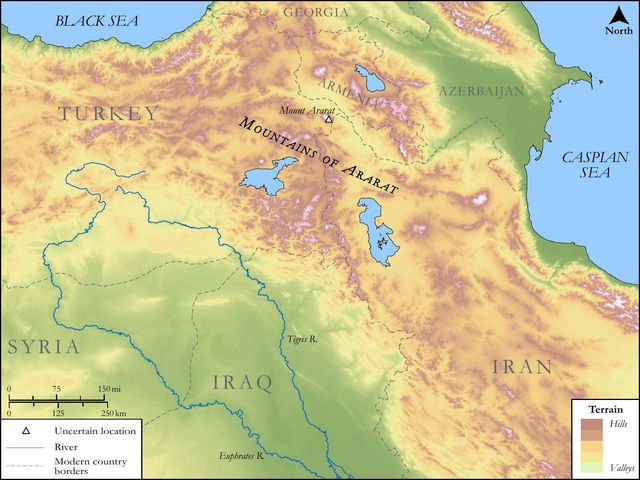
See on the biblical-era maps


Study this verse
Public-domain commentary
Matthew Henry
From his Commentary on the Whole Bible. Henry comments on passages, not single verses — this entry covers Genesis 8:6–12. His three-level outline is real structure in the source text, so it is rendered as structure.
We have here an account of the spies which Noah sent forth to bring him intelligence from abroad, a raven and a dove. Observe here,
I.That though God had told Noah particularly when the flood would come, even to a day (Gen 7:4), yet he did not give him a particular account by revelation at what times, and by what steps, it should go away,
1.Because the knowledge of the former was necessary to his preparing the ark, and settling himself in it; but the knowledge of the latter would serve only to gratify his curiosity, and the concealing of it from him would be the needful exercise of his faith and patience. And,
2.He could not foresee the flood, but by revelation; but he might, by ordinary means, discover the decrease of it, and therefore God was pleased to leave him to the use of them.
II.That though Noah by faith expected his enlargement, and by patience waited for it, yet he was inquisitive concerning it, as one that thought it long to be thus confined. Note, Desires of release out of trouble, earnest expectations of it, and enquiries concerning its advances towards us, will very well consist with the sincerity of faith and patience. He that believes does not make haste to run before God, but he does make haste to go forth to meet him, Isa 28:16. Particularly,
1.Noah sent forth a raven through the window of the ark, which went forth, as the Hebrew phrase is, going forth and returning, that is, flying about, and feeding on the carcases that floated, but returning to the ark for rest; probably not in it, but upon it. This gave Noah little satisfaction; therefore,
2.He sent forth a dove, which returned the first time with no good news, but probably wet and dirty; but, the second time, she brought an olive-leaf in her bill, which appeared to be first plucked off, a plain indication that now the trees, the fruit-trees, began to appear above water. Note here,
(1.)That Noah sent forth the dove the second time seven days after the first time, and the third time was after seven days too; and probably the first sending of her out was seven days after the sending forth of the raven. This intimates that it was done on the sabbath day, which, it should seem, Noah religiously observed in the ark. Having kept the sabbath in a solemn assembly of his little church, he then expected special blessings from heaven, and enquired concerning them. Having directed his prayer, he looked up, Psa 5:3.
(2.)The dove is an emblem of a gracious soul, which finding no rest for its foot, no solid peace or satisfaction in this world, this deluged defiling world, returns to Christ as to its ark, as to its Noah. The carnal heart, like the raven, takes up with the world, and feeds on the carrions it finds there; but return thou to thy rest, O my soul, to thy Noah, so the word is, Psa 116:7. O that I had wings like a dove, to flee to him! Psa 55:6. And as Noah put forth his hand, and took the dove, and pulled her in to him, into the ark, so Christ will graciously preserve, and help, and welcome, those that fly to him for rest.
(3.)The olive-branch, which was an emblem of peace, was brought, not by the raven, a bird of prey, nor by a gay and proud peacock, but by a mild, patient, humble dove. It is a dove-like disposition that brings into the world earnests of rest and joy.
(4.)Some make these things an allegory. The law was first sent forth like the raven, but brought no tidings of the assuaging of the waters of God's wrath, with which the world of mankind was deluged; therefore, in the fulness of time, God sent forth his gospel, as the dove, in the likeness of which the Holy Spirit descended, and this presents us with an olive-branch and brings in a better hope.
Historical interpretation
Three Centuries of Reception
3 surviving comments on this verse. Each one is dated, so this reads as a timeline rather than a list.
Select a marker to jump to its quote. Markers stagger vertically where authors wrote within a few decades of each other.
The Synagogue has not this oil, inasmuch as she has not the olive, and understood not that dove which brought back the olive branch after the deluge. For that Dove descended afterwards when Christ was baptized, and abode upon Him, as John testified in the Gospel, saying: "I saw the Spirit descending from heaven like a dove, and He abode upon Him."
Christ is a dove because he commands his holy ones to be as doves when he says, “Be simple as doves.” But the prophet speaks of what Christ the dove is when, in his person, he describes his return to heaven after his suffering: “Who will give me wings like a dove, and I shall fly away and be at rest?” When Christ the Lord, therefore, initiated the sacraments of the church a dove came down from heaven. I understand the mystery, and I recognize the sacrament. For the very dove that once hastened to Noah’s ark in the flood now comes to Christ’s church in baptism.
After [the raven] he sent a dove, and it came to him in the evening, carrying in its mouth an olive branch with green leaves.You are paying attention, I believe, and with your intellect you anticipate me as I speak. The olive branch with green leaves is the grace of the Holy Spirit, rich in the words of life, the fullness of which rests upon Christ, [as] the psalm says, “God, your God, has anointed you with the oil of gladness above your fellows.” Concerning this gift given to Christ’s fellows, John speaks: “You have the anointing from the holy one, and you know all things.” And by a most beautiful conjunction the figure is in agreement with the fulfillment—a corporeal dove brought the olive branch to the ark which was washed by the waters of the flood; the Holy Spirit descended in the form of a corporeal dove upon the Lord when he was baptized in the waters of the Jordan. Not only the human beings but also the living things which the ark contained, and also the very wood from which the ark was made, prefigure us members of Christ and of the church after our reception of the washing of the waters of regeneration. Through the anointing of the sacred chrism may we be signed with the grace of the Holy Spirit, and may he deign to keep it inviolate in us who himself gave it [to us], Jesus Christ our Lord who with the almighty Father in the unity of the same Holy Spirit lives and reigns for all ages. Amen.
Continue studying Genesis 8:10 across the web’s major study libraries — every link below opens this exact verse, chapter, or book on the destination site.
Read & Compare
 BibleGatewayThis verse in more than 200 translations and 70 languages.
 Bible.comThe YouVersion reader — hundreds of translations, reading plans, and highlights.
 ESV.orgCrossway's official English Standard Version reader.
 NET BibleThe NET translation with 60,000+ translators' notes on every rendering decision.
 STEP BibleTyndale House's free study tool — original text, vocabulary, and scholarly resources.
 BibliaLogos Bible Software's free web reader.
 USCCBThe New American Bible (Revised Edition) with the U.S. bishops' study notes.
Commentaries
 BibleHub CommentariesDozens of classic commentaries on this verse, gathered on one page.
 StudyLightMore than 100 commentary sets — the largest collection on the web.
 BibleRefPlain-English commentary on what this verse means, verse by verse.
 Enduring WordDavid Guzik's free commentary on this chapter, widely used by Bible teachers.
 Bible Study ToolsVerse commentary alongside Greek and Hebrew study aids.
Original Language & Research
- BibleHub InterlinearThe verse word by word — original language, transliteration, and English.
- BibleHub LexiconEvery word's original-language definition and Strong's entry.
 Blue Letter BibleDeep-study tools — Strong's numbers, concordance, and word studies.
 SefariaThe Hebrew text with Rashi and centuries of Jewish commentary.
Sermons, Hymns & Audio


TrulyRandomVerse is not affiliated with these sites and doesn’t control their content. They’re linked because they’re genuinely useful.
Summary
Genesis 8:10 meticulously records Noah's continued exercise of patience and methodical discernment during the post-Flood period, specifically detailing his second seven-day waiting interval before dispatching the dove from the ark. This verse underscores Noah's reliance on observable signs and divine timing as he diligently sought confirmation that the earth was sufficiently dry for disembarkation, highlighting a profound trust in God's unfolding plan amidst prolonged confinement.
Context
ShowHideLiterary Context
This verse is situated within the climactic narrative of the Great Flood's aftermath, following the ark's resting on the mountains of Ararat and the gradual recession of the waters. Prior to this, Noah had already sent forth a raven, which flew back and forth but did not return to the ark permanently, indicating only that some land was exposed but not necessarily dry enough for habitation (Genesis 8:7 "Noah sends the raven and then the dove"). Immediately preceding our verse, Noah had sent out a dove for the first time, which returned to him because it found "no rest for the sole of her foot," signifying that the ground was still covered with water (Genesis 8:9 "The first sending of the dove"). Genesis 8:10 thus marks a deliberate, patient continuation of Noah's investigative actions, occurring after a specific waiting period and setting the stage for the dove's eventual return with an olive leaf in Genesis 8:11 "The dove returns with an olive leaf", which signals a significant turning point.
Historical & Cultural Context
The act of sending birds to scout conditions was a practical and logical method in ancient times, especially for those confined or navigating unknown territories. Noah's use of a raven (a scavenger) and then a dove (known for its homing instinct and sensitivity to its environment) demonstrates a shrewd understanding of animal behavior for a specific purpose. The ark itself, as described in Genesis 6:14-16 "God's instructions for building the ark", was a vessel designed for survival, not exploration, necessitating external means to assess the world outside. The concept of a global flood, while unique in its biblical scope, is remembered in the flood tales of the nations, though the Genesis account emphasizes God's righteous judgment and covenantal faithfulness. The "seven days" motif, prevalent throughout the biblical narrative, carries significant weight, often denoting completeness, divine action, or a sacred cycle, reflecting a cultural understanding of time and divine order.
Key Themes
ShowHideGenesis 8:10 contributes significantly to several overarching themes within the Flood narrative and the broader book of Genesis. Patience and Perseverance are vividly displayed in Noah's repeated, methodical waiting periods, underscoring the importance of enduring faith even when God's timing seems protracted. The theme of Divine Sovereignty and Human Discernment is also prominent; while God is in ultimate control of the waters' recession, Noah actively engages in discerning the opportune moment for disembarkation through practical observation. This period of waiting and testing also reinforces the theme of New Creation, as the earth is being prepared for a fresh start, a new beginning for humanity and all living creatures, echoing the original creation account found in Genesis 1 "The Creation Account". Furthermore, the recurring "seven days" motif highlights God's Ordered Providence, demonstrating that God's work unfolds according to a precise and purposeful divine calendar, rather than arbitrary events.
Exposition and Analysis
ShowHideGenesis 8:10, though brief, is rich with meaning, revealing Noah's character, God's providential working, and significant thematic undertones.
Key Word Analysis
ShowHideThis word (H2342) implies more than passive waiting; it can mean "to twist or whirl," "to writhe in pain," or figuratively, "to wait carefully" or "to hope." In this context, it conveys an active, expectant waiting, a deliberate tarrying with a purpose. Noah's "staying" is not idleness but a patient endurance, a hopeful anticipation of God's next move. It suggests a process of "forming" or "shaping" the next stage of God's plan through patient observation.
The combination of H7651 (shebaʻ, "seven") and H3117 (yôwm, "day") is highly significant. "Seven" often represents completeness, perfection, or a sacred cycle in biblical numerology, as seen in the seven days of creation. "Day" refers to a specific period of time. The phrase "seven days" here denotes a full, deliberate, and divinely ordained cycle of waiting, emphasizing that Noah's actions were not impulsive but followed a measured, purposeful rhythm, reflecting God's own ordered work.
This verb (H7971) means "to send away, for, or out," with a wide range of applications including "to cast out," "to let depart," or "to spread." Here, it signifies a purposeful dispatch, an active sending out of the dove with a specific mission—to scout the conditions of the earth. It is a deliberate action taken by Noah to gain information, demonstrating his active role in discerning God's timing.
Verse Breakdown
ShowHide"And he stayed yet other seven days"
This clause emphasizes Noah's deliberate patience and adherence to a recurring pattern. The word "other" (H312, ʼachêr') highlights that this was a second such seven-day interval, following the first sending of the dove. This repetition reinforces the idea of a methodical, unhurried process, demonstrating Noah's profound trust in God's timing and his refusal to act prematurely despite the long confinement. It suggests a divinely ordained rhythm to the unfolding of the new creation.
"and again he sent forth the dove out of the ark;"
This second clause describes Noah's renewed action after the completion of the seven-day waiting period. The word "again" (H3254, yâçaph') signifies a continuation or repetition of the previous action of sending the dove. This was not a random act but a calculated re-evaluation, building upon the inconclusive results of the first attempt. The dove, a creature known for its sensitivity to its environment and its need for a dry resting place, served as Noah's living barometer, a practical tool for discerning the state of the earth's surface. This action highlights Noah's active discernment and his reliance on observable signs in conjunction with his faith.
Literary Devices
ShowHideThe verse employs several literary devices that enrich its meaning. Repetition is prominent with the phrase "seven days," which appears multiple times in this chapter (verses 10, 12), underscoring the methodical nature of Noah's waiting and hinting at the biblical significance of the number seven as a symbol of completeness or divine cycles. Symbolism is also at play, particularly with the dove itself, which will later become a symbol of peace and new beginnings (in Genesis 8:11 "The dove returns with an olive leaf") and, much later, of the Holy Spirit. The ark serves as a symbol of divine preservation and temporary refuge, from which Noah is patiently seeking release. The entire sequence of sending out birds can be seen as a form of foreshadowing, hinting at the eventual emergence into a new, cleansed world, and the establishment of a new covenant.
Theological and Thematic Connections
ShowHideGenesis 8:10 powerfully illustrates the interplay between divine sovereignty and human responsibility. While God controls the recession of the waters and the timing of the new beginning, Noah is not passive; he actively engages in discerning God's will through patient observation and methodical testing. This balance teaches us that faith is not merely waiting for a direct command but also wisely using the means God provides, including our intellect and the natural world, to understand His unfolding plan. The recurring "seven days" motif reinforces the theme of God's ordered and purposeful work, echoing the creation week and suggesting that God's redemptive plan, like His creative acts, unfolds in deliberate, complete cycles.
Reflection and Application
ShowHideGenesis 8:10 offers profound spiritual nourishment for believers navigating seasons of waiting, uncertainty, or transition. Noah's example challenges us to cultivate a deep, active patience rooted in trust, rather than passive resignation. In a world that often pressures us towards immediate gratification and impulsive action, Noah's methodical "staying" and repeated, measured discernment remind us that God's timing is perfect, even when it feels slow or prolonged from our perspective. We are called to be like Noah: not merely waiting, but waiting well—observing, praying, seeking wisdom, and preparing ourselves for God's next instruction. This verse encourages us to utilize the resources and wisdom God has given us (our "doves" of discernment) to understand our circumstances, while steadfastly anchoring our hope in His sovereign plan. Our patient endurance in waiting often serves as a crucible, refining our faith and preparing us for the new beginnings God has in store, just as Noah's waiting prepared him for the re-peopling of the earth.
Questions for Reflection
ShowHideFAQ
ShowHideWhy did Noah wait "yet other seven days" before sending the dove again?
ShowHideThe "seven days" motif is highly significant in biblical contexts, often symbolizing completeness, perfection, or a divinely ordained cycle. Noah's repeated seven-day intervals (seen again in Genesis 8:12 "Noah waits seven more days") demonstrate his methodical patience and profound trust in God's timing. It suggests that God's work unfolds in purposeful, measured stages rather than random occurrences, and Noah was aligning his actions with this divine rhythm, indicating a full, deliberate period of observation and waiting.
Why did Noah send a dove again after the raven?
ShowHideNoah sent the raven first because as a scavenger, it could find sustenance on floating carcasses and simply fly back and forth, indicating only that some land might be exposed. The raven's behavior did not confirm the earth was dry enough for habitation. The dove, however, is known for its sensitivity to its environment and its need for a dry, stable resting place. Sending the dove was a more precise and reliable test to determine if the earth was truly dry and habitable, as it would only return if it found no suitable dry ground, as it did in Genesis 8:9 "The first sending of the dove".
Did Noah know the earth was drying before sending the dove?
ShowHideYes, the narrative indicates that Noah had observed the waters receding. Genesis 8:5 "The waters receded continually" explicitly states that "the waters were abated" and the tops of the mountains had become visible. However, Noah's actions with the birds were not to confirm if the waters were receding at all, but to discern the extent of the drying—specifically, whether the ground was firm and dry enough for disembarkation and for life to thrive outside the ark. He used the birds as a practical, observable means of assessment, blending his faith in God's process with wise, empirical observation.
Christ-Centered Fulfillment
ShowHideNoah's patient waiting in the ark, discerning the signs of a new beginning, profoundly foreshadows the ultimate new creation found in Christ. Just as Noah waited for the earth to be cleansed and prepared for new life, humanity awaited the coming of Christ to cleanse the world of sin and usher in the new covenant. The ark, a vessel of salvation through judgment, points to Christ as the ultimate refuge and means of salvation from God's wrath. The dove, a creature of peace and a symbol of new beginnings, anticipates the descent of the Holy Spirit upon Jesus at His baptism, signifying the inauguration of His ministry and the beginning of God's ultimate redemptive work in the world (Matthew 3:16 "The Spirit descends like a dove"). In Christ, we find true rest and the promise of a new heaven and a new earth, fulfilling the hope of a secure dwelling place that Noah sought for the sole of his foot. Christ is the "true Ark" who carries His people through the waters of judgment into the safety of God's eternal presence, providing the ultimate "rest for the sole of our foot" in Him (Hebrews 4:9-10 "There remains a Sabbath rest for the people of God"). Through His finished work, the world is cleansed, and a new creation is made possible for all who believe (2 Corinthians 5:17 "Therefore, if anyone is in Christ, he is a new creation").