


Genesis 8:7
Bible text: King James Version (1769 Blayney text) · Public domain
Bible text: Berean Standard Bible · Public domain
Bible text: American Standard Version (1901) · Public domain
Bible text: World English Bible, Messianic edition · Public domain
Bible text: Geneva Bible (1599) · Public domain
Bible text: Young's Literal Translation · Public domain
- וַיְשַׁלַּחvay·sha·Lachand he sent outH7971Conj-w ¦ V-Piel-ConsecImperf-3msVerb Piel Consecutive Imperfect 3rd Singular Masculineוַandיְשַׁלַּחhe sent out
- אֶת'et<obj.>H853DirObjMParticle Object Indicator
- הָעֹרֵבha·'o·Revthe ravenH6158Art ¦ N-msNoun Singular Masculine Absoluteהָtheעֹרֵבraven
- וַיֵּצֵאvai·ye·Tze'and it went outH3318Conj-w ¦ V-Qal-ConsecImperf-3msVerb Qal Consecutive Imperfect 3rd Singular Masculineוַandיֵּצֵאit went out
- יָצוֹאya·tzO'continuously <to go out>H3318V-Qal-InfAbsVerb Qal Infinitive Absolute
- וָשׁוֹבva·Shovand returnedH7725Conj-w ¦ V-Qal-InfAbsVerb Qal Infinitive Absoluteוָandשׁוֹבreturned
- עַד'aduntilH5704PrepPreposition
- יְבֹשֶׁתye·Vo·shetdried upH3001V-Qal-InfVerb Qal Infinitive Construct
- הַמַּיִםha·Ma·yimthe watersH4325Art ¦ N-mpNoun Plural Masculine Absoluteהַtheמַּיִםwaters
- מֵעַלme·'Alfrom onH5921Prep-m ¦ PrepPrepositionמֵfromעַלon
- הָאָרֶץha·'A·retzthe earthH776Art ¦ N-fsNoun Singular Feminine Absoluteהָtheאָרֶץearth
English is a literal word-by-word gloss of the Hebrew, not the KJV's wording. Why?
This is the original text the KJV's translators worked from — each Hebrew word with its own literal English meaning in this verse, prepared by scholars at Tyndale House, Cambridge. The KJV translates whole sentences, not word by word, so its wording differs: one Hebrew word can become several English words, and the KJV may choose “the LORD” where the gloss reads “Yahweh”. Both are faithful — they answer different questions. For the KJV's own rendering, switch to the KJV text.
Details
See on the biblical-era maps


Study this verse
Public-domain commentary
Matthew Henry
From his Commentary on the Whole Bible. Henry comments on passages, not single verses — this entry covers Genesis 8:6–12. His three-level outline is real structure in the source text, so it is rendered as structure.
We have here an account of the spies which Noah sent forth to bring him intelligence from abroad, a raven and a dove. Observe here,
I.That though God had told Noah particularly when the flood would come, even to a day (Gen 7:4), yet he did not give him a particular account by revelation at what times, and by what steps, it should go away,
1.Because the knowledge of the former was necessary to his preparing the ark, and settling himself in it; but the knowledge of the latter would serve only to gratify his curiosity, and the concealing of it from him would be the needful exercise of his faith and patience. And,
2.He could not foresee the flood, but by revelation; but he might, by ordinary means, discover the decrease of it, and therefore God was pleased to leave him to the use of them.
II.That though Noah by faith expected his enlargement, and by patience waited for it, yet he was inquisitive concerning it, as one that thought it long to be thus confined. Note, Desires of release out of trouble, earnest expectations of it, and enquiries concerning its advances towards us, will very well consist with the sincerity of faith and patience. He that believes does not make haste to run before God, but he does make haste to go forth to meet him, Isa 28:16. Particularly,
1.Noah sent forth a raven through the window of the ark, which went forth, as the Hebrew phrase is, going forth and returning, that is, flying about, and feeding on the carcases that floated, but returning to the ark for rest; probably not in it, but upon it. This gave Noah little satisfaction; therefore,
2.He sent forth a dove, which returned the first time with no good news, but probably wet and dirty; but, the second time, she brought an olive-leaf in her bill, which appeared to be first plucked off, a plain indication that now the trees, the fruit-trees, began to appear above water. Note here,
(1.)That Noah sent forth the dove the second time seven days after the first time, and the third time was after seven days too; and probably the first sending of her out was seven days after the sending forth of the raven. This intimates that it was done on the sabbath day, which, it should seem, Noah religiously observed in the ark. Having kept the sabbath in a solemn assembly of his little church, he then expected special blessings from heaven, and enquired concerning them. Having directed his prayer, he looked up, Psa 5:3.
(2.)The dove is an emblem of a gracious soul, which finding no rest for its foot, no solid peace or satisfaction in this world, this deluged defiling world, returns to Christ as to its ark, as to its Noah. The carnal heart, like the raven, takes up with the world, and feeds on the carrions it finds there; but return thou to thy rest, O my soul, to thy Noah, so the word is, Psa 116:7. O that I had wings like a dove, to flee to him! Psa 55:6. And as Noah put forth his hand, and took the dove, and pulled her in to him, into the ark, so Christ will graciously preserve, and help, and welcome, those that fly to him for rest.
(3.)The olive-branch, which was an emblem of peace, was brought, not by the raven, a bird of prey, nor by a gay and proud peacock, but by a mild, patient, humble dove. It is a dove-like disposition that brings into the world earnests of rest and joy.
(4.)Some make these things an allegory. The law was first sent forth like the raven, but brought no tidings of the assuaging of the waters of God's wrath, with which the world of mankind was deluged; therefore, in the fulness of time, God sent forth his gospel, as the dove, in the likeness of which the Holy Spirit descended, and this presents us with an olive-branch and brings in a better hope.
Historical interpretation
Three Centuries of Reception
5 surviving comments on this verse. Each one is dated, so this reads as a timeline rather than a list.
Select a marker to jump to its quote. Markers stagger vertically where authors wrote within a few decades of each other.
But for the present we need to explain the reason why the bird [the raven] did not come back. Perhaps, with the waters subsiding, the bird, being unclean, happened upon corpses of men and beasts and, finding nourishment to its liking, stayed there! This would have been something that proved to be no little sign of hope and encouragement for the just man [if the raven had returned].
As a sign that the flood had abated
the dove is now bringing
Back to the ark in her beak
the budding green branch of an olive.
For the raven, held captive by gluttony,
clung to foul bodies,
While the dove brought back
the glad tidings of peace that was given.
You do not know when that last hour is going to come and yet you say, "I am reforming." When are you going to reform? When are you going to change? "Tomorrow," you say. Behold, how often you say, "Tomorrow, tomorrow." You have really become a crow. Behold, I say to you that when you make the noise of a crow, ruin is threatening you. For that crow whose cawing you imitate went forth from the ark and did not return.
Noah wanted to know how things stood on the face of the earth when the inundation had come to an end, and he sent forth a raven, which scorned to return to the ark, signifying those who, although they have been cleansed by the waters of baptism, nevertheless neglect putting off the very black dress of their old selves by living more faultlessly; and lest they deserve to be renewed by the anointing of the Holy Spirit, they at once fall away from the inmost unity of catholic peace and rest by following exterior things, that is, the desires of the world.
He went out and returned, until the waters were dried up from the earth. It does not say he went out and returned to the ark; but he went out and returned, it says, until the waters were dried up from the earth, because obviously he was turning here and there with uncertain flight, now beginning to go away, now returning as if about to enter the ark, but not really seeking the window he had left, but rather wandering outside until, the waters being removed, he would find rest and a place for himself outside the ark; his going out and journey are rightly compared to those who, although initiated and imbued with heavenly sacraments, do not lay aside the blackness of earthly delight, but rather love the broad paths of the world more than the confines of ecclesiastical conversation.
Continue studying Genesis 8:7 across the web’s major study libraries — every link below opens this exact verse, chapter, or book on the destination site.
Read & Compare
 BibleGatewayThis verse in more than 200 translations and 70 languages.
 Bible.comThe YouVersion reader — hundreds of translations, reading plans, and highlights.
 ESV.orgCrossway's official English Standard Version reader.
 NET BibleThe NET translation with 60,000+ translators' notes on every rendering decision.
 STEP BibleTyndale House's free study tool — original text, vocabulary, and scholarly resources.
 BibliaLogos Bible Software's free web reader.
 USCCBThe New American Bible (Revised Edition) with the U.S. bishops' study notes.
Commentaries
 BibleHub CommentariesDozens of classic commentaries on this verse, gathered on one page.
 StudyLightMore than 100 commentary sets — the largest collection on the web.
 BibleRefPlain-English commentary on what this verse means, verse by verse.
 Enduring WordDavid Guzik's free commentary on this chapter, widely used by Bible teachers.
 Bible Study ToolsVerse commentary alongside Greek and Hebrew study aids.
Original Language & Research
- BibleHub InterlinearThe verse word by word — original language, transliteration, and English.
- BibleHub LexiconEvery word's original-language definition and Strong's entry.
 Blue Letter BibleDeep-study tools — Strong's numbers, concordance, and word studies.
 SefariaThe Hebrew text with Rashi and centuries of Jewish commentary.
Sermons, Hymns & Audio


TrulyRandomVerse is not affiliated with these sites and doesn’t control their content. They’re linked because they’re genuinely useful.
Summary
Genesis 8:7 records Noah's initial investigative act after the ark grounded on the mountains of Ararat, where he dispatched a raven to ascertain the state of the receding floodwaters. This strategic move highlights Noah's prudence and methodical approach in discerning the opportune moment for the ark's inhabitants to safely disembark onto a newly cleansed earth, demonstrating a reliance on observable signs while patiently awaiting divine direction.
Context
ShowHideLiterary Context
Genesis 8 opens with God "remembering" Noah and initiating the process of the floodwaters receding, signifying a shift from judgment to restoration. After the ark comes to rest on the mountains of Ararat and the mountaintops become visible, Noah, confined for over a year, begins a series of exploratory actions. The sending of the raven in Genesis 8:7 is the first of these, followed by the repeated dispatch of a dove in Genesis 8:8-12. This sequence of events meticulously details Noah's patient and systematic efforts to determine the earth's habitability, setting the stage for God's eventual command for Noah and all life to exit the ark in Genesis 8:15-17. The narrative emphasizes Noah's role as a faithful steward navigating a world transformed by divine judgment.
Historical & Cultural Context
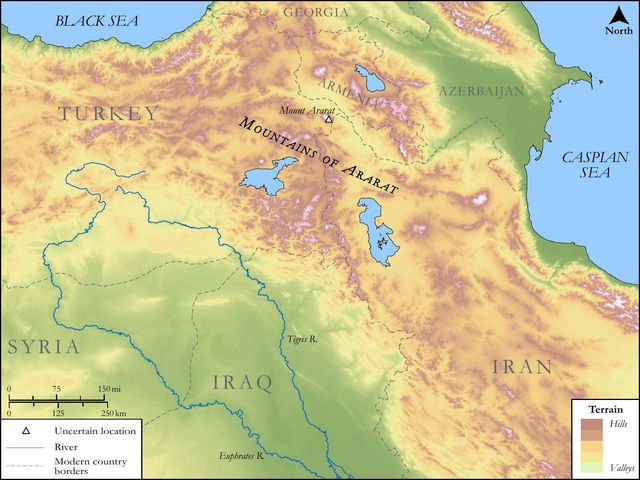
The nations round about told of great floods, but the biblical account in Genesis stands apart in its global scope and moral purpose. The practice of using birds for reconnaissance was known in ancient seafaring and land exploration. Noah's actions reflect a practical, cautious approach consistent with survival in a post-cataclysmic world. The ark's resting place on the "mountains of Ararat" (likely referring to a region in modern-day eastern Turkey) suggests a high elevation, indicating the vastness of the floodwaters that covered even the highest peaks, as described in Genesis 7:19-20. The gradual recession of the waters would have left a landscape of mud and debris, making the choice of a scavenger bird like the raven a pragmatic first step.
Key Themes
ShowHideThis passage significantly contributes to several overarching themes in Genesis. It reinforces the theme of Divine Sovereignty and Providence, as God orchestrates the flood's beginning and end, "remembering" Noah and initiating the drying process (Genesis 8:1). It also highlights Human Prudence and Patience in the face of uncertainty, as Noah does not act impulsively but waits and tests the environment before disembarking. The narrative subtly introduces the theme of Cleansing and Renewal, as the receding waters signify the completion of God's judgment and the preparation for a new beginning for humanity and creation. Furthermore, the distinction between the raven and the dove, and their respective behaviors, foreshadows the later Distinction Between Clean and Unclean Animals that would become central to Israelite law and worship, a concept introduced more fully in Leviticus 11.
Exposition and Analysis
ShowHideGenesis 8:7 states, "And he sent forth a raven, which went forth to and fro, until the waters were dried up from off the earth." This verse marks a pivotal moment, as Noah begins to actively assess the conditions outside the ark.
Key Word Analysis
ShowHideA primitive root meaning "to send away, for, or out (in a great variety of applications)." In this context, it signifies Noah's deliberate action of releasing the raven from the ark, initiating its mission to survey the external environment. It implies a purposeful dispatch rather than a mere letting go.
Meaning "a raven (from its dusky hue)." The choice of the raven is significant. Ravens are known for their hardiness, scavenging nature, and ability to survive in harsh conditions. Unlike the dove, which requires clean, stable ground and fresh vegetation, the raven can subsist on carrion and perch on floating debris, making it a suitable first scout for a post-flood landscape.
Meaning "to turn back (hence, away) transitively or intransitively, literally or figuratively." Combined with the preceding verb "went forth" (H3318, yâtsâʼ), the phrase "went forth to and fro" (הָלוֹךְ וָשׁוֹב, halokh vashov) vividly describes the raven's continuous, restless flight. It indicates that the raven did not return to the ark, implying it found sufficient places to alight and sustenance outside, even if the earth was not yet fully dry.
Meaning "to dry up (as water) or wither (as herbage)." This word describes the gradual but incomplete recession of the floodwaters. The raven's continued "to and fro" movement, without returning, signifies that while the waters were indeed diminishing, the earth was not yet sufficiently dry or hospitable to compel the raven back to the ark, unlike the later behavior of the dove.
Verse Breakdown
ShowHide"And he sent forth a raven"
This clause initiates Noah's proactive exploration. After a prolonged period of passive waiting, Noah takes a calculated step to gather information about the external world. The act of "sending forth" implies a deliberate mission, not merely releasing a bird.
"which went forth to and fro"
This describes the raven's behavior. The Hebrew phrase halokh vashov emphasizes continuous, restless movement. The raven flew out and did not return to the ark, indicating that it found sufficient places to land (perhaps on exposed mountaintops, floating debris, or carcasses) and sustenance, making a return to the ark unnecessary. Its non-return provides a negative indicator: the earth was not yet fully dry or suitable for the ark's inhabitants.
"until the waters were dried up from off the earth"
This specifies the duration and context of the raven's activity. The raven continued its flight until the waters had receded to a significant degree. This does not mean the earth was completely dry and ready for habitation, but rather that enough land or debris was exposed for the raven to sustain itself indefinitely outside the ark. This partial drying prompted Noah to continue his patient observation and subsequent tests with the dove.
Literary Devices
ShowHideThe narrative employs Symbolism through the choice of the raven. As an "unclean" bird (proleptically, according to later Mosaic Law in Leviticus 11:15), its ability to thrive in the post-judgment, still-recovering world suggests its affinity for a landscape not yet fully purified. This contrasts with the dove, a symbol of peace and purity, which would later bring back a fresh olive leaf, signifying new life and a truly habitable environment. The phrase "to and fro" is an example of Repetition (or a repeated action) that vividly portrays the raven's restless, unceasing flight, emphasizing the ongoing, yet incomplete, process of the earth's drying. The narrative's careful sequencing of the raven's mission followed by the dove's missions creates a Foreshadowing effect, subtly building anticipation for the moment when truly dry and habitable land would be confirmed.
Theological and Thematic Connections
ShowHideGenesis 8:7 underscores the profound interplay between divine sovereignty and human responsibility in the unfolding of God's redemptive plan. While God is ultimately in control of the flood's recession, Noah's actions demonstrate a faithful stewardship and prudent initiative, modeling a responsive faith that seeks to discern God's timing and will through observation and patient waiting. This passage teaches that even when God is actively working, there is a space for human diligence and wisdom in navigating the journey of faith.
Reflection and Application
ShowHideGenesis 8:7 offers a powerful paradigm for believers navigating periods of uncertainty, transition, or waiting in their own lives. Noah, confined and dependent, did not act presumptuously but engaged in a methodical, patient process of discernment. He utilized the resources at hand (the raven) to gather information, even if that information was incomplete or negative. This teaches us the importance of exercising prudence and wisdom in our decisions, diligently seeking signs, counsel, and understanding, rather than rushing ahead of God's timing. Our "ravens" might be careful research, seeking wise counsel, prayerful contemplation, or a patient observation of circumstances. Ultimately, like Noah, we are called to balance our active, responsible efforts with an unwavering trust in God's sovereign leading, knowing that His perfect timing will eventually be revealed, guiding us to our "new earth" or next step.
Questions for Reflection
ShowHideFAQ
ShowHideWhy did Noah send a raven first, rather than a dove?
ShowHideNoah likely chose the raven as his initial scout due to its practical advantages in a post-flood environment. Ravens (H6158, ʻôrêb') are known for their hardiness, scavenging nature, and ability to subsist on carrion or debris. They are less particular about their resting places and can perch on exposed land, floating carcasses, or even mud. If the raven did not return, as was the case, it indicated that there was sufficient sustenance and places for it to alight outside the ark, even if the earth was not yet suitable for human habitation or the delicate dove. This provided Noah with a crucial, albeit negative, indicator of the earth's condition, prompting him to then send the dove, which requires cleaner, stable ground and fresh vegetation, as a more precise gauge of habitability (Genesis 8:8-12).
Does the raven's non-return imply disloyalty or a failure on its part?
ShowHideThe raven's non-return should not be interpreted as disloyalty or a failure. Its behavior was consistent with its natural instincts as a scavenger. The phrase "went forth to and fro" (H3318, yâtsâʼ and H7725, shûwb) implies that the raven found ample food and places to perch outside the ark, and therefore had no compelling reason to return. Its mission was not to bring back a token of dry land, but to provide an indication of the earth's condition by its very presence or absence. Its continued flight confirmed that while the waters were receding (H3001, yâbêsh'), the earth was not yet fully dried or hospitable enough to compel the raven back to the confined space of the ark. This provided Noah with valuable, albeit incomplete, information for his next steps.
Christ-Centered Fulfillment
ShowHideWhile Genesis 8:7 describes a specific historical event, it resonates with profound Christ-centered themes. Noah's patient waiting for a "new earth" after judgment foreshadows the ultimate new creation ushered in by Christ's redemptive work. Just as Noah sought a safe and habitable dwelling place for humanity and creation, humanity, through Christ, finds a secure and eternal dwelling in God's kingdom, not based on human observation or the flight of a bird, but on God's definitive act of salvation. The ark itself, a vessel of salvation through judgment, prefigures Christ as the ultimate refuge and means of deliverance from the judgment of sin. Through His death and resurrection, Christ leads His people to a new and perfect dwelling place, a kingdom that will never be swept away by judgment (Hebrews 9:28, Revelation 21:1-5). He is the one who brings true peace and a lasting home, far surpassing the temporary dry land sought by Noah's raven.