


Ezekiel 42:16
Bible text: King James Version (1769 Blayney text) · Public domain
Bible text: Berean Standard Bible · Public domain
Bible text: American Standard Version (1901) · Public domain
Bible text: World English Bible, Messianic edition · Public domain
Bible text: Geneva Bible (1599) · Public domain
Bible text: Young's Literal Translation · Public domain
- מָדַדma·Dadhe measuredH4058V-Qal-Perf-3msVerb Qal Perfect 3rd Singular Masculine
- רוּחַRu·ach[the] side ofH7307N-fscNoun Singular Feminine Construct
- הַקָּדִיםha·ka·Dimthe eastH6921Art ¦ N-msNoun Singular Masculine Absoluteהַtheקָּדִיםeast
- בִּקְנֵהbik·Nehwith [the] reed ofH7070Prep-b ¦ N-mscNoun Singular Masculine Constructבִּwithקְנֵה[the] reed of
- הַמִּדָּהha·mi·Dah<the> measurementH4060Art ¦ N-fsNoun Singular Feminine Absoluteהַ<the>מִּדָּהmeasurement
- חֲמֵשׁcha·meshfiveH2568Adj-cscAdjective Numerical Singular common gender Construct
- מֵאוֹתe·mothundred<s>H3967Adj-fpcAdjective Numerical Plural Feminine Construct
- קָנִיםka·NimreedsH7070N-mpNoun Plural Masculine Absolute
- בִּקְנֵהbik·Nehby [the] reed ofH7070Prep-b ¦ N-mscNoun Singular Masculine Constructבִּbyקְנֵה[the] reed of
- הַמִּדָּהha·mi·Dah<the> measurementH4060Art ¦ N-fsNoun Singular Feminine Absoluteהַ<the>מִּדָּהmeasurement
- סָבִיבsa·Vivall aroundH5439N-csNoun Singular common gender Absolute
English is a literal word-by-word gloss of the Hebrew, not the KJV's wording. Why?
This is the original text the KJV's translators worked from — each Hebrew word with its own literal English meaning in this verse, prepared by scholars at Tyndale House, Cambridge. The KJV translates whole sentences, not word by word, so its wording differs: one Hebrew word can become several English words, and the KJV may choose “the LORD” where the gloss reads “Yahweh”. Both are faithful — they answer different questions. For the KJV's own rendering, switch to the KJV text.
Details
See on the biblical-era map
Study this verse
Public-domain commentary
Matthew Henry
From his Commentary on the Whole Bible. Henry comments on passages, not single verses — this entry covers Ezekiel 42:15–20.
We have attended the measuring of this mystical temple and are now to see how far the holy ground on which we tread extends; and that also is here measured, and found to take in a great compass. Observe, 1. What the dimensions of it were. It extended each way 500 reeds (Eze 42:16-19), each reed above three yards and a half, so that it reached every way about an English measured mile, which, the ground lying square, was above four miles round. Thus large were the suburbs (as I may call them) of this mystical temple, signifying the great extent of the church in gospel-times, when all nations should be discipled and the kingdoms of the world made Christ's kingdoms. Room should be made in God's courts for the numerous forces of the Gentiles that shall flow into them, as was foretold, Isa 49:18; Isa 60:4. It is in part fulfilled already in the accession of the Gentiles to the church; and we trust it shall have a more full accomplishment when the fulness of the Gentiles shall come in and all Israel shall be saved. 2. Why the dimensions of it were made thus large. It was to make a separation, by putting a very large distance between the sanctuary and the profane place; and therefore there was a wall surrounding it, to keep off those that were unclean and to separate between the previous and the vile. Note, A difference is to be put between common and sacred things, between God's name and other names, between his day and other days, his book and other books, his institutions and other observances; and a distance is to be put between our worldly and religious actions, so as still to go about the worship of God with a solemn pause.
Historical interpretation
Historical reception
1 surviving comment on this verse from the historical church.
(Verse 15 onwards) When he had finished measuring the interior dimensions of the house, he led me along the way of the gate that faced east, and he measured it all around. (He measured the likeness of the house all around in order.) He measured the east side with the measuring rod; it was 500 rods long by the measuring rod all around. (He also measured the north side, south side, and west side.) And he measured against the north wind, five hundred cubits, measuring with a cubit in circumference. And he measured against the south wind, five hundred cubits, measuring with a cubit in circumference. And he measured against the west wind, five hundred cubits, measuring with a cubit. He measured on all four sides, the wall surrounding it, with a length of five hundred cubits and a width of five hundred cubits, dividing between the sanctuary and the common area. It should be known that after the East and North wind, the South and West wind has a reversed order among the Seventy. For they first set the West, that is the sea; and then the South, whereas among the Hebrews the South wind is first, and then the West. And what the Scripture now says: 'And when he had finished measuring the interior of the house, he led me through the gate that faces toward the East, and showed me all that has been mentioned, both inside and out, and the inner parts of the temple, that is, the Most Holy Place, properly belong to the building of the temple and the inner temple.' Now it follows: He led me through the gate, which looked towards the Eastern road, and measured it all around, like the likeness of a house. By this it is shown that it is not the house itself, but the likeness of the house that is seen: for now we see through a glass darkly; but then face to face: now I know in part; but then I shall know even as I am known (I Cor. XIII). Therefore, even Moses in the tabernacle, and Solomon in the building, made not the true tent of the temple, but the likeness and figure of it: that by these things which are lesser and earthly, we may understand those things which are heavenly, and in the spiritual building. But the man who had brought the prophet, went not into the outer courtyard, but through the gate which looked towards the eastern way, first measuring against the eastern wind, that is, the eastern quarter, five hundred reeds round about; second, towards the north; thirdly, towards the south; fourthly, towards the sea, that is, towards the west, on the four sides, a wall all around, as much in length as in breadth, that is, square, which wall had together with it two thousand reeds. But if the reed was six cubits long, and the wrestler one-sixth of a cubit, it is clear that the outer wall had a circumference of 2,000 reeds, which makes 12,333 cubits and a third of two thousand. Let the wise and diligent reader read the book of Joshua and he will find how this measure is preserved in the suburbs. Therefore, even the legion of demons chose this number in the suffocation of the pigs (Luke 8), so that he who was separated from the servants of God by the command of the Lord may be led to his own destruction, to the ruin of those who lead a life worthy of filth and squalor. But every exterior wall, which has a very spacious length and width in the form of a square, contains the number of the apostles, that is, twelve thousand: so that a thousand number is assigned to each apostle, and yet it does not reach the measure of the fullness of Christ and the perfect man, unless it is joined by the παλαιστὴ, which is three hundred and thirty-three cubits, and a third part of a cubit: through which the mystery of the holy and venerable Trinity is demonstrated, which encircles and protects everything, and provides the safest dwelling for the inhabitants of its temple. Where the ark of Noah has a length of three hundred cubits, and a height of thirty cubits, which is completed in one cubit (Gen. 5). But the fifty cubits that are added there in width signify the sacrament of remission (as we have often said). Hence the Lord came to baptism at the age of thirty, and this very prophet puts the thirtieth year at the beginning of his book: which is completed by adding three hundred and thirtieth, and the thirtieth number and a third part. However, in regard to the simplicity of the interpretation, while we pay little attention to the speed of dictation, both the Septuagint and our translation have its wall on all sides, with a length of five hundred cubits and a width of five hundred cubits. The Hebrew text, however, does not include the word 'wall', but simply the length of five hundred and the width of five hundred, with the understanding of 'reeds'. As mentioned earlier, towards the east wind, and towards the north, and towards the south, and towards the sea, the wall of each section was measured by the person holding the reed. But the number five hundred, which is close to fifty, concerning the remission of all sins, is indicated not only in the old Scripture (Lev. XXV), but also in the words of the Savior in the Gospel, saying: There were two debtors to a certain creditor: one owed five hundred denarii, and the other fifty (Luke VII, 41). And the wall divides between the sanctuary and the place of the common people. From this we understand that all the description above the temple, the priests, who are the sons of Zadok, were delegated to ministries. But this wall, which stretches over such a large space and surrounds everything, separates the sanctuary from the common area.
Continue studying Ezekiel 42:16 across the web’s major study libraries — every link below opens this exact verse, chapter, or book on the destination site.
Read & Compare
 BibleGatewayThis verse in more than 200 translations and 70 languages.
 Bible.comThe YouVersion reader — hundreds of translations, reading plans, and highlights.
 ESV.orgCrossway's official English Standard Version reader.
 NET BibleThe NET translation with 60,000+ translators' notes on every rendering decision.
 STEP BibleTyndale House's free study tool — original text, vocabulary, and scholarly resources.
 BibliaLogos Bible Software's free web reader.
 USCCBThe New American Bible (Revised Edition) with the U.S. bishops' study notes.
Commentaries
 BibleHub CommentariesDozens of classic commentaries on this verse, gathered on one page.
 StudyLightMore than 100 commentary sets — the largest collection on the web.
 BibleRefPlain-English commentary on what this verse means, verse by verse.
 Enduring WordDavid Guzik's free commentary on this chapter, widely used by Bible teachers.
 Bible Study ToolsVerse commentary alongside Greek and Hebrew study aids.
Original Language & Research
- BibleHub InterlinearThe verse word by word — original language, transliteration, and English.
- BibleHub LexiconEvery word's original-language definition and Strong's entry.
 Blue Letter BibleDeep-study tools — Strong's numbers, concordance, and word studies.
 SefariaThe Hebrew text with Rashi and centuries of Jewish commentary.
Sermons, Hymns & Audio


TrulyRandomVerse is not affiliated with these sites and doesn’t control their content. They’re linked because they’re genuinely useful.
Summary
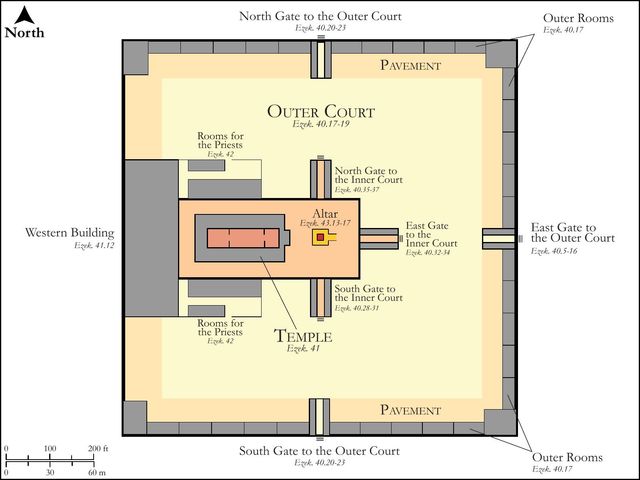
Ezekiel 42:16 initiates the meticulous measurement of the outer perimeter of the visionary temple complex, a pivotal moment in the prophet's grand architectural revelation. This verse specifically details the precise measurement of the east side, establishing its immense scale at "five hundred reeds" and underscoring the comprehensive nature of the divine survey encompassing the entire sacred area. It profoundly emphasizes the divine precision, order, and absolute holiness inherent in God's future dwelling place, setting the foundational dimensions for the vast and sacred boundaries of the restored sanctuary.
Context
ShowHideLiterary Context
Ezekiel 42:16 is strategically positioned within the highly detailed temple vision that spans Ezekiel 40-48. Following the intricate descriptions and measurements of the temple's interior, outer and inner courts, and various chambers found in Ezekiel 40-41, this verse marks a significant transition. It shifts the focus from the internal structure to the overall sacred precinct, initiating the measurement of the entire outer boundary. This verse is the first of four (Ezekiel 42:16-19) that systematically describe the measurement of each of the four sides of the holy area, culminating in Ezekiel 42:20 which explicitly confirms the perfect square shape and immense size of the area set apart from the common. The meticulous and repetitive detail throughout this section emphasizes the divine origin, perfect order, and absolute authority of the vision, starkly contrasting with the recent destruction of the first temple and the chaos of the Babylonian exile.
Historical & Cultural Context
The book of Ezekiel was composed during the traumatic period of the Babylonian exile (597-538 BC), a time of profound national and spiritual despair for the Israelites. Jerusalem had been devastated, the temple—the very symbol of God's presence—lay in ruins, and the people were forcibly removed from their homeland, leading to deep questioning of God's faithfulness and their future. In this context of profound crisis, Ezekiel's elaborate vision of a new, glorious temple served as a powerful, divinely inspired message of hope, restoration, and the unwavering promise of God's renewed dwelling among His people. The precise architectural blueprint, including the specific measurements detailed in this verse, would have conveyed a tangible sense of divine control, order, and a concrete promise of future blessing, reassuring the exiles that God's covenant promises remained steadfast despite their dire circumstances. The concept of a sacred space, meticulously defined and set apart, was already familiar from the tabernacle and Solomon's temple, and here it is tied to Yahweh's absolute holiness and His sovereign plan for Israel's restoration.
Key Themes
ShowHideThis verse significantly contributes to several overarching themes woven throughout Ezekiel's prophecy. Firstly, it powerfully illustrates Divine Precision and Order, demonstrating God's meticulous attention to detail in His plans for restoration and His kingdom. The exact measurements, down to the specific "measuring reed," underscore that God's future kingdom is not arbitrary but perfectly designed and executed. Secondly, it reinforces the crucial theme of Holiness and Separation, as the vast dimensions define an immense sacred space, creating an unmistakable boundary that separates the holy from the common. This concept is central to Ezekiel's entire message, emphasizing the absolute holiness of God and the imperative for His people to live set apart, as seen in the call to distinguish between the clean and unclean, the holy and the profane, in Ezekiel 44:23. Finally, the entire temple vision, initiated by these foundational measurements, embodies Future Hope and Restoration for a dispossessed and disheartened people, promising a renewed relationship with God and a restored dwelling place for His glory, ultimately pointing to a future where God's presence is fully and gloriously manifested among His people.
Exposition and Analysis
ShowHideKey Word Analysis
ShowHideThis primitive root signifies "to stretch" and, by implication, "to measure (as if by stretching a line)." In Ezekiel 42:16, it denotes a precise, deliberate, and authoritative act of determining dimensions. This is not a casual estimation but a methodical process, reinforcing the theme of divine order and the exactness of God's blueprint for the future temple. The verb emphasizes the intentionality and thoroughness of the divine survey.
This noun refers to a "reed (as erect)" and, by extension, a "rod (especially for measuring)." In the context of Ezekiel's vision, this "measuring reed" is a specific, standardized instrument, described in Ezekiel 40:5 as being six "long cubits" (each cubit being a handbreadth longer than a common cubit). This makes one reed approximately 10.5 feet (3.2 meters) long. Its mention highlights the tangible, verifiable, and consistent nature of the measurements, lending credibility and authority to the detailed vision.
This term functions as an adverb meaning "around," "circuit," or "on every side." Its inclusion in Ezekiel 42:16, even though only the east side is explicitly measured in this verse, serves as a proleptic statement. It anticipates and confirms that the subsequent verses (Ezekiel 42:17-19) will complete the measurement of all four sides, creating a perfect square. This signifies the comprehensive nature of the divine measurement, indicating that the entire sacred complex is being meticulously defined on all sides, establishing a fully enclosed, perfectly symmetrical, and utterly set-apart space.
Verse Breakdown
ShowHide"He measured the east side"
This opening clause immediately introduces the action of the angelic guide, who continues his role as the divine architect's representative throughout the temple vision. The specific focus on the "east side" is highly significant, as the east gate is consistently associated with the entrance and departure of God's glory in Ezekiel's prophecy (Ezekiel 43:1-5). Beginning the measurement here establishes the orientation of the vast sacred precinct and sets the stage for the full revelation of its immense scale.
"with the measuring reed, five hundred reeds"
This phrase specifies both the instrument used for the divine survey and the precise dimension of the east side. The "measuring reed" (Hebrew: qaneh middah) is the standard unit of length employed throughout the vision, ensuring consistency and accuracy. The quantification of "five hundred reeds" translates to an astonishing 5,250 feet, or just under one mile (approximately 1.6 kilometers). This immense scale underscores the grandeur, sanctity, and unparalleled holiness of the envisioned temple complex, far surpassing the dimensions of any historical temple structure in Jerusalem and emphasizing its divine origin.
"with the measuring reed round about"
This concluding phrase, though appearing somewhat redundant after the measurement of only the east side, is profoundly significant. It functions as a crucial anticipatory declaration, indicating that the precise measurement of "five hundred reeds" will apply uniformly to all four sides of the sacred precinct, thereby creating a perfect square. This reinforces the comprehensive, perfectly symmetrical, and divinely ordered nature of the entire design, signifying completeness, perfection, and the absolute separation of this vast holy space from the common and profane world surrounding it.
Literary Devices
ShowHideEzekiel 42:16 is rich in literary devices that enhance its theological message. The most prominent is Precision and Detail, evident in the exact numerical measurements ("five hundred reeds") and the specific instrument ("measuring reed"). This meticulousness is not merely architectural but theological, underscoring the divine origin, perfect order, and absolute authority of the temple vision, contrasting starkly with human imperfection and chaos. The Repetition of "with the measuring reed" within the verse itself, and implicitly across the subsequent verses (Ezekiel 42:17-19) that complete the square, serves to emphasize the systematic, thorough, and divinely ordained nature of the survey. This repetition also reinforces the authority and reliability of the vision. Furthermore, the entire temple vision, of which this verse provides the foundational dimensions, functions as profound Symbolism. While scholars debate its literal fulfillment, the vision undeniably symbolizes God's renewed presence, His absolute holiness, and the comprehensive restoration of His people. The vast, perfectly measured square precinct symbolizes the absolute separation of the holy from the common, the divine order that governs God's kingdom, and the comprehensive reach of His sacred space and redemptive purposes.
Theological and Thematic Connections
ShowHideEzekiel 42:16, with its meticulous measurements of the temple precinct, speaks profoundly to God's inherent nature of order, holiness, and His unwavering commitment to dwelling among His people. The immense and perfectly defined sacred space reflects the absolute holiness of God, who requires a distinct separation between the holy and the profane for His presence to reside. This grand vision, given in a time of deep exile and despair, served as a powerful testament to God's faithfulness to His covenant promises, assuring Israel of future restoration and a renewed, glorious presence among them. It foreshadows the ultimate spiritual reality of God's dwelling, not just in a physical structure, but among His redeemed people, culminating in the New Jerusalem where God's presence is fully realized without the need for a physical temple.
Reflection and Application
ShowHideThe meticulous measurements in Ezekiel 42:16, describing a vast and perfectly ordered sacred space, offer profound insights for contemporary believers regarding God's character and our calling. They serve as a powerful reminder that God is a God of absolute order, divine precision, and intentionality. His plans are never haphazard but are meticulously designed, even when we cannot fully grasp their immense scope or ultimate purpose. This truth should instill in us a deep and abiding trust in His sovereignty and His overarching blueprint for our lives, for the church, and for history itself. Furthermore, the emphatic emphasis on the separation of the holy from the common, powerfully signified by the immense dimensions of the temple precinct, serves as a compelling call to holiness for God's people today. While we no longer have a physical temple in Jerusalem, believers are now called to be living temples of the Holy Spirit (1 Corinthians 6:19), indwelt by God Himself. This profound reality means living lives set apart for God's purposes, marked by purity, integrity, and wholehearted devotion in every sphere of existence. The vision of a perfectly measured, holy space should inspire us to cultivate both inner and outer holiness, recognizing that God's presence transforms, sanctifies, and demands our consecrated lives.
Questions for Reflection
ShowHideFAQ
ShowHideIs Ezekiel's temple vision meant to be literal or symbolic?
ShowHideThe interpretation of Ezekiel's temple vision, including the precise measurements in Ezekiel 42:16, is a complex and highly debated subject among biblical scholars. Some interpret it as a literal blueprint for a future temple that will be built during a millennial kingdom, citing the highly detailed and specific nature of the description as evidence for its physical reality. Others view it primarily as symbolic, representing an idealized, perfect worship system and God's renewed presence, emphasizing spiritual truths and principles rather than a physical structure. A third, more nuanced view, considers it both literal and symbolic, suggesting a future literal temple that also embodies profound spiritual realities and serves as a tangible representation of God's perfect order and holiness. Regardless of the exact interpretation, the vision's emphasis on divine precision, absolute holiness, and God's enduring desire to dwell among His people remains central to its profound theological significance.
What is the significance of the "five hundred reeds" measurement?
ShowHideThe "five hundred reeds" measurement, as detailed in Ezekiel 42:16, is profoundly significant due to its immense scale and perfect symmetry. A "reed" in Ezekiel's context was approximately 10.5 feet (3.2 meters), meaning 500 reeds translates to a staggering 5,250 feet (approximately 1.6 kilometers) on each side. This creates a square precinct nearly a mile on each side, an area far larger than any historical temple complex in Jerusalem or indeed, any known ancient sacred precinct. This immense vastness serves to emphasize the absolute holiness of God and the imperative for a substantial, divinely ordained separation between the sacred and the common. It signifies a divinely designed, perfectly proportioned, and utterly comprehensive space for God's glory to dwell, underscoring the completeness of His restoration plans and the profound reverence due to His majestic presence. The perfect square shape also speaks to divine order, stability, and perfection.
Christ-Centered Fulfillment
ShowHideEzekiel 42:16, with its meticulous measurement of a vast, holy precinct, finds its ultimate Christ-centered fulfillment not in a reconstructed physical temple, but profoundly in the person and redemptive work of Jesus Christ. The Old Testament temple, with its precise dimensions, intricate design, and sacrificial system, consistently pointed forward to the perfect dwelling of God among humanity, a reality fully realized in Christ. Jesus Himself declared, "Destroy this temple, and in three days I will raise it up," explicitly referring to the temple of His body (John 2:19-21). He is the ultimate, living temple, the true meeting place between God and humanity, where God's glory dwells in its absolute fullness (Colossians 2:9). The vast, perfectly measured holiness envisioned in Ezekiel is spiritually fulfilled in Christ, who perfectly embodies divine holiness and, through His atoning sacrifice, sets apart a people for God. Through His shed blood, Christ consecrated a new and living way for believers to draw near to God's holy presence (Hebrews 10:19-20). Moreover, the Church, as the collective body of Christ, becomes a spiritual temple, built upon the foundation of the apostles and prophets, with Christ Jesus Himself as the cornerstone (Ephesians 2:20-22). Ultimately, the vision of a perfectly measured, holy city culminates in the New Jerusalem, described in Revelation, where God Himself dwells eternally with His people, and there is no longer a need for a physical temple, "for the Lord God Almighty and the Lamb are the temple of it" (Revelation 21:22). Thus, the precision, order, and holiness of Ezekiel's temple find their glorious and eternal reality in Christ and His redeemed community.