


Exodus 38:13
Bible text: King James Version (1769 Blayney text) · Public domain
Bible text: Berean Standard Bible · Public domain
Bible text: American Standard Version (1901) · Public domain
Bible text: World English Bible, Messianic edition · Public domain
Bible text: Geneva Bible (1599) · Public domain
Bible text: Young's Literal Translation · Public domain
- וְלִפְאַתve·lif·'Atand for [the] side ofH6285Conj-w ¦ Prep-l ¦ N-fscNoun Singular Feminine Constructוְandלִforפְאַת[the] side of
- קֵדְמָהKe·de·maheast -wardH6924N-ms ¦ SfxNoun Singular Masculine Absoluteקֵדְמָeastה-ward
- מִזְרָחָהmiz·Ra·chaheast -wardH4217N-ms ¦ SfxNoun Singular Masculine Absoluteמִזְרָחָeastה-ward
- חֲמִשִּׁיםcha·mi·ShimfiftyH2572Adj-mpAdjective Numerical Plural Masculine Absolute
- אַמָּה'a·Mahcubit[s]H520N-fsNoun Singular Feminine Absolute
English is a literal word-by-word gloss of the Hebrew, not the KJV's wording. Why?
This is the original text the KJV's translators worked from — each Hebrew word with its own literal English meaning in this verse, prepared by scholars at Tyndale House, Cambridge. The KJV translates whole sentences, not word by word, so its wording differs: one Hebrew word can become several English words, and the KJV may choose “the LORD” where the gloss reads “Yahweh”. Both are faithful — they answer different questions. For the KJV's own rendering, switch to the KJV text.
Details
See on the biblical-era maps

Study this verse
Public-domain commentary
Matthew Henry
From his Commentary on the Whole Bible. Henry comments on passages, not single verses — this entry covers Exodus 38:9–20.
The walls of the court, or church-yard, were like the rest curtains or hangings, made according to the appointment, Exo 27:9, etc. This represented the state of the Old Testament church: it was a garden enclosed; the worshippers were then confined to a little compass. But the enclosure being of curtains only intimated that the confinement of the church in one particular nation was not to be perpetual. The dispensation itself was a tabernacle-dispensation, movable and mutable, and in due time to be taken down and folded up, when the place of the tent should be enlarged and its cords lengthened, to make room for the Gentile world, as is foretold, Isa 54:2, Isa 54:3. The church here on earth is but the court of God's house, and happy they that tread these courts and flourish in them; but through these courts we are passing to the holy place above. Blessed are those that dwell in that house of God: they well be still praising him. The enclosing of a court before the tabernacle teaches us a gradual approach to God. The priests that ministered must pass through the holy court, before they entered the holy house. Thus before solemn ordinances there ought to be the separated and enclosed court of a solemn preparation, in which we must wash our hands, and so draw near with a true heart.
Continue studying Exodus 38:13 across the web’s major study libraries — every link below opens this exact verse, chapter, or book on the destination site.
Read & Compare
 BibleGatewayThis verse in more than 200 translations and 70 languages.
 Bible.comThe YouVersion reader — hundreds of translations, reading plans, and highlights.
 ESV.orgCrossway's official English Standard Version reader.
 NET BibleThe NET translation with 60,000+ translators' notes on every rendering decision.
 STEP BibleTyndale House's free study tool — original text, vocabulary, and scholarly resources.
 BibliaLogos Bible Software's free web reader.
 USCCBThe New American Bible (Revised Edition) with the U.S. bishops' study notes.
Commentaries
 BibleHub CommentariesDozens of classic commentaries on this verse, gathered on one page.
 StudyLightMore than 100 commentary sets — the largest collection on the web.
 BibleRefPlain-English commentary on what this verse means, verse by verse.
 Enduring WordDavid Guzik's free commentary on this chapter, widely used by Bible teachers.
 Bible Study ToolsVerse commentary alongside Greek and Hebrew study aids.
Original Language & Research
- BibleHub InterlinearThe verse word by word — original language, transliteration, and English.
- BibleHub LexiconEvery word's original-language definition and Strong's entry.
 Blue Letter BibleDeep-study tools — Strong's numbers, concordance, and word studies.
 SefariaThe Hebrew text with Rashi and centuries of Jewish commentary.
Sermons, Hymns & Audio


TrulyRandomVerse is not affiliated with these sites and doesn’t control their content. They’re linked because they’re genuinely useful.
Summary
Exodus 38:13 precisely details the dimensions of the Tabernacle's courtyard, specifying that the east side measured fifty cubits. This verse is an integral part of the larger divine blueprint for the portable sanctuary, underscoring God's meticulousness in commanding the construction of a sacred space where His presence would dwell among His people. It highlights divine order, precision, and the critical importance of faithful obedience in every aspect of worship, from the grand design to the smallest measurement.
Context
ShowHideLiterary Context
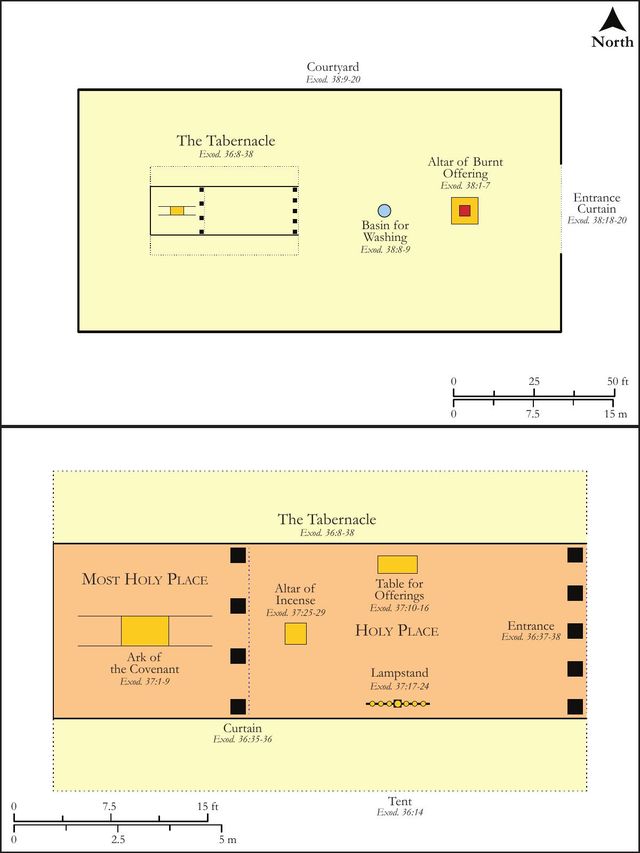
Exodus 38:13 is situated within the detailed account of the Tabernacle's construction, specifically following the instructions for the courtyard's design given in Exodus 27. Chapters 36-38 describe the actual execution of these divine commands by Bezalel, Oholiab, and the skilled artisans. Verse 13 is part of the description of the courtyard's perimeter, which began in Exodus 38:9. The preceding verses detail the south and north sides, each measuring one hundred cubits, while the subsequent verses (Exodus 38:14-15) specify the dimensions of the two "wings" of the east side that flanked the entrance. This verse, therefore, provides the total length of the east side, serving as a foundational measurement for the entrance area. The meticulous enumeration of every dimension across these chapters highlights the divine origin and sacred purpose of each component, emphasizing that the Tabernacle was not a human invention but a divinely revealed pattern.
Historical & Cultural Context
The Tabernacle served as the central place of worship for the Israelites during their wilderness wanderings, a tangible symbol of God's presence among them, as commanded in Exodus 25:8. The instructions for its construction were given to Moses on Mount Sinai, emphasizing their divine authority and sacred origin. The "cubit" was a standard ancient unit of length, typically ranging from 18 to 21 inches (approximately 45-53 cm), representing the distance from the elbow to the tip of the middle finger. Thus, fifty cubits would be roughly 75-87.5 feet (23-26.5 meters). This precise measurement, along with all other specifications, reflects the pattern shown to Moses in the mount, where the sanctuary was constructed with exactitude to mirror heavenly realities and to ensure ritual purity and order. The east side, in particular, held significant symbolic meaning in Scripture, often associated with the rising sun, new beginnings, and the direction from which divine manifestations might appear, a theme echoed in later biblical texts like Ezekiel 43:1.
Key Themes
ShowHideThis verse, embedded within the Tabernacle construction narrative, contributes to several overarching themes in Exodus and the Pentateuch. Firstly, it underscores the theme of Divine Order and Perfection. God's meticulous instructions for every detail of the Tabernacle, including precise measurements like the fifty cubits for the east side, demonstrate His inherent orderliness and the perfection of His design. Nothing is left to human improvisation, emphasizing that true worship must align with divine standards. Secondly, it highlights the theme of Holiness and Separation. The Tabernacle, as God's dwelling place, was set apart from the common, and its precise dimensions created a sacred boundary, reinforcing the distinction between the holy and the profane. Access to God's presence was not arbitrary but strictly defined, as seen in the singular, east-facing entrance. Thirdly, the verse subtly points to the theme of Access to God's Presence. The east side, being the entry point, symbolizes the divinely appointed way for humanity to approach the Holy God. This theme of access, though restricted in the Old Covenant, foreshadows a greater, more open access in the New Covenant. Finally, the faithful execution of these commands by Bezalel and Oholiab, including the precise adherence to measurements, exemplifies the theme of Obedience to God's Revealed Will, a foundational principle throughout the entire book of Exodus.
Exposition and Analysis
ShowHideKey Word Analysis
ShowHideThis word refers to the front, or the direction of the sunrise, hence the east. In biblical geography and symbolism, the east often holds significant meaning, representing beginnings, the direction from which God's glory might appear, or the location of important events (e.g., the Garden of Eden was planted "eastward" in Genesis 2:8). Its use here emphasizes the specific orientation of this side of the Tabernacle courtyard.
Derived from a root meaning "to rise" (like the sun), this term specifically denotes the direction of the sunrise, confirming the eastern orientation. The combination of "east side eastward" (from H6924 and H4217 in the Hebrew) serves to emphatically confirm the precise direction, leaving no ambiguity about the Tabernacle's alignment, which was crucial for its symbolic and functional purposes.
This is the standard ancient unit of linear measurement, typically the length from the elbow to the tip of the middle finger. While its exact length varied slightly (approximately 18-21 inches or 45-53 cm), its use here signifies the meticulous precision of God's instructions. The specification of "fifty cubits" highlights that every dimension of the Tabernacle was divinely ordained, not left to human estimation or convenience, thereby emphasizing the sacredness and divine order of the sanctuary.
Verse Breakdown
ShowHide"And for the east side"
This phrase introduces the specific boundary being described, clearly distinguishing it from the north, south, and west sides previously or subsequently detailed in the Tabernacle's courtyard dimensions. It sets the geographical orientation of this particular segment of the enclosure, emphasizing its unique position.
"eastward"
This adverbial repetition (from the Hebrew mizrâch in conjunction with qedem) reinforces the direction, emphatically stating that this is indeed the side facing the rising sun. This emphasis is not merely for clarity but underscores the symbolic importance of this orientation, particularly as it houses the main and sole entrance to the sacred courtyard, signifying the direction of divine access.
"fifty cubits"
This is the precise linear measurement for the total length of the east side. This numerical detail, like all other measurements for the Tabernacle, signifies the divine precision and intentionality behind every aspect of the sanctuary. It underscores that God's design is not arbitrary but perfectly ordered, contributing to the overall harmony, sacred geometry, and functional purpose of the holy dwelling.
Literary Devices
ShowHideExodus 38:13, though brief, employs several significant literary devices that contribute to its theological weight. The most prominent is Precision and Detail, a characteristic feature of the entire Tabernacle construction narrative (Exodus 36-38). The exact specification of "fifty cubits" for the "east side eastward" is not merely architectural instruction but a profound theological statement. It conveys God's meticulousness, His demand for order in worship, and the sacredness of every dimension of the Tabernacle. This Repetition of directional terms (e.g., "east side eastward" in English, reflecting the Hebrew's emphatic use of qedem and mizrâch) serves as an intensifying device, drawing particular attention to the significance of this specific side, which held the courtyard's entrance. Furthermore, the entire description of the Tabernacle, including this verse, functions as Symbolism. The precise dimensions and orientation of the Tabernacle, particularly its east-facing entrance, are not arbitrary but point to a divinely ordered creation and a structured approach to God, foreshadowing deeper spiritual realities and the ultimate access to God through Christ.
Theological and Thematic Connections
ShowHideExodus 38:13, in its precise detailing of the Tabernacle courtyard's east side, underscores profound theological truths about God's character and His relationship with humanity. It reveals a God of infinite precision, who cares deeply about order and detail in all matters pertaining to His worship and presence. The exact measurements for the sacred enclosure demonstrate that access to God is not haphazard but is governed by divine prescription, emphasizing the holiness of God and the need for His people to approach Him on His terms. This meticulousness also highlights the Israelites' faithful obedience in constructing the Tabernacle exactly as commanded, setting a precedent for future generations regarding adherence to God's revealed will. The east side's particular significance, as the point of entry, subtly points to the idea of a divinely appointed gateway to God's presence, a concept that finds its ultimate fulfillment in the person and work of Jesus Christ.
Reflection and Application
ShowHideExodus 38:13, though seemingly a mere architectural detail, offers rich lessons for contemporary believers. The divine insistence on meticulous precision in the Tabernacle's construction reminds us that God is a God of order, excellence, and intentionality. This principle extends beyond physical structures to our spiritual lives, our worship, and our service. It challenges us to consider whether we approach God with the same reverence for His revealed will and with a commitment to excellence in our spiritual disciplines and communal gatherings. Just as every cubit contributed to the sacred enclosure, every detail of our lives, when offered to God, can contribute to a life of worship. The Tabernacle's design, with its precise boundaries, also speaks to the sacredness of God's presence and the need for a consecrated approach. While we no longer have a physical Tabernacle, the principles of holiness, order, and intentionality in approaching God remain paramount. We are called to live lives that reflect the divine order, acknowledging that God cares about the "small" details as much as the grand narratives, because these details contribute to the overall beauty and integrity of His divine plan.
Questions for Reflection
ShowHideFAQ
ShowHideWhy is so much detail given to the Tabernacle's measurements, even seemingly minor ones like Exodus 38:13?
ShowHideThe extensive detail, including the specific measurement in Exodus 38:13, serves several crucial purposes. Firstly, it underscores the divine origin of the Tabernacle's design. This was not a human invention but a direct revelation from God, emphasizing His meticulousness and sovereignty. Secondly, it ensured uniformity and precision in construction, guaranteeing that the Tabernacle would be built exactly as God intended, reflecting His perfect order and holiness. This precision was vital for its function as a "copy and shadow of the heavenly things" (Hebrews 8:5). Finally, it demonstrated the Israelites' faithful obedience to God's commands, highlighting the importance of adherence to divine instruction, even in what might seem like minor architectural specifications, as a testament to their trust and reverence for God.
What is the significance of the "east side" of the Tabernacle courtyard?
ShowHideThe east side of the Tabernacle courtyard held particular significance because it contained the main and only entrance to the sacred enclosure. This orientation is consistent with biblical symbolism, where the east often represented the direction of new beginnings, the rising sun, and the anticipated appearance of divine glory. For example, the Garden of Eden was planted "eastward" (Genesis 2:8), and the glory of the Lord is depicted as entering the temple from the east in Ezekiel 43:1-2. Thus, the east gate symbolized the divinely appointed access point for humanity to approach God's dwelling place, a concept that finds its ultimate fulfillment in Christ. It served as a controlled and designated path, emphasizing that access to God is on His terms, not ours.
Christ-Centered Fulfillment
ShowHideExodus 38:13, with its precise measurement of the Tabernacle's east side, finds its profound Christ-centered fulfillment in Jesus Christ. The Tabernacle, in its entirety, was a "copy and shadow of the heavenly things" (Hebrews 8:5), and its eastern entrance, meticulously measured, prefigured Christ as the singular, divinely appointed "door" or "gate" to God's presence. Just as the east gate was the only way into the courtyard, Jesus declares, "I am the door. If anyone enters by Me, he will be saved" (John 10:9). The fifty cubits of the east side, representing a carefully defined and limited access point, foreshadowed the perfect and complete access that would be granted through Christ's singular sacrifice. Through His broken body, the veil of the temple was torn from top to bottom at His crucifixion (Matthew 27:51), signifying that the way into the Most Holy Place, God's very presence, was now opened to all believers. This new and living way is not through a physical gate or ritual, but through the perfect High Priest who has entered the true sanctuary in heaven (Hebrews 10:19-20). Thus, the precise dimensions and singular access point of the Tabernacle's entrance ultimately point to the perfect, unchangeable, and sufficient work of the Lamb of God, who is our ultimate access and dwelling place with God, embodying the very presence of God among us (John 1:14).