


Exodus 38:12
Bible text: King James Version (1769 Blayney text) · Public domain
Bible text: King James Version with Strong's numbers · Public domain
Bible text: Berean Standard Bible · Public domain
Bible text: American Standard Version (1901) · Public domain
Bible text: World English Bible, Messianic edition · Public domain
Bible text: Geneva Bible (1599) · Public domain
Bible text: Young's Literal Translation · Public domain
- וְלִפְאַתve·lif·'atand for [the] side ofH6285Conj-w ¦ Prep-l ¦ N-fscNoun Singular Feminine Constructוְandלִforפְאַת[the] side of
- יָםYam[the] westH3220N-msNoun Singular Masculine Absolute
- קְלָעִיםke·la·'ImcurtainsH7050N-mpNoun Plural Masculine Absolute
- חֲמִשִּׁיםcha·mi·ShimfiftyH2572Adj-mpAdjective Numerical Plural Masculine Absolute
- בָּאַמָּהba·'a·Mahby the cubitH520Prep-b ¦ N-fsNoun Singular Feminine Absoluteבָּby theאַמָּהcubit
- עַמּוּדֵיהֶם'a·mu·dei·Hemtheir pillarsH5982N-mpc ¦ 3mpNoun Plural Masculine Constructעַמּוּדֵיpillarsהֶםtheir
- עֲשָׂרָה'a·sa·RahtenH6235N-fsNoun Singular Feminine Absolute
- וְאַדְנֵיהֶםve·'ad·nei·Hemand their basesH134Conj-w ¦ N-mpc ¦ 3mpNoun Plural Masculine Constructוְandאַדְנֵיbasesהֶםtheir
- עֲשָׂרָה'a·sa·RahtenH6235N-fsNoun Singular Feminine Absolute
- וָוֵיva·Vei[the] hooks ofH2053N-mpcNoun Plural Masculine Construct
- הָעַמֻּדִיםha·'a·mu·Dimthe pillarsH5982Art ¦ N-mpNoun Plural Masculine Absoluteהָtheעַמֻּדִיםpillars
- וַחֲשׁוּקֵיהֶםva·cha·shu·kei·Hemand their bandsH2838Conj-w ¦ N-mpc ¦ 3mpNoun Plural Masculine Constructוַandחֲשׁוּקֵיbandsהֶםtheir
- כָּסֶףKa·sef[were] silverH3701N-msNoun Singular Masculine Absolute
English is a literal word-by-word gloss of the Hebrew, not the KJV's wording. Why?
This is the original text the KJV's translators worked from — each Hebrew word with its own literal English meaning in this verse, prepared by scholars at Tyndale House, Cambridge. The KJV translates whole sentences, not word by word, so its wording differs: one Hebrew word can become several English words, and the KJV may choose “the LORD” where the gloss reads “Yahweh”. Both are faithful — they answer different questions. For the KJV's own rendering, switch to the KJV text.
Details
See on the biblical-era maps

Study this verse
Public-domain commentary
Matthew Henry
From his Commentary on the Whole Bible. Henry comments on passages, not single verses — this entry covers Exodus 38:9–20.
The walls of the court, or church-yard, were like the rest curtains or hangings, made according to the appointment, Exo 27:9, etc. This represented the state of the Old Testament church: it was a garden enclosed; the worshippers were then confined to a little compass. But the enclosure being of curtains only intimated that the confinement of the church in one particular nation was not to be perpetual. The dispensation itself was a tabernacle-dispensation, movable and mutable, and in due time to be taken down and folded up, when the place of the tent should be enlarged and its cords lengthened, to make room for the Gentile world, as is foretold, Isa 54:2, Isa 54:3. The church here on earth is but the court of God's house, and happy they that tread these courts and flourish in them; but through these courts we are passing to the holy place above. Blessed are those that dwell in that house of God: they well be still praising him. The enclosing of a court before the tabernacle teaches us a gradual approach to God. The priests that ministered must pass through the holy court, before they entered the holy house. Thus before solemn ordinances there ought to be the separated and enclosed court of a solemn preparation, in which we must wash our hands, and so draw near with a true heart.
Continue studying Exodus 38:12 across the web’s major study libraries — every link below opens this exact verse, chapter, or book on the destination site.
Read & Compare
 BibleGatewayThis verse in more than 200 translations and 70 languages.
 Bible.comThe YouVersion reader — hundreds of translations, reading plans, and highlights.
 ESV.orgCrossway's official English Standard Version reader.
 NET BibleThe NET translation with 60,000+ translators' notes on every rendering decision.
 STEP BibleTyndale House's free study tool — original text, vocabulary, and scholarly resources.
 BibliaLogos Bible Software's free web reader.
 USCCBThe New American Bible (Revised Edition) with the U.S. bishops' study notes.
Commentaries
 BibleHub CommentariesDozens of classic commentaries on this verse, gathered on one page.
 StudyLightMore than 100 commentary sets — the largest collection on the web.
 BibleRefPlain-English commentary on what this verse means, verse by verse.
 Enduring WordDavid Guzik's free commentary on this chapter, widely used by Bible teachers.
 Bible Study ToolsVerse commentary alongside Greek and Hebrew study aids.
Original Language & Research
- BibleHub InterlinearThe verse word by word — original language, transliteration, and English.
- BibleHub LexiconEvery word's original-language definition and Strong's entry.
 Blue Letter BibleDeep-study tools — Strong's numbers, concordance, and word studies.
 SefariaThe Hebrew text with Rashi and centuries of Jewish commentary.
Sermons, Hymns & Audio


TrulyRandomVerse is not affiliated with these sites and doesn’t control their content. They’re linked because they’re genuinely useful.
Summary
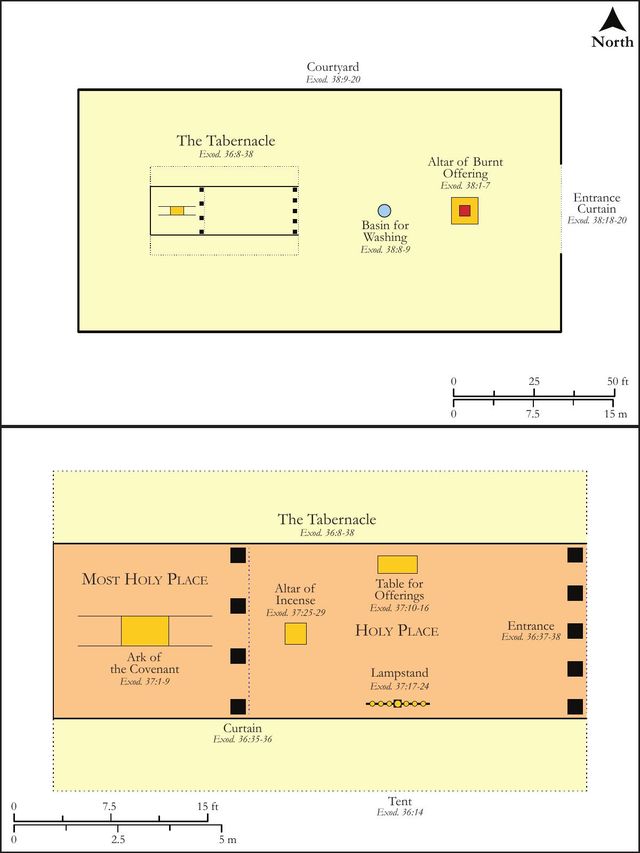
Exodus 38:12 provides the precise specifications for the western perimeter of the Tabernacle's outer courtyard, detailing the length of its linen hangings, the number of supporting pillars and their foundational sockets, and the silver hooks and connecting fillets that secured the entire structure. This verse, part of the meticulous account of the Tabernacle's construction, highlights the divine blueprint's absolute precision and the integral role of every component in establishing God's sacred dwelling place among His people.
Context
ShowHideLiterary Context
Exodus 38 is situated within the broader narrative of the Tabernacle's actual construction, following the detailed divine instructions given to Moses on Mount Sinai in Exodus 25-31 and preceding its final erection and consecration. Chapters Exodus 36-39 narrate the fulfillment of these divine commands by Bezalel, Oholiab, and the skilled artisans, empowered by the Spirit of God, and supported by the generous contributions of the Israelite community. Specifically, Exodus 38:9-20 focuses on the outer courtyard, providing precise dimensions and material specifications for its perimeter. Verse 12 zeroes in on the west side, completing the description of the courtyard's four boundaries, each contributing to the sacred enclosure that separated the holy space from the common camp. This detailed repetition throughout the construction account reinforces the divine origin, importance, and exactness required for every element of God's dwelling.
Historical & Cultural Context
The construction of the Tabernacle occurred during Israel's forty-year wilderness wanderings, a pivotal period following their liberation from Egyptian bondage and preceding their entry into the Promised Land. As a nomadic people, a portable sanctuary was essential for maintaining God's tangible presence among them, serving as the central point of worship, sacrifice, and divine revelation. The meticulous instructions for its construction, including the precise measurements and materials for components like the courtyard hangings and pillars, were not arbitrary. While the nations built houses for their gods with immense precision, the Tabernacle's design was uniquely tied to Yahweh's holiness and His specific covenant with Israel. The use of precious materials like silver, often sourced from the atonement money collected from the census (Exodus 30:11-16), highlighted the value and sacredness of the undertaking, linking the very fabric of the sanctuary to the concept of redemption and propitiation for sin.
Key Themes
ShowHideExodus 38:12 contributes to several overarching themes within the book of Exodus and the Pentateuch. Firstly, it underscores the theme of Divine Presence and Holiness. The Tabernacle's meticulous construction, including its defined boundaries, ensured a sacred space where a holy God could dwell among an unholy people. The careful separation enforced by the courtyard hangings emphasized God's transcendence and the need for proper approach. Secondly, the verse exemplifies Divine Order and Precision. God's instructions leave no room for human improvisation, demonstrating His perfect design and His expectation of absolute obedience. This precision reflects His character as a God of order, not chaos. Thirdly, the use of specific materials, particularly silver, subtly reinforces the theme of Redemption and Atonement. As noted in Exodus 38:27, much of the silver used in the Tabernacle came from the half-shekel atonement money, linking even the structural components to the means by which Israel could approach a holy God. Finally, the collective effort in building the Tabernacle, as seen in the broader context of Exodus 36, highlights the theme of Community and Obedience, where the entire nation participates in fulfilling God's command.
Exposition and Analysis
ShowHideKey Word Analysis
ShowHideThis term refers to the woven linen curtains that formed the walls of the Tabernacle courtyard. These hangings, often described as "fine twined linen" (Exodus 38:9), served as a physical boundary, demarcating the sacred space from the common camp. Their presence underscored the principle of separation and the holiness of God, indicating that access to His presence was not casual but regulated and sacred, protecting the sanctity of the divine dwelling.
From a root suggesting strength, this word denotes the foundational bases into which the pillars were set. These sockets provided stability and support for the entire perimeter structure. The inclusion of such foundational elements in the divine blueprint highlights God's meticulous attention to every detail, ensuring the integrity and stability of His dwelling place, reflecting His desire for a firm and secure foundation for His presence among His people.
This term refers to the connecting pieces, likely silver rods or bands, that linked the tops of the pillars. These fillets provided additional stability and ensured the hangings were securely fastened along the perimeter, preventing sagging or displacement. Their mention, even as seemingly minor structural elements, underscores God's comprehensive design, where every component, no matter how small, contributes to the overall strength, beauty, and functional integrity of the Tabernacle.
Verse Breakdown
ShowHide"And for the west side [were] hangings of fifty cubits"
This clause specifies the dimensions of the linen curtains forming the western boundary of the Tabernacle courtyard. Fifty cubits, approximately 75 feet, indicates a substantial length, creating a significant and imposing enclosure. This precise measurement, consistent with the exact dimensions given for other sides, emphasizes the absolute exactness required in the Tabernacle's construction, leaving no room for human improvisation and underscoring the divine origin of the design.
"their pillars ten, and their sockets ten"
This part describes the structural support system for the hangings on the west side. Ten pillars, likely made of acacia wood overlaid with bronze (Exodus 38:10), were erected, each firmly set into a corresponding socket. The one-to-one correspondence between pillars and sockets highlights the divine design's order, balance, and robust engineering, ensuring the stability and integrity of the courtyard's perimeter.
"the hooks of the pillars and their fillets [of] silver"
This final clause details the specific hardware used to secure the hangings to the pillars and connect the pillars themselves. The "hooks" were likely used to attach the hangings, while the "fillets" (connecting rods or bands) provided additional stability across the top of the pillars, ensuring the curtains remained taut and secure. The material specified—silver—elevates these seemingly small components, associating them with the preciousness and sacredness of the entire Tabernacle structure and subtly linking them to themes of redemption or purification.
Literary Devices
ShowHideThe passage employs several key literary devices to convey its message. The pervasive repetition of precise measurements and material specifications throughout Exodus 38, including this verse, emphasizes the divine origin of the blueprint and the critical importance of exact obedience in its execution. This creates an overwhelming sense of order and precision, reflecting God's own character as a meticulous and sovereign Creator. The detailed enumeration of each component, from hangings to hooks and fillets, serves as a form of merism, where the listing of individual parts represents the completeness and integrity of the entire Tabernacle structure, implying that no detail was accidental or insignificant. Furthermore, the symbolism of the materials, particularly silver, subtly points to deeper theological truths, such as redemption and holiness, even in the most functional elements of the Tabernacle. The entire description functions as a detailed architectural blueprint, conveying God's meticulous care for His dwelling place and, by extension, His relationship with His people.
Theological and Thematic Connections
ShowHideExodus 38:12, though seemingly a technical detail in a long list of specifications, profoundly communicates God's character and His relationship with humanity. The divine insistence on exact measurements and specific materials for every part of the Tabernacle, down to the hooks and fillets, reveals God's meticulous nature, His demand for order, and His absolute holiness. The courtyard's enclosure, supported by these pillars and hangings, served as a physical boundary, symbolizing the spiritual separation between a holy God and an unholy people, yet simultaneously providing a divinely appointed means for controlled access. This careful construction established a sacred space where God's presence could dwell among Israel, foreshadowing His ultimate desire to indwell His people. The consistent use of silver, often associated with atonement and redemption, even in these functional parts, subtly reinforces the idea that the entire structure, and indeed the means of access to God, was predicated on divine provision for sin.
Reflection and Application
ShowHideThe detailed instructions for the Tabernacle's construction, even for something as seemingly minor as the west side's hooks and fillets, offer profound insights for our spiritual lives. They remind us that God is a God of order, precision, and holiness, who cares about every detail of His creation and His redemptive plan for us. Just as every component of the Tabernacle was essential for its function and symbolic meaning, so too is every aspect of our lives, when surrendered to God, purposed for His glory. We are called to live lives marked by intentionality and obedience, recognizing that even the "small" things matter in God's economy. Our lives, as temples of the Holy Spirit, should reflect the same divine order and holiness, set apart for His purposes. This means paying attention to the details of our faith, our character, and our service, striving for excellence and faithfulness in all things, knowing that God delights in our meticulous obedience and our desire to honor Him in every sphere.
Questions for Reflection
ShowHideFAQ
ShowHideWhy is so much detail given to the Tabernacle's construction, even down to specific parts like hooks and fillets?
ShowHideThe extensive detail, including specific measurements, materials, and components like hooks and fillets, underscores several key points. Firstly, it emphasizes the divine origin of the blueprint; God is the ultimate Architect, and His design is perfect and complete, leaving no room for human improvisation or error. This precision reflects God's own character of order, holiness, and sovereignty. Secondly, every detail, no matter how small, held symbolic or functional significance within the overall structure, which was designed to facilitate God's holy presence among His people and to teach them about His nature and the way of atonement. The Tabernacle was not merely a building; it was a profound visual sermon, illustrating deep theological truths. Finally, the meticulous instructions served as a test of Israel's obedience and faithfulness, demonstrating their commitment to God's commands and their willingness to follow His precise will, as seen in Exodus 39:42-43.
Christ-Centered Fulfillment
ShowHideExodus 38:12, with its precise details of the Tabernacle's outer courtyard, finds its ultimate and glorious fulfillment in Jesus Christ. The Tabernacle, as a whole, was a temporal and physical shadow of the true dwelling place of God among humanity. While the physical hangings and pillars of the west side created a necessary barrier, signifying the profound separation between a holy God and sinful humanity, Jesus Himself became the ultimate and perfect means of access. He is the true and perfect Tabernacle, the Word made flesh who "dwelt among us" (literally, "tabernacled among us") as described in John 1:14, bringing God's presence directly to humanity. The meticulous construction, including the precious silver components, pointed to the immense value of God's presence and the costly nature of atonement required for sinful humanity to approach Him. In Christ, the need for a physical, temporary structure is superseded, for through His singular, perfect sacrifice on the cross, the veil separating humanity from God was torn from top to bottom (Matthew 27:51), granting direct and unhindered access to the Father. Believers, through faith in Christ, become living stones, built into a spiritual house, a "holy priesthood," as described in 1 Peter 2:5, thereby fulfilling the Tabernacle's ultimate purpose of God dwelling in His people through the Holy Spirit (1 Corinthians 6:19). Thus, the temporary structure of Exodus 38:12 points forward to the eternal reality of God's presence fully realized in Jesus and His body, the Church.