


Exodus 38:11
Bible text: King James Version (1769 Blayney text) · Public domain
Bible text: King James Version with Strong's numbers · Public domain
Bible text: Berean Standard Bible · Public domain
Bible text: American Standard Version (1901) · Public domain
Bible text: World English Bible, Messianic edition · Public domain
Bible text: Geneva Bible (1599) · Public domain
Bible text: Young's Literal Translation · Public domain
- וְלִפְאַתve·lif·'Atand for [the] side ofH6285Conj-w ¦ Prep-l ¦ N-fscNoun Singular Feminine Constructוְandלִforפְאַת[the] side of
- צָפוֹןtza·fOn[the] northH6828N-fsNoun Singular Feminine Absolute
- מֵאָהme·'Ahone hundredH3967Adj-fsAdjective Numerical Singular Feminine Absolute
- בָאַמָּהva·'a·Mahby the cubitH520Prep-b ¦ N-fsNoun Singular Feminine Absoluteבָby theאַמָּהcubit
- עַמּוּדֵיהֶם'a·mu·dei·Hemtheir pillarsH5982N-mpc ¦ 3mpNoun Plural Masculine Constructעַמּוּדֵיpillarsהֶםtheir
- עֶשְׂרִים'es·RimtwentyH6242Adj-mpAdjective Numerical Plural Masculine Absolute
- וְאַדְנֵיהֶםve·'ad·nei·Hemand their basesH134Conj-w ¦ N-mpc ¦ 3mpNoun Plural Masculine Constructוְandאַדְנֵיbasesהֶםtheir
- עֶשְׂרִים'es·RimtwentyH6242Adj-mpAdjective Numerical Plural Masculine Absolute
- נְחֹשֶׁתne·Cho·shet[were] bronzeH5178N-fsNoun Singular Feminine Absolute
- וָוֵיva·Vei[the] hooks ofH2053N-mpcNoun Plural Masculine Construct
- הָעַמּוּדִיםha·'a·mu·Dimthe pillarsH5982Art ¦ N-mpNoun Plural Masculine Absoluteהָtheעַמּוּדִיםpillars
- וַחֲשֻׁקֵיהֶםva·cha·shu·kei·Hemand their bandsH2838Conj-w ¦ N-mpc ¦ 3mpNoun Plural Masculine Constructוַandחֲשֻׁקֵיbandsהֶםtheir
- כָּסֶףKa·sef[were] silverH3701N-msNoun Singular Masculine Absolute
English is a literal word-by-word gloss of the Hebrew, not the KJV's wording. Why?
This is the original text the KJV's translators worked from — each Hebrew word with its own literal English meaning in this verse, prepared by scholars at Tyndale House, Cambridge. The KJV translates whole sentences, not word by word, so its wording differs: one Hebrew word can become several English words, and the KJV may choose “the LORD” where the gloss reads “Yahweh”. Both are faithful — they answer different questions. For the KJV's own rendering, switch to the KJV text.
Details
See on the biblical-era maps

Study this verse
Public-domain commentary
Matthew Henry
From his Commentary on the Whole Bible. Henry comments on passages, not single verses — this entry covers Exodus 38:9–20.
The walls of the court, or church-yard, were like the rest curtains or hangings, made according to the appointment, Exo 27:9, etc. This represented the state of the Old Testament church: it was a garden enclosed; the worshippers were then confined to a little compass. But the enclosure being of curtains only intimated that the confinement of the church in one particular nation was not to be perpetual. The dispensation itself was a tabernacle-dispensation, movable and mutable, and in due time to be taken down and folded up, when the place of the tent should be enlarged and its cords lengthened, to make room for the Gentile world, as is foretold, Isa 54:2, Isa 54:3. The church here on earth is but the court of God's house, and happy they that tread these courts and flourish in them; but through these courts we are passing to the holy place above. Blessed are those that dwell in that house of God: they well be still praising him. The enclosing of a court before the tabernacle teaches us a gradual approach to God. The priests that ministered must pass through the holy court, before they entered the holy house. Thus before solemn ordinances there ought to be the separated and enclosed court of a solemn preparation, in which we must wash our hands, and so draw near with a true heart.
Continue studying Exodus 38:11 across the web’s major study libraries — every link below opens this exact verse, chapter, or book on the destination site.
Read & Compare
 BibleGatewayThis verse in more than 200 translations and 70 languages.
 Bible.comThe YouVersion reader — hundreds of translations, reading plans, and highlights.
 ESV.orgCrossway's official English Standard Version reader.
 NET BibleThe NET translation with 60,000+ translators' notes on every rendering decision.
 STEP BibleTyndale House's free study tool — original text, vocabulary, and scholarly resources.
 BibliaLogos Bible Software's free web reader.
 USCCBThe New American Bible (Revised Edition) with the U.S. bishops' study notes.
Commentaries
 BibleHub CommentariesDozens of classic commentaries on this verse, gathered on one page.
 StudyLightMore than 100 commentary sets — the largest collection on the web.
 BibleRefPlain-English commentary on what this verse means, verse by verse.
 Enduring WordDavid Guzik's free commentary on this chapter, widely used by Bible teachers.
 Bible Study ToolsVerse commentary alongside Greek and Hebrew study aids.
Original Language & Research
- BibleHub InterlinearThe verse word by word — original language, transliteration, and English.
- BibleHub LexiconEvery word's original-language definition and Strong's entry.
 Blue Letter BibleDeep-study tools — Strong's numbers, concordance, and word studies.
 SefariaThe Hebrew text with Rashi and centuries of Jewish commentary.
Sermons, Hymns & Audio


TrulyRandomVerse is not affiliated with these sites and doesn’t control their content. They’re linked because they’re genuinely useful.
Summary
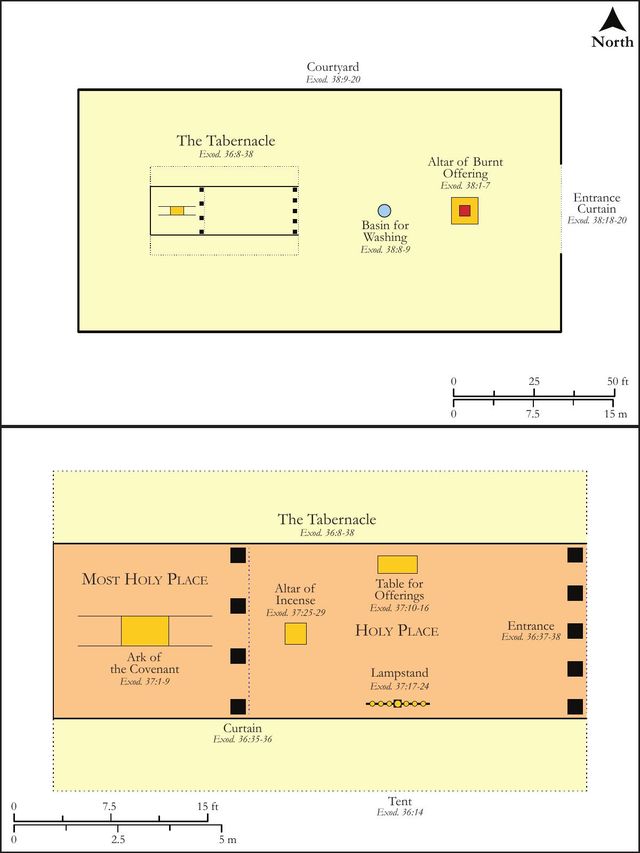
Exodus 38:11 meticulously describes the construction of the Tabernacle's outer court, specifically detailing the dimensions and materials for its north side. This verse, consistent with the surrounding chapters, emphasizes the precise adherence to God's divine blueprint for His sacred dwelling place among the Israelites, highlighting the profound significance of every detail in establishing a holy space for worship and demonstrating the people's obedience to divine command.
Context
ShowHideLiterary Context
Exodus 38:11 is situated within the latter portion of the book of Exodus (chapters 35-40), which meticulously chronicles the actual construction and erection of the Tabernacle and its various furnishings. This section serves as the tangible fulfillment of the detailed instructions God had previously given to Moses on Mount Sinai in earlier chapters (Exodus 25-31). The narrative shift from divine command to human execution underscores the Israelites' faithfulness and the divine origin of the sanctuary's design. This particular verse follows the description of the south side of the outer court in Exodus 38:9-10, demonstrating a deliberate pattern of symmetry and uniformity in the Tabernacle's design, reinforcing the divine order inherent in God's plan for His presence among His people.
Historical & Cultural Context
The construction of the Tabernacle occurred during Israel's forty-year wilderness journey after their miraculous exodus from Egyptian bondage. As a nomadic people, a portable sanctuary was not merely convenient but essential, symbolizing God's continuous presence, guidance, and covenant faithfulness among them. While temples were common among the nations, Israel's Tabernacle was unique in its monotheistic focus and its emphasis on a holy God dwelling among a set-apart people. The outer court, detailed in Exodus 38:9-17, served as a crucial sacred boundary, separating the holy space from the common, thereby protecting the people from God's unapproachable holiness while simultaneously providing a designated, divinely ordained place for corporate worship, sacrifice, and atonement. The specified materials—brass (bronze) and silver—were valuable and symbolic, reflecting the sacredness, enduring nature, and redemptive purpose of the structure.
Key Themes
ShowHideThis verse contributes significantly to several overarching themes within Exodus and the Pentateuch. The theme of Divine Presence is paramount, as the Tabernacle's construction is the means by which God will dwell among His people, fulfilling His promise from Exodus 29:45-46. The meticulous details highlight the theme of Holiness and Separation, emphasizing the vast chasm between a holy God and sinful humanity, and the necessity of a divinely appointed means of access. The repeated measurements and specific materials also underscore the theme of Obedience to Divine Command, demonstrating Israel's faithfulness in executing God's precise instructions, a motif seen throughout the Tabernacle accounts (e.g., Exodus 39:32). Furthermore, the symbolic use of materials like brass and silver introduces the themes of Judgment and Redemption, which are foundational to understanding the sacrificial system and the path to reconciliation with God.
Exposition and Analysis
ShowHideKey Word Analysis
ShowHideFrom the same root as "lord" (adon) in the sense of strength, this term refers to a basis or foundation, particularly for a building or column. In Exodus 38:11, the "sockets of brass" provided the firm and durable base for the twenty pillars of the north side. Their foundational role signifies strength, stability, and the unyielding nature of God's righteous standards upon which His dwelling place was established.
This word describes connecting rods or bands, specifically made of silver in this context. These "fillets" would have run between the tops of the pillars, providing crucial stability and support for the linen hangings, ensuring the structural integrity and tautness of the outer court's enclosure. This detail illustrates the comprehensive and robust nature of the Tabernacle's design, where even seemingly minor components played a vital role in the overall sacred structure and its orderly appearance.
Derived from a root meaning "to be pale" or "to long for," silver was a valuable metal. In the Tabernacle's context, silver frequently symbolizes redemption, purification, and preciousness. Its use for the hooks and fillets in this verse, as well as for the sockets derived from "atonement money" (Exodus 38:27), imbues these connecting and supporting elements with the profound theological truth that access to God and the maintenance of His holy space are predicated upon a costly act of redemption.
Verse Breakdown
ShowHide"And for the north side [the hangings were] an hundred cubits"
This initial clause precisely specifies the length of the fine linen hangings that formed the boundary of the Tabernacle's outer court on its northern perimeter. The measurement of "an hundred cubits" (approximately 150-175 feet) indicates a significant expanse, mirroring the dimensions of the south side and contributing to the overall grandeur and enclosed nature of the sacred space. These hangings served as a visual and symbolic barrier, delineating the holy from the common and controlling access to God's immediate presence.
"their pillars [were] twenty, and their sockets of brass twenty"
This segment details the vertical support structure essential for holding the hangings aloft. Twenty pillars were evenly spaced along the hundred-cubit length, providing the necessary framework. Each of these pillars was firmly anchored into a "socket of brass" (bronze), emphasizing the foundational strength and stability of the entire structure. The use of brass for these foundational elements, given its symbolic association with judgment and endurance, suggests that the very basis of access to God's presence rested upon His unyielding righteous standards.
"the hooks of the pillars and their fillets [of] silver"
This final clause describes the connecting and ornamental elements at the top of the pillars. The "hooks" were essential for suspending the linen hangings, allowing them to hang uniformly and securely. The "fillets" (connecting rods) ran horizontally between the pillars, providing additional stability and ensuring the hangings remained taut and orderly. The specification of "silver" for these components is highly symbolic; silver in the Tabernacle context often points to redemption and atonement, particularly as seen in the "atonement money" used for the Tabernacle's sockets. This suggests that the very means of connecting and supporting the holy space was imbued with the preciousness of redemption, highlighting the divine provision for humanity to draw near.
Literary Devices
ShowHideThe description in Exodus 38:11, like much of the Tabernacle narrative, employs several key literary devices to convey its profound theological message. Repetition of precise measurements, numbers, and materials (e.g., "twenty pillars," "twenty sockets") emphasizes the exactitude required by God and highlights the divine origin of the blueprint. This meticulous detail underscores the paramount importance of obedience and faithfulness in executing God's commands for worship. Symbolism is pervasive, with the materials themselves carrying deep theological weight: brass (bronze) often represents judgment, strength, and endurance, forming the sturdy, foundational sockets, while silver, used for the hooks and fillets, consistently points to redemption, purity, and preciousness. The mirroring of the north side's specifications with the south side (Exodus 38:9) demonstrates symmetry and order, reflecting God's character as a God of perfect design, not chaos. This meticulous architectural description also functions as a form of typology, foreshadowing greater spiritual realities to be revealed in the New Testament.
Theological and Thematic Connections
ShowHideExodus 38:11, with its minute details of the Tabernacle's construction, profoundly reveals God's character and His relationship with humanity. The divine precision in every measurement and material underscores God's absolute sovereignty and His expectation of meticulous obedience in matters of worship and service. The Tabernacle, and specifically its outer court, served as a physical manifestation of God's holiness and His desire to dwell among His people, yet it simultaneously emphasized the necessary separation between a holy God and sinful humanity. The symbolic use of brass for foundations (judgment/strength) and silver for connections (redemption/purity) points to the foundational truths upon which access to God is granted: through His righteous standards and the provision of atonement. This intricate design foreshadows the deeper theological realities of God's dwelling with humanity through Christ, who perfectly embodies these principles.
Reflection and Application
ShowHideThe meticulous instructions for the Tabernacle's construction, even down to the number of pillars and the material of their hooks, offer profound lessons for believers today. God's attention to detail teaches us that He values diligence, precision, and faithfulness in all aspects of our lives, especially in our worship and service to Him. There are no "small" details when it comes to honoring God; every act of obedience, however seemingly insignificant, contributes to the larger tapestry of His will and reflects His character. The Tabernacle's orderly and purposeful design reflects God's character as a God of order, not confusion, encouraging us to seek order, intentionality, and purpose in our personal spiritual disciplines, our communal worship, and the overall structure of our lives as the church. Furthermore, the Tabernacle's role as God's dwelling place reminds us that through the Holy Spirit, individual believers are now temples of God, and the church collectively is His spiritual dwelling. This calls us to live lives that reflect the holiness, order, and redemptive purpose of the God who dwells within and among us, always striving for excellence in our walk and witness.
Questions for Reflection
ShowHideFAQ
ShowHideWhy are the dimensions and materials so meticulously detailed in Exodus?
ShowHideThe meticulous detailing of the Tabernacle's dimensions and materials in Exodus serves several crucial purposes. Firstly, it underscores God's absolute sovereignty and His desire for worship to be conducted according to His precise will, not human invention. It emphasizes that the Tabernacle was a divine blueprint, not a human design, ensuring that it faithfully represented the heavenly pattern (Hebrews 8:5). Secondly, the precision ensured uniformity and order, reflecting God's character as a God of order, not chaos (1 Corinthians 14:33). Thirdly, every element, from the brass sockets to the silver fillets described in Exodus 38:11, carried rich symbolic meaning, teaching profound theological truths about holiness, sin, judgment, and redemption. Finally, the exact specifications were necessary for its construction as a portable sanctuary, ensuring it could be assembled and disassembled consistently during Israel's wilderness journey, symbolizing God's faithful presence with His people wherever they went (Exodus 40:34-38).
What is the significance of "brass" and "silver" in the Tabernacle's construction?
ShowHideIn the Tabernacle's rich symbolism, "brass" (bronze) and "silver" carry distinct and profound meanings. Brass, being a strong and durable metal, is often associated with judgment, strength, and endurance. Its prominent use for the altar of burnt offering (Exodus 27:1-2) and the foundational sockets for the pillars (Exodus 38:11) signifies that access to God's holy presence is founded upon the reality of His righteous judgment against sin and the necessity of atonement. Silver, conversely, frequently symbolizes redemption, purity, and preciousness. Notably, the "atonement money" collected from the Israelites was used for the silver sockets of the sanctuary and the pillars (Exodus 38:27). Its use for the hooks and fillets in Exodus 38:11 suggests that the very means of connecting and maintaining the holy space was imbued with the preciousness of redemption, highlighting that it is through a costly act of atonement that humanity can draw near to a holy God.
Christ-Centered Fulfillment
ShowHideThe Tabernacle, meticulously detailed in Exodus 38:11 and throughout the book of Exodus, serves as a profound Old Testament foreshadowing of Jesus Christ. While the Tabernacle was a temporary, physical dwelling place for God among His people, Jesus is the ultimate and eternal embodiment of God dwelling with humanity. As John 1:14 declares, "The Word became flesh and made his dwelling among us," literally "tabernacled" among us. The Tabernacle's outer court, with its precise dimensions, hangings, and pillars, established a sacred boundary and provided a divinely appointed pathway to God, but it was ultimately a shadow of the true reality. Jesus, however, is the true and living way, the ultimate access point to the Father (John 14:6). The brass sockets, symbolizing judgment and the steadfastness of God's righteous demands, find their complete fulfillment in Christ's sacrifice on the cross, where He bore the full weight of divine judgment for our sins, becoming our perfect propitiation and atonement (Romans 3:25). Similarly, the silver hooks and fillets, pointing to redemption and purity, are fully realized in the precious blood of Christ, by which we are redeemed from futile ways and purified from all unrighteousness (1 Peter 1:18-19). Through His finished work on the cross, the veil separating humanity from God was torn from top to bottom (Matthew 27:51), granting believers direct, unhindered access to God's presence. Ultimately, the Tabernacle's purpose of God dwelling with His people is perfectly fulfilled in Christ, who not only dwelt among us but, through His Holy Spirit, now indwells individual believers, making each one a temple of the Holy Spirit (1 Corinthians 6:19), and the church, His collective spiritual dwelling place on earth (Ephesians 2:21-22).