


Exodus 38:14
Bible text: King James Version (1769 Blayney text) · Public domain
Bible text: Berean Standard Bible · Public domain
Bible text: American Standard Version (1901) · Public domain
Bible text: World English Bible, Messianic edition · Public domain
Bible text: Geneva Bible (1599) · Public domain
Bible text: Young's Literal Translation · Public domain
- קְלָעִיםke·la·'ImcurtainsH7050N-mpNoun Plural Masculine Absolute
- חֲמֵשׁcha·meshfif-H2568Adj-cscAdjective Numerical Singular common gender Construct
- עֶשְׂרֵה'es·RehteenH6240Adj-csAdjective Numerical Singular common gender Absolute
- אַמָּה'a·Mahcubit[s]H520N-fsNoun Singular Feminine Absolute
- אֶל'eltoH413PrepPreposition
- הַכָּתֵףha·ka·Tefthe sideH3802Art ¦ N-fsNoun Singular Feminine Absoluteהַtheכָּתֵףside
- עַמּוּדֵיהֶם'a·mu·dei·Hemtheir pillarsH5982N-mpc ¦ 3mpNoun Plural Masculine Constructעַמּוּדֵיpillarsהֶםtheir
- שְׁלֹשָׁהshe·lo·ShahthreeH7969Adj-csAdjective Numerical Singular common gender Absolute
- וְאַדְנֵיהֶםve·'ad·nei·Hemand their basesH134Conj-w ¦ N-mpc ¦ 3mpNoun Plural Masculine Constructוְandאַדְנֵיbasesהֶםtheir
- שְׁלֹשָׁהshe·lo·ShahthreeH7969Adj-csAdjective Numerical Singular common gender Absolute
English is a literal word-by-word gloss of the Hebrew, not the KJV's wording. Why?
This is the original text the KJV's translators worked from — each Hebrew word with its own literal English meaning in this verse, prepared by scholars at Tyndale House, Cambridge. The KJV translates whole sentences, not word by word, so its wording differs: one Hebrew word can become several English words, and the KJV may choose “the LORD” where the gloss reads “Yahweh”. Both are faithful — they answer different questions. For the KJV's own rendering, switch to the KJV text.
Details
See on the biblical-era maps
Study this verse
Public-domain commentary
Matthew Henry
From his Commentary on the Whole Bible. Henry comments on passages, not single verses — this entry covers Exodus 38:9–20.
The walls of the court, or church-yard, were like the rest curtains or hangings, made according to the appointment, Exo 27:9, etc. This represented the state of the Old Testament church: it was a garden enclosed; the worshippers were then confined to a little compass. But the enclosure being of curtains only intimated that the confinement of the church in one particular nation was not to be perpetual. The dispensation itself was a tabernacle-dispensation, movable and mutable, and in due time to be taken down and folded up, when the place of the tent should be enlarged and its cords lengthened, to make room for the Gentile world, as is foretold, Isa 54:2, Isa 54:3. The church here on earth is but the court of God's house, and happy they that tread these courts and flourish in them; but through these courts we are passing to the holy place above. Blessed are those that dwell in that house of God: they well be still praising him. The enclosing of a court before the tabernacle teaches us a gradual approach to God. The priests that ministered must pass through the holy court, before they entered the holy house. Thus before solemn ordinances there ought to be the separated and enclosed court of a solemn preparation, in which we must wash our hands, and so draw near with a true heart.
Continue studying Exodus 38:14 across the web’s major study libraries — every link below opens this exact verse, chapter, or book on the destination site.
Read & Compare
 BibleGatewayThis verse in more than 200 translations and 70 languages.
 Bible.comThe YouVersion reader — hundreds of translations, reading plans, and highlights.
 ESV.orgCrossway's official English Standard Version reader.
 NET BibleThe NET translation with 60,000+ translators' notes on every rendering decision.
 STEP BibleTyndale House's free study tool — original text, vocabulary, and scholarly resources.
 BibliaLogos Bible Software's free web reader.
 USCCBThe New American Bible (Revised Edition) with the U.S. bishops' study notes.
Commentaries
 BibleHub CommentariesDozens of classic commentaries on this verse, gathered on one page.
 StudyLightMore than 100 commentary sets — the largest collection on the web.
 BibleRefPlain-English commentary on what this verse means, verse by verse.
 Enduring WordDavid Guzik's free commentary on this chapter, widely used by Bible teachers.
 Bible Study ToolsVerse commentary alongside Greek and Hebrew study aids.
Original Language & Research
- BibleHub InterlinearThe verse word by word — original language, transliteration, and English.
- BibleHub LexiconEvery word's original-language definition and Strong's entry.
 Blue Letter BibleDeep-study tools — Strong's numbers, concordance, and word studies.
 SefariaThe Hebrew text with Rashi and centuries of Jewish commentary.
Sermons, Hymns & Audio


TrulyRandomVerse is not affiliated with these sites and doesn’t control their content. They’re linked because they’re genuinely useful.
Summary
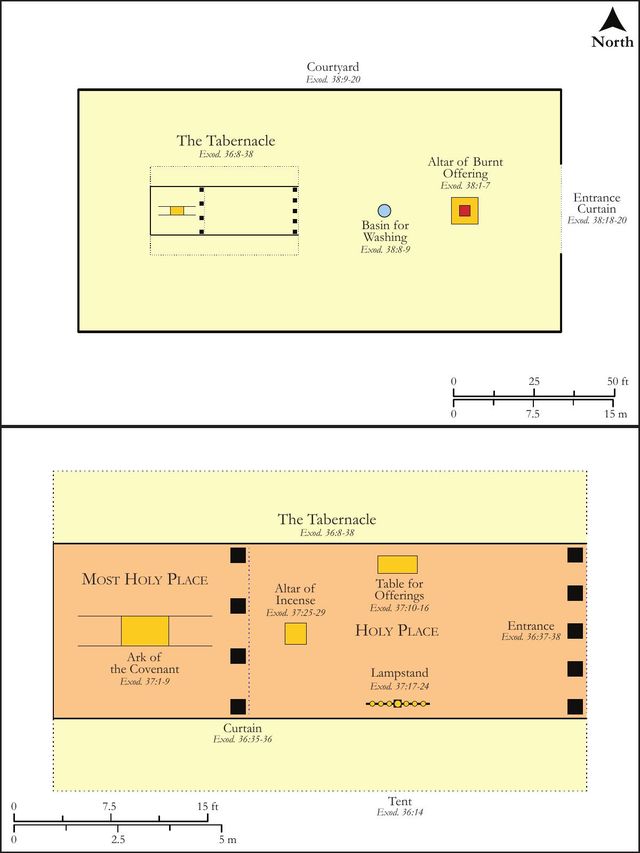
Exodus 38:14 provides meticulous architectural specifications for one side of the Tabernacle courtyard's gate, detailing its hangings as fifteen cubits long, supported by three pillars, which in turn rested upon three corresponding sockets. This precise description, embedded within the broader account of the Tabernacle's construction, profoundly underscores the divine blueprint's exactness, the Israelites' faithful adherence to God's intricate instructions, and the foundational principles of order, holiness, and intentionality inherent in true worship.
Context
ShowHideLiterary Context
Exodus 38 is situated within the larger narrative of the Tabernacle's construction, following the detailed divine instructions given to Moses on Mount Sinai in Exodus 25-31. After the initial command to build God's dwelling so He might dwell among His people (Exodus 25:8), Moses received intricate plans for every component, from the Ark of the Covenant to the courtyard hangings. Chapters Exodus 35-40 then describe the actual execution of these plans by skilled artisans like Bezalel and Oholiab, demonstrating the people's obedience and dedication. Specifically, Exodus 38:9-20 focuses on the courtyard surrounding the Tabernacle proper, detailing its dimensions, materials, and the number of pillars and sockets. Verse 14, along with Exodus 38:15, provides the specific measurements for the gate, the sole entrance to this sacred outer perimeter, highlighting the meticulous fulfillment of God's architectural blueprint for His holy dwelling.
Historical & Cultural Context
The construction of the Tabernacle occurred during Israel's forty-year wilderness wanderings, a pivotal period following their liberation from Egyptian slavery and the establishment of the Mosaic Covenant at Mount Sinai. As a nomadic people, a portable sanctuary was essential for God's presence to dwell among them, signifying His continued guidance and covenant faithfulness. The detailed specifications, including measurements like the cubit, reflect the understanding that sacred spaces required precise, divinely ordained designs, as the LORD showed Moses the pattern in the mount. The use of fine twisted linen for hangings (Exodus 27:9) and bronze for sockets (Exodus 38:17) indicates valuable materials dedicated to God's service, emphasizing the sanctity, importance, and costliness of the structure. The entire project was a communal effort, with the people contributing materials and skilled craftsmen executing the work, demonstrating their corporate obedience and devotion to the Lord who had redeemed them.
Key Themes
ShowHideExodus 38:14 contributes significantly to several overarching themes within the book of Exodus and the Pentateuch. Primarily, it underscores the theme of Divine Precision and Order. God is not haphazard; His instructions for His dwelling place are exact, down to the number of pillars and cubits, emphasizing His character as a God of order and intention. This meticulousness also highlights the theme of Holiness and Separation, as the Tabernacle, and especially its courtyard, was a sacred space set apart from the common. The gate, with its specific dimensions, served as the singular, divinely appointed point of access, reinforcing that approach to God is on His terms, not human whim. Finally, the faithful execution of these commands by Bezalel, Oholiab, and the people (Exodus 38:22) powerfully illustrates the theme of Obedience and Fidelity as foundational to the covenant relationship between God and His people, demonstrating that true worship involves diligent adherence to His revealed will.
Exposition and Analysis
ShowHideKey Word Analysis
ShowHideThis term refers to the curtains or tapestries, specifically those forming the perimeter walls of the Tabernacle courtyard and the gate. Made of fine twisted linen, these hangings served as a visual barrier, defining the sacred space and controlling access. Their presence underscored the principle of separation between the holy and the common, signifying the purity and sanctity required for approaching God.
This is an ancient unit of linear measurement, typically derived from the length of the forearm, approximately 18-21 inches (45-53 cm). The repeated use of "cubits" throughout the Tabernacle descriptions (e.g., "fifteen cubits" here) underscores the divine precision and exactness required in its construction. This detail leaves no room for human estimation or deviation, emphasizing that God's design is perfect and must be followed precisely.
This term denotes a basis or foundation, into which the pillars were set. In the Tabernacle courtyard, these sockets were made of bronze (Exodus 38:10), providing essential stability and support for the upright pillars and the hangings they held. Their foundational role emphasizes the structural integrity and stability of God's dwelling place, built upon firm and divinely ordained supports.
Verse Breakdown
ShowHide"The hangings of the one side [of the gate were] fifteen cubits"
This clause precisely specifies the length of the curtain segment that formed one part of the Tabernacle courtyard gate. A length of fifteen cubits (approximately 22.5 to 26.25 feet or 6.8 to 8 meters) indicates a significant width for this section of the entrance, contributing to the overall grandeur and the specific dimensions of the gate, which was twenty cubits wide (Exodus 38:18). These "hangings" served as both a physical barrier and a symbolic boundary, defining the sacred space.
"their pillars three"
This detail indicates that this fifteen-cubit section of the gate's hanging was supported by three upright posts. These pillars were crucial structural elements, designed to hold the heavy curtains aloft and to clearly define the gateway's form. The specific number "three" is not arbitrary but suggests a divinely ordained arrangement, ensuring both stability and adherence to the precise blueprint.
"and their sockets three"
Corresponding directly to the three pillars, there were three sockets. These foundational bases, likely cast from bronze, were essential for anchoring the pillars firmly into the ground, providing the necessary stability for the entire gate structure. This meticulous detail highlights the comprehensive nature of the divine blueprint, ensuring that every supporting element, no matter how seemingly minor, was accounted for and properly secured according to God's precise instructions.
Literary Devices
ShowHideThe primary literary devices at play in Exodus 38:14, and indeed throughout the detailed construction accounts of the Tabernacle, are Precision and Detailed Enumeration. The text provides exact measurements ("fifteen cubits") and specific quantities ("three pillars," "three sockets"), leaving absolutely no ambiguity regarding the divine specifications. This meticulous recounting serves to emphasize God's absolute sovereignty and His demand for exact obedience in matters of worship and service. It also highlights the Fidelity of the Israelite craftsmen, particularly Bezalel and Oholiab, in executing every divine command without deviation, underscoring their reverence and dedication. The repetition of such detailed specifications across multiple verses and chapters creates a pervasive sense of Order and Completeness, reinforcing the theological truth that the Tabernacle was built precisely "as the Lord commanded Moses" (Exodus 38:22). This literary style powerfully conveys that God is a God of perfect order, who cares about the minutiae of His dwelling place and the precise means by which His people are to approach Him.
Theological and Thematic Connections
ShowHideExodus 38:14, though seemingly a dry architectural detail, profoundly communicates God's nature and His relationship with humanity. The divine precision in every measurement and component of the Tabernacle underscores God's absolute sovereignty and His demand for order in worship. This meticulousness signifies that access to His holy presence is not arbitrary but strictly on His terms, through His appointed means. The gate, with its specific dimensions and supporting structures, served as the singular point of entry into the sacred courtyard, symbolizing that God establishes the sole way to Himself. The faithful execution of these commands by the Israelites also highlights the theme of obedience as a foundational aspect of covenant relationship, demonstrating that true worship involves diligent adherence to God's revealed will, reflecting a deep reverence for His holiness and authority.
Reflection and Application
ShowHideExodus 38:14, with its focus on the precise measurements and components of the Tabernacle gate, offers profound and enduring lessons for contemporary believers. It serves as a powerful reminder that God is a God of infinite order and intentionality, who cares deeply about the details of our lives and, most importantly, our worship. Just as the Israelites were called to meticulous obedience in constructing His dwelling, we are similarly called to faithfulness in following God's revealed will in every area of our lives. This verse encourages us to pay careful attention to the "small" details of our faith—our integrity in private, the sincerity of our words, the purity of our hidden motives, and the faithfulness in our daily tasks. We are to understand that even these seemingly minor aspects reflect our reverence for God and our commitment to His divine design for our lives. It teaches us that true access to God is always on His terms, not ours, and that His way is always perfect, precise, and purposeful. Furthermore, it challenges us to consider if our lives, both individually and corporately as the Church, reflect the same divine order, intentionality, and reverent obedience that God demanded for His ancient sanctuary.
Questions for Reflection
ShowHideFAQ
ShowHideWhat is the significance of the "fifteen cubits" for the hangings of the gate?
ShowHideThe "fifteen cubits" (approximately 22.5 to 26.25 feet) specified for one side of the gate's hangings is a precise measurement that contributes to the overall dimensions of the Tabernacle courtyard's entrance. The entire gate was twenty cubits wide (Exodus 38:18), meaning this verse describes a significant portion of the entry. The exactness of this measurement underscores God's demand for precision in the construction of His dwelling, symbolizing that access to His holy presence is on His terms and according to His detailed, perfect plan, not human discretion or approximation. It also highlights the meticulous obedience of the craftsmen in faithfully following the divine blueprint.
Why are the number of pillars and sockets mentioned specifically?
ShowHideThe specific mention of "three pillars" and "three sockets" for this section of the gate emphasizes the divine order, structural integrity, and foundational stability required for the Tabernacle. Pillars provided essential support for the hangings, holding them aloft and defining the gateway's form, while sockets anchored the pillars firmly into the ground. This detail reinforces the theme of God's meticulous planning and the necessity of every component being exactly as commanded. It ensures the physical stability of the structure, clearly defines the boundaries of the sacred space, and highlights the comprehensive nature of God's instructions for His dwelling place among His people. Every part, no matter how seemingly small, was essential to the whole and divinely ordained for a specific purpose.
Christ-Centered Fulfillment
ShowHideThe meticulous details of the Tabernacle gate described in Exodus 38:14, with its precise measurements and supporting structures, find their ultimate and glorious fulfillment in Jesus Christ. The Tabernacle, as a whole, was a "copy and shadow of the heavenly things" (Hebrews 8:5), and its gate prefigured the singular, divinely appointed way to God. Just as the gate was the only entrance into the Tabernacle courtyard, Jesus, the very embodiment of God's perfect plan, declares, "I am the door; if anyone enters through Me, he will be saved" (John 10:9). The "hangings" that defined the sacred space, separating the holy from the common and restricting access, point powerfully to Christ's flesh, which was torn on the cross, thereby opening a new and living way into the holiest place of God's presence (Hebrews 10:19-20). The "pillars" and "sockets" that provided unwavering stability and support for the gate foreshadow Christ as the unshakeable foundation and cornerstone of God's spiritual temple, the Church, built upon the apostles and prophets (Ephesians 2:20). In Christ, the precision, order, and limited access of the Old Covenant sanctuary are perfectly realized, offering not merely symbolic access, but direct, eternal, and grace-filled access to God's presence through His finished work, making Him the ultimate fulfillment of every intricate detail in God's redemptive plan.