


Exodus 38:22
Bible text: King James Version (1769 Blayney text) · Public domain
Bible text: Berean Standard Bible · Public domain
Bible text: American Standard Version (1901) · Public domain
Bible text: World English Bible, Messianic edition · Public domain
Bible text: Geneva Bible (1599) · Public domain
Bible text: Young's Literal Translation · Public domain
- וּבְצַלְאֵלu·ve·tzal·'Eland BezalelH1212Conj-w ¦ N-proper-mNoun Proper MasculineוּandבְצַלְאֵלBezalel
- בֶּןben[the] son ofH1121N-mscNoun Singular Masculine Construct
- אוּרִי'u·RiUriH221N-proper-mNoun Proper Masculine
- בֶןven[the] son ofH1121N-mscNoun Singular Masculine Construct
- חוּרchurHurH2354N-proper-mNoun Proper Masculine
- לְמַטֵּהle·ma·Tehof [the] tribe ofH4294Prep-l ¦ N-mscNoun Singular Masculine Constructלְofמַטֵּה[the] tribe of
- יְהוּדָהye·hu·DahJudahH3063N-properNoun Proper Location
- עָשָׂה'a·Sahhe madeH6213V-Qal-Perf-3msVerb Qal Perfect 3rd Singular Masculine
- אֵת'et<obj.>H853DirObjMParticle Object Indicator
- כָּלkolallH3605N-msNoun Singular Masculine Absolute
- אֲשֶׁר'a·SherthatH834RelParticle Relative
- צִוָּהtzi·Vahhe had commandedH6680V-Piel-Perf-3msVerb Piel Perfect 3rd Singular Masculine
- יְהוָהYah·wehYahwehH3068N-properNoun Proper Title
- אֶת'et<obj.>H853DirObjMParticle Object Indicator
- מֹשֶׁהmo·ShehMosesH4872N-proper-mNoun Proper Masculine
English is a literal word-by-word gloss of the Hebrew, not the KJV's wording. Why?
This is the original text the KJV's translators worked from — each Hebrew word with its own literal English meaning in this verse, prepared by scholars at Tyndale House, Cambridge. The KJV translates whole sentences, not word by word, so its wording differs: one Hebrew word can become several English words, and the KJV may choose “the LORD” where the gloss reads “Yahweh”. Both are faithful — they answer different questions. For the KJV's own rendering, switch to the KJV text.
Details
See on the biblical-era maps

Study this verse
Public-domain commentary
Matthew Henry
From his Commentary on the Whole Bible. Henry comments on passages, not single verses — this entry covers Exodus 38:21–31.
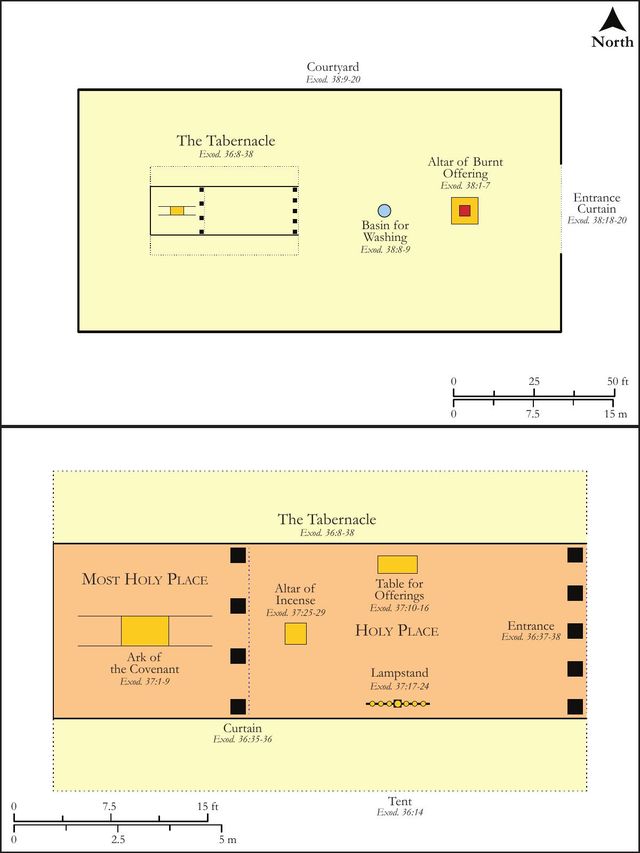
Here we have a breviat of the account which, by Moses's appointment, the Levites took and kept of the gold, silver, and brass, that was brought in for the tabernacle's use, and how it was employed. Ithamar the son of Aaron was appointed to draw up this account, and was thus by less services trained up and fitted for greater, Exo 38:21. Bezaleel and Aholiab must bring in the account (Exo 38:22, Exo 38:23), and Ithamar must audit it, and give it in to Moses. And it was thus: - 1. All the gold was a free-will offering; every man brought as he could and would, and it amounted to twenty-nine talents, and 730 shekels over, which some compute to be about 150,000l. worth of gold, according to the present value of it. Of this were made all the golden furniture and vessels. 2. The silver was levied by way of tax; every man was assessed half a shekel, a kind of poll-money, which amounted in the whole to 100 talents, and 1775 shekels over, Exo 38:25, Exo 38:26. Of this they made the sockets into which the boards of the tabernacle were let, and on which they rested; so that they were as the foundation of the tabernacle, Exo 38:27. The silver amounted to about 34,000l. of our money. The raising of the gold by voluntary contribution, and of the silver by way of tribute, shows that either way may be taken for the defraying of public expenses, provided that nothing be done with partiality. 3. The brass, though less valuable, was of use not only for the brazen altar, but for the sockets of the court, which probably in other tents were of wood: but it is promised (Isa 60:17), For wood I will bring brass. See how liberal the people were and how faithful the workmen were, in both which respects their good example ought to be followed.
Continue studying Exodus 38:22 across the web’s major study libraries — every link below opens this exact verse, chapter, or book on the destination site.
Read & Compare
 BibleGatewayThis verse in more than 200 translations and 70 languages.
 Bible.comThe YouVersion reader — hundreds of translations, reading plans, and highlights.
 ESV.orgCrossway's official English Standard Version reader.
 NET BibleThe NET translation with 60,000+ translators' notes on every rendering decision.
 STEP BibleTyndale House's free study tool — original text, vocabulary, and scholarly resources.
 BibliaLogos Bible Software's free web reader.
 USCCBThe New American Bible (Revised Edition) with the U.S. bishops' study notes.
Commentaries
 BibleHub CommentariesDozens of classic commentaries on this verse, gathered on one page.
 StudyLightMore than 100 commentary sets — the largest collection on the web.
 BibleRefPlain-English commentary on what this verse means, verse by verse.
 Enduring WordDavid Guzik's free commentary on this chapter, widely used by Bible teachers.
 Bible Study ToolsVerse commentary alongside Greek and Hebrew study aids.
Original Language & Research
- BibleHub InterlinearThe verse word by word — original language, transliteration, and English.
- BibleHub LexiconEvery word's original-language definition and Strong's entry.
 Blue Letter BibleDeep-study tools — Strong's numbers, concordance, and word studies.
 SefariaThe Hebrew text with Rashi and centuries of Jewish commentary.
Sermons, Hymns & Audio


TrulyRandomVerse is not affiliated with these sites and doesn’t control their content. They’re linked because they’re genuinely useful.
Summary
Exodus 38:22 serves as a concise yet profound declaration within the detailed account of the Tabernacle's construction, affirming the faithful and precise execution of God's divine blueprint. It specifically highlights Bezaleel, the divinely appointed chief craftsman from the tribe of Judah, and confirms that he meticulously completed every single detail of the sacred dwelling and its furnishings exactly as the LORD had commanded Moses. This verse powerfully underscores the overarching theme of perfect obedience to God's revealed will, emphasizing both the divine origin of the Tabernacle's intricate design and the human faithfulness required in its realization.
Context
ShowHideLiterary Context
Exodus 38:22 is situated within the expansive section of Exodus 35-40, which meticulously documents the actual construction and erection of the Tabernacle and its associated elements. This entire block of chapters functions as the fulfillment narrative to the preceding command sections found in Exodus 25-31, where God delivered the detailed instructions for the sanctuary on Mount Sinai. Following these divine mandates, these later chapters demonstrate the Israelites' diligent and precise adherence to those commands. Verse 22 specifically focuses on Bezaleel's pivotal role as the principal artisan, confirming that his work, and by extension the entire project, was completed "all that the LORD commanded Moses." This phrase acts as a recurring refrain throughout these concluding chapters (e.g., Exodus 39:32, Exodus 40:16), emphasizing the absolute fidelity to the divine blueprint and the successful completion of this monumental undertaking.
Historical & Cultural Context
The construction of the Tabernacle occurred during Israel's forty-year wilderness wanderings, a period of nomadic existence following their miraculous liberation from Egyptian slavery. In this unique context, a portable sanctuary was not merely convenient but essential for God to dwell among His people as they journeyed, symbolizing His constant presence and guidance. The meticulous detail in both the divine instructions and their subsequent execution reflects the understanding of sacred space shown to Moses in the mount, where the divine presence demanded precise adherence to ritual and architectural specifications to ensure purity and efficacy. Craftsmen like Bezaleel and Oholiab (Exodus 31:6) were highly valued in Israel and among the nations, often possessing specialized skills passed down through generations. However, their appointment here is explicitly divine, with Bezaleel being "filled with the Spirit of God, in wisdom, and in understanding, and in knowledge, and in all manner of workmanship" (Exodus 31:3). This divine empowerment elevated their craftsmanship beyond mere human skill, making their work a direct expression of God's will and presence among His chosen people, establishing a visible sign of the covenant.
Key Themes
ShowHideThis verse contributes significantly to several key themes pervasive throughout Exodus and the Pentateuch. Foremost is the theme of Divine Revelation and Command, highlighting that God's will is precisely communicated and demands exact fulfillment. The meticulous details underscore God's holiness and His desire for a pure and specific form of worship. Secondly, it emphasizes Human Obedience and Faithfulness, demonstrating that the Israelites, through Bezaleel, diligently responded to God's commands. This obedience is not passive but active and skilled, empowered by God Himself. Thirdly, the verse reinforces the theme of God's Dwelling Among His People, as the Tabernacle was the tangible manifestation of God's presence, a sacred space where He would meet with Israel (Exodus 25:8). Finally, it speaks to Divine Empowerment for Service, showing that God not only calls individuals to tasks but also equips them supernaturally with the necessary wisdom and skill to accomplish His purposes, as seen in Exodus 31:3.
Exposition and Analysis
ShowHideKey Word Analysis
ShowHideMeaning "in (the) shadow (i.e. protection) of God." This name is profoundly significant for a man chosen by God to oversee the construction of His dwelling place. It suggests that Bezaleel's skill and work were not merely human achievements but were divinely inspired, protected, and carried out under the very presence of God. He was specifically named by God and filled with the Spirit for this monumental task, indicating a unique divine enablement for sacred service.
A primitive root meaning "to do or make, in the broadest sense and widest application." In this context, it signifies the active, complete, and tangible execution of the divine commands. It's not just about conceptualizing or planning, but about the physical creation of every component of the Tabernacle, demonstrating diligent, effective, and precise labor. This verb conveys the bringing into being of something exactly as purposed.
A primitive root meaning "(intensively) to constitute, enjoin." This word highlights the authoritative and specific nature of God's instructions to Moses. It emphasizes that the Tabernacle's design was not a human invention or adaptation, but a direct divine mandate. The use of this verb underscores the absolute necessity of faithful adherence to every detail, as the entire project was an act of obedience to God's sovereign will.
Verse Breakdown
ShowHide"And Bezaleel the son of Uri, the son of Hur, of the tribe of Judah"
This clause precisely identifies the chief artisan responsible for the Tabernacle's construction. His full lineage is given, connecting him to a respected family within the prominent tribe of Judah. This detailed identification underscores his specific divine appointment and the immense importance of his role, not as a generic craftsman, but as God's chosen and uniquely gifted instrument. His selection was not based on human merit or tribal prominence alone, but on divine sovereign choice and empowerment, setting him apart for this sacred work.
"made all that the LORD commanded Moses"
This concluding phrase is the theological heart of the verse and indeed, the entire Tabernacle narrative. It serves as a powerful declaration of the perfect and complete obedience of Bezaleel (and by extension, the entire Israelite community involved in the work) to God's instructions. The phrase "all that the LORD commanded" is a recurring motif throughout the construction accounts, serving as a powerful affirmation of faithfulness and precision. It signifies that every measurement, material, and design element was executed precisely according to the divine blueprint revealed to Moses on Mount Sinai, ensuring the Tabernacle was a true reflection of God's will and a fitting, holy dwelling for His presence among His people.
Literary Devices
ShowHideThe primary literary device at play in Exodus 38:22, and indeed throughout the concluding chapters of Exodus (chapters 35-40), is Repetition, specifically functioning as a Refrain. The phrase "all that the LORD commanded Moses" or very similar variations (e.g., "as the LORD commanded Moses") appears consistently and frequently in Exodus 39 and Exodus 40. This constant reiteration serves as a powerful Emphasis on the theme of perfect obedience and the meticulous fulfillment of divine instructions. It assures the reader that every single detail of the Tabernacle's construction was carried out with absolute fidelity to God's blueprint, leaving no room for human improvisation, oversight, or error. This literary technique underscores the profound theological significance of obedience in establishing God's presence among His people and highlights the sacredness and precision required for the work of God.
Theological and Thematic Connections
ShowHideExodus 38:22 powerfully articulates the theological principle of divine sovereignty and human obedience, a foundational theme throughout the Old Testament. The meticulous construction of the Tabernacle, executed precisely according to God's detailed commands, demonstrates that true worship and service are predicated upon faithful adherence to God's revealed will, not human ingenuity, preference, or convenience. Bezaleel's divine empowerment (as noted in Exodus 31:3) highlights that God not only gives the command but also graciously provides the necessary skill, wisdom, and understanding to accomplish His purposes. This emphasis on completeness ("all that the LORD commanded") underscores the holiness of God and the seriousness with which His instructions are to be regarded, as the Tabernacle was to be a tangible, sacred representation of His presence among His people.
Reflection and Application
ShowHideThe example of Bezaleel in Exodus 38:22 offers profound and enduring lessons for believers today concerning our calling, gifts, and service. Just as Bezaleel was divinely gifted and faithfully executed God's precise instructions for the Tabernacle, we too are called to serve God with diligent obedience and excellence in every sphere of life. Our talents, whether in vocational ministry, family life, or professional endeavors, are not merely innate abilities but are precious gifts from God, to be consecrated and used for His glory, not for our own aggrandizement or recognition. This verse reminds us that true spiritual success and fruitfulness are found not in grand pronouncements or self-initiated projects, but in diligent, faithful, and precise adherence to God's Word and His revealed will for our lives. It encourages us to approach all our tasks, no matter how seemingly mundane or magnificently impactful, with the same commitment to excellence and obedience, trusting that God provides the necessary skill, wisdom, and resources to accomplish His purposes through us, just as He did for Bezaleel. Our work, when done in obedience to God's commands and for His glory, becomes a profound act of worship, contributing to the building of His spiritual dwelling place in the world and the advancement of His kingdom.
Questions for Reflection
ShowHideFAQ
ShowHideWho was Bezaleel and why was he so important in the construction of the Tabernacle?
ShowHideBezaleel was the chief craftsman specifically chosen and named by God to oversee the intricate and sacred construction of the Tabernacle and all its furnishings. His importance is profoundly highlighted by the fact that God explicitly states, "I have filled him with the Spirit of God, in wisdom, and in understanding, and in knowledge, and in all manner of workmanship" (Exodus 31:3). He was far more than just a skilled artisan; he was a divinely empowered leader whose exceptional craftsmanship and spiritual insight were absolutely essential for bringing God's detailed blueprint for His dwelling place to precise fruition. His role underscores the biblical principle that even artistic and technical skills can be consecrated for sacred purposes and are often divinely enabled.
Why does the Bible emphasize that Bezaleel "made all that the LORD commanded Moses"?
ShowHideThis recurring phrase, found throughout the Tabernacle's construction narrative, is crucial because it stresses the absolute precision, completeness, and faithful adherence to God's divine instructions. The Tabernacle was not merely a building but a holy dwelling place for God, a physical representation of heavenly realities and patterns (Hebrews 8:5). Any deviation from the divine blueprint, no matter how minor, would have compromised its sacred purpose, its symbolic integrity, and its ability to properly facilitate God's presence among His people. The emphatic repetition of "all" assures the reader that the Israelites, under Bezaleel's inspired leadership, were perfectly obedient to God's incredibly detailed instructions, ensuring the Tabernacle was built exactly as God intended, reflecting His holiness and His desire for a precise encounter with His people.
Christ-Centered Fulfillment
ShowHideExodus 38:22, with its emphasis on Bezaleel's perfect obedience in constructing the Tabernacle "all that the LORD commanded Moses," powerfully foreshadows the ultimate and perfect obedience of Jesus Christ. The Tabernacle, meticulously built according to a divine blueprint, was God's temporary dwelling among His people (Exodus 25:8), serving as a shadow of heavenly realities and a type pointing to a greater spiritual truth (Hebrews 8:5). In Christ, this dwelling finds its ultimate and eternal fulfillment. Jesus is the true and perfect Tabernacle, the very "Word became flesh and dwelt among us" (John 1:14), embodying God's presence in a way no physical structure ever could. Unlike Bezaleel, who perfectly executed a given command, Jesus perfectly fulfilled the entire Law and the redemptive will of the Father, not merely in building a physical structure, but in His very life, obedient death, and glorious resurrection. He declared, "I always do the things that are pleasing to him" (John 8:29), demonstrating an obedience that was not just external conformity but internal, complete, and perfectly righteous. The Tabernacle's perfect construction pointed to the holiness required for God's presence; Christ's perfect life and atoning sacrifice establish a new covenant, making it possible for God to dwell not just among His people, but within them through the Holy Spirit, transforming believers into living temples (John 14:23, 1 Corinthians 6:19). Thus, Bezaleel's faithful craftsmanship serves as a tangible type, pointing to the flawless work of the ultimate craftsman, Jesus Christ, who perfectly accomplished "all that the LORD commanded" for the salvation and reconciliation of humanity.