


Exodus 38:17
Bible text: King James Version (1769 Blayney text) · Public domain
Bible text: King James Version with Strong's numbers · Public domain
Bible text: Berean Standard Bible · Public domain
Bible text: American Standard Version (1901) · Public domain
Bible text: World English Bible, Messianic edition · Public domain
Bible text: Geneva Bible (1599) · Public domain
Bible text: Young's Literal Translation · Public domain
- וְהָאֲדָנִיםve·ha·'a·da·Nimand the basesH134Conj-w ¦ Art ¦ N-mpNoun Plural Masculine Absoluteוְandהָtheאֲדָנִיםbases
- לָעַמֻּדִיםla·'a·mu·Dimfor the pillarsH5982Prep-l ¦ N-mpNoun Plural Masculine Absoluteלָfor theעַמֻּדִיםpillars
- נְחֹשֶׁתne·cho·Shet[were] bronzeH5178N-fsNoun Singular Feminine Absolute
- וָוֵיva·Vei[the] hooks ofH2053N-mpcNoun Plural Masculine Construct
- הָעַמּוּדִיםha·'a·mu·Dimthe pillarsH5982Art ¦ N-mpNoun Plural Masculine Absoluteהָtheעַמּוּדִיםpillars
- וַחֲשׁוּקֵיהֶםva·cha·shu·kei·Hemand their bandsH2838Conj-w ¦ N-mpc ¦ 3mpNoun Plural Masculine Constructוַandחֲשׁוּקֵיbandsהֶםtheir
- כֶּסֶףKe·sef[were] silverH3701N-msNoun Singular Masculine Absolute
- וְצִפּוּיve·tzi·Puiand [the] overlay ofH6826Conj-w ¦ N-mscNoun Singular Masculine Constructוְandצִפּוּי[the] overlay of
- רָאשֵׁיהֶםra·shei·Hemtheir topsH7218N-mpc ¦ 3mpNoun Plural Masculine Constructרָאשֵׁיtopsהֶםtheir
- כָּסֶףKa·sef[was] silverH3701N-msNoun Singular Masculine Absolute
- וְהֵםve·Hemand theyH1992Conj-w ¦ Pro-3mpPronoun Personal 3rd Plural Masculineוְandהֵםthey
- מְחֻשָּׁקִיםme·chu·sha·Kim[were] furnished with bandsH2836V-Pual-PassPrtcpl-mpVerb Pual Participle Passive Plural Masculine Absolute
- כֶּסֶףKe·sefsilverH3701N-mscNoun Singular Masculine Construct
- כֹּלkolallH3605N-mscNoun Singular Masculine Construct
- עַמֻּדֵי'a·mu·Dei[the] pillars ofH5982N-mpcNoun Plural Masculine Construct
- הֶחָצֵרhe·cha·Tzerthe courtyardH2691Art ¦ N-csNoun Singular common gender Absoluteהֶtheחָצֵרcourtyard
English is a literal word-by-word gloss of the Hebrew, not the KJV's wording. Why?
This is the original text the KJV's translators worked from — each Hebrew word with its own literal English meaning in this verse, prepared by scholars at Tyndale House, Cambridge. The KJV translates whole sentences, not word by word, so its wording differs: one Hebrew word can become several English words, and the KJV may choose “the LORD” where the gloss reads “Yahweh”. Both are faithful — they answer different questions. For the KJV's own rendering, switch to the KJV text.
Details
See on the biblical-era maps

Study this verse
Public-domain commentary
Matthew Henry
From his Commentary on the Whole Bible. Henry comments on passages, not single verses — this entry covers Exodus 38:9–20.
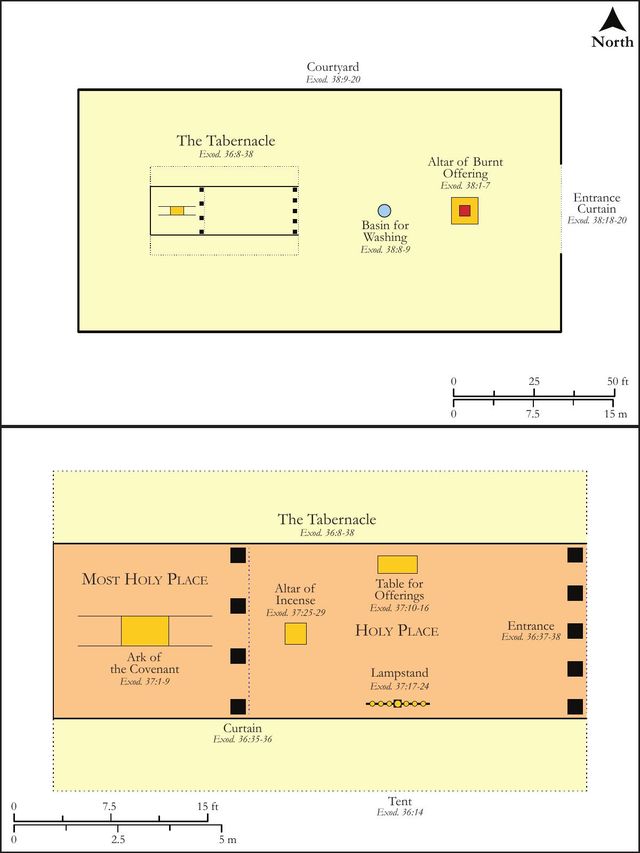
The walls of the court, or church-yard, were like the rest curtains or hangings, made according to the appointment, Exo 27:9, etc. This represented the state of the Old Testament church: it was a garden enclosed; the worshippers were then confined to a little compass. But the enclosure being of curtains only intimated that the confinement of the church in one particular nation was not to be perpetual. The dispensation itself was a tabernacle-dispensation, movable and mutable, and in due time to be taken down and folded up, when the place of the tent should be enlarged and its cords lengthened, to make room for the Gentile world, as is foretold, Isa 54:2, Isa 54:3. The church here on earth is but the court of God's house, and happy they that tread these courts and flourish in them; but through these courts we are passing to the holy place above. Blessed are those that dwell in that house of God: they well be still praising him. The enclosing of a court before the tabernacle teaches us a gradual approach to God. The priests that ministered must pass through the holy court, before they entered the holy house. Thus before solemn ordinances there ought to be the separated and enclosed court of a solemn preparation, in which we must wash our hands, and so draw near with a true heart.
Continue studying Exodus 38:17 across the web’s major study libraries — every link below opens this exact verse, chapter, or book on the destination site.
Read & Compare
 BibleGatewayThis verse in more than 200 translations and 70 languages.
 Bible.comThe YouVersion reader — hundreds of translations, reading plans, and highlights.
 ESV.orgCrossway's official English Standard Version reader.
 NET BibleThe NET translation with 60,000+ translators' notes on every rendering decision.
 STEP BibleTyndale House's free study tool — original text, vocabulary, and scholarly resources.
 BibliaLogos Bible Software's free web reader.
 USCCBThe New American Bible (Revised Edition) with the U.S. bishops' study notes.
Commentaries
 BibleHub CommentariesDozens of classic commentaries on this verse, gathered on one page.
 StudyLightMore than 100 commentary sets — the largest collection on the web.
 BibleRefPlain-English commentary on what this verse means, verse by verse.
 Enduring WordDavid Guzik's free commentary on this chapter, widely used by Bible teachers.
 Bible Study ToolsVerse commentary alongside Greek and Hebrew study aids.
Original Language & Research
- BibleHub InterlinearThe verse word by word — original language, transliteration, and English.
- BibleHub LexiconEvery word's original-language definition and Strong's entry.
 Blue Letter BibleDeep-study tools — Strong's numbers, concordance, and word studies.
 SefariaThe Hebrew text with Rashi and centuries of Jewish commentary.
Sermons, Hymns & Audio


TrulyRandomVerse is not affiliated with these sites and doesn’t control their content. They’re linked because they’re genuinely useful.
Summary
Exodus 38:17 provides a meticulous inventory of the materials used for the pillars and their various components within the outer court of the Tabernacle. This verse specifically details the foundational sockets made of brass, and the hooks, connecting fillets, and the overlaying of the pillar capitals all crafted from silver. This precise enumeration underscores the divine demand for exactness in the construction of God's dwelling place, highlighting the profound theological symbolism embedded in the material choices, which signify divine judgment, unwavering strength, and, most significantly, the pervasive theme of redemption and purity essential for approaching a holy God.
Context
ShowHideLiterary Context
Exodus 38:17 is situated within the extensive and highly detailed account of the Tabernacle's construction, specifically focusing on the outer court's components. This passage serves as a fulfillment report, demonstrating the faithful execution of the divine blueprint previously given in chapters like Exodus 27:9-19, which outlined the court's dimensions and structural elements. Preceding verses in Exodus 38 describe the altar of burnt offering and the bronze laver, setting the scene for the court's perimeter. This verse, therefore, zeroes in on the specific materials for the pillars that formed the court's enclosure, showcasing the meticulous craftsmanship of Bezalel and Aholiab, divinely endowed artisans whose capabilities are highlighted in Exodus 31:1-6. The detailed inventory throughout Exodus 38 confirms that every instruction from Exodus 25 onwards was precisely followed, emphasizing obedience and divine order.
Historical & Cultural Context
The construction of the Tabernacle was a monumental event in Israel's post-Exodus wilderness journey, establishing God's portable sanctuary among His nomadic people. It served as the singular focal point for worship, sacrifice, and the tangible manifestation of God's covenant presence. The use of precious metals like silver and durable alloys like brass (bronze) was common in sacred architecture and objects, signifying status, wealth, and divine favor. Crucially, the silver used for the Tabernacle's construction, particularly for elements like those described in this verse, was largely derived from the half-shekel atonement money collected from every Israelite male aged twenty years and upward, as explicitly commanded in Exodus 30:11-16. This specific origin imbued the silver components with profound symbolic meaning, linking them directly to atonement, redemption, and the purification necessary for a sinful people to approach a holy God. The meticulous craftsmanship, guided by divinely gifted artisans, transformed these freewill offerings into a sacred structure that embodied God's holiness and His desire for intimate communion with His people.
Key Themes
ShowHideExodus 38:17 significantly contributes to several overarching themes within the book of Exodus and the Pentateuch. The theme of Divine Presence is paramount, as the Tabernacle's construction facilitates God's dwelling among Israel, making His presence tangible and accessible. This verse, detailing the outer court, highlights the structured and holy nature of this access. The Holiness of God is underscored by the demand for precise materials and meticulous craftsmanship, emphasizing that God's dwelling place must reflect His perfect character and His separation from sin. Furthermore, the verse powerfully illustrates the theme of Atonement and Redemption, particularly through the pervasive use of silver. Derived from the atonement money, the silver components signify the means by which a sinful people can be reconciled to a holy God. This theme is foundational to the entire sacrificial system outlined in the Tabernacle's design, pointing to the necessity of a covering for sin. Finally, the verse speaks to Obedience and Fulfillment, as it is part of the detailed record confirming that every divine instruction, from the grand design to the smallest material specification, was faithfully executed by the Israelites, demonstrating their commitment to the covenant.
Exposition and Analysis
ShowHideKey Word Analysis
ShowHideFrom a root conveying strength, this term refers to the foundational bases into which the wooden pillars were firmly set. These heavy sockets were indispensable for providing stability and support for the entire perimeter of the court. The choice of brass (bronze) for these foundational elements suggests durability and the capacity to bear significant weight, symbolically pointing to the firm and enduring nature of the divine order and perhaps the earthly, judgmental aspect of the court where sacrifices were made for sin.
This term, a past participle of a root meaning "to cling" or "to join," refers to attached elements, likely silver rods or bands that ran horizontally between the pillars. These fillets served both a structural purpose by connecting the pillars, ensuring unity and coherence, and a decorative one. Their pervasive presence emphasizes the interconnectedness of the Tabernacle's structure and the continuous, unifying symbolism of silver throughout the court's boundary, signifying the pervasive nature of redemption and purity.
Literally meaning "head," this term refers to the capitals or decorative tops of the pillars. The overlaying of these uppermost parts with silver indicates that even the crowning, most visible elements of the pillars were adorned with the metal of redemption. This signifies the beauty, holiness, and divine elevation that crowned the structure, pointing heavenward and emphasizing that the sacred space was consecrated from its very foundation to its highest point by the principle of atonement.
Verse Breakdown
ShowHide"And the sockets for the pillars [were of] brass"
This initial clause establishes the material for the foundational elements of the outer court pillars. Brass (bronze) was a robust and common metal, known for its strength and durability. Theologically, brass often symbolizes judgment, strength, and the earthly realm where sin is confronted. Placing it at the base of the pillars suggests that the court, where sacrifices for sin were offered, rested upon a foundation that acknowledged divine judgment and the solemn necessity of atonement.
"the hooks of the pillars and their fillets [of] silver"
This clause specifies the material for the connecting and supporting elements of the pillars. The "hooks" were likely used to suspend the curtains that formed the court's enclosure, while the "fillets" (connecting rods) provided structural integrity by linking the pillars horizontally. Silver, consistently associated with redemption, purification, and atonement (especially when derived from the atonement money), signifies that the very means of access and the boundaries of the sacred space were defined and consecrated by the principle of atonement and purity.
"and the overlaying of their chapiters [of] silver"
This describes the adornment of the pillar tops. The "chapiters" (capitals), which were the decorative crowning elements, were covered with silver. This indicates that even the highest, most visible parts of these pillars bore the mark of redemption and holiness. This speaks to the beauty, sacredness, and divine elevation that adorned the Tabernacle, signifying that the entire structure, from its base to its crown, was consecrated by the concept of atonement.
"and all the pillars of the court [were] filleted with silver"
This concluding phrase provides a comprehensive statement, reiterating and emphasizing the pervasive presence of silver throughout the entire set of pillars forming the court's perimeter. It underscores that the theme of redemption and purity was not merely confined to specific parts but was a continuous, unifying, and all-encompassing element across the entire boundary of the sacred court, serving as a constant visual reminder to all who approached that access to God's presence was entirely predicated on atonement.
Literary Devices
ShowHideExodus 38:17 is a prime example of the Precision and Detail characteristic of the Tabernacle accounts, which meticulously enumerate every component and material. This literary technique emphasizes God's absolute demand for exactness in worship and the construction of His dwelling. The verse employs profound Symbolism, where brass (bronze) at the base of the pillars represents strength, divine judgment, and the earthly realm where sin is addressed, while silver, used for the connecting elements and adornments, powerfully symbolizes redemption, purity, and atonement. The deliberate Repetition of "silver" throughout the verse ("hooks...fillets [of] silver;...chapiters [of] silver;...filleted with silver") serves to highlight its pervasive presence and paramount theological significance, underscoring that the entire perimeter of the court was infused with the concept of atonement. Furthermore, the description implicitly uses Merism by detailing both the "sockets" (base) and "chapiters" (top) of the pillars, thereby encompassing the entirety of these structural elements and implying that every part, from foundation to crown, was divinely specified and imbued with sacred meaning.
Theological and Thematic Connections
ShowHideExodus 38:17, through its precise description of the materials used in the Tabernacle's outer court, profoundly illustrates the theological tension and ultimate resolution inherent in humanity's approach to a holy God. The use of brass for the foundational sockets speaks to the reality of divine judgment and the strength required to bear the weight of human sin, a theme vividly associated with the altar of burnt offering in the outer court. In stark contrast, the pervasive use of silver for the hooks, fillets, and chapiters powerfully symbolizes redemption, purity, and atonement. This striking dichotomy reveals that while God is perfectly just and demands holiness, He has graciously provided a divinely appointed means of purification and reconciliation. The Tabernacle's very structure, built upon both the sober reality of judgment and the glorious provision of atonement, served as a constant visual sermon to ancient Israel, teaching them that access to God's presence is not achieved through human merit or effort, but solely through His divinely ordained means of cleansing and covering for sin.
Reflection and Application
ShowHideThe meticulous details presented in Exodus 38:17, though describing ancient architectural components, offer timeless principles for our contemporary spiritual lives. God's unwavering demand for precision and specific materials in the Tabernacle's construction profoundly underscores His absolute holiness and His expectation of intentionality, reverence, and purity in our worship and service. Just as the Tabernacle's beauty, function, and sacred purpose depended on every part being made according to divine instruction, so too should our spiritual lives be built upon the solid, unshakeable foundation of Christ and meticulously adorned with the purity, redemption, and righteousness He graciously provides. The symbolic blend of brass (representing strength, judgment, and the reality of sin) and silver (representing redemption, purity, and atonement) in the Tabernacle's pillars can metaphorically represent a life that is both soberly grounded in the reality of human sin and divine judgment, yet simultaneously elevated, sustained, and beautified by God's boundless grace and the complete atonement found in Christ. Every detail of our walk, from our foundational beliefs and theological convictions to our daily interactions and practical obedience, matters immensely to God and should consistently reflect His character and His transformative redemptive work. We are called to live lives that are robustly founded in divine truth, beautifully adorned with holiness, and perpetually pointing others to the glorious and redemptive work of God.
Questions for Reflection
ShowHideFAQ
ShowHideWhy are brass and silver used for these specific parts, but not gold?
ShowHideThe choice of metals in the Tabernacle's construction was deeply symbolic and followed a clear hierarchy, reflecting the varying degrees of holiness and proximity to God's presence. Gold was reserved for the holiest inner parts of the Tabernacle and its sacred furnishings, such as the Ark of the Covenant, the Mercy Seat, and the inner altar, signifying divine glory, absolute holiness, and God's immediate, unapproachable presence. Brass (bronze), known for its strength and durability, was predominantly used for elements in the outer court, particularly those associated with sacrifice, judgment, and the earthly realm, such as the altar of burnt offering and the foundational sockets of the court pillars. Silver, often derived from the atonement money collected from every Israelite (as seen in Exodus 30:11-16), symbolized redemption, purification, and the means by which sinful humanity could approach a holy God. Its use for the connecting elements and adornments of the outer court pillars signifies that the very boundary of the sacred space, the point of entry for all, was defined and consecrated by the principle of atonement, bridging the gap between the earthly and the holy.
What does "filleted with silver" mean, and why is it emphasized?
ShowHide"Filleted with silver" refers to the use of silver bands or rods, known as chashuqím (fillets), that ran along or around the pillars of the court. These fillets likely served both a crucial structural purpose, connecting the pillars and providing stability to the court's perimeter, and a decorative one, adding to the overall beauty and sacredness of the Tabernacle's enclosure. The emphasis on "all the pillars of the court were filleted with silver" (Exodus 38:17) underscores the pervasive and unifying theme of redemption and purity throughout the entire outer court. It suggests a continuous, unbroken line of atonement that surrounded God's dwelling place, visually reinforcing the profound truth that access to God's holy presence was entirely predicated on the atoning work represented by the silver. This continuous silver band would have served as a constant, tangible reminder to the Israelites of the foundational basis of their relationship with a holy God.
Christ-Centered Fulfillment
ShowHideExodus 38:17, with its meticulous description of brass and silver components in the Tabernacle's outer court, finds its ultimate and glorious fulfillment in the person and work of Jesus Christ. The brass sockets, forming the sturdy and unyielding foundation for the court pillars, powerfully foreshadow Christ as the unshakeable foundation of our faith, who, like brass, endured the full, weighty reality of divine judgment for our sins. He is the one who "became sin for us, so that in him we might become the righteousness of God" (2 Corinthians 5:21), bearing the righteous wrath that we justly deserved. The pervasive and unifying use of silver, symbolizing redemption and purity, points directly to Christ's perfect and complete atoning work. Just as the silver for the Tabernacle came from the atonement money, so our redemption is not bought with perishable things like silver or gold, but "with the precious blood of Christ, a lamb without blemish or defect" (1 Peter 1:18-19). The silver hooks, fillets, and chapiters, which connected and adorned the pillars, reveal Christ as the one who perfectly connects us to God and adorns us with His own imputed righteousness. He is the ultimate sanctuary, the true meeting place between God and humanity, as He declared, "Destroy this temple, and in three days I will raise it up," speaking profoundly of "the temple of his body" (John 2:19-21). Through His sacrificial death and glorious resurrection, the way into God's holy presence has been fully and eternally opened, and we now have "access to the Father through one Spirit" (Ephesians 2:18). The Tabernacle's precision and beauty, built upon the twin realities of judgment and redemption, are perfectly realized in the sinless life and atoning sacrifice of Christ, who fully satisfied God's righteous demands and provided eternal purification for all who believe.