


Exodus 38:16
- כָּלkolallH3605N-mscNoun Singular Masculine Construct
- קַלְעֵיkal·'Ei[the] curtains ofH7050N-mpcNoun Plural Masculine Construct
- הֶחָצֵרhe·cha·Tzerthe courtyardH2691Art ¦ N-csNoun Singular common gender Absoluteהֶtheחָצֵרcourtyard
- סָבִיבsa·Vivall aroundH5439N-csNoun Singular common gender Absolute
- שֵׁשׁshesh[were] fine linenH8336N-msNoun Singular Masculine Absolute
- מָשְׁזָרma·she·ZartwistedH7806V-Hophal-PassPrtcpl-msVerb Hophal Participle Passive Singular Masculine Absolute
English is a literal word-by-word gloss of the Hebrew, not the KJV's wording. Why?
This is the original text the KJV's translators worked from — each Hebrew word with its own literal English meaning in this verse, prepared by scholars at Tyndale House, Cambridge. The KJV translates whole sentences, not word by word, so its wording differs: one Hebrew word can become several English words, and the KJV may choose “the LORD” where the gloss reads “Yahweh”. Both are faithful — they answer different questions. For the KJV's own rendering, switch to the KJV text.
Details
See on the biblical-era map

Study this verse
Public-domain commentary
Matthew Henry
From his Commentary on the Whole Bible. Henry comments on passages, not single verses — this entry covers Exodus 38:9–20.
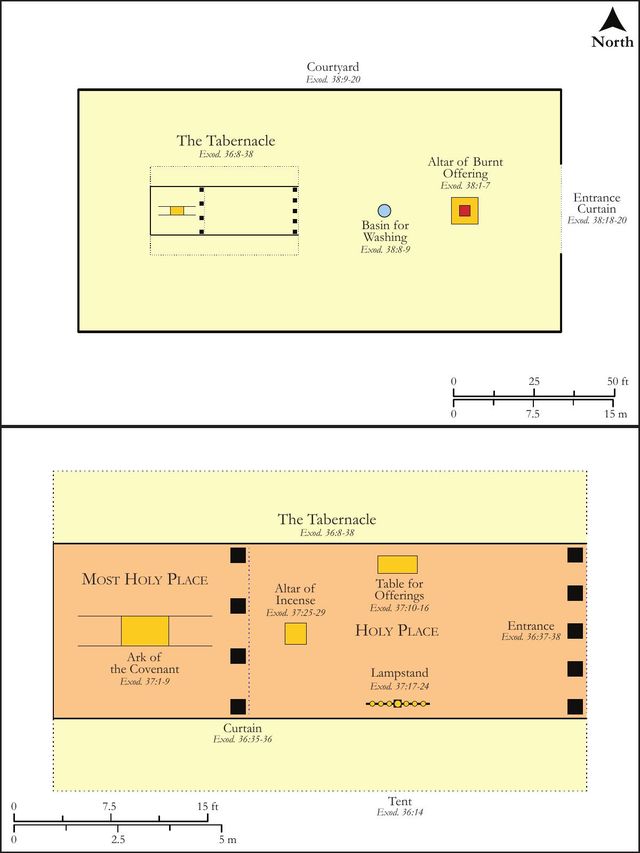
The walls of the court, or church-yard, were like the rest curtains or hangings, made according to the appointment, Exo 27:9, etc. This represented the state of the Old Testament church: it was a garden enclosed; the worshippers were then confined to a little compass. But the enclosure being of curtains only intimated that the confinement of the church in one particular nation was not to be perpetual. The dispensation itself was a tabernacle-dispensation, movable and mutable, and in due time to be taken down and folded up, when the place of the tent should be enlarged and its cords lengthened, to make room for the Gentile world, as is foretold, Isa 54:2, Isa 54:3. The church here on earth is but the court of God's house, and happy they that tread these courts and flourish in them; but through these courts we are passing to the holy place above. Blessed are those that dwell in that house of God: they well be still praising him. The enclosing of a court before the tabernacle teaches us a gradual approach to God. The priests that ministered must pass through the holy court, before they entered the holy house. Thus before solemn ordinances there ought to be the separated and enclosed court of a solemn preparation, in which we must wash our hands, and so draw near with a true heart.
Continue studying Exodus 38:16 across the web’s major study libraries — every link below opens this exact verse, chapter, or book on the destination site.
Read & Compare
 BibleGatewayThis verse in more than 200 translations and 70 languages.
 Bible.comThe YouVersion reader — hundreds of translations, reading plans, and highlights.
 ESV.orgCrossway's official English Standard Version reader.
 NET BibleThe NET translation with 60,000+ translators' notes on every rendering decision.
 STEP BibleTyndale House's free study tool — original text, vocabulary, and scholarly resources.
 BibliaLogos Bible Software's free web reader.
 USCCBThe New American Bible (Revised Edition) with the U.S. bishops' study notes.
Commentaries
 BibleHub CommentariesDozens of classic commentaries on this verse, gathered on one page.
 StudyLightMore than 100 commentary sets — the largest collection on the web.
 BibleRefPlain-English commentary on what this verse means, verse by verse.
 Enduring WordDavid Guzik's free commentary on this chapter, widely used by Bible teachers.
 Bible Study ToolsVerse commentary alongside Greek and Hebrew study aids.
Original Language & Research
- BibleHub InterlinearThe verse word by word — original language, transliteration, and English.
- BibleHub LexiconEvery word's original-language definition and Strong's entry.
 Blue Letter BibleDeep-study tools — Strong's numbers, concordance, and word studies.
 SefariaThe Hebrew text with Rashi and centuries of Jewish commentary.
Sermons, Hymns & Audio


TrulyRandomVerse is not affiliated with these sites and doesn’t control their content. They’re linked because they’re genuinely useful.
Summary
Exodus 38:16 precisely details the material composition of the Tabernacle's outer court hangings: fine twined linen. This seemingly minor architectural specification profoundly underscores the divine standard of purity and holiness inherent in God's dwelling place, emphasizing the sacred separation of the Tabernacle from the common wilderness encampment. It forms an integral part of the broader narrative demonstrating the meticulous and faithful execution of God's intricate blueprint by Bezalel, Aholiab, and the skilled Israelite artisans, highlighting the importance of obedience in constructing a sanctuary worthy of the Almighty.
Context
ShowHideLiterary Context
Exodus 38 serves as a crucial segment within the larger narrative arc of the Tabernacle's construction, following the detailed divine instructions provided in Exodus 25 through Exodus 31. Chapters 35-39 meticulously recount the actual building process, showcasing the Israelites' unwavering obedience to every divine command. Specifically, Exodus 38 focuses on the construction of the bronze altar, the laver, and the surrounding court. Verse 16, by detailing the court hangings, contributes to the final description of the outer perimeter. This perimeter was designed to enclose the sacred space, setting it apart from the profane and common areas of the Israelite camp. The repeated phrase "just as the Lord commanded Moses" (e.g., Exodus 38:22-23) throughout this section reinforces the theological emphasis on divine pattern and human fidelity, ensuring that every component, no matter how small, was built in strict accordance with God's will.
Historical & Cultural Context
The Tabernacle functioned as God's portable dwelling place among the Israelites during their arduous wilderness journey, serving as the spiritual and geographical epicenter of their nomadic existence. In the ancient Near East, where pagan deities were often worshipped in accessible open-air shrines or within temples that frequently served as extensions of royal palaces, the Tabernacle stood distinct. Its precise design, including the court hangings, established a clear physical and symbolic boundary. This boundary reinforced the profound concept of God's transcendence and His unparalleled holiness. The wilderness setting meant the Tabernacle was the central point around which the twelve tribes encamped in a specific, divinely ordained order, as meticulously detailed in Numbers 2. The consistent use of "fine twined linen" for the hangings, a costly and high-quality material often associated with royalty, nobility, and priestly vestments in ancient Near Eastern cultures, further underscored the supreme majesty and sacredness of the God of Israel, distinguishing Him sharply from the common and accessible idols of surrounding nations.
Key Themes
ShowHideExodus 38:16 contributes significantly to several overarching themes within the book of Exodus and the Pentateuch. Foremost is the theme of God's Holiness and Transcendence, as the "fine twined linen" and the very act of creating a boundary emphasize the unapproachable purity of God and the necessary separation between the divine and the mundane. This leads directly to the theme of Sacred Space and Separation, where the Tabernacle, enclosed by these hangings, is consecrated and set apart for divine purposes, distinct from the common ground. The meticulous detail in the verse also highlights Divine Precision and Order, demonstrating that God's instructions are exact and require faithful adherence, reflecting His orderly nature. Finally, the use of a costly and pure material like "fine twined linen" points to the theme of Purity and Righteousness, not only for the sanctuary itself but also as a symbolic representation of the moral and spiritual purity required for those who would draw near to God in worship and service. These themes are foundational to understanding the covenant relationship God established with Israel, particularly in the laws and rituals outlined in Leviticus.
Exposition and Analysis
ShowHideKey Word Analysis
ShowHideThis term refers to the curtains or tapestries that formed the walls of the Tabernacle court. These were not solid walls but fabric barriers, indicating a sacred enclosure that was both defined and permeable in specific ways (e.g., through the court gate). Their function was to create a distinct, visible boundary, separating the holy space where God's presence dwelled from the common ground where the congregation lived, thereby regulating access and instilling reverence.
This word denotes a yard or an enclosed space, specifically referring to the outer courtyard of the Tabernacle. As an area enclosed by a fence or hangings, it served as the transitional space between the common Israelite camp and the most holy inner sanctuary. It was the primary area where the people could gather for worship, observe the sacrifices, and witness the priestly service, signifying a designated, consecrated area for interaction with the divine.
This phrase describes a material of exceptional quality and profound symbolic significance. Shêsh (H8336) denotes a high-grade, brilliant white linen, often imported from Egypt, renowned for its purity and fineness. It was the material of choice for priestly garments and inner Tabernacle curtains, signifying purity, holiness, and righteousness. Shâzar (H7806) means "to twist (a thread of straw)" or "twine," indicating that the threads were tightly spun together, making the fabric strong, durable, and smooth. The combination emphasizes not only the aesthetic beauty and costliness of the material but, more importantly, its inherent symbolic connection to the unblemished holiness of God and the required purity of those who would approach Him.
Verse Breakdown
ShowHide"All the hangings of the court round about"
This phrase emphasizes the comprehensive nature of the enclosure. The hangings completely surrounded the Tabernacle courtyard, creating a defined, sacred perimeter. This totality signifies that the entire area was consecrated, leaving no part of the holy space exposed or undefined. It underscores the divine intention for a distinct and set-apart place for worship and communion with God, ensuring a clear demarcation between the sacred and the profane.
"[were] of fine twined linen"
This specifies the material, which is not merely a practical detail but carries profound theological weight. The choice of "fine twined linen" for the outer boundary signifies that even the outermost layer of God's dwelling place was imbued with purity and holiness. It communicates that God's presence demands the highest standard of material and, by extension, the highest standard of spiritual purity from those who seek Him. It sets a visual and symbolic tone for the entire Tabernacle complex, emphasizing its sacredness from the very first point of encounter and reinforcing the unblemished character of the God being worshipped.
Literary Devices
ShowHideThe description in Exodus 38:16 employs several literary devices to convey its profound message. Symbolism is paramount, with "fine twined linen" serving as a potent symbol of purity, righteousness, and holiness. Its pristine white color and high quality visually represent the unblemished character of God and the moral purity required to enter His presence. The "hangings" themselves function as symbols of separation and boundary, delineating the sacred from the profane and regulating access to the divine. The meticulous detail in this verse, consistent with the broader Tabernacle narrative, exemplifies precision and repetition, reinforcing the idea of God's exactness in His commands and the importance of human obedience. This detailed enumeration also creates a sense of verisimilitude, making the abstract concept of God's dwelling place tangible and real for the Israelite audience, grounding the divine instructions in concrete, observable reality.
Theological and Thematic Connections
ShowHideExodus 38:16, though a seemingly mundane detail of construction, profoundly connects to the overarching biblical themes of God's holiness, the necessity of separation, and the purity required for worship. The Tabernacle's court, defined by these pure linen hangings, served as a tangible representation of God's dwelling among His people, yet simultaneously emphasized His transcendence and the inherent chasm between a holy God and sinful humanity. The material itself, "fine twined linen," consistently signifies purity and righteousness throughout Scripture, foreshadowing the ultimate standard of holiness required for fellowship with God. This divine standard, visible even at the Tabernacle's outer boundary, teaches that approaching God is not a casual endeavor but demands reverence, intentionality, and a recognition of His absolute purity, echoing the divine command for His people to reflect His character.
Reflection and Application
ShowHideThe meticulous detail of Exodus 38:16, specifying the pure "fine twined linen" for the Tabernacle's outer court, serves as a powerful reminder of God's unwavering standard of holiness and the reverence due to Him. It teaches us that even the "outer court" of our lives—the visible aspects of our conduct, our public persona, and our daily interactions—should reflect a commitment to purity and separation unto God. Just as the hangings created a sacred boundary, believers today are called to establish spiritual boundaries in their lives, guarding against the defilements of the world and intentionally setting apart time, resources, and relationships for God's glory. This verse challenges us to consider whether our lives, in their entirety, reflect the "fine twined linen" of righteousness that honors a holy God, or if we have allowed the common and profane to blur the lines of our spiritual walk. It invites us to cultivate a deeper appreciation for God's holiness and to strive for a life of intentional purity, recognizing that our worship extends beyond the sanctuary walls into every sphere of our existence, transforming our entire being into a living sanctuary for God.
Questions for Reflection
ShowHideFAQ
ShowHideWhy was "fine twined linen" specifically chosen for the Tabernacle hangings?
ShowHide"Fine twined linen" (Hebrew: shêsh shâzar) was chosen for several significant reasons. First, it was a material of exceptional quality and high cost, indicating the supreme value and honor due to God's dwelling place. Its brilliant white color symbolized purity, holiness, and righteousness, reflecting the very nature of God Himself. This material was also used for the garments of the priests and the inner curtains of the Tabernacle (e.g., Exodus 26:31), reinforcing its sacred association. Furthermore, the "twined" aspect meant the threads were tightly spun, making the fabric durable and strong, suitable for a structure that would endure the wilderness journey. Thus, the choice of "fine twined linen" was not merely aesthetic but deeply symbolic, communicating God's unblemished character and the standard of purity required for His presence.
What was the purpose of the Tabernacle court hangings?
ShowHideThe primary purpose of the Tabernacle court hangings was to create a distinct, sacred boundary around the Tabernacle proper and its associated altars. They served to separate the holy space, where God's presence was manifested, from the common ground of the Israelite encampment. This physical separation underscored several theological truths: God's holiness and transcendence, the need for reverence when approaching Him, and the regulated access to His presence. The hangings defined the area where sacrifices were offered and where the priests performed their duties, ensuring that only those authorized and prepared could enter. They visually communicated that the Tabernacle was a unique, consecrated space, set apart for divine purposes, thereby fostering a sense of awe and respect among the people of Israel (e.g., Exodus 40:33).
Christ-Centered Fulfillment
ShowHideExodus 38:16, with its emphasis on "fine twined linen" for the Tabernacle court hangings, finds its ultimate and glorious fulfillment in Jesus Christ. The pristine purity and righteousness symbolized by the fine linen point directly to the sinless perfection of Christ, who is the Lamb of God without blemish or spot. The Tabernacle's hangings, acting as a boundary separating the holy from the common, vividly illustrate the formidable barrier that sin erected between a holy God and fallen humanity. However, in Christ, this barrier is completely removed. He is the true and living way, the ultimate "curtain" whose body was torn on the cross, granting us direct access to the very presence of God (as powerfully described in Hebrews 10:19-20). The Tabernacle, with its precise specifications, was a shadow of heavenly realities and God's desire to dwell with His people (as noted in Hebrews 8:5), a desire fully realized in Christ, who "tabernacled" among us (as illuminated in John 1:14), and continues to dwell in His Church, the new temple of the Holy Spirit (as seen in 1 Corinthians 3:16). Through His perfect sacrifice and imputed righteousness, we, who were once separated by sin, are now made pure and holy, invited to draw near with confidence into the holiest place, clothed in His righteousness.