


Exodus 40:33
Bible text: King James Version (1769 Blayney text) · Public domain
Bible text: Berean Standard Bible · Public domain
Bible text: American Standard Version (1901) · Public domain
Bible text: World English Bible, Messianic edition · Public domain
Bible text: Geneva Bible (1599) · Public domain
Bible text: Young's Literal Translation · Public domain
- וַיָּקֶםvai·Ya·kemand he set upH6965Conj-w ¦ V-Hiphil-ConsecImperf-3msVerb Hiphil Consecutive Imperfect 3rd Singular Masculineוַandיָּקֶםhe set up
- אֶת'et<obj.>H853DirObjMParticle Object Indicator
- הֶחָצֵרhe·cha·Tzerthe courtyardH2691Art ¦ N-csNoun Singular common gender Absoluteהֶtheחָצֵרcourtyard
- סָבִיבsa·VivaroundH5439N-csNoun Singular common gender Absolute
- לַמִּשְׁכָּןla·mish·Kan<to> the tabernacleH4908Prep-l ¦ N-msNoun Singular Masculine Absoluteלַ<to> theמִּשְׁכָּןtabernacle
- וְלַמִּזְבֵּחַve·la·miz·Be·achand <to> the altarH4196Conj-w ¦ Prep-l ¦ N-msNoun Singular Masculine Absoluteוְandלַ<to> theמִּזְבֵּחַaltar
- וַיִּתֵּןvai·yi·Tenand he putH5414Conj-w ¦ V-Qal-ConsecImperf-3msVerb Qal Consecutive Imperfect 3rd Singular Masculineוַandיִּתֵּןhe put
- אֶת'et<obj.>H853DirObjMParticle Object Indicator
- מָסַךְma·Sakh[the] screen ofH4539N-mscNoun Singular Masculine Construct
- שַׁעַרSha·'ar[the] gate ofH8179N-mscNoun Singular Masculine Construct
- הֶחָצֵרhe·cha·Tzerthe courtyardH2691Art ¦ N-csNoun Singular common gender Absoluteהֶtheחָצֵרcourtyard
- וַיְכַלvay·Khaland he finishedH3615Conj-w ¦ V-Piel-ConsecImperf-3msVerb Piel Consecutive Imperfect 3rd Singular Masculineוַandיְכַלhe finished
- מֹשֶׁהmo·ShehMosesH4872N-proper-mNoun Proper Masculine
- אֶת'et<obj.>H853DirObjMParticle Object Indicator
- הַמְּלָאכָהha·me·la·Khahthe workH4399Art ¦ N-fsNoun Singular Feminine Absoluteהַtheמְּלָאכָהwork
English is a literal word-by-word gloss of the Hebrew, not the KJV's wording. Why?
This is the original text the KJV's translators worked from — each Hebrew word with its own literal English meaning in this verse, prepared by scholars at Tyndale House, Cambridge. The KJV translates whole sentences, not word by word, so its wording differs: one Hebrew word can become several English words, and the KJV may choose “the LORD” where the gloss reads “Yahweh”. Both are faithful — they answer different questions. For the KJV's own rendering, switch to the KJV text.
Details
See on the biblical-era maps

Study this verse
Public-domain commentary
Matthew Henry
From his Commentary on the Whole Bible. Henry comments on passages, not single verses — this entry covers Exodus 40:16–33.
When the tabernacle and the furniture of it were prepared, they did not put off the rearing of it till they came to Canaan, though they now hoped to be there very shortly; but, in obedience to the will of God, they set it up in the midst of their camp, while they were in the wilderness. Those that are unsettled in the world must not think that this will excuse them in their continued irreligion; as if it were enough to begin to serve God when they begin to be settled in the world. No; a tabernacle for God is a very needful and profitable companion even in a wilderness, especially considering that our carcases may fall in that wilderness, and we may be fixed in another world before we come to fix in this.
The rearing of the tabernacle was a good day's work; the consecrating of it, and of the priests, was attended to some days after. Here we have an account only of that new-year's-day's work. 1. Moses not only did all that God directed him to do, but in the order that God appointed; for God will be sought in the due order. 2. To each particular there is added an express reference to the divine appointment, which Moses governed himself by as carefully and conscientiously as the workmen did; and therefore, as before, so here it is repeated, as the Lord commanded Moses, seven times in less than fourteen verses. Moses himself, as great a man as he was, would not pretend to vary from the institution, neither to add to it nor diminish from it, in the least punctilio. Those that command others must remember that their Master also is in heaven, and they must do as they are commanded. 3. That which was to be veiled be veiled (Exo 40:21), and that which was to be used he used immediately, for the instruction of the priests, that by seeing him do the several offices they might learn to do them the more dexterously. Though Moses was not properly a priest, yet he is numbered among the priests (Psa 99:6), and the Jewish writers call him the priest of the priests; what he did he did by special warrant and direction from God, rather as a prophet, or law-giver, than as a priest. He set the wheels a going, and then left the work in the hands of the appointed ministry. (1.) When he had placed the table, he set the show-bread in order upon it (Exo 40:23); for God will never have his table unfurnished. (2.) As soon as he had fixed the candlestick, he lighted the lamps before the Lord, Exo 40:25. Even that dark dispensation would not admit of unlighted candles. (3.) The golden altar being put in its place, immediately he burnt sweet incense thereon (Exo 40:27); for God's altar must be a smoking altar. (4.) The altar of the burnt-offering was no sooner set up in the court of the tabernacle than he had a burnt-offering, and a meat-offering, ready to offer upon it, Exo 40:29. Some think, though this is mentioned here, it was not done till some time after; but it seems to me that he immediately began the ceremony of its consecration, though it was not completed for seven days. (5.) At the laver likewise, when he had fixed that, Moses himself washed his hands and feet. Thus, in all these instances, he not only showed the priests how to do their duty, but has taught us that God's gifts are intended for use, and not barely for show. Though the altars, and table, and candlestick, were fresh and new, he did not say it was a pity to sully them; no, he handselled them immediately. Talents were given to be occupied, not to be buried.
Continue studying Exodus 40:33 across the web’s major study libraries — every link below opens this exact verse, chapter, or book on the destination site.
Read & Compare
 BibleGatewayThis verse in more than 200 translations and 70 languages.
 Bible.comThe YouVersion reader — hundreds of translations, reading plans, and highlights.
 ESV.orgCrossway's official English Standard Version reader.
 NET BibleThe NET translation with 60,000+ translators' notes on every rendering decision.
 STEP BibleTyndale House's free study tool — original text, vocabulary, and scholarly resources.
 BibliaLogos Bible Software's free web reader.
 USCCBThe New American Bible (Revised Edition) with the U.S. bishops' study notes.
Commentaries
 BibleHub CommentariesDozens of classic commentaries on this verse, gathered on one page.
 StudyLightMore than 100 commentary sets — the largest collection on the web.
 BibleRefPlain-English commentary on what this verse means, verse by verse.
 Enduring WordDavid Guzik's free commentary on this chapter, widely used by Bible teachers.
 Bible Study ToolsVerse commentary alongside Greek and Hebrew study aids.
Original Language & Research
- BibleHub InterlinearThe verse word by word — original language, transliteration, and English.
- BibleHub LexiconEvery word's original-language definition and Strong's entry.
 Blue Letter BibleDeep-study tools — Strong's numbers, concordance, and word studies.
 SefariaThe Hebrew text with Rashi and centuries of Jewish commentary.
Sermons, Hymns & Audio


TrulyRandomVerse is not affiliated with these sites and doesn’t control their content. They’re linked because they’re genuinely useful.
Summary
Exodus 40:33 powerfully culminates the detailed narrative of the Tabernacle's construction, depicting Moses's faithful and meticulous completion of the wilderness sanctuary. This verse signifies the successful execution of God's precise architectural plans, highlighting human obedience as the physical space is prepared for the intimate dwelling of God's glorious presence among His covenant people, Israel, thereby establishing the central hub for their worship and communion.
Context
ShowHideLiterary Context
This verse serves as the grand, climactic finale to the extensive narrative detailing the Tabernacle's construction, which dominates the latter half of the book of Exodus. Exodus 25 through Exodus 31 meticulously outline God's precise and intricate instructions for the Tabernacle's design, its sacred furnishings, and the priestly vestments. Following this divine blueprint, Exodus 35 through Exodus 39 recount the actual execution of these plans, emphasizing Israel's willing contributions and the divinely inspired craftsmanship of Bezalel and Oholiab. Exodus 40 then describes the final assembly of each component on the first day of the first month of the second year after the Exodus. Verse 33 specifically highlights the completion of the outer court, the final structural element to be erected, before the narrative immediately shifts to the glorious indwelling of God's presence in Exodus 40:34-38. The concluding phrase, "So Moses finished the work," brings a definitive closure to this monumental undertaking, setting the stage for the book of Leviticus, which will detail the sacrificial system and worship practices within this newly established sanctuary.
Historical & Cultural Context
The construction of the Tabernacle occurred in the wilderness, a nomadic setting following Israel's miraculous deliverance from Egypt and the establishment of the covenant at Mount Sinai, as detailed in Exodus 19-24. While temples were common among the nations, Israel's Tabernacle was unique in several crucial ways: it was portable, reflecting their transient journey through the wilderness, and its design was divinely revealed, not humanly conceived or adapted from existing models. This portable sanctuary underscored God's desire to dwell among His people, not confined to a fixed location, and to accompany them on their journey. The meticulous adherence to divine blueprints, culminating in "Moses finished the work," was absolutely crucial; any deviation would render the structure unfit for the Holy God. The "court" mentioned in the verse was the outer enclosure, defining the sacred space and controlling access, a common feature in ancient sanctuaries that separated the holy from the common and regulated who could approach the divine presence. The completion of this structure was not merely an architectural feat but a profound theological necessity, preparing the way for the visible manifestation of God's glory (the Shekinah) to descend and dwell among His people, fulfilling His promise to be "God with us."
Key Themes
ShowHideExodus 40:33 contributes significantly to several key themes woven throughout the book of Exodus and the Pentateuch. Foremost among these is the theme of Divine Presence and Dwelling. The entire purpose of the Tabernacle was to provide a tangible place for God to dwell among His people, fulfilling the promise made in Exodus 25:8. The verse highlights the theme of Obedience and Fidelity, as Moses meticulously completes the work precisely as God commanded, demonstrating the importance of adhering to divine instructions in matters of worship and service. This obedience is a recurring motif, particularly evident in Exodus 39 and Exodus 40. Furthermore, the completion of the Tabernacle underscores the theme of Sacred Space and Order. The court and its gate define boundaries, separating the holy from the common and establishing an orderly approach to God, a concept foundational to Israelite worship and the subsequent laws detailed in Leviticus. Finally, it speaks to God's Covenant Faithfulness, as He fulfills His promise to be present with His people, a promise that began with the call of Abraham and continued through the Exodus.
Exposition and Analysis
ShowHideKey Word Analysis
ShowHideThis verb, derived from a primitive root, signifies to "stand up," "arise," or "establish." In the context of construction, it denotes the act of setting something firmly and securely in place, making it stand erect and stable. It implies not just a casual placement but a deliberate and secure erection of the court, emphasizing its structural integrity and permanence as a defined sacred space. The use of this word highlights the purposeful and strong establishment of the Tabernacle's outer boundaries.
As a primitive root, this word means "to complete," "to bring to an end," or "to perfect." Its use here highlights the absolute totality and exactness of Moses's execution of God's instructions. It implies that the work was brought to its intended conclusion without any omission, defect, or deviation from the divine pattern, making it perfectly ready for its sacred purpose. This word underscores the comprehensive and flawless nature of the Tabernacle's completion.
This noun refers to an "occupation," "business," "craftsmanship," or a comprehensive "project." Here, it encompasses the entire monumental undertaking of constructing the Tabernacle, from the preparation of materials to the final assembly of every component. The phrase "finished the work" therefore signifies the successful completion of the entire divine project, not just a single task, emphasizing the immense scope and divine origin of the endeavor.
Verse Breakdown
ShowHide"And he reared up the court round about the tabernacle and the altar"
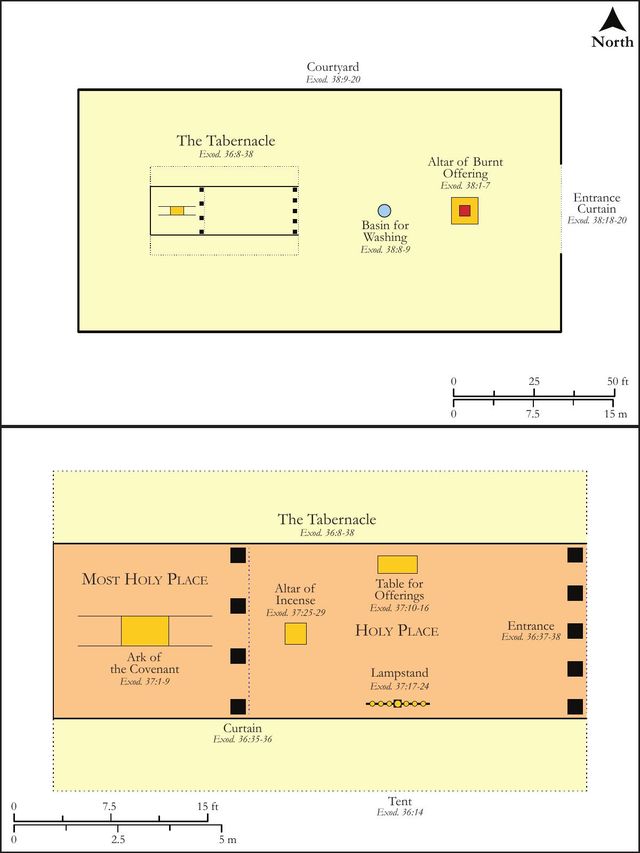
This clause describes the final stage of the Tabernacle's exterior construction. The "court" (Hebrew, châtsêr, H2691) was the large outer enclosure, defined by pillars and linen hangings, which surrounded the Tabernacle proper and the bronze altar of burnt offering (Hebrew, mizbêach, H4196). "Rearing up" emphasizes the establishment of this boundary, which served to delineate the sacred space from the common wilderness, protecting the sanctity of God's dwelling and controlling access for worshipers. This act completed the physical separation of holy ground.
"and set up the hanging of the court gate"
This specifies the final element of the court's enclosure: its entrance. The "hanging" (Hebrew, mâçâk, H4539) of the "court gate" (Hebrew, shaʻar, H8179) was a colorful curtain that served as the sole point of entry into the sacred courtyard. Its installation completed the enclosure, signifying that access to God's presence was not open to all indiscriminately but was regulated and prescribed, emphasizing the need for proper approach, reverence, and adherence to divine protocol.
"So Moses finished the work"
This concluding statement is a powerful declaration of completion and fidelity. It summarizes the entire narrative of the Tabernacle's construction, affirming that Moses, acting as God's faithful servant (Hebrew, Môsheh, H4872), had meticulously executed every single detail of the divine blueprint. This phrase underscores Moses's unwavering obedience and the perfection of the completed sanctuary, making it fit for the indwelling of the Holy God (Hebrew, mishkân, H4908). It is a testament to the successful culmination of a divinely ordered project.
Literary Devices
ShowHideExodus 40:33 employs several literary devices to underscore its profound significance. The verse functions as a Climax, bringing to a definitive close the lengthy narrative of the Tabernacle's construction, which has unfolded over many chapters of detailed instructions and laborious execution. It provides a powerful sense of resolution and accomplishment after the preceding narrative tension. The pervasive theme of "as the LORD commanded Moses" (though not explicitly in this verse, it is the dominant refrain throughout Exodus 39 and Exodus 40) forms a powerful Leitwort or guiding motif, emphasizing Moses's absolute and unwavering obedience to every divine instruction. This repeated affirmation builds anticipation for the ultimate moment of completion. Furthermore, the Tabernacle itself, including its court and gate, functions as rich Symbolism. It symbolizes God's desire for intimate dwelling with His people, the ordered nature of His holiness, the necessity of a prescribed means of approach, and the crucial separation between the sacred and the profane. The "finished work" itself symbolizes perfection, readiness for divine indwelling, and the fulfillment of God's covenant promises.
Theological and Thematic Connections
ShowHideExodus 40:33 powerfully encapsulates themes of divine initiative, human obedience, and God's desire for intimate dwelling among His people. The meticulous completion of the Tabernacle, precisely "as the LORD commanded," highlights the paramount importance of obedience to God's revealed will in matters of worship and service. This "finished work" was not merely an architectural achievement but the establishment of the physical nexus between a holy God and His redeemed people, a place where atonement could be made and communion fostered. It underscores the profound theological truth that God desires to be present among His people, providing a tangible manifestation of His covenant faithfulness and a structured means for them to approach Him. The perfection of the Tabernacle's construction was a prerequisite for the descent of God's glory, demonstrating that preparation, faithfulness, and adherence to divine design are essential for experiencing and maintaining divine presence.
Reflection and Application
ShowHideThe completion of the Tabernacle in Exodus 40:33 offers profound and enduring lessons for believers today. Moses's unwavering diligence and precise obedience in following every detail of God's elaborate blueprints serve as a powerful model for our own walk of faith. It reminds us that our service and worship are not to be haphazard or self-devised, but rather to be undertaken with intentionality, faithfulness, and a deep reverence for God's revealed will. Just as the physical Tabernacle was completed to prepare a dwelling place for God's presence, our lives are called to be prepared through obedience and spiritual readiness, making us fit vessels for the indwelling of the Holy Spirit. This passage also reiterates God's enduring desire to dwell among His people, a desire that finds its ultimate fulfillment in Christ and continues through the church. We are called to be diligent in the "work" God has given us, whether it be in our personal sanctification, our family lives, our professional callings, or our ministries, knowing that our faithfulness contributes to the manifestation of God's presence and glory in the world.
Questions for Reflection
ShowHideFAQ
ShowHideWhat is the significance of the phrase "Moses finished the work"?
ShowHideThe phrase "Moses finished the work" signifies more than just the physical completion of a construction project. It profoundly emphasizes Moses's absolute and meticulous obedience to every single detail of God's divine blueprint for the Tabernacle. It implies that the work was brought to a perfect, flawless conclusion, exactly as God commanded, making it fit for the Holy God to dwell within. This completion was the necessary prerequisite for the manifestation of God's glory, as seen immediately in Exodus 40:34, underscoring the vital connection between human faithfulness and divine presence.
Why was the court important, and what did "reared up" imply?
ShowHideThe court was the large outer enclosure of the Tabernacle complex, formed by pillars and linen hangings, which defined the sacred space and separated it from the common wilderness. Its importance lay in delineating the holy from the profane and controlling access to the Tabernacle and the altar. "Rearing up" implies the firm and deliberate establishment of this boundary, making it stand erect and stable. This act underscored the sanctity of God's dwelling and the prescribed, orderly way in which His people were to approach Him for worship and sacrifice, ensuring reverence and proper protocol.
How does the completion of the Tabernacle relate to God's presence among His people?
ShowHideThe entire purpose of the Tabernacle was to serve as God's dwelling place among His people, fulfilling His command in Exodus 25:8. The completion of the physical structure was the necessary prerequisite for the visible manifestation of God's glory, the Shekinah, to descend and fill it. This awe-inspiring event, described in the very next verse (Exodus 40:34), demonstrated God's covenant faithfulness and His desire for intimate communion with Israel, providing a tangible sign of His presence and guidance throughout their wilderness journey.
Christ-Centered Fulfillment
ShowHideExodus 40:33, marking the completion of the Tabernacle, finds its ultimate and glorious fulfillment in Jesus Christ. The Tabernacle, as God's temporary dwelling place among humanity, was a profound type pointing to the incarnate Son of God. Just as the Tabernacle was meticulously constructed according to divine blueprints to house God's presence, so too did God's eternal Word "tabernacle" or "dwell" among us in the person of Jesus Christ, full of grace and truth, as beautifully declared in John 1:14. Christ is the true and perfect sanctuary, the ultimate meeting place between God and humanity, requiring no physical construction or human "finishing" because He is inherently perfect and divine. Furthermore, Moses's "finished work" on the Tabernacle foreshadows Christ's triumphant declaration from the cross, "It is finished" (John 19:30), signifying the complete and perfect accomplishment of His redemptive work, the ultimate sacrifice that fully atoned for sin and opened the way for direct access to God. Through Christ's finished work, the need for a physical Tabernacle or temple is superseded, as believers themselves become the temple of the Holy Spirit (1 Corinthians 6:19), and the Church is built up as a spiritual house where God dwells by His Spirit (Ephesians 2:19-22). Thus, the temporary dwelling of God in the wilderness finds its eternal reality in Christ and His body, the Church, fulfilling God's enduring desire to dwell intimately with His people.