


Exodus 38:18
- וּמָסַךְu·ma·Sakhand [the] screen ofH4539Conj-w ¦ N-mscNoun Singular Masculine Constructוּandמָסַךְ[the] screen of
- שַׁעַרSha·'ar[the] gate ofH8179N-mscNoun Singular Masculine Construct
- הֶחָצֵרhe·cha·Tzerthe courtyardH2691Art ¦ N-csNoun Singular common gender Absoluteהֶtheחָצֵרcourtyard
- מַעֲשֵׂהma·'a·Seh[was] [the] work ofH4639N-mscNoun Singular Masculine Construct
- רֹקֵםro·Kema worker in colorsH7551V-Qal-Prtcpl-msVerb Qal Participle Singular Masculine Absolute
- תְּכֵלֶתte·Khe·letviolet stuffH8504N-fsNoun Singular Feminine Absolute
- וְאַרְגָּמָןve·'ar·ga·Manand purpleH713Conj-w ¦ N-msNoun Singular Masculine Absoluteוְandאַרְגָּמָןpurple
- וְתוֹלַעַתve·to·La·'atand scarlet stuff ofH8438Conj-w ¦ N-fscNoun Singular Feminine Constructוְandתוֹלַעַתscarlet stuff of
- שָׁנִיsha·NiscarletH8144N-msNoun Singular Masculine Absolute
- וְשֵׁשׁve·Sheshand fine linenH8336Conj-w ¦ N-msNoun Singular Masculine Absoluteוְandשֵׁשׁfine linen
- מָשְׁזָרma·she·ZartwistedH7806V-Hophal-PassPrtcpl-msVerb Hophal Participle Passive Singular Masculine Absolute
- וְעֶשְׂרִיםve·'es·Rimand [was] twentyH6242Conj-w ¦ Adj-mpAdjective Numerical Plural Masculine Absoluteוְandעֶשְׂרִים[was] twenty
- אַמָּה'a·Mahcubit[s]H520N-fsNoun Singular Feminine Absolute
- אֹרֶךְ'O·rekh[the] lengthH753N-msNoun Singular Masculine Absolute
- וְקוֹמָהve·ko·Mahand [the] heightH6967Conj-w ¦ N-fsNoun Singular Feminine Absoluteוְandקוֹמָה[the] height
- בְרֹחַבve·Ro·chavin breadthH7341Prep-b ¦ N-msNoun Singular Masculine Absoluteבְinרֹחַבbreadth
- חָמֵשׁcha·Mesh[was] fiveH2568Adj-csAdjective Numerical Singular common gender Absolute
- אַמּוֹת'a·MotcubitsH520N-fpNoun Plural Feminine Absolute
- לְעֻמַּתle·'u·Mat<to> corresponding toH5980Prep-l ¦ N-fscNoun Singular Feminine Constructלְ<to>עֻמַּתcorresponding to
- קַלְעֵיkal·'Ei[the] curtains ofH7050N-mpcNoun Plural Masculine Construct
- הֶחָצֵרhe·cha·Tzerthe courtyardH2691Art ¦ N-csNoun Singular common gender Absoluteהֶtheחָצֵרcourtyard
English is a literal word-by-word gloss of the Hebrew, not the KJV's wording. Why?
This is the original text the KJV's translators worked from — each Hebrew word with its own literal English meaning in this verse, prepared by scholars at Tyndale House, Cambridge. The KJV translates whole sentences, not word by word, so its wording differs: one Hebrew word can become several English words, and the KJV may choose “the LORD” where the gloss reads “Yahweh”. Both are faithful — they answer different questions. For the KJV's own rendering, switch to the KJV text.
Details
See on the biblical-era map

Study this verse
Public-domain commentary
Matthew Henry
From his Commentary on the Whole Bible. Henry comments on passages, not single verses — this entry covers Exodus 38:9–20.
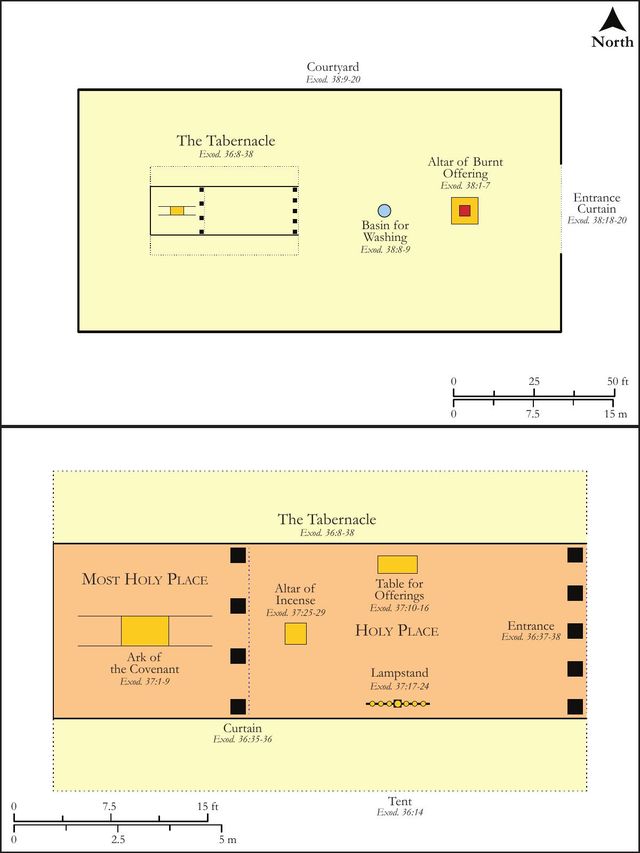
The walls of the court, or church-yard, were like the rest curtains or hangings, made according to the appointment, Exo 27:9, etc. This represented the state of the Old Testament church: it was a garden enclosed; the worshippers were then confined to a little compass. But the enclosure being of curtains only intimated that the confinement of the church in one particular nation was not to be perpetual. The dispensation itself was a tabernacle-dispensation, movable and mutable, and in due time to be taken down and folded up, when the place of the tent should be enlarged and its cords lengthened, to make room for the Gentile world, as is foretold, Isa 54:2, Isa 54:3. The church here on earth is but the court of God's house, and happy they that tread these courts and flourish in them; but through these courts we are passing to the holy place above. Blessed are those that dwell in that house of God: they well be still praising him. The enclosing of a court before the tabernacle teaches us a gradual approach to God. The priests that ministered must pass through the holy court, before they entered the holy house. Thus before solemn ordinances there ought to be the separated and enclosed court of a solemn preparation, in which we must wash our hands, and so draw near with a true heart.
Continue studying Exodus 38:18 across the web’s major study libraries — every link below opens this exact verse, chapter, or book on the destination site.
Read & Compare
 BibleGatewayThis verse in more than 200 translations and 70 languages.
 Bible.comThe YouVersion reader — hundreds of translations, reading plans, and highlights.
 ESV.orgCrossway's official English Standard Version reader.
 NET BibleThe NET translation with 60,000+ translators' notes on every rendering decision.
 STEP BibleTyndale House's free study tool — original text, vocabulary, and scholarly resources.
 BibliaLogos Bible Software's free web reader.
 USCCBThe New American Bible (Revised Edition) with the U.S. bishops' study notes.
Commentaries
 BibleHub CommentariesDozens of classic commentaries on this verse, gathered on one page.
 StudyLightMore than 100 commentary sets — the largest collection on the web.
 BibleRefPlain-English commentary on what this verse means, verse by verse.
 Enduring WordDavid Guzik's free commentary on this chapter, widely used by Bible teachers.
 Bible Study ToolsVerse commentary alongside Greek and Hebrew study aids.
Original Language & Research
- BibleHub InterlinearThe verse word by word — original language, transliteration, and English.
- BibleHub LexiconEvery word's original-language definition and Strong's entry.
 Blue Letter BibleDeep-study tools — Strong's numbers, concordance, and word studies.
 SefariaThe Hebrew text with Rashi and centuries of Jewish commentary.
Sermons, Hymns & Audio


TrulyRandomVerse is not affiliated with these sites and doesn’t control their content. They’re linked because they’re genuinely useful.
Summary
Exodus 38:18 meticulously details the design and materials of the gate for the Tabernacle's outer court. This entrance, unlike the plain linen hangings of the court, was a work of intricate needlework, adorned with vibrant blue, purple, and scarlet threads, interwoven with fine twined linen. Its precise dimensions of twenty cubits in length and five cubits in height underscored its significant role as the sole, divinely appointed access point into the sacred precinct, reflecting God's order, holiness, and the preciousness of His presence.
Context
ShowHideLiterary Context
Exodus 38:18 is situated within the latter portion of the book of Exodus, specifically in chapters 35-40, which describe the actual construction and assembly of the Tabernacle and its furnishings. These chapters serve as the fulfillment of the detailed divine instructions given to Moses on Mount Sinai in earlier chapters, particularly Exodus 25-31. Having outlined the blueprint for the Tabernacle, God now commands its meticulous execution by skilled artisans, empowering them with His Spirit. Verse 18 focuses on the gateway to the outer court, distinguishing it from the surrounding perimeter hangings (described in Exodus 38:9-17), thereby emphasizing its unique function and symbolic importance as the singular point of entry into the holy space. This detailed description highlights God's demand for precision, beauty, and order in worship, reflecting His own character and the sanctity of His dwelling place.
Historical & Cultural Context
The Tabernacle served as God's mobile dwelling place among the Israelites during their wilderness wanderings, a tangible symbol of His presence and covenant faithfulness. In the ancient Near East, sacred spaces often had defined boundaries and restricted access, emphasizing the sanctity and transcendence of the deity. The Tabernacle's court, with its single, prominent gate, reinforced this concept for Israel, teaching them reverence and the necessity of approaching God on His terms. The materials specified—fine twined linen, and particularly the costly blue, purple, and scarlet dyes—were highly valued and often associated with royalty, divinity, and sacrifice in the ancient world. The use of "needlework" (embroidery) implied skilled craftsmanship and significant expense, signifying the immense value and sacredness of what lay beyond the gate. This meticulous attention to detail underscored the profound reverence required when approaching the holy God of Israel, setting a standard for worship that was both aesthetically rich and spiritually profound, in stark contrast to the more rudimentary and often idolatrous forms of worship found in surrounding cultures.
Key Themes
ShowHideThis verse contributes significantly to several key themes pervasive throughout Exodus and the Pentateuch. Foremost is the theme of God's Holiness and Accessibility, demonstrating that while God is utterly holy and distinct, He also provides a divinely ordained means for His people to approach Him. The gate, as the sole point of entry, underscores the theme of Exclusive Access, foreshadowing the singular path to God. The meticulous details and costly materials highlight the theme of Divine Design and Perfection, emphasizing that every aspect of God's dwelling and worship is carefully planned and executed to His glory. Furthermore, the symbolic colors and materials introduce the theme of Typology and Foreshadowing, as these elements point forward to the person and work of the Messiah, who would ultimately provide perfect access to God (as seen in Hebrews 9:11-12). The entire Tabernacle narrative, including this verse, reinforces the overarching theme of God's Desire to Dwell Among His People, yet on terms that uphold His absolute purity and sovereignty.
Exposition and Analysis
ShowHideKey Word Analysis
ShowHideFrom the root meaning "to cover," this term refers to a veil, covering, or curtain. In this context, it specifically denotes the elaborate curtain that served as the gate of the court. Unlike the plain "hangings" (qelaʻ, H7050) that formed the perimeter, this mâçâk was a special, ornate barrier, signifying its unique function as the singular point of entry and separation between the common and the sacred.
This primitive root means "to variegate color, i.e., embroider," and by implication, "to fabricate." It describes a highly skilled form of artistic craftsmanship, involving the creation of intricate patterns and designs with colored threads. The use of needlework for the gate indicates that it was not merely a functional barrier but a work of art, designed to be visually striking and to convey the preciousness and unique significance of the access it provided into God's sacred space.
This term refers to bleached stuff, specifically white linen of the finest quality, often described as "fine twined linen" (with shâzar, H7806, meaning "twined"). In biblical contexts, fine linen consistently symbolizes purity, righteousness, and holiness. Its inclusion in the gate's fabric underscores the purity and sanctity required for entry into God's presence, and metaphorically, the perfect righteousness of the one who ultimately provides access.
Verse Breakdown
ShowHide"And the hanging for the gate of the court [was] needlework"
This opening clause immediately distinguishes the gate from the surrounding court hangings. It was not a simple curtain but an elaborately crafted, embroidered tapestry, signaling its distinct purpose and profound significance as the sole entrance into the sacred outer precinct of the Tabernacle. This artistic detail emphasizes its importance as the divinely appointed threshold.
"[of] blue, and purple, and scarlet, and fine twined linen"
These materials are deeply symbolic. The "fine twined linen" represents purity, righteousness, and the holiness necessary for approaching God. The colors carry profound theological meaning: blue (tᵉkêleth) often symbolizes heaven, divinity, and God's heavenly origin and majesty; purple (ʼargâmân) signifies royalty, kingship, and majesty, as it was a rare and costly dye reserved for kings and nobles; scarlet (shânîy tôwlâʻ) represents blood, sacrifice, and atonement, often associated with life and redemption. Together, these colors and materials paint a rich picture of divine majesty, royal authority, and sacrificial purity, all essential attributes for approaching the holy God.
"and twenty cubits [was] the length, and the height in the breadth [was] five cubits"
These precise dimensions (approximately 30 feet long and 7.5 feet high) define the exact size of the gateway. The length indicates a wide, grand entrance, yet its defined boundaries maintain order and control. The height ensures it is a clear, imposing portal, visible and significant. The specificity of these measurements highlights God's meticulousness and the intentionality of His design for access to His presence, indicating that such access is both generous and strictly on His terms.
"answerable to the hangings of the court"
This phrase indicates that while the gate was distinct in its materials and artistry, its dimensions and overall placement were in perfect harmony and proportion with the rest of the court's structure. It was an integral, yet uniquely adorned, part of the Tabernacle's outer boundary, designed to fit seamlessly within the divine blueprint, emphasizing the unity and coherence of God's entire redemptive plan.
Literary Devices
ShowHideExodus 38:18 employs several literary devices to convey its profound message. Symbolism is paramount, with the gate itself symbolizing the singular, divinely appointed access point to God's presence. The vibrant colors—blue, purple, and scarlet—are rich in symbolic meaning, representing divinity, royalty, and sacrifice, respectively, while the fine twined linen symbolizes purity and righteousness. These elements collectively foreshadow the multifaceted nature and redemptive work of the Messiah. Contrast is evident in the distinction between the ornate, colorful gate and the plain white linen hangings that formed the rest of the court's perimeter, drawing immediate attention to the gate's unique importance and sacred function. The meticulous detail in the description serves as a form of Emphasis, highlighting God's demand for perfection, order, and beauty in all that pertains to His worship and presence. Furthermore, the entire Tabernacle structure, including this gate, functions as Typology, serving as a divinely ordained pattern or shadow pointing forward to the greater reality of Christ and His redemptive work, particularly His role as the exclusive way to the Father.
Theological and Thematic Connections
ShowHideExodus 38:18, in its detailed description of the Tabernacle gate, powerfully communicates profound theological truths about access to God. The gate's singularity underscores the principle that approach to the holy God is not arbitrary or by human invention, but exclusively by His divine provision and according to His terms. Its rich, symbolic materials—blue for divinity, purple for royalty, scarlet for sacrifice, and fine linen for purity—collectively prefigure the Person and work of Jesus Christ, who perfectly embodies these qualities. The gate serves as a vivid Old Testament type, pointing to the New Testament reality that Jesus is the sole, divinely appointed "door" and "way" to the Father, through whom all believers gain access to God's presence, not through human merit or effort, but through His perfect sacrifice and righteousness. This passage reminds us that God always provides the means of approach, and that means is always costly and glorious, culminating in Christ.
Reflection and Application
ShowHideThe meticulous design of the Tabernacle gate in Exodus 38:18 offers a profound spiritual lesson for believers today. Just as this gate was the singular, divinely appointed entrance into God's earthly dwelling, so too is Jesus Christ the exclusive and only way to approach the Father. This ancient blueprint reminds us that access to God is not a right we earn, but a privilege graciously provided through His Son. The gate's beauty and costly materials should evoke a sense of awe and profound gratitude for the immeasurable value of the salvation offered through Christ, a salvation purchased not with perishable things but with His precious blood. Contemplating God's precise instructions for the Tabernacle should inspire us to approach Him with reverence, purity, and a deep appreciation for the perfect and complete access we now have through the finished work of our Savior. It calls us to walk worthy of this immense privilege, living lives that reflect the righteousness and holiness of the One who opened the way, striving for purity and devotion in our worship and daily conduct, knowing that we now stand in His holy presence by grace.
Questions for Reflection
ShowHideFAQ
ShowHideWhy was the gate different from the rest of the court hangings?
ShowHideThe gate was distinct from the plain white linen hangings of the court primarily because of its unique function as the sole point of entry into the sacred precinct of the Tabernacle. Its elaborate "needlework" and vibrant colors (blue, purple, and scarlet) served to highlight its profound significance and set it apart as a special threshold. This distinction emphasized that access to God's presence was not arbitrary or common, but divinely ordained and highly precious. It symbolized God's holiness and the specific, beautiful provision He made for His people to approach Him, foreshadowing the unique and glorious person of Jesus Christ as the only "door" to God, as seen in John 10:9. The gate's ornate design underscored the immense value and sacredness of the divine presence it guarded.
What is the significance of the dimensions (20 cubits by 5 cubits)?
ShowHideThe precise dimensions of the gate—twenty cubits in length (approximately 30 feet) and five cubits in height (approximately 7.5 feet)—underscore God's meticulousness and intentionality in all aspects of the Tabernacle's design. The width of the gate allowed for a clear, prominent entrance, wide enough for people or even small processions to enter, yet its defined boundaries maintained order and control, preventing unauthorized or haphazard access. The height ensured it was a visible and imposing structure, a clear demarcation of the sacred space. These specific measurements, like all details of the Tabernacle, were not arbitrary but part of a divine blueprint, emphasizing the order, accessibility (under specific terms), and sacredness of the space. They demonstrate that God's provision for access is both grand and perfectly measured, reflecting His wisdom and sovereignty.
Christ-Centered Fulfillment
ShowHideThe gate of the Tabernacle court, with its unique design and rich materials, finds its ultimate and glorious fulfillment in Jesus Christ. Just as the gate was the singular, divinely appointed entrance into God's earthly dwelling, so Jesus declares Himself to be "the door" (John 10:9) and "the way, the truth, and the life" (John 14:6), through whom alone humanity can approach the Father. The symbolic colors of the gate beautifully prefigure Christ's multifaceted identity and redemptive work: the blue points to His heavenly origin and divine nature, affirming His status as God incarnate (Colossians 1:15-17); the purple signifies His royal authority as King of kings and Lord of lords, the promised Messiah of David's line (Revelation 19:16); and the scarlet powerfully foreshadows His atoning blood, shed for the remission of sins, providing redemption and new life (1 Peter 1:18-19). Furthermore, the "fine twined linen" of the gate speaks to His perfect purity and righteousness, which is imputed to believers, enabling them to stand holy and blameless before God (2 Corinthians 5:21). Through Christ's sacrificial death and glorious resurrection, the very "veil" that separated humanity from God was torn (Matthew 27:51), and the way into the Most Holy Place, into God's very presence, was opened for all who believe, as described in Hebrews 10:19-20). The Tabernacle gate, therefore, stands as a vivid Old Testament type, pointing directly to the person and saving work of our Lord Jesus Christ, the ultimate and living gateway to God.