


Deuteronomy 3:19
Bible text: King James Version (1769 Blayney text) · Public domain
Bible text: Berean Standard Bible · Public domain
Bible text: American Standard Version (1901) · Public domain
Bible text: World English Bible, Messianic edition · Public domain
Bible text: Geneva Bible (1599) · Public domain
Bible text: Young's Literal Translation · Public domain
- רַקrakonlyH7535AdvAdverb
- נְשֵׁיכֶםne·shei·Khemyour wivesH802N-mpc ¦ 2mpNoun Plural Masculine Constructנְשֵׁיwivesכֶםyour
- וְטַפְּכֶםve·ta·pe·Khemand your little one[s]H2945Conj-w ¦ N-msc ¦ 2mpNoun Singular Masculine Constructוְandטַפְּlittle one[s]כֶםyour
- וּמִקְנֵכֶםu·mik·ne·Khemand your livestockH4735Conj-w ¦ N-msc ¦ 2mpNoun Singular Masculine Constructוּandמִקְנֵlivestockכֶםyour
- יָדַעְתִּיya·Da'·tiI knowH3045V-Qal-Perf-1csVerb Qal Perfect 1st Singular common gender
- כִּיkithatH3588PrtParticle Conditional
- מִקְנֶהmik·NehlivestockH4735N-msNoun Singular Masculine Absolute
- רַבravmuchH7227Adj-msAdjective Singular Masculine Absolute
- לָכֶםla·Khem[belongs] to youPrep-l ¦ 2mpSuffix Personal 2nd Plural Masculineלָ[belongs] toכֶםyou
- יֵשְׁבוּye·she·Vuthey will remainH3427V-Qal-Imperf-3mpVerb Qal Imperfect 3rd Plural Masculine
- בְּעָרֵיכֶםbe·'A·rei·Khemin your citiesH5892Prep-b ¦ N-mpc ¦ 2mpNoun Plural Masculine Constructבְּinעָרֵיcitiesכֶםyour
- אֲשֶׁר'a·SherwhichH834RelParticle Relative
- נָתַתִּיna·Ta·tiI have givenH5414V-Qal-Perf-1csVerb Qal Perfect 1st Singular common gender
- לָכֶםla·Khemto youPrep-l ¦ 2mpSuffix Personal 2nd Plural Masculineלָtoכֶםyou
English is a literal word-by-word gloss of the Hebrew, not the KJV's wording. Why?
This is the original text the KJV's translators worked from — each Hebrew word with its own literal English meaning in this verse, prepared by scholars at Tyndale House, Cambridge. The KJV translates whole sentences, not word by word, so its wording differs: one Hebrew word can become several English words, and the KJV may choose “the LORD” where the gloss reads “Yahweh”. Both are faithful — they answer different questions. For the KJV's own rendering, switch to the KJV text.
Details
See on the biblical-era maps
Study this verse
Public-domain commentary
Matthew Henry
From his Commentary on the Whole Bible. Henry comments on passages, not single verses — this entry covers Deuteronomy 3:12–20.
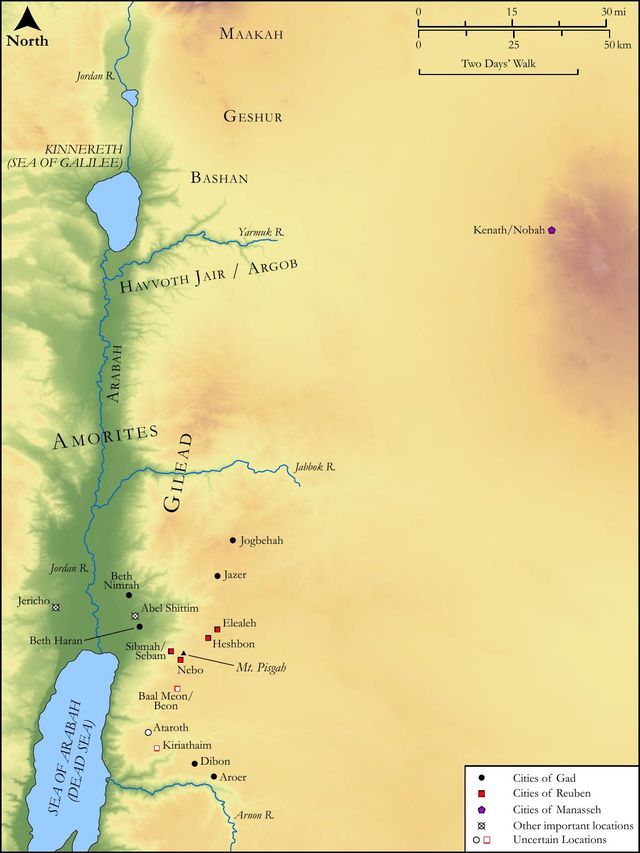
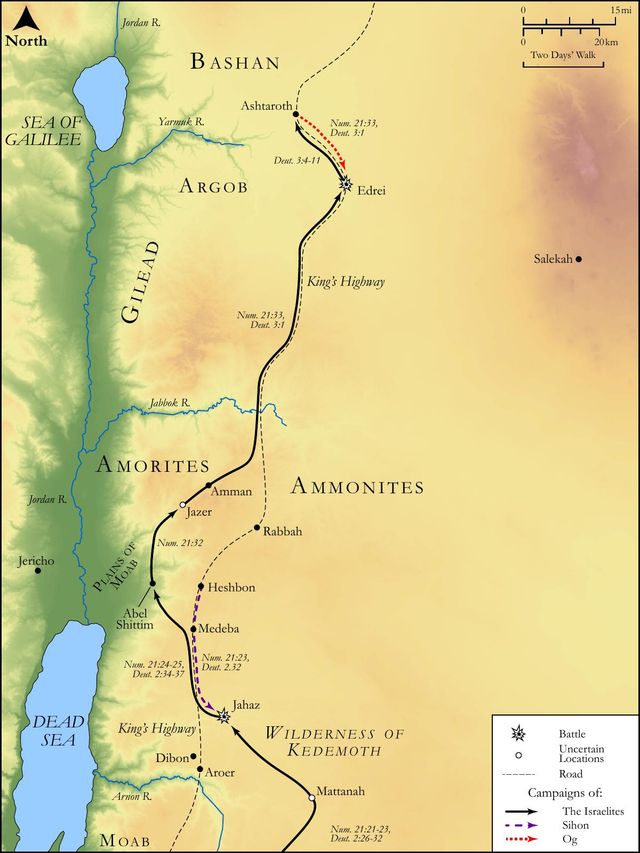
Having shown how this country which they were now in was conquered, in these verses he shows how it was settled upon the Reubenites, Gadites, and half the tribe of Manasseh, which we had the story of before, Num. 32. Here is the rehearsal. 1. Moses specifies the particular parts of the country that were allotted to each tribe, especially the distribution of the lot to the half tribe of Manasseh, the subdividing of which tribe is observable. Joseph was divided into Ephraim and Manasseh; Manasseh was divided into one half on the one side Jordan and the other half on the other side: that on the east side Jordan was again divided into two great families, which had their several allotments: Jair, Deu 3:14, Machir, Deu 3:15. And perhaps Jacob's prediction of the smallness of that tribe was now accomplished in these divisions and subdivisions. Observe that Bashan is here called the land of the giants, because it had been in their possession, but Og was the last of them. These giants, it seems, had lost their country, and were rooted out of it sooner than any of their neighbours; for those who, presuming upon their strength and stature, had their hand against every man, had every man's hand against them, and went down slain to the pit, though they were the terror of the mighty in the land of the living. 2. He repeats the condition of the grant which they had already agreed to, Deu 3:18-20. That they should send a strong detachment over Jordan to lead the van in the conquest of Canaan, who should not return to their families, at least not to settle (though for a time they might retire thither into winter quarters, at the end of a campaign), till they had seen their brethren in as full possession of their respective allotments as they themselves were now in of theirs. They must hereby be taught not to look at their own things only, but at the things of others, Phi 2:4. It ill becomes an Israelite to be selfish, and to prefer any private interest before the public welfare. When we are rest we should desire to see our brethren at rest too, and should be ready to do what we can towards it; for we are not born for ourselves, but are members one of another. A good man cannot rejoice much in the comforts of his family unless withal he sees peace upon Israel, Psa 128:6.
Continue studying Deuteronomy 3:19 across the web’s major study libraries — every link below opens this exact verse, chapter, or book on the destination site.
Read & Compare
 BibleGatewayThis verse in more than 200 translations and 70 languages.
 Bible.comThe YouVersion reader — hundreds of translations, reading plans, and highlights.
 ESV.orgCrossway's official English Standard Version reader.
 NET BibleThe NET translation with 60,000+ translators' notes on every rendering decision.
 STEP BibleTyndale House's free study tool — original text, vocabulary, and scholarly resources.
 BibliaLogos Bible Software's free web reader.
 USCCBThe New American Bible (Revised Edition) with the U.S. bishops' study notes.
Commentaries
 BibleHub CommentariesDozens of classic commentaries on this verse, gathered on one page.
 StudyLightMore than 100 commentary sets — the largest collection on the web.
 BibleRefPlain-English commentary on what this verse means, verse by verse.
 Enduring WordDavid Guzik's free commentary on this chapter, widely used by Bible teachers.
 Bible Study ToolsVerse commentary alongside Greek and Hebrew study aids.
Original Language & Research
- BibleHub InterlinearThe verse word by word — original language, transliteration, and English.
- BibleHub LexiconEvery word's original-language definition and Strong's entry.
 Blue Letter BibleDeep-study tools — Strong's numbers, concordance, and word studies.
 SefariaThe Hebrew text with Rashi and centuries of Jewish commentary.
Sermons, Hymns & Audio


TrulyRandomVerse is not affiliated with these sites and doesn’t control their content. They’re linked because they’re genuinely useful.
Summary
Deuteronomy 3:19 records Moses' specific instruction to the Transjordanian tribes—Reuben, Gad, and the half-tribe of Manasseh—concerning their families and livestock. Having already received their land inheritance east of the Jordan River, their fighting men were nonetheless obligated to cross the river with the rest of Israel to assist in the conquest of Canaan. This verse clarifies that while the warriors would participate in the western campaign, their wives, children, and extensive cattle were to remain securely in the cities God had already provided for them, ensuring their safety and the protection of their assets during the unified military endeavor.
Context
ShowHideLiterary Context
Deuteronomy 3:19 is situated within Moses' second major discourse to the Israelites, delivered on the plains of Moab as they stand poised to enter the Promised Land. This chapter specifically recounts the decisive victories over Sihon, king of Heshbon, and Og, king of Bashan, and the subsequent allocation of their conquered territories east of the Jordan to the tribes of Reuben, Gad, and the half-tribe of Manasseh, as detailed in Deuteronomy 3:1-11. The verse immediately precedes Moses' solemn charge to Joshua, his chosen successor, to lead the people into the land, as seen in Deuteronomy 3:21-22. The conditional nature of the land grant to these Transjordanian tribes—that their warriors must participate in the conquest of Canaan—is a foundational theme, first established in Numbers 32 and powerfully reiterated here to reinforce the principle of corporate responsibility and unity before the final, momentous push into the land.
Historical & Cultural Context
The historical backdrop for Deuteronomy 3:19 is the critical juncture of the Israelite invasion of Canaan, a defining moment in their national and covenantal history. The initial allocation of land east of the Jordan was a significant event, marking the first permanent settlement of Israelite tribes within the promised territory, albeit outside the primary land west of the Jordan. Culturally, land inheritance was paramount, symbolizing divine blessing, stability, identity, and the fulfillment of God's promises. The explicit mention of "wives, little ones, and cattle" highlights the societal structure where family and livestock represented the core of wealth, security, and the future viability of the community. Leaving these most precious assets behind was not a trivial matter; it signified a profound act of trust, obedience, and commitment to the larger national objective over immediate personal comfort or gain. The Jordan River, a natural and often formidable barrier, also made the logistical separation of families a practical necessity for efficient military operations.
Key Themes
ShowHideThis verse powerfully contributes to several overarching themes woven throughout Deuteronomy and the broader Pentateuch. Firstly, it profoundly underscores the theme of corporate unity and shared responsibility. Despite receiving their inheritance early, the Transjordanian tribes were not exempt from the collective mission to conquer the entire land, illustrating that the covenant obligations and the divine mandate extended to all Israel, as clearly outlined in Numbers 32:16-19. Secondly, it highlights the theme of divine provision and protection. Moses' statement, "your cities which I have given you," emphasizes that their land was a direct divine gift, and the instruction for their families to "abide" securely demonstrates God's practical and compassionate care for the vulnerable within the community, even amidst the rigors of warfare. This reflects a compassionate God who provides comprehensively for the well-being of His people, a theme echoed in Deuteronomy 2:7. Finally, the passage subtly reinforces the theme of obedience and trust in God's plan. For these tribes, fulfilling their part of the agreement required a profound act of faith—to leave their most precious possessions and loved ones in God-given security while they engaged in a potentially long and perilous campaign, trusting in God's faithfulness to both His promises and His people.
Exposition and Analysis
ShowHideKey Word Analysis
ShowHideThis term, derived from a root perhaps referring to the tripping gait of children, collectively denotes a family's young children. In ancient Israelite society, children were seen as a blessing and the future of the family and tribe. The inclusion of "little ones" alongside wives and cattle emphasizes the comprehensive nature of the protection and provision being commanded, highlighting God's concern for the most vulnerable members of the community and the continuity of the generations.
This primitive root signifies "to know" in a deep, experiential sense, not merely intellectual acquaintance. It encompasses observation, care, recognition, and even instruction or designation. When Moses states, "I know that ye have much cattle," it reveals his intimate understanding of the Transjordanian tribes' specific economic reality and pastoral lifestyle. This "knowing" is not detached but empathetic and informed, demonstrating pastoral wisdom and a leadership that considers the practical needs and circumstances of the people under divine instruction.
This primitive root primarily means "to sit down," but broadly implies "to dwell," "to remain," or "to settle." In this context, it conveys a sense of secure, stable, and permanent dwelling. For the wives, children, and livestock, "abiding" in the given cities means establishing a fixed and safe habitation, contrasting sharply with the nomadic wilderness journey. This signifies not just a temporary stay but a settled existence, underscoring the divine provision of a secure home for those not participating in the military campaign.
Verse Breakdown
ShowHide"But your wives, and your little ones, and your cattle,"
This opening phrase precisely identifies the specific groups and assets that are to remain behind in the Transjordanian territories. "Wives" (Hebrew: ʼishshâh) and "little ones" (Hebrew: ṭaph) collectively represent the non-combatant, vulnerable members of the community whose safety and well-being are paramount. "Cattle" (Hebrew: miqneh) signifies their primary economic foundation, wealth, and means of sustenance. The comprehensive listing underscores the full scope of the protection and provision being extended to those not directly involved in the military campaign across the Jordan.
"(for I know that ye have much cattle,)"
This parenthetical interjection serves as a pastoral aside from Moses, revealing his deep understanding and practical wisdom. It explicitly acknowledges the particular circumstances of these tribes, who were renowned for their extensive herds (Hebrew: rab miqneh), a key factor that influenced their initial request for land east of the Jordan. This demonstrates a leadership that is not only delivering divine commands but is also attuned to the material realities and specific needs of the people, ensuring that the divine arrangement is both just and practically considerate of their livelihood.
"shall abide in your cities which I have given you;"
This concluding clause outlines the divine provision and security for the families and assets. The verb "abide" (Hebrew: yâshab) conveys a strong sense of secure, settled dwelling, implying permanence and safety. The crucial phrase "your cities which I have given you" emphasizes that these cities were not merely conquered territories but divinely appointed and gifted habitations. This highlights God's active and generous role (Hebrew: nâthan) in providing for His people's security and future, even as they engage in the difficult and dangerous task of conquest. It reinforces the theological truth that their settled life and security are a direct result of God's faithfulness and generosity, not merely human effort.
Literary Devices
ShowHideDeuteronomy 3:19 employs several effective literary devices to convey its message with clarity and emphasis. The most prominent is Parenthesis or Aside, evident in the phrase "(for I know that ye have much cattle,)". This interjection breaks the direct flow of Moses' command to offer a personal, empathetic, and explanatory note. It serves to humanize the divine instruction, showing Moses' deep understanding of the tribes' specific economic circumstances and validating the practical wisdom behind the arrangement. This parenthetical remark also functions as Emphasis, highlighting the significant wealth in livestock held by these tribes, which was a key reason for their desire for the Transjordanian territory. Furthermore, the repeated emphasis on "your cities which I have given you" utilizes Divine Assurance, underscoring that the security and provision for their families and assets are not merely human logistical arrangements but are deeply rooted in God's covenant faithfulness and generosity, providing a theological foundation for their obedience and trust.
Theological and Thematic Connections
ShowHideDeuteronomy 3:19 transcends a mere logistical command, serving as a profound theological statement about the nature of God's covenant people and their collective mission. It teaches that individual blessings and tribal inheritances are always subsumed under the greater corporate call of God. The security of families and possessions is divinely guaranteed, but this guarantee comes with the expectation of unified action and shared sacrifice for the common good of the entire community. This principle of corporate responsibility and mutual aid is fundamental to Israel's identity as God's chosen nation, reminding them that their success in possessing the Promised Land depends on their unity and obedience to God's commands, not solely on individual prosperity or comfort. It illustrates that true flourishing within the covenant requires a willingness to prioritize the collective divine purpose.
Reflection and Application
ShowHideDeuteronomy 3:19 offers a timeless blueprint for community, discipleship, and faithful stewardship. It challenges us to consider our own "inheritances" or blessings—our resources, talents, time, and even our comfort zones—and how they relate to the broader mission of God's people in the world today. Are we willing to leverage what God has given us for the sake of the collective good, especially when it involves advancing God's kingdom and serving others? The passage also speaks powerfully to the importance of protecting the vulnerable among us—our families, children, and those who depend on us—ensuring their well-being and security even as we engage in challenging spiritual battles or pursue demanding callings. It reminds us that God is intimately concerned with both the grand sweep of His redemptive plan and the practical, daily needs of His people. Our ultimate security and provision come from Him, freeing us to participate wholeheartedly in His purposes, trusting that He will faithfully care for what we leave in His hands. This crucial balance between receiving God's blessings and actively participating in His work is essential for a vibrant, thriving faith.
Questions for Reflection
ShowHideFAQ
ShowHideWhy was it so important for the fighting men to cross the Jordan, even though their tribes had already received land?
ShowHideIt was crucial for two primary reasons: corporate unity and covenant faithfulness. Moses had made a solemn agreement with the Transjordanian tribes (Reuben, Gad, and half of Manasseh) in Numbers 32 that in exchange for receiving their inheritance east of the Jordan, their fighting men would lead the charge into Canaan and help the other tribes conquer their land. This ensured that Israel acted as a unified nation, fulfilling God's command to take the entire Promised Land. It prevented complacency and demonstrated that individual tribal blessings did not negate their collective responsibility to God's larger plan for all of Israel. Their participation ensured the success of the entire nation and prevented a potential division or weakening of the Israelite forces, reinforcing the principle that all of Israel was bound by the same covenant obligations and shared in the same divine destiny.
What is the significance of Moses mentioning the "much cattle" of these tribes?
ShowHideMoses' parenthetical remark, "for I know that ye have much cattle," highlights his pastoral insight and the practical wisdom behind the arrangement. The tribes of Reuben and Gad, in particular, were primarily pastoralists, and their initial request for land east of the Jordan was specifically because it was "a land for livestock" (Numbers 32:1). By acknowledging their extensive herds, Moses validates their specific economic needs and assures them that their valuable assets would be protected and cared for while they were away. This demonstrates that God's commands are not arbitrary or detached but are given with an understanding of His people's realities, ensuring both their spiritual and practical well-being. It underscores God's comprehensive care for all aspects of their lives, including their material prosperity and livelihood, building trust and facilitating obedience.
Christ-Centered Fulfillment
ShowHideDeuteronomy 3:19, while a specific logistical command for ancient Israel, points to profound Christ-centered truths that resonate with the spiritual journey of believers. The corporate mission of conquering the Promised Land, requiring temporary separation and sacrifice from the Transjordanian tribes for a greater, shared inheritance, foreshadows the spiritual calling of the church. Just as these tribes left their families and possessions in a secure, God-given place to fight for the whole nation's inheritance, so too are believers called to engage in the spiritual battle for the Kingdom of God, trusting that our true security and ultimate inheritance are found in Christ. Our "cities" and "little ones"—our earthly concerns, loved ones, and material possessions—are ultimately safe in the hands of the One who holds all things together (Colossians 1:17). The unified effort of Israel to possess their earthly inheritance points to the church, the body of Christ, working together in unity to advance His kingdom and inherit the spiritual promises. Christ Himself, the ultimate warrior and shepherd, perfectly fulfilled this principle. He left the glory of heaven and endured profound separation and sacrifice to secure our eternal inheritance, humbling Himself even to death on a cross (Philippians 2:6-8). He is the one who leads us into our true "Promised Land"—the heavenly city, for which Abraham also longed (Hebrews 11:10). We, like the Transjordanian tribes, are called to participate in this great mission, knowing that our ultimate security and provision rest in the finished work and ongoing intercession of our Lord Jesus Christ, who ever lives to make intercession for us (Hebrews 7:25).