


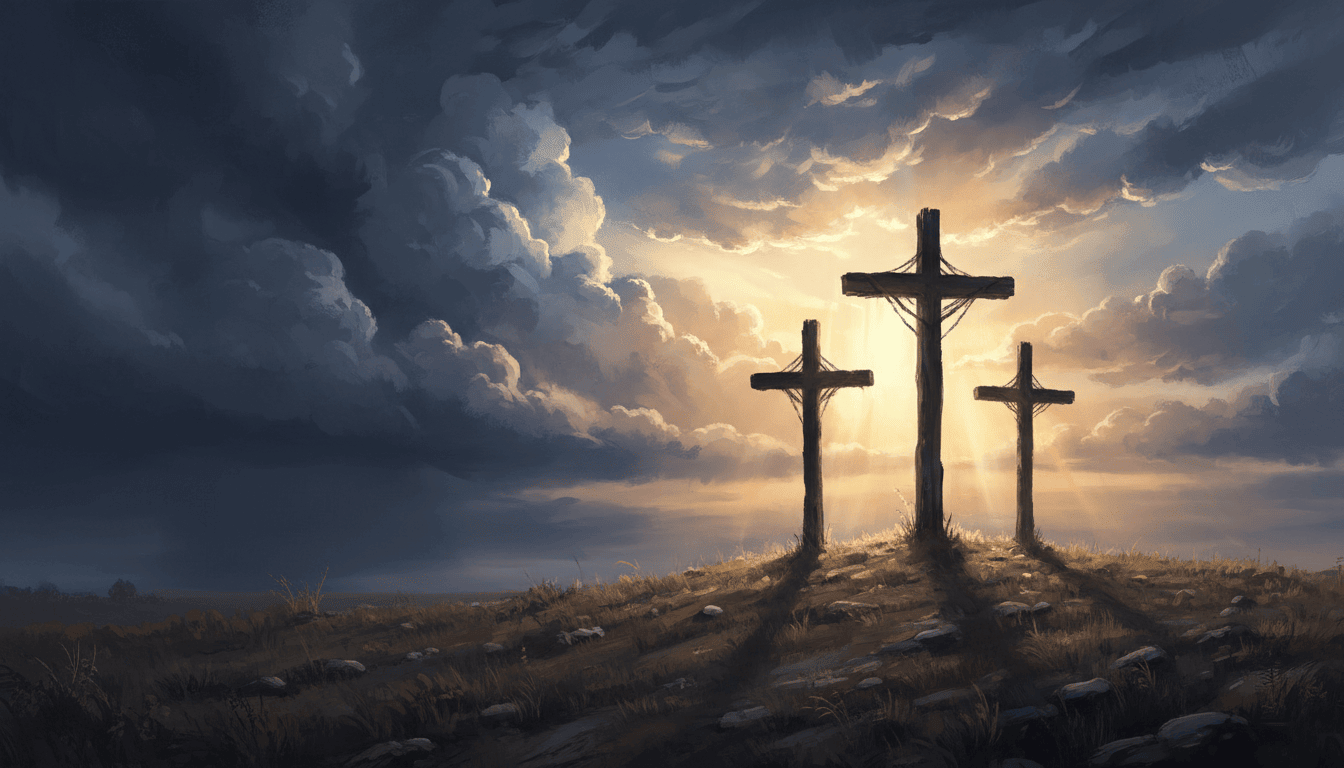
Good FridayThe Crucifixion
Introduction
Good Friday is the darkest and most glorious day in human history. On this day, the sinless Son of God hung between heaven and earth, bearing the weight of humanity's sin and experiencing the full wrath of God against evil. What appeared to be a tragic miscarriage of justice was actually the divine plan of redemption unfolding exactly as prophesied. The cross represents both the depth of human depravity and the heights of divine love. Good Friday reminds us that salvation was purchased at an infinite cost, that our redemption required nothing less than the death of God incarnate.
The Events Leading to the Cross
After his arrest in Gethsemane, Jesus endured a series of illegal trials before both Jewish and Roman authorities. The religious leaders had already determined his fate; they merely sought legal justification for their predetermined verdict. False witnesses were brought forward, but their testimonies contradicted one another. Finally, the high priest asked Jesus directly whether he was the Christ, the Son of God. When Jesus affirmed his identity, the high priest tore his robes and declared him guilty of blasphemy.
But Jesus held his peace. And the high priest answered and said unto him, I adjure thee by the living God, that thou tell us whether thou be the Christ, the Son of God. Jesus saith unto him, Thou hast said: nevertheless I say unto you, Hereafter shall ye see the Son of man sitting on the right hand of power, and coming in the clouds of heaven. Then the high priest rent his clothes, saying, He hath spoken blasphemy; what further need have we of witnesses? behold, now ye have heard his blasphemy. What think ye? They answered and said, He is guilty of death.
Matthew 26:63-66
KJV
The Jewish authorities had no power to execute, so they brought Jesus to Pilate, the Roman governor. Pilate found no fault in Jesus and tried repeatedly to release him. He offered the crowd a choice between Jesus and Barabbas, a notorious criminal, assuming they would choose to free Jesus. But the chief priests stirred up the crowd to demand Barabbas's release and Jesus's crucifixion.
Pilate saith unto them, What shall I do then with Jesus which is called Christ? They all say unto him, Let him be crucified. And the governor said, Why, what evil hath he done? But they cried out the more, saying, Let him be crucified.
Matthew 27:22-23
KJV
Pilate, knowing Jesus was innocent yet fearing a riot, symbolically washed his hands and delivered Jesus to be crucified. The soldiers mocked him, placing a crown of thorns on his head and a purple robe on his shoulders, pretending to worship him as "King of the Jews." They spat on him and struck him with a reed. After this brutal treatment, they led him away to be crucified.
The Physical Suffering of Crucifixion
Crucifixion was the most painful and humiliating form of execution in the Roman world, reserved for slaves, rebels, and the worst criminals. The condemned typically carried the horizontal beam of the cross to the place of execution. Jesus, weakened by beatings and blood loss, collapsed under the weight. Simon of Cyrene was compelled to carry the cross the rest of the way to Golgotha, "the place of a skull."
And as they led him away, they laid hold upon one Simon, a Cyrenian, coming out of the country, and on him they laid the cross, that he might bear it after Jesus.
Luke 23:26
KJV
Isaiah prophesied the physical suffering of the Messiah centuries before crucifixion was even invented. The suffering servant would be "marred more than any man," his appearance disfigured beyond human recognition. This prophecy was literally fulfilled as Jesus endured beating, scourging, and the trauma of crucifixion.
As many were astonied at thee; his visage was so marred more than any man, and his form more than the sons of men:
Isaiah 52:14
KJV
The crucifixion itself involved driving large nails through the wrists and feet, fixing the victim to the cross. Victims died slowly from a combination of blood loss, shock, dehydration, and ultimately asphyxiation. To breathe, they had to push up against the nails in their feet, creating a horrific cycle of agony. Death could take hours or even days.
The Seven Last Words from the Cross
During his hours on the cross, Jesus spoke seven times, each statement revealing theological truth. His first words were a prayer for his executioners: "Father, forgive them, for they know not what they do." Even in agony, Jesus embodied the forgiveness he preached, praying for those who were murdering him.
Then said Jesus, Father, forgive them; for they know not what they do. And they parted his raiment, and cast lots.
Luke 23:34
KJV
To the repentant thief crucified beside him, Jesus promised, "To day shalt thou be with me in paradise." This statement demonstrates that salvation is by grace through faith alone, not by works. The thief had no opportunity for baptism, church membership, or good deeds. He simply acknowledged Jesus as Lord and threw himself on Christ's mercy—and was immediately granted eternal life.
And Jesus said unto him, Verily I say unto thee, To day shalt thou be with me in paradise.
Luke 23:43
KJV
Jesus ensured his mother's care, entrusting her to the apostle John. Even in his suffering, he fulfilled the fifth commandment, honoring his mother by providing for her future. "Woman, behold thy son... Behold thy mother," he said, creating a new familial bond between Mary and John.
When Jesus therefore saw his mother, and the disciple standing by, whom he loved, he saith unto his mother, Woman, behold thy son! Then saith he to the disciple, Behold thy mother! And from that hour that disciple took her unto his own home.
John 19:26-27
KJV
After hours of suffering, darkness fell over the land from noon until three in the afternoon. In this supernatural darkness, Jesus cried out, "My God, my God, why hast thou forsaken me?" This agonized question, quoting Psalm 22, reveals the deepest mystery of the atonement. At this moment, the Father poured out his wrath against sin upon the Son. Jesus, who had never known separation from the Father, experienced divine abandonment as he bore our sins.
And about the ninth hour Jesus cried with a loud voice, saying, Eli, Eli, lama sabachthani? that is to say, My God, my God, why hast thou forsaken me?
Matthew 27:46
KJV
To the chief Musician upon Aijeleth Shahar, A Psalm of David. My God, my God, why hast thou forsaken me? why art thou so far from helping me, and from the words of my roaring?
Psalms 22:1
KJV
Jesus then said, "I thirst," fulfilling another prophecy from Psalm 69. Someone offered him sour wine on a sponge. After receiving it, Jesus declared, "It is finished"—the Greek word tetelestai, meaning "paid in full." The debt of sin was completely satisfied; the work of redemption was accomplished; the requirements of the law were met. Nothing remained to be done for salvation.
After this, Jesus knowing that all things were now accomplished, that the scripture might be fulfilled, saith, I thirst. Now there was set a vessel full of vinegar: and they filled a spunge with vinegar, and put it upon hyssop, and put it to his mouth. When Jesus therefore had received the vinegar, he said, It is finished: and he bowed his head, and gave up the ghost.
John 19:28-30
KJV
Finally, Jesus committed his spirit to the Father: "Father, into thy hands I commend my spirit." Unlike other crucifixion victims who died slowly and helplessly, Jesus voluntarily gave up his spirit. He laid down his life; no one took it from him. With this final prayer of trust, Jesus died.
And when Jesus had cried with a loud voice, he said, Father, into thy hands I commend my spirit: and having said thus, he gave up the ghost.
Luke 23:46
KJV
Theological Significance of the Cross
The cross is the centerpiece of Christian theology, where God's justice and mercy meet. Paul explains that God presented Christ as a propitiation by his blood. Propitiation means the satisfying of divine wrath against sin. God is perfectly holy and must punish sin; yet he is perfectly loving and desires to save sinners. The cross resolves this apparent contradiction. Christ bore the punishment that we deserved, satisfying God's justice, enabling God to justify those who have faith in Jesus.
For all have sinned, and come short of the glory of God; Being justified freely by his grace through the redemption that is in Christ Jesus: Whom God hath set forth to be a propitiation through faith in his blood, to declare his righteousness for the remission of sins that are past, through the forbearance of God; To declare, I say, at this time his righteousness: that he might be just, and the justifier of him which believeth in Jesus.
Romans 3:23-26
KJV
The cross demonstrates both the severity of sin and the greatness of God's love. Sin is so serious that nothing less than the death of the Son of God could atone for it. Yet God's love is so great that he willingly paid this infinite price to redeem us. Paul writes that God demonstrates his own love for us in that while we were still sinners, Christ died for us.
But God commendeth his love toward us, in that, while we were yet sinners, Christ died for us.
Romans 5:8
KJV
Peter emphasizes that Christ died as our substitute. He bore our sins in his own body on the tree, that we might die to sin and live to righteousness. By his wounds we are healed. Jesus didn't merely die as a martyr or example; he died as our representative, taking the punishment we deserved so that we could receive the righteousness we don't deserve.
Who his own self bare our sins in his own body on the tree, that we, being dead to sins, should live unto righteousness: by whose stripes ye were healed.
1 Peter 2:24
KJV
Prophecies Fulfilled at the Cross
The crucifixion fulfilled dozens of Old Testament prophecies with stunning precision. Psalm 22, written a thousand years before Christ, describes crucifixion in detail—despite the fact that this method of execution didn't exist when David wrote the psalm. "They pierced my hands and my feet... They part my garments among them, and cast lots upon my vesture." All of this was literally fulfilled at Calvary.
For dogs have compassed me: the assembly of the wicked have inclosed me: they pierced my hands and my feet. I may tell all my bones: they look and stare upon me. They part my garments among them, and cast lots upon my vesture.
Psalms 22:16-18
KJV
Then the soldiers, when they had crucified Jesus, took his garments, and made four parts, to every soldier a part; and also his coat: now the coat was without seam, woven from the top throughout. They said therefore among themselves, Let us not rend it, but cast lots for it, whose it shall be: that the scripture might be fulfilled, which saith, They parted my raiment among them, and for my vesture they did cast lots. These things therefore the soldiers did.
John 19:23-24
KJV
Isaiah 53, the greatest prophetic portrait of the suffering Messiah, was fulfilled in every detail. He was despised and rejected, wounded for our transgressions, crushed for our iniquities. The punishment that brought us peace was upon him, and by his wounds we are healed. Though he had done no violence and there was no deceit in his mouth, he was numbered with transgressors.
But he was wounded for our transgressions, he was bruised for our iniquities: the chastisement of our peace was upon him; and with his stripes we are healed. All we like sheep have gone astray; we have turned every one to his own way; and the LORD hath laid on him the iniquity of us all. He was oppressed, and he was afflicted, yet he opened not his mouth: he is brought as a lamb to the slaughter, and as a sheep before her shearers is dumb, so he openeth not his mouth. He was taken from prison and from judgment: and who shall declare his generation? for he was cut off out of the land of the living: for the transgression of my people was he stricken. And he made his grave with the wicked, and with the rich in his death; because he had done no violence, neither was any deceit in his mouth.
Isaiah 53:5-9
KJV
Even seemingly minor details fulfilled prophecy. Not one of Jesus's bones was broken, fulfilling both the Passover typology and Psalm 34. Zechariah prophesied that they would look on him whom they have pierced. Every aspect of the crucifixion testified that Jesus was the promised Messiah.
He keepeth all his bones: not one of them is broken.
Psalms 34:20
KJV
For these things were done, that the scripture should be fulfilled, A bone of him shall not be broken.
John 19:36
KJV
Conclusion: The Power of the Cross
Good Friday is "good" not because of the suffering itself, but because of what that suffering accomplished. Through the cross, God reconciled the world to himself, not counting our trespasses against us. The blood of Jesus cleanses us from all sin. The barrier between God and humanity has been destroyed. The penalty for sin has been paid in full. Death itself has been defeated. As we remember Good Friday, we stand in awe before the cross, marveling that the Creator would die for his creatures, that the Judge would take the criminal's place, that infinite love would endure infinite wrath to save undeserving sinners. The cross is our only hope, our greatest treasure, and our eternal song of praise.